
BASICS OF NUCLEAR REACTION A general introduction to
BASICS OF NUCLEAR REACTION A general introduction to the main concepts of fusion, fusion vs. fission, solar fusion vs. fusion on Earth. 1 Graphic: EUROfusion, Reinald Fenke, CC BY 4. 0, www. euro-fusion. org
! m 1 WE KNOW THAT TWO TYPES OF NUCLEAR REACTIONS EXIST: FUSION & FISSION 2 Graphic: EUROfusion, CC BY 4. 0, www. euro-fusion. org
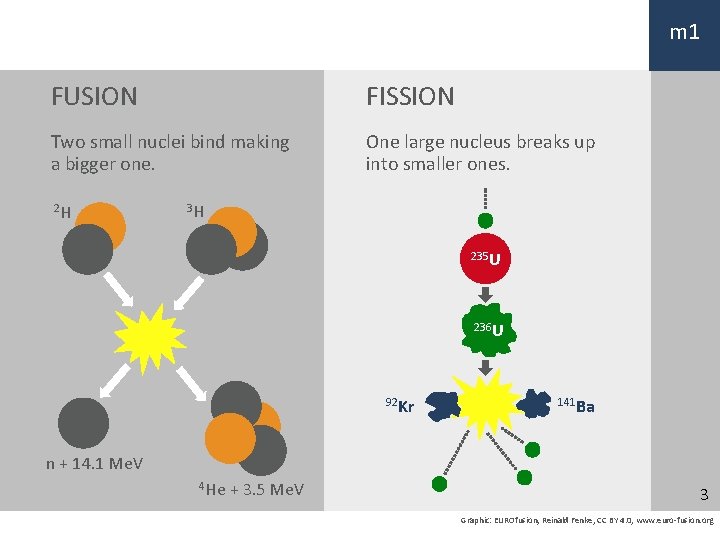
m 1 FUSION FISSION Two small nuclei bind making a bigger one. One large nucleus breaks up into smaller ones. 2 H 3 H 235 U 236 U 92 Kr 141 Ba n + 14. 1 Me. V 4 He + 3. 5 Me. V 3 Graphic: EUROfusion, Reinald Fenke, CC BY 4. 0, www. euro-fusion. org
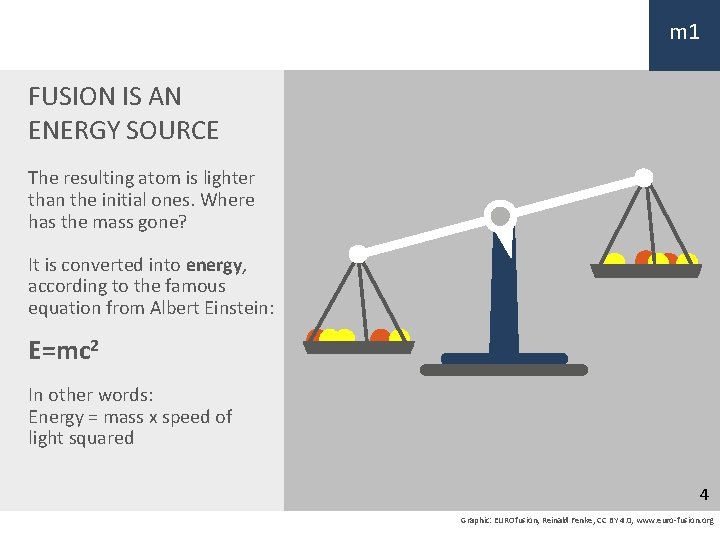
m 1 FUSION IS AN ENERGY SOURCE The resulting atom is lighter than the initial ones. Where has the mass gone? It is converted into energy, according to the famous equation from Albert Einstein: E=mc 2 In other words: Energy = mass x speed of light squared 4 Graphic: EUROfusion, Reinald Fenke, CC BY 4. 0, www. euro-fusion. org
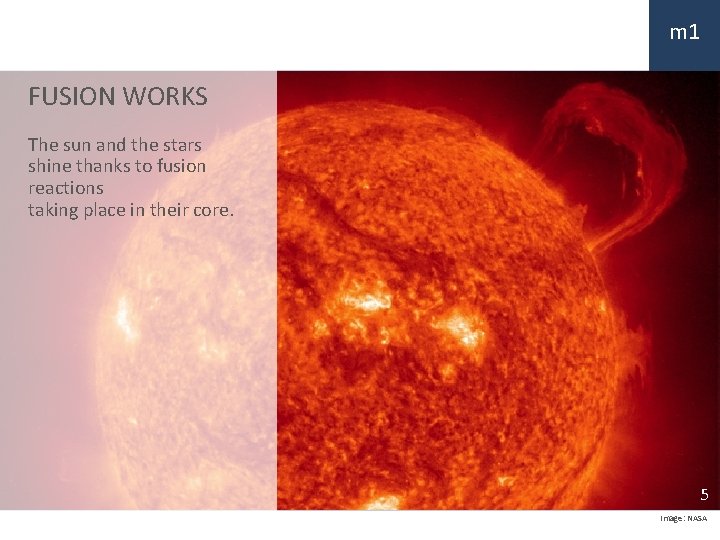
m 1 FUSION WORKS The sun and the stars shine thanks to fusion reactions taking place in their core. 5 Image: NASA
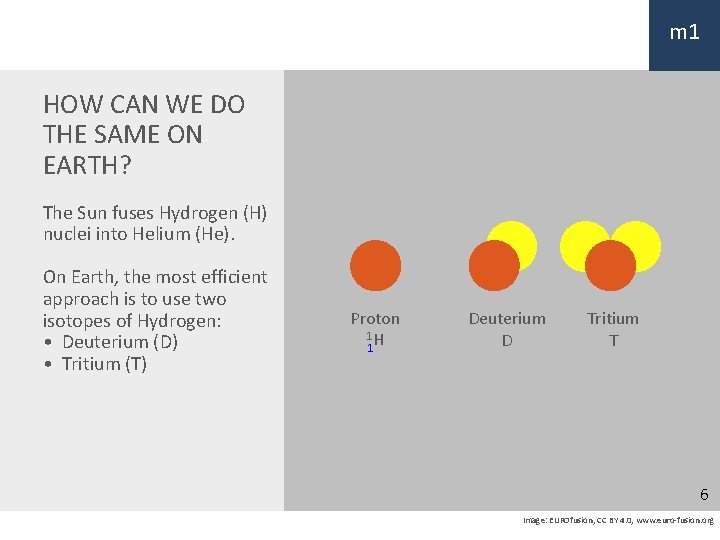
m 1 HOW CAN WE DO THE SAME ON EARTH? The Sun fuses Hydrogen (H) nuclei into Helium (He). On Earth, the most efficient approach is to use two isotopes of Hydrogen: • Deuterium (D) • Tritium (T) Proton 1 H 1 Deuterium D Tritium T 6 Image: EUROfusion, CC BY 4. 0, www. euro-fusion. org
- Slides: 6