
Basics of Muscular Training What is resistance training
Basics of Muscular Training
What is resistance training? • Any activity utilizing resistance to induce muscle contractions • Usually organized into workouts made up of different exercises, sets, and repetitions. • Benefits of regular resistance training include: Increased strength, muscular size, explosiveness, bone, ligament, and tendon strength, increased metabolism, cardiovascular health, confidence, physical attractiveness. Decrease risk of heart disease, diabetes, obesity, orthopedic injury, cholesterol
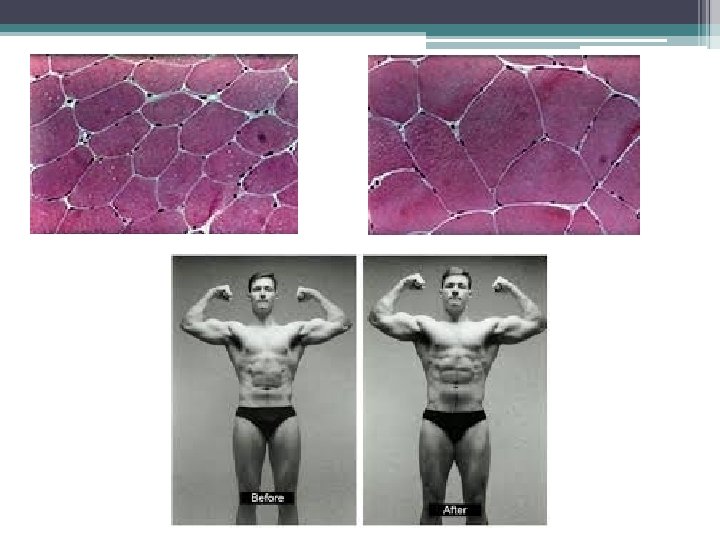
Muscular hypertrophy • Skeletal muscles increase size through a process called hypertrophy. • Stress to muscles (resistance training) causes micro trauma to individual muscle cells. • The body repairs these micro trauma by synthesizing more proteins. • The result is an increase in muscle cell size.
Hyperplasia • Hyperplasia is the increase in muscle size due to an increased number of muscle fibers. • This has been observed in many animals such as rats, mice and rabbits. • Studies show that humans do NOT grow through hyperplasia.

Components of a workout • Warm-up ▫ 5 -10 minutes of light aerobic activity-enough to maintain a sweat ▫ Can include dynamic stretching ▫ Increases blood flow to muscles, synovial fluid to joints, increases core body temperature
Components of a workout • “Bulk” of workout ▫ Can be resistance training, agility training, speed training, or aerobic training. • Cool down ▫ Similar or identical to warm-up • Flexibility ▫ Static stretching
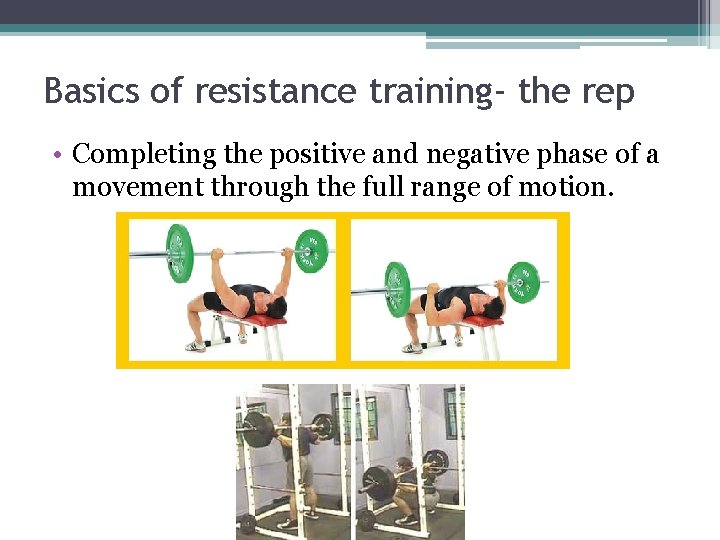
Basics of resistance training- the rep • Completing the positive and negative phase of a movement through the full range of motion.
Basics of resistance training- the Rep • Positive phase ▫ Contraction of prime mover ▫ The “push” of a push-up ▫ The “pull” of a pull-up • Negative phase ▫ The CONTROLLED lengthening of the prime mover ▫ The lowering of a push-up ▫ The lowering of a pull-up
The perfect rep • 2 -4 seconds of smooth movement during the positive phase • A complete ½ second pause (don’t even move an 8 th of an inch!) at the top of the motion • 3 -5 seconds of smooth movement during the negative phase. • A complete ½ second pause at bottom of movement. • ELIMINATE THE USE OF MOMENTUM • You are 60% stronger in the negative phase of a lift. DO NOT NEGLECT THE NEGATIVE
The perfect set • All sets should be to true momentary muscular failure. • This is easier said than done… • Most beginners and many experienced weight lifters take their sets to perceived muscular failure

Factors preventing reaching momentary muscular failure • Lack of experience • Lack of pain tolerance • Fear ▫ Fear of injury ▫ Fear of embarrassment �Reaching true momentary muscular failure is an intense experience �Your bodies may act in ways you aren’t expecting �Facial and body contortions �Involuntary yelling or moaning �Vomiting �Crying
• A high intensity workout sample • https: //www. youtube. com/watch? v=U 3 UAZ-p. Mt. A

Triple progressive overload • To stimulate hypertrophy of muscles, you need to progressively increase the intensity of your lifts. To do this, you should increase: ▫ Time under tension ▫ Amount of reps per set ▫ Weight

How many reps per set? • For overall strength, power, and size, 8 -12 reps is most efficient. • Many power lifters will complete 3 -6 reps per set. • Endurance athletes may complete 15 -20 reps per set.

Types of exercises • Multi-jointed exercises- exercise that causes movement in more than one joint. Works multiple muscles ▫ Squat –Knee, hip, a little of ankle ▫ Bench press- Elbow and shoulder • Single-jointed- exercises that causes movement in only one joint ▫ Lateral raise- shoulder ▫ Bicep curl- elbow

Order of Exercise • Post-exhaust cycle- A multi-jointed exercise that targets a large muscle followed by a singlejointed exercise that isolates that same muscle ▫ Bench press followed by Chest Flys
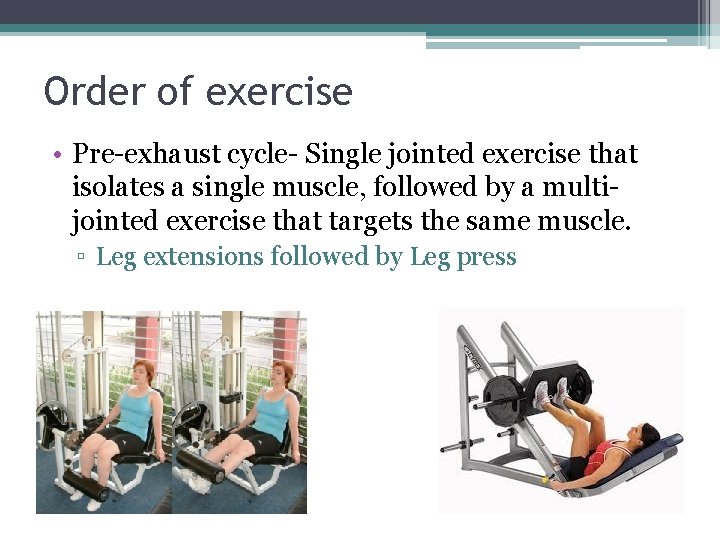
Order of exercise • Pre-exhaust cycle- Single jointed exercise that isolates a single muscle, followed by a multijointed exercise that targets the same muscle. ▫ Leg extensions followed by Leg press
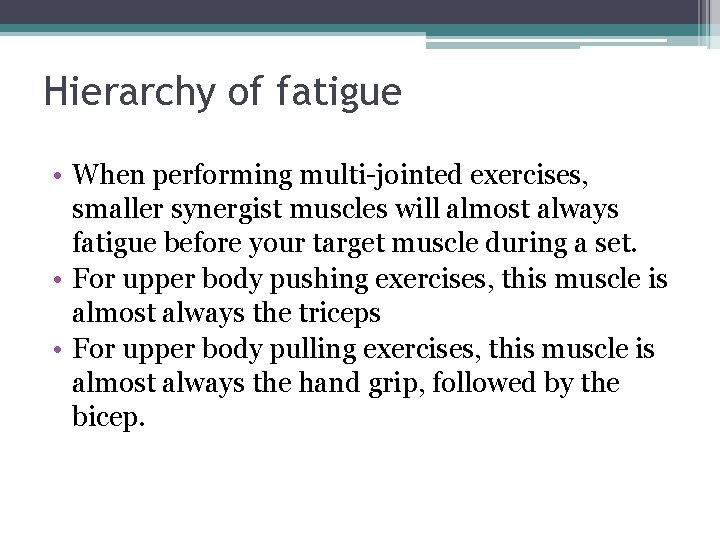
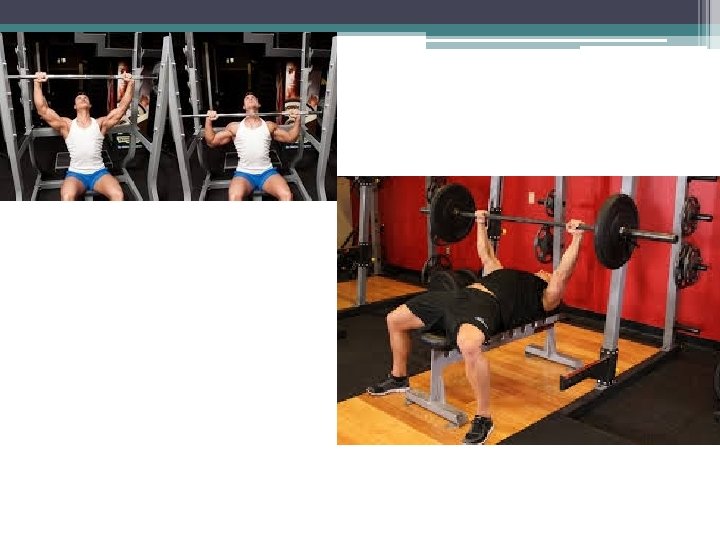
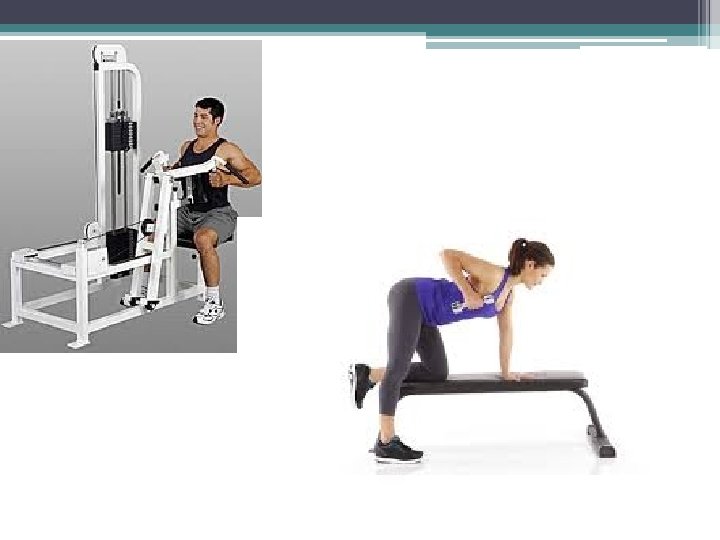
Hierarchy of fatigue • When performing multi-jointed exercises, smaller synergist muscles will almost always fatigue before your target muscle during a set. • For upper body pushing exercises, this muscle is almost always the triceps • For upper body pulling exercises, this muscle is almost always the hand grip, followed by the bicep.
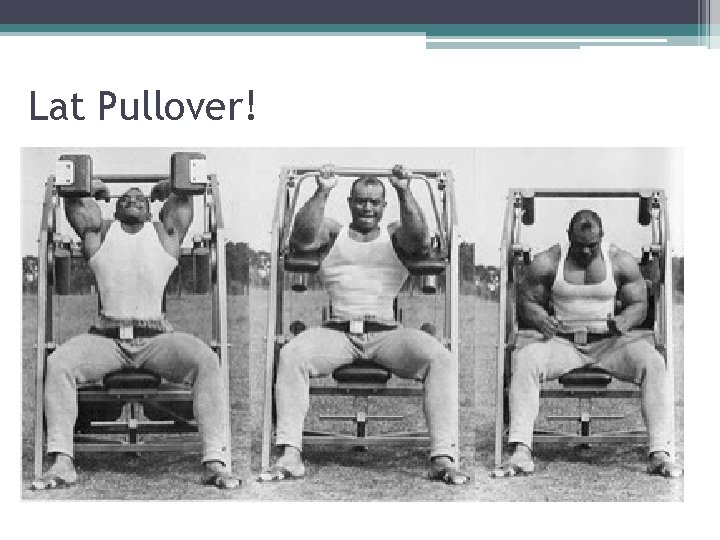
Lat Pullover!
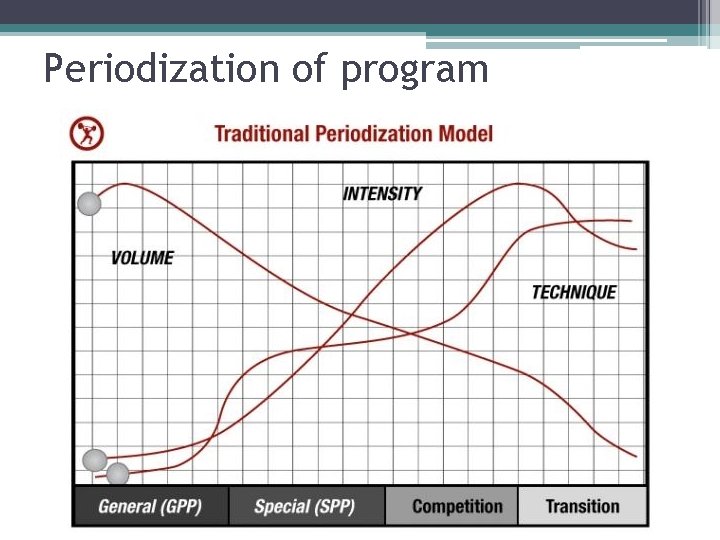
Periodization of program
- Slides: 23