
Basics of Ion Beam Analysis Srdjan Petrovi Laboratory
Basics of Ion Beam Analysis Srdjan Petrović Laboratory of Physics, Vinča Institute of Nuclear Sciences, University of Belgrade, Serbia 1/32
INTRODUCTION • Ion Beam Analysis (IBA) of the target material is based on the information obtained from the ion beam – target interaction. • In general, IBA provides the depth profiling of the material - the material atoms concentration dependence on the target depth and/or the elemental analysis - material atoms composition (stoichiometry). • Rutherford Backscattering Spectrometry (RBS) - depth profiling and elemental analysis • Elastic Backscattering Spectrometry (EBS) – depth profiling and elemental analysis • Elastic Recoil Detection Analysis (ERDA) – depth profiling and elemental analysis • Nuclear Reaction Analysis (NRA) – depth profiling and/or elemental analysis • Particle-Induced X-Ray Emission Analysis (PIXE) – elemental analysis • Particle-Induced -Ray Emission Analysis (PIGE) – elemental analysis and/or depth profiling • Ion Channeling – RBS/C, ERDA/C and impurity/crystal characterization 2/32

Rutherford backscattering spectrometry (RBS) Schematic figure of the Rutherford experiment 3/32
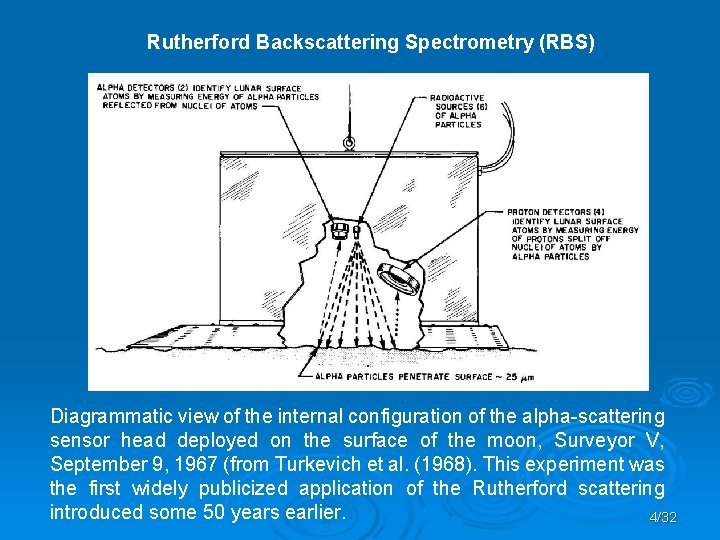
Rutherford Backscattering Spectrometry (RBS) Diagrammatic view of the internal configuration of the alpha-scattering sensor head deployed on the surface of the moon, Surveyor V, September 9, 1967 (from Turkevich et al. (1968). This experiment was the first widely publicized application of the Rutherford scattering introduced some 50 years earlier. 4/32

Experimental set up for RBS Schematic diagram of a typical backscattering spectrometry in use today 5/32

Rutherford Backscattering Spectrometry (RBS) • RBS is an analytical method, which provides depth profiling and stoichiometry • It is suitable for heavier elements in lighter matrix material • Typical depth profiling accuracy is 10 – 30 nm • Detection limit range from about a few parts per million for heavy elements to a few percent for light elements • RBS is nondestructive method, which is insensitive to the sample chemical bonding • From the practical point of view, it is quick and easy experiment, with data acquisition times of a few tens of minutes 6/32
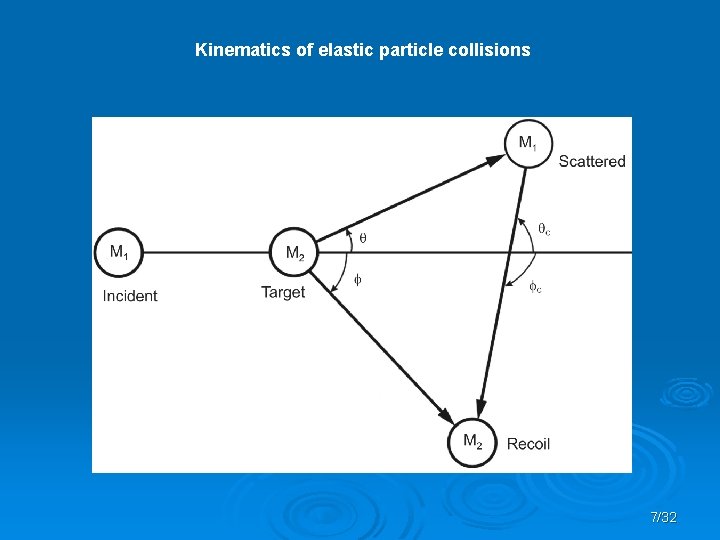
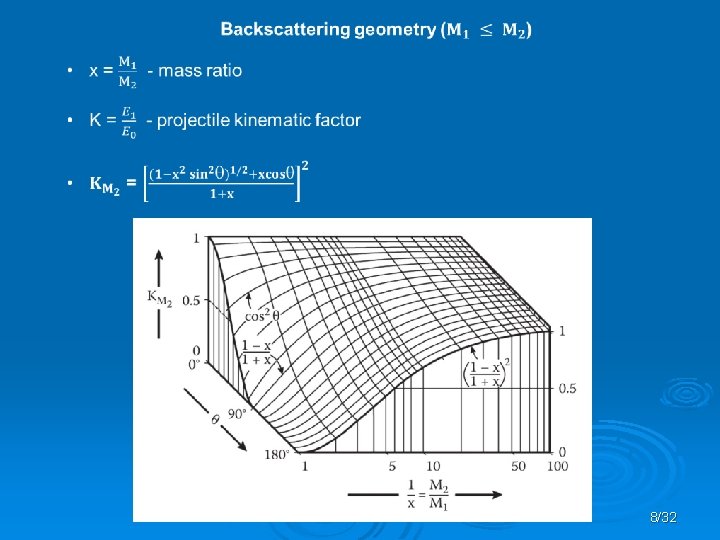
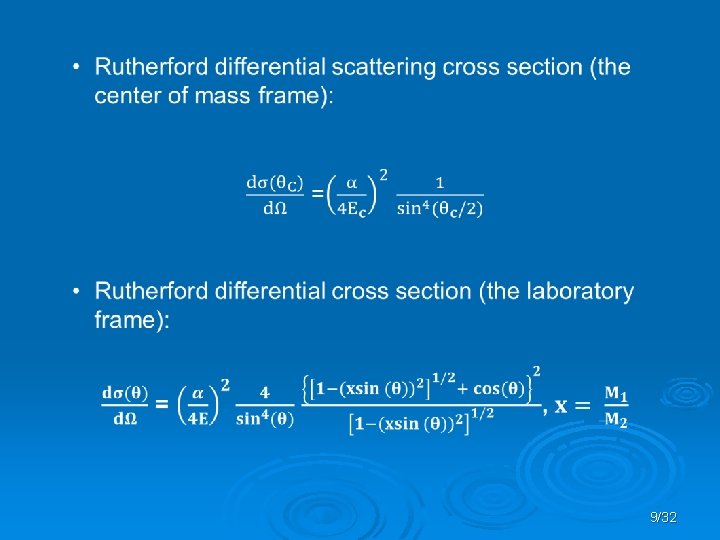
Kinematics of elastic particle collisions 7/32
8/32
9/32
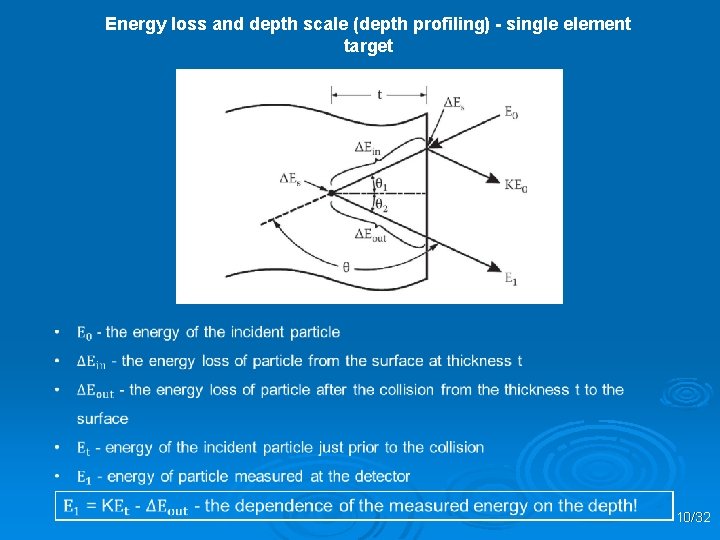
Energy loss and depth scale (depth profiling) - single element target 10/32
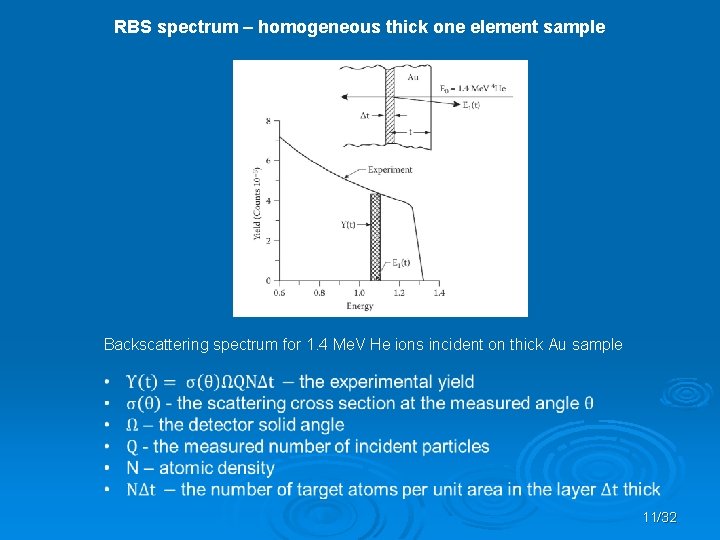
RBS spectrum – homogeneous thick one element sample Backscattering spectrum for 1. 4 Me. V He ions incident on thick Au sample 11/32
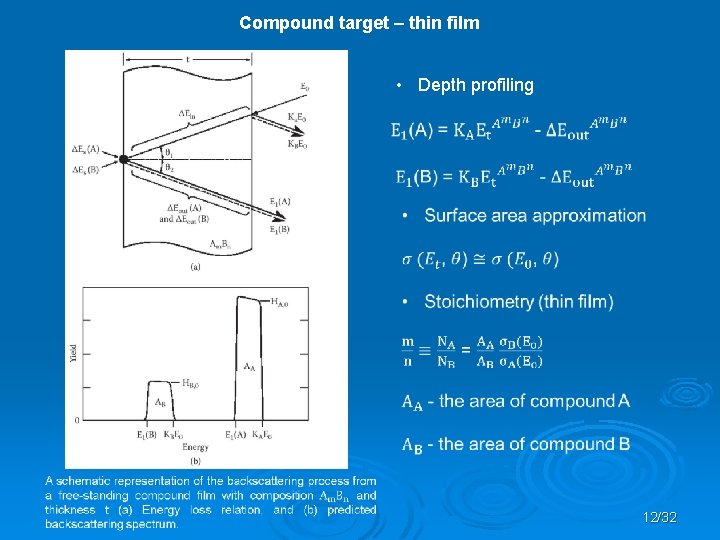
Compound target – thin film • Depth profiling 12/32
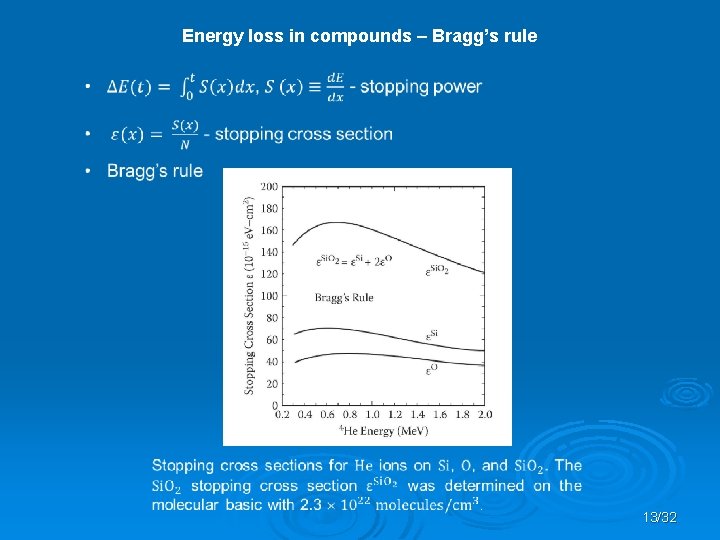
Energy loss in compounds – Bragg’s rule 13/32
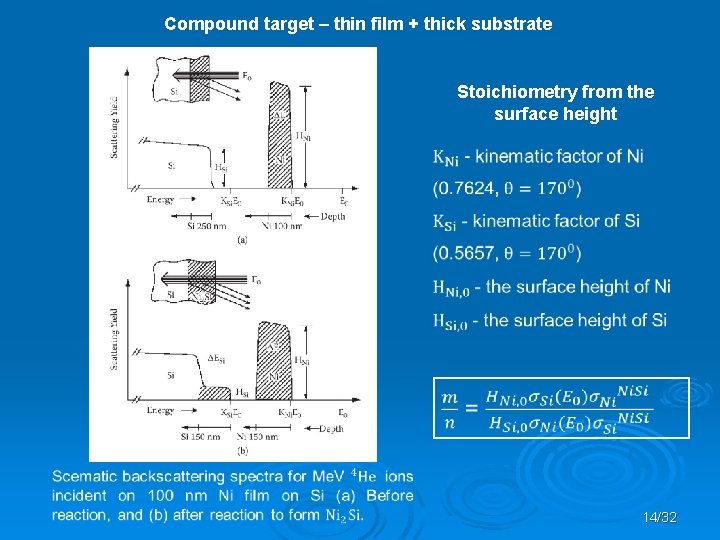
Compound target – thin film + thick substrate Stoichiometry from the surface height 14/32
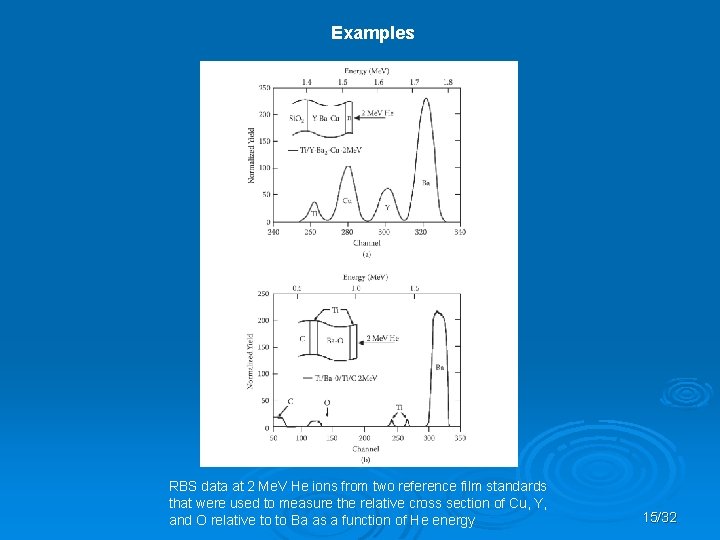
Examples RBS data at 2 Me. V He ions from two reference film standards that were used to measure the relative cross section of Cu, Y, and O relative to to Ba as a function of He energy 15/32
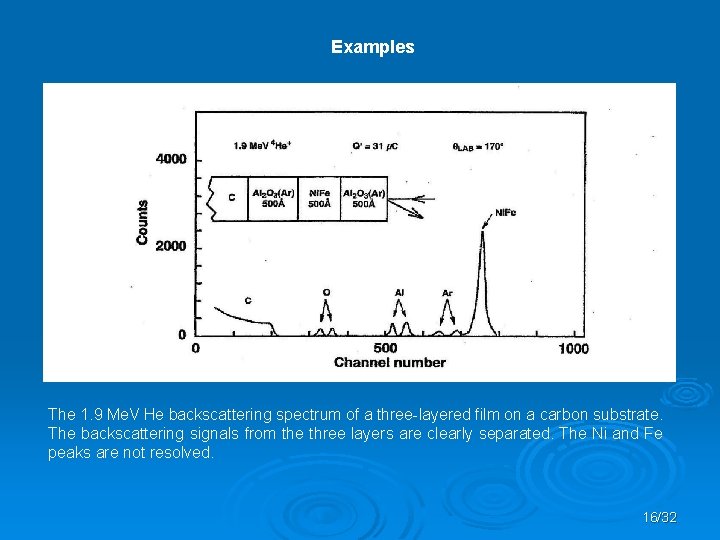
Examples The 1. 9 Me. V He backscattering spectrum of a three-layered film on a carbon substrate. The backscattering signals from the three layers are clearly separated. The Ni and Fe peaks are not resolved. 16/32
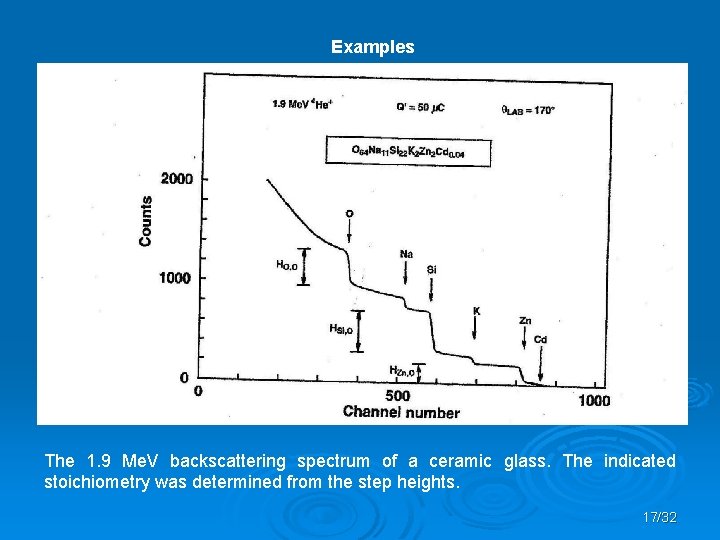
Examples The 1. 9 Me. V backscattering spectrum of a ceramic glass. The indicated stoichiometry was determined from the step heights. 17/32
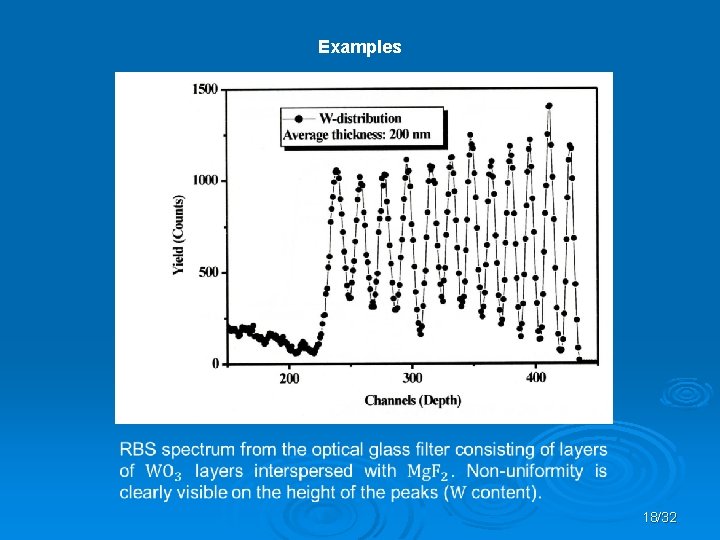
Examples 18/32
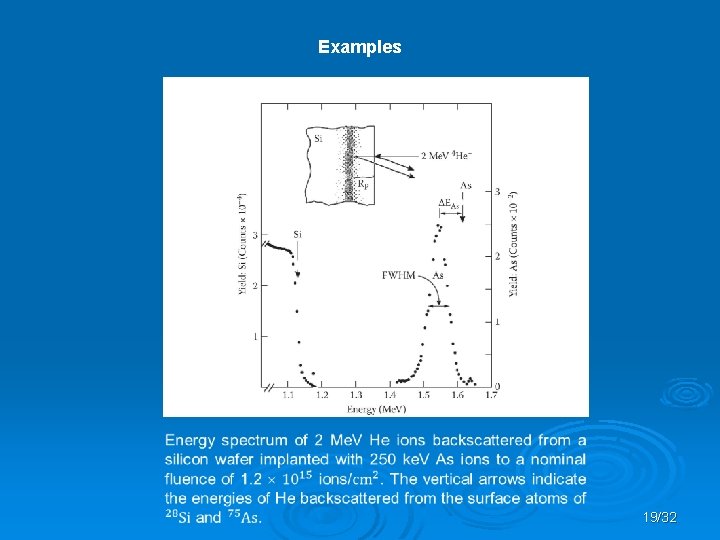
Examples 19/32
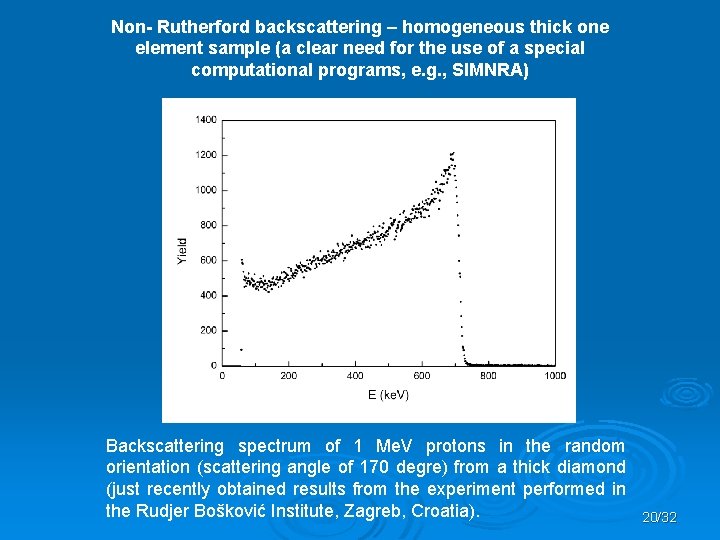
Non- Rutherford backscattering – homogeneous thick one element sample (a clear need for the use of a special computational programs, e. g. , SIMNRA) Backscattering spectrum of 1 Me. V protons in the random orientation (scattering angle of 170 degre) from a thick diamond (just recently obtained results from the experiment performed in the Rudjer Bošković Institute, Zagreb, Croatia). 20/32
Elastic Recoil Detection Analysis (ERDA) • ERDA is an analytical method, which provides depth profiling and stoichiometry • It is complementary with RBS and suitable for lighter elements in heavier matrix material • Depending on the way how the recoil ion(s) are detected, there are for example: a conventional range-foil ERDA, Time of Flight (TOF) ERDA and E-E ERDA • Depth profiling accuracy and detection limit range depend on the way recoil ion(s) are measured. • ERDA is nondestructive method, which is insensitive to the sample chemical bonding • From the practical point of view, it is quick and easy experiment, with data acquisition times of a few tens of minutes 21/32
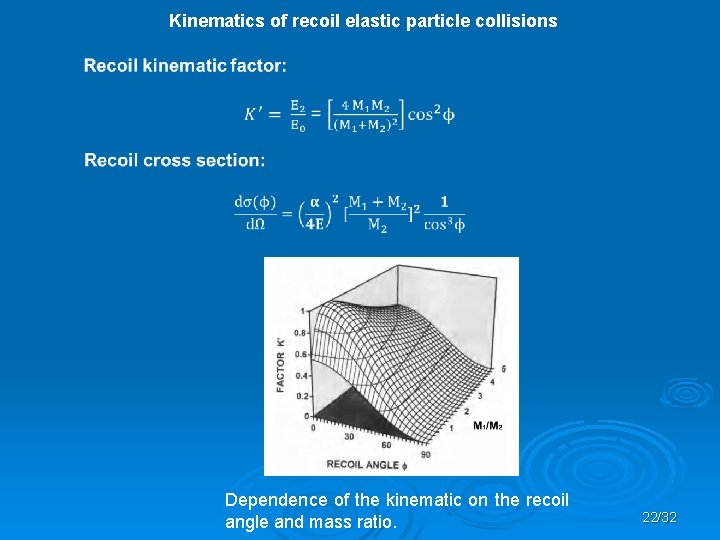
Kinematics of recoil elastic particle collisions Dependence of the kinematic on the recoil angle and mass ratio. 22/32
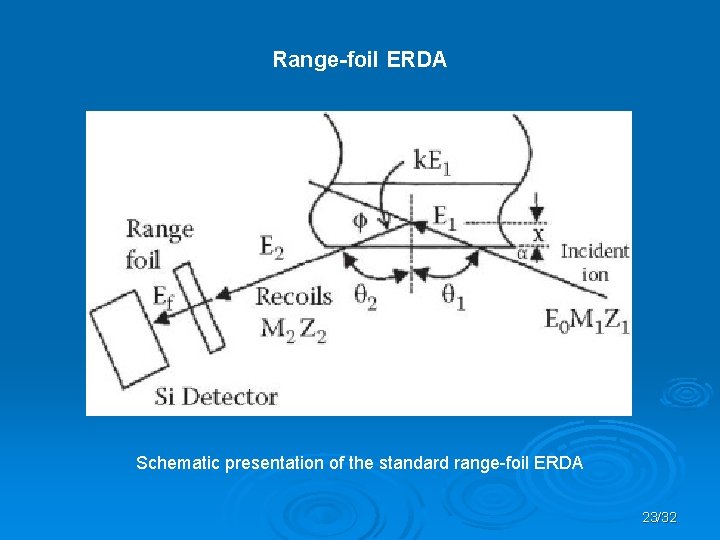
Range-foil ERDA Schematic presentation of the standard range-foil ERDA 23/32
Ideal versus realistic recoil energy spectrum • Converting a measured energy spectrum, i. e. counts versus recoil energy into a desired depth profile requires a lot of analytical efforts that in many cases cannot produce an accurate result. • In the computational programs, like SIMNRA, one can include the reflection geometry (ERDA) and a foil, as well as, the energy loss straggling, multiple scattering energy spread due to specific ERDA geometry and the non-Rutherford cross sections. Practically, the only computational programs are used for the ERDA depth profiling. • Sensitivity of a standard foil ERDA for hydrogen is around 0. 1%, for 1 – 3 Me. V He projectile beams. 24/32
Examples of standard range-foil ERDA – thin layers 25/32
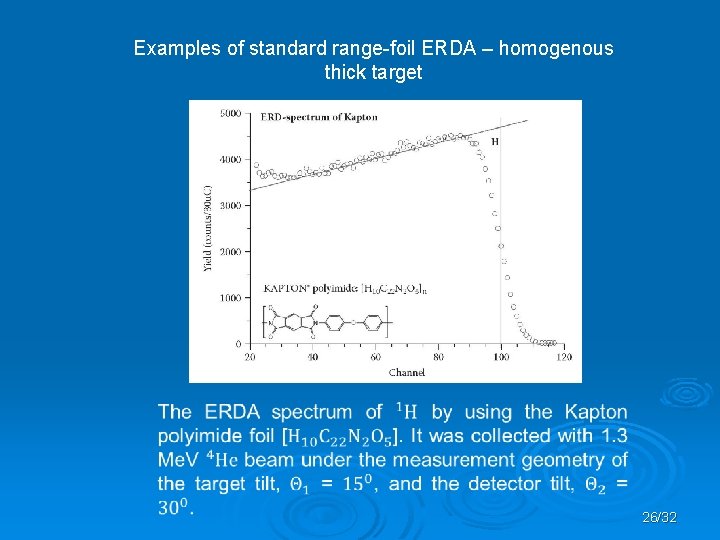
Examples of standard range-foil ERDA – homogenous thick target 26/32
Example of a transmission ERDA experiment Schematic of a transmission ERDA experiment for hydrogen profiling with an helium beam, with the zero detection angle and a target thick enough to stop completely incident particles. 27/32
Example of a range-foil ERDA implanted depth profiling of hydrogen Typical range-foil ERDA hydrogen profiling with an helium beam in the case of the hydrogen implantation a target. (The thin peak is due to hydrogen adsorbed on the surface. ) 28/32
Time-of-flight ERDA (TOF-ERDA) • Simultaneous measurements of both the velocity (via time-of -flight) and energy of recoiled ions. • Energy measurement – standard solid state detector. • TOF measurement – a telescope with the start (T 1) and stop (T 2) detectors (two ultra thin carbon foils producing secondary electrons, not disturbing the ion path). Example of the TOF-ERDA experimental set-up. 29/32
Example 30/32
E–E ERDA (solid-state telescope) • Simultaneous measurements of both the energy loss and energy of recoiled ions with a E–E telescope. • Energy loss measurement – very thin solid state detector • Energy measurement – standard solid state detector Schematic view of a solid-state telescope Variation of energy loss in a 10 m thick solid state detector for protons, deuterons and alpha particles 31/32
Example (a) Three-dimensional plot of hydrogen, deuterium, and tritium distributions in a titanium hydride sample bombarded with 4 Me. V He ions. (b) Two-dimensional plot in the interval 470 -510 ke. V. 32/32
- Slides: 32