
Basics of Flow Cytometry Holden Maecker Outline n
Basics of Flow Cytometry Holden Maecker
Outline n n n Definitions, what can be measured by flow cytometry Fluidics: Sheath and sample streams, flow cells, sorting Optics: Lasers, filters Electronics: PMTs, signal processing Fluorochromes: spectra, spillover Data analysis: FSC files, gating, statistics
Definitions n n Flow cytometry: study of cells as they move in fluid suspension, allowing multiple measurements to be made per cell. FACS™: fluorescence-activated cell sorting

What measurements can be made? n n n Forward light scatter (FSC): proportional to cell size Side light scatter (SSC): proportional to cell granularity Fluorescence: n n Binding of fluorescent-labeled antibodies Ca++-sensitive dyes within cells Fluorescent proteins expressed by cells Binding of DNA dyes
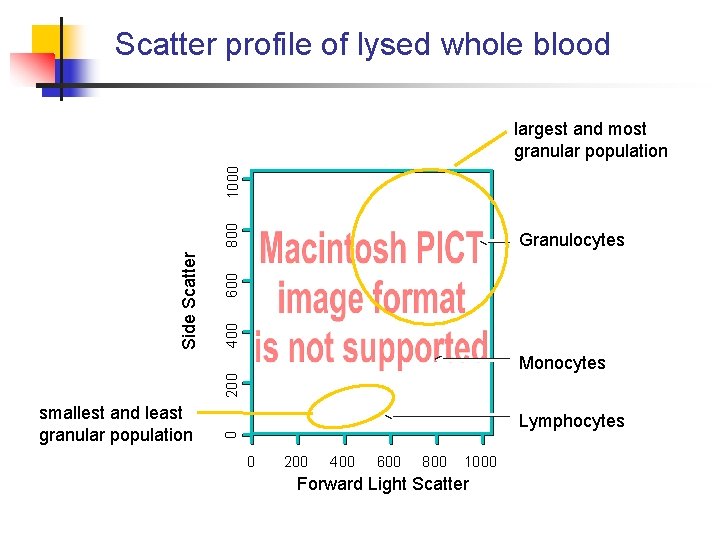
Scatter profile of lysed whole blood 600 Granulocytes 400 Side Scatter 800 1000 largest and most granular population 200 Monocytes Lymphocytes 0 smallest and least granular population 0 200 400 600 800 1000 Forward Light Scatter
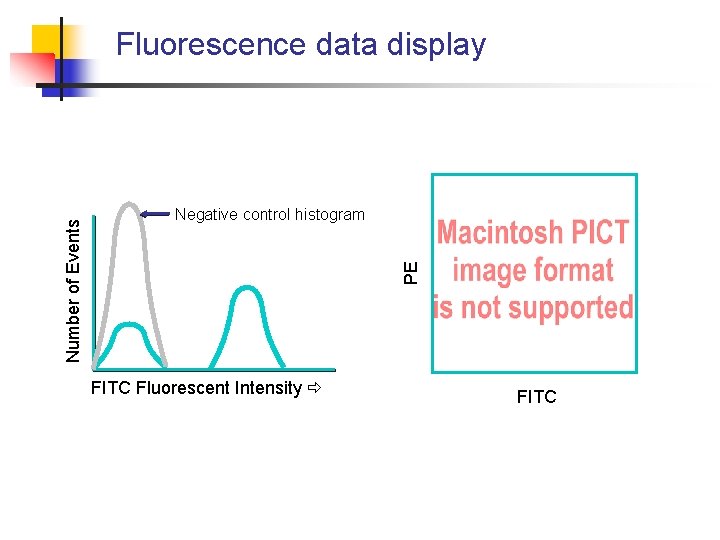
Negative control histogram PE Number of Events Fluorescence data display FITC Fluorescent Intensity FITC

Major components of a flow cytometer n n n n Sample intake port Sheath and waste reservoirs Flow cell Laser(s) Optical filters PMTs (photomultiplier tubes) or photodiodes Signal processor
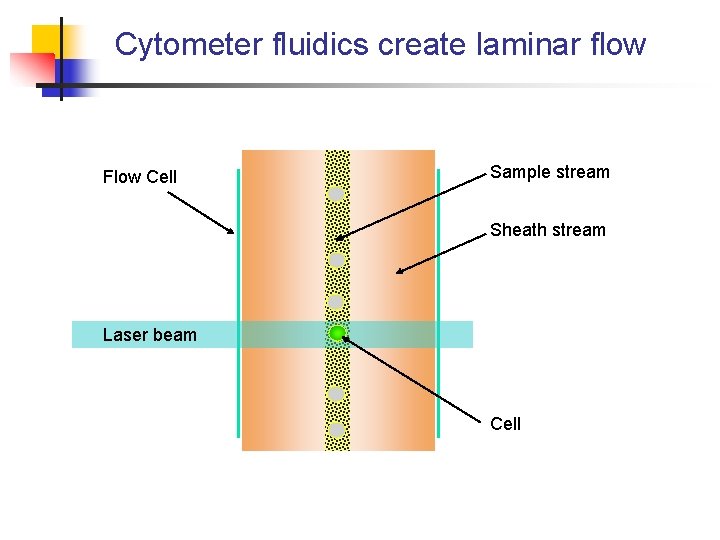
Cytometer fluidics create laminar flow Flow Cell Sample stream Sheath stream Laser beam Cell
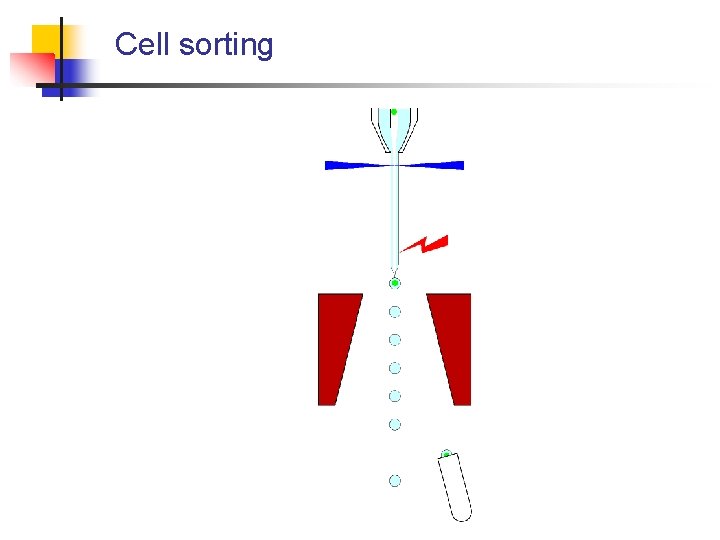
Cell sorting
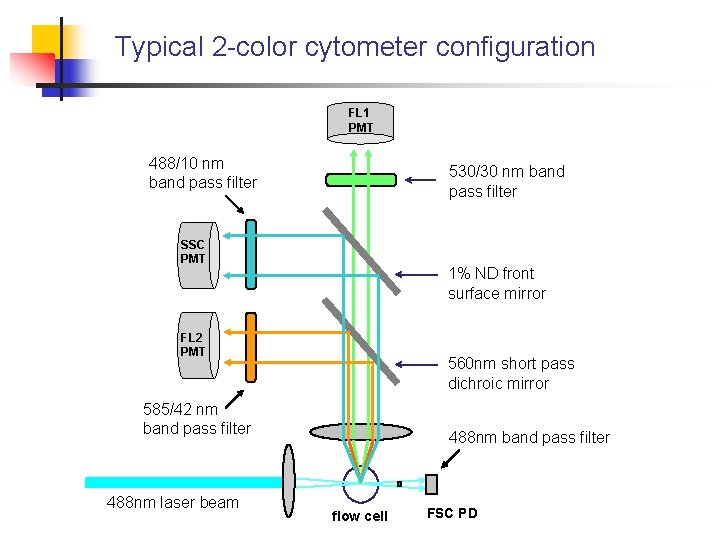
Typical 2 -color cytometer configuration FL 1 PMT 488/10 nm band pass filter 530/30 nm band pass filter SSC PMT 1% ND front surface mirror FL 2 PMT 560 nm short pass dichroic mirror 585/42 nm band pass filter 488 nm laser beam 488 nm band pass filter flow cell FSC PD
Background autofluorescence n All cells have a certain level of background fluorescence, due to: n n n Autofluroescence: from pigments and fluorescent moieties on cellular proteins Non-specifically bound antibodies, and free antibody in the sample stream The level of autofluorescence varies with the wavelength of excitation and collection: n Highest in FITC, PE detectors; lowest in far red (APC, Cy 7) detectors
Fluorescence sensitivity n Detection Efficiency (Q): number of photoelectrons generated per molecule of fluorophore n n Dependent upon fluorophore, filters, PMT sensitivity, voltage gain setting, etc. Background (B): non-specific signal intrinsic to the system n Dependent upon autofluorescence, unbound fluorophore, stray light, etc.

Common fluorophores for Ab conjugation FLUOROCHROME Type of molecule Typical excitation laser Approximate emission peak Fluorescein isotyocyanate (FITC) Small organic 488 nm 518 nm Alexa. Fluor 488 Small organic 488 nm 518 nm Phycoerythrin (PE) Protein 488 or 532 nm 574 nm PE-Texas Red Protein tandem 488 or 532 nm 615 nm PE-Cy 5 Protein tandem 488 or 532 nm 665 nm Peridinin chlorophyll protein (Per. CP) Protein 488 or 532 nm 676 nm Per. CP-Cy 5. 5 Protein tandem 488 or 532 nm 695 nm PE-Cy 7 Protein tandem 488 or 532 nm 776 nm Allophycocyanin (APC) Protein 633 nm 659 nm Alexa. Fluor 647 Small organic 633 nm 667 nm Alexa. Fluor 700 Small organic 633 nm 718 nm APC-Cy 7 Protein tandem 633 nm 784 nm Pacific Blue Small organic 405 nm 454 nm Am. Cyan Protein 405 nm 487 nm
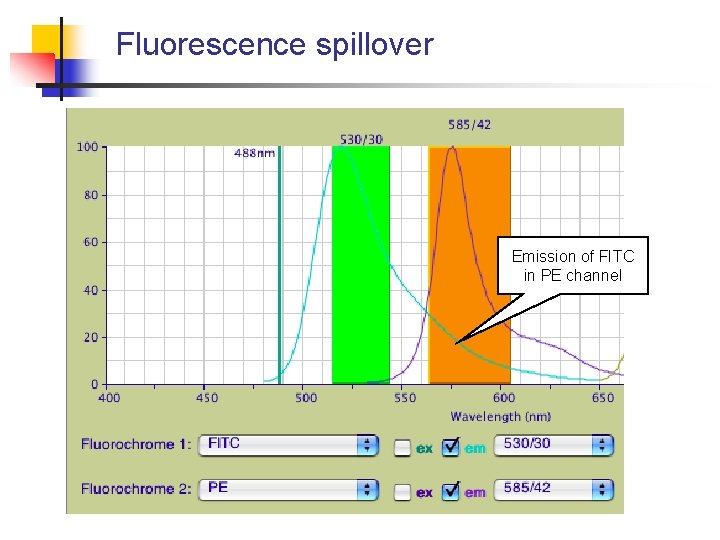
Fluorescence spillover Emission of FITC in PE channel
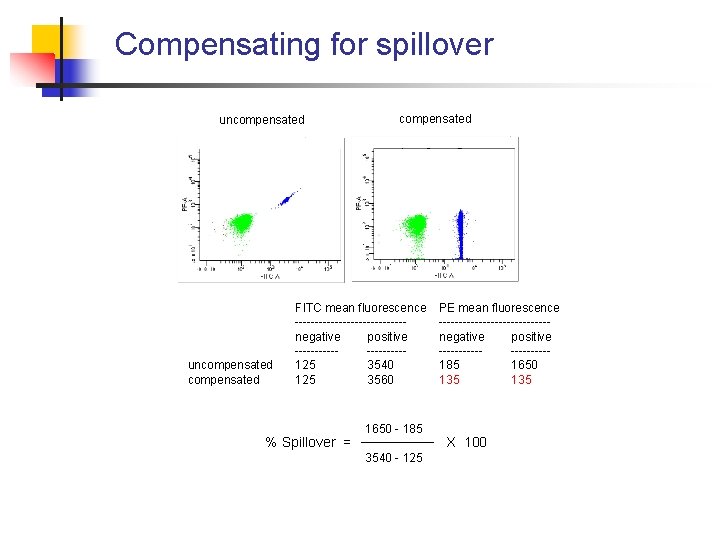
Compensating for spillover uncompensated FITC mean fluorescence --------------negative positive ----------125 3540 125 3560 % Spillover = 1650 - 185 3540 - 125 PE mean fluorescence --------------negative positive ----------185 1650 135 X 100
FCS files n n n FCS 2. 0 and FCS 3. 0 conventions Often referred to as list-mode files Contain all of the measurements (FSC-H, FSC -A, SSC-H, SSC-A, FL 1 -H…) for each individual cell processed in a given sample
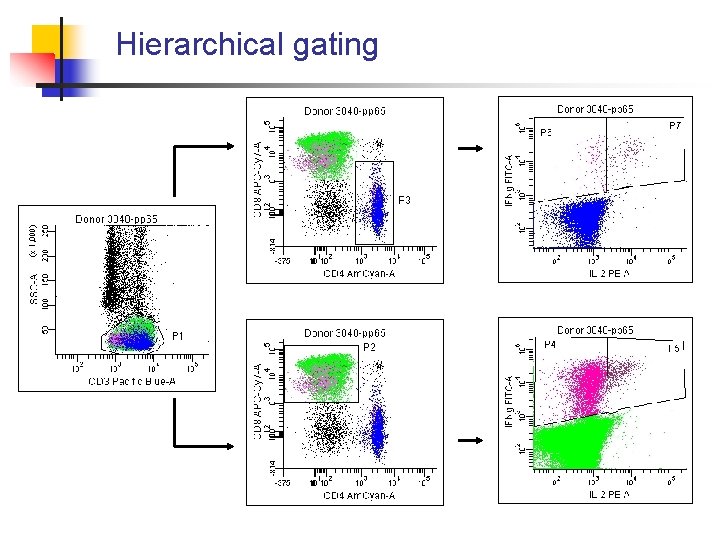
Hierarchical gating
Web reference tools n BD Spectrum Viewer: http: //www. bdbiosciences. com/spectra n Maecker lab weblog: http: //maeckerlab. typepad. com (protocols, manuscripts, literature updates)
- Slides: 18