
BASICS OF FIRST AID FOODIES AND HEALTH CLUB
BASICS OF FIRST AID FOODIES AND HEALTH CLUB
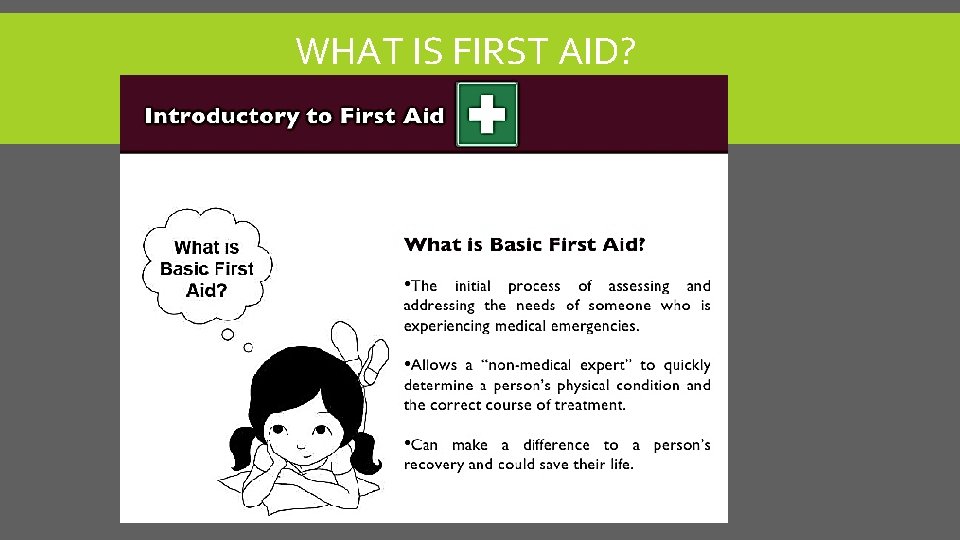
WHAT IS FIRST AID?
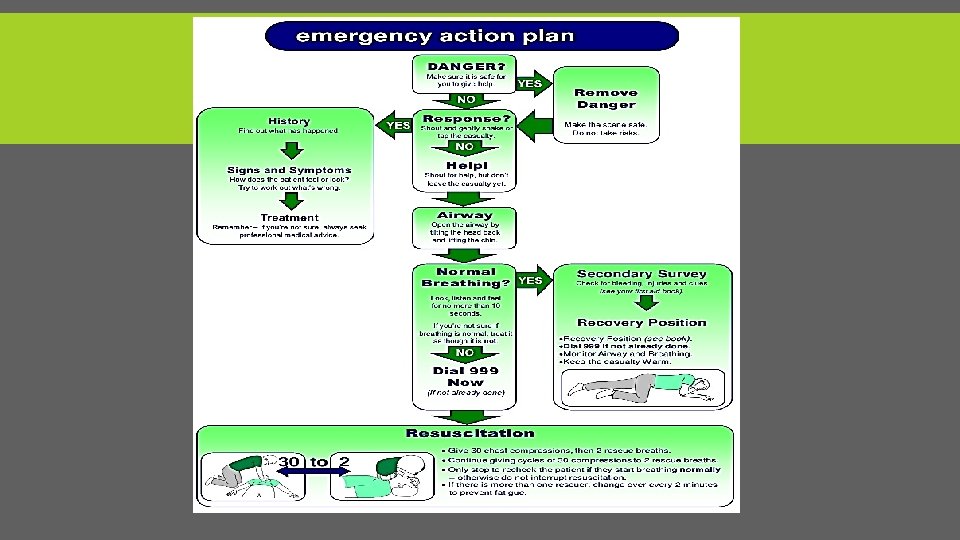
EMERGENCY ACTION PLAN In an emergency, particularly one involving children, it is important to remain calm and think logically. Remember these four steps: 1. Assess the situation. 2. Think of safety. 3. Treat serious injuries first. 4. Get help.
1. ASSESS THE SITUATION: What happened? How did it happen? Is there more than one injured child/individual? Is there any continuing danger? Is there anyone who can help? Do I need an ambulance?
2. THINK OF SAFETY Do not risk injuring yourself-you cannot help if you become a casualty. Remove any source of danger from your child or the individual. Move if the individual only if you must for his/her safety and do so carefully.
3. TREAT SERIOUS INJURIES FIRST In children there are two conditions that immediately threaten life: Inability to breathe or unconsciousness. Serious bleeding

4. GET HELP Shout for help early and get others to: Make the area safe. Seek medical advice or call an ambulance. Emergency Numbers: 112, 999, 767 Help with first aid. Move the chid to safety if necessary.
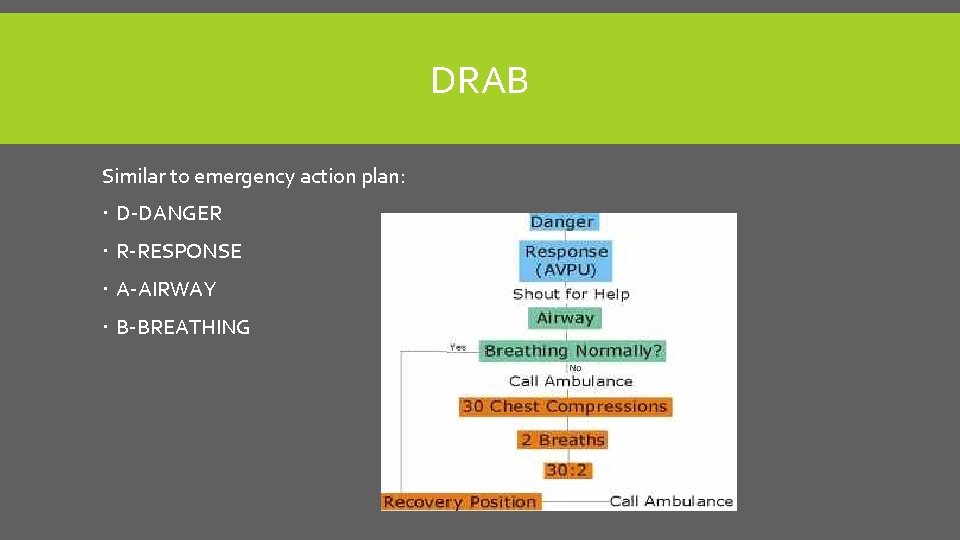
DRAB Similar to emergency action plan: D-DANGER R-RESPONSE A-AIRWAY B-BREATHING

TELEPHONING FOR HELP When you call the emergency services ask for an ambulance the following information will be useful: Your telephone number The location of the incident/accident The type of incident Number, sex and ages of the casualties Details of injuries Information about hazards such as gas, power line, fog etc.
CARDIOPULMONARY RESUSCITATION-CPR 1. CALL Check the victim for unresponsiveness. If the person is not responsive and not breathing or not breathing normally. Call emergency services and return to the victim. In most locations the emergency dispatcher can assist you with CPR instructions. 2. PUMP If the victim is still not breathing normally, coughing or moving, begin chest compressions. Push down in the centre of the chest 2 inches 30 times. Pump hard and fast at the rate of at least 100/minute, faster than once per second. 3. BLOW Tilt the head back and lift the chin. Pinch nose and cover the mouth with yours and blow until you see the chest rise. Give 2 breaths. Each breath should take 1 second.
NOTE The ratio mentioned above is the same for one-person & two-person CPR. In twoperson CPR the person pumping the chest stops while the other gives mouth-to-mouth breathing. If you’ve been trained in CPR, including rescue breaths, and feel confident using your skills, you should give chest compressions with rescue breaths. If you're not completely confident, attempt hands-only CPR instead.
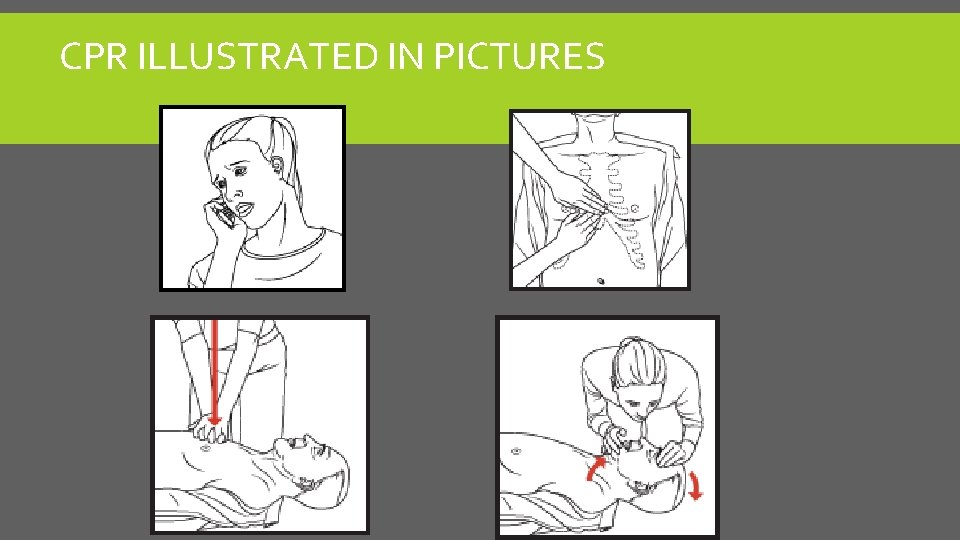
CPR ILLUSTRATED IN PICTURES
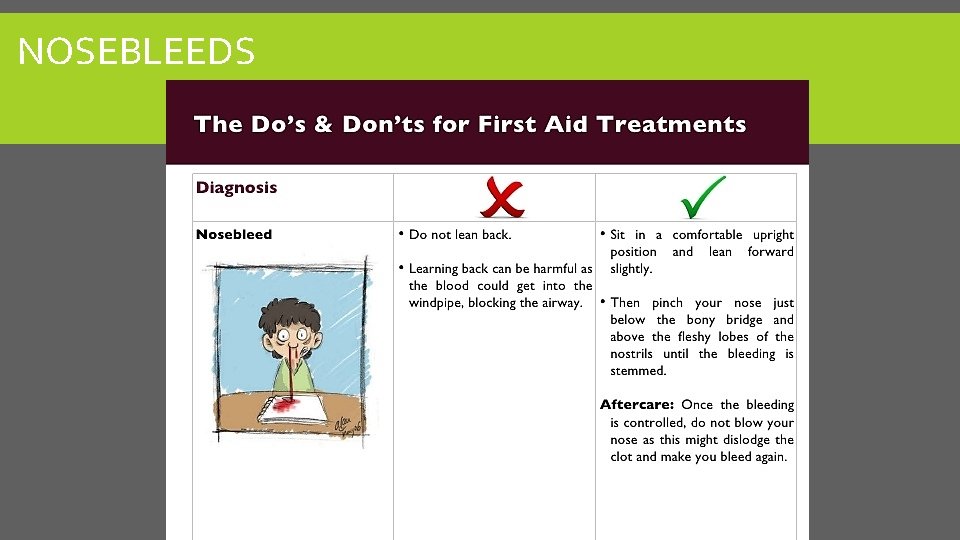
NOSEBLEEDS

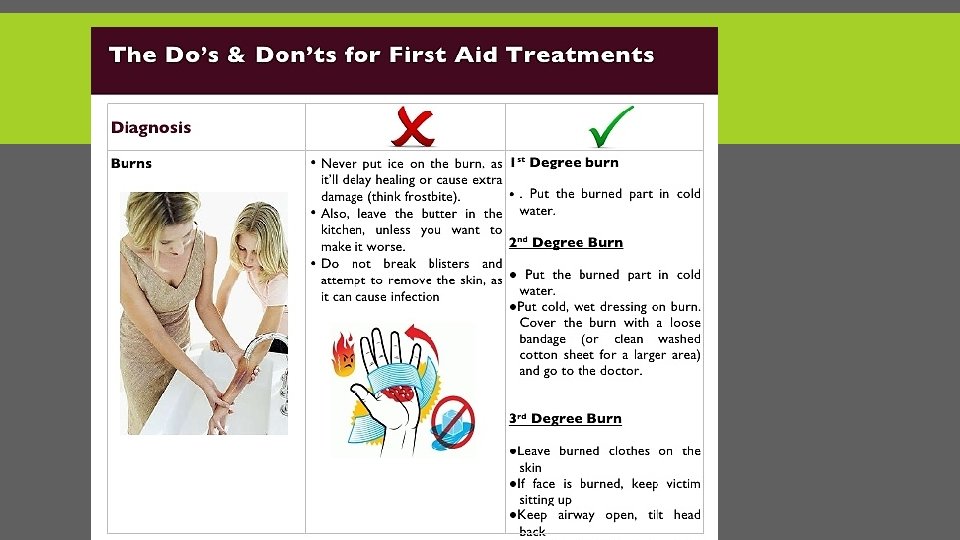
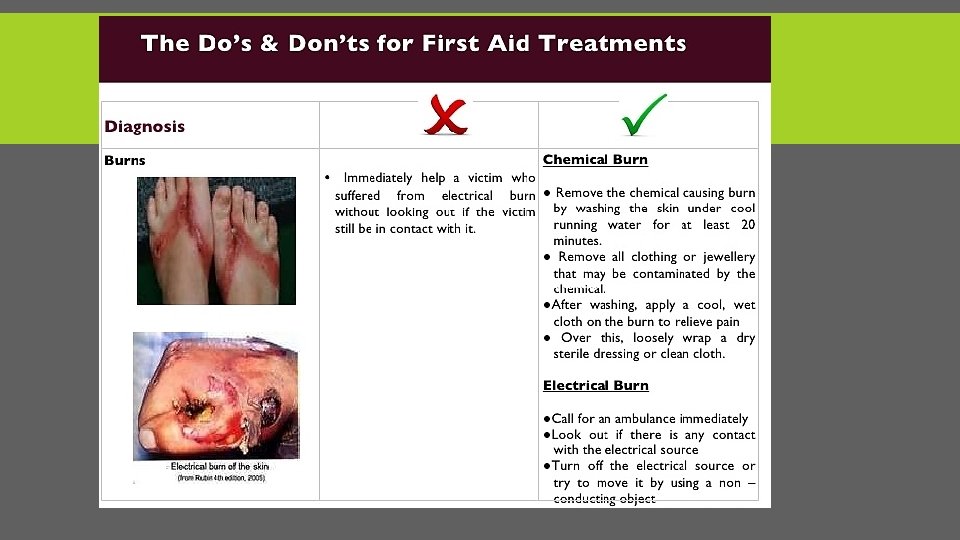
BURNS AND DEGREE OF BURNS

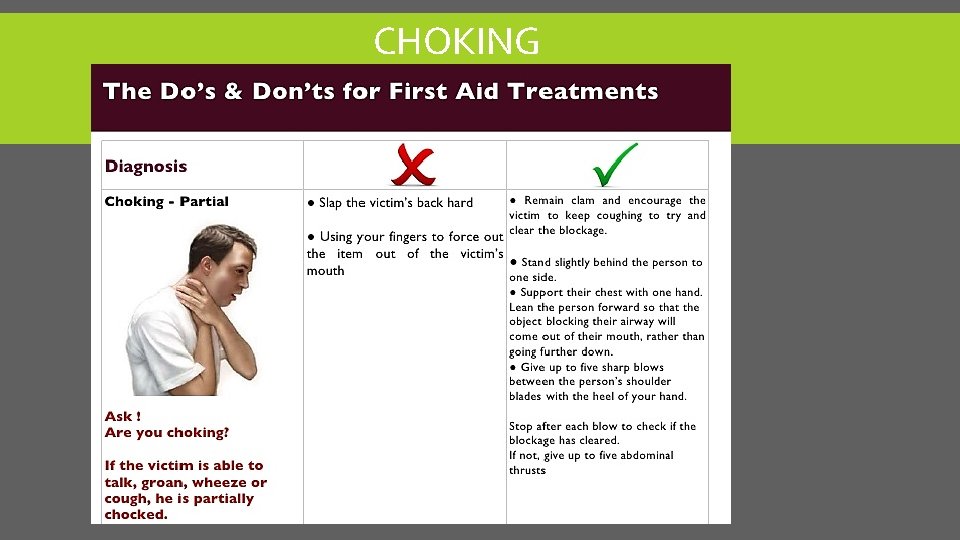
CHOKING
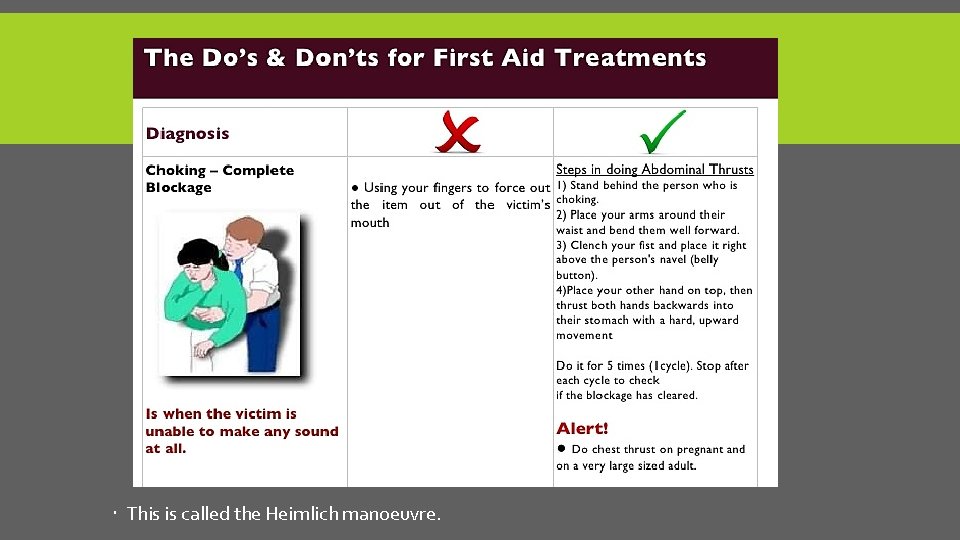
This is called the Heimlich manoeuvre.

SNAKE BITE


FIRST AID KIT AND ITS COMPONENTS
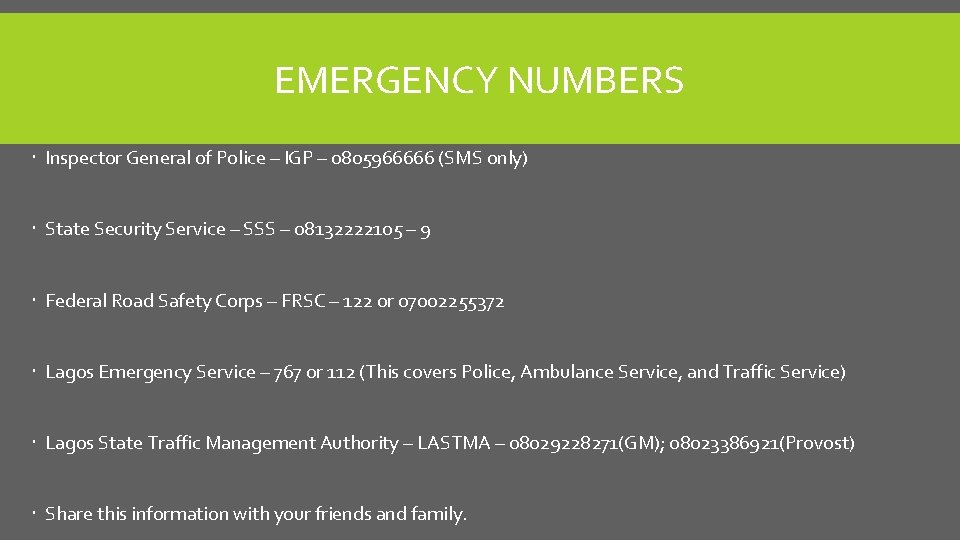
EMERGENCY NUMBERS Inspector General of Police – IGP – 0805966666 (SMS only) State Security Service – SSS – 08132222105 – 9 Federal Road Safety Corps – FRSC – 122 or 07002255372 Lagos Emergency Service – 767 or 112 (This covers Police, Ambulance Service, and Traffic Service) Lagos State Traffic Management Authority – LASTMA – 08029228271(GM); 08023386921(Provost) Share this information with your friends and family.

SHORT QUIZ

TEAR OUT SHEETS OF PAPER
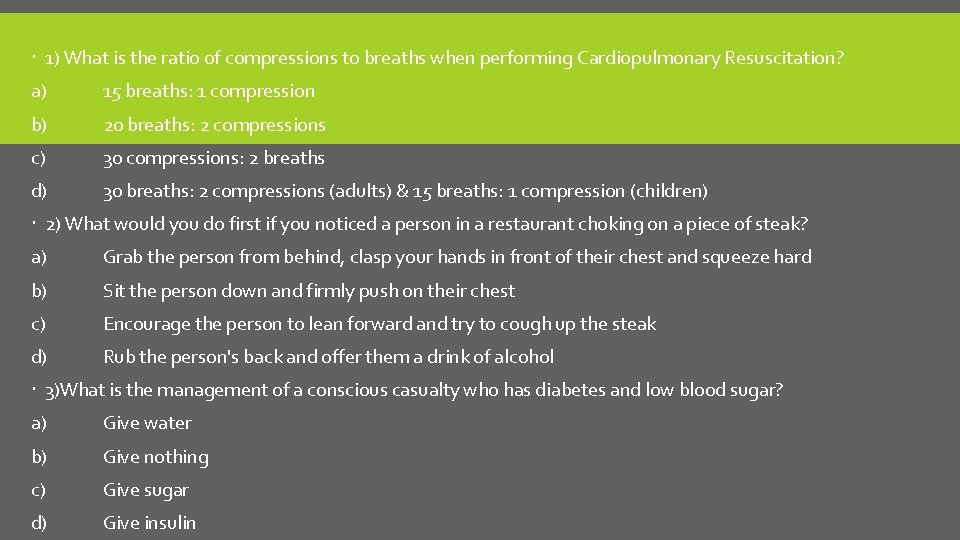
1) What is the ratio of compressions to breaths when performing Cardiopulmonary Resuscitation? a) 15 breaths: 1 compression b) 20 breaths: 2 compressions c) 30 compressions: 2 breaths d) 30 breaths: 2 compressions (adults) & 15 breaths: 1 compression (children) 2) What would you do first if you noticed a person in a restaurant choking on a piece of steak? a) Grab the person from behind, clasp your hands in front of their chest and squeeze hard b) Sit the person down and firmly push on their chest c) Encourage the person to lean forward and try to cough up the steak d) Rub the person's back and offer them a drink of alcohol 3)What is the management of a conscious casualty who has diabetes and low blood sugar? a) Give water b) Give nothing c) Give sugar d) Give insulin
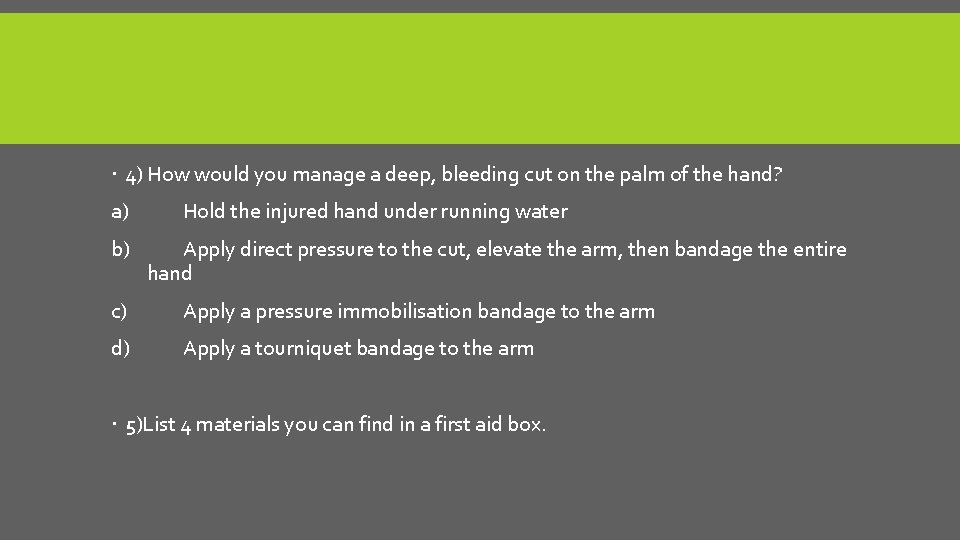
4) How would you manage a deep, bleeding cut on the palm of the hand? a) b) Hold the injured hand under running water Apply direct pressure to the cut, elevate the arm, then bandage the entire hand c) Apply a pressure immobilisation bandage to the arm d) Apply a tourniquet bandage to the arm 5)List 4 materials you can find in a first aid box.
6). Would you know what to do? Your co-worker has gone very pale and he says he is short of breath. He suddenly collapses and becomes unresponsive - he is not breathing normally. All collapsed patients should be carefully assessed to decide what emergency care is needed. Put these actions in the correct order to show the best way of assessing the situation. RESPONSE AIRWAY DANGERS BREATHING
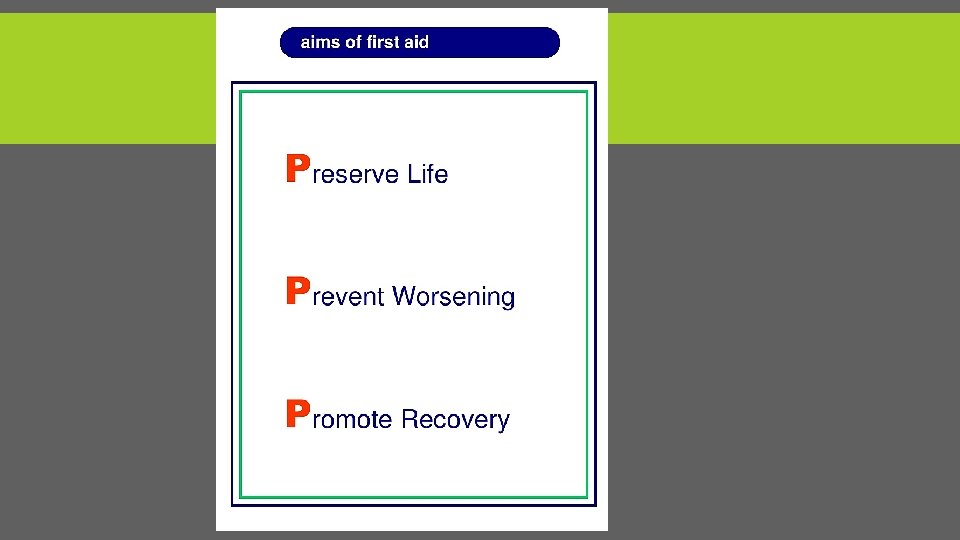
7) What Are the AIMS of a firs aider? a) Preserve b) Give medication to make casualty better c) Prevent d) Practice e) Promote 8) If available, what should you always try and wear when treating wounds and bleeding? a) Nothing at all b) A funny hat c) Gloves d) A gas mask
9). Which of the following is the correct treatment for a nose bleed? a) Seat the patient, nip the soft part of the nose and tip their head forward b) Push patient's head back and tell them to close their eyes c) Ask the patient to do a handstand d) Hold the patient's ears and sing softly 10). What is the ideal dressing for a burn? a) Cotton wool b) Twinset and pearls c) Sterile, lint-free dressing d) Butter

THANK YOU FOR WATCHING!
- Slides: 33