
Basics of femtosecond laser spectroscopy Alexander Mikhailovsky Optical
Basics of femtosecond laser spectroscopy Alexander Mikhailovsky, Optical Characterization Facility Coordinator Institute for Polymer and Organic Solids Department of Chemistry and Biochemistry, University of CA Santa Barbara, CA 93106 mikhailovsky@chem. ucsb. edu, (805)893 -2327

What’s so Special About Femtosecond Lasers? ? ? • Short optical pulse. • Most of energy dissipation and transfer processes occur on the time scale larger than 100 fs. • Femtosecond laser pulses enable one to excite the species studied “instantly” (texc<< trel) • Dynamics of the excited state can be monitored with high temporal resolution (~ 0. 5 tpulse ≈ 12 -50 fs for most of commercial lasers) • Visualization of ultrafast dynamical processes (fluorescence, excited state absorption) • High peak power of the light • I ~ J/tpulse, , I – Power, J – pulse energy. • 1 m. J pulse with 10 ns duration - 0. 1 MW • 1 m. J pulse with 100 fs duration - 10 GW • Non-linear spectroscopy and materials processing (e. g. , multi-photon absorption, optical harmonics generation, materials ablation, etc. ) W. Kaiser, ed. , “Ultrashort Laser Pulses: Generation and Applications”, Springer-Verlag, Berlin, 1993

How to Prepare a Femtosecond Pulse I Femtosecond laser pulses are usually Fourier transform-limited pulses Dw·Dt ≈ 2 p Dl ≈ l 2 /(c. Dt) fs pulse Dw ≈ 2 p/Dt Dl ≈ 21 nm for 100 fs pulses with l 0 = 800 nm ns pulse Wavelength Large spectral bandwidth for short pulses Large bandwidth limits the choice of the laser active medium (broad-band materials only, e. g. , Ti: Sapphire, laser dyes) and laser cavity design (no bandwidth limiting elements, such as narrowband mirrors)

How to Prepare a Femtosecond Pulse II Laser mode – combination of frequency (w) and direction (k) of the electromagnetic wave allowed by the laser cavity geometry. L The spectrum of laser modes is not continuous ln = 2 L/n Laser pulse as a sum of modes Lock Relative phase of the modes has to be constant (locked) in order to obtain a stable output pulse No lock Time

Passive Mode-Locking Saturating absorber technique Active medium Saturating absorber Initial noise “seed” Time Absorption (Cavity losses) Mirrors Intensity Steady-state operation Time

Passive Mode-Locking II Kerr-lens mode-locking • Kerr’s effect – inetnsity-dependent index of refraction: n = n 0 + n 2 I • The e/m field inside the laser cavity has Gaussian distribution of intensity which creates similar distribution of the refractive index. • High-intensity beam is self-focused by the photoinduced lens. Low-intensity Kerr-medium High-intensity • High-intensity modes have smaller cross-section and are less lossy. Thus, Kerr-lens is similar to saturating absorber! • Some lasing materials (e. g. Ti: Sapphire) can act as Kerr-media • Kerr’s effect is much faster than saturating absorber allowing one generate very short pulses (~5 fs).
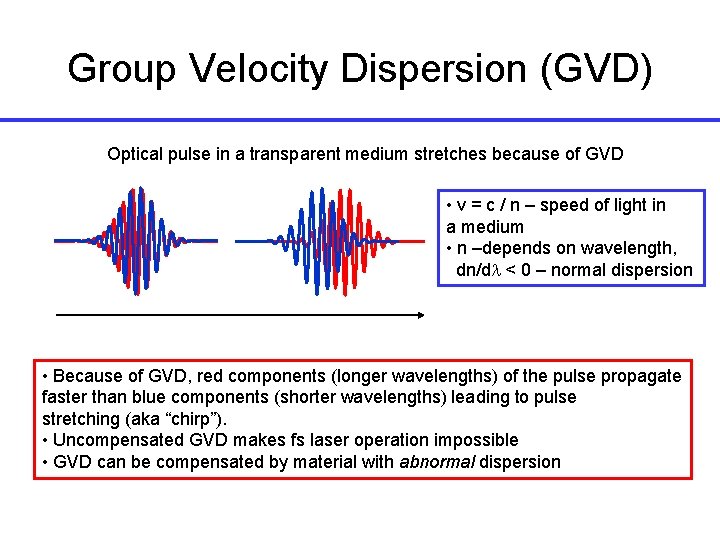
Group Velocity Dispersion (GVD) Optical pulse in a transparent medium stretches because of GVD • v = c / n – speed of light in a medium • n –depends on wavelength, dn/dl < 0 – normal dispersion • Because of GVD, red components (longer wavelengths) of the pulse propagate faster than blue components (shorter wavelengths) leading to pulse stretching (aka “chirp”). • Uncompensated GVD makes fs laser operation impossible • GVD can be compensated by material with abnormal dispersion
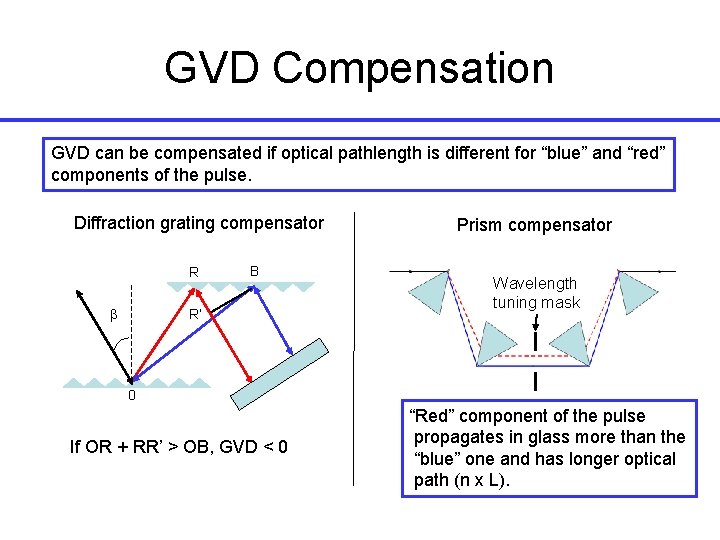
GVD Compensation GVD can be compensated if optical pathlength is different for “blue” and “red” components of the pulse. Diffraction grating compensator R b B R’ Prism compensator Wavelength tuning mask 0 If OR + RR’ > OB, GVD < 0 “Red” component of the pulse propagates in glass more than the “blue” one and has longer optical path (n x L).

Typical fs Oscillator Typical Ti: Sapphire fs Oscillator Layout Active medium (Also Kerr medium) GVDC From the pump laser Wavelength tuning mask • Tuning range 690 -1050 nm • Pulse duration > 5 fs (typically 50 -100 fs) • Pulse energy < 10 n. J • Repetition rate 40 – 1000 MHz (determined by the cavity length) • Pump source: Ar-ion laser (488+514 nm) DPSS CW YAG laser (532 nm) • Typical applications: time-resolved emission studies, multi-photon absorption spectroscopy and imaging O. Zvelto, “Principles of lasers”, Plenum, NY (2004)

Amplification of fs Pulses Due to high intensity, fs pulses can not be amplified as is. Recipe for the amplification: Chirped pulse amplifier (CPA) • Stretch the pulse in time, thus reducing the peak power (I = J / tpulse !) (typically the pulse is stretched up to hundreds of ps) • Amplify the stretched pulse • Compress the pulse

Pulse Stretcher b • Pulse stretcher utilizes the same principle as compressor: separation of spectral components and manipulation with their delays • Compressor can converted into stretcher by addition of focusing optics “flipping” paths of red and blue components.
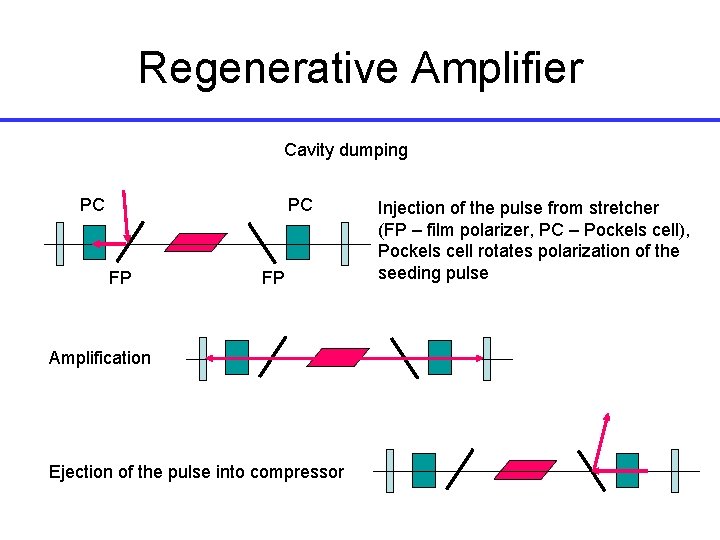
Regenerative Amplifier Cavity dumping PC PC FP FP Amplification Ejection of the pulse into compressor Injection of the pulse from stretcher (FP – film polarizer, PC – Pockels cell), Pockels cell rotates polarization of the seeding pulse

Typical CPA • Repetition rate ~ 1 KHz • Pulse duration 50 -150 fs • Pulse energy 1 m. J • Wavelength – usually fixed close to 800 nm • Typical applications: pumping optical frequency converters, non-linear spectroscopy, materials processing

Frequency Conversion of fs Pulses With fs pulses non-linear optical processes are very efficient due to high intensity of input light: Iout = A Iinm Parametric down-conversion Non-linear crystal lp Signal ls Idler li 1/lp = 1/ls + 1/li kp = ks + ki Pump : 800 nm, 1 m. J, 100 fs Signal: 1100 -1600 nm, 0. 12 m. J Idler: 1600 – 3000 nm, 0. 08 m. J Optical harmonic generation Second harmonic 1/l. SH = 2/l. F k. SH = 2 k. F Pump : 800 nm, 1 m. J, 100 fs SHG: 400 nm, 0. 2 m. J Harmonic generation can be used to upconvert signal or idler into the visible range of spectrum

Femtosecond Continuum White-light continuum generation 3 35 x 10 30 25 Intensity 800 nm Sapphire plate 2 mm 20 15 1 m. J 100 fs 10 5 0 400 500 600 Wavelength (nm) 700 • Self-focusing and self-phase-modulation broadens the spectrum • Extremely broad-band, ultrafast pulses (Vis and IR ranges) • Strongly chirped 1. R. L. Fork et al, 8 Opt. Lett. , p. 1, (1983)
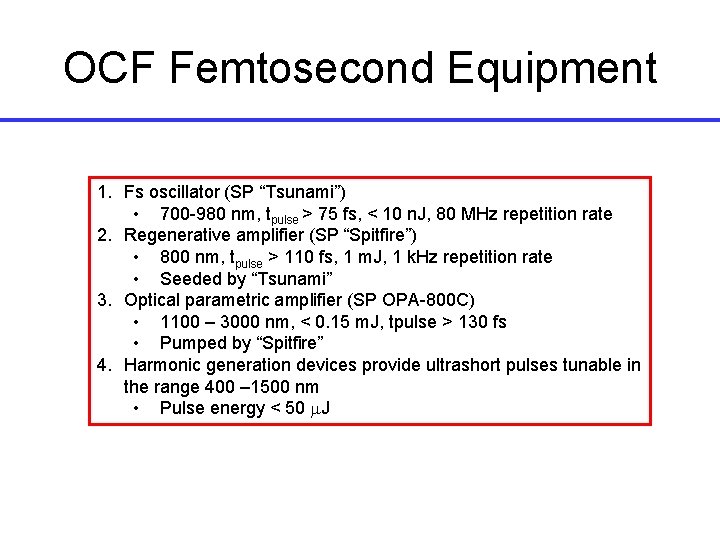
OCF Femtosecond Equipment 1. Fs oscillator (SP “Tsunami”) • 700 -980 nm, tpulse > 75 fs, < 10 n. J, 80 MHz repetition rate 2. Regenerative amplifier (SP “Spitfire”) • 800 nm, tpulse > 110 fs, 1 m. J, 1 k. Hz repetition rate • Seeded by “Tsunami” 3. Optical parametric amplifier (SP OPA-800 C) • 1100 – 3000 nm, < 0. 15 m. J, tpulse > 130 fs • Pumped by “Spitfire” 4. Harmonic generation devices provide ultrashort pulses tunable in the range 400 – 1500 nm • Pulse energy < 50 m. J

Two-Photon Absorption I 1 -DI I 1 I 2 Dx Degenerate case b – TPA cross-section, c – concentration of material 1 PA Beer’s Law TPA
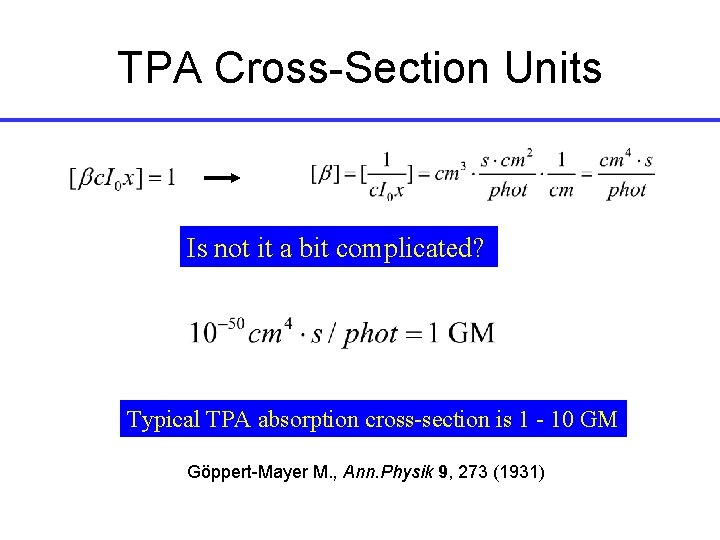
TPA Cross-Section Units Is not it a bit complicated? Typical TPA absorption cross-section is 1 - 10 GM Göppert-Mayer M. , Ann. Physik 9, 273 (1931)

Do We Really Need a Fs Pulse? Accuracy limit of the most of intensity measurements I I-DI b= 10 GM c = 10 -4 M x = 1 mm 1 W ~ 1018 phot/sec I = 16 GW/cm 2 If beam diameter is 10 m, required lasers power/pulse energy is: CW laser power 12000 W YAG: Nd laser (10 ns pulse, 25 Hz rep. rate) 120 m. J pulse energy (3 m. W) Ti: Sapphire laser (100 fs pulse, 100 MHz rep. rate), 1. 2 n. J pulse energy (120 m. W)

TPA PL excitation Tunable fs (ps) laser light (700 -1000 nm) Sample Beam shaping optics Emission Pickup Optics And Filters Two-photon Absorption Emission Spectrometer Photomultiplier tube Or CCD camera Pros: • Very sensitive • Easy to setup • Works without amplifier Cons: • Works only for PL emitting materials • Not absolute (requires reference material)

TPA PLE II , if , then b – TPA cross-section, c – concentration, x – length of interaction, I – laser light intensity, A – geometrical factor (usually unknown) TPA PL technique requires a reference measurement for collimated beams Good reference materials: laser dyes (Fluorescein, Rhodamin, Coumarin) C. Xu and W. W. Webb, J. of Am. Opt. Soc. 13, 481 (1996)

TPA Measurements in Non. Fluorescent Materials Z-Scan Technique Sample Lens Intensity of light Transmission of the sample z Open aperture Z-scan, TPA measurements

Z-Scan Measurements of Kerr’s Non-Linearity Aperture Sample Z Closed aperture Z-scan • Kerr lens focuses or defocuses light clipped by the aperture thus modulating its transmission DT Z
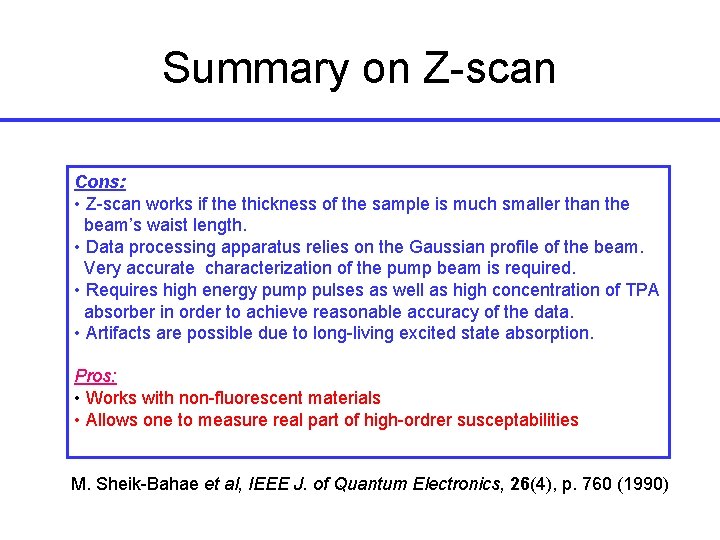
Summary on Z-scan Cons: • Z-scan works if the thickness of the sample is much smaller than the beam’s waist length. • Data processing apparatus relies on the Gaussian profile of the beam. Very accurate characterization of the pump beam is required. • Requires high energy pump pulses as well as high concentration of TPA absorber in order to achieve reasonable accuracy of the data. • Artifacts are possible due to long-living excited state absorption. Pros: • Works with non-fluorescent materials • Allows one to measure real part of high-ordrer susceptabilities M. Sheik-Bahae et al, IEEE J. of Quantum Electronics, 26(4), p. 760 (1990)

TPA Applications • 3 D optical memory • 3 D holographic gratings and photonic structures • Remote sensing and hi-res imaging
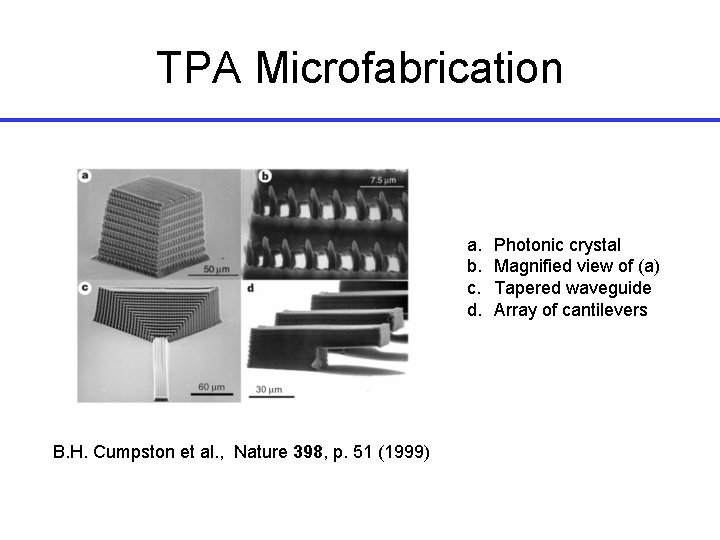
TPA Microfabrication a. b. c. d. B. H. Cumpston et al. , Nature 398, p. 51 (1999) Photonic crystal Magnified view of (a) Tapered waveguide Array of cantilevers
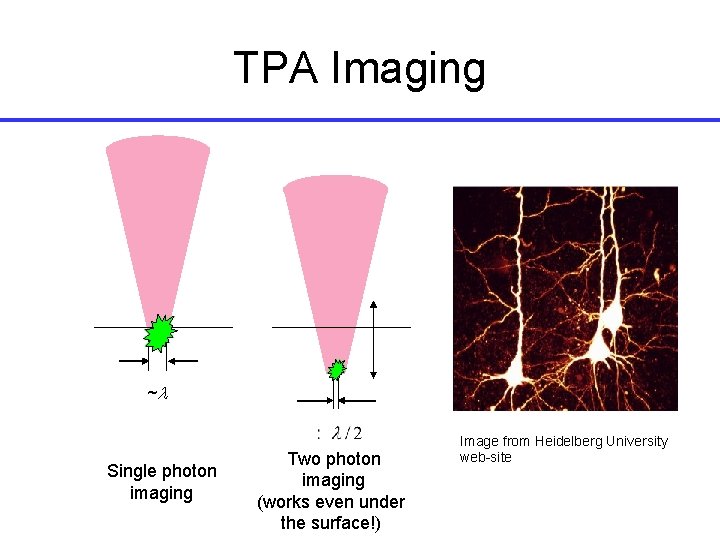
TPA Imaging ~l Single photon imaging Two photon imaging (works even under the surface!) Image from Heidelberg University web-site

Time-Resolved Emission Spectroscopy Time-correlated photon counting techniques Dt 1 ps PL up-conversion 1 ns 1 ms Single-shot measurements

Single-Shot PL Decay Measurement Beamsplitter From a pulsed laser PC (YAG: Nd, Ti: Sapphire) Fast Photodiode Sample Emission Pickup Optics And Filters Trigger Signal Digital Oscilloscope Spectrometer PMT • Temporal resolution is limited by the detector(~20 ns) • Works best on amplified laser systems. • Can collect the data in 1 shot of the laser. (In macroscopic systems)

Time-Resolved Luminescence Experiments Beamsplitter Time-Correlated Single Photon Counting (TCSPC) Sample “Start” “Stop” Dt 360 -470 nm 100 fs Fast PD Filter Laser Luminescence MCP PMT Spectrometer PC Histogram “Start” “Stop” N Correlator Dt Erdman R. , “Time Correlated Single Photon Counting & Fluorescence Spectroscopy”, Wiley-VCH, (2005)

TCSPC • Temporal resolution ~ 50 ps. • Excitation range 470 – 360 nm, emission range 300 – 900 nm • Works excellent on timescale < 50 ns, on longer time-scales, data collection time may be quite long. • Very sensitive, works well with low emission yield materials • Resolution is limited by the jitter and width of detector response (The highest resolution is possible only with MCP PMT. Price tag $15 K. Regular PMTs provide resolution about 1 ns. ) Why Single Photon counting? “Start” “Stop 1” “Stop 2” “Pile-up” effect N Laser Luminescence Dt
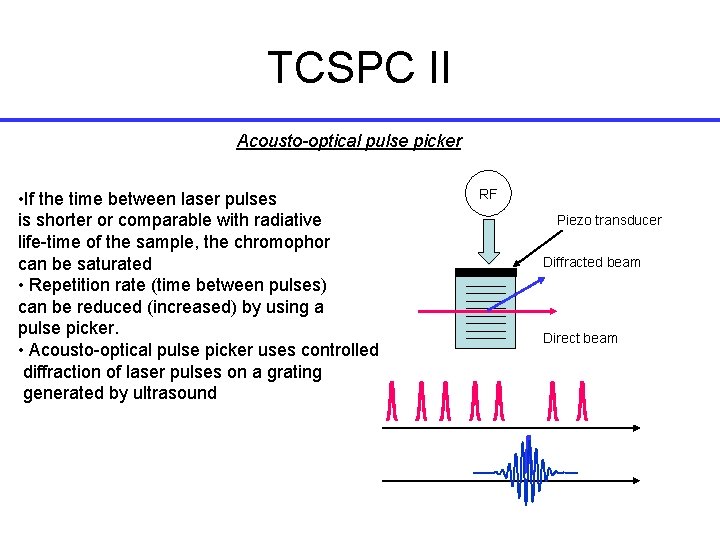
TCSPC II Acousto-optical pulse picker • If the time between laser pulses is shorter or comparable with radiative life-time of the sample, the chromophor can be saturated • Repetition rate (time between pulses) can be reduced (increased) by using a pulse picker. • Acousto-optical pulse picker uses controlled diffraction of laser pulses on a grating generated by ultrasound RF Piezo transducer Diffracted beam Direct beam

Luminescence Upconversion SHG Sample Gate pulse delay 100 fs, 800 nm Upconversion crystal Spectrometer
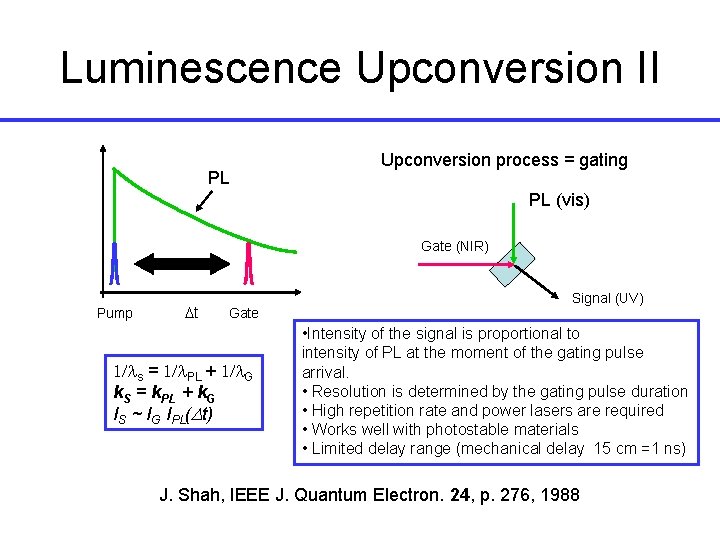
Luminescence Upconversion II PL Upconversion process = gating PL (vis) Gate (NIR) Pump Dt Gate 1/ls = 1/l. PL + 1/l. G k. S = k. PL + k. G IS ~ IG IPL(Dt) Signal (UV) • Intensity of the signal is proportional to intensity of PL at the moment of the gating pulse arrival. • Resolution is determined by the gating pulse duration • High repetition rate and power lasers are required • Works well with photostable materials • Limited delay range (mechanical delay 15 cm =1 ns) J. Shah, IEEE J. Quantum Electron. 24, p. 276, 1988

Pump-Probe Experiments I Idea of the experiment Dt 2 1 0 Before excitation 0 -1 After Da 1 -2
Pump-Probe Experiments II • PPE enable one to trace the relaxation dynamics with sub-100 fs resolution • Types of the data generated by PPE: time-resolved absorption spectra and absorption transients at a certain wavelength. • Numerous combinations of pump and probe beams are possible (UV pump + visible probe, UV-pump+continuum probe, etc. ) • High pump intensities are required in order to produce noticeable change in the optical absorption of the sample (GW/cm 2 – TW/cm 2) (Ti: Sapphire amplifiers are generally required) • Interpretation of the data is sometimes complicated
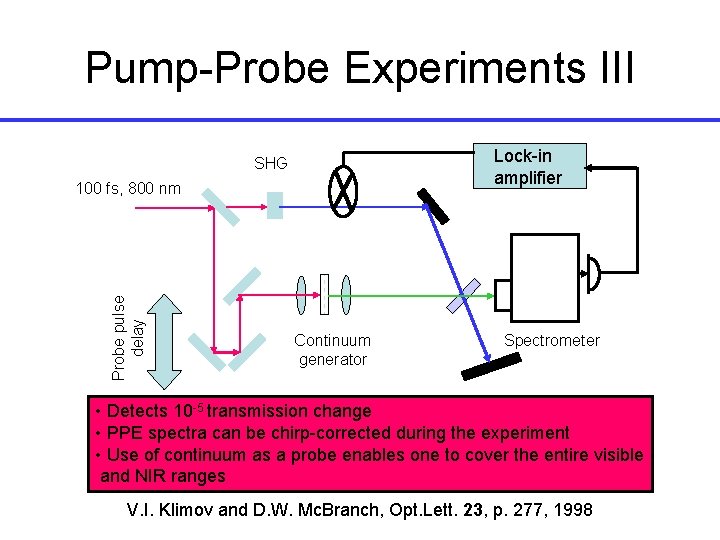
Pump-Probe Experiments III Lock-in amplifier SHG Probe pulse delay 100 fs, 800 nm Continuum generator Spectrometer • Detects 10 -5 transmission change • PPE spectra can be chirp-corrected during the experiment • Use of continuum as a probe enables one to cover the entire visible and NIR ranges V. I. Klimov and D. W. Mc. Branch, Opt. Lett. 23, p. 277, 1998
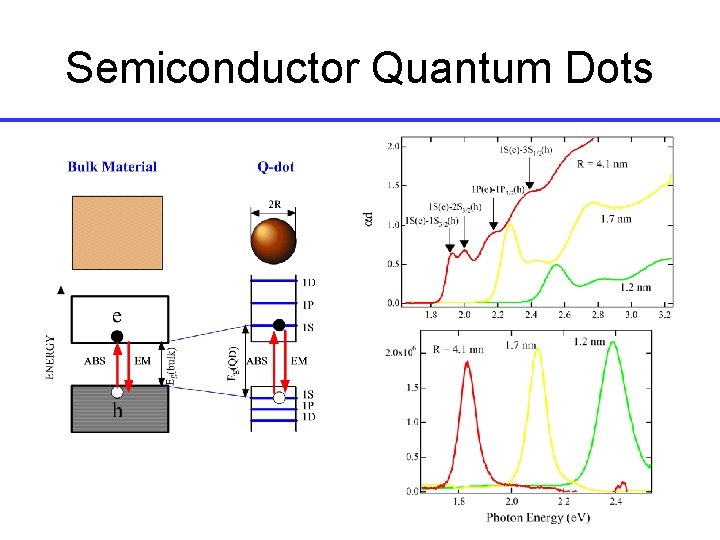
Semiconductor Quantum Dots
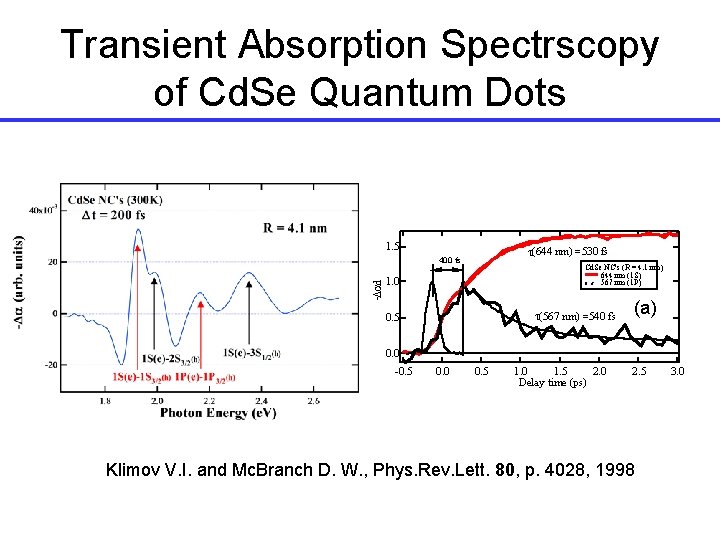
Transient Absorption Spectrscopy of Cd. Se Quantum Dots 1. 5 t(644 nm) =530 fs -Dad 400 fs Cd. Se NC's (R = 4. 1 nm) 644 nm (1 S) 567 nm (1 P) 1. 0 t(567 nm) =540 fs 0. 5 (a) 0. 0 -0. 5 0. 0 0. 5 1. 0 1. 5 2. 0 Delay time (ps) 2. 5 Klimov V. I. and Mc. Branch D. W. , Phys. Rev. Lett. 80, p. 4028, 1998 3. 0
- Slides: 39