
Basics of Electrochemical Impedance Spectroscopy Islam Mosa 11142017
Basics of Electrochemical Impedance Spectroscopy Islam Mosa 11/14/2017
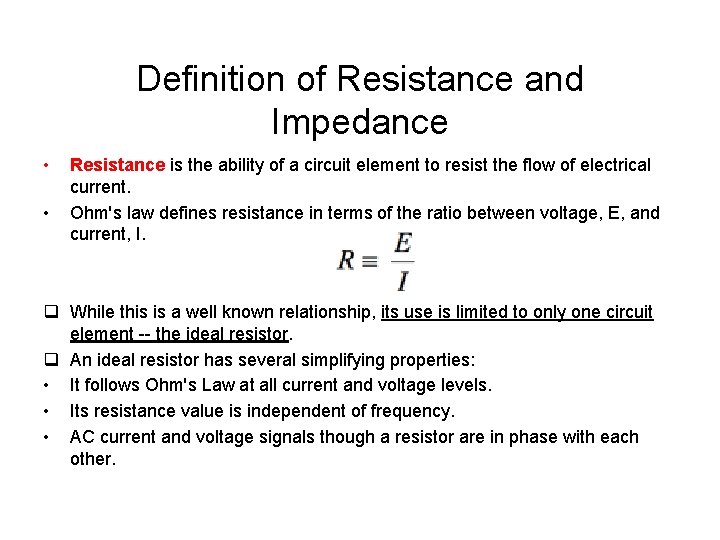
Definition of Resistance and Impedance • • Resistance is the ability of a circuit element to resist the flow of electrical current. Ohm's law defines resistance in terms of the ratio between voltage, E, and current, I. q While this is a well known relationship, its use is limited to only one circuit element -- the ideal resistor. q An ideal resistor has several simplifying properties: • It follows Ohm's Law at all current and voltage levels. • Its resistance value is independent of frequency. • AC current and voltage signals though a resistor are in phase with each other.
Definition of Resistance and Impedance • Most real applications contain more complex circuit elements and more complex behavior. • Impedance replaces resistance as a more general circuit parameter. • Impedance is a measure of the ability of a circuit to resist the flow of electrical current • Unlike resistance, it is not limited by the simplifying properties mentioned earlier.
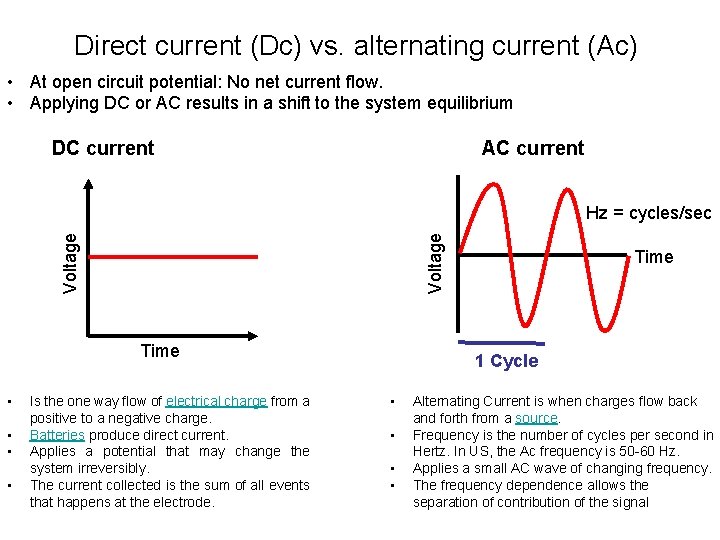
Direct current (Dc) vs. alternating current (Ac) • At open circuit potential: No net current flow. • Applying DC or AC results in a shift to the system equilibrium DC current AC current Voltage Hz = cycles/sec Time • • Is the one way flow of electrical charge from a positive to a negative charge. Batteries produce direct current. Applies a potential that may change the system irreversibly. The current collected is the sum of all events that happens at the electrode. Time 1 Cycle • • Alternating Current is when charges flow back and forth from a source. Frequency is the number of cycles per second in Hertz. In US, the Ac frequency is 50 -60 Hz. Applies a small AC wave of changing frequency. The frequency dependence allows the separation of contribution of the signal
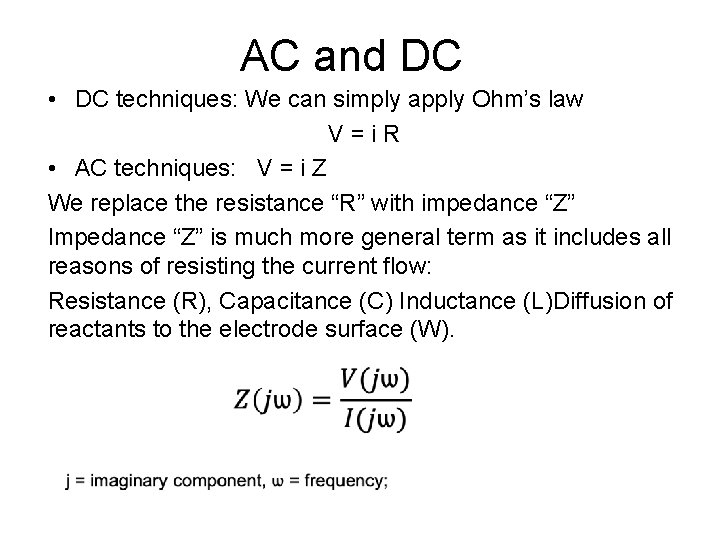
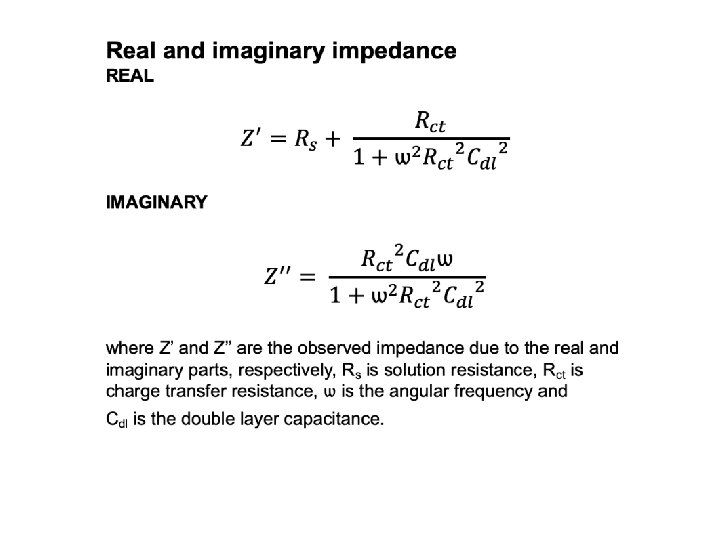
AC and DC • DC techniques: We can simply apply Ohm’s law V = i R • AC techniques: V = i Z We replace the resistance “R” with impedance “Z” Impedance “Z” is much more general term as it includes all reasons of resisting the current flow: Resistance (R), Capacitance (C) Inductance (L)Diffusion of reactants to the electrode surface (W).
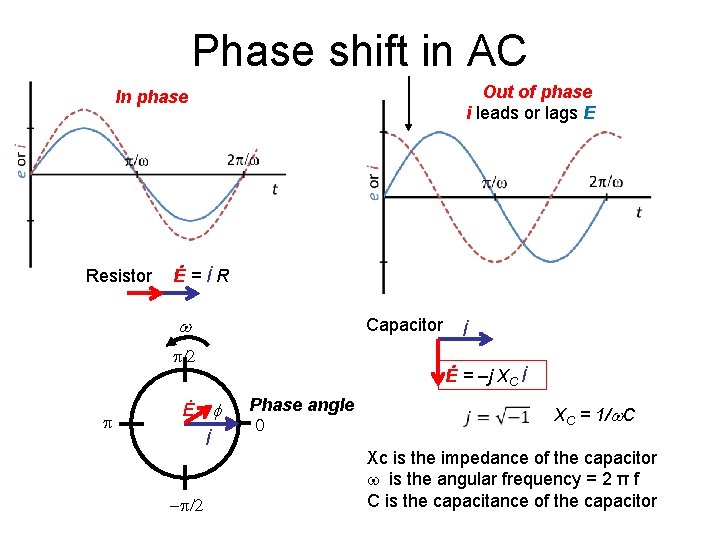
Phase shift in AC Out of phase i leads or lags E In phase Resistor Ė=İR w Capacitor /2 Ė = –j XC İ Ė f İ - /2 İ Phase angle 0 XC = 1/w. C Xc is the impedance of the capacitor is the angular frequency = 2 π f C is the capacitance of the capacitor

Phase shift and impedance The excitation signal, expressed as a function of time, has the form The response signal, It, is shifted in phase (Φ) and has a different amplitude than I 0. -Where Et is the potential at time t, E 0 is the amplitude of the signal, and ω is the radial frequency. The relationship between radial frequency ω (expressed in radians/second) and frequency f (expressed in hertz) is: An expression analogous to Ohm's Law allows us to calculate the impedance of the system as: The impedance is therefore expressed in terms of a magnitude, Zo, and a phase shift, Φ as a function of ѡ
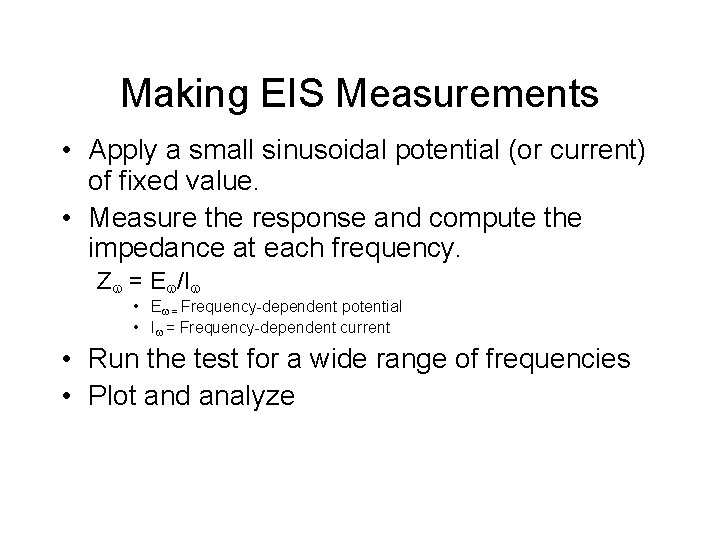
Making EIS Measurements • Apply a small sinusoidal potential (or current) of fixed value. • Measure the response and compute the impedance at each frequency. Z = E /I • E = Frequency-dependent potential • I = Frequency-dependent current • Run the test for a wide range of frequencies • Plot and analyze
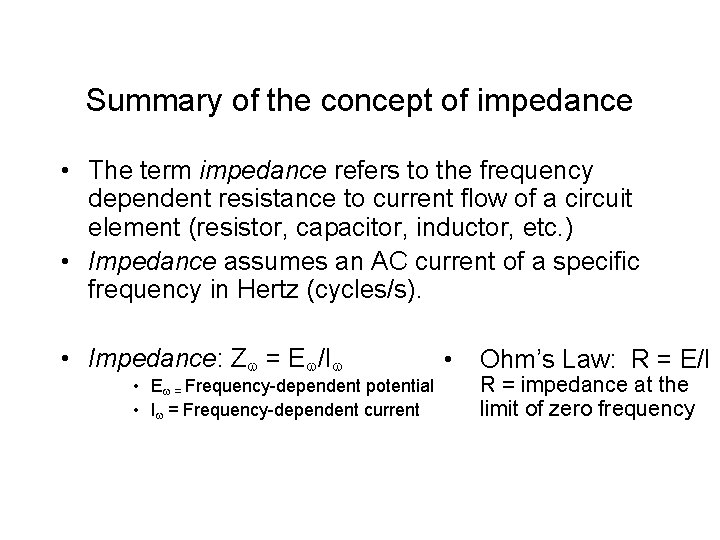
Summary of the concept of impedance • The term impedance refers to the frequency dependent resistance to current flow of a circuit element (resistor, capacitor, inductor, etc. ) • Impedance assumes an AC current of a specific frequency in Hertz (cycles/s). • Impedance: Z = E /I • E = Frequency-dependent potential • I = Frequency-dependent current • Ohm’s Law: R = E/I R = impedance at the limit of zero frequency
Reasons To Run EIS • EIS is theoretically complex – why bother? – The information content of EIS is much higher than DC techniques or single frequency measurements. – EIS may be able to distinguish between two or more electrochemical reactions taking place. – EIS can identify diffusion-limited reactions, e. g. , diffusion through a passive film. – EIS provides information on the capacitive behavior of the system. – EIS can test components within an assembled device using the device’s own electrodes. – EIS can provide information about the electron transfer rate of reaction
Applications of EIS • Study corrosion of metals. • Study adsorption and desorption to electrode surface • Study the electrochemical synthesis of materials. • Study the catalytic reaction kinetics. • Label free detection sensors. • Study the ions mobility in energy storage devices such as batteries and supercapacitors.
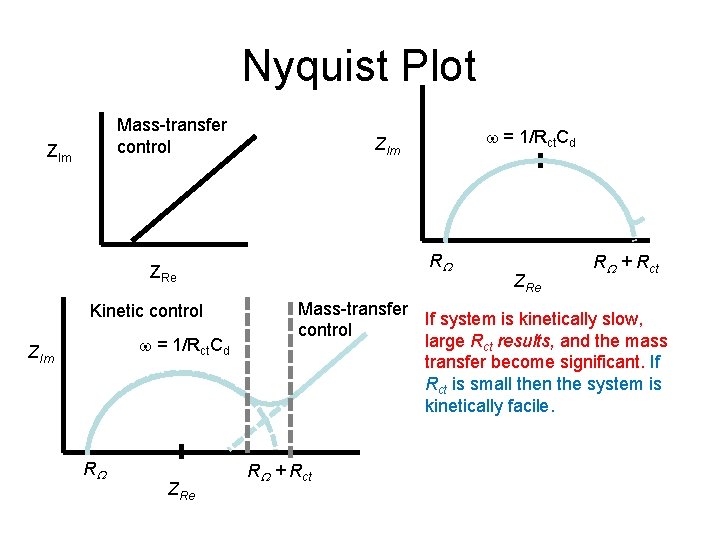
Nyquist Plot Mass-transfer control ZIm RW ZRe Kinetic control = 1/Rct. Cd ZIm RW ZRe = 1/Rct. Cd ZIm ZRe RW + Rct Mass-transfer If system is kinetically slow, control large Rct results, and the mass transfer become significant. If Rct is small then the system is kinetically facile. RW + Rct
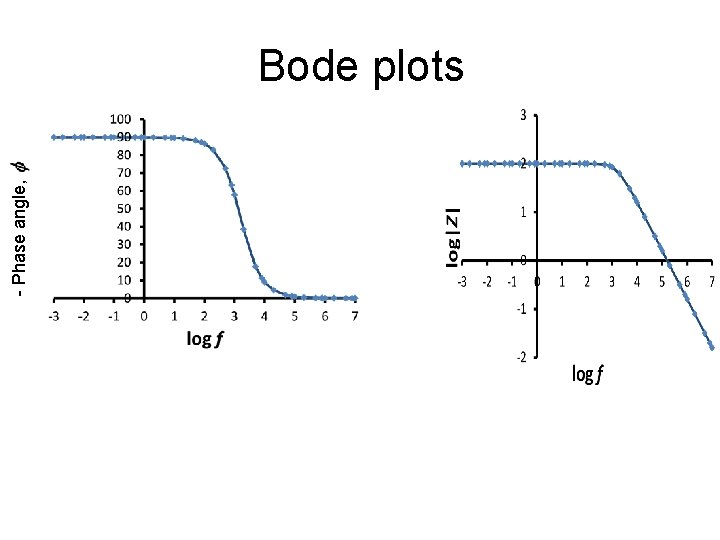
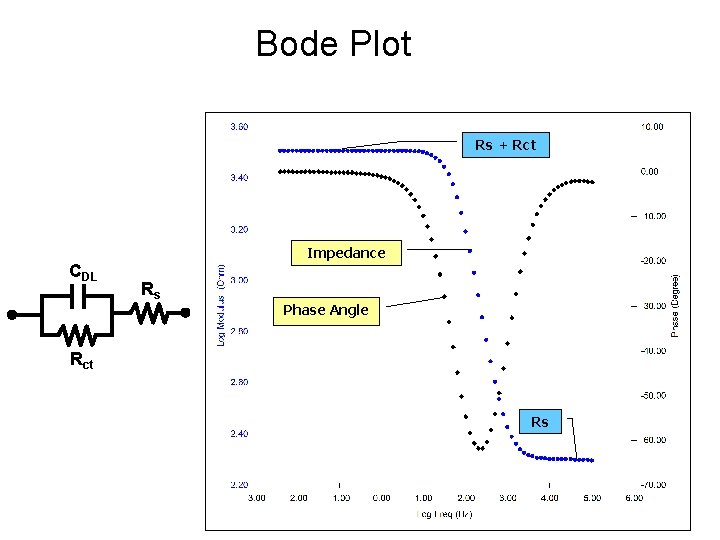
- Phase angle, Bode plots
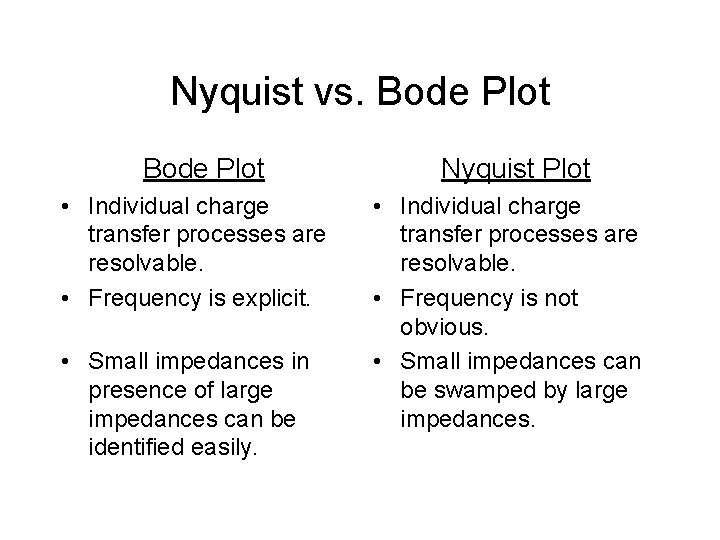
Nyquist vs. Bode Plot Nyquist Plot • Individual charge transfer processes are resolvable. • Frequency is explicit. • Individual charge transfer processes are resolvable. • Frequency is not obvious. • Small impedances can be swamped by large impedances. • Small impedances in presence of large impedances can be identified easily.
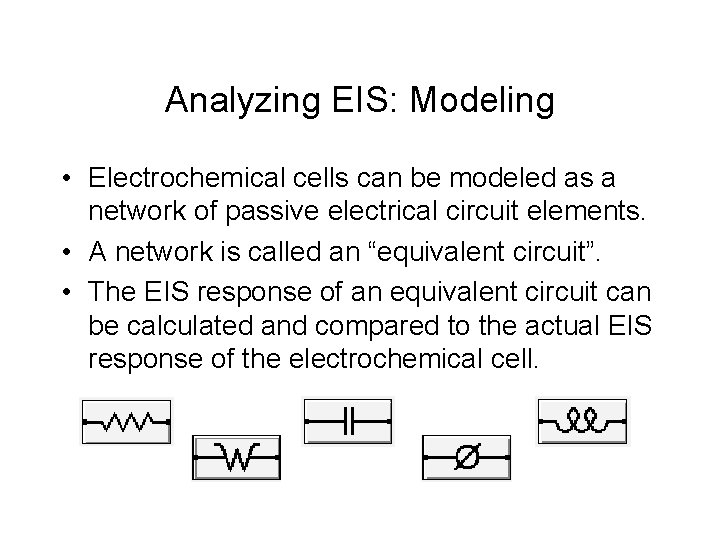
Analyzing EIS: Modeling • Electrochemical cells can be modeled as a network of passive electrical circuit elements. • A network is called an “equivalent circuit”. • The EIS response of an equivalent circuit can be calculated and compared to the actual EIS response of the electrochemical cell.
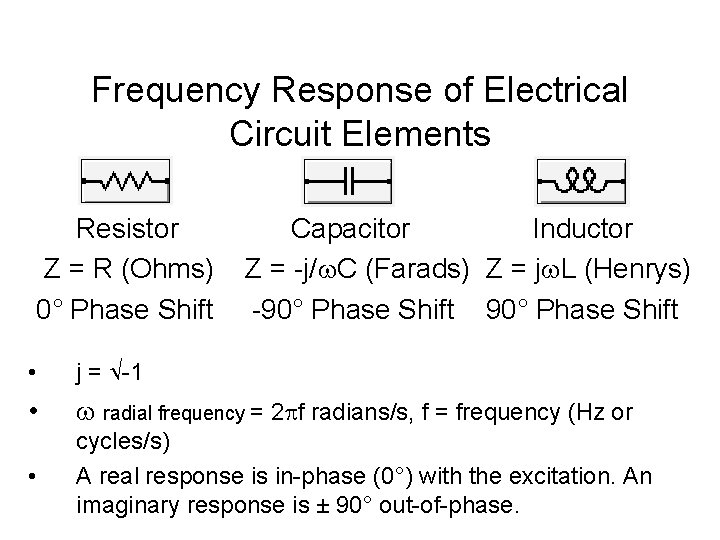
Frequency Response of Electrical Circuit Elements Resistor Capacitor Inductor Z = R (Ohms) Z = -j/ C (Farads) Z = j L (Henrys) 0° Phase Shift -90° Phase Shift • j = -1 • radial frequency = 2 f radians/s, f = frequency (Hz or • cycles/s) A real response is in-phase (0°) with the excitation. An imaginary response is ± 90° out-of-phase.
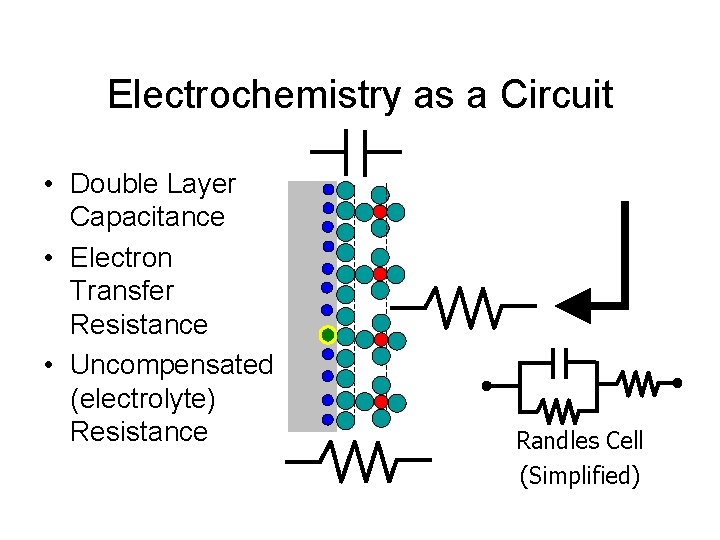
Electrochemistry as a Circuit • Double Layer Capacitance • Electron Transfer Resistance • Uncompensated (electrolyte) Resistance Randles Cell (Simplified)
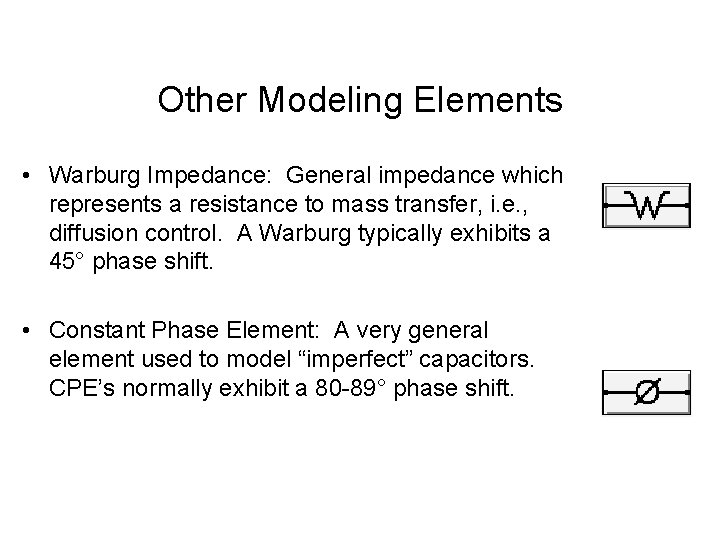
Other Modeling Elements • Warburg Impedance: General impedance which represents a resistance to mass transfer, i. e. , diffusion control. A Warburg typically exhibits a 45° phase shift. • Constant Phase Element: A very general element used to model “imperfect” capacitors. CPE’s normally exhibit a 80 -89° phase shift.
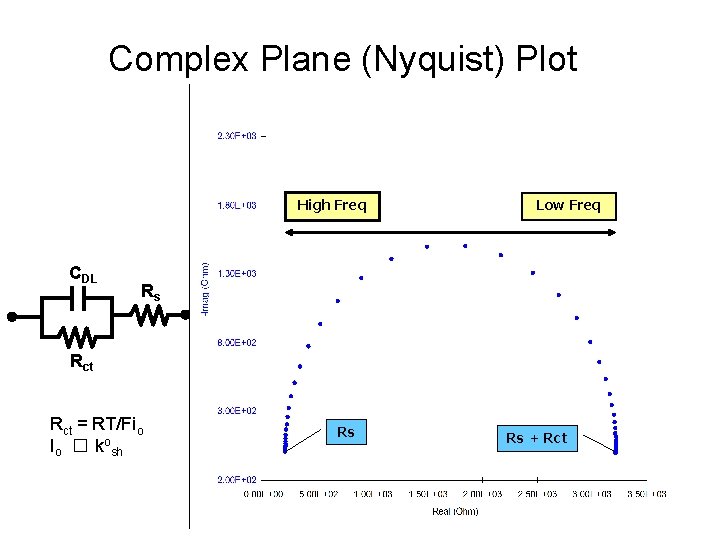
Complex Plane (Nyquist) Plot High Freq CDL Low Freq Rs Rct = RT/Fio Io � kosh Rs Rs + Rct
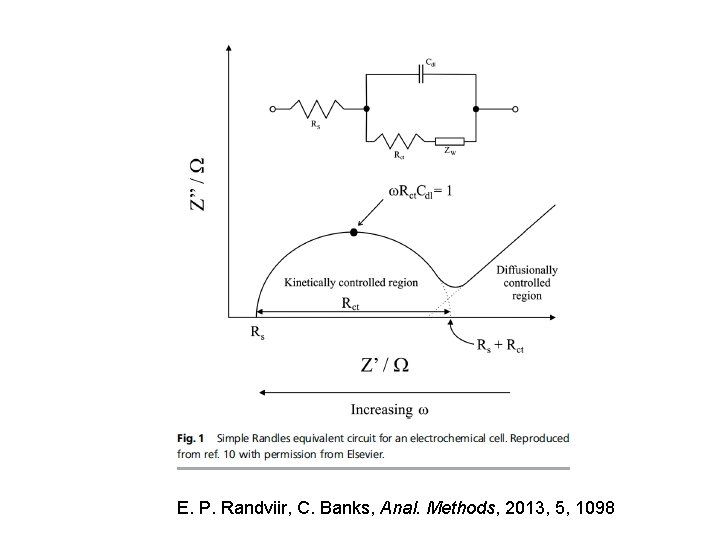
E. P. Randviir, C. Banks, Anal. Methods, 2013, 5, 1098
Bode Plot Rs + Rct Impedance CDL Rs Phase Angle Rct Rs
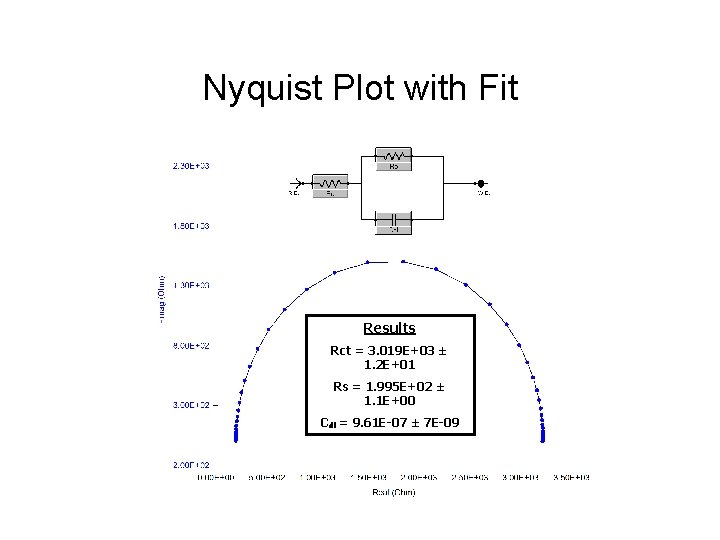
Nyquist Plot with Fit Results Rct = 3. 019 E+03 ± 1. 2 E+01 Rs = 1. 995 E+02 ± 1. 1 E+00 Cdl = 9. 61 E-07 ± 7 E-09
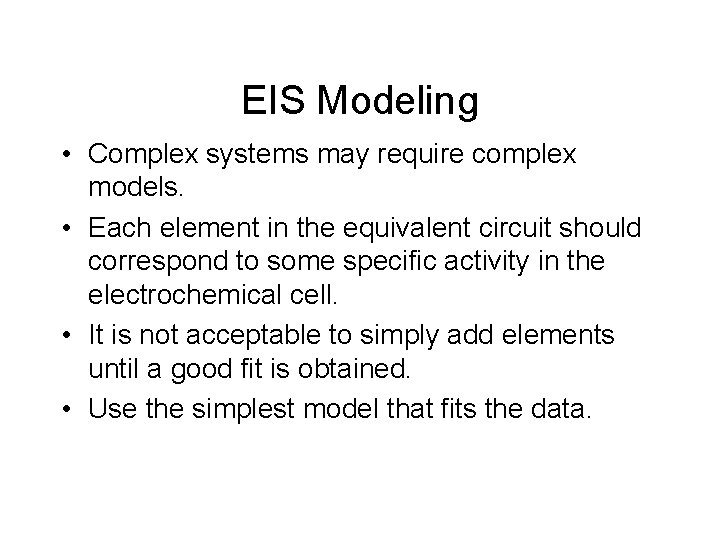
EIS Modeling • Complex systems may require complex models. • Each element in the equivalent circuit should correspond to some specific activity in the electrochemical cell. • It is not acceptable to simply add elements until a good fit is obtained. • Use the simplest model that fits the data.
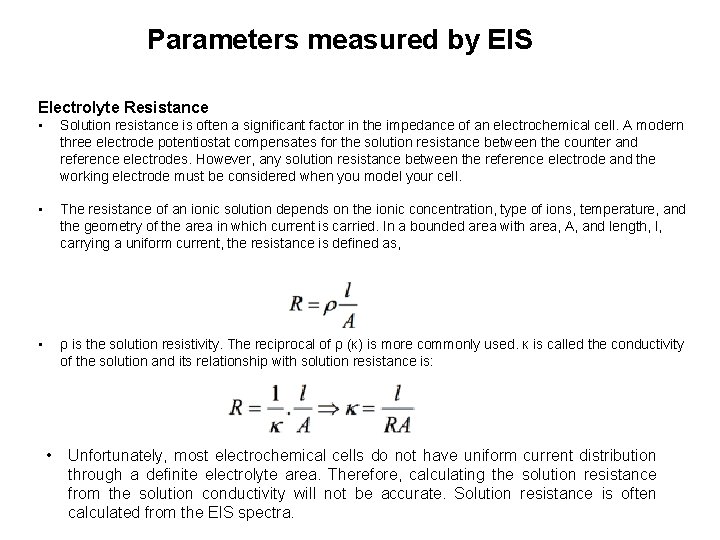
Parameters measured by EIS Electrolyte Resistance • Solution resistance is often a significant factor in the impedance of an electrochemical cell. A modern three electrode potentiostat compensates for the solution resistance between the counter and reference electrodes. However, any solution resistance between the reference electrode and the working electrode must be considered when you model your cell. • The resistance of an ionic solution depends on the ionic concentration, type of ions, temperature, and the geometry of the area in which current is carried. In a bounded area with area, A, and length, l, carrying a uniform current, the resistance is defined as, • ρ is the solution resistivity. The reciprocal of ρ (κ) is more commonly used. κ is called the conductivity of the solution and its relationship with solution resistance is: • Unfortunately, most electrochemical cells do not have uniform current distribution through a definite electrolyte area. Therefore, calculating the solution resistance from the solution conductivity will not be accurate. Solution resistance is often calculated from the EIS spectra.
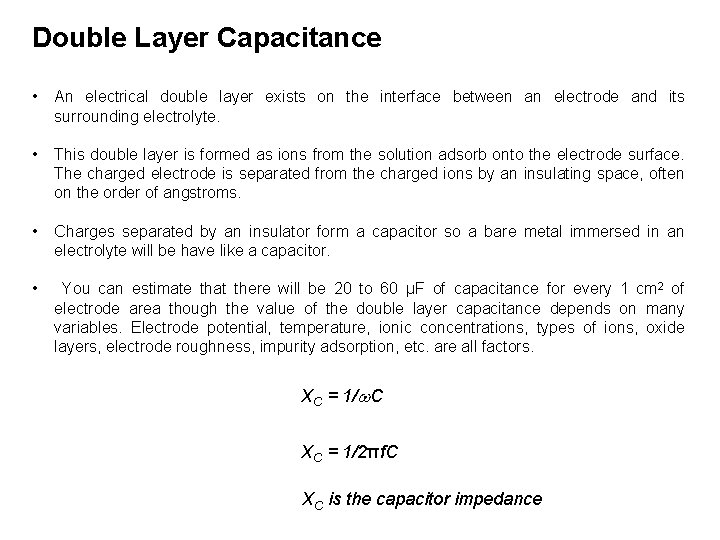
Double Layer Capacitance • An electrical double layer exists on the interface between an electrode and its surrounding electrolyte. • This double layer is formed as ions from the solution adsorb onto the electrode surface. The charged electrode is separated from the charged ions by an insulating space, often on the order of angstroms. • Charges separated by an insulator form a capacitor so a bare metal immersed in an electrolyte will be have like a capacitor. • You can estimate that there will be 20 to 60 μF of capacitance for every 1 cm 2 of electrode area though the value of the double layer capacitance depends on many variables. Electrode potential, temperature, ionic concentrations, types of ions, oxide layers, electrode roughness, impurity adsorption, etc. are all factors. XC = 1/w. C XC = 1/2πf. C XC is the capacitor impedance
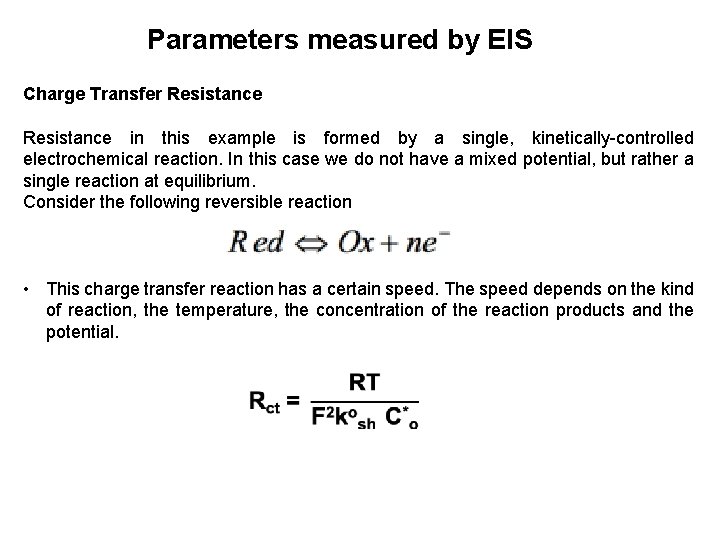
Parameters measured by EIS Charge Transfer Resistance in this example is formed by a single, kinetically-controlled electrochemical reaction. In this case we do not have a mixed potential, but rather a single reaction at equilibrium. Consider the following reversible reaction • This charge transfer reaction has a certain speed. The speed depends on the kind of reaction, the temperature, the concentration of the reaction products and the potential.
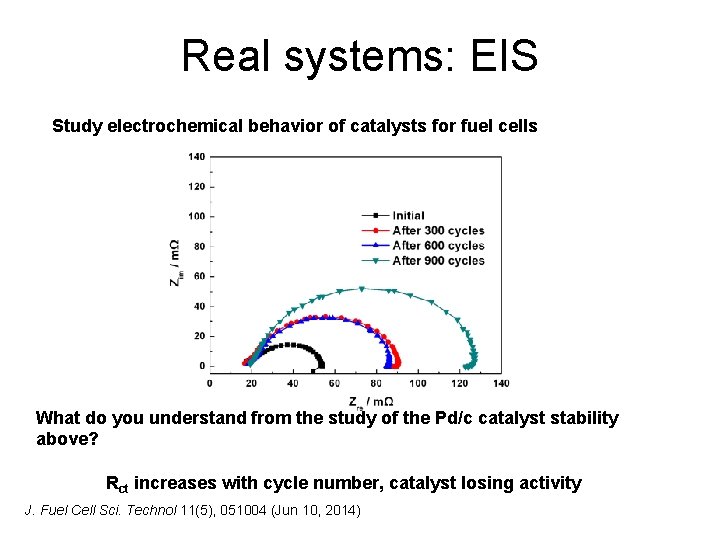
Real systems: EIS Study electrochemical behavior of catalysts for fuel cells What do you understand from the study of the Pd/c catalyst stability above? Rct increases with cycle number, catalyst losing activity J. Fuel Cell Sci. Technol 11(5), 051004 (Jun 10, 2014)

Catalytic activity Oxygen evolution reaction Cs-Mn. Ox-450, Ir/C smallest Rct Largest rate const. Mosa, I. M. ; Biswas, S. ; El-Sawy, A. M. ; Botu, V. ; Guild, C. ; Song, W. ; Ramprasad, R. ; Rusling, J. F. ; Suib, S. L. , Tunable mesoporous manganese oxide for high performance oxygen reduction and evolution reactions. Journal of Materials Chemistry A 2016, 4 (2), 620 -631.
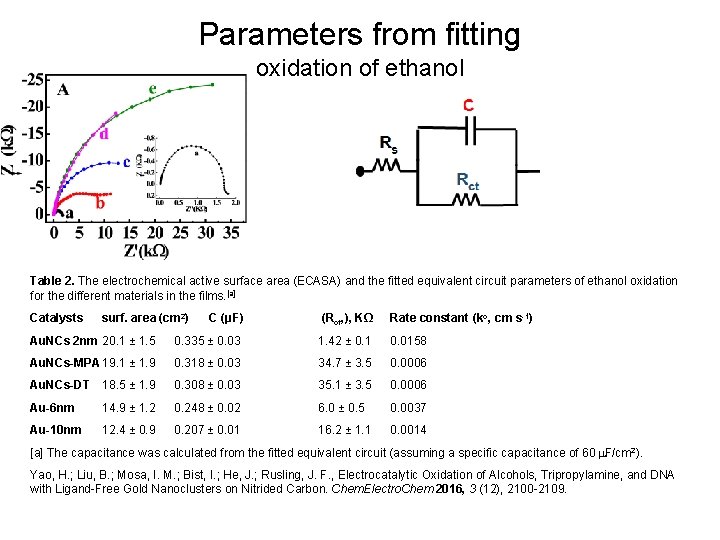
Parameters from fitting oxidation of ethanol Table 2. The electrochemical active surface area (ECASA) and the fitted equivalent circuit parameters of ethanol oxidation for the different materials in the films. [a] Catalysts surf. area (cm 2) C (μF) (Rct, ), KΩ Rate constant (ko, cm s-1) Au. NCs 2 nm 20. 1 ± 1. 5 0. 335 ± 0. 03 1. 42 ± 0. 1 0. 0158 Au. NCs-MPA 19. 1 ± 1. 9 0. 318 ± 0. 03 34. 7 ± 3. 5 0. 0006 Au. NCs-DT 18. 5 ± 1. 9 0. 308 ± 0. 03 35. 1 ± 3. 5 0. 0006 Au-6 nm 14. 9 ± 1. 2 0. 248 ± 0. 02 6. 0 ± 0. 5 0. 0037 Au-10 nm 12. 4 ± 0. 9 0. 207 ± 0. 01 16. 2 ± 1. 1 0. 0014 [a] The capacitance was calculated from the fitted equivalent circuit (assuming a specific capacitance of 60 m. F/cm 2). Yao, H. ; Liu, B. ; Mosa, I. M. ; Bist, I. ; He, J. ; Rusling, J. F. , Electrocatalytic Oxidation of Alcohols, Tripropylamine, and DNA with Ligand-Free Gold Nanoclusters on Nitrided Carbon. Chem. Electro. Chem 2016, 3 (12), 2100 -2109.
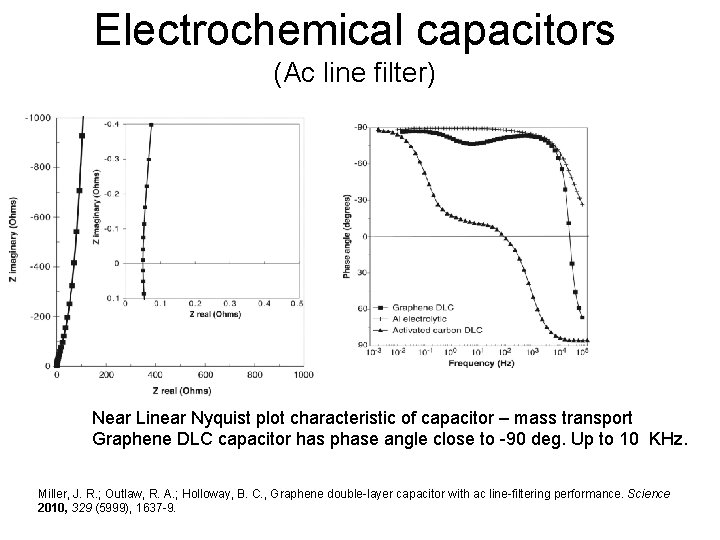
Electrochemical capacitors (Ac line filter) Near Linear Nyquist plot characteristic of capacitor – mass transport Graphene DLC capacitor has phase angle close to -90 deg. Up to 10 KHz. Miller, J. R. ; Outlaw, R. A. ; Holloway, B. C. , Graphene double-layer capacitor with ac line-filtering performance. Science 2010, 329 (5999), 1637 -9.
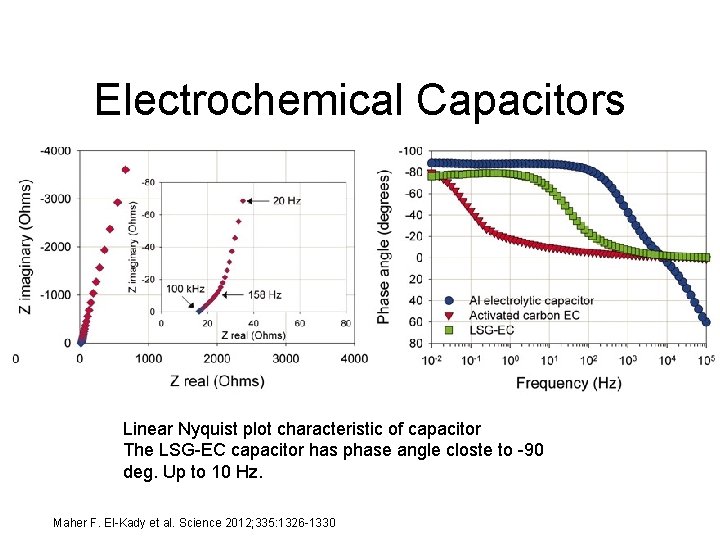
Electrochemical Capacitors Linear Nyquist plot characteristic of capacitor The LSG-EC capacitor has phase angle closte to -90 deg. Up to 10 Hz. Maher F. El-Kady et al. Science 2012; 335: 1326 -1330
EIS Take Home • EIS is a versatile technique – Non-destructive – High information content • Running EIS is easy • EIS modeling analysis is very powerful – Simplest working model is best – Complex system analysis is possible.
References for EIS • E. P. Randviir, C. Banks, Anal. Methods, 2013, 5, 1098 • http: //www. gamry. com/application-notes/EIS/basics-ofelectrochemical-impedance-spectroscopy/ • Electrochemical Impedance and Noise, R. Cottis and S. Turgoose, NACE International, 1999. ISBN 1 -57590 -093 -9. An excellent tutorial that is highly recommended. . • Electrochemical Impedance: Analysis and Interpretation, STP 1188, Edited by Scully, Silverman, and Kendig, ASTM, ISBN 08031 -1861 -9. 26 papers covering modeling, corrosion, inhibitors, soil, concrete, and coatings. • EIS Primer, Gamry Instruments website, www. gamry. com
- Slides: 34