
Basics of Effective Communication Business 101 Lecture 2
Basics of Effective Communication Business 101 Lecture 2 and 3
The Basics 1) 2) 3) 4) 5) Gathering Information Communicate clearly and efficiently Think of your audience Maintain/Create goodwill Referencing
Gathering Information -read a lot about topic before researching details -sources: library, internet search engines, experts, newspapers, magazines, online and offline databases
Some useful websites • www. google. com for news, random facts, and organizations’ home pages • www. ixquick. com to search many search engines at once • www. fedstats. gov/search. html for statistics
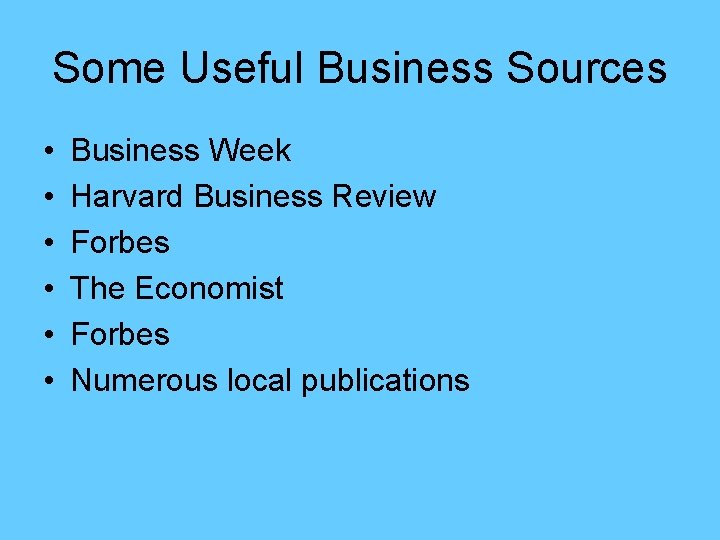
Some Useful Business Sources • • • Business Week Harvard Business Review Forbes The Economist Forbes Numerous local publications
Gathering Information • Deciding what to communicate and what not to: -Is the source biased, out of date, or incorrect? -what is the minimum that the audience needs to know?

Communicating clearly and efficiently
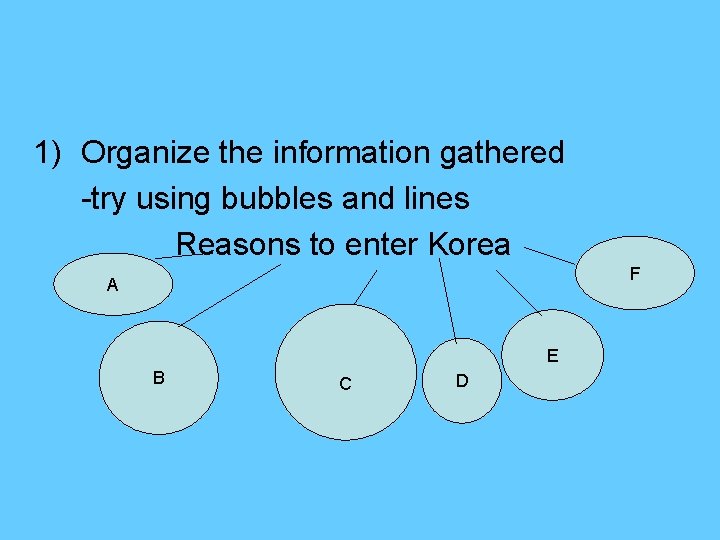
1) Organize the information gathered -try using bubbles and lines Reasons to enter Korea F A E B C D
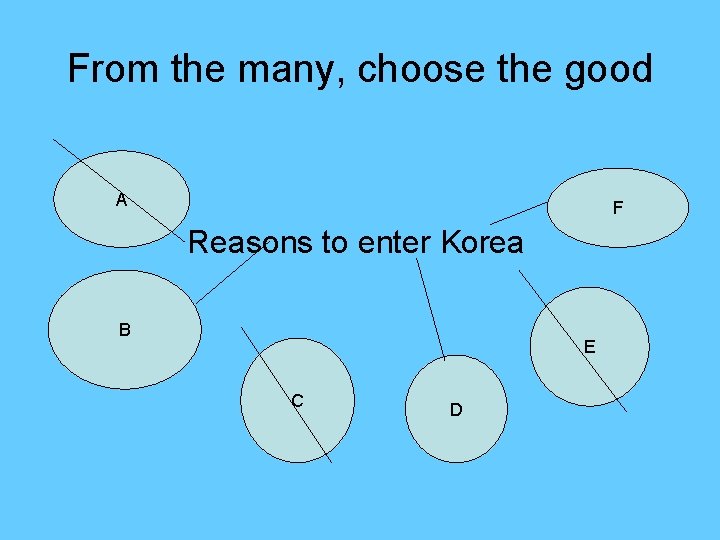
From the many, choose the good A F Reasons to enter Korea B E C D
- Use bubbles wherever useful - Look at page 199 for more details on prewriting organization
2) Organize information to suit situation -usually… -your decisions followed by main reasons and information that supports those reasons.
For Example: After a careful review of our marketing practices, we have decided that they must be changed for the Korean market. reason 1 …. . supporting evidence…. . reason 2 ……supporting evidence…. . reason 3 ……supporting evidence…. Conclusion (结论)=restatement + explanation of why it is important
Or maybe… • A well-organized description of facts
The Basics 1) 2) 3) 4) 5) Gathering Information Communicate clearly and efficiently Think of your audience Maintain/Create goodwill Referencing
Think of your Audience • Information and style depends on who -department -higher-ups vs. peers -culture -age, knowledge, job etc…
Motivating Them • • • Through Benefits Through Credibility Through Message Structure Through Appeals to Principles Through Emotions
Problems to think about • people that have the power to stop the message • upsetting the audience • lack of knowledge • audience original opposition • degree of difficulty for audience
The Basics 1) 2) 3) 4) 5) Gathering Information Communicate clearly and efficiently Think of your audience Maintain/Create goodwill Referencing

Maintaining/Creating Goodwill
• Focus on the reader and their needs. -but avoid personal issues • Use “you/your” where suitable. -“As far as your investment is concerned, all is well. ”
• Present negative (负面的) information in a positive (积极的) way. - “This year has been difficult for your account, but next year still looks very good. ” • Avoid discussing your own feelings except where it might make reader happy. - “Congratulations on your promotion. I was glad to hear about it. ”

Avoid Negative Language • Anything which could possibly hurt or upset anybody • Be extra careful with strangers
Use Proper Titles • Mr. Miss. Dr. for people outside company • First names often ok inside company

Referencing Your Work
Plagiarizing (抄袭)is bad 1) 2) 3) 4) Stealing Dangerous Harmful to self and society Not necessary -use references (参考资料)and create your own ideas from many sources 5) Facts are stronger when referenced
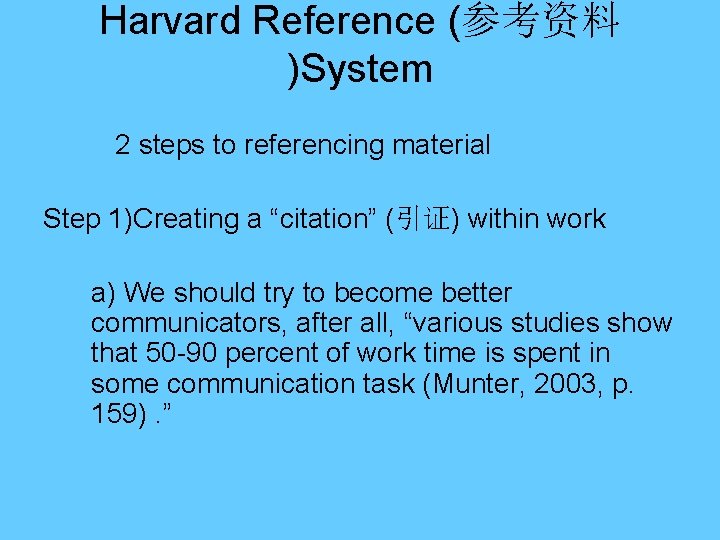
Harvard Reference (参考资料 )System 2 steps to referencing material Step 1)Creating a “citation” (引证) within work a) We should try to become better communicators, after all, “various studies show that 50 -90 percent of work time is spent in some communication task (Munter, 2003, p. 159). ”

Step 2: creating a bibliography of the works that you have used
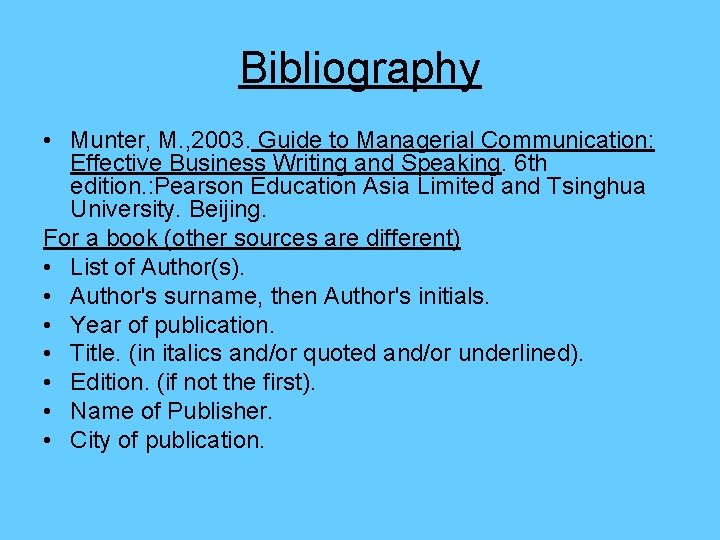
Bibliography • Munter, M. , 2003. Guide to Managerial Communication: Effective Business Writing and Speaking. 6 th edition. : Pearson Education Asia Limited and Tsinghua University. Beijing. For a book (other sources are different) • List of Author(s). • Author's surname, then Author's initials. • Year of publication. • Title. (in italics and/or quoted and/or underlined). • Edition. (if not the first). • Name of Publisher. • City of publication.
Bibliography • Munter, M. , 2003. Guide to Managerial Communication: Effective Business Writing and Speaking. 6 th edition. : Pearson Education Asia Limited and Tsinghua University. Beijing.
Harvard Reference (参考资料 )System Another Example: B) According to Smith (2004), “a tomato is a fruit to a scientist and a vegetable to a cook. ”
Bibliography • Smith, B. , 2003. What is a Tomato? . The New York Times, 3 Oct. pp. 2 -3. For Newspaper Articles: Author(s) surname(s) and first name initials Year of publication. Article title. Name of newspaper, in italics, day and month. Page numbers.
Bibliography • Smith, B. , 2003. What is a Tomato? . The New York Times, 3 Oct. pp. 2 -3.
Harvard Reference (参考资料 )System For Further Information: Guide to the Harvard System of Referencing: http: //libweb. anglia. ac. uk/referencing/harvar d. htm

Rewriting
Things to focus on when rewriting/revising • Easy or hard to read? -too much information? -confusing? • How will your audience feel when reading? • Do you convince yourself? • Do the beginning and end of document do what they should? • Language stuff
Things to focus on when rewriting/revising • Varied sentence length -more interesting -though most sentences should be short • Keep paragraphs short • Should be clear separation between parts -headings and subheadings etc. • All points must be well-supported

For more information: • Thill and Mcgee 164 -176 • Especially page 174
Homework 1 • Munter Appendix(附录) A-D and English Bibliography (目录索引) page 345 -348 • Report on “your” Company’s progress in China (more in tutorial) • Rough Draft due in Friday tutorial
Homework 2 • Read Munter Chapter 2 • Don’t forget about report due tomorrow
- Slides: 39