
Basics of Dynamic Routing 1 Agenda Introduction to
Basics of Dynamic Routing 1
Agenda • Introduction to Dynamic Routing • Choosing the Right Protocol • Configuring Dynamic Routing
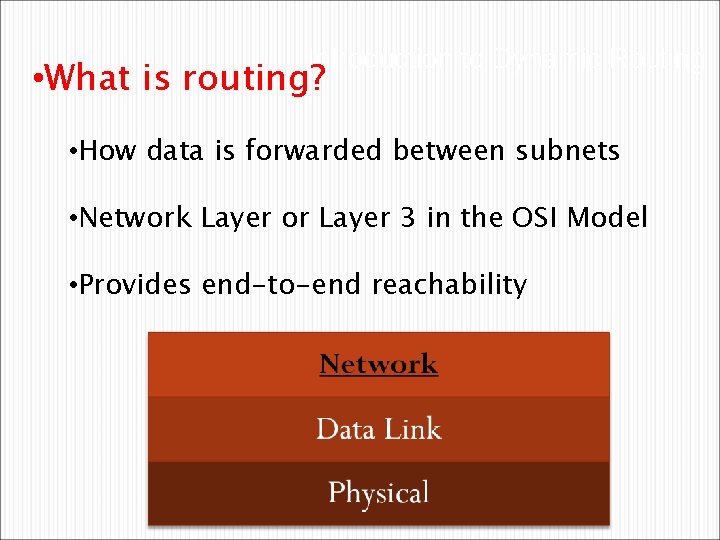
Introduction to Dynamic Routing • What is routing? • How data is forwarded between subnets • Network Layer or Layer 3 in the OSI Model • Provides end-to-end reachability
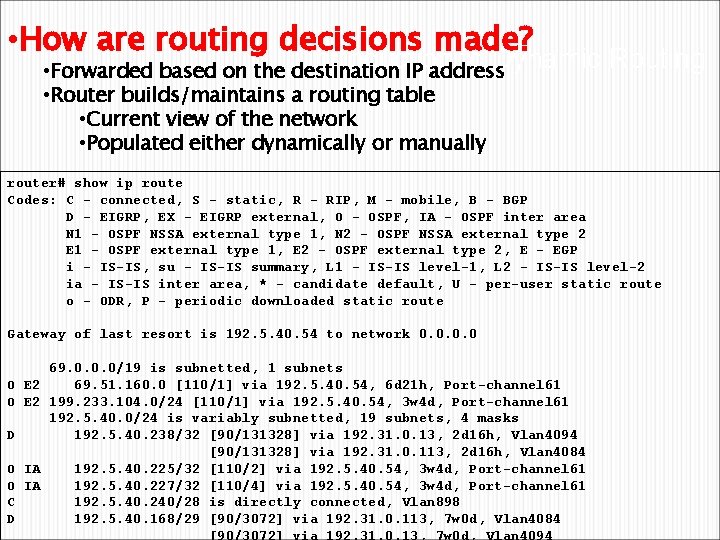
• How are routing decisions made? Introduction to Dynamic • Forwarded based on the destination IP address • Router builds/maintains a routing table • Current view of the network • Populated either dynamically or manually Routing router# show ip route Codes: C - connected, S - static, R - RIP, M - mobile, B - BGP D - EIGRP, EX - EIGRP external, O - OSPF, IA - OSPF inter area N 1 - OSPF NSSA external type 1, N 2 - OSPF NSSA external type 2 E 1 - OSPF external type 1, E 2 - OSPF external type 2, E - EGP i - IS-IS, su - IS-IS summary, L 1 - IS-IS level-1, L 2 - IS-IS level-2 ia - IS-IS inter area, * - candidate default, U - per-user static route o - ODR, P - periodic downloaded static route Gateway of last resort is 192. 5. 40. 54 to network 0. 0 O E 2 D O IA C D 69. 0. 0. 0/19 is subnetted, 1 subnets 69. 51. 160. 0 [110/1] via 192. 5. 40. 54, 6 d 21 h, Port-channel 61 199. 233. 104. 0/24 [110/1] via 192. 5. 40. 54, 3 w 4 d, Port-channel 61 192. 5. 40. 0/24 is variably subnetted, 19 subnets, 4 masks 192. 5. 40. 238/32 [90/131328] via 192. 31. 0. 13, 2 d 16 h, Vlan 4094 [90/131328] via 192. 31. 0. 113, 2 d 16 h, Vlan 4084 192. 5. 40. 225/32 [110/2] via 192. 5. 40. 54, 3 w 4 d, Port-channel 61 192. 5. 40. 227/32 [110/4] via 192. 5. 40. 54, 3 w 4 d, Port-channel 61 192. 5. 40. 240/28 is directly connected, Vlan 898 192. 5. 40. 168/29 [90/3072] via 192. 31. 0. 113, 7 w 0 d, Vlan 4084 [90/3072] via 192. 31. 0. 13, 7 w 0 d, Vlan 4094
Agenda • Introduction to Dynamic Routing • Choosing the Right Protocol • Configuring Dynamic Routing • How the ITa. P Production Data Network uses dynamic routing

• Interior Routing Protocols Choosing the Right Protocol • Used within an autonomous system • Used within an area of administrative control • Exterior Routing Protocols • Used between autonomous systems • Used to peer with networks in which you have no administrative control
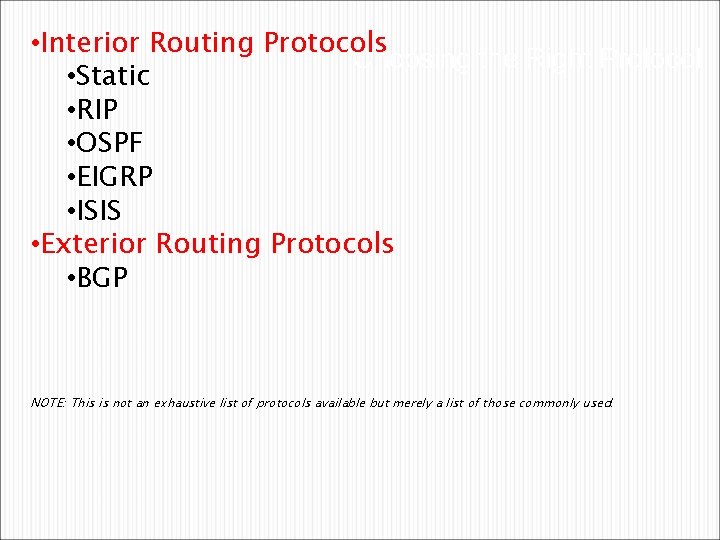
• Interior Routing Protocols Choosing the Right Protocol • Static • RIP • OSPF • EIGRP • ISIS • Exterior Routing Protocols • BGP NOTE: This is not an exhaustive list of protocols available but merely a list of those commonly used.
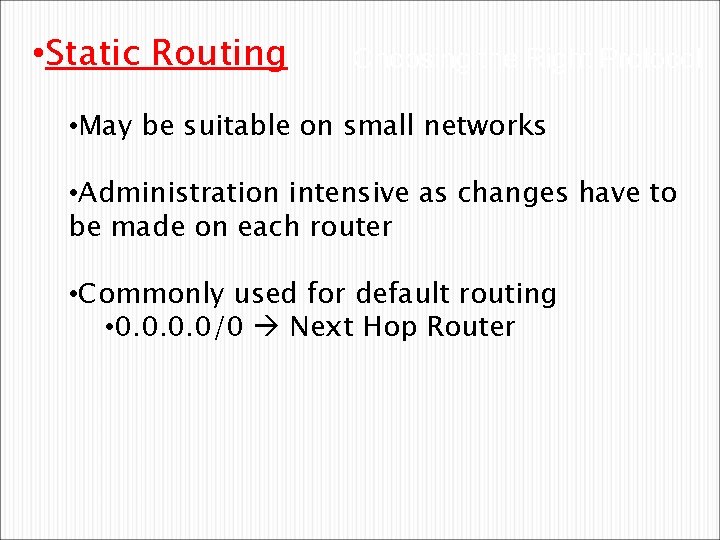
• Static Routing Choosing the Right Protocol • May be suitable on small networks • Administration intensive as changes have to be made on each router • Commonly used for default routing • 0. 0/0 Next Hop Router
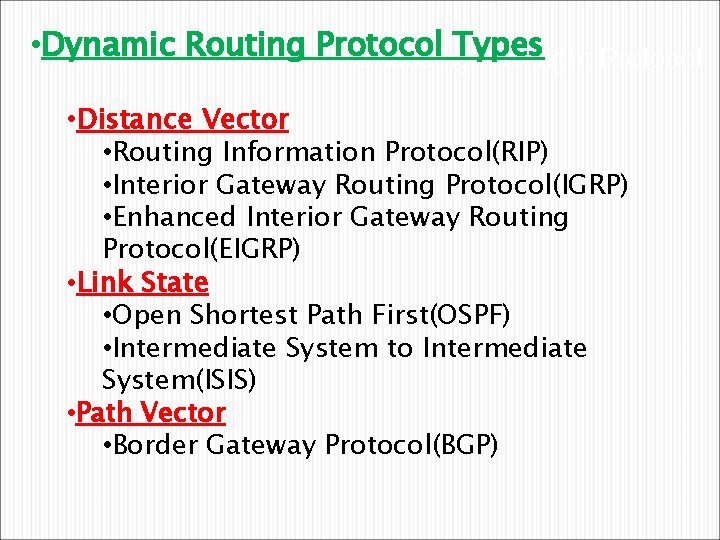
• Dynamic Routing Protocol Types Choosing the Right Protocol • Distance Vector • Routing Information Protocol(RIP) • Interior Gateway Routing Protocol(IGRP) • Enhanced Interior Gateway Routing Protocol(EIGRP) • Link State • Open Shortest Path First(OSPF) • Intermediate System to Intermediate System(ISIS) • Path Vector • Border Gateway Protocol(BGP)
• Routing Information Protocol(RIP) Choosing the Right Protocol • (RIPv 1), 1988 • Class full, no support for VLSM • No support for authentication • (RIPv 2), 1998 • Classless, support for CIDR • Support for authentication • Uses hop count as routing metric • Slow to converge • Not very scalable • Limited to 15 hops
• Interior Gateway Routing Protocol(IGRP) Choosing the Right Protocol • Invented by Cisco to overcome limitations of RIP • Allows for hop count up to 255 • Allows for multiple route metrics • Bandwidth • Delay • Load • MTU • Reliability • Classful, no support for VLSM
• Enhanced Interior Gateway Routing Protocol(EIGRP) Choosing the Right Protocol • Replaced IGRP • Maintains a Topology table • Successors, feasible successors • Allows for multiple route metrics • Classless, support for CIDR • Very fast to converge • Maintains neighbor relationships • Diffusing Update Algorithm(DUAL) • Not as CPU intensive as OSPF
• Open Shortest Path First(OSPF) Choosing the Right Protocol • RFC (remote function call)2328(OSPFv 2), 1998 • Maintains neighbor relationships • Concept of Areas • Different areas can be used to control flooding of routing information • Classless, supports VLSM • Fast to converge • CPU Algorithm • Designing can be complicated
Choosing the Right Protoc • Border Gateway Protocol(BGP) ol • RFC 4271(BGPv 4), 2006 • Peers manually defined • Used typically for multi-homing to ISP(s) • Very scalable • Makes decisions based upon AS Path • Lots of policy options • Very granular control
• Introduction to Dynamic Routing Agenda • Choosing the Right Protocol • Configuring Dynamic Routing • How the ITa. P Production Data Network uses dynamic routing
• How to configure. Configuring dynamic. Dynamic routing? Routing • Choose a protocol that meets your needs • Each vendor has specific commands but should have a configuration guide available to assist • Plan well to ensure a functional network • Create a diagram • Consider high availability technologies
Agenda • Introduction to Dynamic Routing • Choosing the Right Protocol • Configuring Dynamic Routing • How the Production Data Network uses dynamic routing
• Routing How the ITa. P Production Network Uses Dynamic Routing Protocols Used • Interior • EIGRP • OSPF • Static • Exterior • BGP
- Slides: 18