
Basics of Digital Imaging BDI Steffen Dietzel LudwigMaximiliansUniversitt
Basics of Digital Imaging (BDI) Steffen Dietzel Ludwig-Maximilians-Universität München Walter-Brendel-Zentrum für experimentelle Medizin (Wbex) and Core Facility Bioimaging at the Biomedical Center ©Steffen Dietzel 2015 -16. License: Creative Commons Attribution Share. Alike.
Digital images • A digital image is composed of pixels. • A pixel may have one (gray) or several colors (e. g. red, green, blue). • Each color of a pixel has a given intensity value, called “gray value”, “gray level” or similar. ©Steffen Dietzel 2015 -16. License: Creative Commons Attribution Share. Alike.
Pixels and Voxels A pixel (=picture element) is the element of a digital 2 D image A voxel (= volume pixel) is the element of a digital 3 D image ©Steffen Dietzel 2015 -16. License: Creative Commons Attribution Share. Alike.
A Pixel Is Not A Little Square, A Pixel Is Not A Little Square! (And a Voxel is Not a Little Cube) Microsoft Technical Memo 6 Alvy Ray Smith, July 17, 1995. (available online) “A pixel is a point sample. ” “There are cases where the contributions to a pixel can be modeled … by a little square, but not ever the pixel itself. ” ©Steffen Dietzel 2015 -16. License: Creative Commons Attribution Share. Alike.
“But the pixels on my CCD camera chip are little squares…” • The recording elements on the chip may be square shaped. But the light intensity that is recorded from all the square‘s surface is represented in just one value. • Thus, although the ‚contributions to the image may be modelled by a square‘, the pixels that build up the image are still point samples. ©Steffen Dietzel 2015 -16. License: Creative Commons Attribution Share. Alike.
„Pixel size“ • Since a pixel is a point sample, it really has no size. • Whenever we talk about pixel size in microscopy, what we really mean is „pixel distance“. • It may help to imagine this as the distance from the center of one pixel to the center of the next. (Although strictly speaking a point has no center…) • Despite of the above, „pixel size“ is the established term for the pixel distance and broadly used. ©Steffen Dietzel 2015 -16. License: Creative Commons Attribution Share. Alike.
Resolution and “pixel size” in digital images (Nyquist) ©Steffen Dietzel 2015 -16. License: Creative Commons Attribution Share. Alike.
We talked about resolution. But how to capture the resolution on the digital image? • If pixels of an image are spaced 2 µm, obviously the image does not resolve structures with a 200 nm resolution. • Which pixel distance (“pixel size”) do we need to digitally capture the resolution (Rayleigh Criterion) that the microscope provides? ©Steffen Dietzel 2015 -16. License: Creative Commons Attribution Share. Alike.
The idealized situation • Unlimited number of photons • Two point-like sources emit the same number of photons (identical intensity) • No other sources in the neighborhood • No spherical aberration, Ri mismatch • No noise ©Steffen Dietzel 2015 -16. License: Creative Commons Attribution Share. Alike.
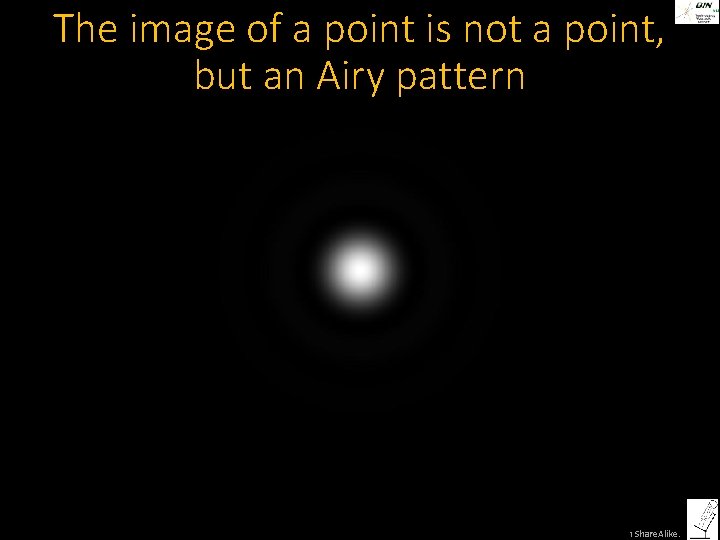
The image of a point is not a point, but an Airy pattern ©Steffen Dietzel 2015 -16. License: Creative Commons Attribution Share. Alike.
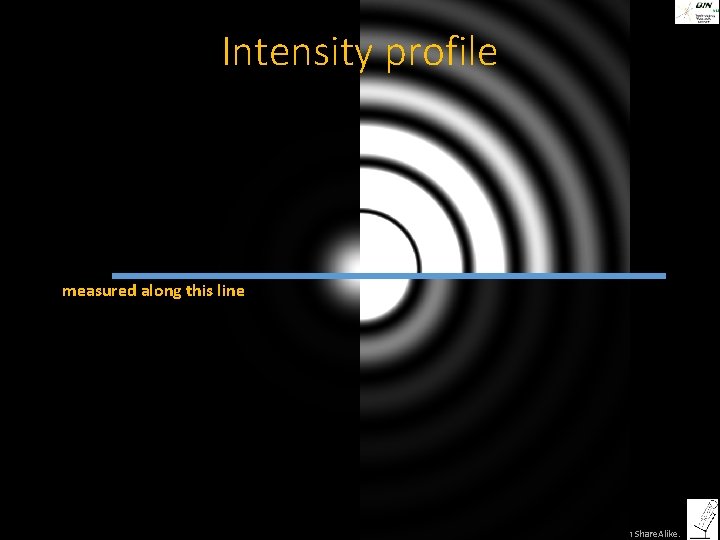
Intensity profile measured along this line ©Steffen Dietzel 2015 -16. License: Creative Commons Attribution Share. Alike.
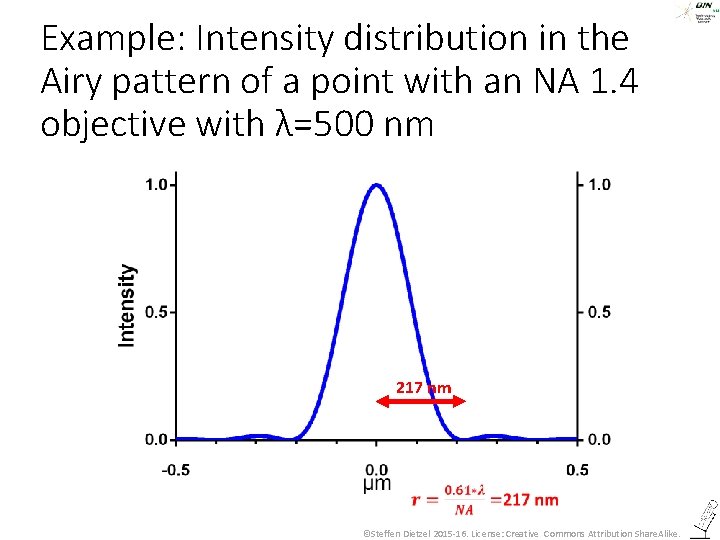
Example: Intensity distribution in the Airy pattern of a point with an NA 1. 4 objective with λ=500 nm 217 nm ©Steffen Dietzel 2015 -16. License: Creative Commons Attribution Share. Alike.
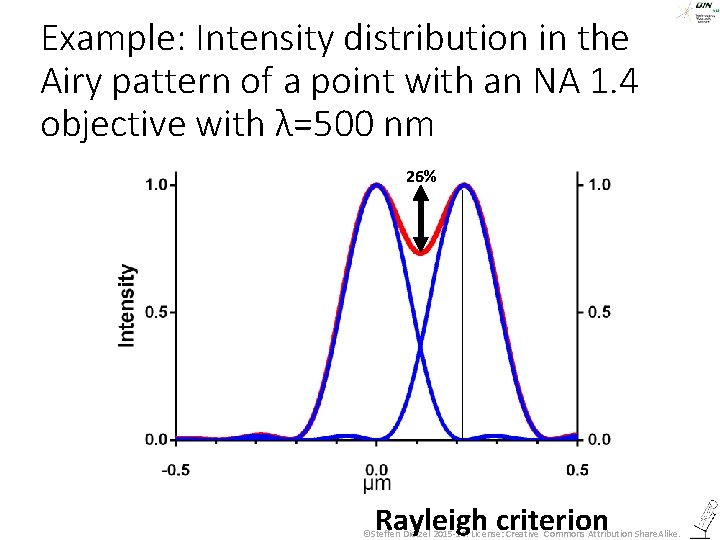
Example: Intensity distribution in the Airy pattern of a point with an NA 1. 4 objective with λ=500 nm 26% Rayleigh criterion ©Steffen Dietzel 2015 -16. License: Creative Commons Attribution Share. Alike.
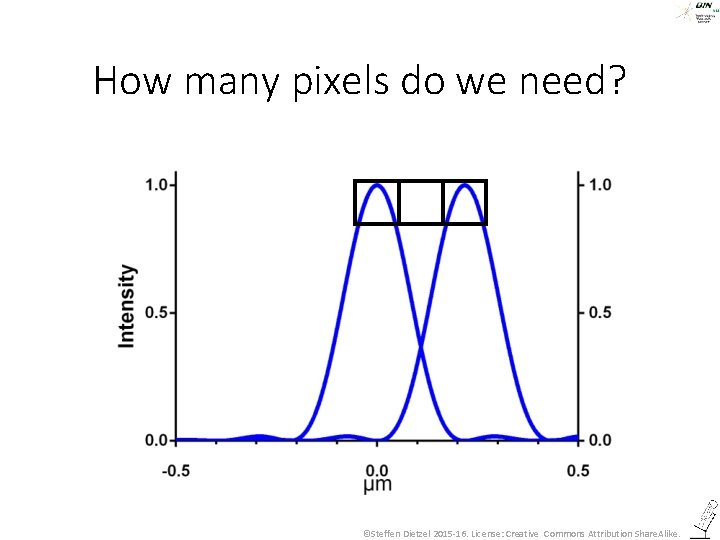
How many pixels do we need? ©Steffen Dietzel 2015 -16. License: Creative Commons Attribution Share. Alike.
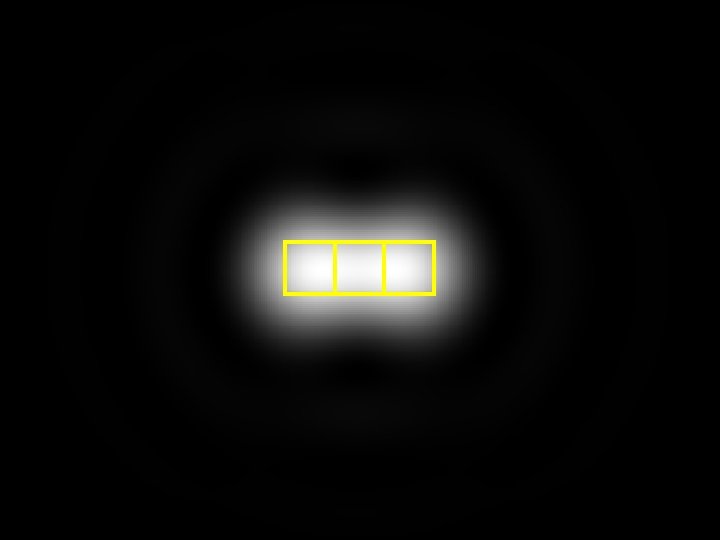
©Steffen Dietzel 2015 -16. License: Creative Commons Attribution Share. Alike.
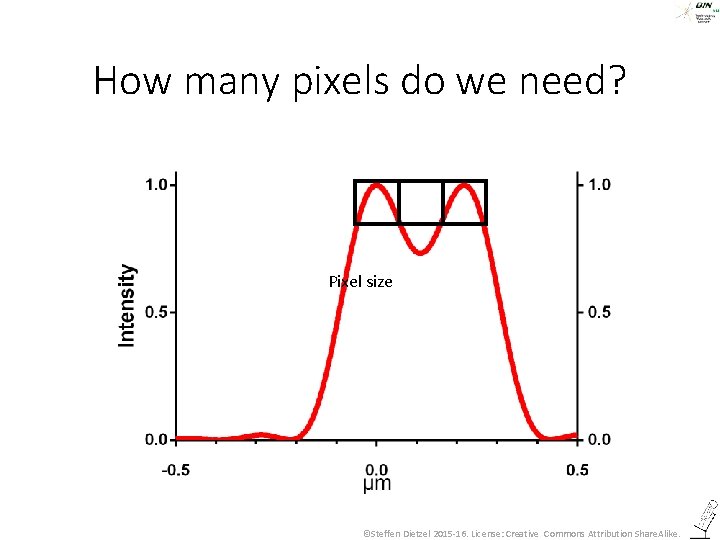
How many pixels do we need? Pixel size ©Steffen Dietzel 2015 -16. License: Creative Commons Attribution Share. Alike.
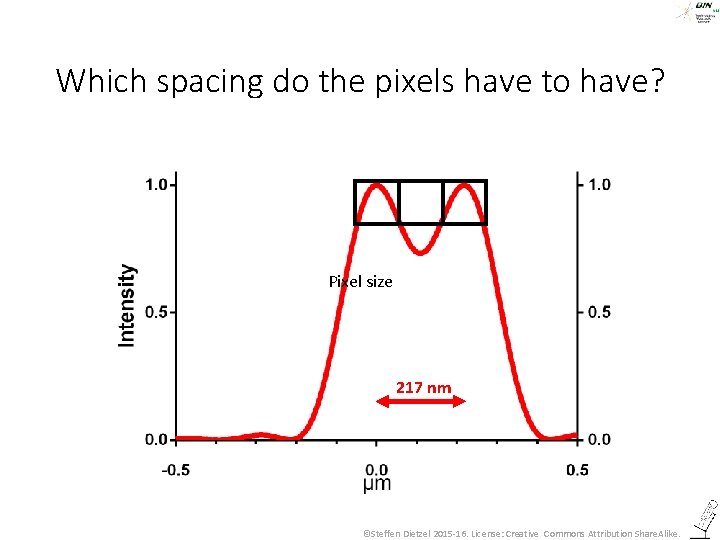
Which spacing do the pixels have to have? Pixel size 217 nm ©Steffen Dietzel 2015 -16. License: Creative Commons Attribution Share. Alike.
Which spacing do the pixels have to have? • To realize the physical resolution, pixel size must be < 2 x smaller than the resolution (Nyquist criterion, after Harry Nyquist, 07. 02. 1889 - 04. 1976. ) • „< 2 x smaller“ is often interpreted as 2. 3 x smaller. In the given example that would be 94 nm. ©Steffen Dietzel 2015 -16. License: Creative Commons Attribution Share. Alike.
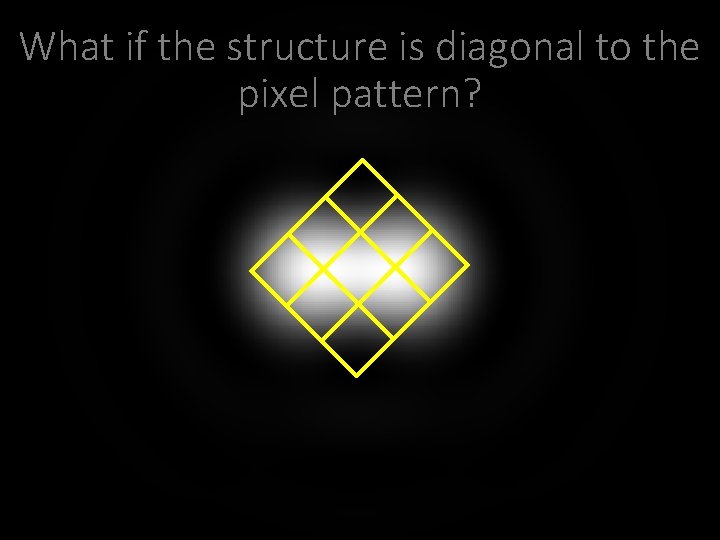
What if the structure is diagonal to the pixel pattern? ©Steffen Dietzel 2015 -16. License: Creative Commons Attribution Share. Alike.
Which spacing do the pixels have to have? • Pixel distance at the 45°-angle is √ 2 = 1. 41 times larger than along the axis. • To cover diagonal point sources, pixel size must be < 2. 82 x smaller than the physical resolution • “< 2. 82 x smaller” can be interpreted as 1/3 of the resolution. ©Steffen Dietzel 2015 -16. License: Creative Commons Attribution Share. Alike.
Which spacing do the pixels have to have? • On the one hand, in real life we don‘t usually reach theoretical resolution (spherical aberration, etc. ), so we could use somewhat larger pixels. • On the other hand, a little oversampling may smoothen the image. Also, we may want to allow for potential confocal resolution improvement, arguing for smaller pixels. • For an NA 1. 4 objective, 70 - 80 nm pixel size can be recommended for many cases. • Much smaller pixels do not usually improve image quality but do increase scanning time, bleaching and phototoxicity. ©Steffen Dietzel 2015 -16. License: Creative Commons Attribution Share. Alike.
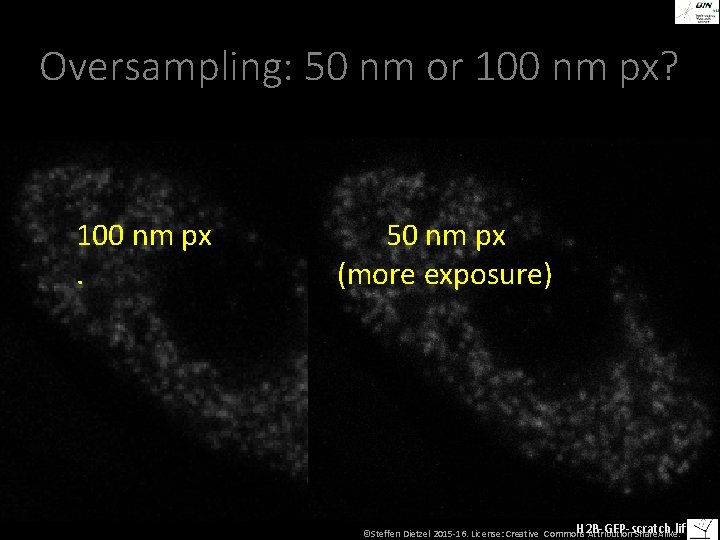
Oversampling: 50 nm or 100 nm px? 100 nm px. 50 nm px (more exposure) H 2 B-GFP-scratch. lif ©Steffen Dietzel 2015 -16. License: Creative Commons Attribution Share. Alike.
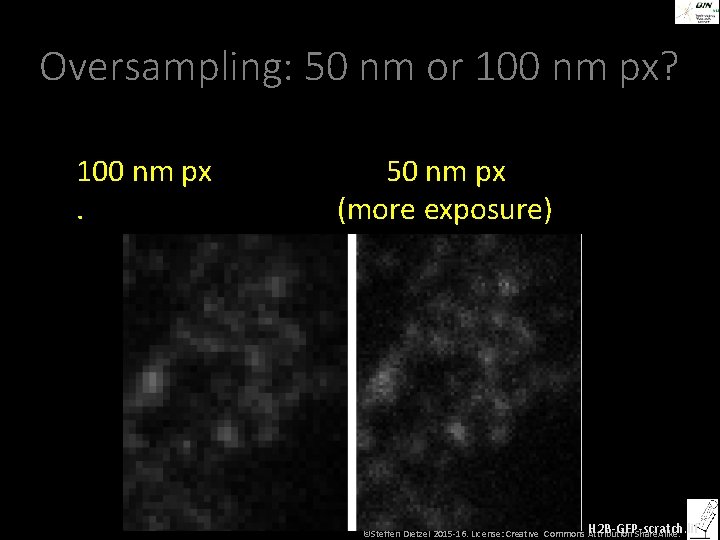
Oversampling: 50 nm or 100 nm px? 100 nm px. 50 nm px (more exposure) H 2 B-GFP-scratch. lif ©Steffen Dietzel 2015 -16. License: Creative Commons Attribution Share. Alike.
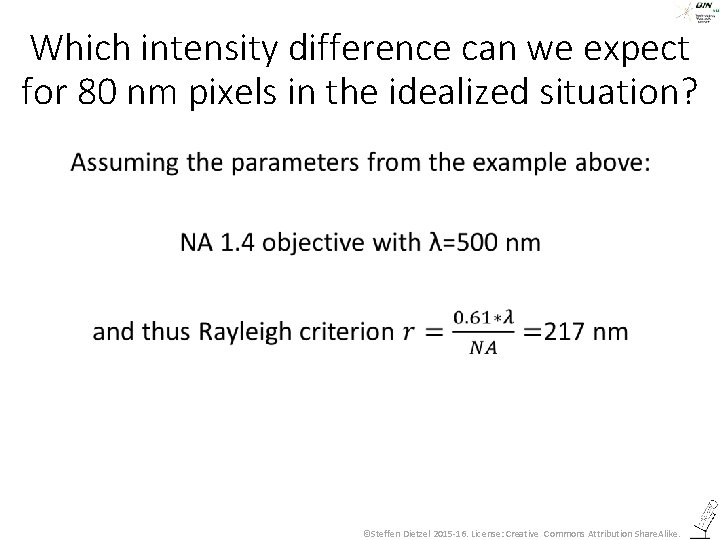
Which intensity difference can we expect for 80 nm pixels in the idealized situation? • ©Steffen Dietzel 2015 -16. License: Creative Commons Attribution Share. Alike.
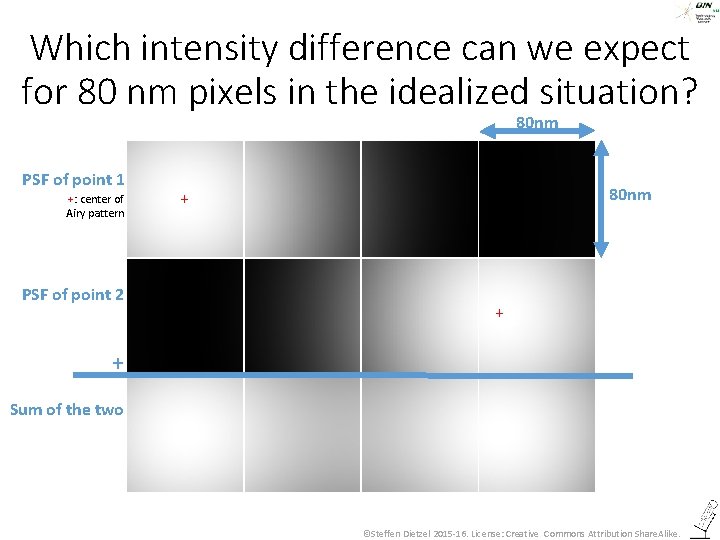
Which intensity difference can we expect for 80 nm pixels in the idealized situation? 80 nm PSF of point 1 +: center of Airy pattern PSF of point 2 80 nm + + + Sum of the two ©Steffen Dietzel 2015 -16. License: Creative Commons Attribution Share. Alike.
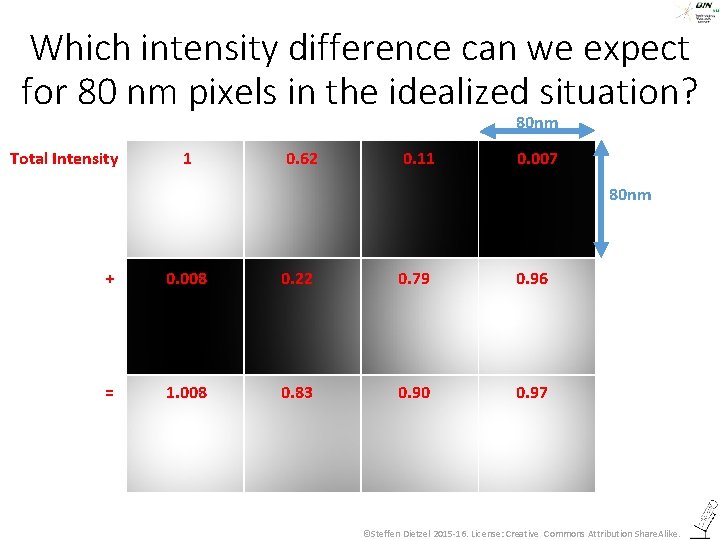
Which intensity difference can we expect for 80 nm pixels in the idealized situation? 80 nm Total Intensity 1 0. 62 0. 11 0. 007 80 nm + 0. 008 0. 22 0. 79 0. 96 = 1. 008 0. 83 0. 90 0. 97 ©Steffen Dietzel 2015 -16. License: Creative Commons Attribution Share. Alike.
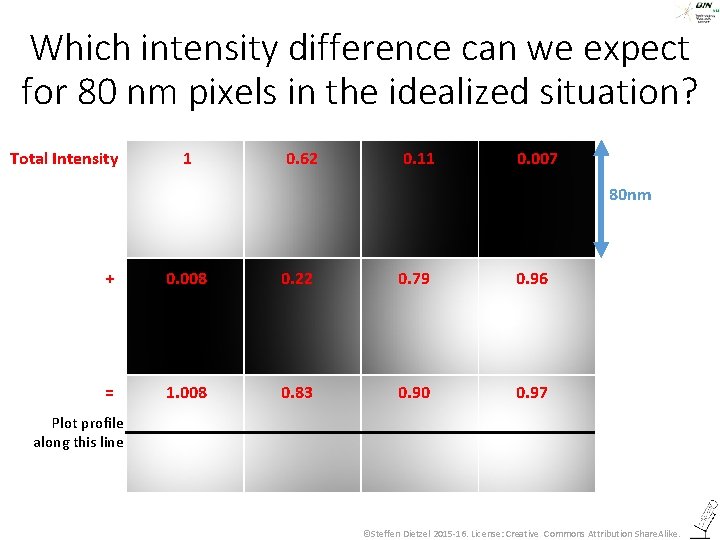
Which intensity difference can we expect for 80 nm pixels in the idealized situation? Total Intensity 1 0. 62 0. 11 0. 007 80 nm + 0. 008 0. 22 0. 79 0. 96 = 1. 008 0. 83 0. 90 0. 97 Plot profile along this line ©Steffen Dietzel 2015 -16. License: Creative Commons Attribution Share. Alike.
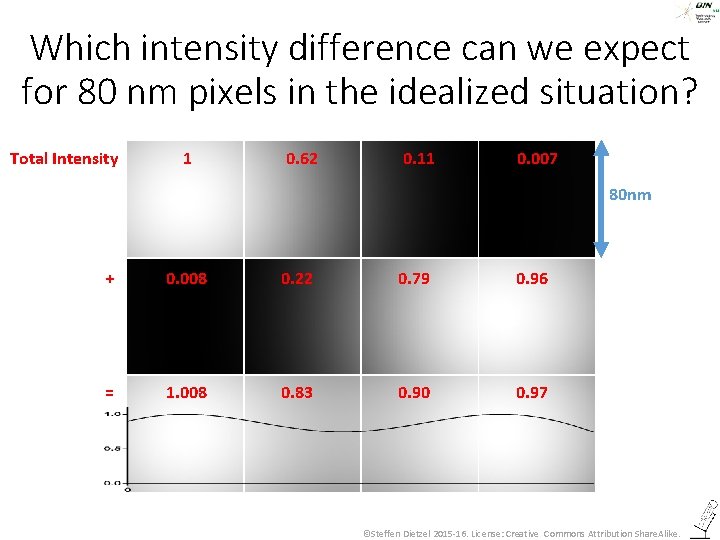
Which intensity difference can we expect for 80 nm pixels in the idealized situation? Total Intensity 1 0. 62 0. 11 0. 007 80 nm + 0. 008 0. 22 0. 79 0. 96 = 1. 008 0. 83 0. 90 0. 97 ©Steffen Dietzel 2015 -16. License: Creative Commons Attribution Share. Alike.
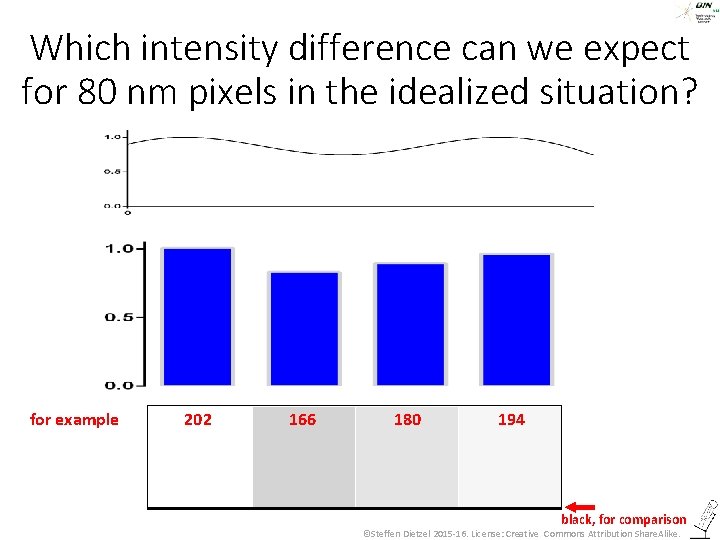
Which intensity difference can we expect for 80 nm pixels in the idealized situation? for example 202 166 180 194 black, for comparison ©Steffen Dietzel 2015 -16. License: Creative Commons Attribution Share. Alike.
Reminder: This is for the idealized case! • Unlimited number of photons • Two point-like sources emit the same number of photons (identical intensity) • No other sources in the neighborhood • No spherical aberration, Ri mismatch • No noise ©Steffen Dietzel 2015 -16. License: Creative Commons Attribution Share. Alike.
Statistical noise = Poisson noise = shot noise ©Steffen Dietzel 2015 -16. License: Creative Commons Attribution Share. Alike.
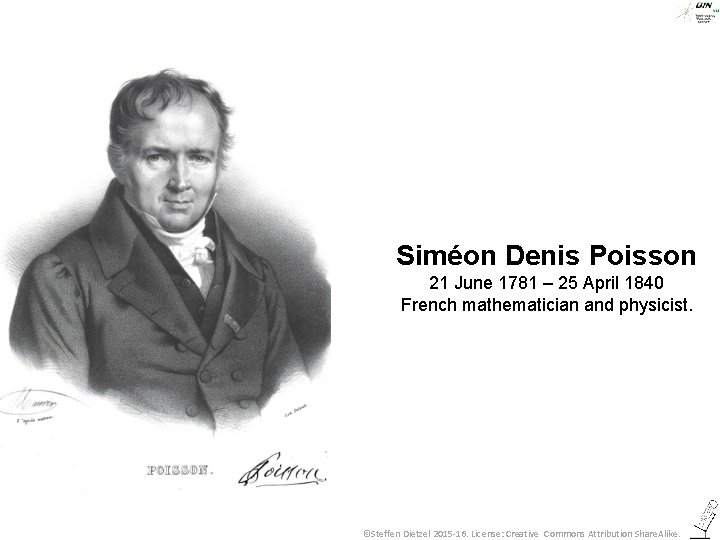
Siméon Denis Poisson 21 June 1781 – 25 April 1840 French mathematician and physicist. ©Steffen Dietzel 2015 -16. License: Creative Commons Attribution Share. Alike.
Statistical noise = Poisson noise • Whether any particular fluorescent molecule emits a photon or not is a random, statistical process: Good fluorochromes have a higher probability than bad ones. • Poisson noise is independent of the hardware! (But hardware may cause other noise). ©Steffen Dietzel 2015 -16. License: Creative Commons Attribution Share. Alike.
Statistical noise = Poisson noise • …is the square root of the number of photons detected, meaning 2/3 of theoretical photon numbers are within this range. • Example: 16 photons are read (Poisson noise √ 16=4). 2/3 of such measurements “should have been” between 12 and 20 photons (without noise). 1/3 deviate even stronger. • For 64 photons, the noise is 8. • For 4 photons, the noise is 2. ©Steffen Dietzel 2015 -16. License: Creative Commons Attribution Share. Alike.
Signal to noise ratio, SNR Examples • 16 photons are read. Poisson noise √ 16=4 SNR = 16/4 = 4 • 64 photons are read. Poisson noise √ 64=8 SNR = 64/8 = 8 • 4 photons are read. Poisson noise √ 4=2 SNR = 4/2 = 2 ©Steffen Dietzel 2015 -16. License: Creative Commons Attribution Share. Alike.
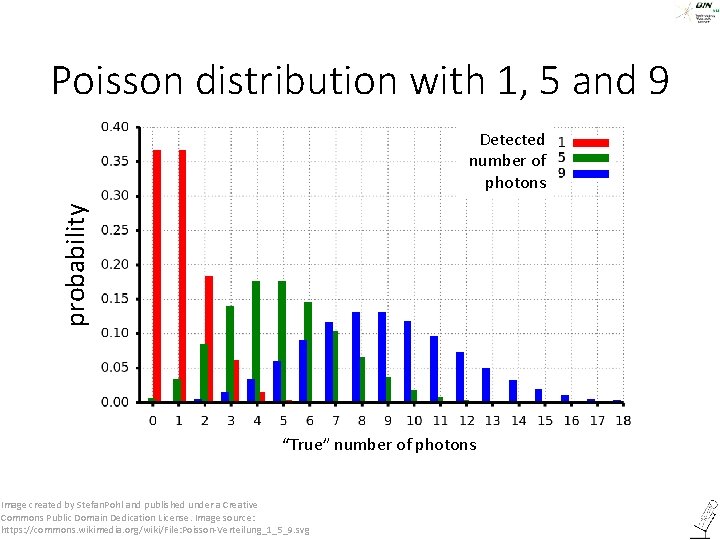
Poisson distribution with 1, 5 and 9 probability Detected number of photons “True” number of photons Image created by Stefan. Pohl and published under a Creative Commons Public Domain Dedication License. Image source: https: //commons. wikimedia. org/wiki/File: Poisson-Verteilung_1_5_9. svg ©Steffen Dietzel 2015 -16. License: Creative Commons Attribution Share. Alike.
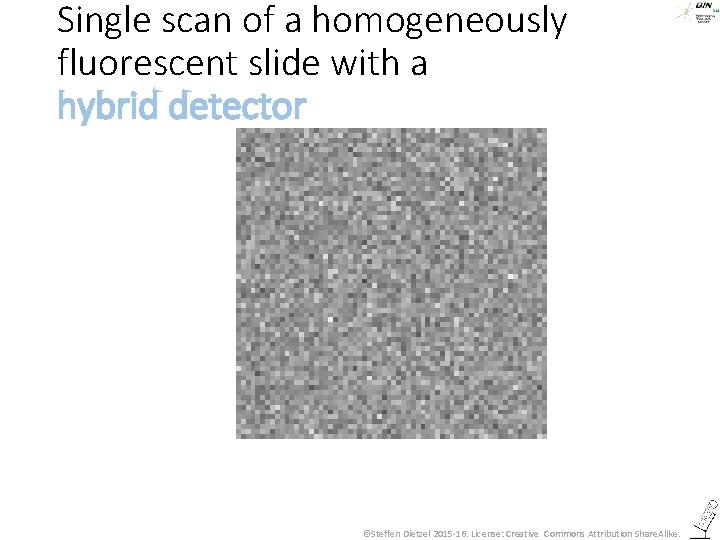
Single scan of a homogeneously fluorescent slide with a hybrid detector ©Steffen Dietzel 2015 -16. License: Creative Commons Attribution Share. Alike.
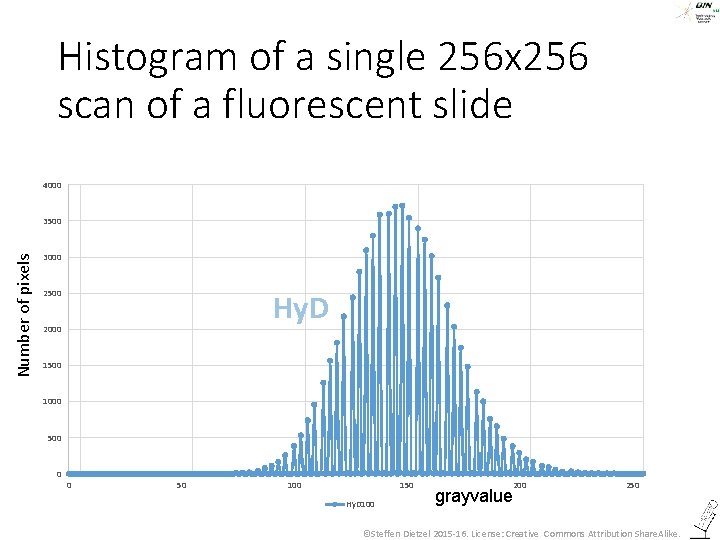
Histogram of a single 256 x 256 scan of a fluorescent slide Histogram Hy. Ds vs PMTs 4000 Number of pixels 3500 3000 2500 Hy. D 2000 1500 1000 500 0 0 50 100 150 Hy. D 100 200 grayvalue 250 ©Steffen Dietzel 2015 -16. License: Creative Commons Attribution Share. Alike.
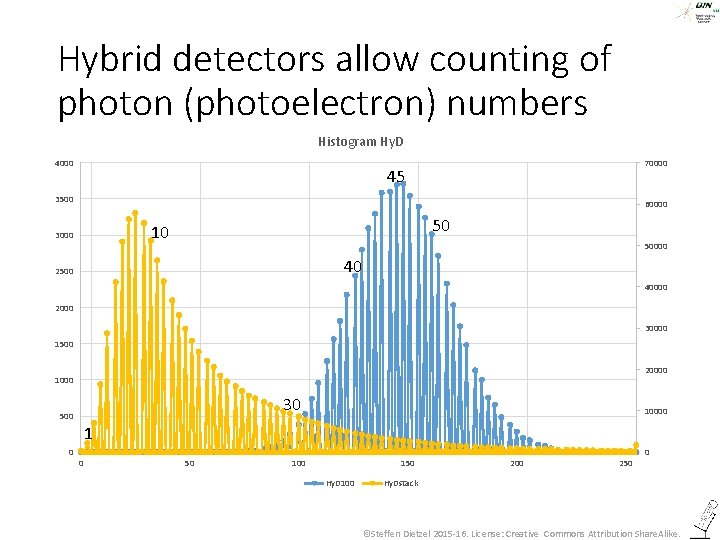
Hybrid detectors allow counting of photon (photoelectron) numbers Histogram Hy. D 4000 70000 45 3500 60000 50 10 3000 50000 40 2500 40000 2000 30000 1500 20000 1000 30 500 10000 1 0 0 50 100 150 Hy. D 100 250 0 Hy. Dstack ©Steffen Dietzel 2015 -16. License: Creative Commons Attribution Share. Alike.
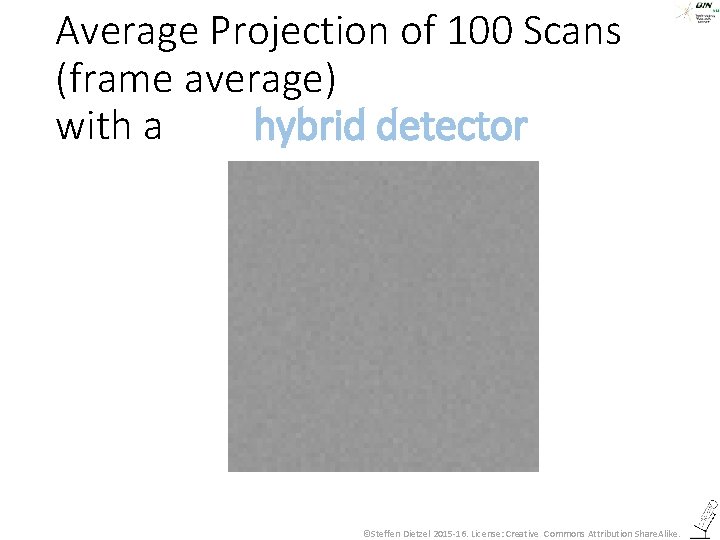
Average Projection of 100 Scans (frame average) with a hybrid detector ©Steffen Dietzel 2015 -16. License: Creative Commons Attribution Share. Alike.
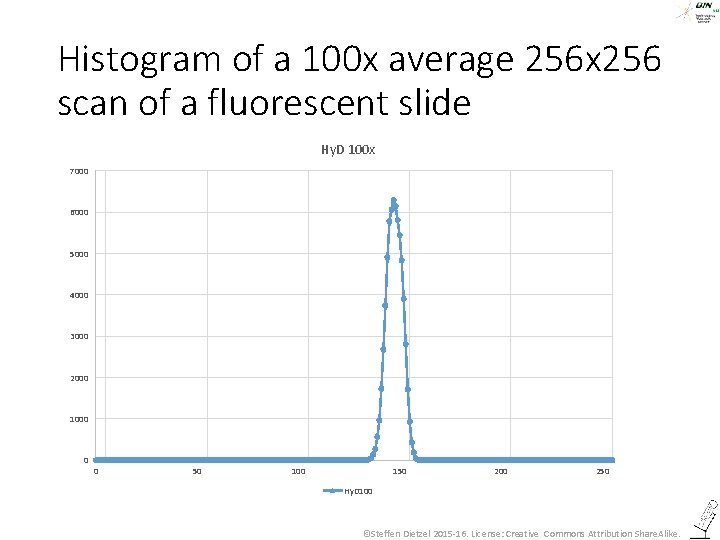
Histogram of a 100 x average 256 x 256 scan of a fluorescent slide Hy. D 100 x 7000 6000 5000 4000 3000 2000 1000 0 0 50 100 150 200 250 Hy. D 100 ©Steffen Dietzel 2015 -16. License: Creative Commons Attribution Share. Alike.
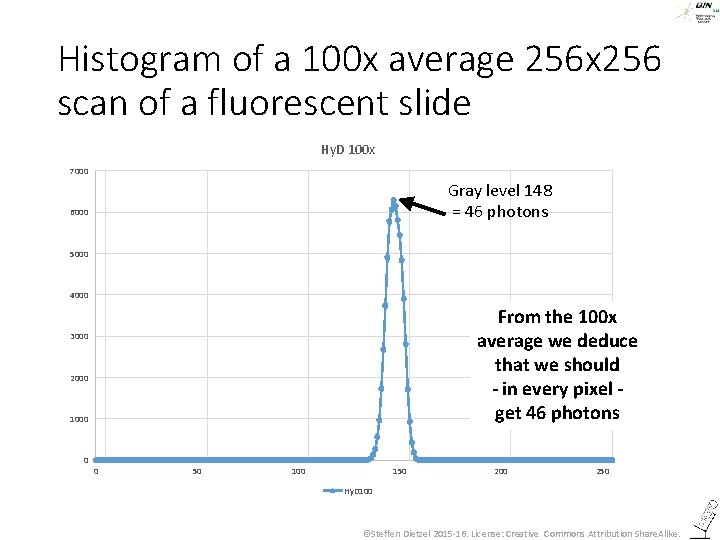
Histogram of a 100 x average 256 x 256 scan of a fluorescent slide Hy. D 100 x 7000 Gray level 148 = 46 photons 6000 5000 4000 From the 100 x average we deduce that we should - in every pixel get 46 photons 3000 2000 1000 0 0 50 100 150 200 250 Hy. D 100 ©Steffen Dietzel 2015 -16. License: Creative Commons Attribution Share. Alike.
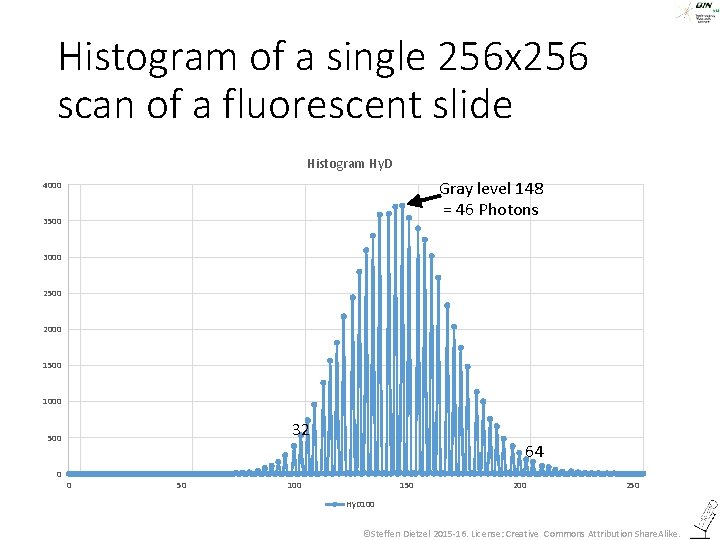
Histogram of a single 256 x 256 scan of a fluorescent slide Histogram Hy. D Gray level 148 = 46 Photons 4000 3500 3000 2500 2000 1500 1000 32 500 0 64 0 50 100 150 200 250 Hy. D 100 ©Steffen Dietzel 2015 -16. License: Creative Commons Attribution Share. Alike.
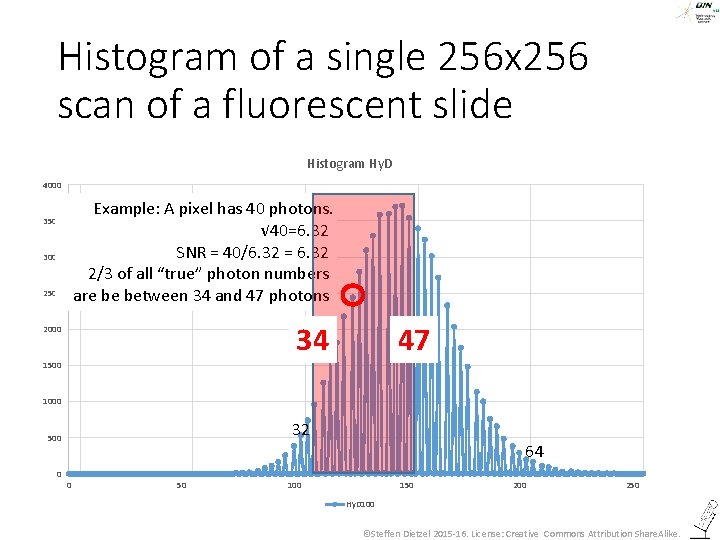
Histogram of a single 256 x 256 scan of a fluorescent slide Histogram Hy. D 4000 Example: A pixel has 40 photons. √ 40=6. 32 SNR = 40/6. 32 = 6. 32 2/3 of all “true” photon numbers are be between 34 and 47 photons 3500 3000 2500 34 2000 47 1500 1000 32 500 0 64 0 50 100 150 200 250 Hy. D 100 ©Steffen Dietzel 2015 -16. License: Creative Commons Attribution Share. Alike.
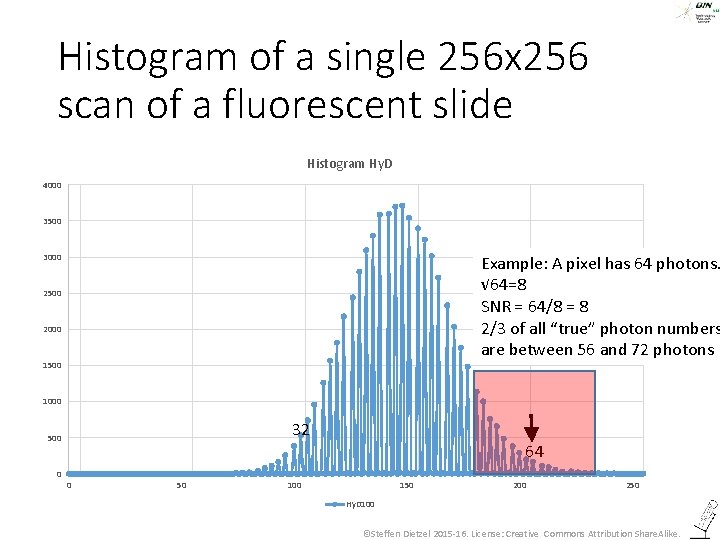
Histogram of a single 256 x 256 scan of a fluorescent slide Histogram Hy. D 4000 3500 3000 Example: A pixel has 64 photons. √ 64=8 SNR = 64/8 = 8 2/3 of all “true” photon numbers are between 56 and 72 photons 2500 2000 1500 1000 32 500 0 64 0 50 100 150 200 250 Hy. D 100 ©Steffen Dietzel 2015 -16. License: Creative Commons Attribution Share. Alike.
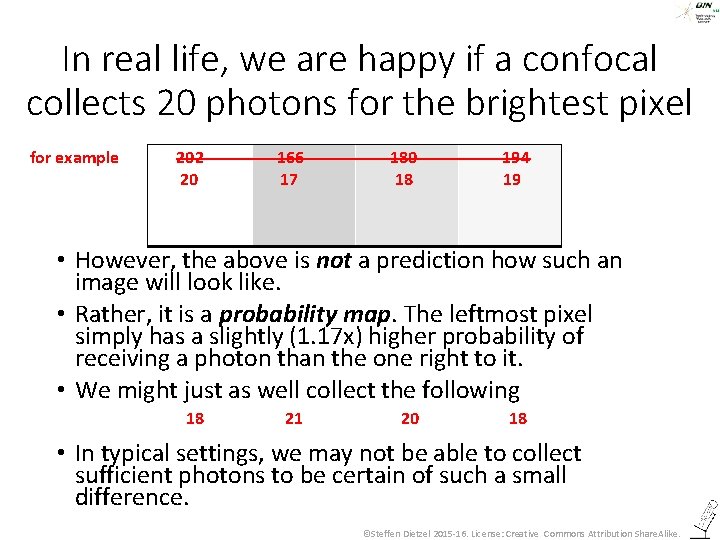
In real life, we are happy if a confocal collects 20 photons for the brightest pixel for example 202 20 166 17 180 18 194 19 • However, the above is not a prediction how such an image will look like. • Rather, it is a probability map. The leftmost pixel simply has a slightly (1. 17 x) higher probability of receiving a photon than the one right to it. • We might just as well collect the following 18 21 20 18 • In typical settings, we may not be able to collect sufficient photons to be certain of such a small difference. ©Steffen Dietzel 2015 -16. License: Creative Commons Attribution Share. Alike.
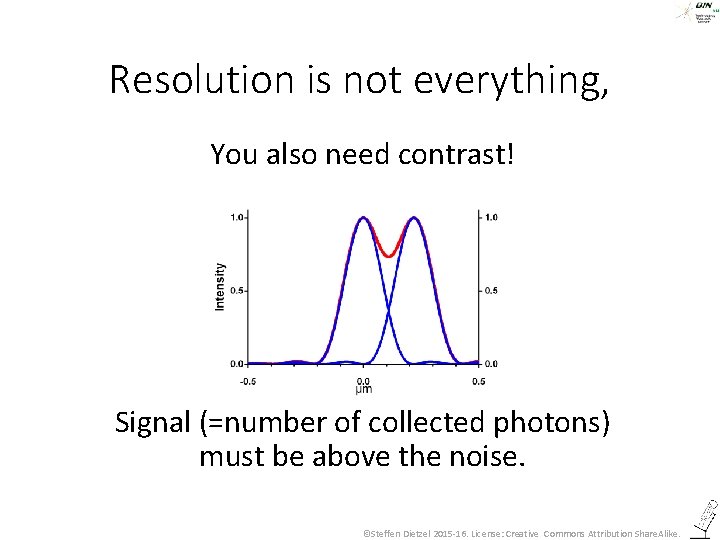
Resolution is not everything, You also need contrast! Signal (=number of collected photons) must be above the noise. ©Steffen Dietzel 2015 -16. License: Creative Commons Attribution Share. Alike.
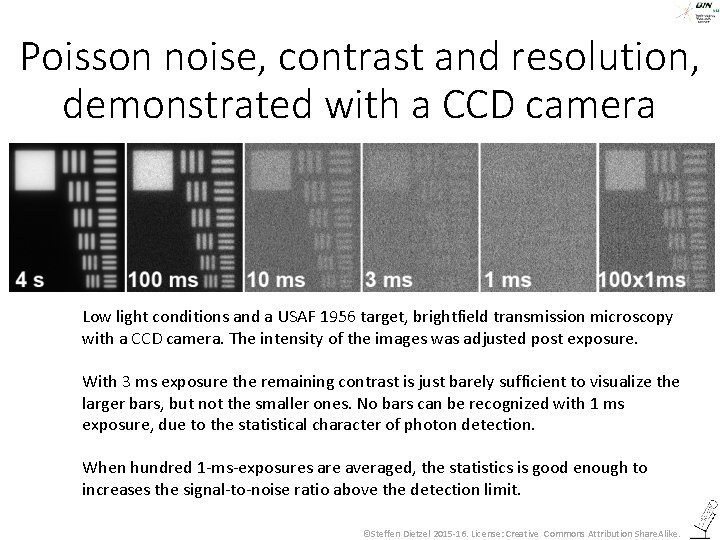
Poisson noise, contrast and resolution, demonstrated with a CCD camera Low light conditions and a USAF 1956 target, brightfield transmission microscopy with a CCD camera. The intensity of the images was adjusted post exposure. With 3 ms exposure the remaining contrast is just barely sufficient to visualize the larger bars, but not the smaller ones. No bars can be recognized with 1 ms exposure, due to the statistical character of photon detection. When hundred 1 -ms-exposures are averaged, the statistics is good enough to increases the signal-to-noise ratio above the detection limit. ©Steffen Dietzel 2015 -16. License: Creative Commons Attribution Share. Alike.
Statistical noise = Poisson noise • Poisson noise is a hard physical limit, just as diffraction! Only counting more photons helps! ©Steffen Dietzel 2015 -16. License: Creative Commons Attribution Share. Alike.
Photon statistics • Only if a large enough number of photons is collected to detect differences in brightness, structures can be resolved. • This fundamentally sets minimal the exposure time and the number of exciting photons. • This is true for all kinds of microscopic image generation. In practice, it plays a role only for fluorescence, since only here too short exposure times are relevant. • Every photon lost in the microscope decreases signal-to-noise ratio, leading to longer exposure times and damage to the sample. ©Steffen Dietzel 2015 -16. License: Creative Commons Attribution Share. Alike.
Shot noise = Poisson noise = statistical noise • In a perfect fluorescence microscopy setup, Poisson noise will be the major problem. It can be attenuated by increasing exposure time (camera) or by averaging sequentially recorded images (confocal). ©Steffen Dietzel 2015 -16. License: Creative Commons Attribution Share. Alike.
Insufficient image quality can be caused by Noise • Poisson noise • Electronic detector noise: dark noise and read noise Blur • Optical aberrations like Ri mismatch, scattering in deep samples, dirty lenses or slides Unwanted signal (photons) • Unspecific dye binding, autofluorescence in sample or immersion oil, room lights System or sample variations • Uneven staining, uneven illumination, uneven blur. ©Steffen Dietzel 2015 -16. License: Creative Commons Attribution Share. Alike.
File formats, bit depth and compression ©Steffen Dietzel 2015 -16. License: Creative Commons Attribution Share. Alike.
Tagged image file format, . tif • Tiff-files may contain just one image or image stacks. • Standard tiff is uncompressed, but compressed versions also exist. • . tif, 8 bit gray scale • . tif, 16 bit gray scale • . tif, color image with 3 channels (RGB), 8 bit each. • . ome. tif, with extra headers for microscopy ©Steffen Dietzel 2015 -16. License: Creative Commons Attribution Share. Alike.
How to get a scale bar • From your microscope software, you know the size of one pixel, e. g. 80 nm x 80 nm • Thus, in 10 µm you have 10 µm : 0. 08 µm = 125 pixels. • In your image software, draw a box 125 pixels wide (and e. g. 10 px high) for a 10 µm scale bar. ©Steffen Dietzel 2015 -16. License: Creative Commons Attribution Share. Alike.
- Slides: 55