
Basics of DFT and TDDFT Hardy Gross E
Basics of DFT and TDDFT Hardy Gross E. K. U. Gross Max-Planck Institute of Microstructure Physics, Halle (Saale), of. Germany Max-Planck Institute and Microstructure Physics Fritz Haber Center Halle (Saale) The Hebrew University of Jerusalem
The Hamiltonian of Condensed Matter (atoms, molecules, clusters, solids)
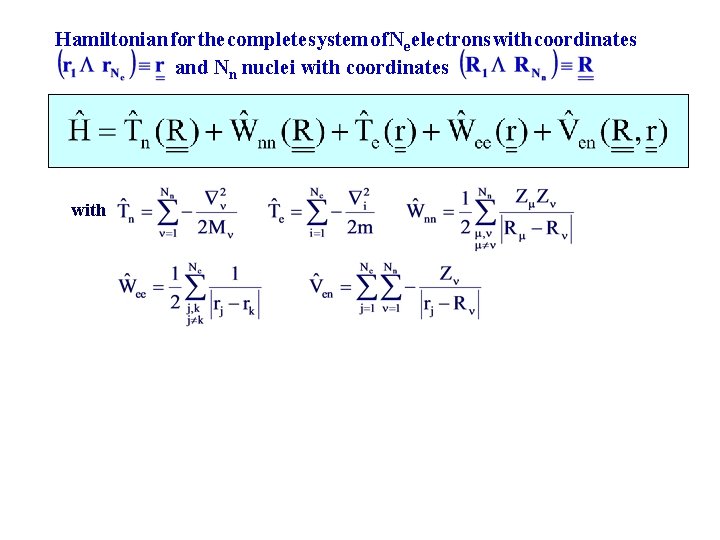
Hamiltonian for the complete system of Ne electrons with coordinates and Nn nuclei with coordinates with
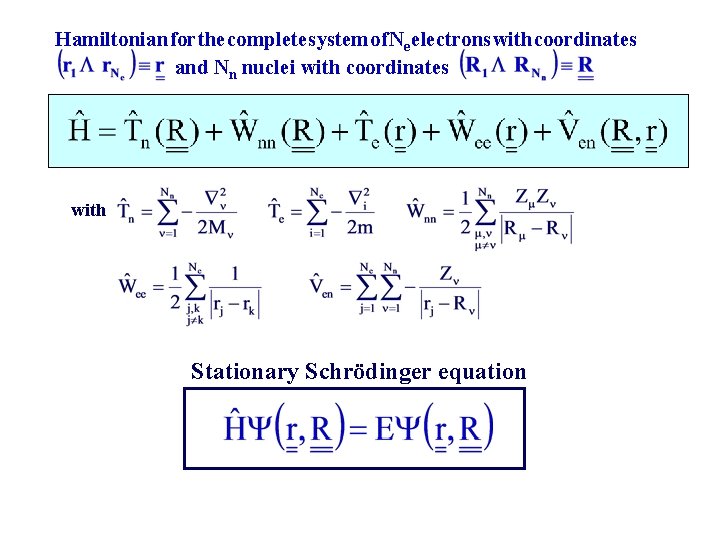
Hamiltonian for the complete system of Ne electrons with coordinates and Nn nuclei with coordinates with Stationary Schrödinger equation
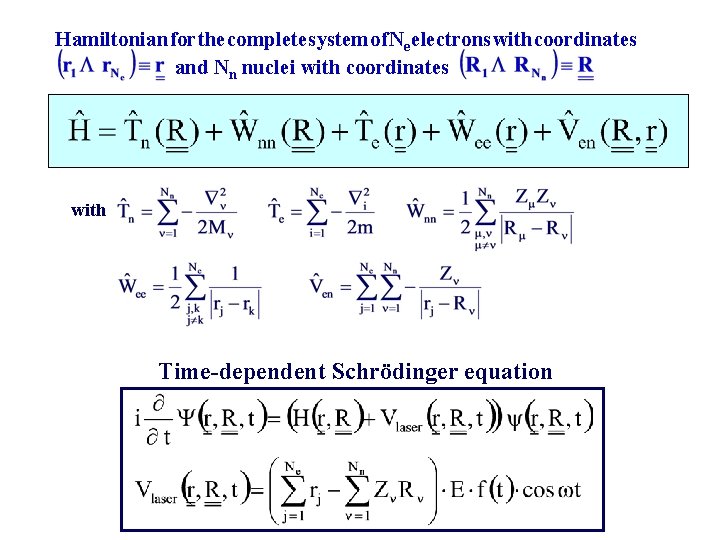
Hamiltonian for the complete system of Ne electrons with coordinates and Nn nuclei with coordinates with Time-dependent Schrödinger equation
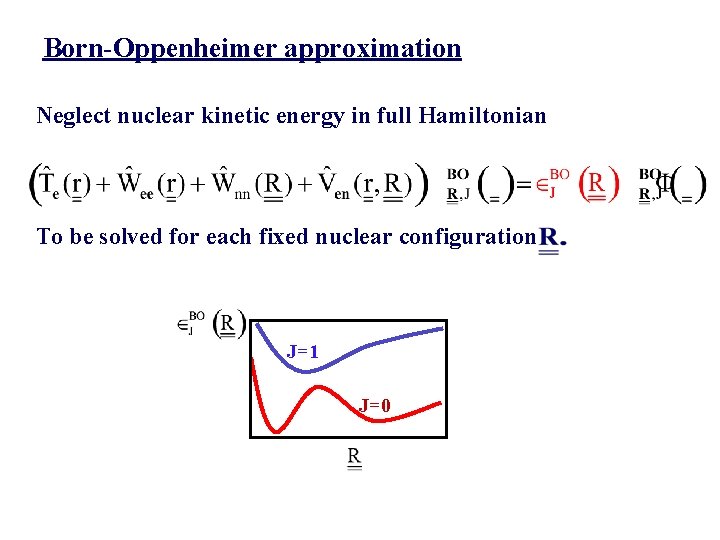
Born-Oppenheimer approximation Neglect nuclear kinetic energy in full Hamiltonian To be solved for each fixed nuclear configuration J=1 J=0
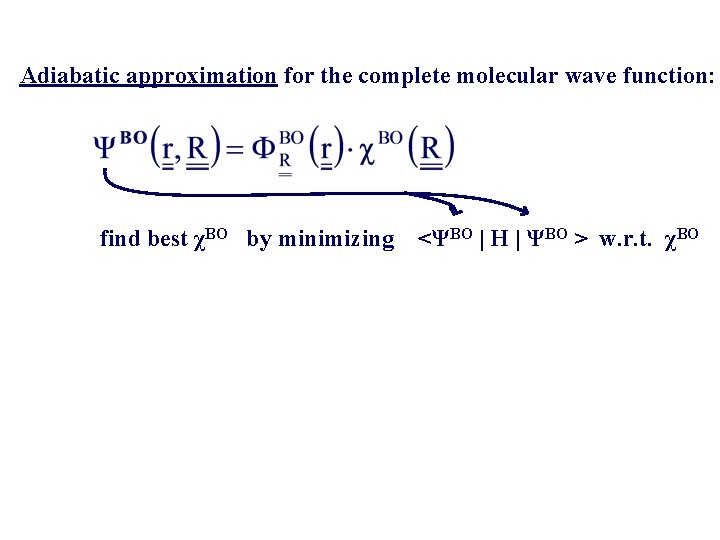
Adiabatic approximation for the complete molecular wave function: find best χBO by minimizing <ΨBO | H | ΨBO > w. r. t. χBO
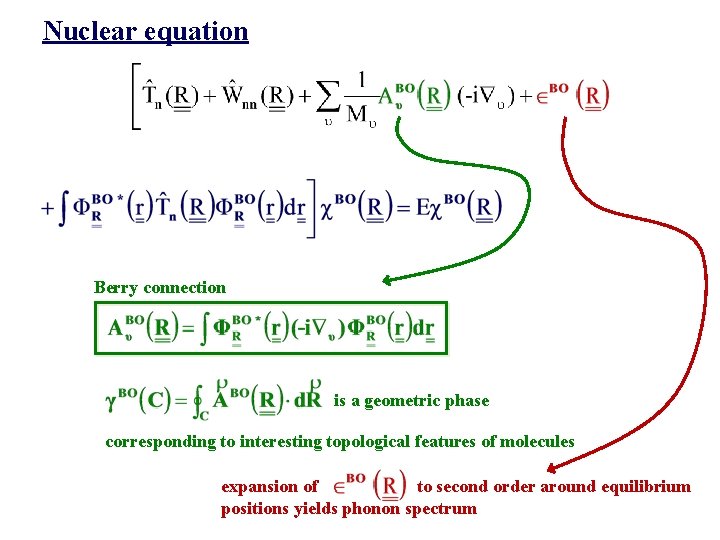
Nuclear equation Berry connection is a geometric phase corresponding to interesting topological features of molecules expansion of to second order around equilibrium positions yields phonon spectrum
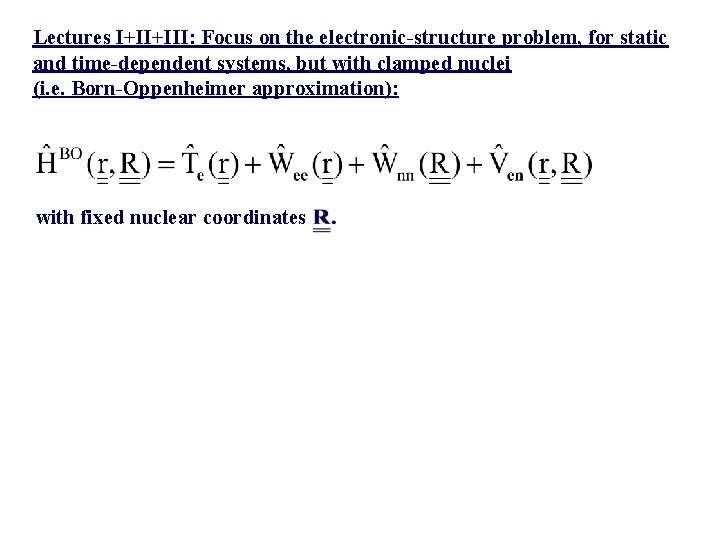
Lectures I+II+III: Focus on the electronic-structure problem, for static and time-dependent systems, but with clamped nuclei (i. e. Born-Oppenheimer approximation): with fixed nuclear coordinates
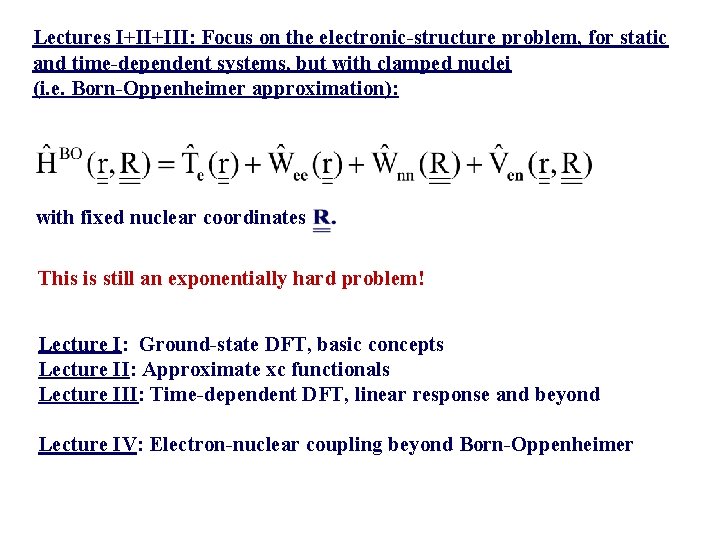
Lectures I+II+III: Focus on the electronic-structure problem, for static and time-dependent systems, but with clamped nuclei (i. e. Born-Oppenheimer approximation): with fixed nuclear coordinates This is still an exponentially hard problem! Lecture I: Ground-state DFT, basic concepts Lecture II: Approximate xc functionals Lecture III: Time-dependent DFT, linear response and beyond Lecture IV: Electron-nuclear coupling beyond Born-Oppenheimer
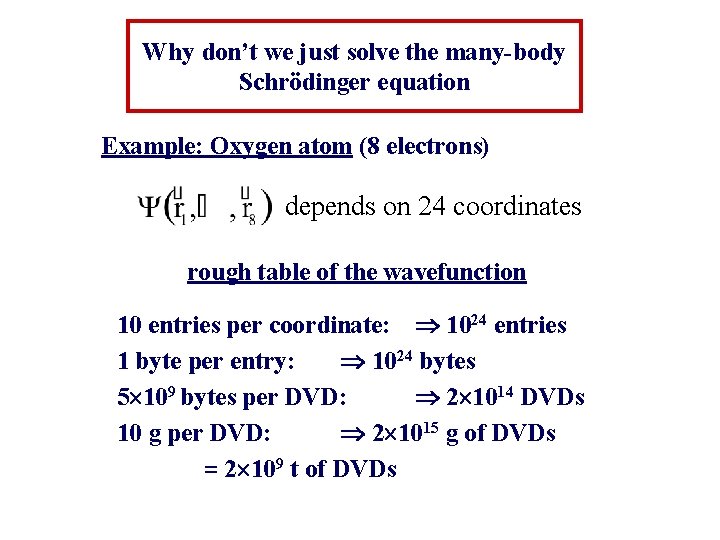
Why don’t we just solve the many-body Schrödinger equation Example: Oxygen atom (8 electrons) depends on 24 coordinates rough table of the wavefunction 10 entries per coordinate: 1024 entries 1 byte per entry: 1024 bytes 5 109 bytes per DVD: 2 1014 DVDs 10 g per DVD: 2 1015 g of DVDs = 2 109 t of DVDs
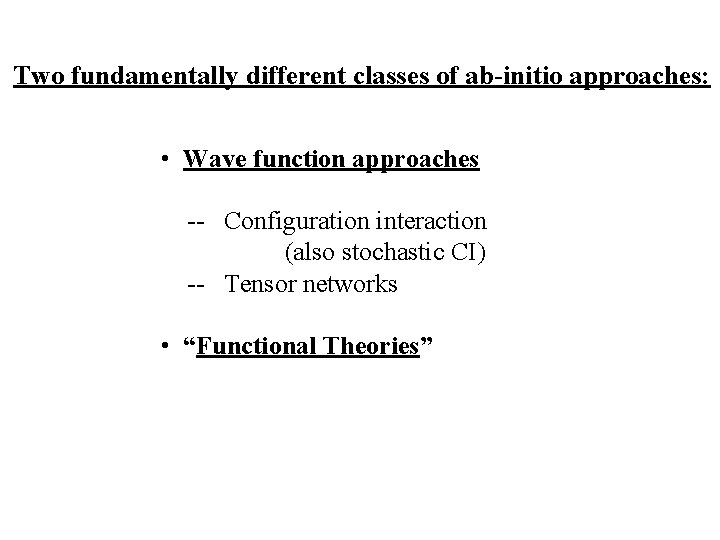
Two fundamentally different classes of ab-initio approaches: • Wave function approaches -- Configuration interaction (also stochastic CI) -- Tensor networks • “Functional Theories”
Two fundamentally different classes of ab-initio approaches: • Wave function approaches -- Configuration interaction (also stochastic CI) -- Tensor networks • “Functional Theories” Write total energy as functional of a simpler quantity and minimize
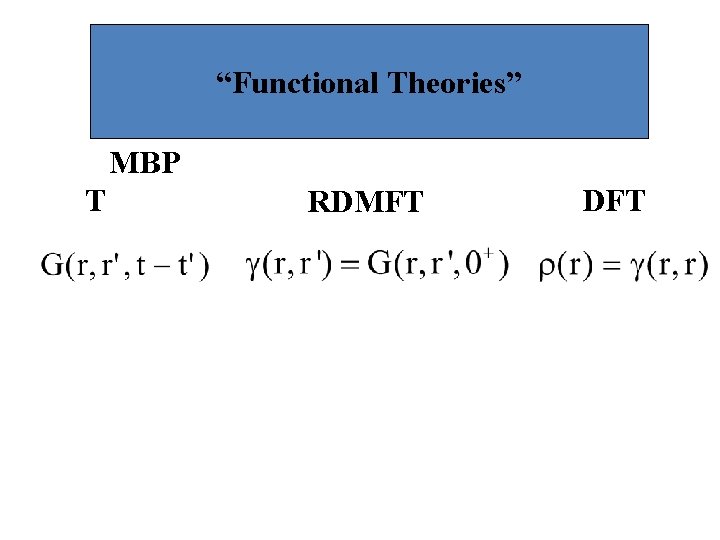
Motivation “Functional Theories” MBP T RDMFT DFT
![Motivation “Functional Theories” MBP T Functional: Φxc[G] or Σxc[G] RDMFT DFT Functional: Exc[γ] Functional:](http://slidetodoc.com/presentation_image_h/107521cfb76f7e97215e1c5f554dfb22/image-15.jpg "Motivation “Functional Theories” MBP T Functional: Φxc[G] or Σxc[G] RDMFT DFT Functional: Exc[γ] Functional:")
Motivation “Functional Theories” MBP T Functional: Φxc[G] or Σxc[G] RDMFT DFT Functional: Exc[γ] Functional: Exc[ρ] or vxc[ρ]
![Motivation “Functional Theories” MBP T Functional: Φxc[G] or Σxc[G] easy (e. g. GW) RDMFT](http://slidetodoc.com/presentation_image_h/107521cfb76f7e97215e1c5f554dfb22/image-16.jpg "Motivation “Functional Theories” MBP T Functional: Φxc[G] or Σxc[G] easy (e. g. GW) RDMFT")
Motivation “Functional Theories” MBP T Functional: Φxc[G] or Σxc[G] easy (e. g. GW) RDMFT Functional: Exc[γ] difficult DFT Functional: Exc[ρ] or vxc[ρ] very difficult
![Motivation “Functional Theories” MBP T Functional: Φxc[G] or Σxc[G] easy (e. g. GW) numerically](http://slidetodoc.com/presentation_image_h/107521cfb76f7e97215e1c5f554dfb22/image-17.jpg "Motivation “Functional Theories” MBP T Functional: Φxc[G] or Σxc[G] easy (e. g. GW) numerically")
Motivation “Functional Theories” MBP T Functional: Φxc[G] or Σxc[G] easy (e. g. GW) numerically heavy RDMFT Functional: Exc[γ] DFT difficult Functional: Exc[ρ] or vxc[ρ] very difficult moderate light
ESSENCE OF DENSITY-FUNTIONAL THEORY • Every observable quantity of a quantum system can be calculated from the density of the system ALONE • The density of particles interacting with each other can be calculated as the density of an auxiliary system of non-interacting particles
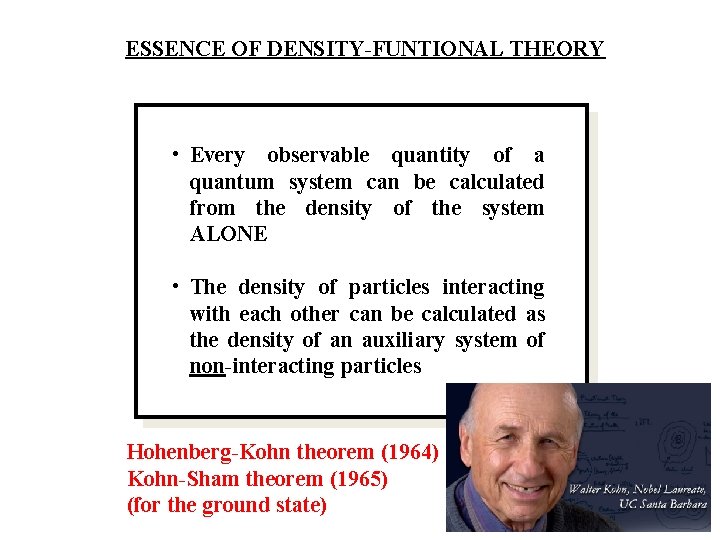
ESSENCE OF DENSITY-FUNTIONAL THEORY • Every observable quantity of a quantum system can be calculated from the density of the system ALONE • The density of particles interacting with each other can be calculated as the density of an auxiliary system of non-interacting particles Hohenberg-Kohn theorem (1964) Kohn-Sham theorem (1965) (for the ground state)
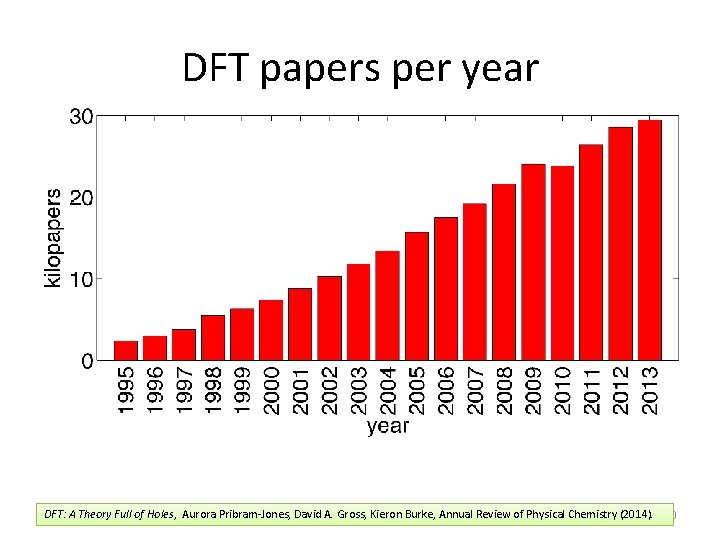
DFT papers per year DFT: A Theory Jul 5 th, 2017 Full of Holes, Aurora Pribram-Jones, David A. Gross, KITSKieron Burke, Annual Review of Physical Chemistry (2014). 20
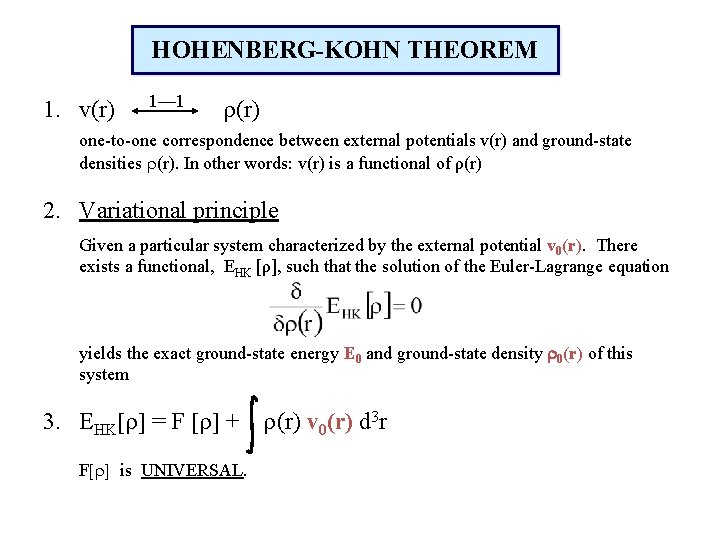
HOHENBERG-KOHN THEOREM 1. v(r) 1— 1 (r) one-to-one correspondence between external potentials v(r) and ground-state densities (r). In other words: v(r) is a functional of ρ(r) 2. Variational principle Given a particular system characterized by the external potential v 0(r). There exists a functional, EHK [ρ], such that the solution of the Euler-Lagrange equation yields the exact ground-state energy E 0 and ground-state density 0(r) of this system 3. EHK[ ] = F [ ] + (r) v 0(r) d 3 r F[ ] is UNIVERSAL.
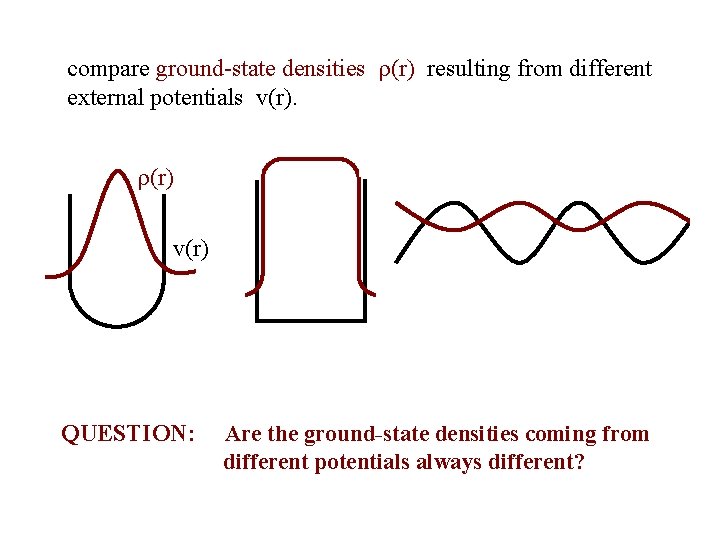
compare ground-state densities (r) resulting from different external potentials v(r). (r) v(r) QUESTION: Are the ground-state densities coming from different potentials always different?

G A v(r) Ã (r) (r 1…r. N) single-particle potentials having nondegenerate ground state ground-state wavefunctions ground-state densities Hohenberg-Kohn-Theorem (1964) G: v(r) is invertible
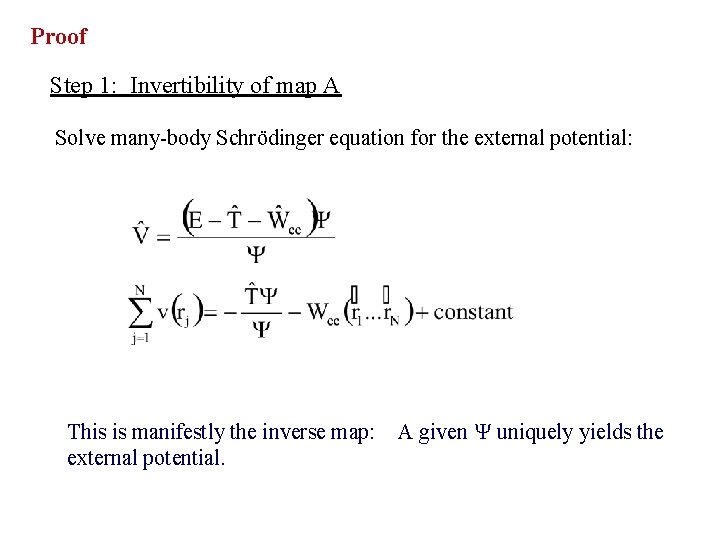
Proof Step 1: Invertibility of map A Solve many-body Schrödinger equation for the external potential: This is manifestly the inverse map: external potential. A given uniquely yields the

Step 2: Invertibility of map à Given: two (nondegenerate) ground states , ’ satisfying with to be shown: ’ = ’ cannot happen
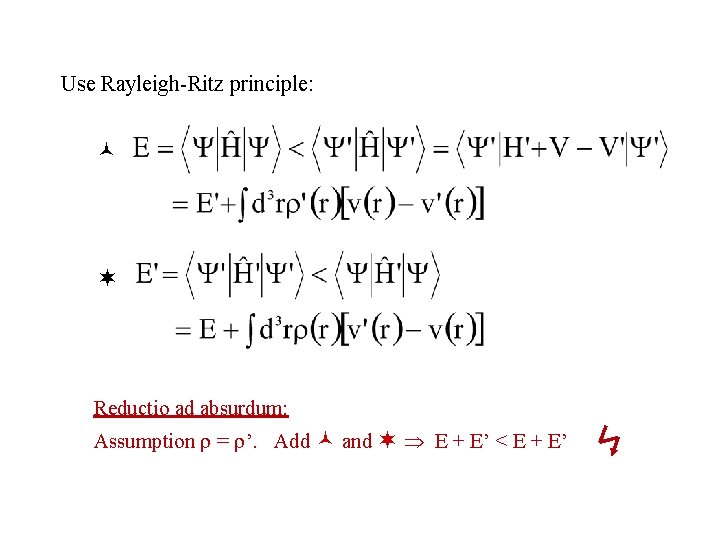
Use Rayleigh-Ritz principle: Reductio ad absurdum: Assumption = ’. Add and E + E’ < E + E’
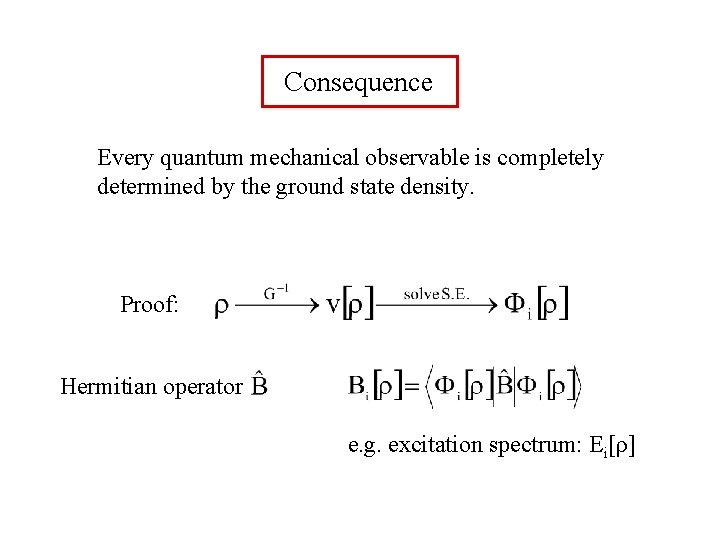
Consequence Every quantum mechanical observable is completely determined by the ground state density. Proof: Hermitian operator e. g. excitation spectrum: Ei[ρ]
![What is a FUNCTIONAL? E[ ] (r) set of functions R functional set of](http://slidetodoc.com/presentation_image_h/107521cfb76f7e97215e1c5f554dfb22/image-28.jpg "What is a FUNCTIONAL? E[ ] (r) set of functions R functional set of")
What is a FUNCTIONAL? E[ ] (r) set of functions R functional set of real numbers Generalization: functional depending parametrically on or on
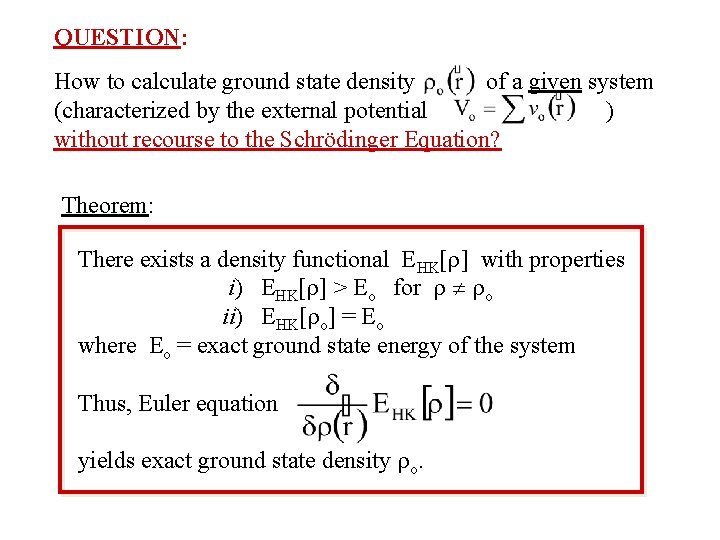
QUESTION: How to calculate ground state density of a given system (characterized by the external potential ) without recourse to the Schrödinger Equation? Theorem: There exists a density functional EHK[ ] with properties i) EHK[ ] > Eo for o ii) EHK[ o] = Eo where Eo = exact ground state energy of the system Thus, Euler equation yields exact ground state density o.
![proof: formal construction of EHK[ ] : for arbitrary ground state density define: >](http://slidetodoc.com/presentation_image_h/107521cfb76f7e97215e1c5f554dfb22/image-30.jpg "proof: formal construction of EHK[ ] : for arbitrary ground state density define: >")
proof: formal construction of EHK[ ] : for arbitrary ground state density define: > Eo for o = Eo for = o EHK[ ] = q. e. d. d 3 r (r) vo(r) + F[ ] is universal
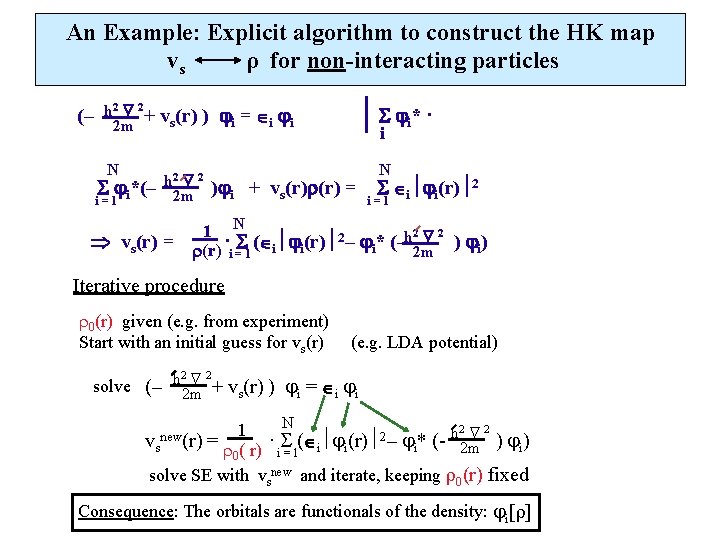
An Example: Explicit algorithm to construct the HK map vs ρ for non-interacting particles (– h 2 2+ v (r) s 2 m N i*(– i=1 ) i = i i h 2 2 2 m vs(r) = i* · i N ) i + vs(r) = i i(r) 2 i=1 1 N 2– * (- h 2 2 ) ) · ( (r) i i (r) i = 1 i i 2 m Iterative procedure 0(r) given (e. g. from experiment) Start with an initial guess for vs(r) (e. g. LDA potential) 2 2 solve (– h 2 m + vs(r) ) i = i i N 1 h 2 2 = ( r) · ( i i(r) 2– i* (- 2 m ) i) i=1 0 solve SE with vsnew and iterate, keeping ρ0(r) fixed vsnew(r) Consequence: The orbitals are functionals of the density: i[ρ]
![KOHN-SHAM EQUATIONS Rewrite HK functional: EHK[ ] = TS[ ] + (r) v 0(r)](http://slidetodoc.com/presentation_image_h/107521cfb76f7e97215e1c5f554dfb22/image-32.jpg "KOHN-SHAM EQUATIONS Rewrite HK functional: EHK[ ] = TS[ ] + (r) v 0(r)")
KOHN-SHAM EQUATIONS Rewrite HK functional: EHK[ ] = TS[ ] + (r) v 0(r) d 3 r + EH[ ] + Exc[ ] where is the kinetic energy functional of non-interacting particles yields the Kohn-Sham equations: The orbitals from these equations yield the true density of the interacting system Walter Kohn: “The KS equations are an exactification of the Hartree mean-field equation” Exc[ρ] is a universal functional of the density which, in practice, needs to be approximated.
![The functional Exc[ ] is universal: Curse or blessing?](http://slidetodoc.com/presentation_image_h/107521cfb76f7e97215e1c5f554dfb22/image-33.jpg "The functional Exc[ ] is universal: Curse or blessing?")
The functional Exc[ ] is universal: Curse or blessing?
![The functional Exc[ ] is universal: Curse or blessing? Only ONE functional needs to](http://slidetodoc.com/presentation_image_h/107521cfb76f7e97215e1c5f554dfb22/image-34.jpg "The functional Exc[ ] is universal: Curse or blessing? Only ONE functional needs to")
The functional Exc[ ] is universal: Curse or blessing? Only ONE functional needs to be approximated
![The functional Exc[ ] is universal: Curse or blessing? Only ONE functional needs to](http://slidetodoc.com/presentation_image_h/107521cfb76f7e97215e1c5f554dfb22/image-35.jpg "The functional Exc[ ] is universal: Curse or blessing? Only ONE functional needs to")
The functional Exc[ ] is universal: Curse or blessing? Only ONE functional needs to be approximated Functional can be systematically improved, i. e. results will improve -on average- for all systems. Systematic improvement for a single given system is not possible.

The five levels of (TD)DFT Level 1: Basic Theorems Level 2: Deduce exact features of the xc functional Level 3: Find approximate functionals for Level 4: Write code that solves the (TD)KS equations Level 5: Run code for interesting systems/questions
- Slides: 36