
Basics of Counseling Counseling Skills and Techniques OUTLINE
Basics of Counseling, Counseling Skills and Techniques
OUTLINE �What is counseling �Why is counseling required �Specific counseling skills �Counseling techniques �Characteristics of counselor
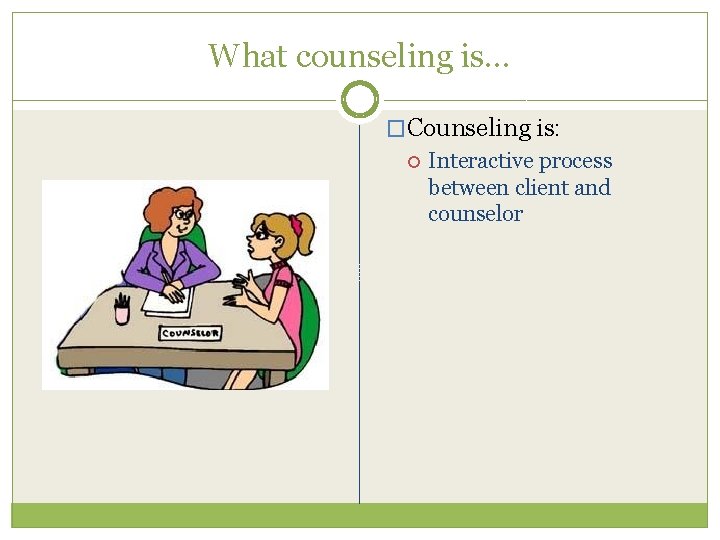
What counseling is… �Counseling is: Interactive process between client and counselor
What counseling is not… �Friendship �Telling or directing �An interrogation �Confession
Need for counseling… �GROUP DISCUSSION Why is counseling required? ? ?
Need for counseling… �Assessment of client’s problems �Explore client’s thoughts, emotions and defenses regarding drug use �Helping client get a perspective about his drug use and its consequences in a protected environment �Develop individualized treatment plan
Specific Counseling Skills Opening technique Structuring the session Open-ended vs closed-ended questions Understanding non-verbal language Listening skills
Specific Counseling Skills Opening technique Establishing rapport with the client • Make the client comfortable • Address him by name • Be aware of self’s body language when talking to client • Be sensitive to what client says • Let the client talk
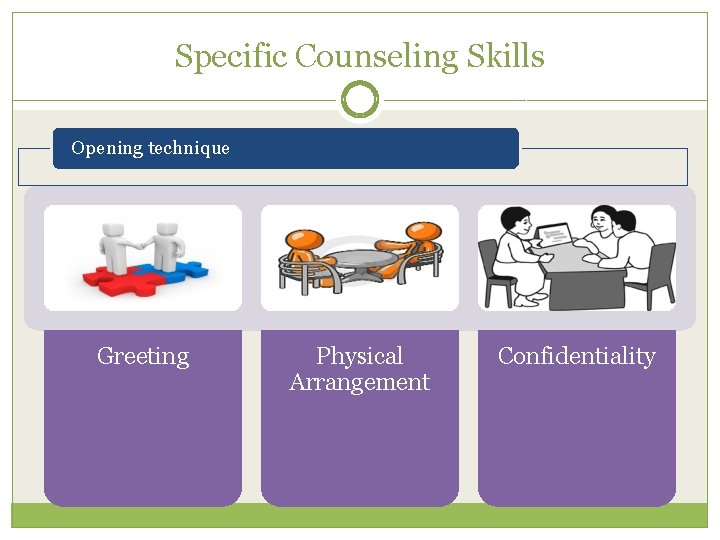
Specific Counseling Skills Opening technique Greeting Physical Arrangement Confidentiality
Specific Counseling Skills Structuring the session q. Providing client a framework or orientation for counseling q. Need to set rules, guidelines and expectations from future sessions üClient should not come intoxicated in session üClient should be honest üCounseling is a collaborative process
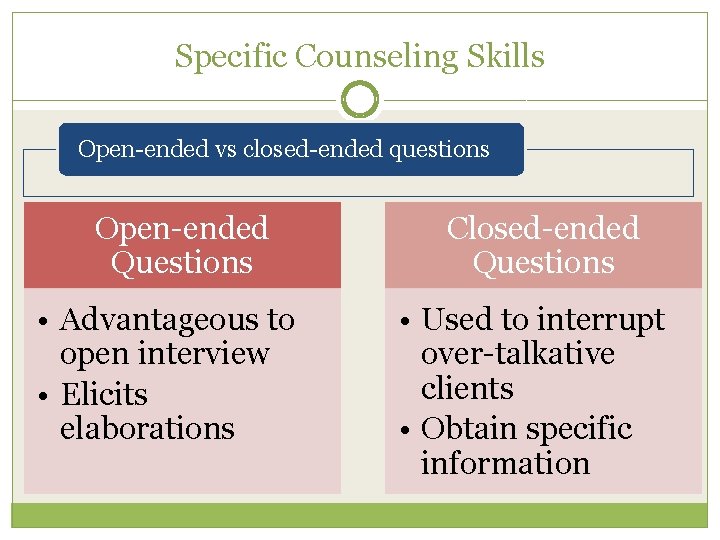
Specific Counseling Skills Open-ended vs closed-ended questions Open-ended Questions • Advantageous to open interview • Elicits elaborations Closed-ended Questions • Used to interrupt over-talkative clients • Obtain specific information
Specific Counseling Skills Understanding non-verbal language q. Understanding non-verbal language important q. Can give important clues to what is going on in client’s mind q. Can help in pointing discrepancies

Specific Counseling Skills Understanding non-verbal language q. Types of important non-verbal signs* Facial expression Pitch/tone/ volume Posture Gestures Eye-to-eye contact
Specific Counseling Skills Listening skills q. As a counselor, listening is the most important skill q. The art is listening to what the client “says” and what he “does not say” q. Comes with practice
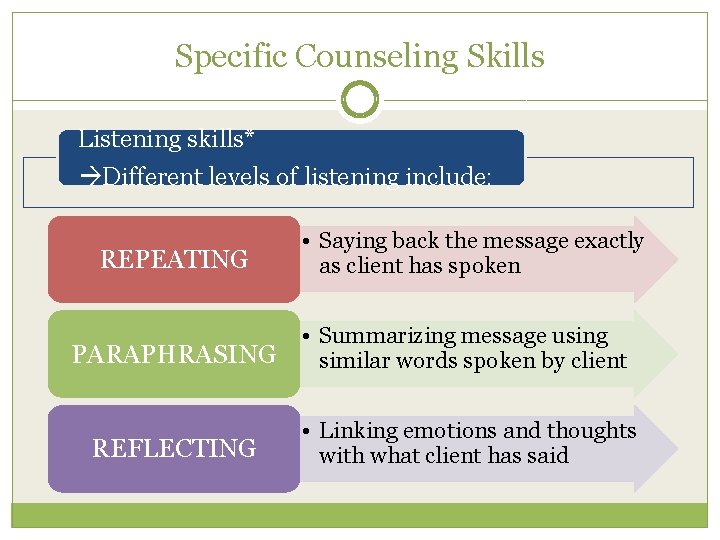
Specific Counseling Skills Listening skills* Different levels of listening include: REPEATING • Saying back the message exactly as client has spoken PARAPHRASING • Summarizing message using similar words spoken by client REFLECTING • Linking emotions and thoughts with what client has said
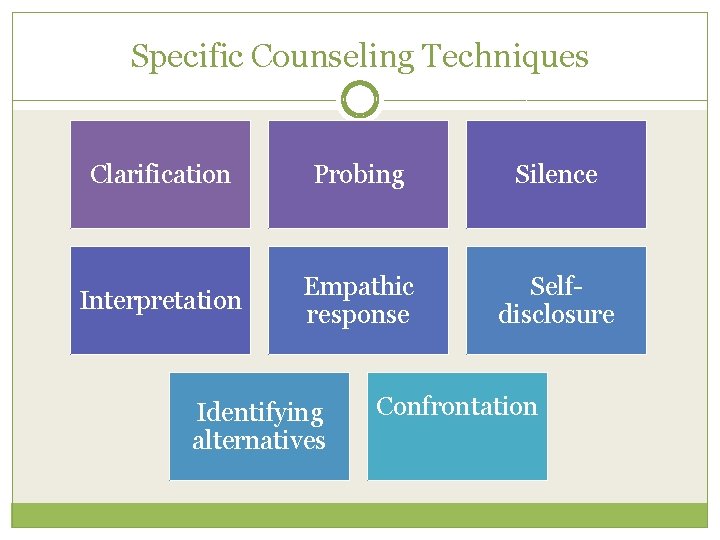
Specific Counseling Techniques Clarification Probing Silence Interpretation Empathic response Selfdisclosure Identifying alternatives Confrontation
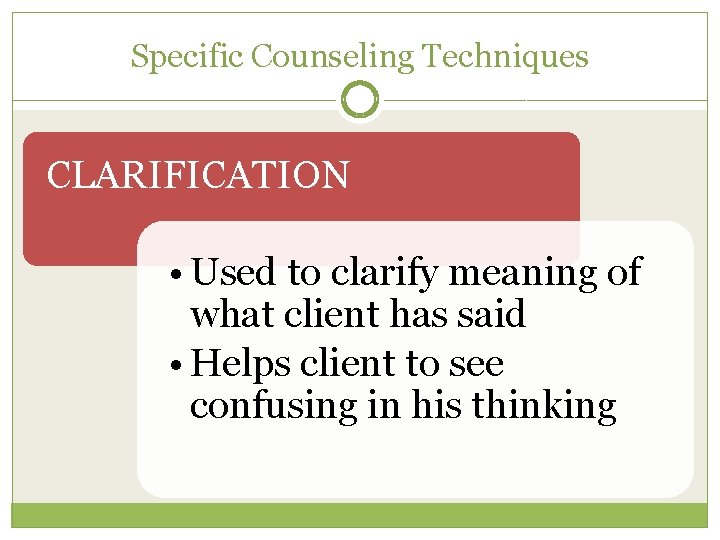
Specific Counseling Techniques CLARIFICATION • Used to clarify meaning of what client has said • Helps client to see confusing in his thinking
Specific Counseling Techniques CLARIFICATION • Commonly used phrases: • Would you tell me more about… • I did not understand… • Would you please elaborate/describe…
Specific Counseling Techniques PROBING • Questions encouraging client to express his thoughts/emotions in greater details • Used to develop self-insight
Specific Counseling Techniques PROBING • Probe should not be overwhelming for client • Important to avoid starting probe with a “WHY”
Specific Counseling Techniques PROBING • Commonly used probes: • What happened? • What made you use …? • What were you thinking? • How did you feel…?
Specific Counseling Techniques SILENCE • Very powerful technique • Helps client to continue sharing
Specific Counseling Techniques SILENCE • Used when client is • indulged in self-analysis • Expressing strong emotions- e. g. crying
Specific Counseling Techniques SILENCE • Commonly used expressions: • Nodding head • Saying, “Hmm. . ”
Specific Counseling Techniques INTERPRETATION • Pointing out discrepancy between what client says and does • Explaining it in a nonconfronting manner
Specific Counseling Techniques INTERPRETATION • Should not be given as a final verdict • Should only be done if counselor is sure of what client behavior could be indicating
Specific Counseling Techniques INTERPRETATION • Commonly used expressions: • Perhaps… • Correct me if I am wrong, but I think… • Would you agree if I said…?
Specific Counseling Techniques EMPATHIC RESPONSE • Indicates understanding and acceptance of client • Includes verbal/non-verbal communication (e. g. looking encouragingly at client)
Specific Counseling Techniques EMPATHIC RESPONSE • Commonly used expression: • I understand… • I can imagine how you must be feeling…
Specific Counseling Techniques EMPATHIC RESPONSE • Is different from sympathy
Specific Counseling Techniques EMPATHIC RESPONSE GROUP DISCUSSION What is difference sympathy and empathy? between
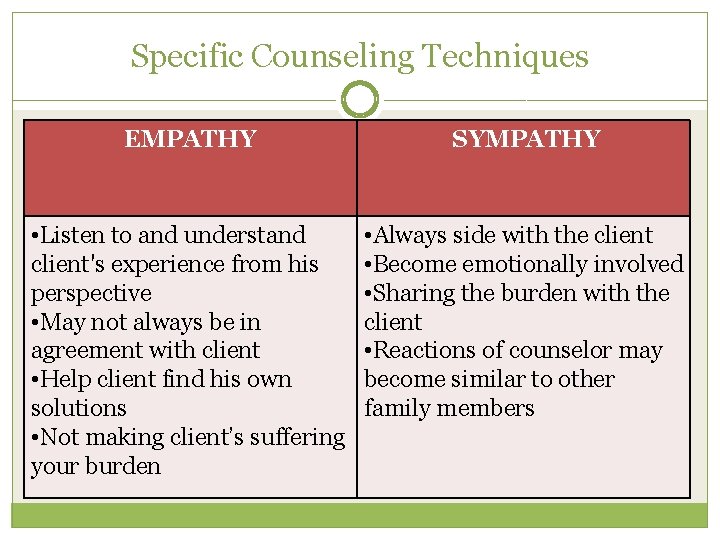
Specific Counseling Techniques EMPATHY SYMPATHY • Listen to and understand client's experience from his perspective • May not always be in agreement with client • Help client find his own solutions • Not making client’s suffering your burden • Always side with the client • Become emotionally involved • Sharing the burden with the client • Reactions of counselor may become similar to other family members
Specific Counseling Techniques SELF-DISCLOSURE • Contradictory views about how much counselor should disclose to client
Specific Counseling Techniques SELF-DISCLOSURE • May/may not help therapy process • Needs to be done carefully
Specific Counseling Techniques IDENTIFYING ALTERNATIVES • Client may feel helpless/hopeless • Needs to be made aware of choices he has with respect to drug use, relationships, occupation etc.
Specific Counseling Techniques IDENTIFYING ALTERNATIVES • Commonly used expressions: • Lets try and see what all options we have… • I was just wondering what are the possibilities… • Do you think there could be an alternative…
Specific Counseling Techniques CONFRONTATION • Involves challenging discrepancies and distortions in client’s thinking • Difficult technique
Specific Counseling Techniques CONFRONTATION • Should be used very carefully and only when absolutely necessary • Should be delivered in a firm, but polite way
Specific Counseling Techniques CONFRONTATION • Commonly used expressions: • I am not sure you meant that… • What I think is…
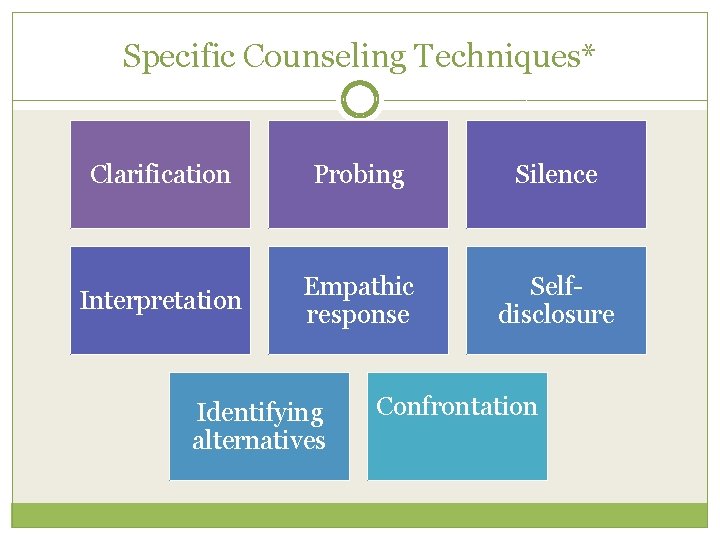
Specific Counseling Techniques* Clarification Probing Silence Interpretation Empathic response Selfdisclosure Identifying alternatives Confrontation
Characteristics of an effective counselor �GROUP ACTIVITY �Ask the group what could be the characteristics that make a good counselor?
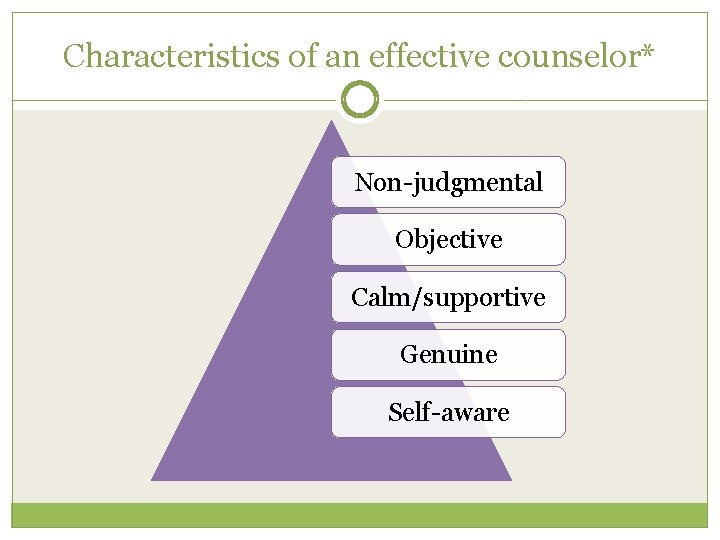
Characteristics of an effective counselor* Non-judgmental Objective Calm/supportive Genuine Self-aware
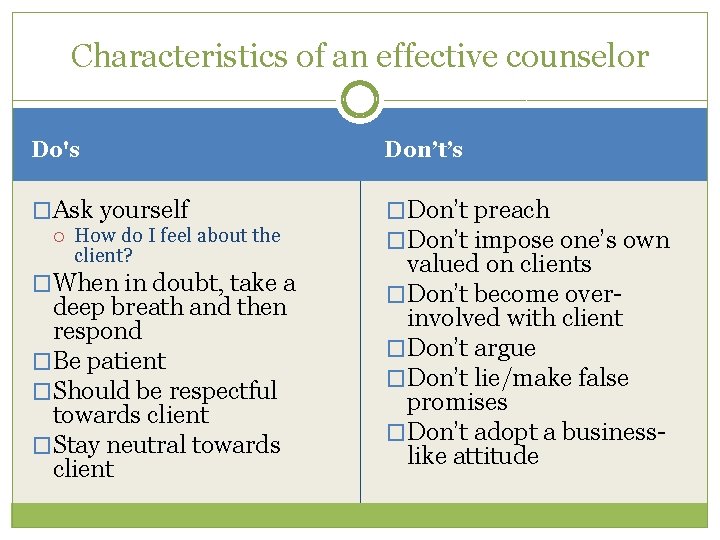
Characteristics of an effective counselor Do's Don’t’s �Ask yourself �Don’t preach �Don’t impose one’s own How do I feel about the client? �When in doubt, take a deep breath and then respond �Be patient �Should be respectful towards client �Stay neutral towards client valued on clients �Don’t become overinvolved with client �Don’t argue �Don’t lie/make false promises �Don’t adopt a businesslike attitude
Summary �Counseling helps the client get a perspective to their problems �A good counselor can help client with not only dealing with his drug problem but also building healthy relationships
A H T U O Y K N
- Slides: 45