
Basics of Computational Neuroscience 1 1 Introduction Lecture
Basics of Computational Neuroscience 1

1) Introduction Lecture: Computational Neuroscience, The Basics – A reminder: Contents 1) Brain, Maps, Areas, Networks, Neurons, and Synapses The tough stuff: 2, 3) Membrane Models 3, 4) Spiking Neuron Models 5) Calculating with Neurons I: adding, subtracting, multiplying, dividing 5, 6) Calculating with Neurons II: Integration, differentiation 6) Calculating with Neurons III: networks, vector-/matrix- calculus, assoc. memory 6, 7) Information processing in the cortex I: Neurons as filters 7) Information processing in the cortex II: Correlation analysis of neuronal connections 7, 8) Information processing in the cortex III: Neural Codes and population responses 8) Information processing in the cortex IV: Neuronal maps Something interesting – the broader perspective 9) On Intelligence and Cognition – Computational Properties? Motor Function 10, 11) Models of Motor Control Adaptive Mechanisms 11, 12) Learning and plasticity I: Physiological mechanisms and formal learning rules 12, 13) Learning and plasticity II: Developmental models of neuronal maps 13) Learning and plasticity III: Sequence learning, conditioning Higher functions 14) Memory: Models of the Hippocampus 2 15) Models of Attention, Sleep and Cognitive Processes
Literature (all of this is very mathematical!) General Theoretical Neuroscience: „Theoretical Neuroscience“, P. Dayan and L. Abbott, MIT Press (there used to be a version of this on the internet) „Spiking Neuron Models“, W. Gerstner & W. M. Kistler, Cambridge University Press. (there is a version on the internet) Neural Coding Issues: „Spikes“ F. Rieke, D. Warland, R. de Ruyter v. Steveninck, W. Bialek, MIT Press Artificial Neural Networks: „Konnektionismus“, G. Dorffner, B. G. Teubner Verlg. Stuttgart „Fundamentals of Artificial Neural Networks“, M. H. Hassoun, MIT Press Hodgkin Huxley Model: See above „Spiking Neuron Models“, W. Gerstner & W. M. Kistler, Cambridge University Press. Learning and Plasticity: See above „Spiking Neuron Models“, W. Gerstner & W. M. Kistler, Cambridge University Press. Calculating with Neurons: Has been compiled from many different sources. Maps: Has been compiled from many different sources. 3
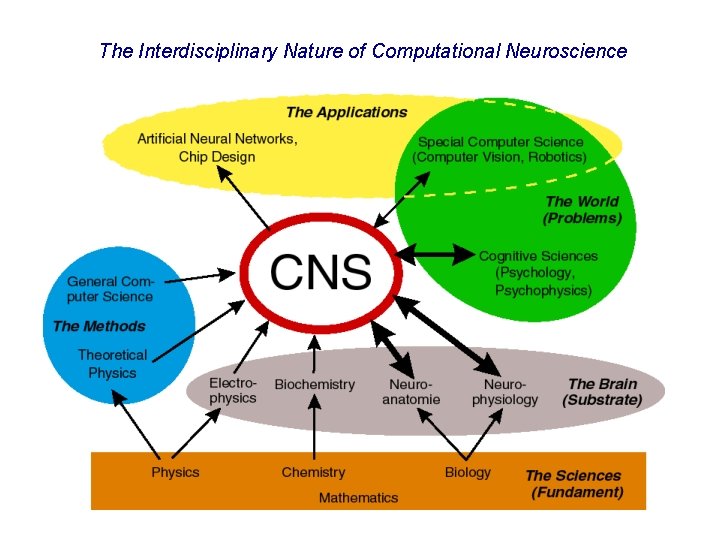
The Interdisciplinary Nature of Computational Neuroscience What is computational neuroscience ? 4
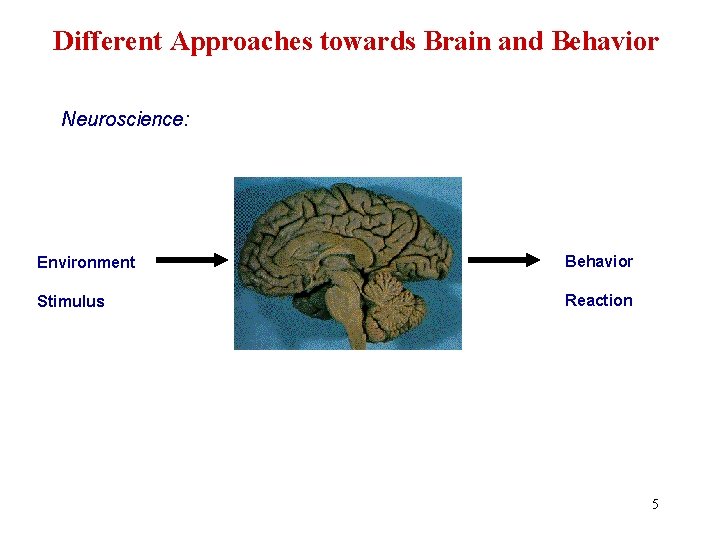
Different Approaches towards Brain and Behavior Neuroscience: Environment Behavior Stimulus Reaction 5
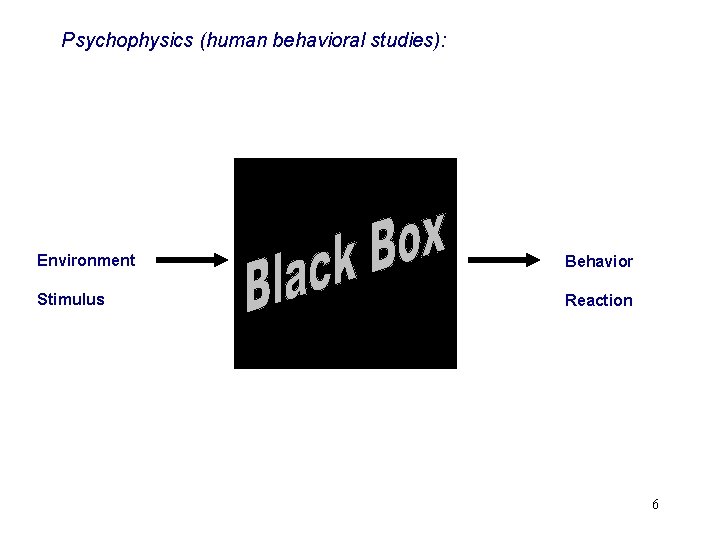
Psychophysics (human behavioral studies): Environment Behavior Stimulus Reaction 6
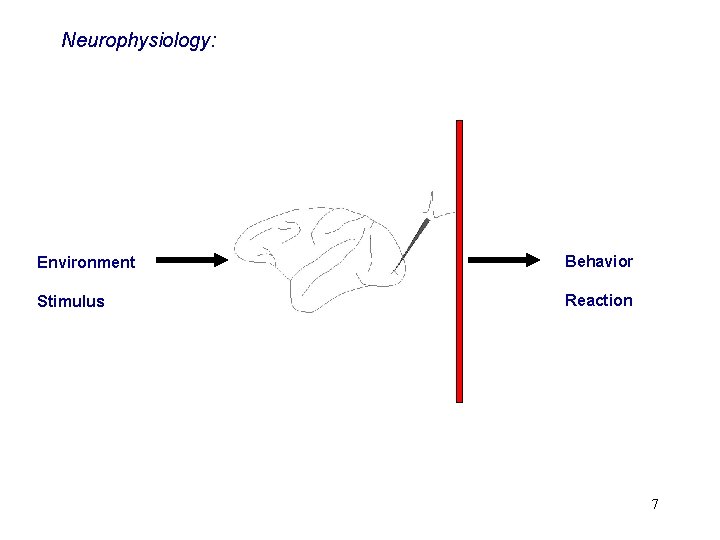
Neurophysiology: Environment Behavior Stimulus Reaction 7
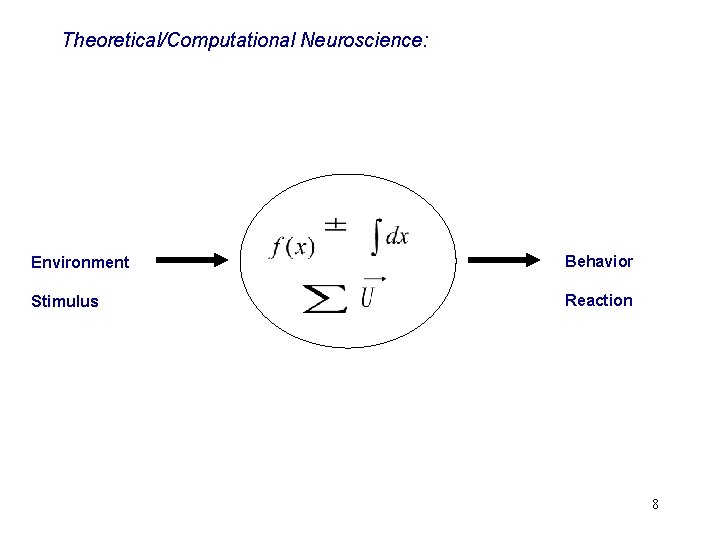
Theoretical/Computational Neuroscience: Environment Behavior Stimulus Reaction 8
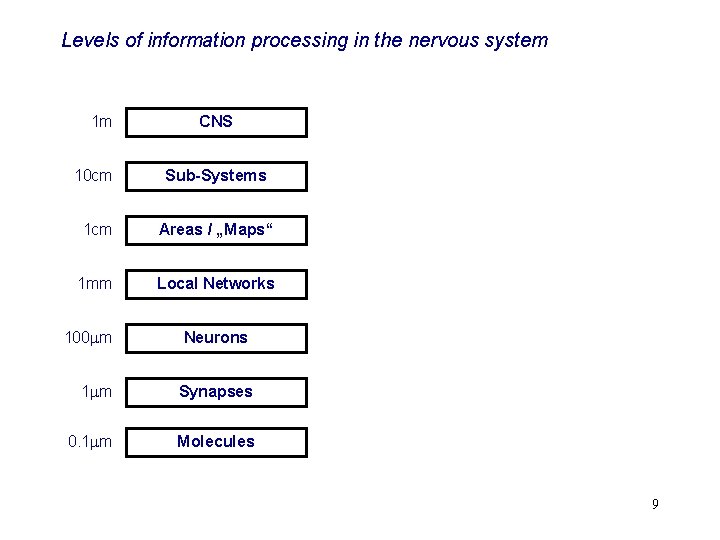
Levels of information processing in the nervous system 1 m CNS 10 cm Sub-Systems 1 cm Areas / „Maps“ 1 mm Local Networks 100 mm Neurons 1 mm Synapses 0. 1 mm Molecules 9
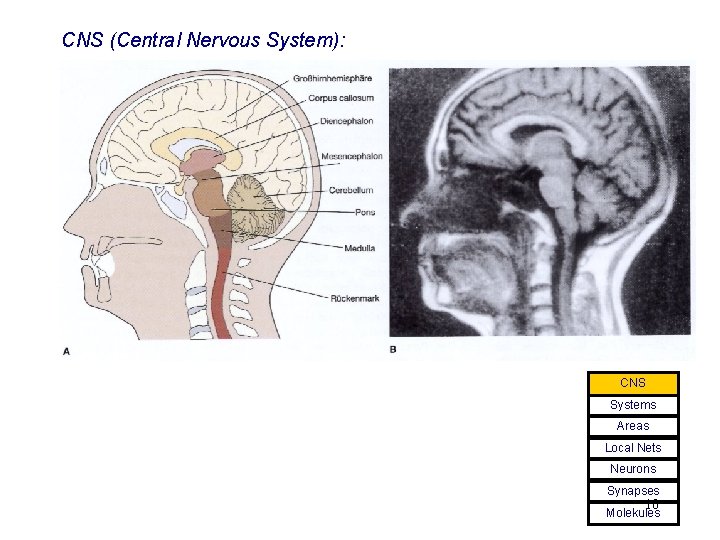
CNS (Central Nervous System): CNS Systems Areas Local Nets Neurons Synapses 10 Molekules
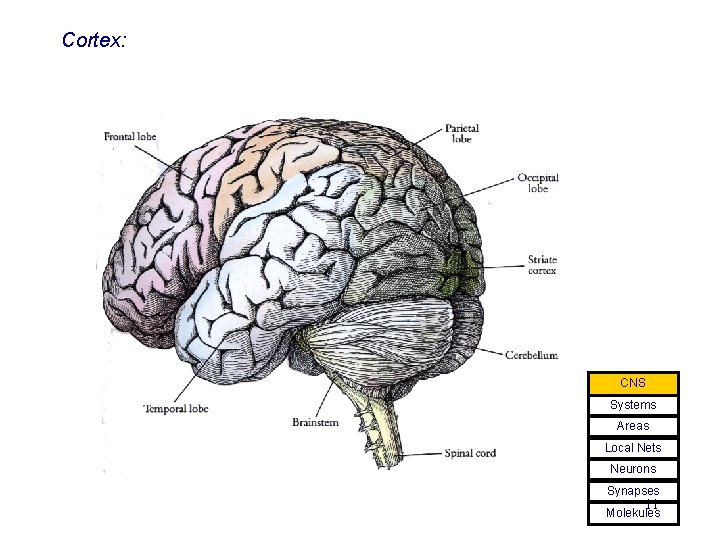
Cortex: CNS Systems Areas Local Nets Neurons Synapses 11 Molekules
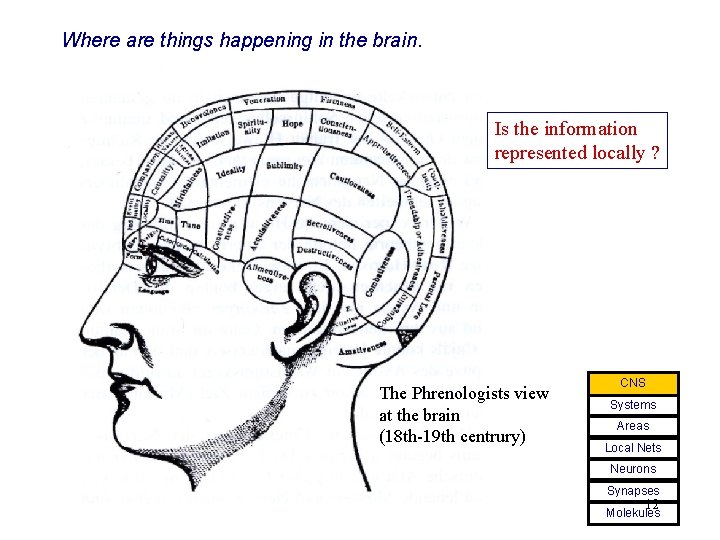
Where are things happening in the brain. Is the information represented locally ? The Phrenologists view at the brain (18 th-19 th centrury) CNS Systems Areas Local Nets Neurons Synapses 12 Molekules
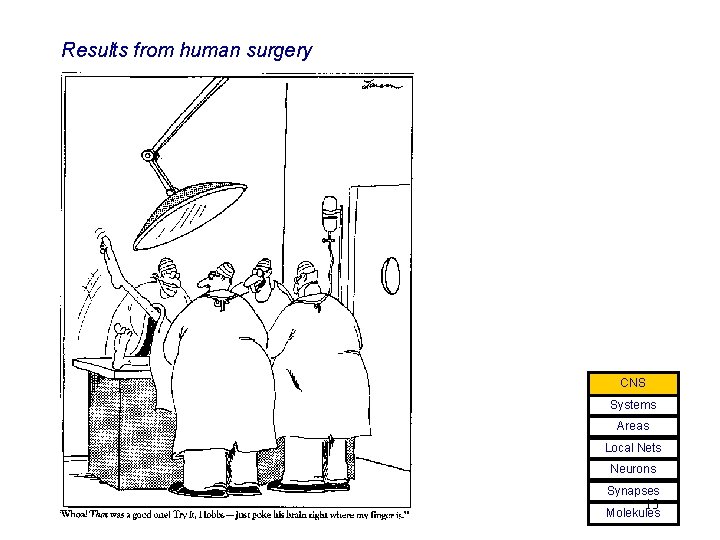
Results from human surgery CNS Systems Areas Local Nets Neurons Synapses 13 Molekules
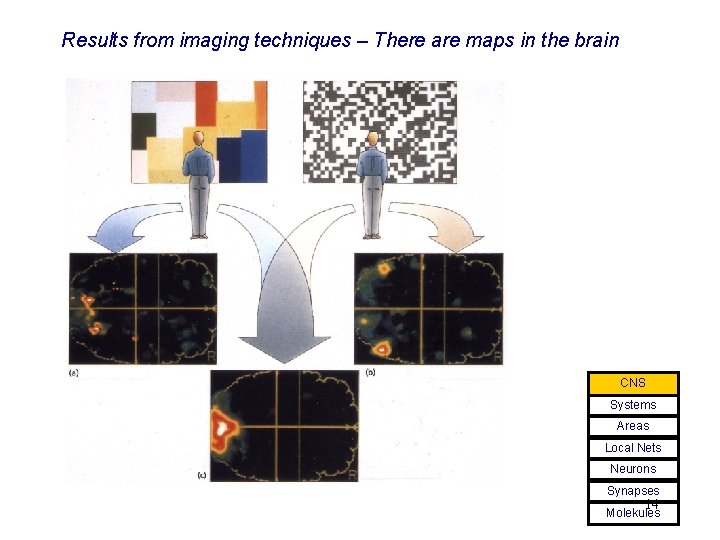
Results from imaging techniques – There are maps in the brain CNS Systems Areas Local Nets Neurons Synapses 14 Molekules
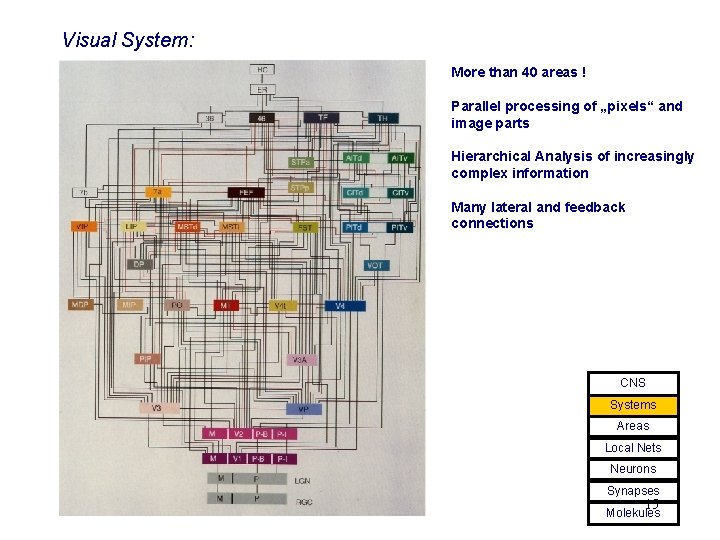
Visual System: More than 40 areas ! Parallel processing of „pixels“ and image parts Hierarchical Analysis of increasingly complex information Many lateral and feedback connections CNS Systems Areas Local Nets Neurons Synapses 15 Molekules
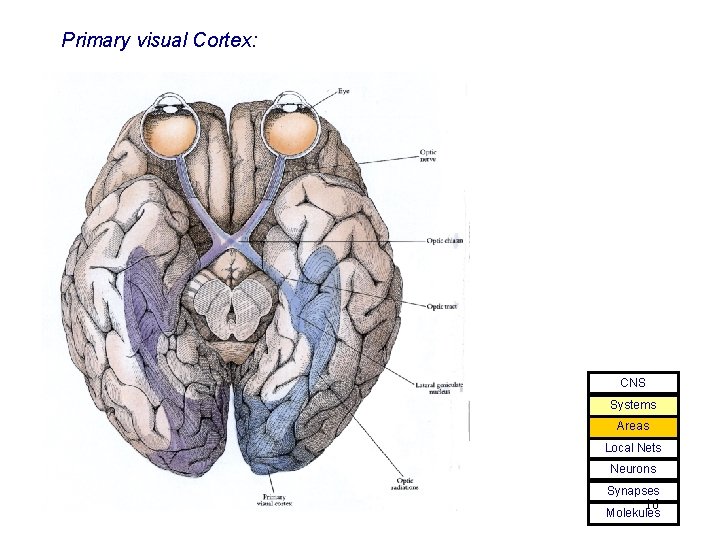
Primary visual Cortex: CNS Systems Areas Local Nets Neurons Synapses 16 Molekules
Retinotopic Maps in V 1: V 1 contains a retinotopic map of the visual Field. Adjacent Neurons represent adjacent regions in the retina. That particular small retinal region from which a single neuron receives its input is called the receptive field of this neuron. V 1 receives information from both eyes. Alternating regions in V 1 (Ocular Dominanz Columns) receive (predominantely) Input from either the left or the right eye. Each location in the cortex represents a different part of the visual scene through the activity of many neurons. Different neurons encode different aspects of the image. For example, orientation of edges, color, motion speed and direction, etc. V 1 decomposes an image into these components. CNS Systems Areas Local Nets Neurons Synapses 17 Molekules
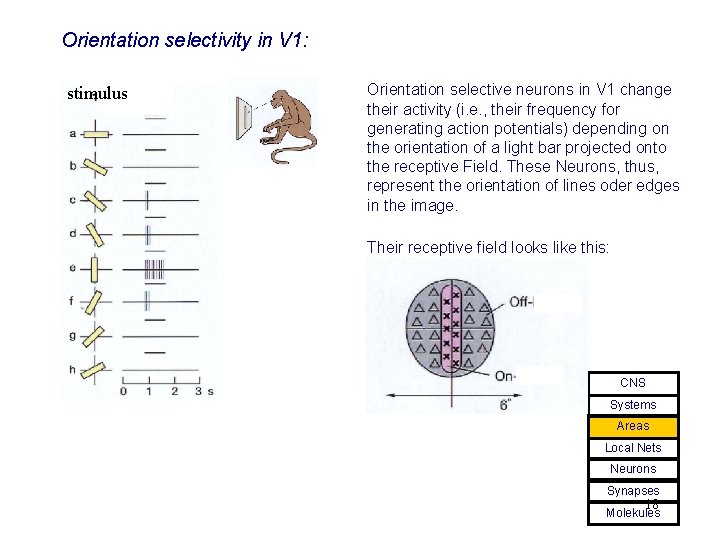
Orientation selectivity in V 1: stimulus Orientation selective neurons in V 1 change their activity (i. e. , their frequency for generating action potentials) depending on the orientation of a light bar projected onto the receptive Field. These Neurons, thus, represent the orientation of lines oder edges in the image. Their receptive field looks like this: CNS Systems Areas Local Nets Neurons Synapses 18 Molekules
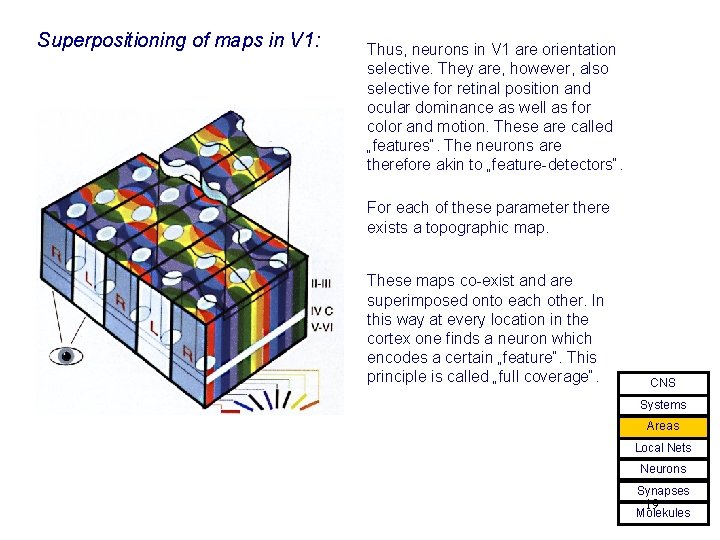
Superpositioning of maps in V 1: Thus, neurons in V 1 are orientation selective. They are, however, also selective for retinal position and ocular dominance as well as for color and motion. These are called „features“. The neurons are therefore akin to „feature-detectors“. For each of these parameter there exists a topographic map. These maps co-exist and are superimposed onto each other. In this way at every location in the cortex one finds a neuron which encodes a certain „feature“. This principle is called „full coverage“. CNS Systems Areas Local Nets Neurons Synapses 19 Molekules
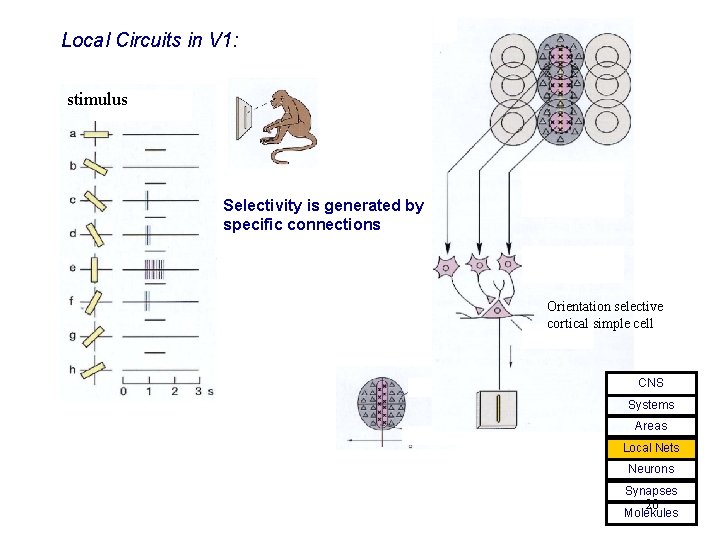
Local Circuits in V 1: stimulus Selectivity is generated by specific connections Orientation selective cortical simple cell CNS Systems Areas Local Nets Neurons Synapses 20 Molekules
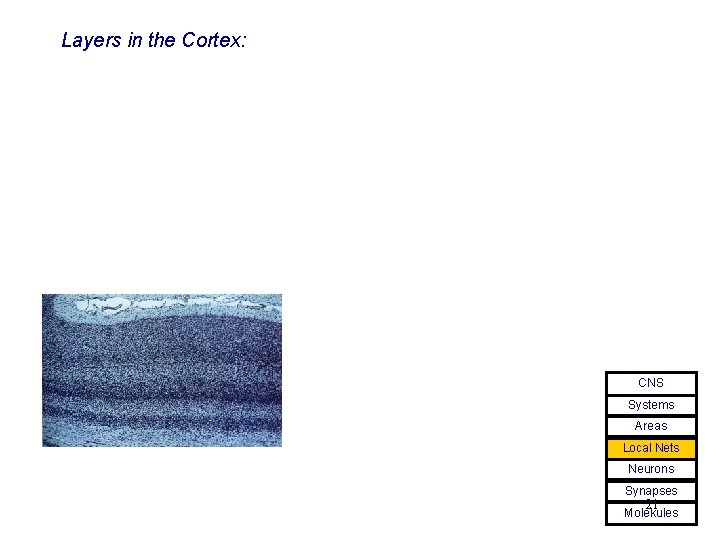
Layers in the Cortex: CNS Systems Areas Local Nets Neurons Synapses 21 Molekules
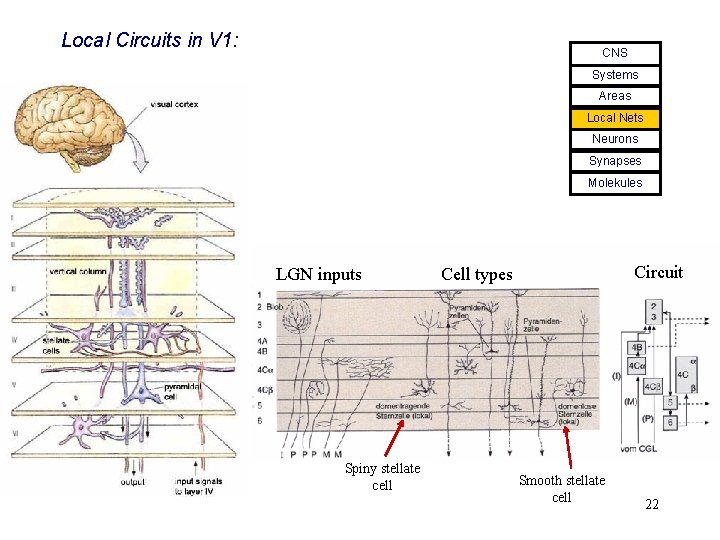
Local Circuits in V 1: CNS Systems Areas Local Nets Neurons Synapses Molekules LGN inputs Spiny stellate cell Circuit Cell types Smooth stellate cell 22
Considerations for a Cortex Model • Input – Structure of the visual pathway • Anatomy of the Cortex – Cell Types – Connections • Topography of the Cortex – – „X-Y Pixel-Space“ and its distortion Ocularity-Map Orientation-Map Color • Functional Connectivity of the cortex – Connection Weights – Physiological charateristics of the neurons At least all these things need to be considered when making a „complete“ cortex model 23
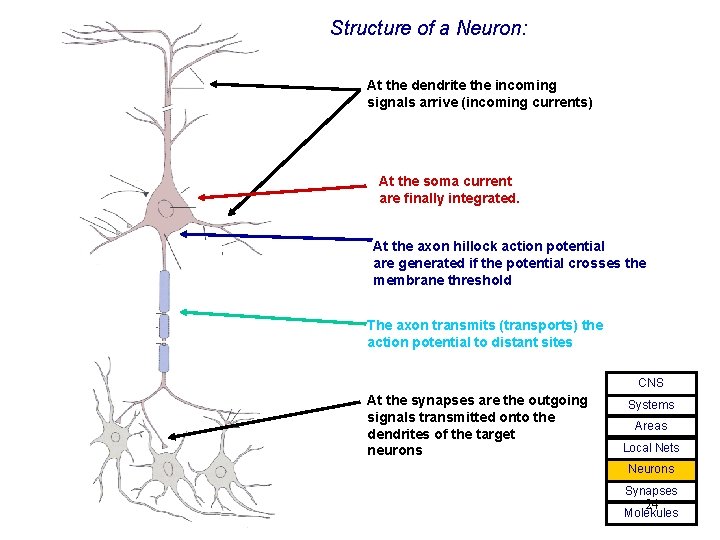
Structure of a Neuron: At the dendrite the incoming signals arrive (incoming currents) At the soma current are finally integrated. At the axon hillock action potential are generated if the potential crosses the membrane threshold The axon transmits (transports) the action potential to distant sites CNS At the synapses are the outgoing signals transmitted onto the dendrites of the target neurons Systems Areas Local Nets Neurons Synapses 24 Molekules
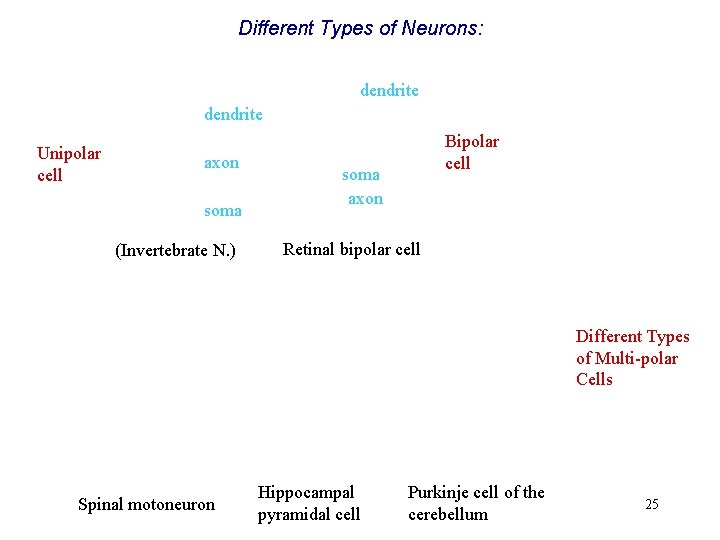
Different Types of Neurons: dendrite Unipolar cell axon soma (Invertebrate N. ) Bipolar cell soma axon Retinal bipolar cell Different Types of Multi-polar Cells Spinal motoneuron Hippocampal pyramidal cell Purkinje cell of the cerebellum 25
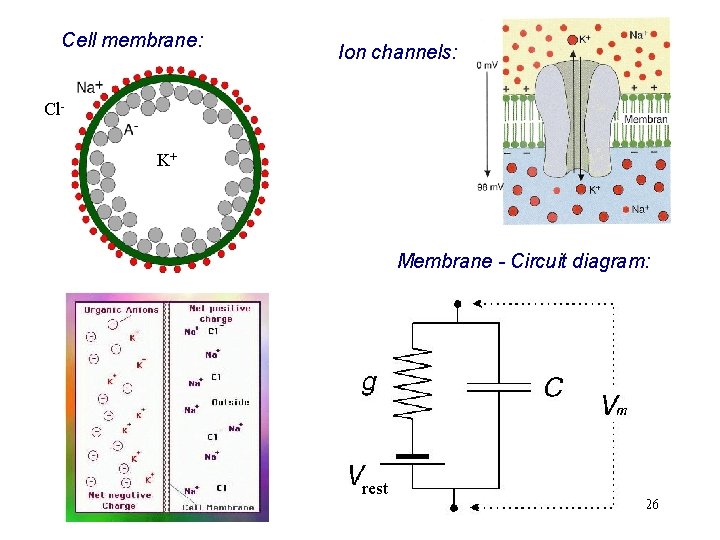
Cell membrane: Ion channels: Cl. K+ Membrane - Circuit diagram: rest 26
- Slides: 26