
Basics of Communication Latin words communicare communico to
Basics of Communication Latin words – communicare, communico (to share) Exchange of ideas, opinions, & as a means that individuals & organisations share meaning with another. Importance(value, )worth of communication: 1) Communication is a tool of supervision: ------which is in constant use & must always be in good condition. ------Power to reach out to every individual.
2)Communication is essential for encouragment: -----to encourage the employees. ------to make good relations among other workers. ------increases the morale (self-esteem, confidence) In the mind of the employees. 3) Helps to exchange ideas & information: -------it is important for group work. ----helps to achieve a common goal. 4)Good co-ordination(organising) depends on good communication: -----all levels shd be catered to -----upward, downward, sideway comm as per the situation demands for.
• 5)Communication maintains good relations: ----It connects people with each other. ----improves the working conditions & maintains healthy relations. COMMUNICATION CYCLE Thought of idea -----Encoding (programing(ie)put the message into words or images)---transmission(spread) of message(shd be simple & clear)----channel (the media thru which the message is sent) -----receiving ---decoding( understanding, make sense of the language) -----understanding ----action ------ feedback (is the response, most imp link).

QUESTIONS: 1) Explain the importance of communication. 2) Explain the five elements of the communication cycle. Sender(may be single or group) -----message(verbal, non-verbal)-----channel ----receiver -------feedback. 3)What role does “encoding” and “decoding” play in a communication process. 4) Which is the most important link in communication cycle? Give reasons. Feedback, the process of communication remains incomplete if feedback is not given.
Communication can be made more effective by by using the following principles: The 7 Cs are as follows: 1) C orrectness: (giving factually & linguistically correct inf) A business letter shd b correct in all aspects. The language shd b used correctly – no spelling mistakes, punctuation mistakes & grammatical mistakes. The layout of the letter shd b correct. Information in the letter shd b factual & correct. No place for guess work or inaccurate statements.
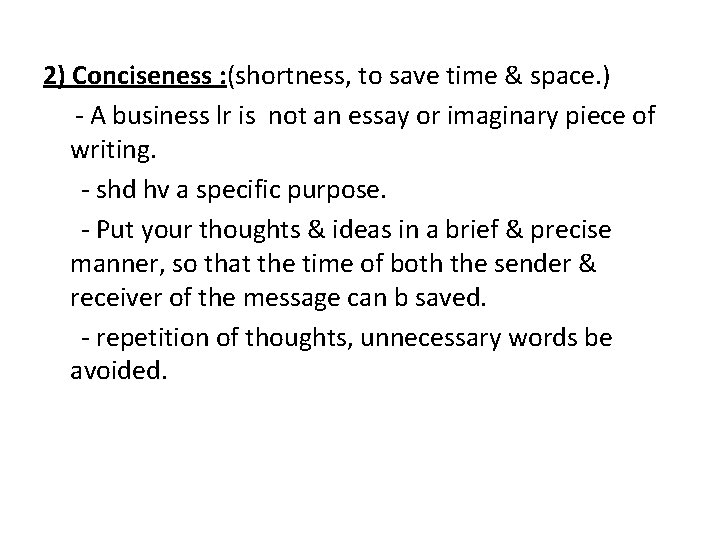
2) Conciseness : (shortness, to save time & space. ) - A business lr is not an essay or imaginary piece of writing. - shd hv a specific purpose. - Put your thoughts & ideas in a brief & precise manner, so that the time of both the sender & receiver of the message can b saved. - repetition of thoughts, unnecessary words be avoided.
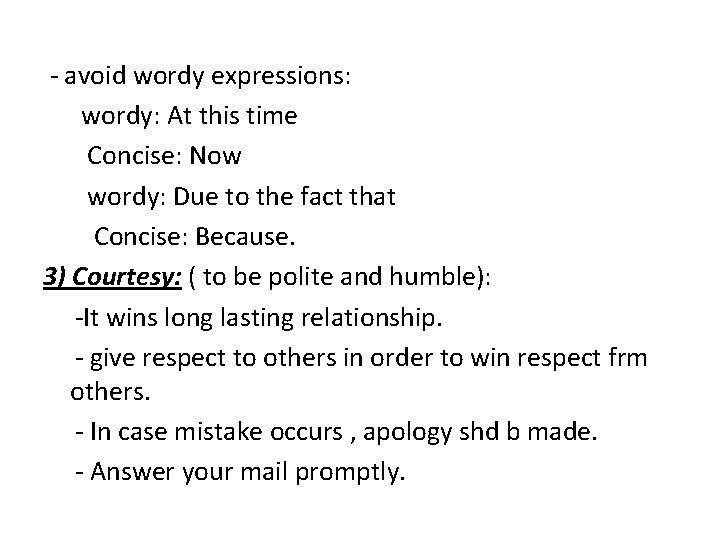
- avoid wordy expressions: wordy: At this time Concise: Now wordy: Due to the fact that Concise: Because. 3) Courtesy: ( to be polite and humble): -It wins long lasting relationship. - give respect to others in order to win respect frm others. - In case mistake occurs , apology shd b made. - Answer your mail promptly.

- while writing a business letter, take into consideration the other person’s point of view & feelings into considerations. - The writer shd adopt the ‘you attitude’. Please, thank you, would you, can you are some of the polite discourse markers in use. Eg: a) Stupid letter, I cant understand any of it. I just need a bit of information on the context to get a better understanding.

4) Concrete: (specific, actual) • Words used in the business letter shd be specific. • Eg: 1) I made (prepared) a speech I delivered ( presented)a speech. 2) I have not heard from you. I have not received any communication. Concrete: I have not received any letter. 3) With reference to earlier communication……. . Concrete: With reference to the letter dated on ……………
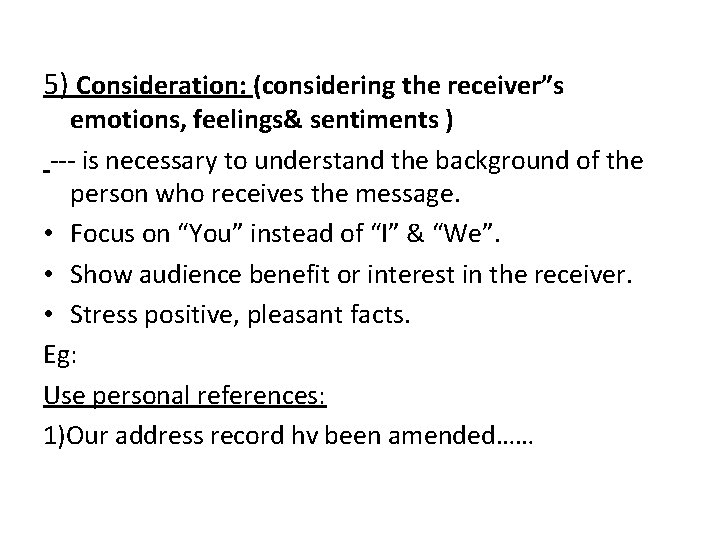
5) Consideration: (considering the receiver”s emotions, feelings& sentiments ) --- is necessary to understand the background of the person who receives the message. • Focus on “You” instead of “I” & “We”. • Show audience benefit or interest in the receiver. • Stress positive, pleasant facts. Eg: Use personal references: 1)Our address record hv been amended……
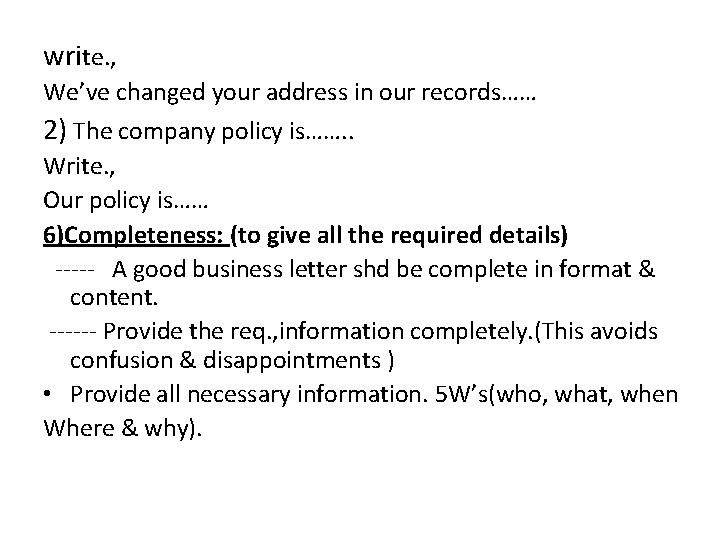
write. , We’ve changed your address in our records…… 2) The company policy is……. . Write. , Our policy is…… 6)Completeness: (to give all the required details) ----- A good business letter shd be complete in format & content. ------ Provide the req. , information completely. (This avoids confusion & disappointments ) • Provide all necessary information. 5 W’s(who, what, when Where & why).
• Answer all questions asked. (Look for ques. , some may even appear buried within a paragraph) • Give somethg extra , when desirable. • For the letter to be complete, the writing mst be properly planned & organised. 7) Clarity: ( to have clear information) • Shd be easy to understand by people at all levels of an org. • Understood by the receiver, in the same sense with which the sender conveys it. • Proper punctuation makes the writing clear. • Choose precise & familiar words.
Eg: after……subsequent Home……. Domicile for example……e. g. • Construct effective sentences & paragraphs; Eg: Unclear: Being an excellent lawyer, I am sure you can help us. Clear: Being an excellent lawyer, you can surely help us. Unclear: GMAT scores are higher by 70% this year.
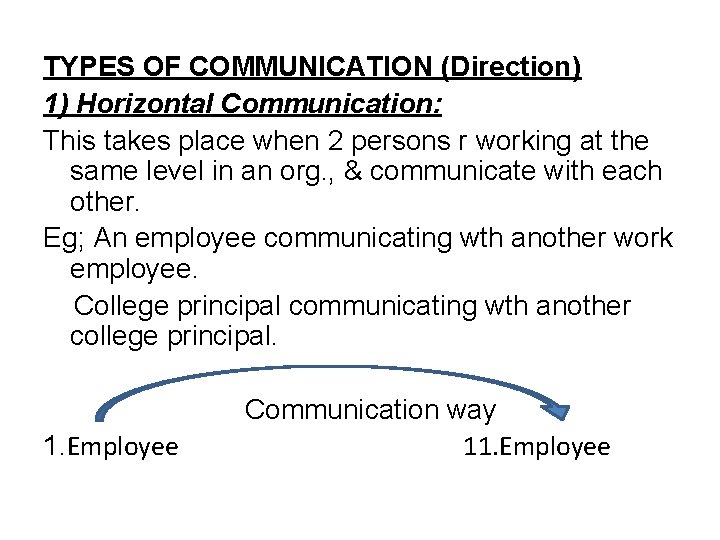
TYPES OF COMMUNICATION (Direction) 1) Horizontal Communication: This takes place when 2 persons r working at the same level in an org. , & communicate with each other. Eg; An employee communicating wth another work employee. College principal communicating wth another college principal. 1. Employee Communication way 11. Employee
2)Vertical Communication: Here communication takes place in 2 opposite levels as per situations. Eg: worker communicatng with the manager of his dept. , & at the same time he communicates wth his co-worker. ----It shows the worker communicates wth the manager as well as the worker. Vertical comm. , is classified in 2 ways: Upward & downward comm.
a) Upward Comm: ---which turns upwards in transaction of message. -----It contains the communication of junior to senior. ------ A person working at a lower level in an org. , communicates with the person wrkng at a higher level. ------The communication includes discipline, mannerism & also strict observation of rules. -----Eg: job application, request letter, application for loan, submission of report.
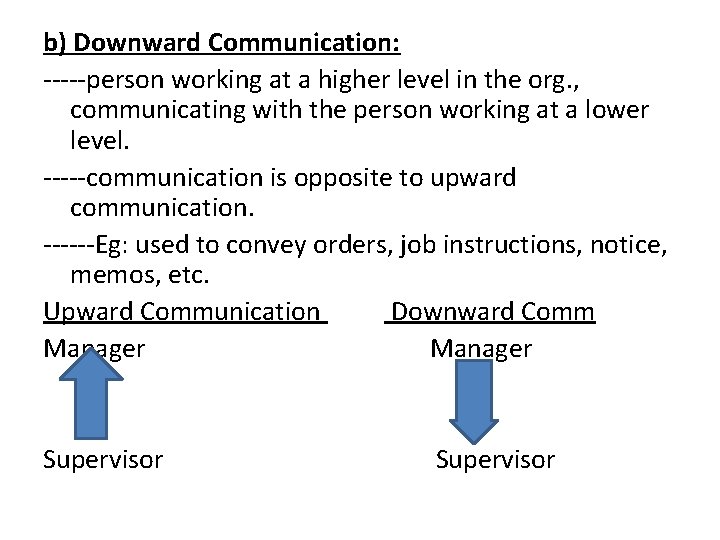
b) Downward Communication: -----person working at a higher level in the org. , communicating with the person working at a lower level. -----communication is opposite to upward communication. ------Eg: used to convey orders, job instructions, notice, memos, etc. Upward Communication Downward Comm Manager Supervisor
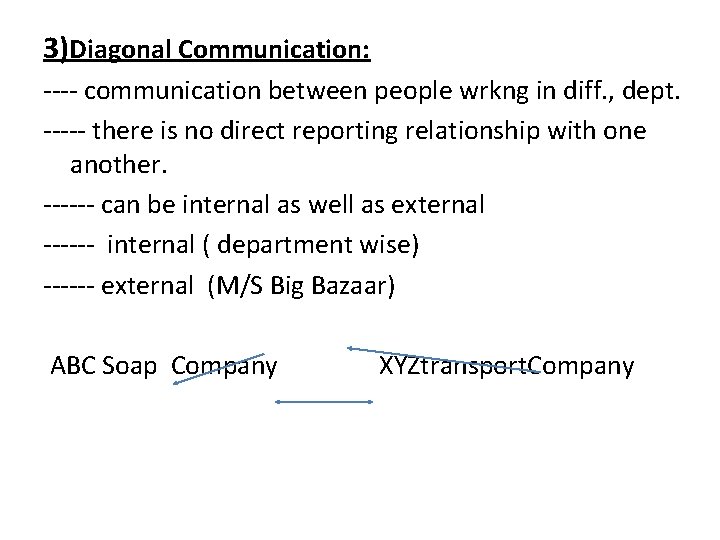
3)Diagonal Communication: ---- communication between people wrkng in diff. , dept. ----- there is no direct reporting relationship with one another. ------ can be internal as well as external ------ internal ( department wise) ------ external (M/S Big Bazaar) ABC Soap Company XYZtransport. Company
Verbal Communication -----also called as oral comm. -----2 types of verbal comm. a)Oral comm b)Written comm Oral Communication: • most imp type of comm. • Eg: face to face, telephonic talk, lectures, interviews, counselling, • Public speeches, movies, etc. • More than one medium is required here---visuals, gestures, facial expressions, etc.
Adv. Of Oral Comm: • Get immediate feedback. • Both sender & receiver r present. • Gestures, facial exp. , postures r being used to make comm. , more effective. • More powerful ---gives more personal touch. • Saves time. • Can address a large group of people at a time. • Sender or speaker gets chances to repair his message by observing facial expressions of listener.
Disadvantages of Oral Comm: • Communication cannot take place, when either the sender or receiver remains absent. • Lenghty messages become monotonous in oral comm. eg: Lecture method. • Most people r nt good listeners, so comm. , may not be understand properly. • Oral messages hv no legal importance. • Speaker gets less time to think in oral comm. Therefore, there may be chances for misunderstanding or mistakes. • Every person is not an orator. Common people do face problems or difficulties in speaking & listening.
• Most people do not take oral message seriously. • This becomes less effective over long distance. Eg: ISD call. • Oral Comm. , cannot be repeated same as first. Every time the presentation keeps changing. • Oral messages has lot of chances for external barriers.
Definitions: 1)Verbal Comm: It is the use of language arranged in meaningful patterns. Communication that takes place with the help of words or language is called as verbal comm. 2)Oral Comm: Communication that takes place using words as a medium of speech is called as oral communication. 3) Written Communication: “The comm. , in which message is conveyed in the written format is called written comm. ” Here communication is based on the use of alphabets, signs , or codes of any kind , which is rendered by writing or typing. Eg: letter, circular, notice, books, newspapers, etc. .
Adv. , of Written Comm: • The writer gets much time to think & to reflect his ideas on paper. Therefore, it becomes more correct because of careful preparation. • It can be repeated till the final understanding of reader. • Written messages can be given to large number of persons in a cost effective manner. Eg: pamphlets, circulars, newspapers. • Lenghty messages can be transmitted easily.
• Gives sufficient time to reader to give feedback. • Serves as permanent record & importance as a legal document. • It facilitates ( make it easier) the assigned responsibility. • Assures more uniformity as it is circulated among the people.
Disadvantages of Written Communication: • Has no use for illiterate people. • It is time consuming. • Quick feedback is not possible. • Has no chance for quick clarification in the message. • Confidential messages has a chance of leakage. • It also contains barriers in dispatch. • Few words have special terminology. Their wrong uses lead wrong interpretation.
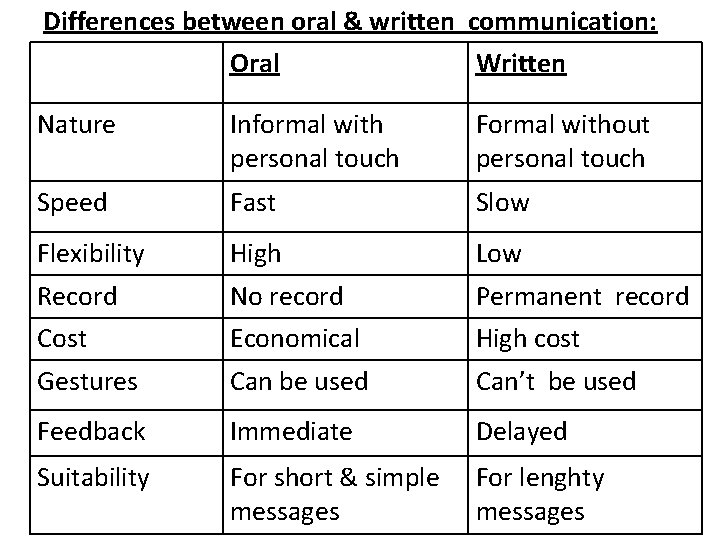
Differences between oral & written communication: Oral Written Nature Informal with personal touch Formal without personal touch Speed Fast Slow Flexibility High Low Record No record Permanent record Cost Economical High cost Gestures Can be used Can’t be used Feedback Immediate Delayed Suitability For short & simple messages For lenghty messages
Non-Verbal Communication without the use of words is called as non-verbal communication. These wordless messages can be communicated through gestures, body language or postures, facial expressions, eye contact, signs, symbols, maps, graphs, etc. This communication happens all the time & is everywhere. It is spontaneous & usually not deliberate or planned. Types of Non-Verbal Communication 1) Body language or Kinesics: It includes gestures, facial expressions, postures, touch
Etc. This is one of the most powerful ways that humans can communicate non-verbally. It is used to potray moods & emotions, & to emphasize or contradict what is being said. “To effectively communicate, it’s not always what you say, but what your body says, that makes the difference. ” Its therefore, we will see now how different parts of the body send out signals. a) Facial Expression: Whatever we feel deep in ourselves is atonce reflected in the face. It is very important in face-to-face communication. Every facial muscle is an instrument of communication.
Eg: The lines of our forehead, the eyebrows, the muscles of our cheeks, our lips in a smile or in a surprise ----all these speaks louder than words. b) Eye Contact: This is of paramount importance in face to face communication. When we look at somebody’s face , we focus primarily on his eyes & try to understand what he means to convey. Eg: Raised eyelids tells us that the person is surprised or frightened. A long , fixed gaze shows our interest in something or somebody.
c) Gestures: Movements of arms, legs, heads, shoulders & head are Called gestures. The way we place our palms, arms, hands, head, shoulders, etc while speaking, listening or reading convey diff. , meanings. Eg: A namaste, raising eyebrows, handshake, shaking head. d) Posture: • The way you sit , stand or walk, or the way you carry yourself speaks about your personality. • Good postures shows smartness and confidence. • Eg: Attending interview ----have eyecontact & be relaxed.
e) Appearance: It means general grooming. It is imp. , not to draw attention for all the wrong reasons. Eg: We dress differently for different occassions. A wedding in the family, a visit next door, a friend’s birthday party, attending an interview or going to college------all call for different dressing. 2) Silence: • Silence can be a positive or negative influence in the communication process. • It can create tension & uneasiness or create a peaceful situation.
• Radio & television announcers also knw that the best way to highlight or emphasize a word is to pause slightly before it. ( and even after it). • Eg; 1) The st. keeping silent for a few moments before answering a ques. -------he is thinking. 2) Two strangers remain silent after a few moments of conversation-------they do not hv much in common. 3) A V. I. P. enters the room & people becomes silent -----respect his presence. 4) A person in the train begins talking to u & u look out of the window in silence -------u do not wish to get friendly.
5) A joke at a party is greeted with silence ------people disapprove of the joke or the speaker. 6) A teacher demands frm his student why a certain assignment has not been done & the st. , remain silent -------he does nt hv an explanation. So finally we can conclude that Body Language is a part & parcel of human expression in communication.
Barriers in communication Def: “Hindrance that blocks the flow of communicaation is termed as barrier. ” Different people devise different messages in different ways for different receivers. It results more into communication gap so that some one may turn towards misunderstanding & misjudgment. Types of barriers: 1) Physical barrier: They are those which are mostly beyond the control of the persons involved in the communication process. Some can be controlled , but at times the defect lies in
the environment. a) Noise: It affects the transmission & reception of the message. Noise is the major cause of disruption in communication. Eg: When 2 people r communicating in a factory, the noise frm the machinery can be a barrier. b) Distance: Distance between the communicators may act as a barrier. Eg: When people speak frm far distant areas, their voice becomes inaudible or unrecognizable for the listeners c) Environmental condition:
Environmental conditions like humidity, temperature, cold, decrease the attention level of the listeners. They feel uninterested & suffocated in communication. Eg : AC in the classroom d) Natural calamities: like floods, earthquake, cyclone, tsunami. eg: 2 friends r discussing abt their study on the ground. Suddenly the atmosphere changes & clouds gathers in the sky. With it rain starts. The result is that these friends had to stop their conversation & leave that place. Here the sudden change in the atmosphere & rain becomes the barrier.
e) Physical disability: like dumbness, tentative loss of hearing ability can cause barriers. Overcoming physical barriers: • The sender shd be very careful and aware while transmitting message. • Minimise visual and aural distractions. • Provide environmental comfort. 2) Psychological barriers: • It is nothing but the mind set of a person. Several abstract ideas , i. e. , mental conditions, likes, dislikes, fear, happiness, ego ----all these directly affect on our thinking. It is because of this communication gap
Appears in conversation. This defect is knwn as psychological barrier in communication. Some of its types are: 1) Negative bias about himself: Whenever a person is going to express anything before a speaker, many times he may be controlled by his negative thinking. Eg: When anyone looks forward to do something in life, he looks behind & looses confidence. 2) Status: In organisations, status consciousness is treated at the highest level & different manner. The sub-ordinates are always afraid of such people.
There fore, it all leads to: a) Communication gap. (boss-employee relationship. ) b) Sometimes postponed in communication. (afraid of talking to the seniors)----manager & the workers. c) Unexplained feedback (happens when the senior does not listen carefully due to inferior status as junior. )---officer & a peon. 3) Emotions: Emotions does affect our attitude & behaviour. When any human is fully indulged into any emotion, he becomes irresponsive to new idea and so he feels disturbed. a) When a person is in grief or sorrow he does not like to listen. Even if he listens, he will not behave according to you. (When a student fails in an examination. )
b) When a man is happy, again he is not in a condition of listening to others. (Passing IIT Exam) c) When a man is angry, he is not able to deliver proper message, & it prevents smooth communication. 4) Less attentiveness: If a person has less attention towards the said topic, he fails in giving feedback. a) When a person is disinterested in a topic, he forgets it very easily, & refuses to store it into his long term memory. Overcoming Psychological barriers: • Use feedback process. • Provide assistance to comprehend the message clearly. (In the class rooms, difficult topics are not
understood by the students. Therefore, the teacher shd make an attempt to simplify the topic. ) • Call attention & motivate the listener. • Develop trust & confidence. , & this will help the others to open up their problems. • Catch up with individual background. 3) Semantic barriers: Communication itself is impossible without using language. Therefore, every sender & receiver has to use lang. , properly. This is the most imp. , means of communication. Words have different shades of meaning &
Pronunciations , which shd be used very carefully. Eg: • Foreigners are less understood by Indians due to their language & pronunciation. • The court terminology is not understood by common people. • When u use new words in your daily conversation. listener’s vocabulary becomes a barrier. Overcoming semantic barriers: 1) Use simple & precise lang. 2) Employ different methods of communication. 3) Avoid ambiguous & abstract words.
4) Try to grab listeners attention. 5) Before going to deliver the message, the sender has to evaluate the listeners. (their intelligence level) 6) The sender must have to take pause in each sentence , so that the listener may get chance to translate the said sentence. 7) He shd concentrate on his own pronunciation. 4) Organisational barriers: In any organisational set up, 2 basic channels of communication---formal & informal flows. Here the processing of information from several people gets delayed & distorted before it reaches to the destination. Eg: Upward Communication, Downward Communication, horizontal & vertical communication.
Overcoming Organisational barriers: • Make Communication 2 way process. • Establish feedback system. • Use informal channel of communication. • Avoid unnecessary information. • Purposeful communication. 5) Interpersonal barriers: Here emotional reactions, positive & negative attitude of the sender & the receiver, wrong timing of message & inattentive listening create communication barriers. As we all r different, our perceptions, our understanding & our value systems r different, the process of communicating effectively with other people is rather difficult at times.
When there are shared assumptions of ideas, views, values & opinions , it is easy to communicate. When there are unshared assumptions of ideas, views, values & opinions , it is difficult to communicate. Eg: It is difficult to communicate with people who have negative attitude in life. Overcoming Interpersonal barriers: 1) Explain the importance of message. eg: to a student, why education is important in life & why he has to pass in the exam. 2) Clarity in emotional expressions: Eg: To subordinates , when you provide instructions
to accomplish the work in accordance with requirement. 3) Attitude of the sender & the receiver: Eg: superiors recommending the necessary actions & subordinates accepts this & reporting to him. When u r doing this, be polite, friendly, helpful and guide others when necessary. 4) Attentive listening with full concentration: Eg: Students listening in the classroom. 5) Time your message carefully: That is. , what , where, when , how, why to say.
UNIT 3 BUSINESS COMMUNICATION AT WORK PLACE • Letter Components and Layout • To give letter the right look, we need -----structure ------layout ------form -------punctuation • It reflects the image of the organisation. Objective: • Is to achieve a definite purpose. • Shd impress the reader.
• Shd hv the necessary built in attraction. To achieve this, we shd pay attention to various components of letter , its structure, to its layout, its form and punctuation. VARIOUS COMPONENTS OF A LETTER 1. Letter head 2. Date 3. Inside address 4. Salutation 5. Subject/Reference 6. Body of the letter 7. Complimentary Close 8. Signature Block
1) Letter head: Most business org. , use printed letterhead for correspondence. Experts are often engaged to design such letterheads, esp. , an eye-catching logo with which the company is associated. Letterhead contains: -----the full name of the company ------the address ------telephone nos ------e-mail ----fax no -------working schedule, etc.
Uses: • Gives business details of the org • Sender’s address is easily available to the receiver and this ensures a prompt reply. 2) Date: It is to show the date in order. It contains, that is, Day, month and year Or Month, date and year. No suffix such as “nd”, “rd”, “th” (2 nd, 3 rd, 4 th) is added to the day. For date, we can use either of the foll. , styles: 26 August 2010 (here no comma is added) August 26, 2010. common
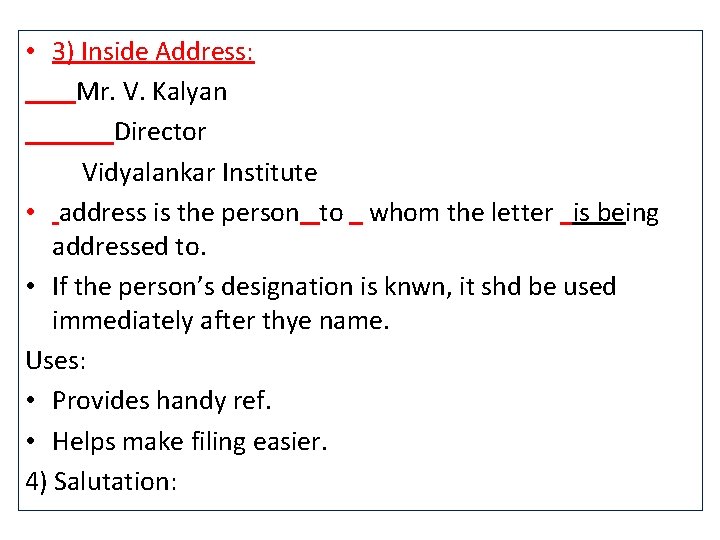
• 3) Inside Address: Mr. V. Kalyan Director Vidyalankar Institute • address is the person to whom the letter is being addressed to. • If the person’s designation is knwn, it shd be used immediately after thye name. Uses: • Provides handy ref. • Helps make filing easier. 4) Salutation:
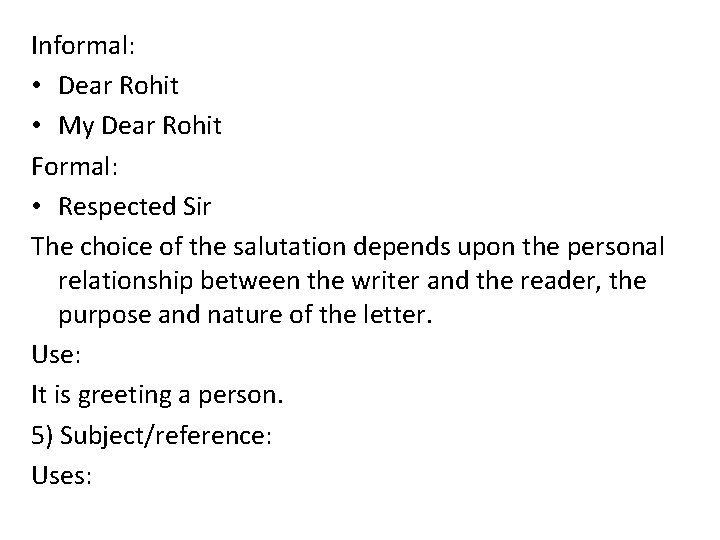
Informal: • Dear Rohit • My Dear Rohit Formal: • Respected Sir The choice of the salutation depends upon the personal relationship between the writer and the reader, the purpose and nature of the letter. Use: It is greeting a person. 5) Subject/reference: Uses:
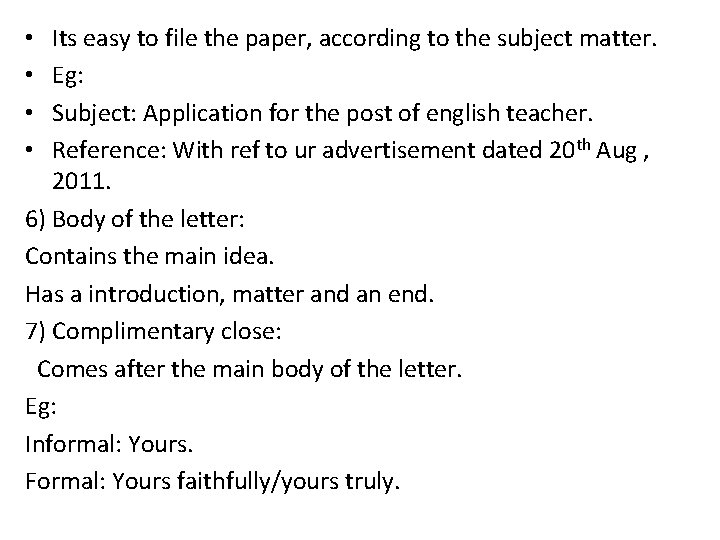
Its easy to file the paper, according to the subject matter. Eg: Subject: Application for the post of english teacher. Reference: With ref to ur advertisement dated 20 th Aug , 2011. 6) Body of the letter: Contains the main idea. Has a introduction, matter and an end. 7) Complimentary close: Comes after the main body of the letter. Eg: Informal: Yours. Formal: Yours faithfully/yours truly. • •
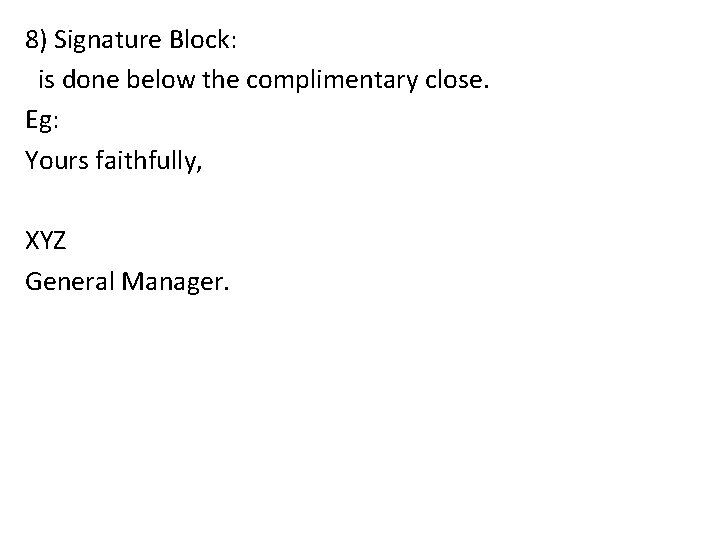
8) Signature Block: is done below the complimentary close. Eg: Yours faithfully, XYZ General Manager.
Electronic Mail (e-mail) • It facilitates the transmittal of messages thru the use of computer storage, and computer inter-links, thus avoiding postal delays. The message is simply keyed into the system. Apart frm helping users find information on all subjects, the internet allows them to send messages in the form of e-mail. Besides being cheap, it is very convenient in comparison to transmission by post. • It has even replaced typed memos & letters in business & industry. In some cases, e-mails replace telephonic conversations, saving time of the users. • It is efficient & quick means of communication. It overcomes the problems of inconvenience in face to face meetings & expenses of travelling frm one place
to another. EMPLOYMENT COMMUNICATION It gives the process & analysis of how the organisation identifies the job openings & find the right employees. Adequate planning and preparation r required for the employers & the employee to participate in the employment communication. Employer’s purpose is to seek information about the candidate’s attitude , aptitude , communication skills, commitment, creativity, motivation & temperament. The candidate shd be able to relate his abilities to the requirements of the job. A careful preparation for the interview & effective participation in the interview r required to secure a job.
Ur chance of getting interview call virtually depends on the effectiveness of the preparation of resume & covering letter. Ur resume is ur personal guidance manual. In employment communication, both the organisation & the candidates have to play their respective roles. The organisation’s role is recruitment process, screening applicants, interviewing applicants, evaluation of the applicants. The applicant’s role is locating job vacancies, preparing the resume, preparation fo the interview, participation in the interview.
• MEMO & MEMO REPORTS • A memo , like a letter , is a form of correspondence. A memo is a note written for circulation for other people within the organisation interested in what u hv to say. The memo is usually written under pressure of time. It ensures quick & smooth flow of information in all directions. Since it is a record of facts & decisions , u can refer it in future whenever u need it. Small events, requests, telephone conversations on official matters can be recorded in the form of memos. Thus it serves as a reminder & maintains a permanent record of discussions, meetings, activities, changes, procedures or policies.
Often all copies of memos r maintained in the company’s central file. In the event of investigation, they can be produced as evident. A memo is a note to remind someone of somethg, or to issue an instruction. The components of memo are: 1) To 2) From 3) Date 4) Subject. The body of the memo consists of, a) Introduction: To communicate immediately, write lead-in sentence and provide overview stating why
And what u r writing about. b) Discussion: To develop content specifically, through highlighting techniques , explaining clearly what u want to say. c) Conclusion: To sum up & provide complimentary close of ur action. In general, memo shd end with a re-statement of ur specific request or action.
Notice, Agenda and Minutes of the meeting • NOTICE : “Notice” in relation to meeting signifies the bringing of knowledge of the meeting to the persons concerned. Notice of the meeting may be oral or written or in the form of notification issued or published in some news media. The notice shd be circulated to members within reasonable time before the meeting. The foll. Principles must be observed while sending the notice: • Every person concerned must be summoned or given notice.
• The notice must contain all relevant material & particulars relating to day, date, time place & agenda. • The notice must be clear , precise & unambiguous. Def: A notice is served by the secretary of the group to all members of a specific group for holding a meeting to facilitate exchange of ideas &interaction among the concerned group of people. AGENDA OF MEETING: Agenda is a written official list of business activities to be discussed at a meeting. It is drafted by the secretary in consultation with the chairperson. A copy of the agenda is normally enclosed with the notice of meeting & to be sent to all the members to attend a
meeting. It provides the participants with the information needed to prepare effectively for the meeting. Usually no business shd be discussed at a meeting, unless it is included in the agenda. Each item in the agenda is numbered & agenda is prepared for each meeting sparately. A scheduled programe helps the members to avoid meaningless & irrelevant discussions. The common practice is “confirmation of the minutes of the previous meeting” as the first item on every agenda. The last item in the agenda is usually “any other matter with the permission of the chairperson”. The remaining items r generally arranged in their order of importance.
MINUTES OF MEETING: • The official records of procedings at a meeting is called “ MINUTES. ” It is a summarised record of discussions held & decisions reached at a meeting. Minutes shd report only the facts presented & the actions taken. Personal opinions , emotional feelings r generally not recorded. To ensure precise & accurate record, every group that conducts meetings shd appoint or elect a secretary. The secretary’s task is to take notes during the group discussions & to provide minutes. Minutes shd be brief. The factual elements shd be
exact. Irrelevant details must be excluded. Emphasis shd be given to such items as responsibilities delegated to members of the group (eg: accounts, reappointment of member) & action that is to be taken after the meeting. Then when a member receives his copy, he is reminded of the duty he has to perform. This emphasis & distribution helps in proper functioning of the group. In short, the minutes constitute an important record of the organisation. They form the basis for further action & decision in the organisation.
BROCHURES A brochure is a small booklet or pamphlet containing inf. , abt a specific activity. It is a small single page, 2 sided folded document specially designed to be handed out or mailed. They r excellent devices for communicating condensed inf. , to a targetted group. These groups may be employees, participants of seminars & conferences , suppliers, customers, community-at-large, shareholdres, etc. They r used as effective devices for advertising & r also prepared & sent to participants of seminars & conferences.
They contain inf. , like : Incentive schemes for employees, Company’s bonus scheme or special feature, Services offered, Profits made or losses incurred, Specifications to be met, etc. The purpose of a well-defined brochure may be: 1) Informative: For eg. , health department brochures. 2) Educational: For eg: at educational institutions, results & achievements, special features of educational institutions, advertising the services.
3)Persuasive: For eg: usually with commercial & advertising intent, to organise a sale to encourage customers/clients.
- Slides: 69