
Basics of chest X ray Dr Sheetu Singh
Basics of chest X ray Dr Sheetu Singh Assistant Professor Institute of respiratory disease, SMS Medical college, Jaipur Basics Chest Xray: Dr Sheetu Singh
Chest X Ray How will you evaluate a chest X ray? 1. Type of view 2. Exposure 3. Complete vs Incomplete film 4. Soft tissue 5. Bony structures 6. Trachea 7. Hilum 8. Heart 9. Cardiophrenic and Costophrenic angles 10. Lung Basics Chest Xray: Dr Sheetu Singh
1. Type of view • PA view • AP view • Lateral view (all fissures are seen on lateral film) • Lateral decubitus • Lordotic view Basics Chest Xray: Dr Sheetu Singh
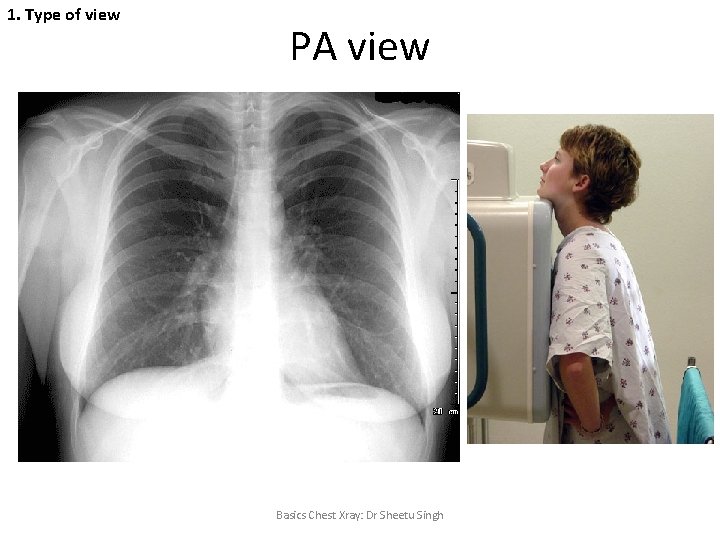
1. Type of view PA view Basics Chest Xray: Dr Sheetu Singh
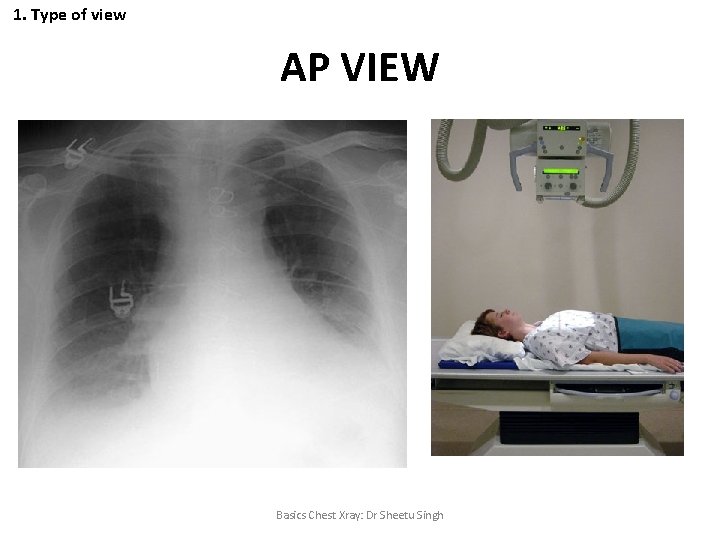
1. Type of view AP VIEW Basics Chest Xray: Dr Sheetu Singh
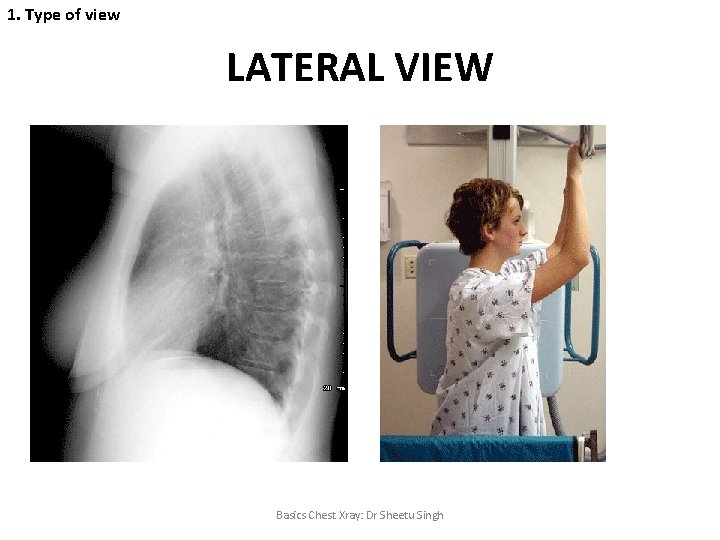
1. Type of view LATERAL VIEW Basics Chest Xray: Dr Sheetu Singh
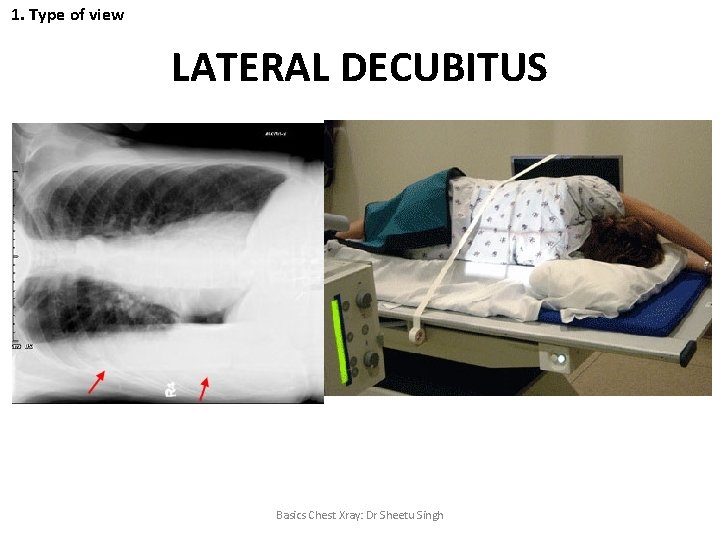
1. Type of view LATERAL DECUBITUS Basics Chest Xray: Dr Sheetu Singh

1. Type of view LORDOTIC VIEW Basics Chest Xray: Dr Sheetu Singh

1. Type of view LORDOTIC VIEW Basics Chest Xray: Dr Sheetu Singh
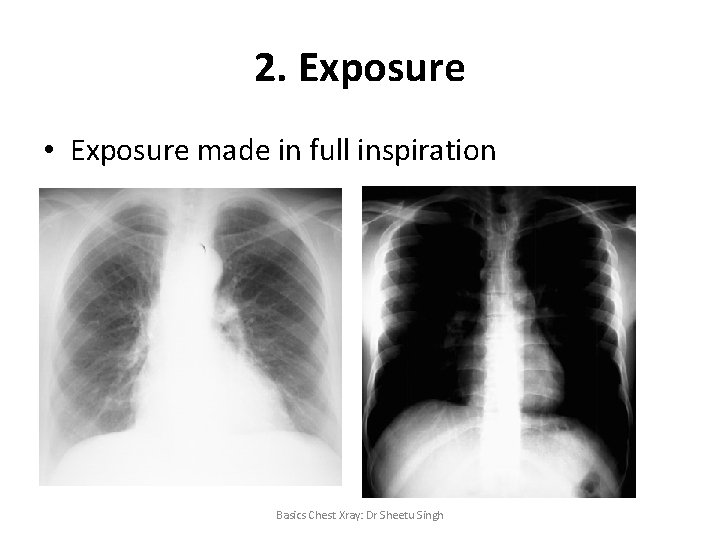
2. Exposure • Exposure made in full inspiration Basics Chest Xray: Dr Sheetu Singh
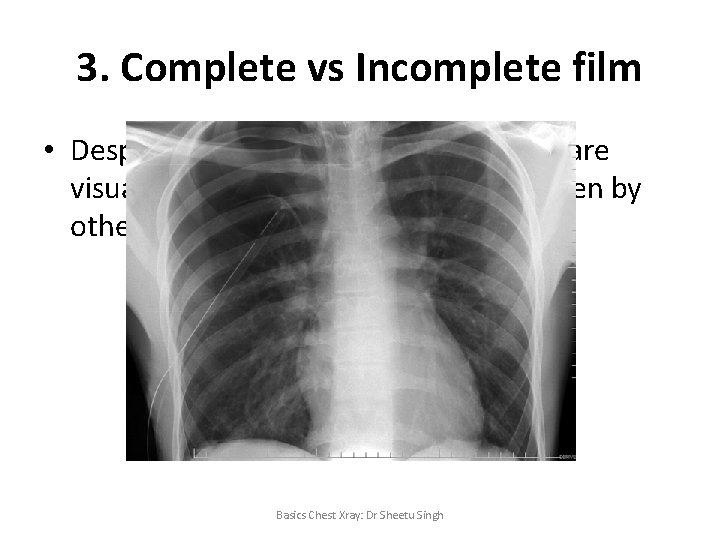
3. Complete vs Incomplete film • Despite best efforts only 60% of lungs are visualized on chest X ray as rest is hidden by other structures Basics Chest Xray: Dr Sheetu Singh
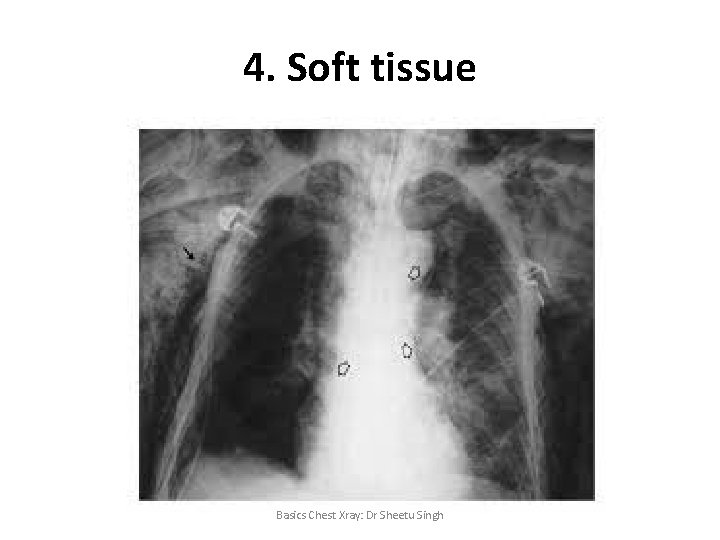
4. Soft tissue Basics Chest Xray: Dr Sheetu Singh
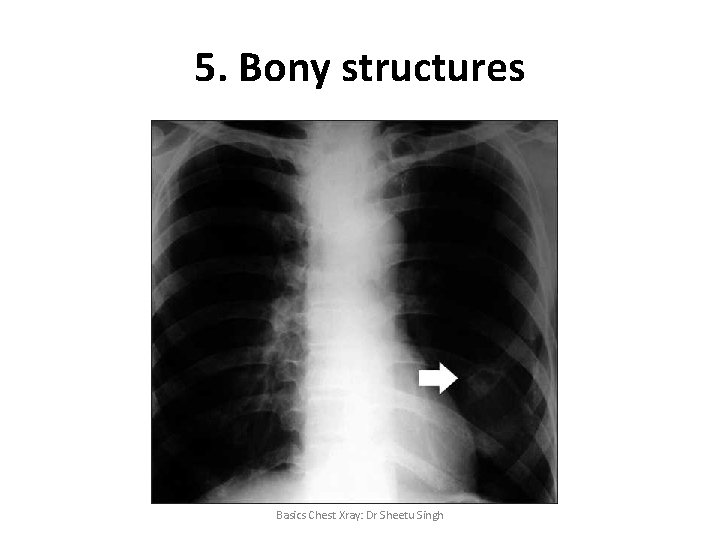
5. Bony structures Basics Chest Xray: Dr Sheetu Singh
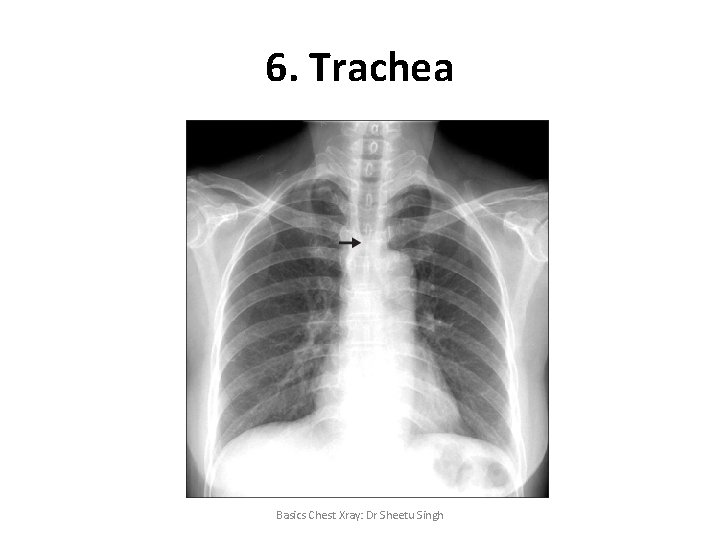
6. Trachea Basics Chest Xray: Dr Sheetu Singh
7. Hilum • • Pulmonary arteries and their main branches Upper lobe pulmonary veins Major bronchi Lymph nodes Left hilum is higher than the right hilum. Basics Chest Xray: Dr Sheetu Singh
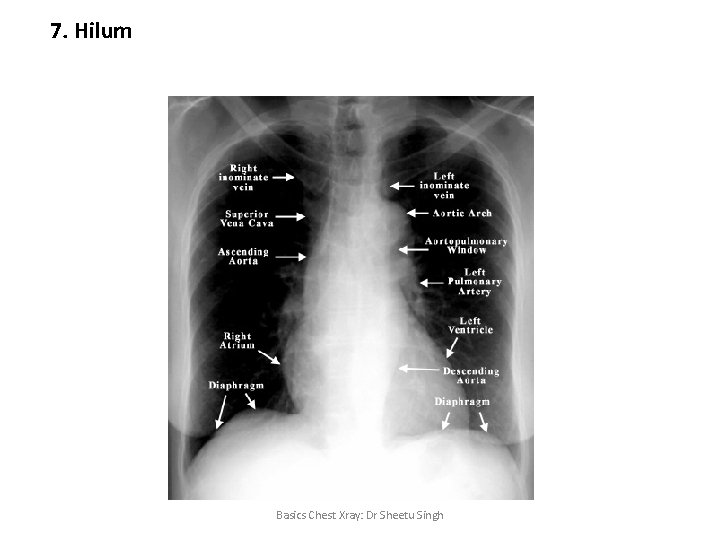
7. Hilum Basics Chest Xray: Dr Sheetu Singh
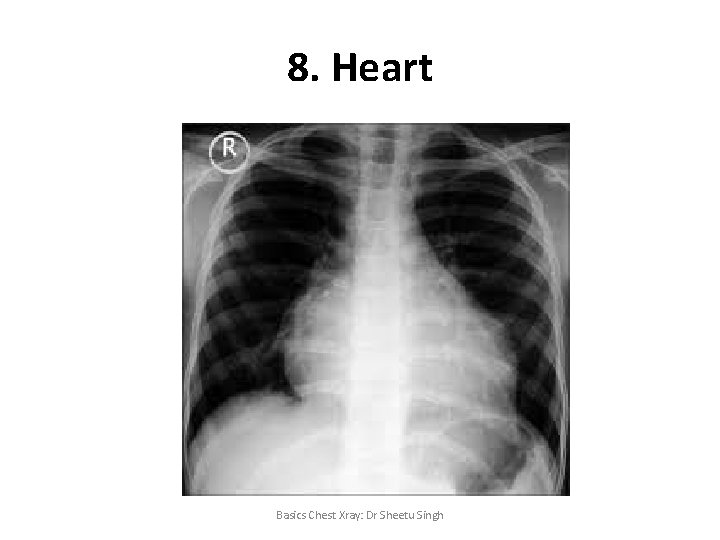
8. Heart Basics Chest Xray: Dr Sheetu Singh
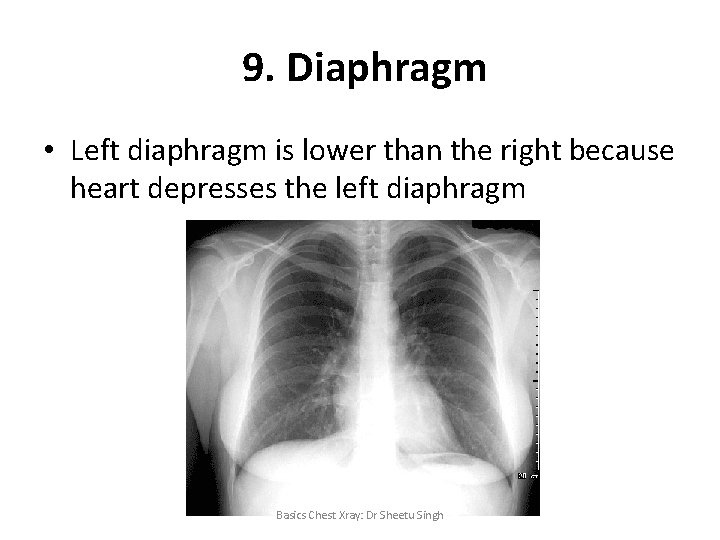
9. Diaphragm • Left diaphragm is lower than the right because heart depresses the left diaphragm Basics Chest Xray: Dr Sheetu Singh
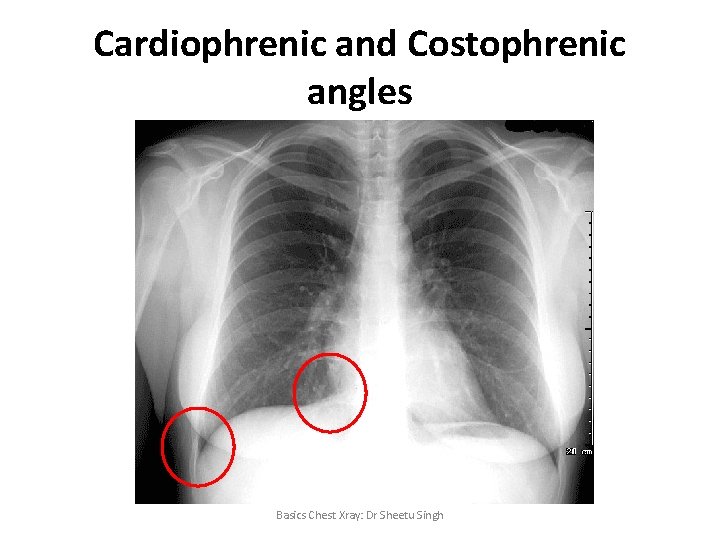
Cardiophrenic and Costophrenic angles Basics Chest Xray: Dr Sheetu Singh
10. Lung Basics Chest Xray: Dr Sheetu Singh
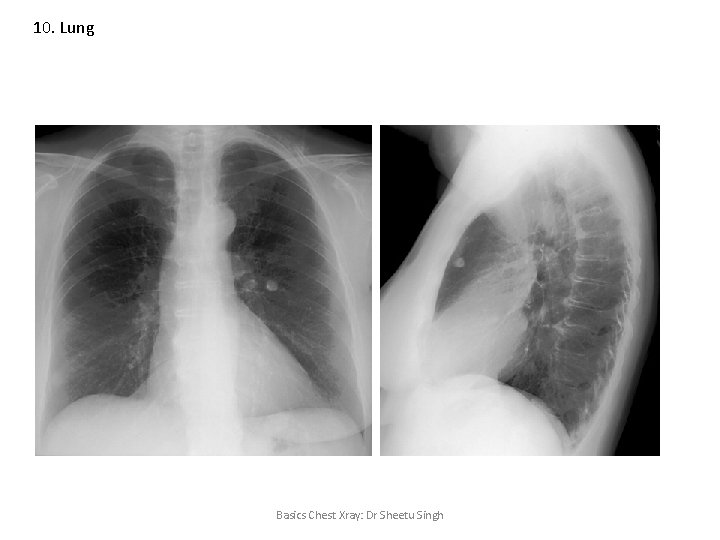
10. Lung Solitary pulmonary nodule • A solitary pulmonary nodule is defined as a discrete, well-marginated, rounded opacity less than or equal to 3 cm in diameter that is completely surrounded by lung parenchyma, does not touch the hilum or mediastinum, and is not associated with adenopathy, atelectasis or pleural effusion. • Lesions larger than 3 cm are considered masses and are treated as malignancies until proven otherwise. Basics Chest Xray: Dr Sheetu Singh
10. Lung Basics Chest Xray: Dr Sheetu Singh
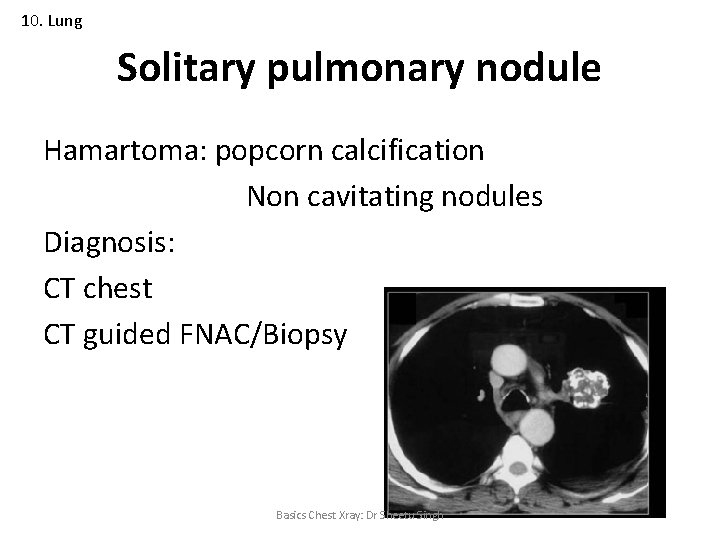
10. Lung Solitary pulmonary nodule Hamartoma: popcorn calcification Non cavitating nodules Diagnosis: CT chest CT guided FNAC/Biopsy Basics Chest Xray: Dr Sheetu Singh
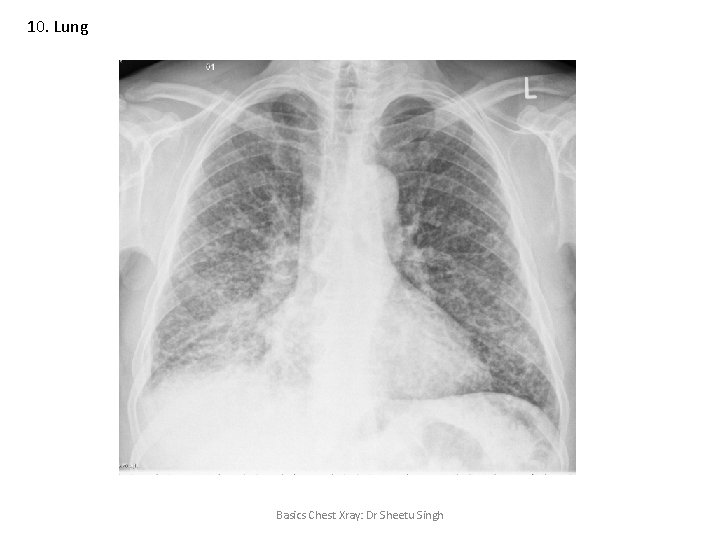
10. Lung Miliary shadows • • • Silicosis Coal workers pneumoconiosis Loeffler’s syndrome Sarcoidosis / Berryliosis Tuberculosis/Nocardia/Brucella Histoplasmosis Varicella Metastasis Rheumatoid arthritis nodules Wegner’s granulomatosis Amyloidosis Basics Chest Xray: Dr Sheetu Singh
10. Lung Basics Chest Xray: Dr Sheetu Singh
10. Lung Unilateral radiolucency on chest X ray • • • Pneumothorax Emphysema Resection of mammary gland Pulmonary artery obstruction Patient rotation Basics Chest Xray: Dr Sheetu Singh
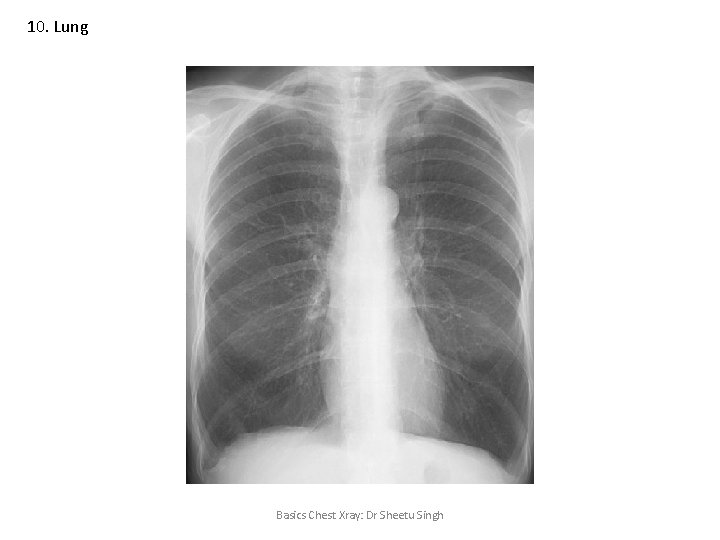
10. Lung Emphysema • • Flattened diaphragm (terrace pattern) Tubular heart Increased rib spaces Increased retrosternal air spaces Basics Chest Xray: Dr Sheetu Singh
10. Lung Basics Chest Xray: Dr Sheetu Singh
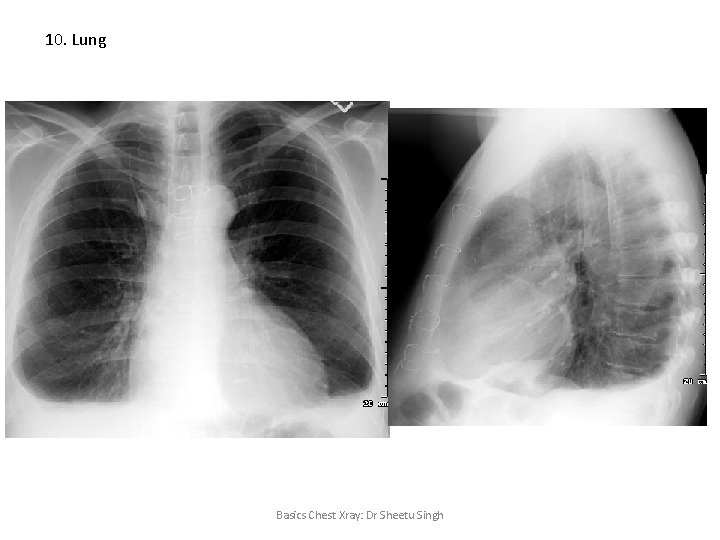
10. Lung Pleural effusion • Obtuse angle with chest wall • Not confined to bronchopulmonary segment • Air bronchogram not visualized (seen in Consolidation) Diagnostic modality – I/L Lateral decubitus USG chest CT chest Basics Chest Xray: Dr Sheetu Singh
10. Lung Basics Chest Xray: Dr Sheetu Singh
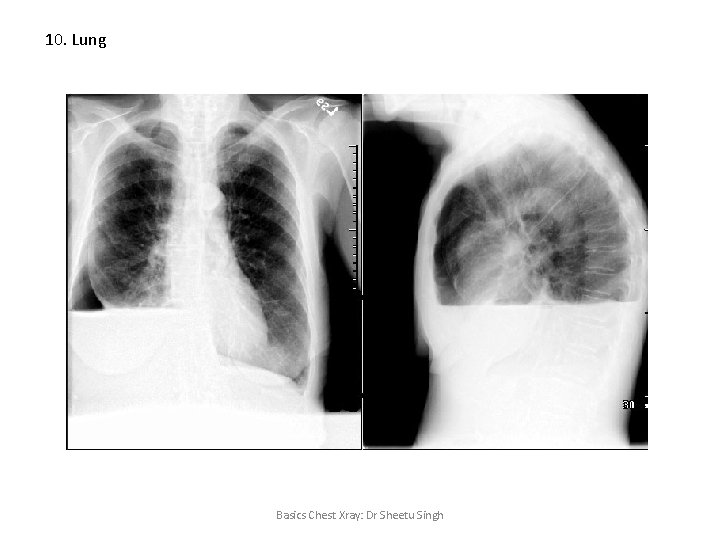
10. Lung Basics Chest Xray: Dr Sheetu Singh
10. Lung Asbestosis • Pleural plaques (primarily the diaphragmatic pleura) • Pulmonary fibrosis • Mesothelioma • Lung cancer Basics Chest Xray: Dr Sheetu Singh
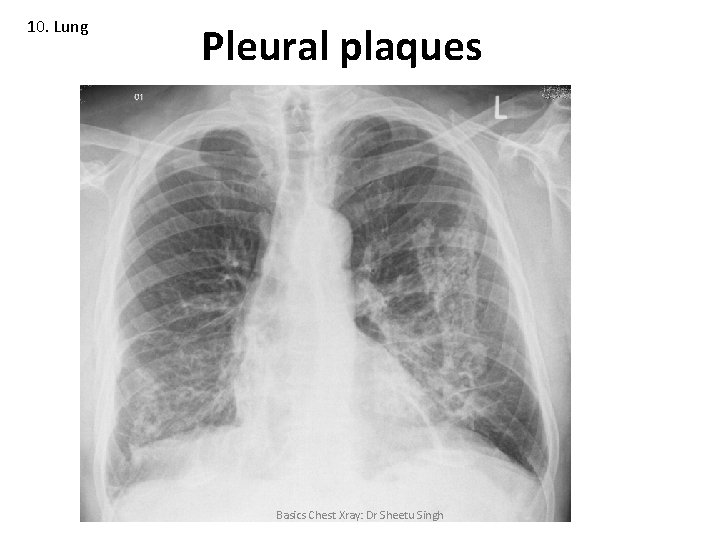
10. Lung Pleural plaques Basics Chest Xray: Dr Sheetu Singh
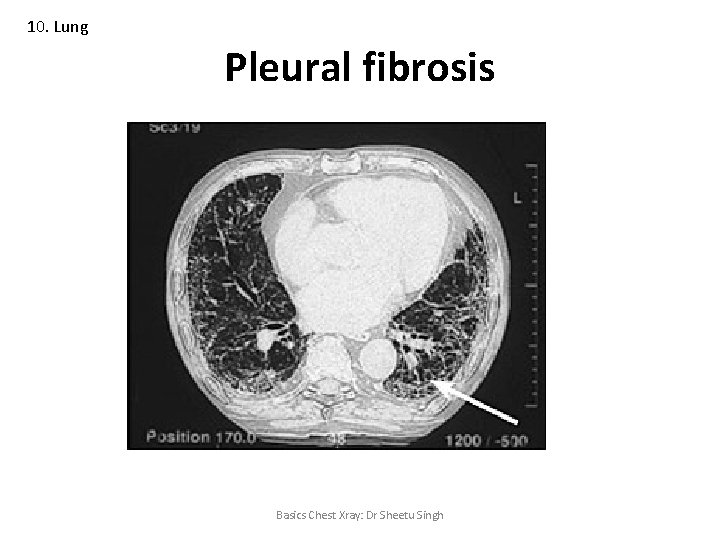
10. Lung Pleural fibrosis Basics Chest Xray: Dr Sheetu Singh
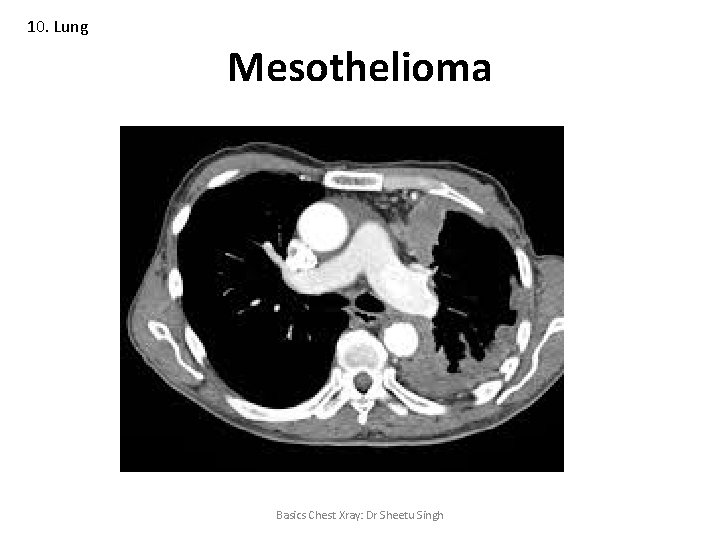
10. Lung Mesothelioma Basics Chest Xray: Dr Sheetu Singh
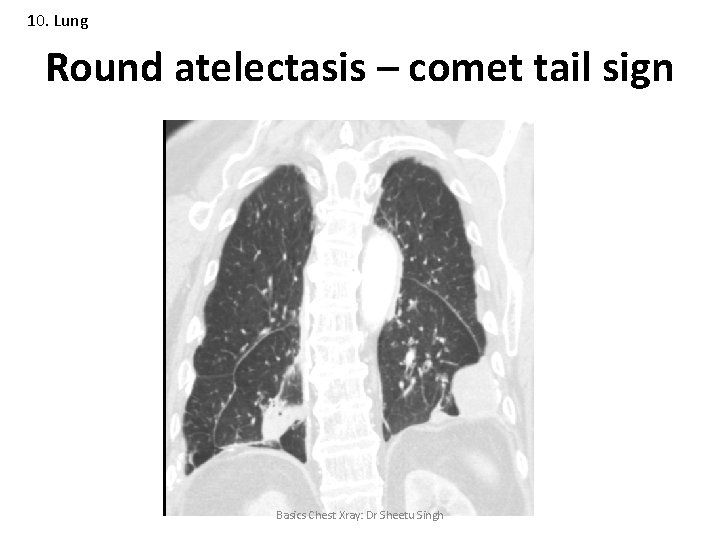
10. Lung Round atelectasis – comet tail sign Basics Chest Xray: Dr Sheetu Singh
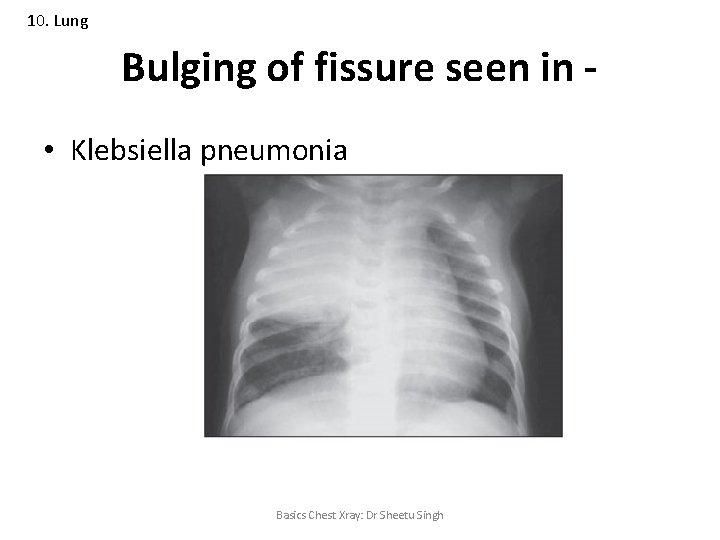
10. Lung Bulging of fissure seen in • Klebsiella pneumonia Basics Chest Xray: Dr Sheetu Singh
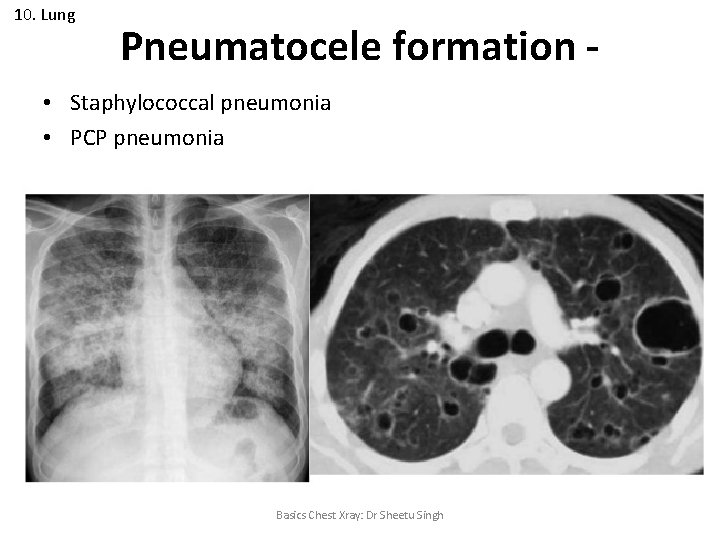
10. Lung Pneumatocele formation - • Staphylococcal pneumonia • PCP pneumonia Basics Chest Xray: Dr Sheetu Singh
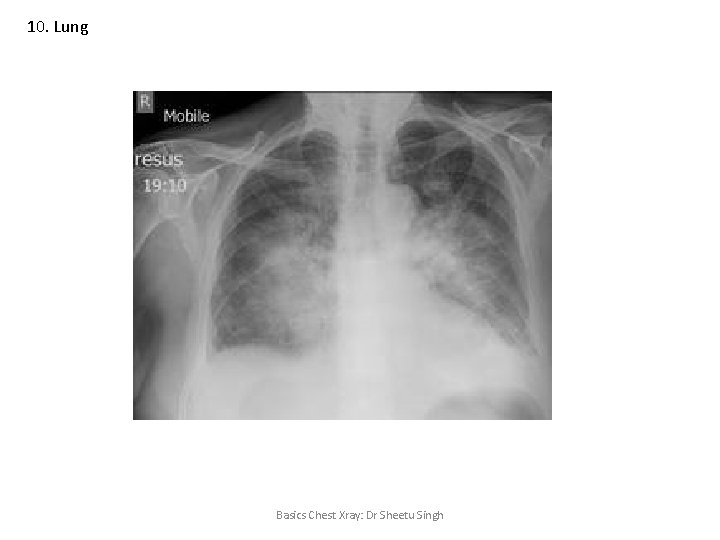
10. Lung Pulmonary edema • Bat wing appearance on Chest X ray • Seen in – 1. Congestive cardiac failure 2. Uremic lung Basics Chest Xray: Dr Sheetu Singh
10. Lung Basics Chest Xray: Dr Sheetu Singh
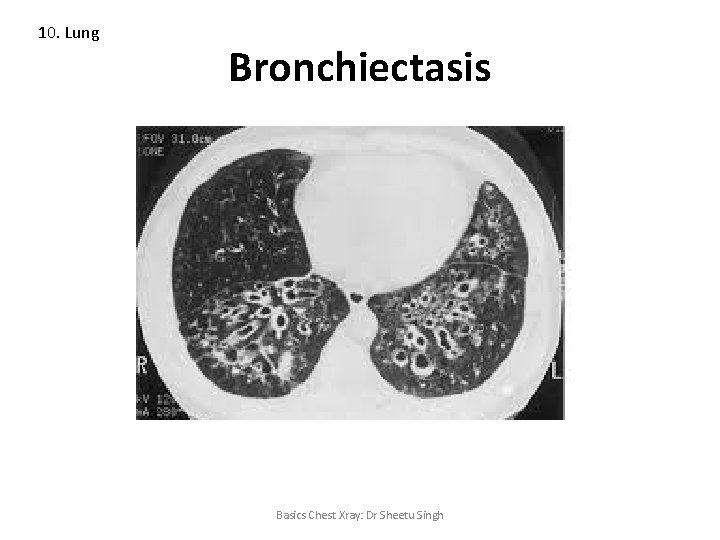
10. Lung Bronchiectasis Basics Chest Xray: Dr Sheetu Singh
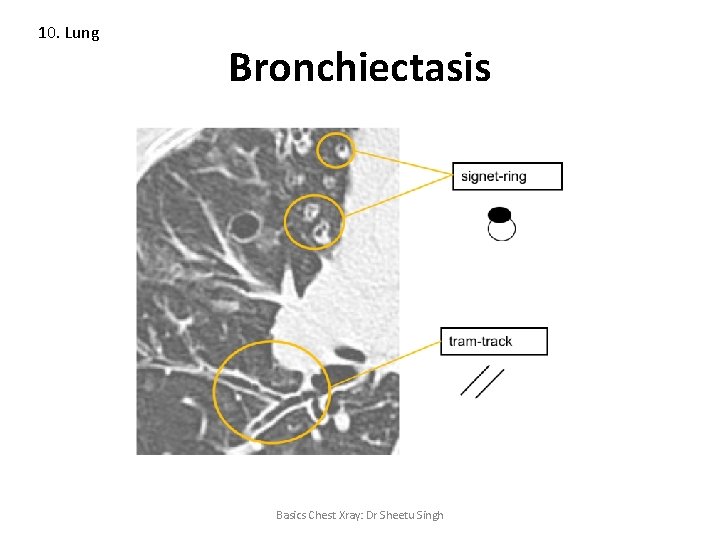
10. Lung Bronchiectasis Basics Chest Xray: Dr Sheetu Singh
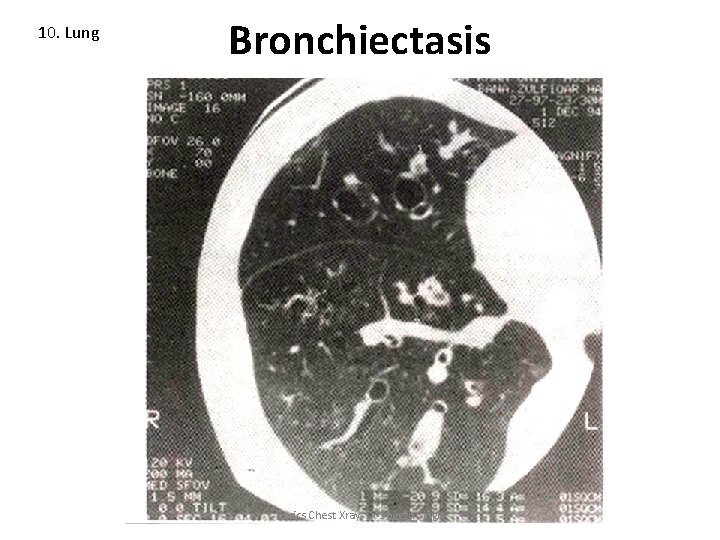
10. Lung Bronchiectasis Basics Chest Xray: Dr Sheetu Singh
10. Lung Massive hemoptysis • Bronchial artery Basics Chest Xray: Dr Sheetu Singh
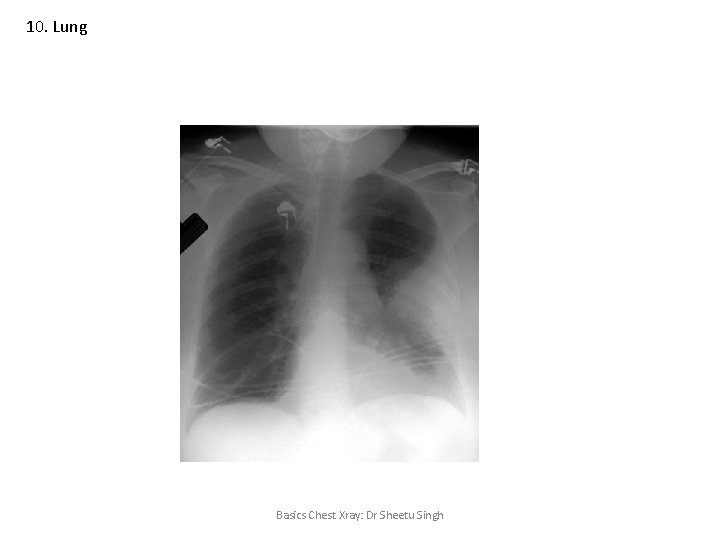
10. Lung Pulmonary embolism • Hampton’s hump • Westermark sign • Palla’s sign Gold standard investigation Pulmonary angiography VQ scan – perfusion defect with normal lung scan Basics Chest Xray: Dr Sheetu Singh
10. Lung Basics Chest Xray: Dr Sheetu Singh
10. Lung Tuberculosis • Upper lobe predominance • Lower lobe involvement in immunocompromised host (DM, HIV) • Cavitation, Fibrosis • Mediastinal lymph node enlargement with necrosis Basics Chest Xray: Dr Sheetu Singh
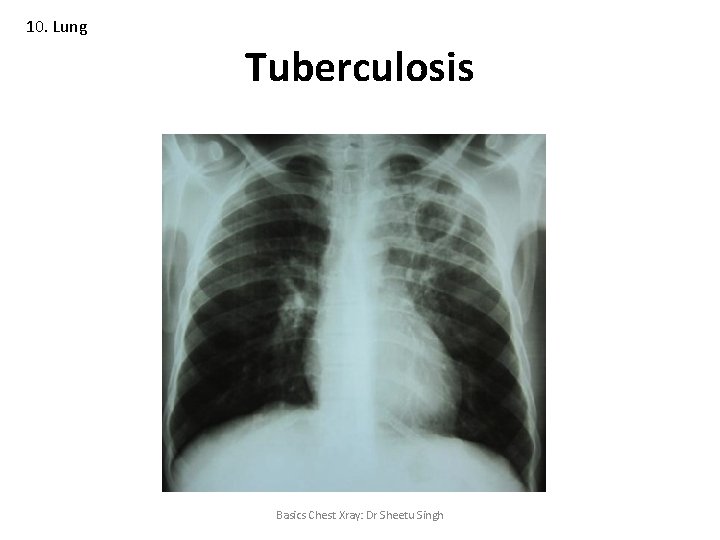
10. Lung Tuberculosis Basics Chest Xray: Dr Sheetu Singh
10. Lung HIV • PCP – perihilar bat wing appearance (GGO) AIDS defining illness Pentamidine increases risk of pneumothorax • Tuberculosis – if CD 4 count is low cavitation is less likely and chances of lymphadenopathy • Kaposi sarcoma – pulmonary, visceral and cutaneous involvement. (pleural and pericardial effusion common) Basics Chest Xray: Dr Sheetu Singh
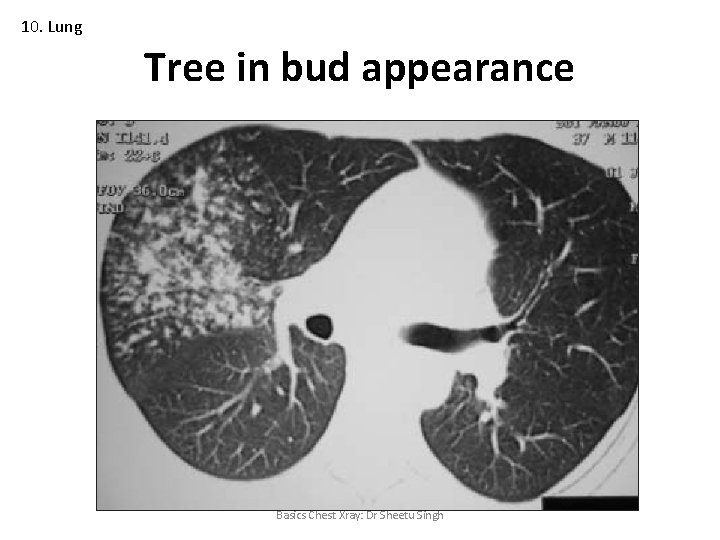
10. Lung Tree in bud appearance Basics Chest Xray: Dr Sheetu Singh
10. Lung Tree in bud appearance Infective bronchiolitis • Pulmonary tuberculosis • MAC • Viral pneumonia • Fungal infection – aspergillus • ABPA • PCP Congenital • Cystic fibrosis Bronchiolitis Neoplastic • Bronchioalveolar carcinoma Basics Chest Xray: Dr Sheetu Singh
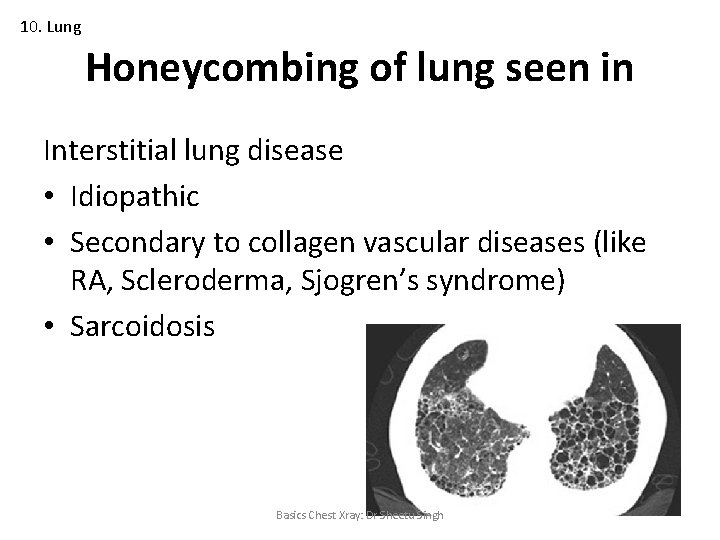
10. Lung Honeycombing of lung seen in Interstitial lung disease • Idiopathic • Secondary to collagen vascular diseases (like RA, Scleroderma, Sjogren’s syndrome) • Sarcoidosis Basics Chest Xray: Dr Sheetu Singh
Computed Tomography • Tomography = sectional imaging / slice (transverse section view) • CT generates images in transaxial section (perpendicular to cranio-caudal axis) • CT measures the degree of attenuation of X ray beams by various tissues in the body → called as HOUNSEFIELD unit (Godfrey Hounsefield) • Ranges from -1000 HU (Black)→ 3000 HU (White) • Air = -1000 HU • Water = 0 HU Basics Chest Xray: Dr Sheetu Singh
Walls of CT scan room are coated with – • Lead • Glass • Tungsten • Iron Basics Chest Xray: Dr Sheetu Singh
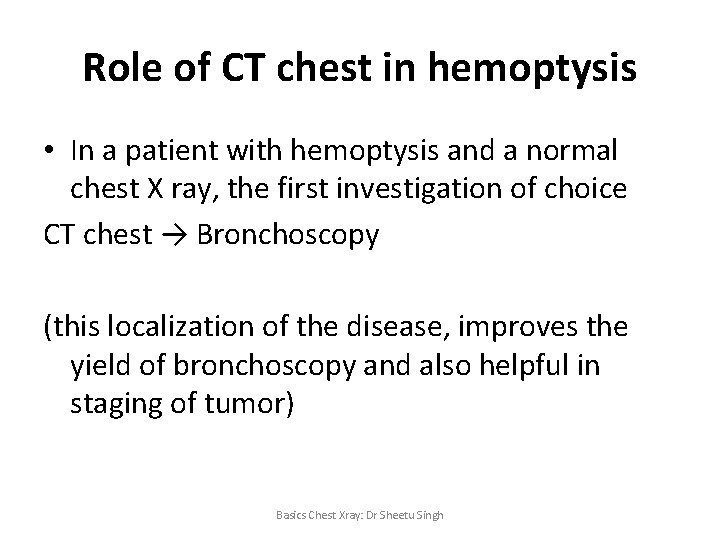
Role of CT chest in hemoptysis • In a patient with hemoptysis and a normal chest X ray, the first investigation of choice CT chest → Bronchoscopy (this localization of the disease, improves the yield of bronchoscopy and also helpful in staging of tumor) Basics Chest Xray: Dr Sheetu Singh
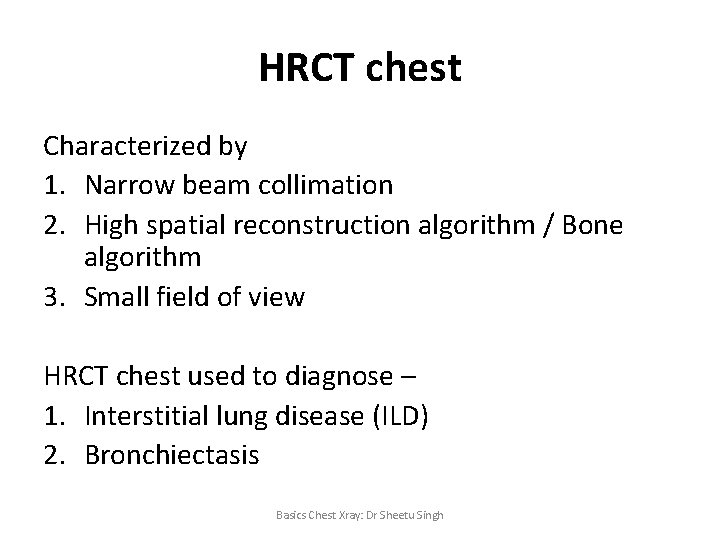
HRCT chest Characterized by 1. Narrow beam collimation 2. High spatial reconstruction algorithm / Bone algorithm 3. Small field of view HRCT chest used to diagnose – 1. Interstitial lung disease (ILD) 2. Bronchiectasis Basics Chest Xray: Dr Sheetu Singh
- Slides: 56