
Basics of Biblical Greek Chapter 8 Prepositions 1132022
Basics of Biblical Greek Chapter 8 - Prepositions & ειμι 1/13/2022 1
Overview o Prepositions are words that define the relationship between two words; 1/13/2022 2
Overview o o Prepositions are words that define the relationship between two words; The word following the preposition is called the object of the preposition; 1/13/2022 3
Overview o o o Prepositions are words that define the relationship between two words; The word following the preposition is called the object of the preposition; The meaning of prepositions change; 1/13/2022 4
Overview o o Prepositions are words that define the relationship between two words; The word following the preposition is called the object of the preposition; The meaning of prepositions change; Dependent clauses; 1/13/2022 5
Overview o o o Prepositions are words that define the relationship between two words; The word following the preposition is called the object of the preposition; The meaning of prepositions change; Dependent clauses; eιμι and predicate nominative. 1/13/2022 6
Exegetical Insight 1 Corinthians 5: 5 “hand this man over to Satan, so that the sinful nature may be destroyed and his spirit saved on the day of the Lord. ” NIV 1/13/2022 7
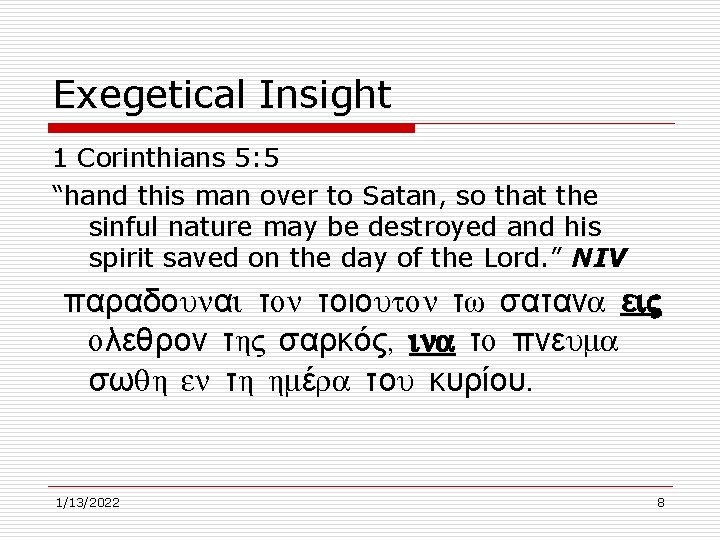
Exegetical Insight 1 Corinthians 5: 5 “hand this man over to Satan, so that the sinful nature may be destroyed and his spirit saved on the day of the Lord. ” NIV παραδοunαi τon τοιοuton τw σατανa εi. V oλεθρον τh. V σαρκός, ina τo πνεuma σωqh en τh hmέra τοu κυρίου. 1/13/2022 8
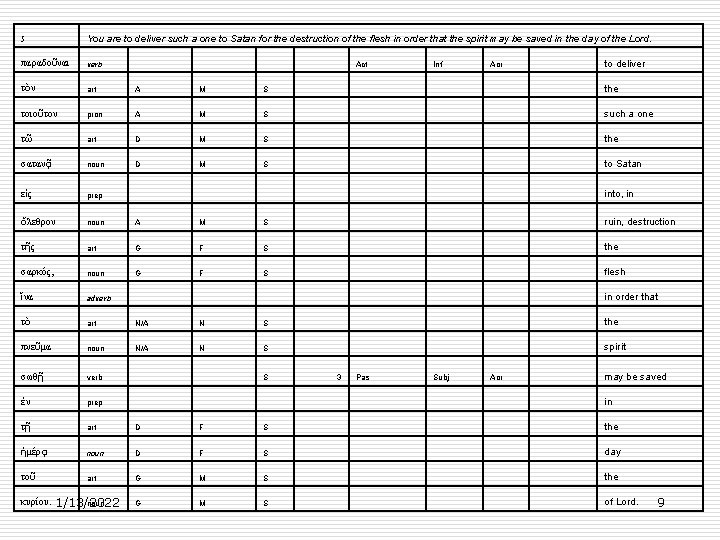
5 You are to deliver such a one to Satan for the destruction of the flesh in order that the spirit may be saved in the day of the Lord. παραδοῦναι verb τὸν art A M S the τοιοῦτον pron A M S such a one τῶ art D M S the σατανᾷ noun D M S to Satan εἰς prep ὄλεθρον noun A M S ruin, destruction τῆς art G F S the σαρκός, noun G F S flesh ἵνα adverb τὸ art N/A N S the πνεῦμα noun N/A N S spirit σωθῇ verb ἐν prep τῇ art D F S the ἡμέρᾳ noun D F S day τοῦ art G M S the G M S of Lord. κυρίου. noun 1/13/2022 Act Inf Aor to deliver into, in in order that S 3 Pas Subj Aor may be saved in 9
English - Prepositions - Words that indicate the relationship between two words. 1/13/2022 10
English - Prepositions - - Words that indicate the relationship between two words. State or Motion. 1/13/2022 11
English - Prepositions - - Words that indicate the relationship between two words. State or Motion. “John came with his disciples. ” 1/13/2022 12
English - Prepositions - - Words that indicate the relationship between two words. State or Motion. “John came with his disciples. ” “The ball went over his head. ” 1/13/2022 13
English - Prepositions - - Words that indicate the relationship between two words. State or Motion. “John came with his disciples. ” “The ball went over his head. ” “Her feet are on the chair. ” 1/13/2022 14
English - Prepositions - - Words that indicate the relationship between two words. State or Motion. “John came with his disciples. ” “The ball went over his head. ” “Her feet are on the chair. ” “Frank is in New York. ” 1/13/2022 15
English - Prepositions o The word that follows the preposition is the “object of the preposition”. 1/13/2022 16
English - Prepositions o o The word that follows the preposition is the “object of the preposition. ” The object is always in the “objective” case. 1/13/2022 17
English - Prepositions o o o The word that follows the preposition is the “object of the preposition”. The object is always in the “objective” case. The preposition and its object make up the “prepositional phrase. ” 1/13/2022 18
English – Predicate Nominative o “to be” – am, are, is (was, were, will be, had been, etc. ) 1/13/2022 19
English – Predicate Nominative o o “to be” – am, are, is (was, were, will be, had been, etc. ) What is normally considered the object is “predicating” something about the subject. 1/13/2022 20
English – Predicate Nominative o o o “to be” – am, are, is (was, were, will be, had been, etc. ) What is normally considered the object is ‘predicating’ something about the subject. The predicate nominative is normally in a subjective case. 1/13/2022 21
English – Predicate Nominative o o “to be” – am, are, is (was, were, will be, had been, etc. ) What is normally considered the object is ‘predicating” something about the subject. The predicate nominative is normally in a subjective case. “The substitute teacher is I. ” (not me. ) 1/13/2022 22
Greek - Prepositions o Greek Prepositions work the same way as English. 1/13/2022 23
Greek - Prepositions o o Greek Prepositions work the same way as English. Greek Prepositions change their meaning depending on the case of its object. 1/13/2022 24
Greek - Prepositions o o o Greek Prepositions work the same way as English. Greek Prepositions change their meaning depending on the case of its object. Some Prepositions can be followed by three, two or only one case. 1/13/2022 25
Greek - Prepositions o o Greek Prepositions work the same way as English. Greek Prepositions change their meaning depending on the case of its object. Some Prepositions can be followed by three, two or only one case. Prepositions are almost never followed by a nominative. 1/13/2022 26
Greek - Prepositions o Key Words: - 1/13/2022 Genitive - ? 27
Greek - Prepositions o Key Words: - 1/13/2022 Genitive – of Dative - ? 28
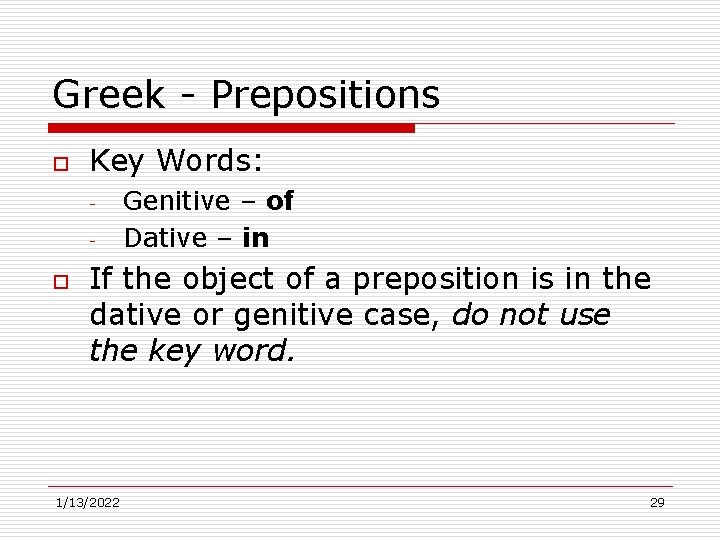
Greek - Prepositions o Key Words: - o Genitive – of Dative – in If the object of a preposition is in the dative or genitive case, do not use the key word. 1/13/2022 29
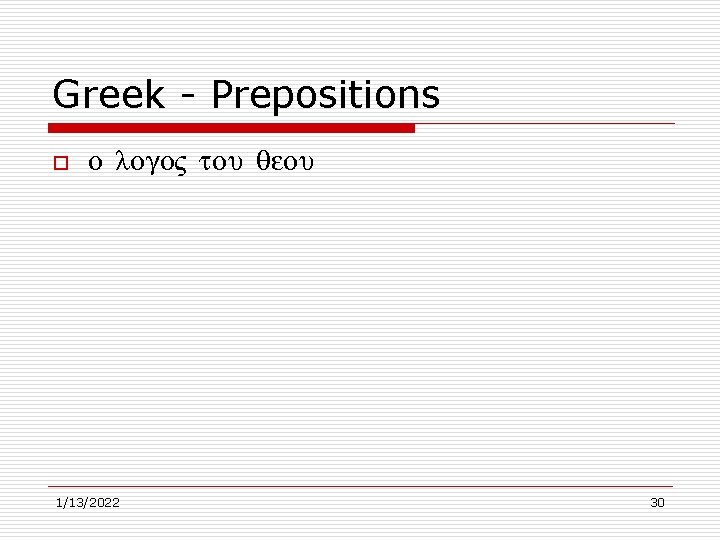
Greek - Prepositions o o logoß tou qeou 1/13/2022 30
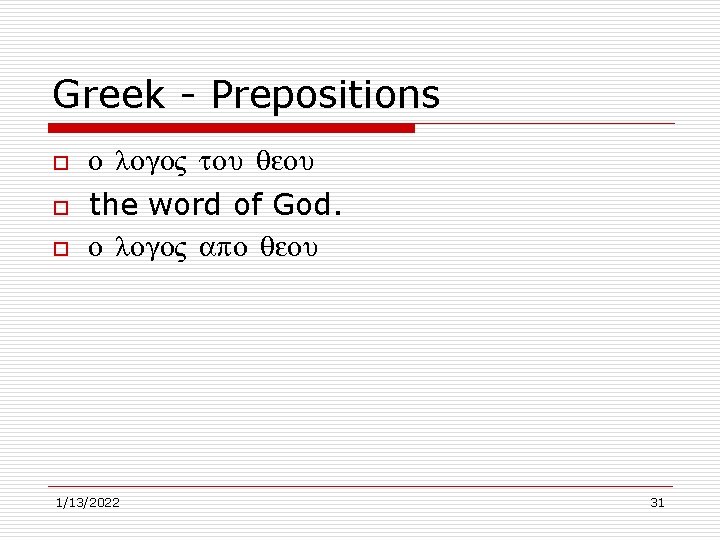
Greek - Prepositions o o logoß tou qeou the word of God. o logoß apo qeou 1/13/2022 31
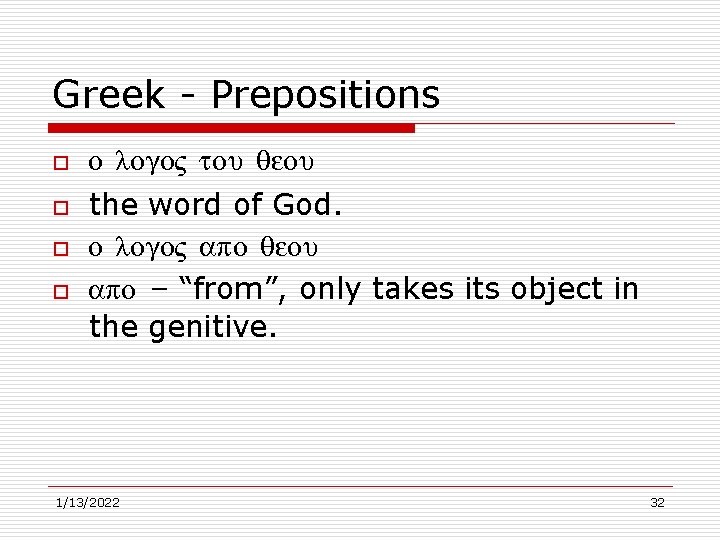
Greek - Prepositions o o o logoß tou qeou the word of God. o logoß apo qeou apo – “from”, only takes its object in the genitive. 1/13/2022 32
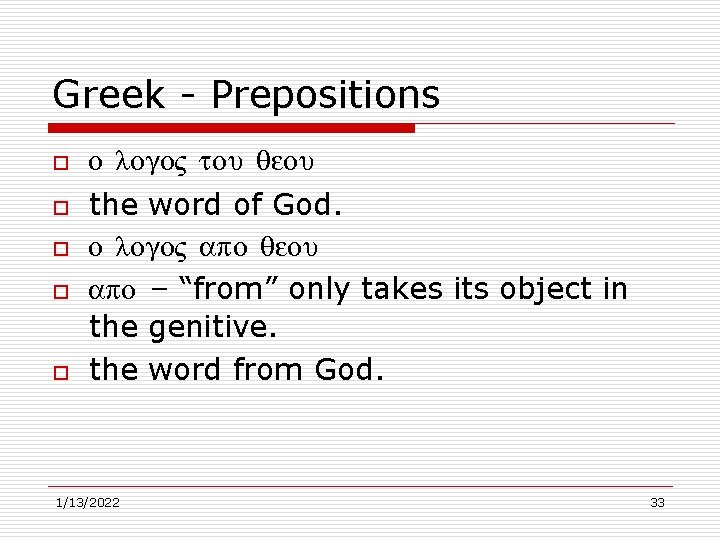
Greek - Prepositions o o o logoß tou qeou the word of God. o logoß apo qeou apo – “from” only takes its object in the genitive. the word from God. 1/13/2022 33
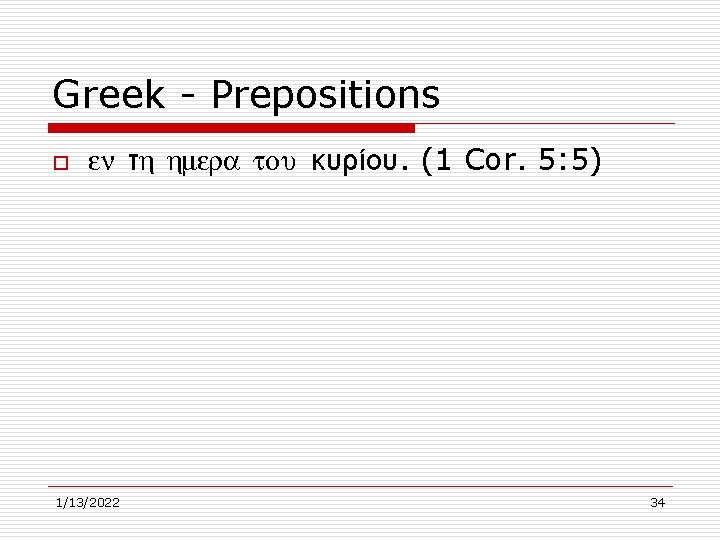
Greek - Prepositions o en τh hmera tou κυρίου. (1 Cor. 5: 5) 1/13/2022 34
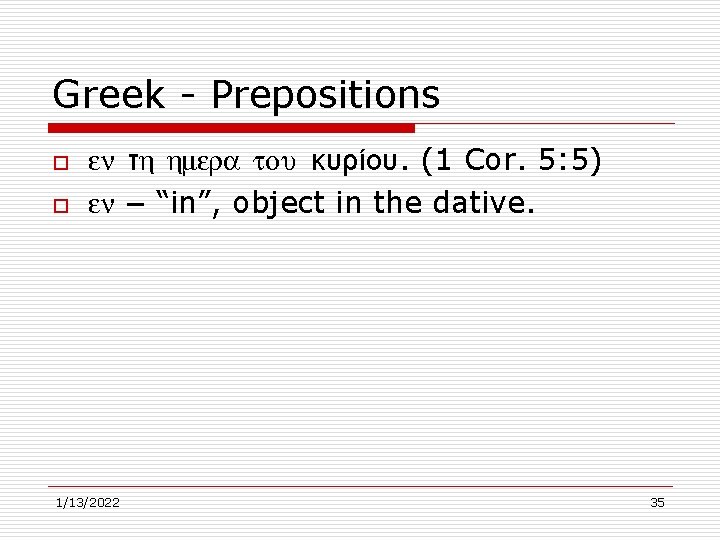
Greek - Prepositions o o en τh hmera tou κυρίου. (1 Cor. 5: 5) en – “in”, object in the dative. 1/13/2022 35
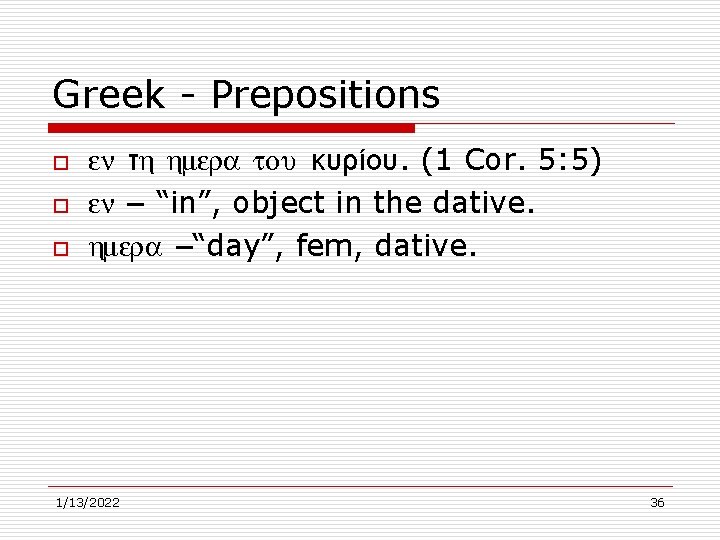
Greek - Prepositions o o o en τh hmera tou κυρίου. (1 Cor. 5: 5) en – “in”, object in the dative. hmera –“day”, fem, dative. 1/13/2022 36
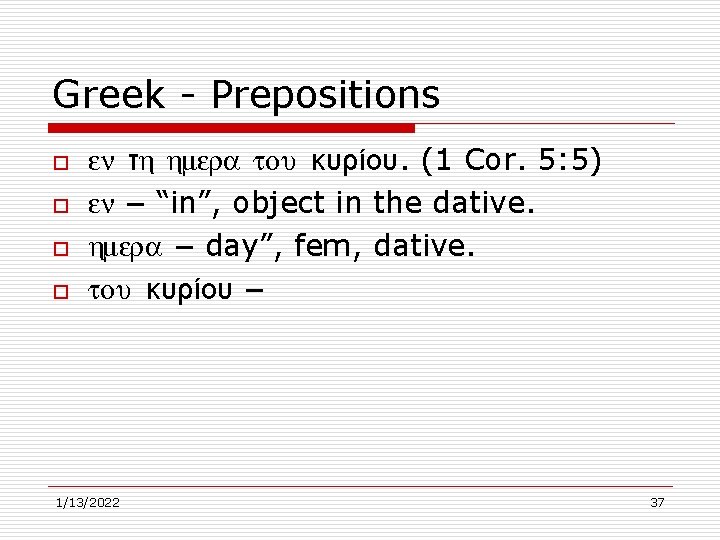
Greek - Prepositions o o en τh hmera tou κυρίου. (1 Cor. 5: 5) en – “in”, object in the dative. hmera – day”, fem, dative. tou κυρίου – 1/13/2022 37
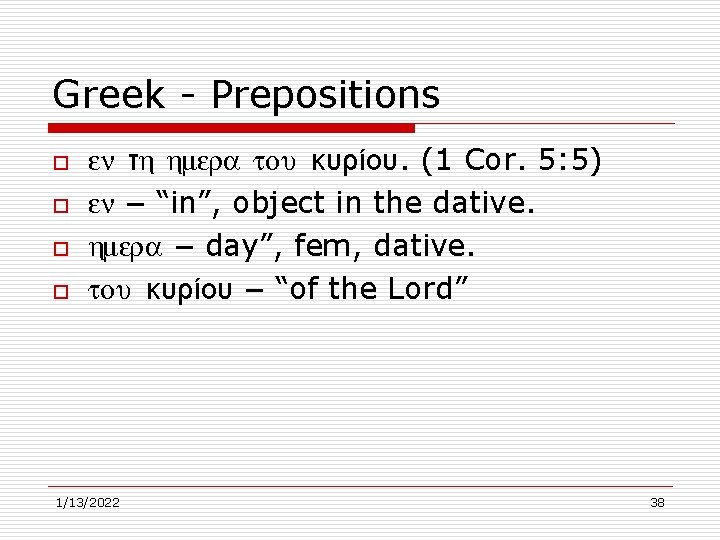
Greek - Prepositions o o en τh hmera tou κυρίου. (1 Cor. 5: 5) en – “in”, object in the dative. hmera – day”, fem, dative. tou κυρίου – “of the Lord” 1/13/2022 38
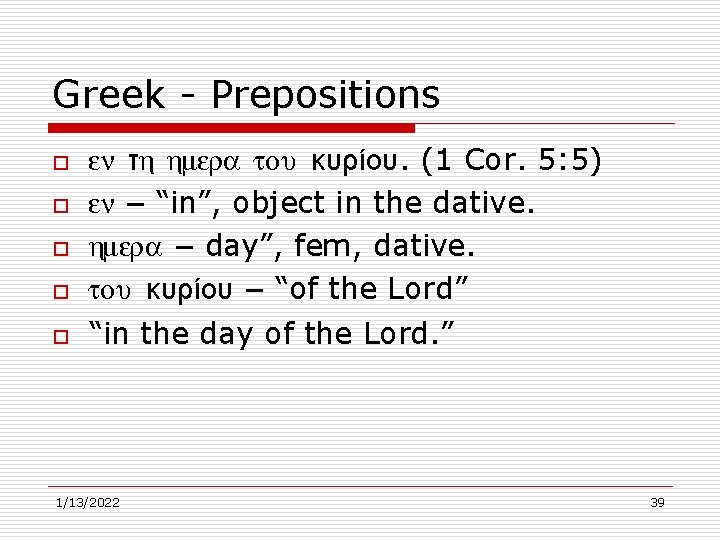
Greek - Prepositions o o o en τh hmera tou κυρίου. (1 Cor. 5: 5) en – “in”, object in the dative. hmera – day”, fem, dative. tou κυρίου – “of the Lord” “in the day of the Lord. ” 1/13/2022 39
Greek - Prepositions o Prepositions are not inflected – they do not change with the case of the object. 1/13/2022 40
Greek - Prepositions o o Prepositions are not inflected – they do not change with the case of the object. The only time the form of a preposition changes is if the preposition ends in a vowel AND it’s object begins with a vowel. 1/13/2022 41
Greek - Prepositions o o o Prepositions are not inflected – they do not change with the case of the object. The only time the form of a preposition changes is if the preposition ends in a vowel AND it’s object begins with a vowel. ‘elision’ – the final vowel is dropped and is marked with an apostrophe. 1/13/2022 42
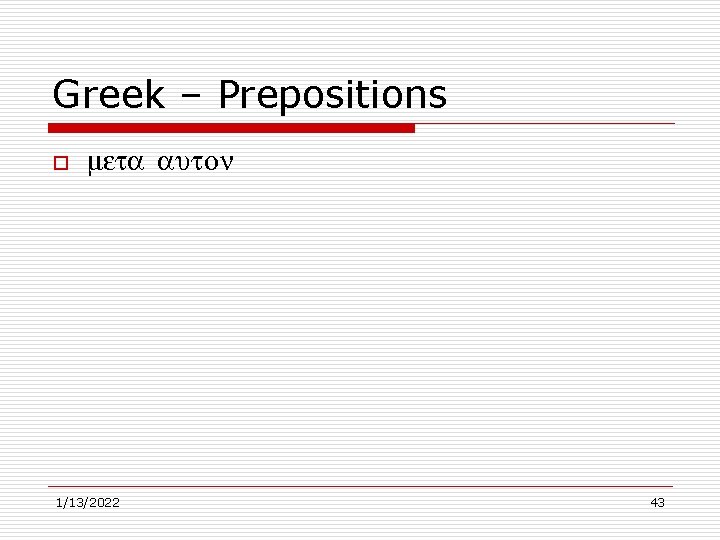
Greek – Prepositions o meta auton 1/13/2022 43
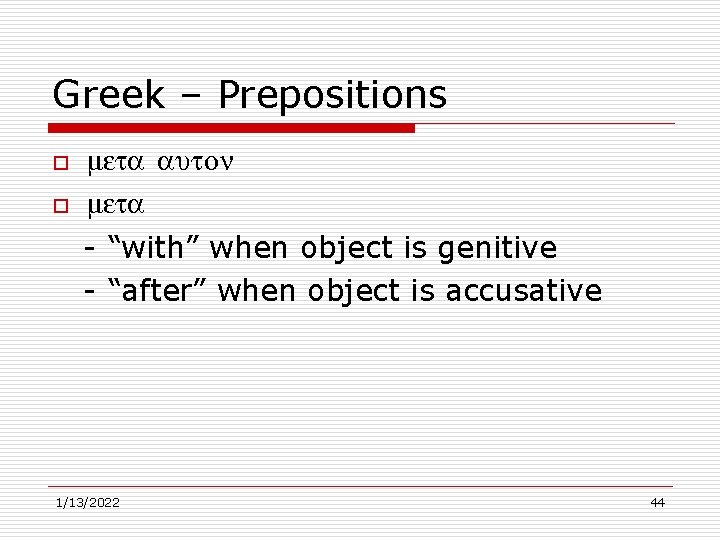
Greek – Prepositions o o meta auton meta - “with” when object is genitive - “after” when object is accusative 1/13/2022 44
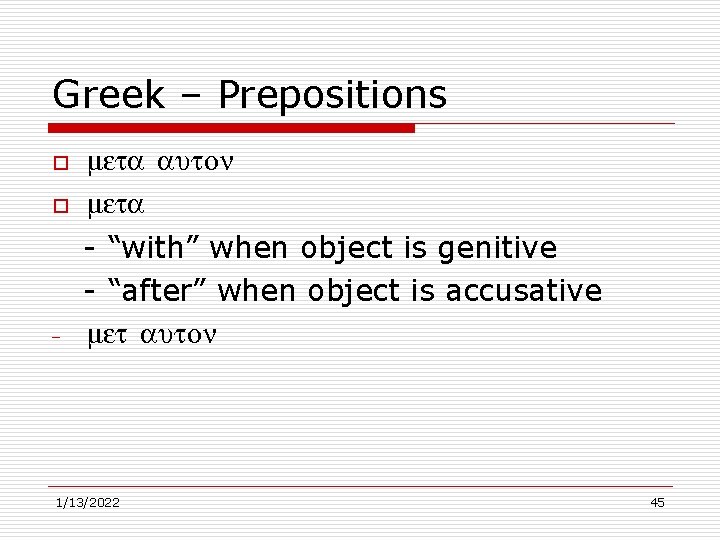
Greek – Prepositions o o - meta auton meta - “with” when object is genitive - “after” when object is accusative met auton 1/13/2022 45
Greek – Prepositions - When the object begins with a rough breathing mark, the last consonant may also change. 1/13/2022 46
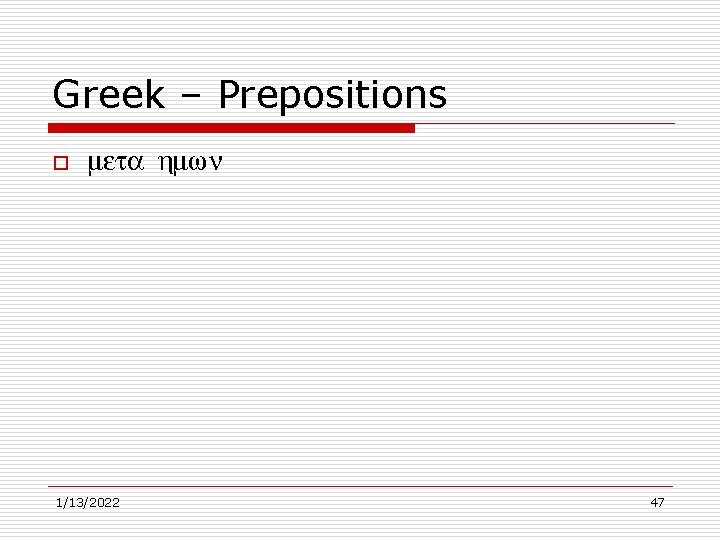
Greek – Prepositions o meta hmwn 1/13/2022 47
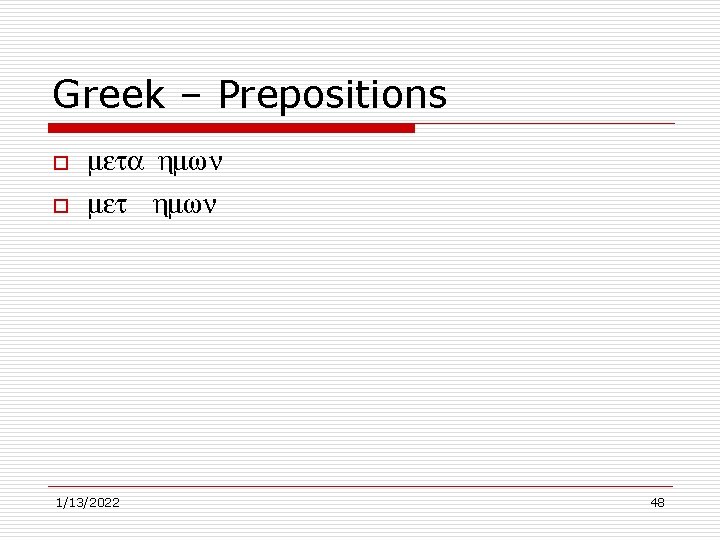
Greek – Prepositions o o meta hmwn met hmwn 1/13/2022 48
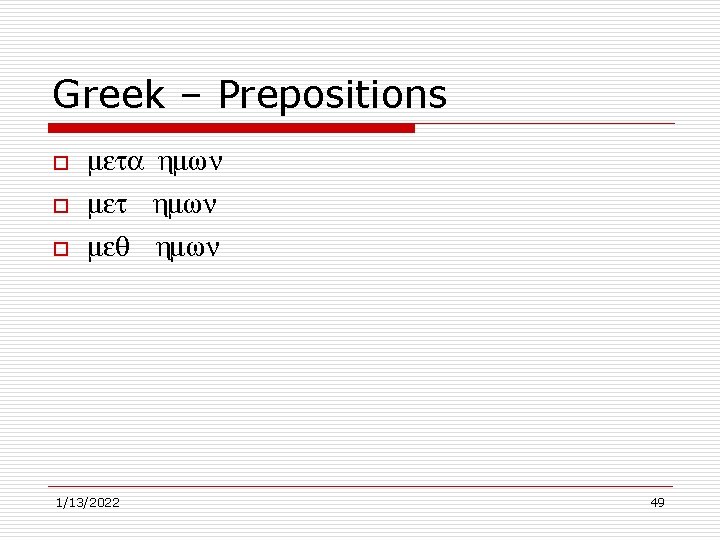
Greek – Prepositions o o o meta hmwn met hmwn meq hmwn 1/13/2022 49
Greek – Prepositions Flash Cards - “preposition with case” o 1/13/2022 50
Greek – Prepositions Flash Cards - “preposition with case” - front = “upo, genitive” - back = “by” o 1/13/2022 51
Greek – Prepositions Flash Cards - “preposition with case” - front = “upo, genitive” - back = “by” o - “___ with the ___ means ___” 1/13/2022 52
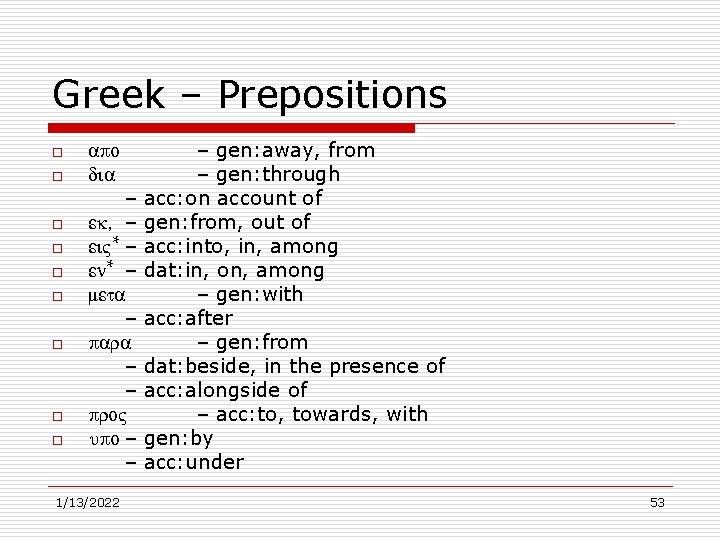
Greek – Prepositions o o o o o apo dia – ek, – eiß* – en* – meta – para – – proß upo – – 1/13/2022 – gen: away, from – gen: through acc: on account of gen: from, out of acc: into, in, among dat: in, on, among – gen: with acc: after – gen: from dat: beside, in the presence of acc: alongside of – acc: to, towards, with gen: by acc: under 53
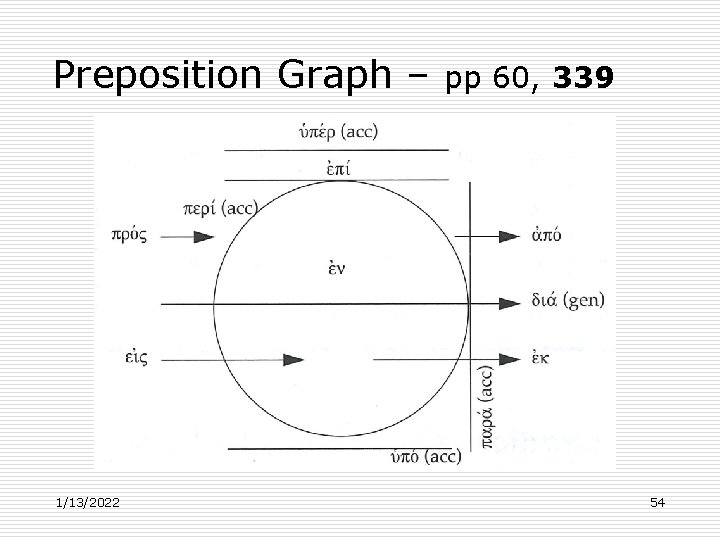
Preposition Graph – 1/13/2022 pp 60, 339 54
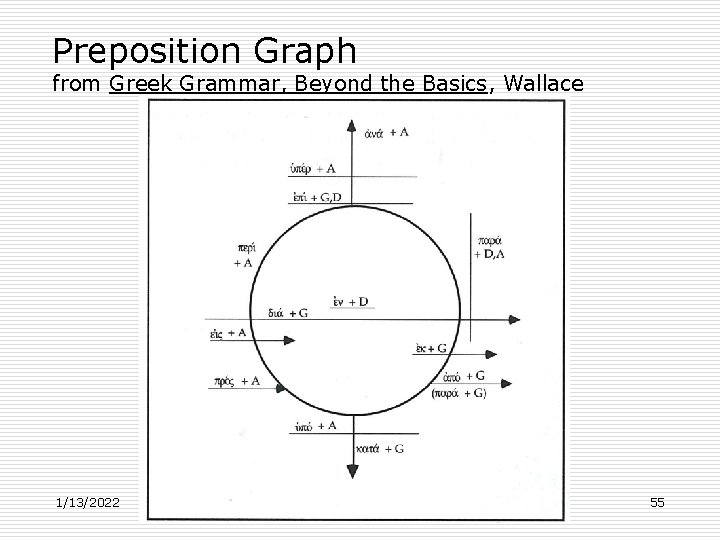
Preposition Graph from Greek Grammar, Beyond the Basics, Wallace 1/13/2022 55
English – Dependent Clauses o Dependent Clauses are… 1/13/2022 56
English – Dependent Clauses o Dependent Clauses are a collection of words that cannot stand alone; it is “dependent” upon the rest of the sentence. 1/13/2022 57
English – Dependent Clauses o o Dependent Clauses are a collection of words that cannot stand alone; it is “dependent” upon the rest of the sentence. “When Frank gets back” 1/13/2022 58
English – Dependent Clauses o o Dependent Clauses are a collection of words that cannot stand alone; it is “dependent” upon the rest of the sentence. “When Frank gets back, you will learn Biblical Greek. ” 1/13/2022 59
Greek – Dependent Clauses o As you are looking for the main subject and verb in the sentence, you will never find them in a dependent clause. 1/13/2022 60
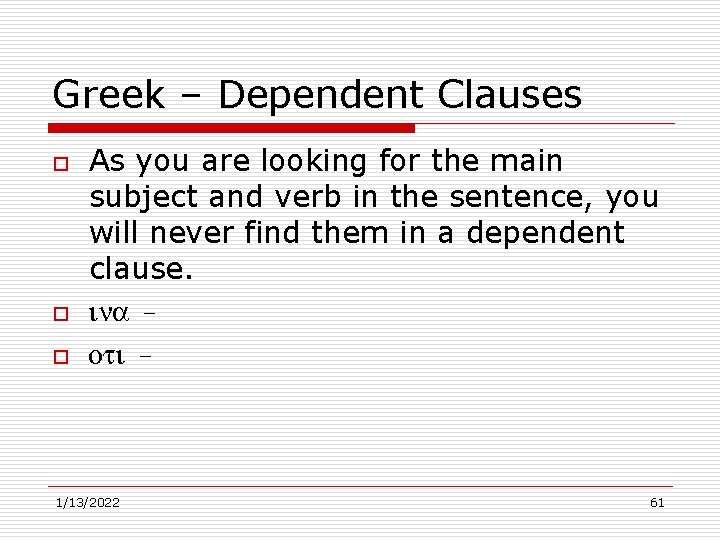
Greek – Dependent Clauses o o o As you are looking for the main subject and verb in the sentence, you will never find them in a dependent clause. ina oti - 1/13/2022 61
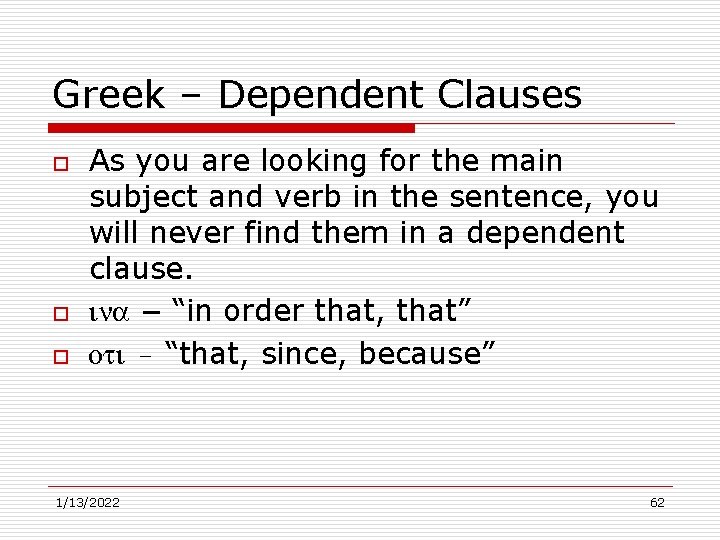
Greek – Dependent Clauses o o o As you are looking for the main subject and verb in the sentence, you will never find them in a dependent clause. ina – “in order that, that” oti - “that, since, because” 1/13/2022 62
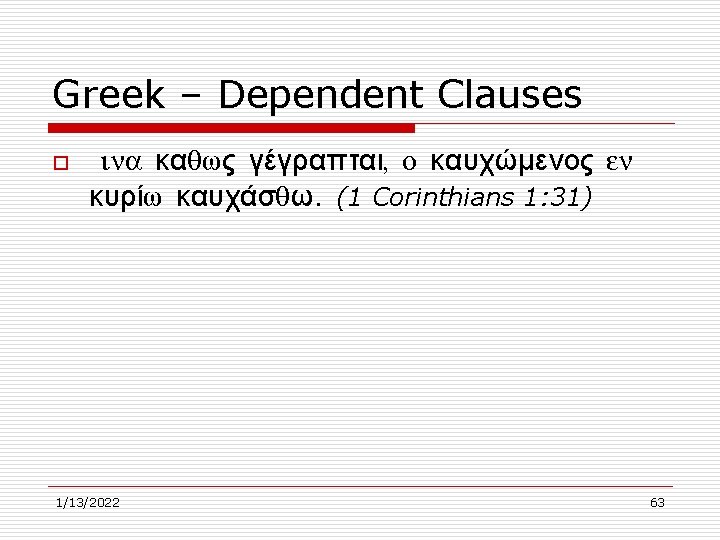
Greek – Dependent Clauses o ina καqwς γέγραπται, o καυχώμενος en κυρίw καυχάσqω. (1 Corinthians 1: 31) 1/13/2022 63
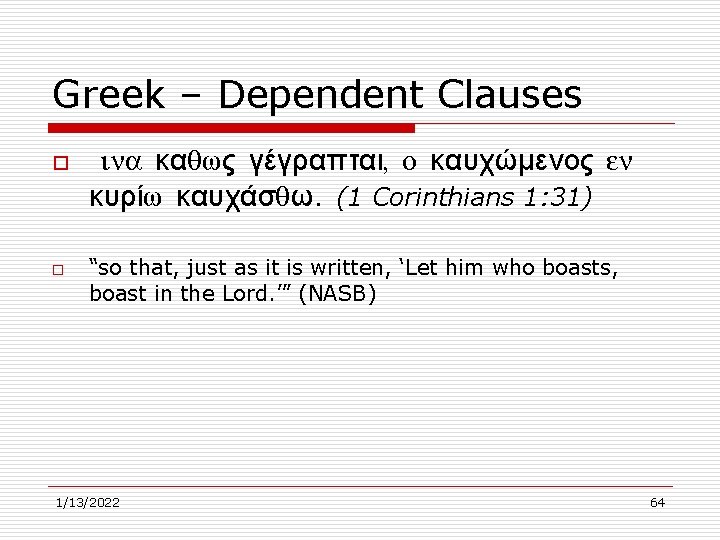
Greek – Dependent Clauses o o ina καqwς γέγραπται, o καυχώμενος en κυρίw καυχάσqω. (1 Corinthians 1: 31) “so that, just as it is written, ‘Let him who boasts, boast in the Lord. ’” (NASB) 1/13/2022 64
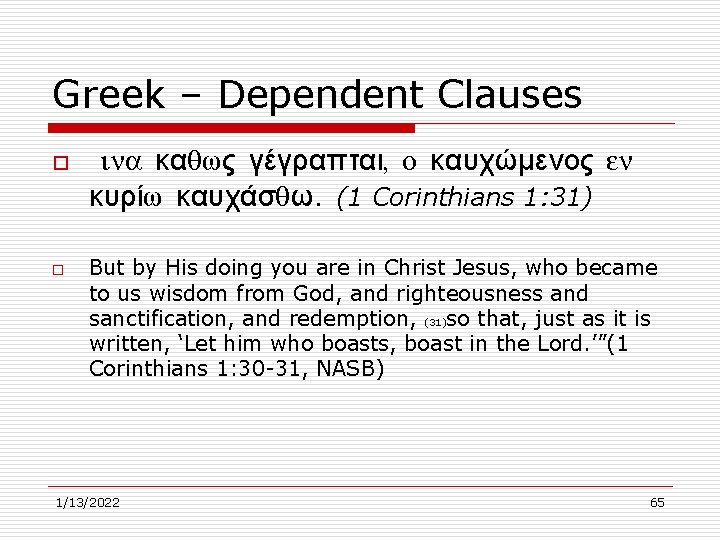
Greek – Dependent Clauses o o ina καqwς γέγραπται, o καυχώμενος en κυρίw καυχάσqω. (1 Corinthians 1: 31) But by His doing you are in Christ Jesus, who became to us wisdom from God, and righteousness and sanctification, and redemption, (31)so that, just as it is written, ‘Let him who boasts, boast in the Lord. ’”(1 Corinthians 1: 30 -31, NASB) 1/13/2022 65
Greek – Your first verb 1/13/2022 66
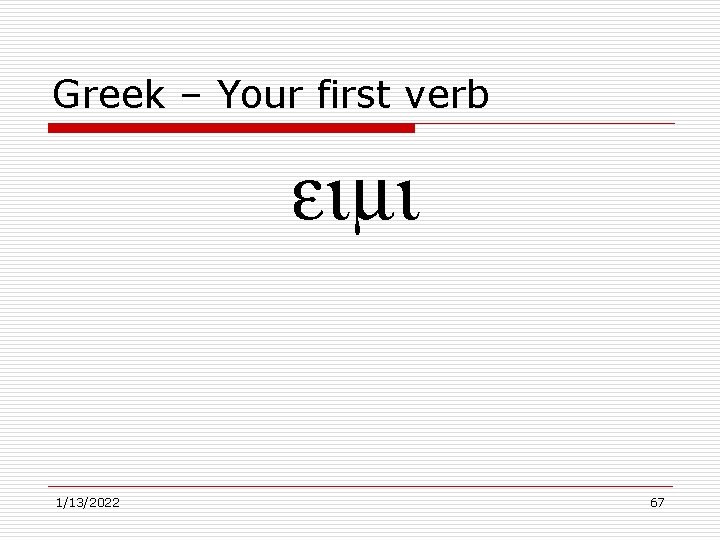
Greek – Your first verb eimi 1/13/2022 67
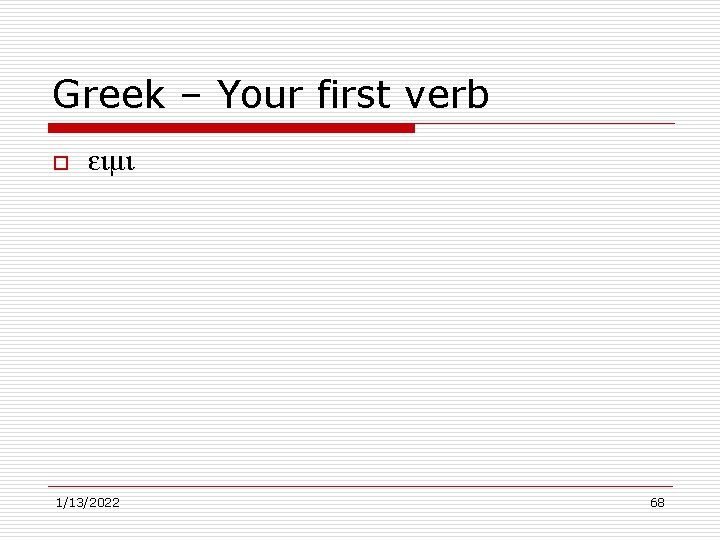
Greek – Your first verb o eimi 1/13/2022 68
Greek – Your first verb o o eimi The most common verb used in Koine Greek. 1/13/2022 69
Greek – Your first verb o o o eimi The most common verb used in Koine Greek. Most Greek verbs do not look like this, however… 1/13/2022 70
Greek – Your first verb o o eimi The most common verb used in Koine Greek. Most Greek verbs do not look like this, however… All verbs have a stem and use personal endingsto differentiate persons and number. 1/13/2022 71
Greek Verb Paradigm 1/13/2022 72
Greek Verb Paradigm 1 st sg 2 nd sg 3 rd sg 1 st pl 2 nd pl 3 rd pl 1/13/2022 73
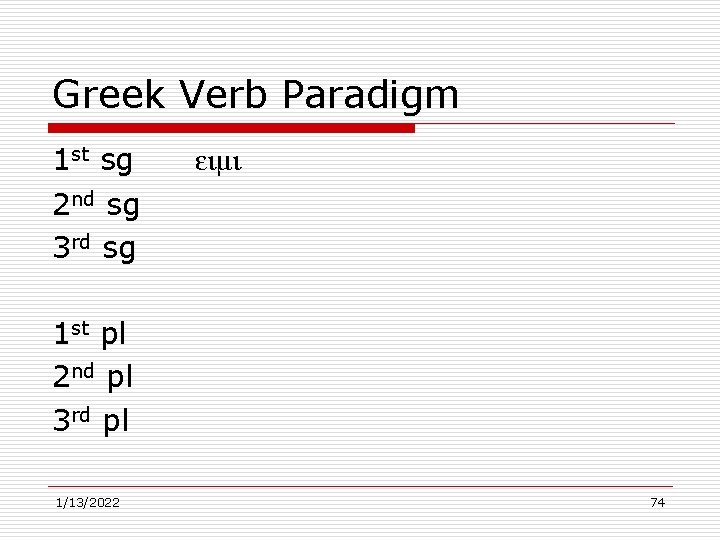
Greek Verb Paradigm 1 st sg 2 nd sg 3 rd sg eimi 1 st pl 2 nd pl 3 rd pl 1/13/2022 74
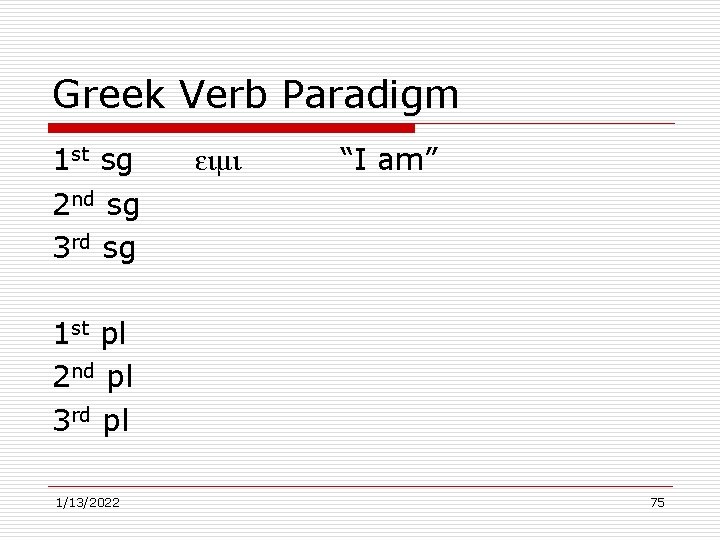
Greek Verb Paradigm 1 st sg 2 nd sg 3 rd sg eimi “I am” 1 st pl 2 nd pl 3 rd pl 1/13/2022 75
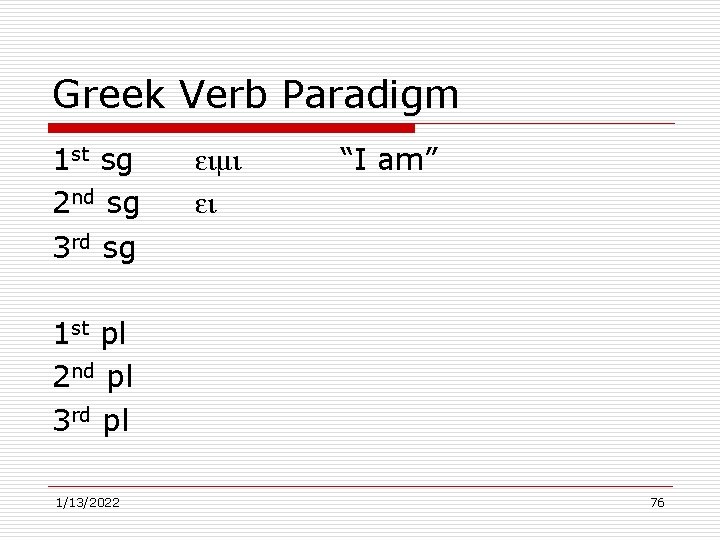
Greek Verb Paradigm 1 st sg 2 nd sg 3 rd sg eimi ei “I am” 1 st pl 2 nd pl 3 rd pl 1/13/2022 76
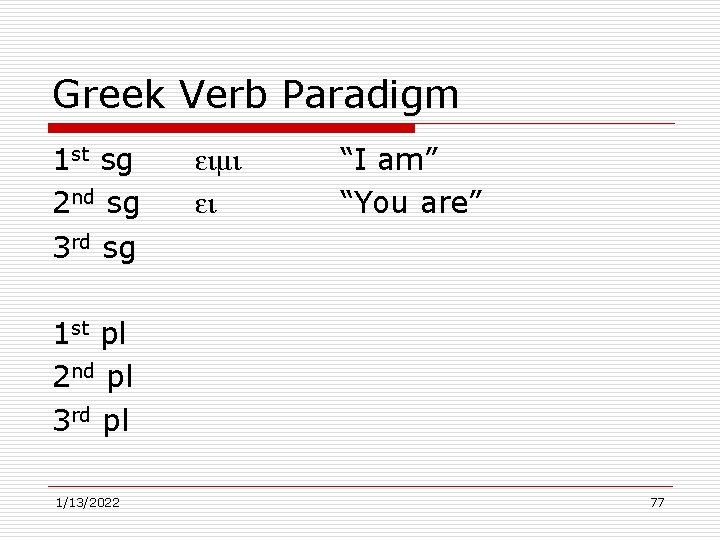
Greek Verb Paradigm 1 st sg 2 nd sg 3 rd sg eimi ei “I am” “You are” 1 st pl 2 nd pl 3 rd pl 1/13/2022 77
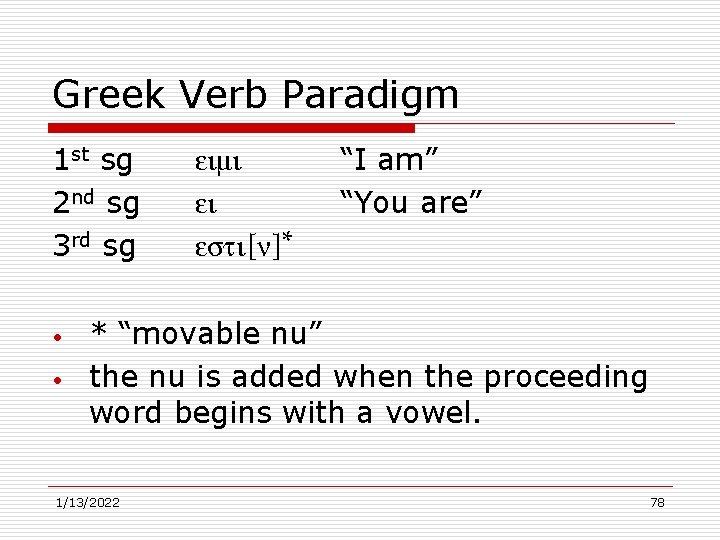
Greek Verb Paradigm 1 st sg 2 nd sg 3 rd sg • • eimi ei esti(n)* “I am” “You are” * “movable nu” the nu is added when the proceeding word begins with a vowel. 1/13/2022 78
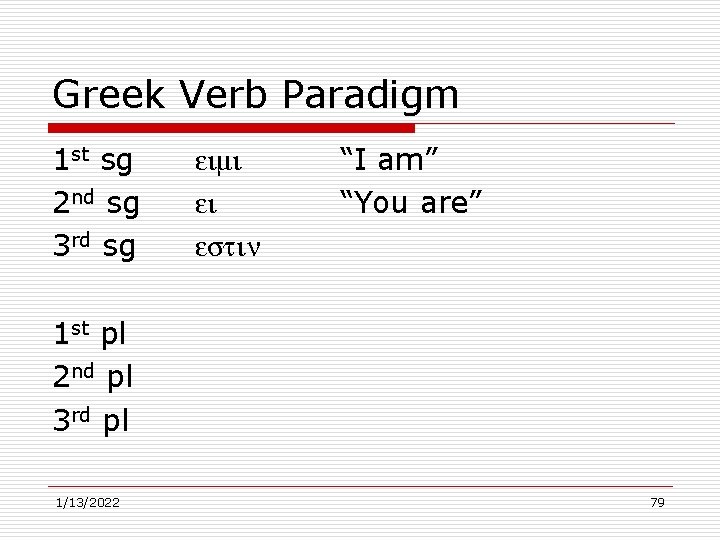
Greek Verb Paradigm 1 st sg 2 nd sg 3 rd sg eimi ei estin “I am” “You are” 1 st pl 2 nd pl 3 rd pl 1/13/2022 79
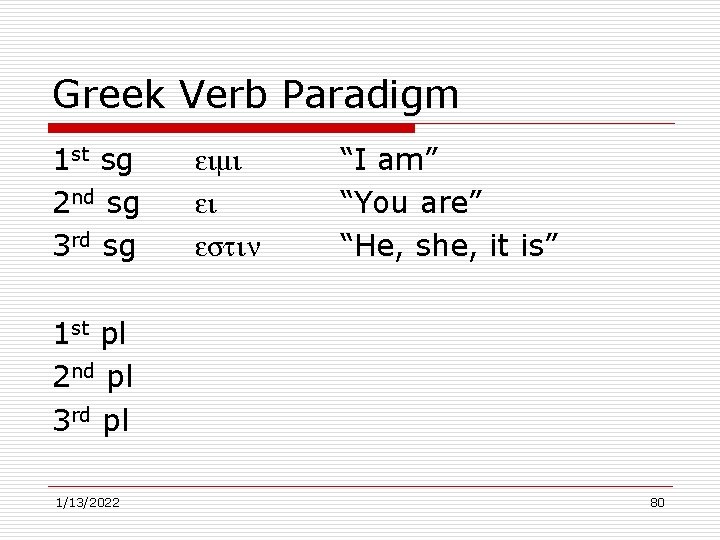
Greek Verb Paradigm 1 st sg 2 nd sg 3 rd sg eimi ei estin “I am” “You are” “He, she, it is” 1 st pl 2 nd pl 3 rd pl 1/13/2022 80
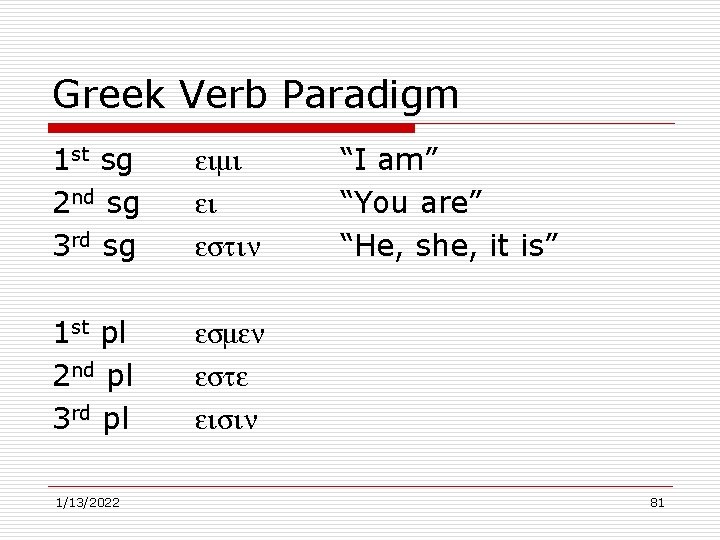
Greek Verb Paradigm 1 st sg 2 nd sg 3 rd sg eimi ei estin 1 st pl 2 nd pl 3 rd pl esmen este eisin 1/13/2022 “I am” “You are” “He, she, it is” 81
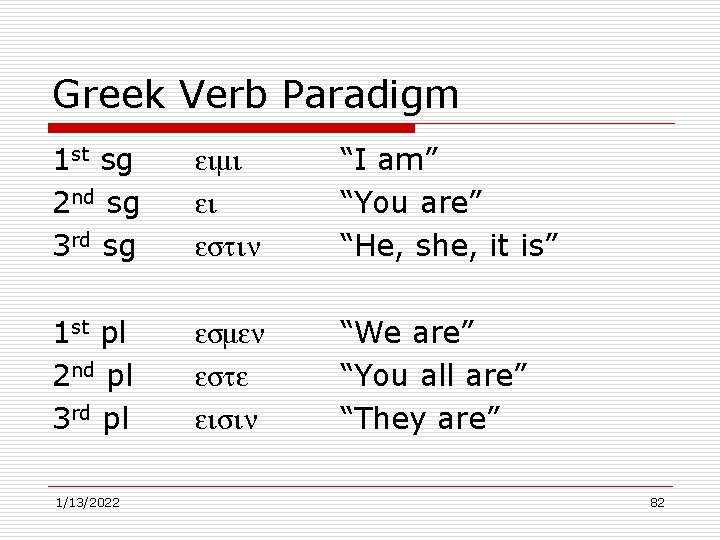
Greek Verb Paradigm 1 st sg 2 nd sg 3 rd sg eimi ei estin “I am” “You are” “He, she, it is” 1 st pl 2 nd pl 3 rd pl esmen este eisin “We are” “You all are” “They are” 1/13/2022 82
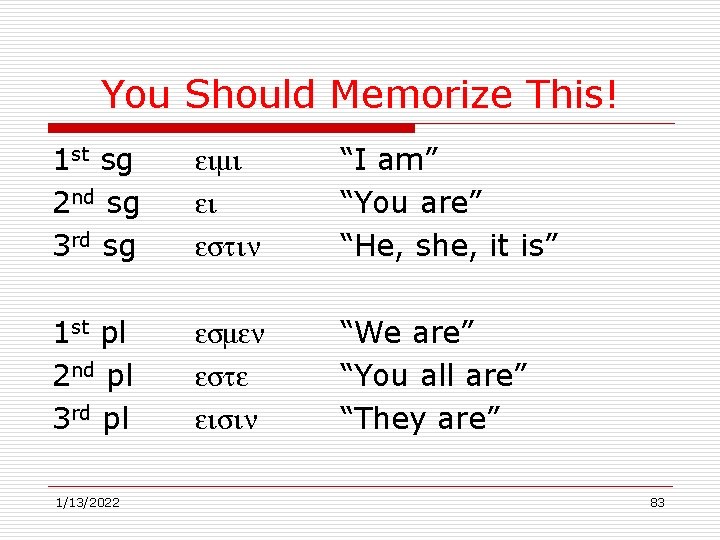
You Should Memorize This! 1 st sg 2 nd sg 3 rd sg eimi ei estin “I am” “You are” “He, she, it is” 1 st pl 2 nd pl 3 rd pl esmen este eisin “We are” “You all are” “They are” 1/13/2022 83
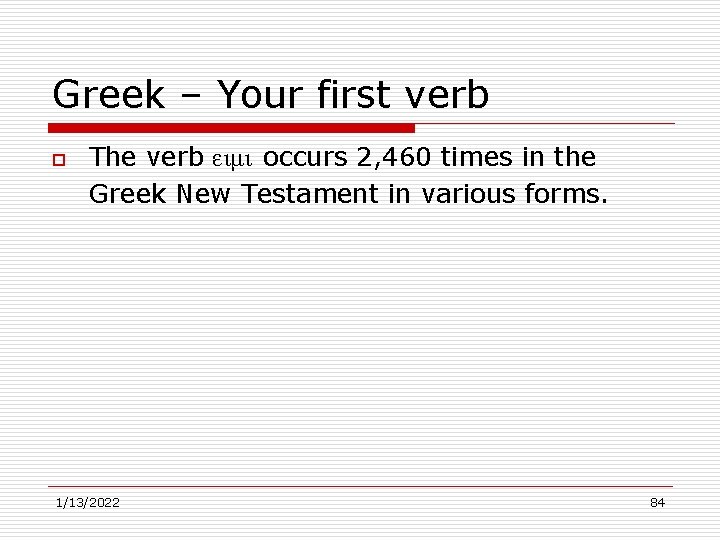
Greek – Your first verb o The verb eimi occurs 2, 460 times in the Greek New Testament in various forms. 1/13/2022 84
Greek – Your first verb o o The verb eimi occurs 2, 460 times in the Greek New Testament in various forms. Besides the present tense, the past tense form (3 rd person singular imperfect) is one of the more common. 1/13/2022 85
Greek – Your first verb o o o The verb eimi occurs 2, 460 times in the Greek New Testament in various forms. Besides the present tense, the past tense form (3 rd person singular imperfect) is one of the more common. hn 1/13/2022 86
Greek – Your first verb o o o The verb eimi occurs 2, 460 times in the Greek New Testament in various forms. Besides the present tense, the past tense form (3 rd person singular imperfect) is one of the more common. hn – “he, she, it was” 1/13/2022 87
Greek – Your first verb o o The verb eimi occurs 2, 460 times in the Greek New Testament in various forms. Besides the present tense, the past tense form (3 rd person singular imperfect) is one of the more common. hn – “he, she, it was” Do not confuse with hn, the acc, fem, reflexive pronoun meaning “whom” 1/13/2022 88
Predicate Nominative o When a noun follows eimi, it is not receiving the action of the verb; it is telling you something about the subject. 1/13/2022 89
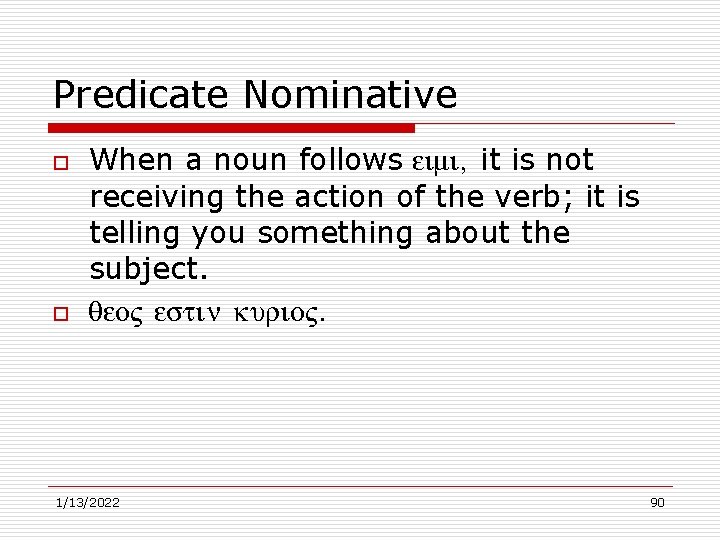
Predicate Nominative o o When a noun follows eimi, it is not receiving the action of the verb; it is telling you something about the subject. qeo. V estin kurio. V. 1/13/2022 90
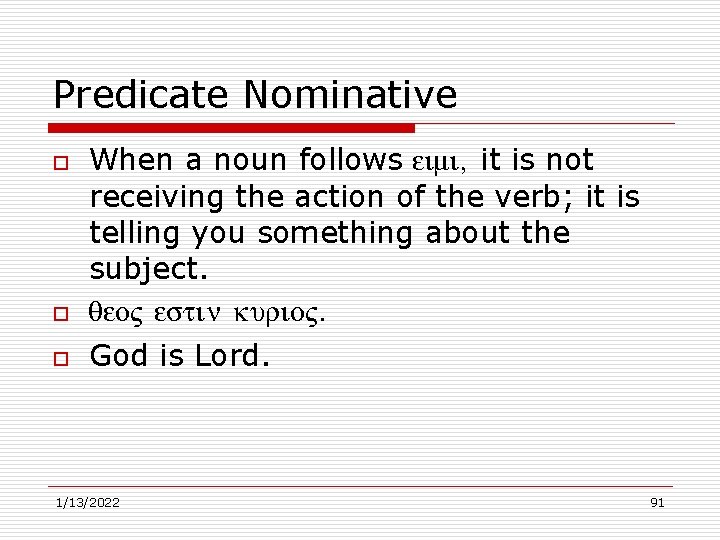
Predicate Nominative o o o When a noun follows eimi, it is not receiving the action of the verb; it is telling you something about the subject. qeo. V estin kurio. V. God is Lord. 1/13/2022 91
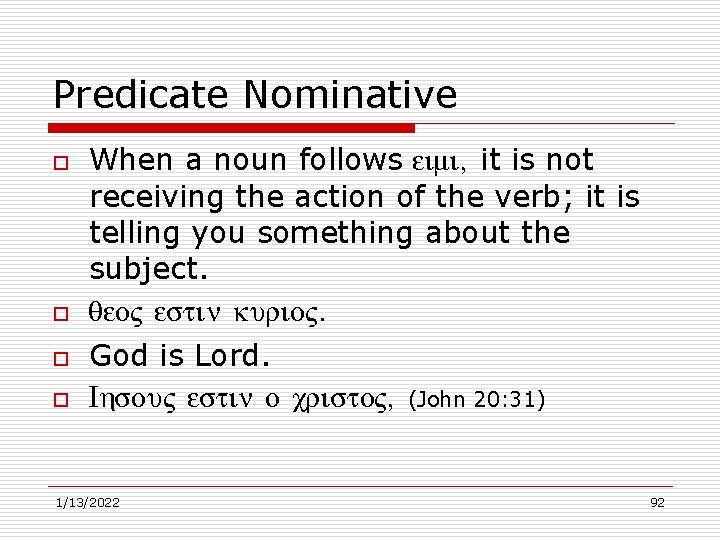
Predicate Nominative o o When a noun follows eimi, it is not receiving the action of the verb; it is telling you something about the subject. qeo. V estin kurio. V. God is Lord. Ihsou. V estin o cristo. V, (John 20: 31) 1/13/2022 92
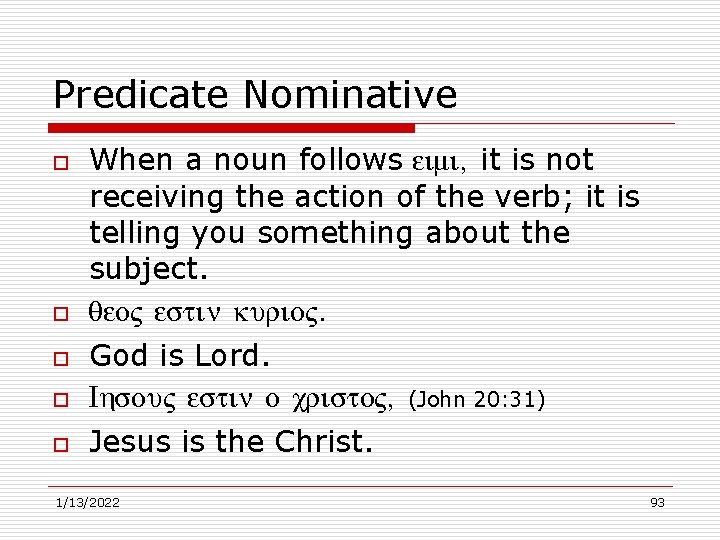
Predicate Nominative o o o When a noun follows eimi, it is not receiving the action of the verb; it is telling you something about the subject. qeo. V estin kurio. V. God is Lord. Ihsou. V estin o cristo. V, (John 20: 31) Jesus is the Christ. 1/13/2022 93
Predicative Nominative o Context will make clear which is the subject and which is the predicate. 1/13/2022 94
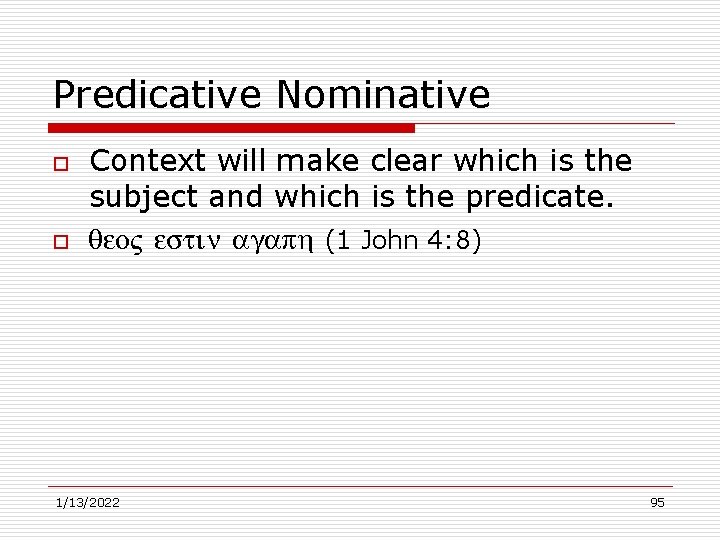
Predicative Nominative o o Context will make clear which is the subject and which is the predicate. qeo. V estin agaph (1 John 4: 8) 1/13/2022 95
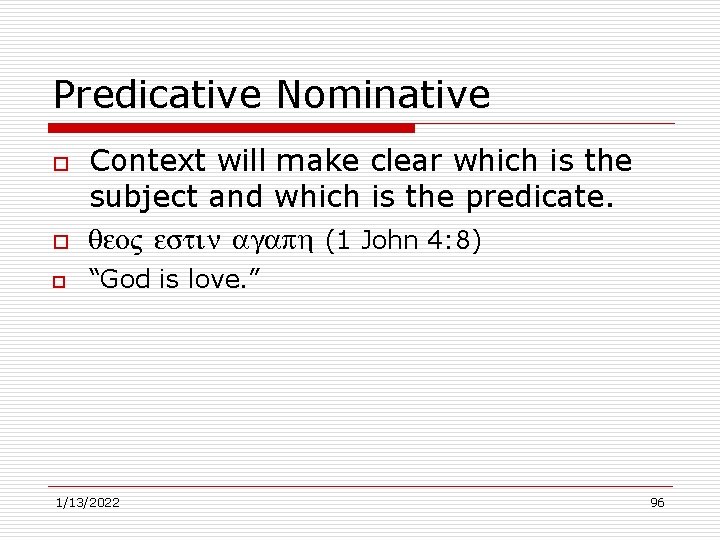
Predicative Nominative o Context will make clear which is the subject and which is the predicate. qeo. V estin agaph (1 John 4: 8) o “God is love. ” o 1/13/2022 96
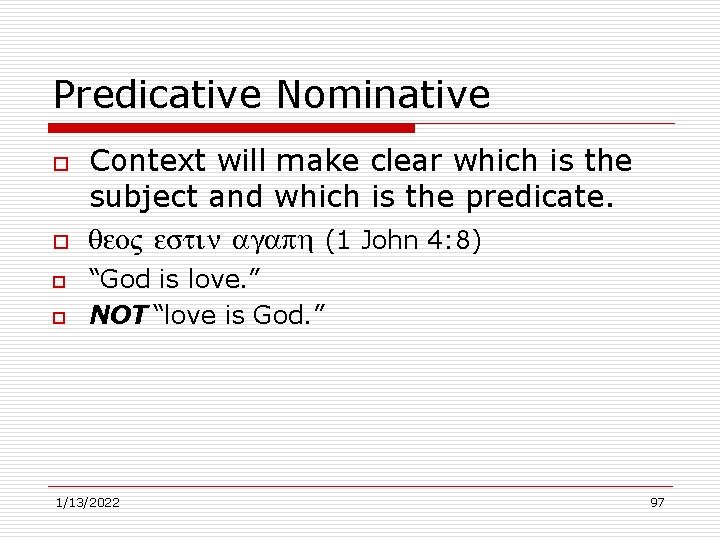
Predicative Nominative o o Context will make clear which is the subject and which is the predicate. qeo. V estin agaph (1 John 4: 8) “God is love. ” NOT “love is God. ” 1/13/2022 97
Greek - Translation o Separate the prepositional phrases or the dependent clauses as a distinct group to determine what the preposition modifies. 1/13/2022 98
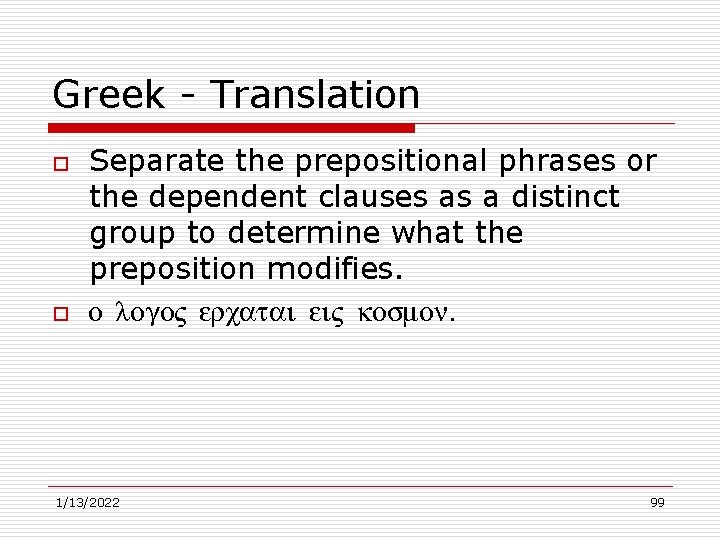
Greek - Translation o o Separate the prepositional phrases or the dependent clauses as a distinct group to determine what the preposition modifies. o logo. V ercatai ei. V kosmon. 1/13/2022 99
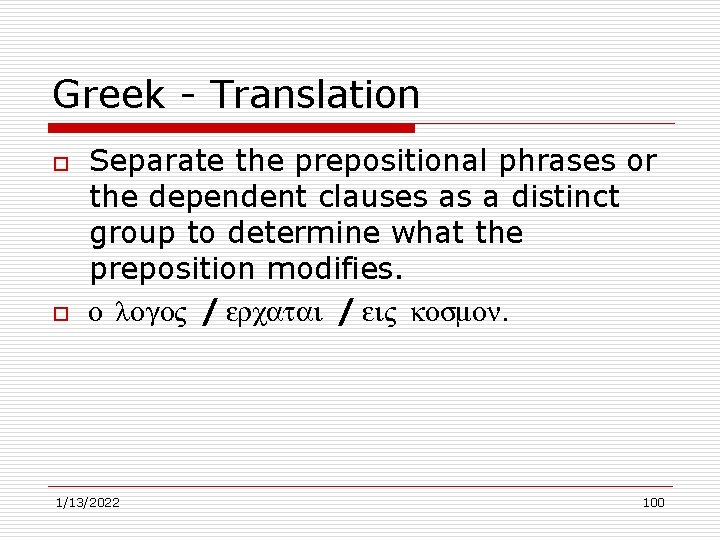
Greek - Translation o o Separate the prepositional phrases or the dependent clauses as a distinct group to determine what the preposition modifies. o logo. V / ercatai / ei. V kosmon. 1/13/2022 100
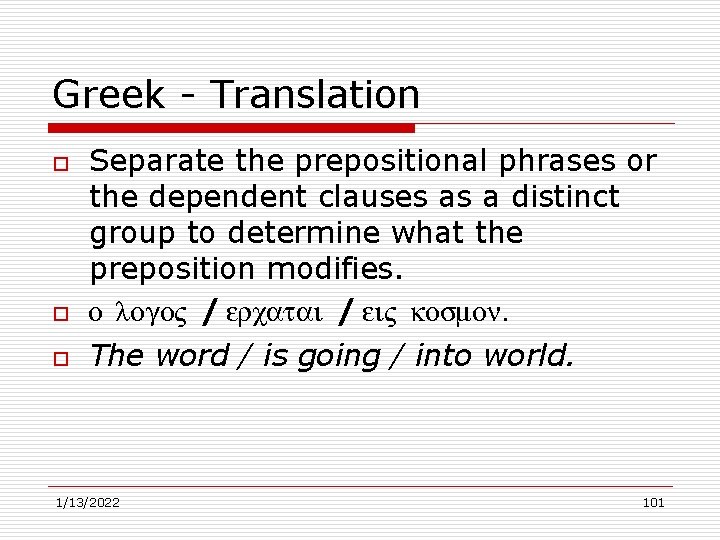
Greek - Translation o o o Separate the prepositional phrases or the dependent clauses as a distinct group to determine what the preposition modifies. o logo. V / ercatai / ei. V kosmon. The word / is going / into world. 1/13/2022 101
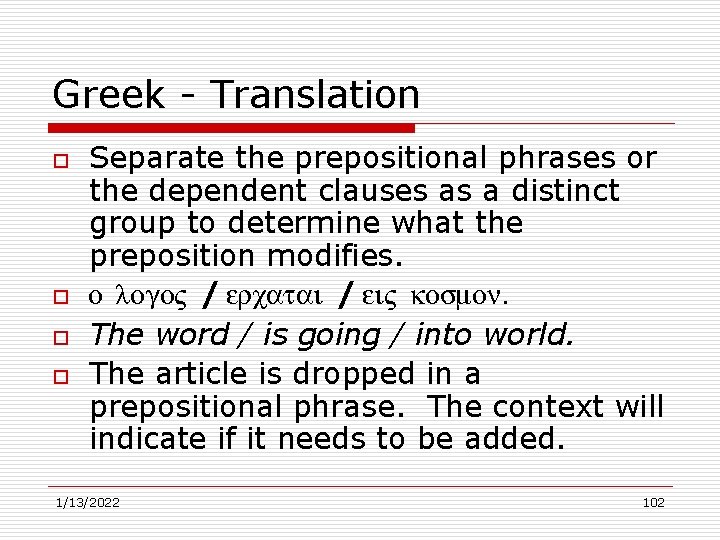
Greek - Translation o o Separate the prepositional phrases or the dependent clauses as a distinct group to determine what the preposition modifies. o logo. V / ercatai / ei. V kosmon. The word / is going / into world. The article is dropped in a prepositional phrase. The context will indicate if it needs to be added. 1/13/2022 102
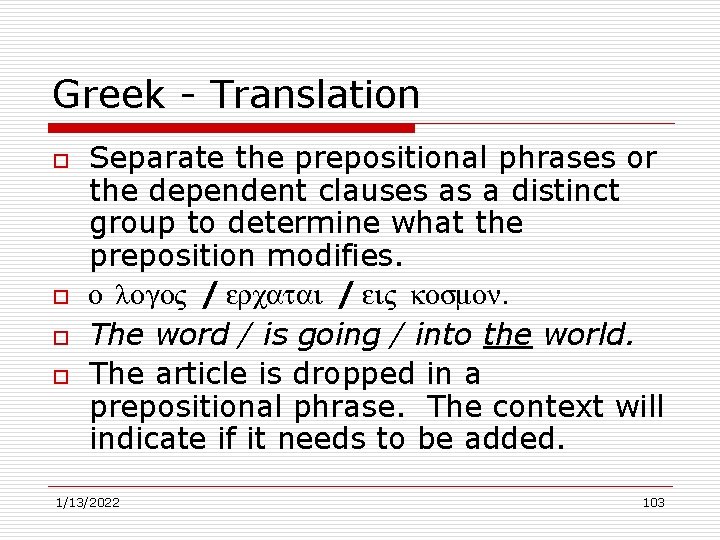
Greek - Translation o o Separate the prepositional phrases or the dependent clauses as a distinct group to determine what the preposition modifies. o logo. V / ercatai / ei. V kosmon. The word / is going / into the world. The article is dropped in a prepositional phrase. The context will indicate if it needs to be added. 1/13/2022 103
Summary o The word following the preposition is the object of the preposition, and the preposition and its object and modifiers form a prepositional phrase. 1/13/2022 104
Summary o o The word following the preposition is the object of the preposition, and the preposition and its object and modifiers form a prepositional phrase. The meaning of a preposition is determined by the case of the object. Always memorize the prepositions with their cases. 1/13/2022 105
Summary o o o The word following the preposition is the object of the preposition, and the preposition and its object and modifiers form a prepositional phrase. The meaning of a preposition is determined by the case of the object. Always memorize the prepositions with their cases. Do not use the key words when translating the object of a preposition. 1/13/2022 106
Summary o o The word following the preposition is the object of the preposition, and the preposition and its object and modifiers form a prepositional phrase. The meaning of a preposition is determined by the case of the object. Always memorize the prepositions with their cases. Do not use the key words when translating the object of a preposition. Prepositions are not inflected, but their endings can change depending on the following word (elision). 1/13/2022 107
Summary o A dependent clause cannot contain the main subject and verb in a sentence. 1/13/2022 108
Summary o o A dependent clause cannot contain the main subject and verb in a sentence. MEMORIZE eimi. “It is always followed by a predicate nominative. ” 1/13/2022 109
Summary o o o A dependent clause cannot contain the main subject and verb in a sentence. MEMORIZE eimi. “It is always followed by a predicate nominative. ” The article is often omitted from Greek prepositional phrases. You can supply it if the context requires it. 1/13/2022 110

Next Week 1/13/2022 111
Next Week o Chapter 9 – Adjectives 1/13/2022 112
Next Week o o Chapter 9 – Adjectives And most importantly… 1/13/2022 113

Next Week o o o Chapter 9 – Adjectives And most importantly… Frank will be back! 1/13/2022 114
- Slides: 114