
Basics of Applied Behavior Analysis Applications for Individuals
Basics of Applied Behavior Analysis: Applications for Individuals of All Ages and Abilities Michael J Morrier, Ph. D, BCBA-D Emory University School of Medicine, Atlanta, GA Robert Babcock, Ph. D, BCBA-D R. Babcock and Associates, Auburn, AL
Financial Disclosures - Morrier Behavior Imagining Solutions NODA Rural Study Bright from the Start: Georgia Department of Early Care and Learning Project Director, Walden Lottery Pre-Kindergarten Program Georgia Department of Public Health Georgia Autism Assessment Collaborative National Institutes of Mental Health Silvio O. Conte Center for Oxytocin and Social Cognition U. S. Centers for Disease Control and Prevention ADDM Expert Reviewer
Learning Objectives Participants will be able to define the underlying principles of applied behavior analysis (ABA). Participants will identify how to incorporate ABA into natural settings within schools, homes, and communities to assist individuals with autism spectrum disorder (ASD) acquire new skills. Participants will be able to describe different ABA programs that have been shown effective for individuals with ASD across the age range.
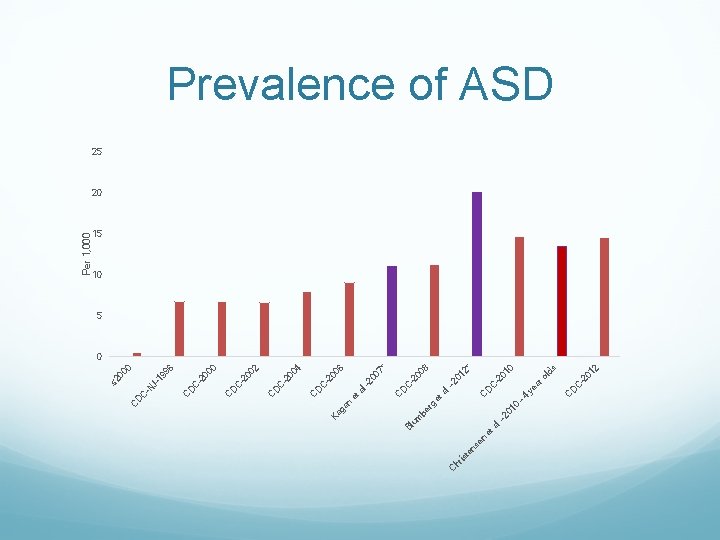
n se en is t hr C et al 0 01 -2 be rg um Bl C D C 2 ol ds -2 01 ar ye 0 01 -2 * 01 2 -2 8 -2 00 C D al C et C * 6 -2 00 4 -2 00 20 07 al - C D C et -4 ga n Ka D C C 2 0 -2 00 C D C C D 0 96 19 J- -N C C D C ≤ 2 00 Per 1, 000 Prevalence of ASD 25 20 15 10 5 0
Applied Behavior Analysis is… Science devoted to the understanding and improvement of human behavior Focus on Objectively defined behavior Intervention to improve behavior Demonstrate reliable relationship between intervention and behavior improvements Use methods of scientific inquiry Discover environmental arrangements that reliably influence socially significant behavior to create behavior change Cooper, Heron, & Heward, 2007
Applied Behavior Analysis (ABA) Not your grandparents ABA Tenants describe in 1968 (Baer, Wolf, & Risley; Journal of Applied Behavior Analysis) Meaningful behavior

What is ABA? “the process of applying sometimes tentative principles of behavior to the improvement of specific behaviors, and simultaneously evaluating whether or not any changes noted are indeed attributed to the process of application” (Baer, Wolf, & Risley, 1968, p. 91) Functional skills Initial and ongoing assessment Behavior is controlled by environmental factors and consequences Prompting – increases probability desired response will occur Fading – systematic withdrawal of prompts Shaping – reinforce successive approximations Use data to make decisions on progress and next steps

Tenants of ABA Applied Socially important Conceptual systems Can be replicated Behavioral Can be seen, Effective Produces large enough Analytic Show control over the Generality Is durable over time and measured, and repeated behavior effect to be meaningful to individual settings Technological Procedures are describe in detail Baer, Wolf, & Risley. (1968) JABA; 1(1), 91 -97
Three Part Contingency Antecedent What happens before the behavior occurs Could be something you are not thinking of Not eating breakfast Missed bus Menstrual cycle starting Behavior Observable, measurable, repeatable Consequence What happens after behavior occurs
Types of Consequences Positive reinforcement – any event which follows a behavior which increases the likelihood that behavior occurs in the future Negative reinforcement – removal of an event which increases the likelihood behavior will occur in the future Punishment - any event which follows a behavior which decreases the likelihood that behavior occurs in the future
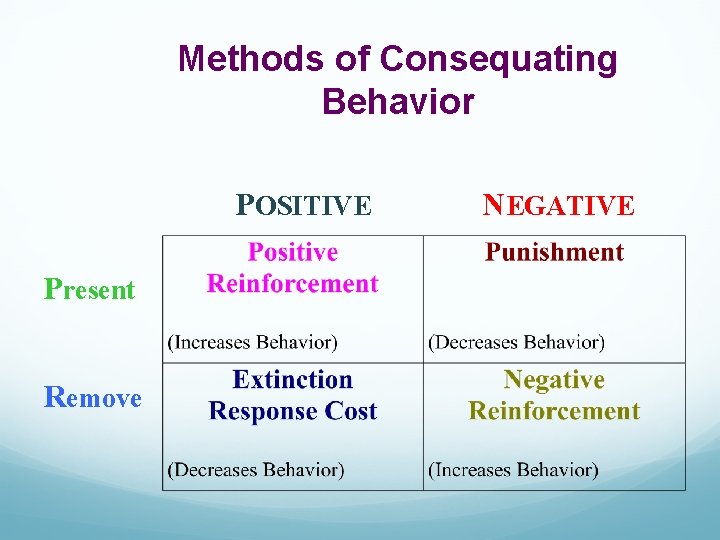
Methods of Consequating Behavior POSITIVE Present Remove NEGATIVE
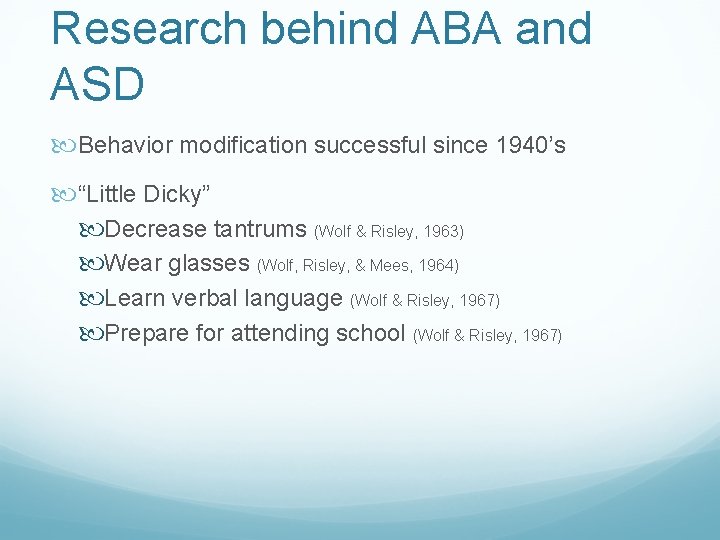
Research behind ABA and ASD Behavior modification successful since 1940’s “Little Dicky” Decrease tantrums (Wolf & Risley, 1963) Wear glasses (Wolf, Risley, & Mees, 1964) Learn verbal language (Wolf & Risley, 1967) Prepare for attending school (Wolf & Risley, 1967)
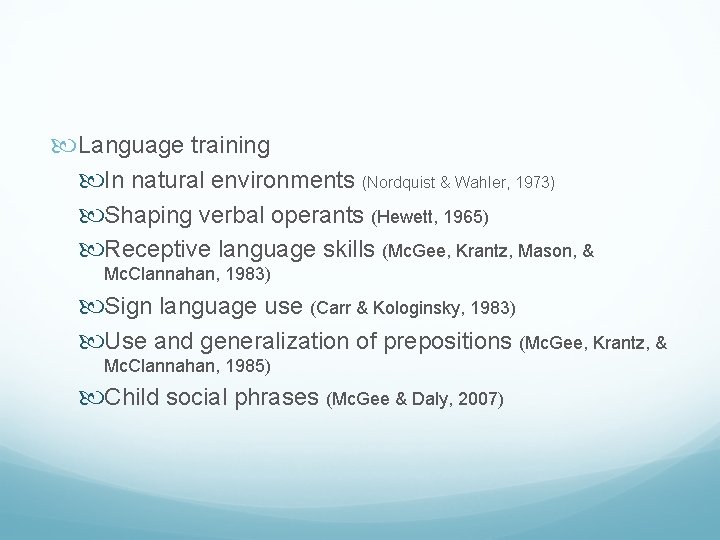
Language training In natural environments (Nordquist & Wahler, 1973) Shaping verbal operants (Hewett, 1965) Receptive language skills (Mc. Gee, Krantz, Mason, & Mc. Clannahan, 1983) Sign language use (Carr & Kologinsky, 1983) Use and generalization of prepositions (Mc. Gee, Krantz, & Mc. Clannahan, 1985) Child social phrases (Mc. Gee & Daly, 2007)
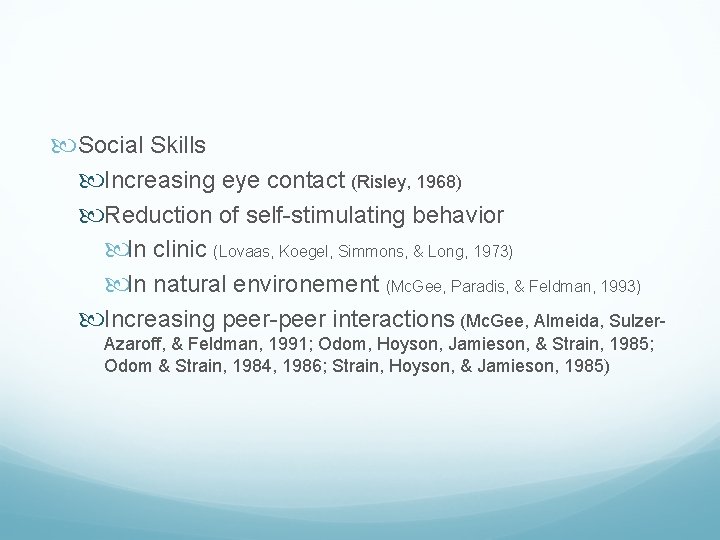
Social Skills Increasing eye contact (Risley, 1968) Reduction of self-stimulating behavior In clinic (Lovaas, Koegel, Simmons, & Long, 1973) In natural environement (Mc. Gee, Paradis, & Feldman, 1993) Increasing peer-peer interactions (Mc. Gee, Almeida, Sulzer. Azaroff, & Feldman, 1991; Odom, Hoyson, Jamieson, & Strain, 1985; Odom & Strain, 1984, 1986; Strain, Hoyson, & Jamieson, 1985)
Comprehensive ABA programs Early Autism Project (Lovaas, 1987; Smith, Groen, & Wynn, 2000) RCT to show hours of ABA matter LEAP Preschool (Strain & Bovey, 2011) RCT of social curriculum Walden Early Childhood Center (Mc. Gee, Daly, & Jacobs, 1991; Mc. Gee, Morrier, & Daly, 1999, 2001)
Common ABA programs for young children with ASD Discrete Trial Training (Lovaas method) Pivotal Response Training (PRT) (Koegel et al. ) Learning Experiences, an Alternative Program for Preschoolers and Parents (LEAP) (Strain et al. ) Incidental Teaching (Walden) (Mc. Gee et al. ) Picture Exchange Communication System (PECS) (Bondy & Frost) Early Start Denver Model (ESDM) (Dawson et al. )
Naturalistic Developmental Behavioral Interventions (NDBI) Schreibman et al. (2015) Journal of Autism and Developmental Disorders, 45(8), 2411 - 2428 Autism researchers representing range of views and diverse disciplines Consensus statement regarding empirical and theoretical basis Describes influence of behavioral psychology and developmental science Achieves optional outcomes Substantial research base supports effectiveness across age range Needs of toddlers with ASD just emerging Schreibman et al. (2015). JADD; 45(8) 2411 -2428
Toddler NDBI Based on “naturalistic” behavioral intervention and developmental orientations Rather than traditional ABA Delivered in naturalistic and interactive social contexts Play and daily routines Involve child-directed teaching strategies Use child-preferred materials (Mc. Gee et al. , 1991) Natural rather than artificial rewards (Koegel & Williams, 1980) Improves effectiveness of DTT procedures Schreibman et al. (2015). JADD; 45(8) 2411 -2428
Advantages of NDBI Improved generalization Cues constantly changing based on environment Decreased need to teach skill in multiple context Children with ASD learn more rapidly Reduced dependency on prompts More natural sounding language Gets used to everyday distractions Promote social development through interactions with peers and adults Considers child’s developmental readiness for goals and behavior plans Chronological age Developmental age Family-friendly approaches Family environments Ongoing activities Schreibman et al. (2015). JADD; 45(8) 2411 -2428
Core Components of NDBI Learning Targets Entire range of developmental domains Integration of knowledge and skills across domains Skills not taught in isolation Provides infrastructure to support learning on functional skills Learning Contexts Experiences natural contingencies of behavior Establishes adult-child engagement activities Facilitates learning and generalization Development-Enhancing Strategies Motivating activities Incorporates behavioral strategies to support development Modeling Shaping Chaining Prompting Differential Reinforcement Schreibman et al. (2015). JADD; 45(8) 2411 -2428
Common Features of NDBIs Three Part Contingency Antecedent-Behavior-Consequence Manualized Practice Fidelity of Implementation Criteria Individualized Treatment Goals Ongoing Measurement Child-Initiated Teaching Episodes Environmental Arrangement Natural Reinforcement Use of Prompting and Prompt Fading Modeling Adult Imitation of Child’s Language, Play, or Body Movements Schreibman et al. (2015). JADD; 45(8) 2411 -2428
Example NDBI Interventions for ASD Incidental Teaching (IT; Hart & Risley, 1968; Mc. Gee et al, 1999) Pivotal Response Training (PRT; Koegel & Koegel, 2006; Koegel et al. , 1989; Schreibman & Koegel, 2005) Early Start Denver Model (ESDM: Dawson et al. , 2010; Rogers & Dawson, 2010; Rogers et al. , 2012) Enhanced Milieu Teaching (EMT; Kaiser & Hester, 1994) Reciprocal Imitation Training (RIT; Ingersoll, 2010; Ingersoll & Schreibman, 2006) Project Improving Parents As Communication Teachers (Project Im. PACT; Ingersoll & Wainer, 2013 a, b) Joint Attention Symbolic Play Engagement and Regulation (JASPER; Kaale et al. 2012, 2104; Kasari et al. , 2006, 2008, 2010, 2014 a, b) Social Communication/Emotional Regulation/Transactional Support (SCERTS; Prizant et al. , 2003) Early Achievements (Landa et al. , 2011; Landa & Kalb, 2012) Schreibman et al. (2015). JADD; 45(8) 2411 -2428
Biological changes after PRT 10 children with ASD Ages 4. 5 – 7. 0 years 20% female 5 hypo-activation at baseline Weaker than normal coherent (BIO) vs. scrambled (SCR) motion 5 hyper-activation at baseline Stronger than normal BIO vs. SCR motion Greater parent-reported symptoms of anxiety and attention problems Great difficulties with compliance/behavioral control 5 typical peers Ages 5. 1 – 7. 7 years 60% female Pre-Post treatment f. MRI changes in neural mechanisms Coherent point-light displays Scrambled point-light displays 16 weeks PRT, 7 hours per week Ventola et al. (2015). Brain Imagining Behav; 9(1) 74 -88
Results Significant gains in social communication skills for all children Hypo-activation children Widespread increases in BIO > SCR activation in right Posterior Superior Temporal Cortex (p. STS) – processing facial expression region No regions of decreased BIO > SCR Increased subcortical activity in social reward circuitry (social motivation) Increased ventral striatum responses to more socially meaningful stimuli Hyper-activation children Decreased BIO > SCR activation in right p. STS, the amygdala, thalamus, and hippocampus Ventola et al. (2015). Brain Imagining Behav; 9(1) 74 -88
Conclusions Neural systems related to social perception were malleable through PRT More similar to typical children after PRT Hyperactivated group decreased activation Hypoactivated group increased activation Potential biomarker for treatment response Evidence-based ABA procedures may be able to change neural mechanism of children with ASD Ventola et al. (2015). Brain Imagining Behav; 9(1) 74 -88
ABA with Adults Continues to focus on Reducing challenging behaviors Maintaining skills from earlier my. LIFE
- Slides: 27