
Basics of Analytical Geometry By Kishore Kulkarni 1
Basics of Analytical Geometry By Kishore Kulkarni 1
Outline w 2 D Geometry n n Straight Lines, Pair of Straight Lines Conic Sections l Circles, Ellipse, Parabola, Hyperbola w 3 D Geometry n Straight Lines, Planes, Sphere, Cylinders w Vectors n n 2 D & 3 D Position Vectors Dot Product, Cross Product & Box Product w Analogy between Scalar and vector representations 2
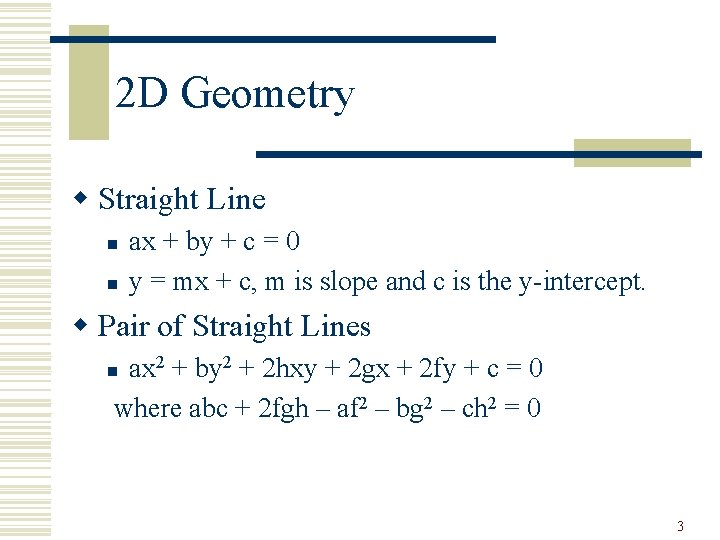
2 D Geometry w Straight Line n n ax + by + c = 0 y = mx + c, m is slope and c is the y-intercept. w Pair of Straight Lines ax 2 + by 2 + 2 hxy + 2 gx + 2 fy + c = 0 where abc + 2 fgh – af 2 – bg 2 – ch 2 = 0 n 3
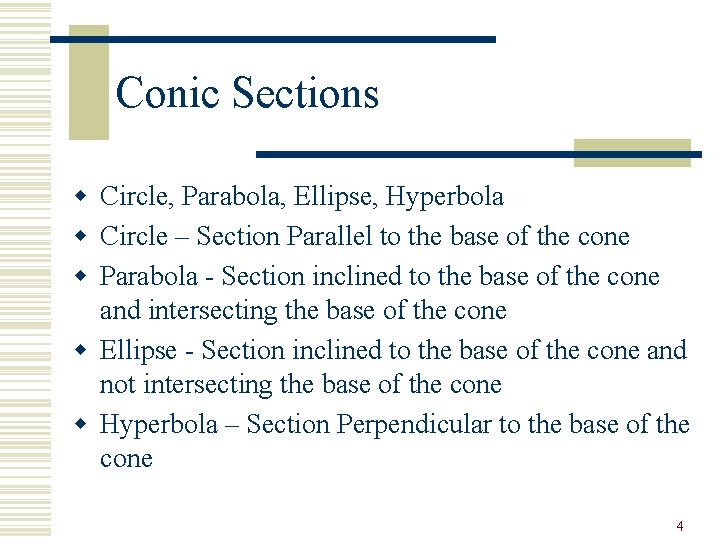
Conic Sections w Circle, Parabola, Ellipse, Hyperbola w Circle – Section Parallel to the base of the cone w Parabola - Section inclined to the base of the cone and intersecting the base of the cone w Ellipse - Section inclined to the base of the cone and not intersecting the base of the cone w Hyperbola – Section Perpendicular to the base of the cone 4
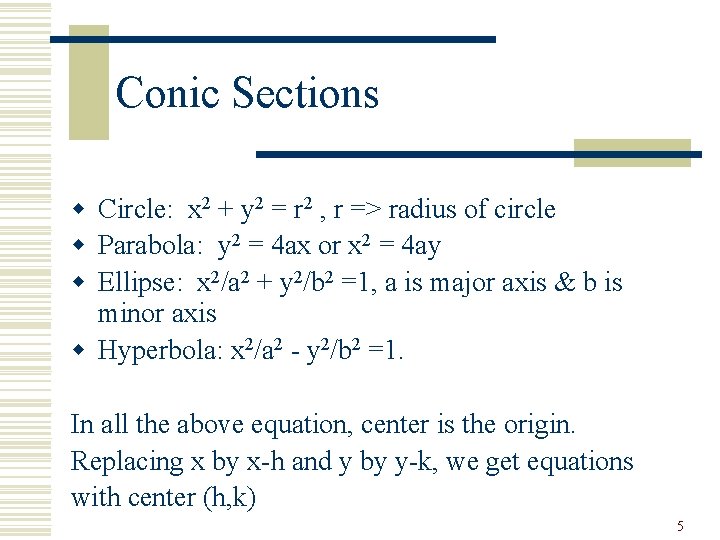
Conic Sections w Circle: x 2 + y 2 = r 2 , r => radius of circle w Parabola: y 2 = 4 ax or x 2 = 4 ay w Ellipse: x 2/a 2 + y 2/b 2 =1, a is major axis & b is minor axis w Hyperbola: x 2/a 2 - y 2/b 2 =1. In all the above equation, center is the origin. Replacing x by x-h and y by y-k, we get equations with center (h, k) 5
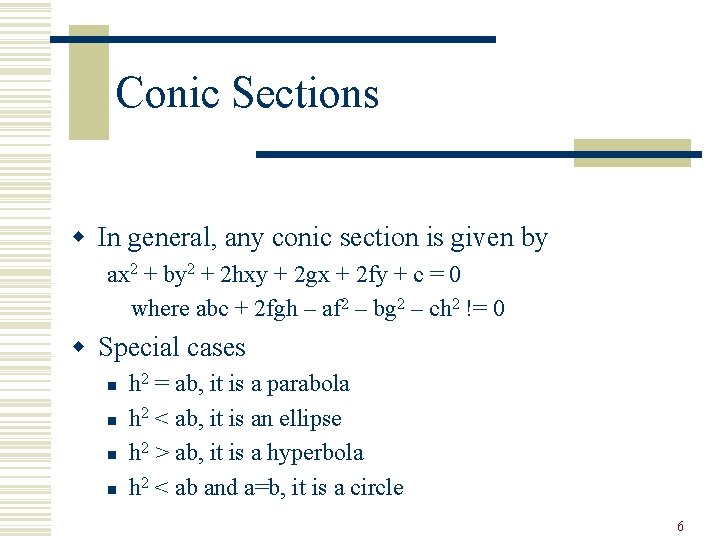
Conic Sections w In general, any conic section is given by ax 2 + by 2 + 2 hxy + 2 gx + 2 fy + c = 0 where abc + 2 fgh – af 2 – bg 2 – ch 2 != 0 w Special cases n n h 2 = ab, it is a parabola h 2 < ab, it is an ellipse h 2 > ab, it is a hyperbola h 2 < ab and a=b, it is a circle 6
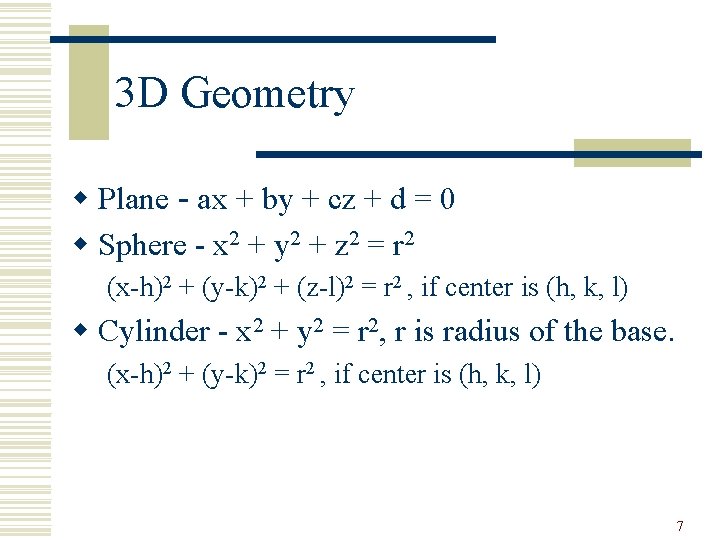
3 D Geometry w Plane - ax + by + cz + d = 0 w Sphere - x 2 + y 2 + z 2 = r 2 (x-h)2 + (y-k)2 + (z-l)2 = r 2 , if center is (h, k, l) w Cylinder - x 2 + y 2 = r 2, r is radius of the base. (x-h)2 + (y-k)2 = r 2 , if center is (h, k, l) 7
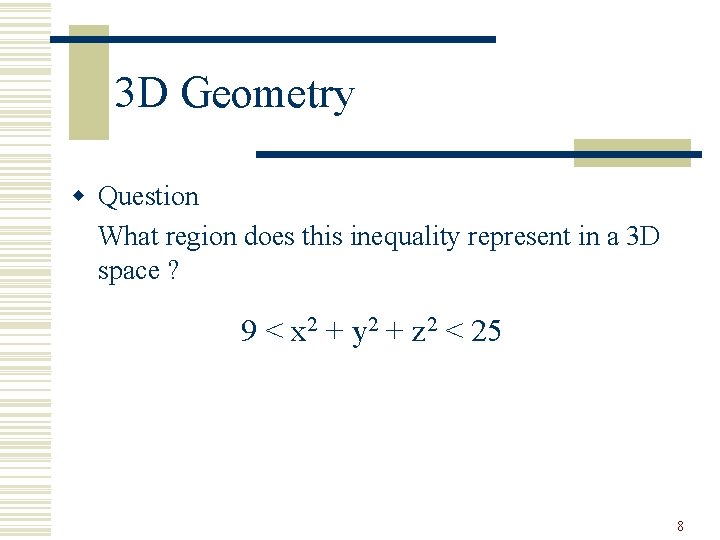
3 D Geometry w Question What region does this inequality represent in a 3 D space ? 9 < x 2 + y 2 + z 2 < 25 8

3 D Geometry w Straight Lines Parametric equations of line passing through (x 0, y 0, z 0) x = x 0 + at, y = y 0 + bt, z = z 0 + ct n Symmetric form of line passing through (x 0, y 0, z 0) (x - x 0)/a = (y - y 0)/b = (z - z 0)/c n where a, b, c are the direction numbers of the line. 9
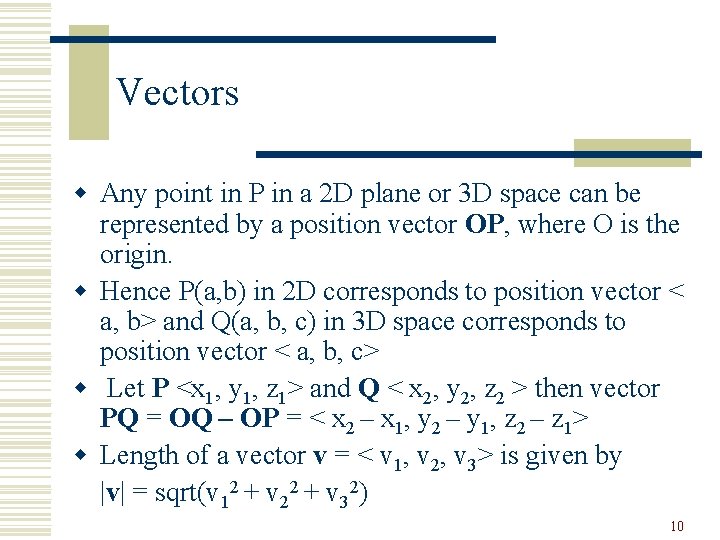
Vectors w Any point in P in a 2 D plane or 3 D space can be represented by a position vector OP, where O is the origin. w Hence P(a, b) in 2 D corresponds to position vector < a, b> and Q(a, b, c) in 3 D space corresponds to position vector < a, b, c> w Let P <x 1, y 1, z 1> and Q < x 2, y 2, z 2 > then vector PQ = OQ – OP = < x 2 – x 1, y 2 – y 1, z 2 – z 1> w Length of a vector v = < v 1, v 2, v 3> is given by |v| = sqrt(v 12 + v 22 + v 32) 10
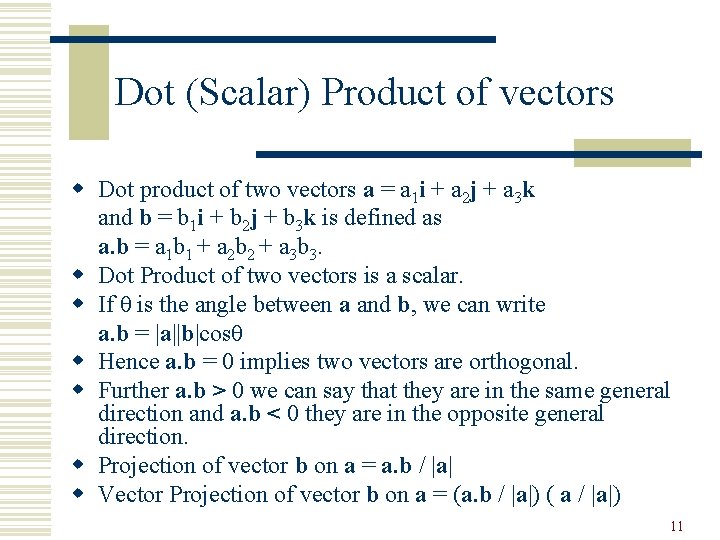
Dot (Scalar) Product of vectors w Dot product of two vectors a = a 1 i + a 2 j + a 3 k and b = b 1 i + b 2 j + b 3 k is defined as a. b = a 1 b 1 + a 2 b 2 + a 3 b 3. w Dot Product of two vectors is a scalar. w If θ is the angle between a and b, we can write a. b = |a||b|cosθ w Hence a. b = 0 implies two vectors are orthogonal. w Further a. b > 0 we can say that they are in the same general direction and a. b < 0 they are in the opposite general direction. w Projection of vector b on a = a. b / |a| w Vector Projection of vector b on a = (a. b / |a|) ( a / |a|) 11
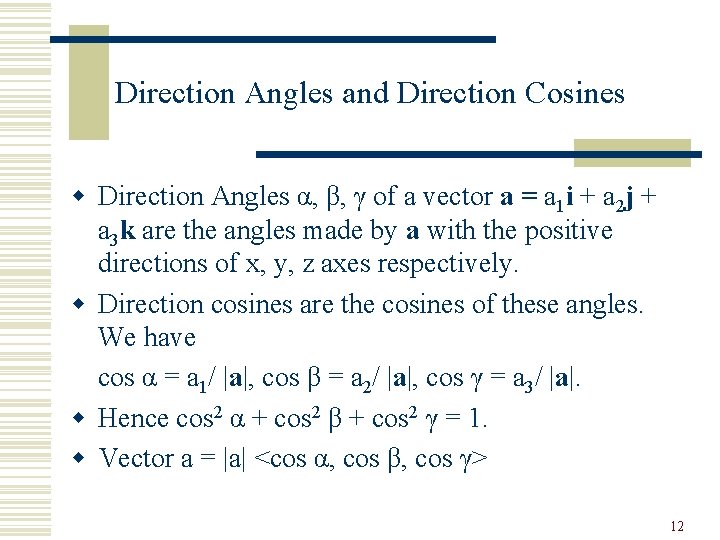
Direction Angles and Direction Cosines w Direction Angles α, β, γ of a vector a = a 1 i + a 2 j + a 3 k are the angles made by a with the positive directions of x, y, z axes respectively. w Direction cosines are the cosines of these angles. We have cos α = a 1/ |a|, cos β = a 2/ |a|, cos γ = a 3/ |a|. w Hence cos 2 α + cos 2 β + cos 2 γ = 1. w Vector a = |a| <cos α, cos β, cos γ> 12
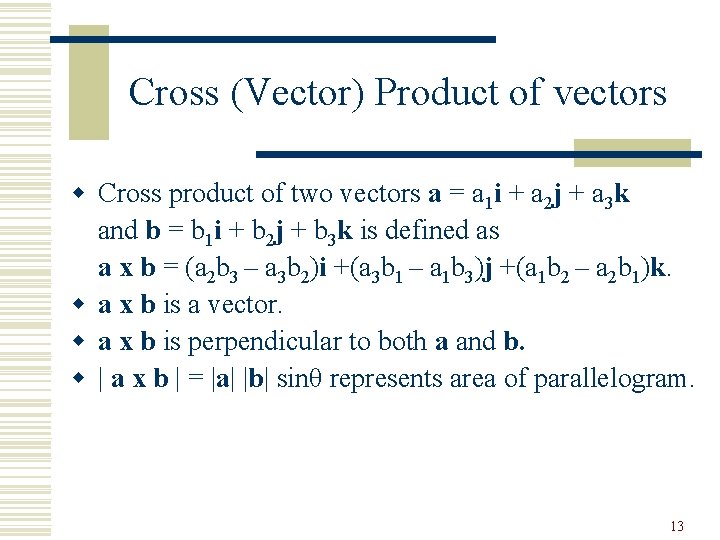
Cross (Vector) Product of vectors w Cross product of two vectors a = a 1 i + a 2 j + a 3 k and b = b 1 i + b 2 j + b 3 k is defined as a x b = (a 2 b 3 – a 3 b 2)i +(a 3 b 1 – a 1 b 3)j +(a 1 b 2 – a 2 b 1)k. w a x b is a vector. w a x b is perpendicular to both a and b. w | a x b | = |a| |b| sinθ represents area of parallelogram. 13
Cross (Vector) Product w Question What can you say about the cross product of two vectors in 2 D ? 14
Box Product of vectors w Box Product of vectors a, b and c is defined as V = a. (b x c) w Box Product is also called Scalar Tripple Product w Box product gives the volume of a parallelepiped. 15

Vector Equations w Equation of a line L with a point P(x 0, y 0, z 0) is given by r = r 0 + tv where r 0 = < x 0, y 0, z 0>, r = < x, y, z>, v = <a, b, c> is a vector parallel to L, t is a scalar. w Equation of a plane is given by n. (r - r 0) = 0 where n is a normal vector, which is analogous to the scalar equation a (x- x 0) + b (y- y 0) + c (z- z 0) = 0 16
Vector Equations w Let a and b be position vectors of points A(x 1, y 1, z 1) and B(x 2, y 2, z 2). Then position vector of the point P dividing the vector AB in the ratio m: n is given by p = (mb + na) / (m+n) which corresponds to P = ((mx 2 + nx 1)/(m+n), (my 2 + ny 1)/(m+n), (mz 2 + nz 1)/(m+n)) 17
- Slides: 17