
Basics of an Electroluminescence Time Projection Chamber EL
Basics of an Electroluminescence Time Projection Chamber (EL TPC) EDIT 2012 Fundamentals Group: James White, Clement Sofka, Andrew Sonnenschien, Lauren Hsu, Ben Loer, Chris Stoughton, Fritz Dejongh, Hugh Lippincott, Jong Hee Yoo
LESSON • Concept of Electroluminescent Time Projection Chamber (EL TPC) – uniform drift field and parallel plate EL gap • Scintillation mechanism in noble gases • Electron drift and diffusion in gases • Electroluminescence: aka light gain / proportional scintillation • Estimate charge yield of alpha in argon gas • Estimate EL yield • Will study the concept using a toy: ”EL TPCito”
EL TPC Physics Detectors • • ZEPLIN II/III XENON 10/100 LUX WARP Dark. Side PANDA-X NEXT-100 two-phase xenon WIMP search two-phase argon WIMP search two-phase xenon WIMP search high pressure xenon 0νββ search • many other prototypes for reactor monitoring, homeland defense, medical …

Concept How does it work? Gamma (for example) Light detectors Anode EL Gap Electroluminescence (S 2) Gate Electron drift Interaction and Drift Region E-field Deposits energy Flash of scintillation (S 1) Cathode S 1 S 2 Time
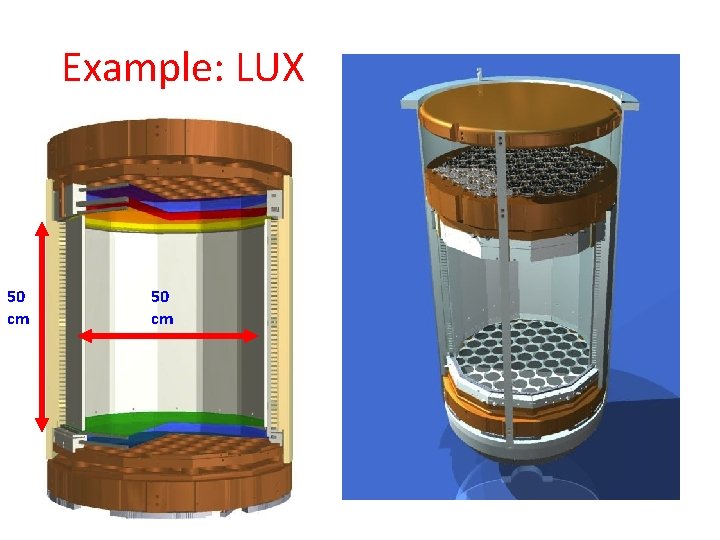
Example: LUX 50 cm
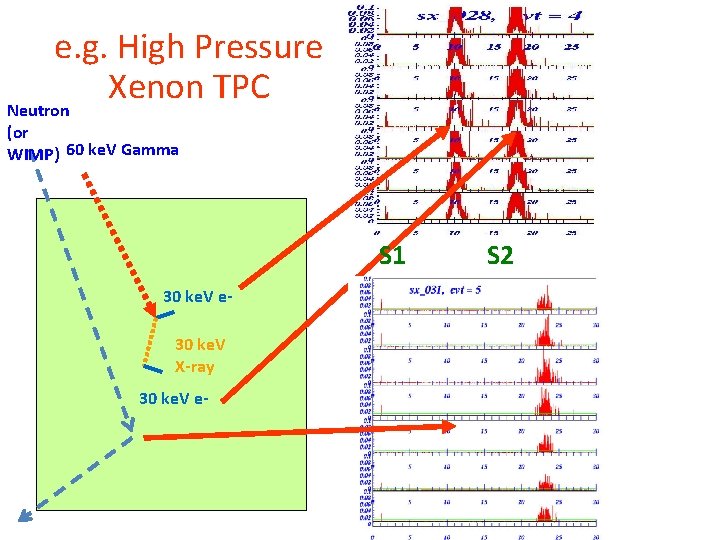
e. g. High Pressure Xenon TPC Neutron (or WIMP) 60 ke. V Gamma S 1 30 ke. V e 30 ke. V X-ray 30 ke. V e- S 2
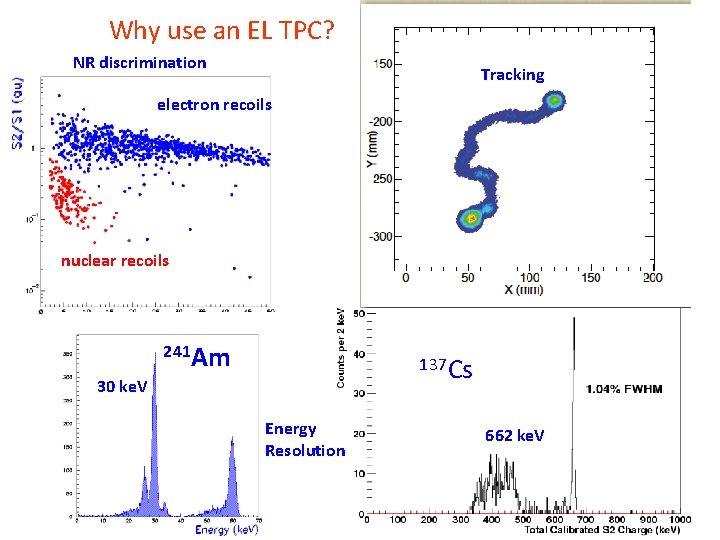
Why use an EL TPC? NR discrimination Tracking electron recoils nuclear recoils 241 Am 137 Cs 30 ke. V Energy Resolution 662 ke. V
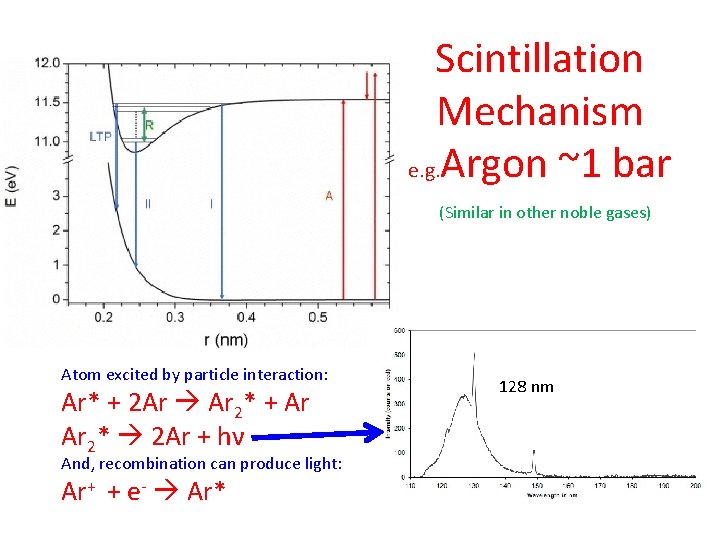
Scintillation Mechanism e. g. Argon ~1 bar (Similar in other noble gases) Atom excited by particle interaction: Ar* + 2 Ar Ar 2* + Ar Ar 2* 2 Ar + hν And, recombination can produce light: Ar+ + e- Ar* 128 nm

Argon Scintillation (cont) Fast component (singlet) Penning effect Slow component (triplet) Example of alpha-induced scintillation (S 1) in pure argon at P ~ 50 bar with zero drift field. (Summed pulses from a high pressure test cell at TAMU. ) Similar, but single event with a trace of xenon. Interaction with impurity atoms greatly alters pulse shape.
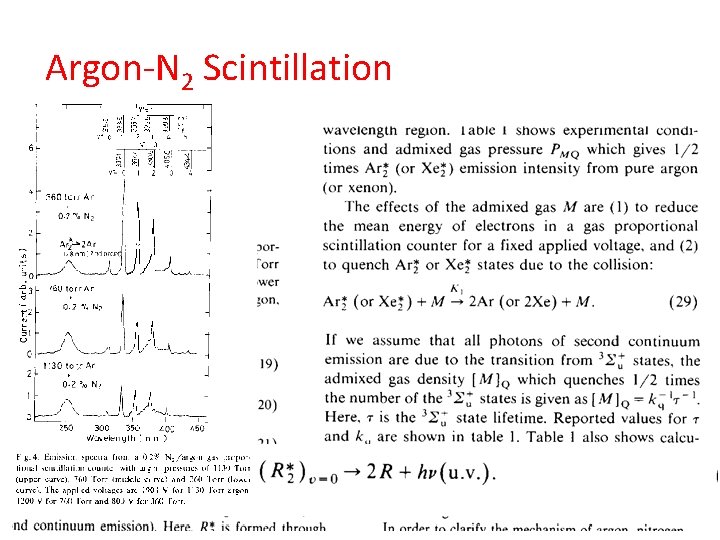
Argon-N 2 Scintillation
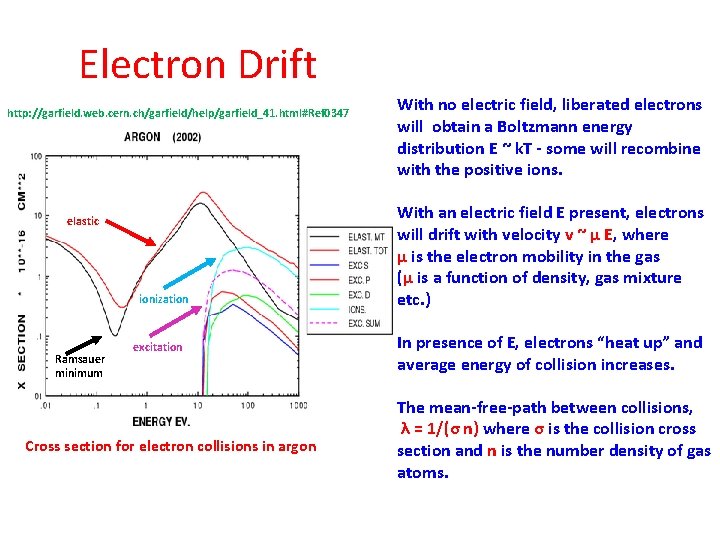
Electron Drift http: //garfield. web. cern. ch/garfield/help/garfield_41. html#Ref 0347 elastic ionization Ramsauer minimum excitation Cross section for electron collisions in argon With no electric field, liberated electrons will obtain a Boltzmann energy distribution E ~ k. T - some will recombine with the positive ions. With an electric field E present, electrons will drift with velocity v ~ µ E, where µ is the electron mobility in the gas (µ is a function of density, gas mixture etc. ) In presence of E, electrons “heat up” and average energy of collision increases. The mean-free-path between collisions, λ = 1/(σ n) where σ is the collision cross section and n is the number density of gas atoms.
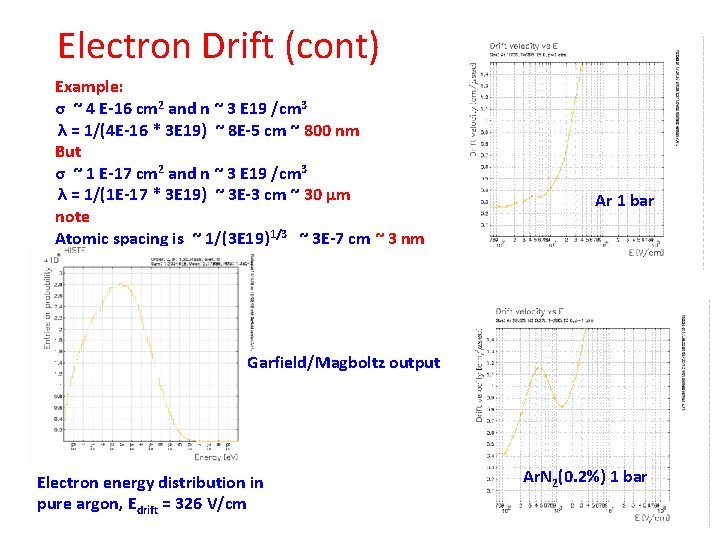
Electron Drift (cont) Example: σ ~ 4 E-16 cm 2 and n ~ 3 E 19 /cm 3 λ = 1/(4 E-16 * 3 E 19) ~ 8 E-5 cm ~ 800 nm But σ ~ 1 E-17 cm 2 and n ~ 3 E 19 /cm 3 λ = 1/(1 E-17 * 3 E 19) ~ 3 E-3 cm ~ 30 µm note Atomic spacing is ~ 1/(3 E 19)1/3 ~ 3 E-7 cm ~ 3 nm Ar 1 bar Garfield/Magboltz output Electron energy distribution in pure argon, Edrift = 326 V/cm Ar. N 2(0. 2%) 1 bar
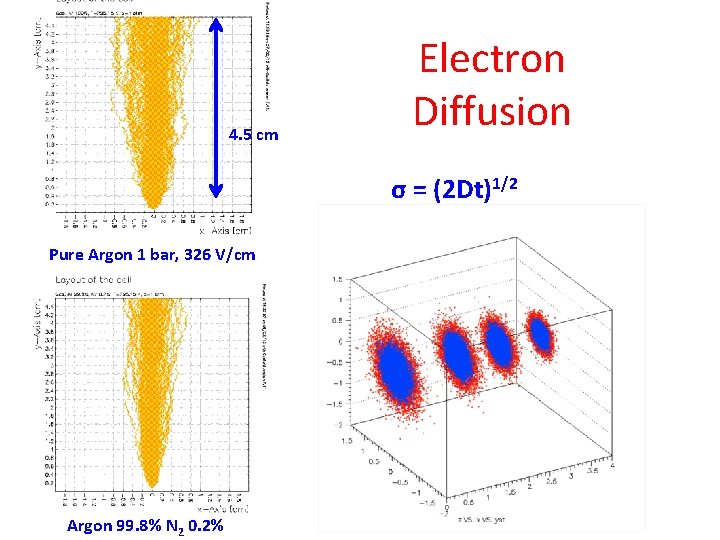
4. 5 cm Electron Diffusion σ = (2 Dt)1/2 Pure Argon 1 bar, 326 V/cm Argon 99. 8% N 2 0. 2%

Electroluminescence At some value of E, the energy of drifting electrons can exceed energy needed to excite atoms Excitation Threshold 11. 6 ev Ionization Threshold 15. 7 e. V Note, these are above excitation threshold but below ionization threshold. This allows optimum energy resolution because there are no fluctuations added due to ionization process Argon: 1 bar, 2133 V/cm

Electroluminescence Yield in argon Example: say N ~ 3 E 19 atoms/cc E = 2100 V/cm E/N = 7 E-17 V cm 2 atom-1 Y/N ~ 0. 4 E-17 ph cm 2 /e-/atom So Y = N*Y/N ~ 120 ph/e-/cm http: //hdl. handle. net/10316/1463 Thesis of C. M. B. Monteiro, U. Coimbra
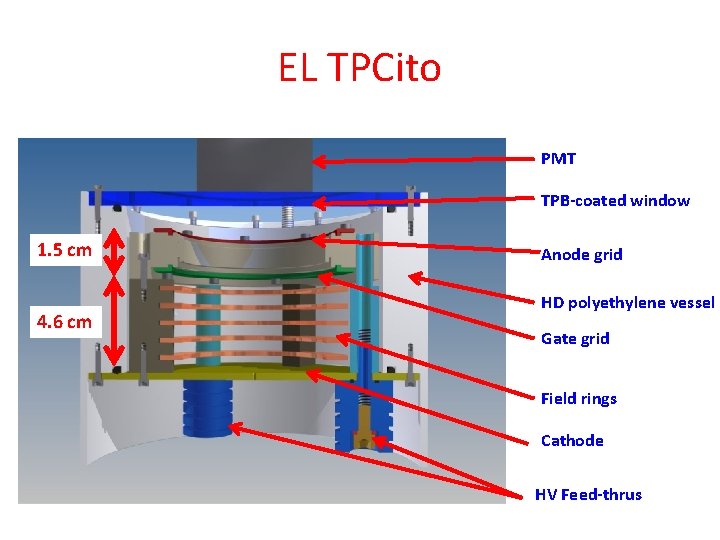
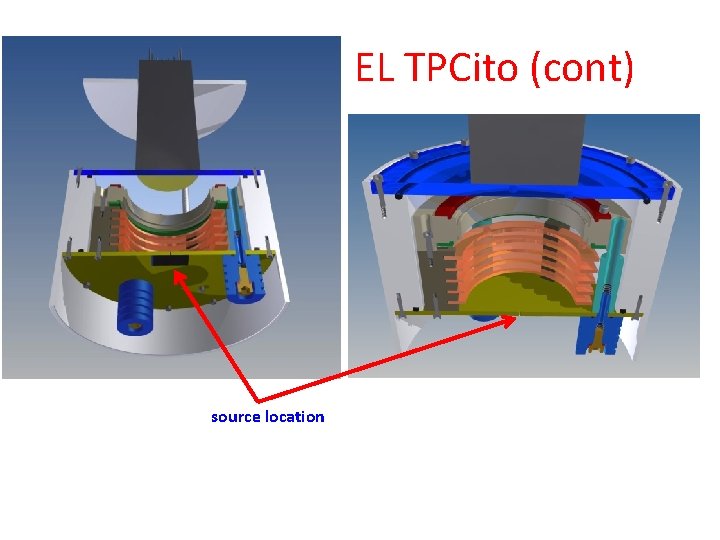
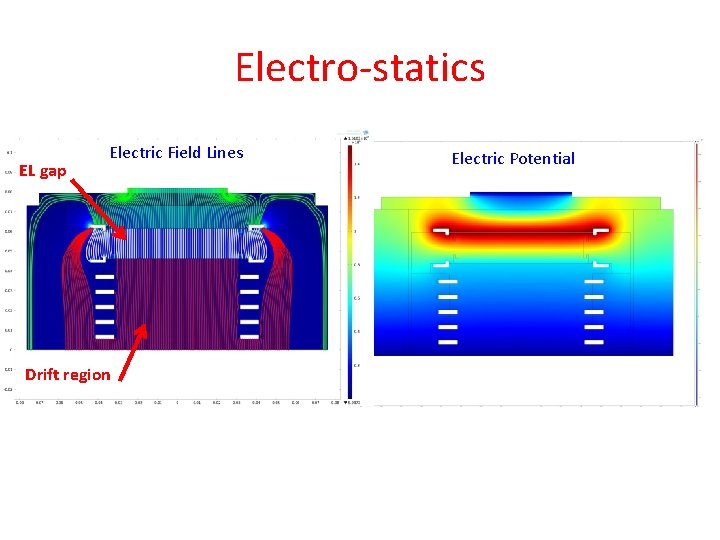
EL TPCito PMT TPB-coated window 1. 5 cm 4. 6 cm Anode grid HD polyethylene vessel Gate grid Field rings Cathode HV Feed-thrus
EL TPCito (cont) source location
Electro-statics EL gap Electric Field Lines Drift region Electric Potential
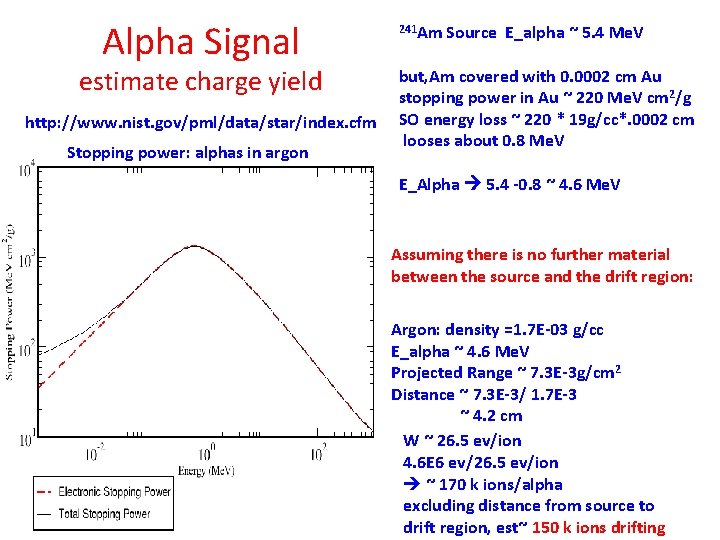
Alpha Signal estimate charge yield http: //www. nist. gov/pml/data/star/index. cfm Stopping power: alphas in argon 241 Am Source E_alpha ~ 5. 4 Me. V but, Am covered with 0. 0002 cm Au stopping power in Au ~ 220 Me. V cm 2/g SO energy loss ~ 220 * 19 g/cc*. 0002 cm looses about 0. 8 Me. V E_Alpha 5. 4 -0. 8 ~ 4. 6 Me. V Assuming there is no further material between the source and the drift region: Argon: density =1. 7 E-03 g/cc E_alpha ~ 4. 6 Me. V Projected Range ~ 7. 3 E-3 g/cm 2 Distance ~ 7. 3 E-3/ 1. 7 E-3 ~ 4. 2 cm W ~ 26. 5 ev/ion 4. 6 E 6 ev/26. 5 ev/ion è ~ 170 k ions/alpha excluding distance from source to drift region, est~ 150 k ions drifting
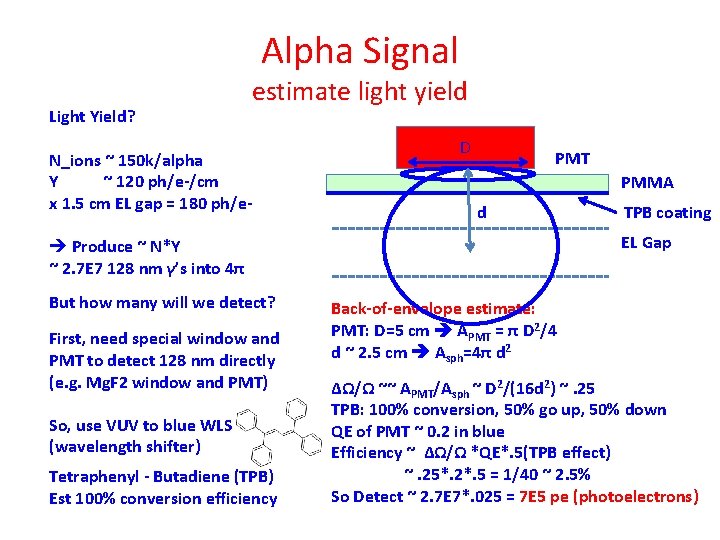
Alpha Signal Light Yield? estimate light yield N_ions ~ 150 k/alpha Y ~ 120 ph/e-/cm x 1. 5 cm EL gap = 180 ph/e- D PMT PMMA d EL Gap è Produce ~ N*Y ~ 2. 7 E 7 128 nm γ’s into 4π But how many will we detect? First, need special window and PMT to detect 128 nm directly (e. g. Mg. F 2 window and PMT) So, use VUV to blue WLS (wavelength shifter) Tetraphenyl - Butadiene (TPB) Est 100% conversion efficiency TPB coating Back-of-envelope estimate: PMT: D=5 cm APMT = π D 2/4 d ~ 2. 5 cm Asph=4π d 2 ΔΩ/Ω ~~ APMT/Asph ~ D 2/(16 d 2) ~. 25 TPB: 100% conversion, 50% go up, 50% down QE of PMT ~ 0. 2 in blue Efficiency ~ ΔΩ/Ω *QE*. 5(TPB effect) ~. 25*. 2*. 5 = 1/40 ~ 2. 5% So Detect ~ 2. 7 E 7*. 025 = 7 E 5 pe (photoelectrons)
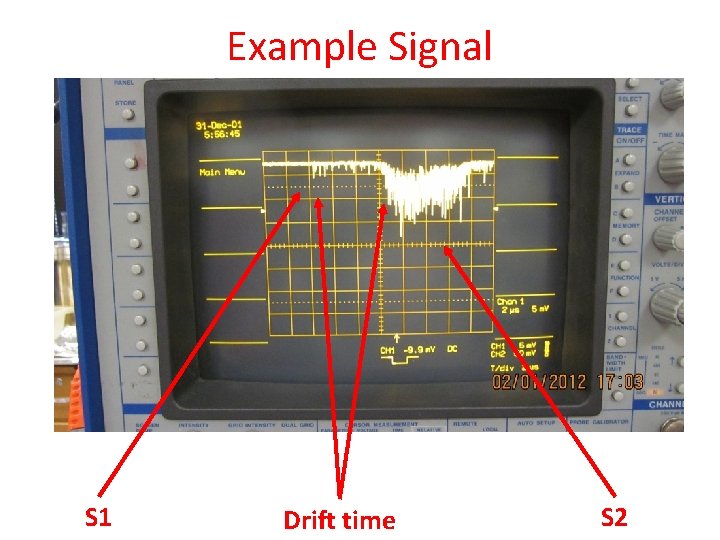
Example Signal S 1 Drift time S 2
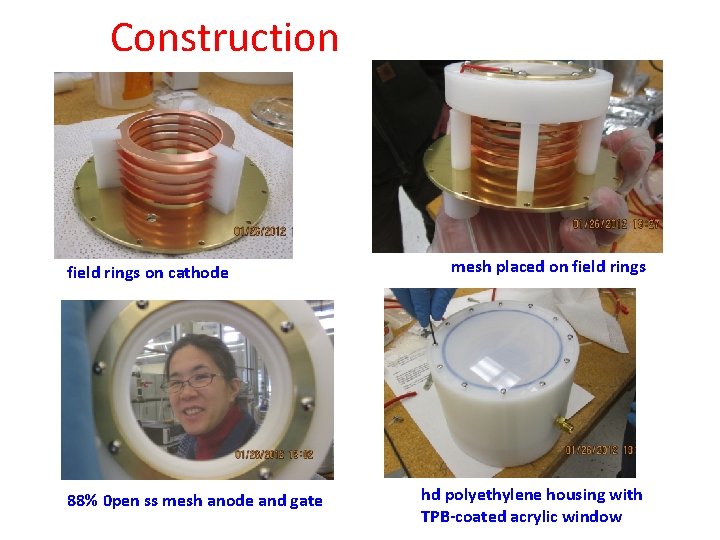
Construction field rings on cathode 88% 0 pen ss mesh anode and gate mesh placed on field rings hd polyethylene housing with TPB-coated acrylic window
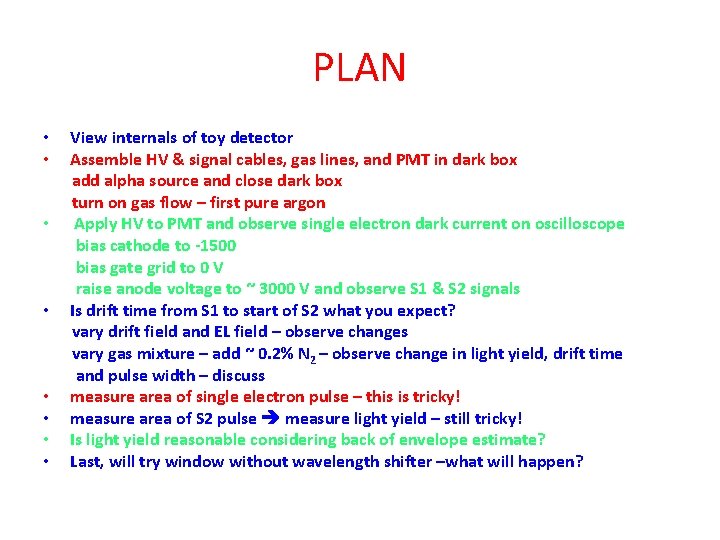
PLAN • • View internals of toy detector Assemble HV & signal cables, gas lines, and PMT in dark box add alpha source and close dark box turn on gas flow – first pure argon Apply HV to PMT and observe single electron dark current on oscilloscope bias cathode to -1500 bias gate grid to 0 V raise anode voltage to ~ 3000 V and observe S 1 & S 2 signals Is drift time from S 1 to start of S 2 what you expect? vary drift field and EL field – observe changes vary gas mixture – add ~ 0. 2% N 2 – observe change in light yield, drift time and pulse width – discuss measure area of single electron pulse – this is tricky! measure area of S 2 pulse measure light yield – still tricky! Is light yield reasonable considering back of envelope estimate? Last, will try window without wavelength shifter –what will happen?
- Slides: 23