
Basics and Review CS 212 First Look at
Basics and Review CS 212
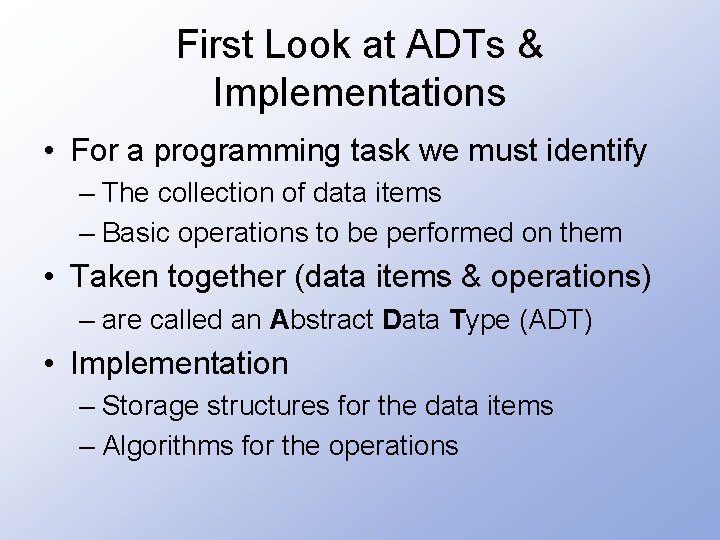
First Look at ADTs & Implementations • For a programming task we must identify – The collection of data items – Basic operations to be performed on them • Taken together (data items & operations) – are called an Abstract Data Type (ADT) • Implementation – Storage structures for the data items – Algorithms for the operations
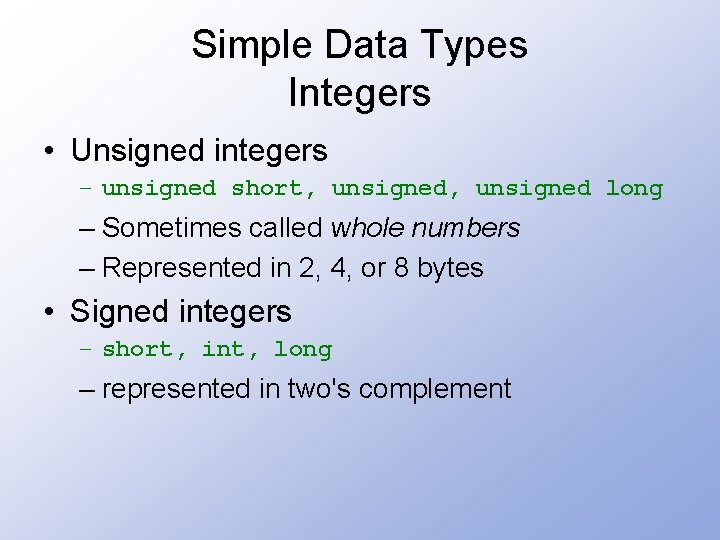
Simple Data Types Integers • Unsigned integers – unsigned short, unsigned long – Sometimes called whole numbers – Represented in 2, 4, or 8 bytes • Signed integers – short, int, long – represented in two's complement
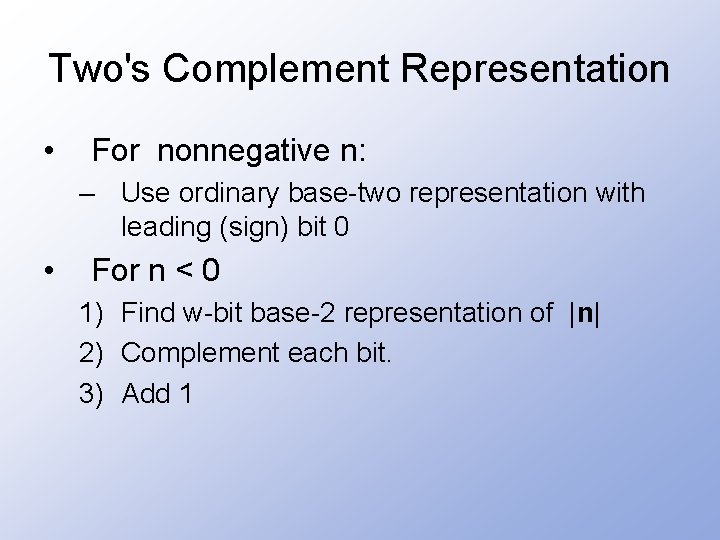
Two's Complement Representation • For nonnegative n: – Use ordinary base-two representation with leading (sign) bit 0 • For n < 0 1) Find w-bit base-2 representation of |n| 2) Complement each bit. 3) Add 1
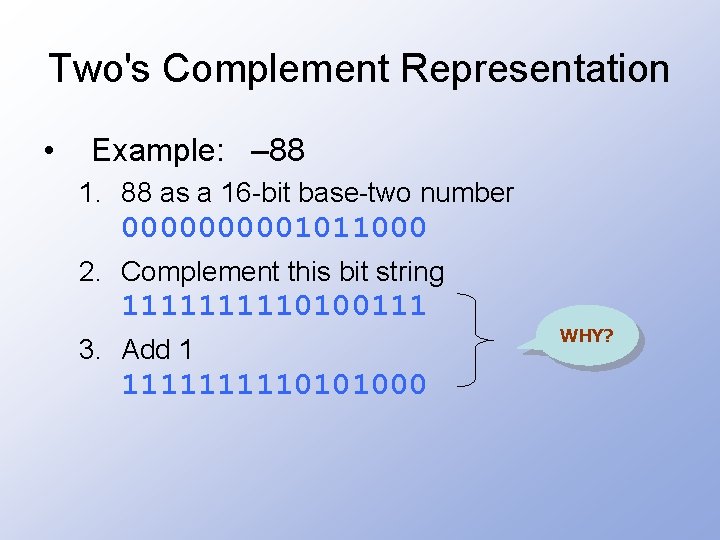
Two's Complement Representation • Example: – 88 1. 88 as a 16 -bit base-two number 000001011000 2. Complement this bit string 111110100111 3. Add 1 111110101000 WHY?

Two's Complement Representation • Works well for arithmetic computations 5 + – 6: 0000000101 +1111111010 11111111 What gets done to the bits to give this answer?
Problems with Integer Representation • Limited Capacity — a finite number of bits • An operation can produce a value that requires more bits than maximum number allowed. This is called overflow. • None of these is a perfect representation of (mathematical) integers • Can only store a finite (sub)range of them. • See Demonstrations Fig. 2. 1, Fig. 2. 2
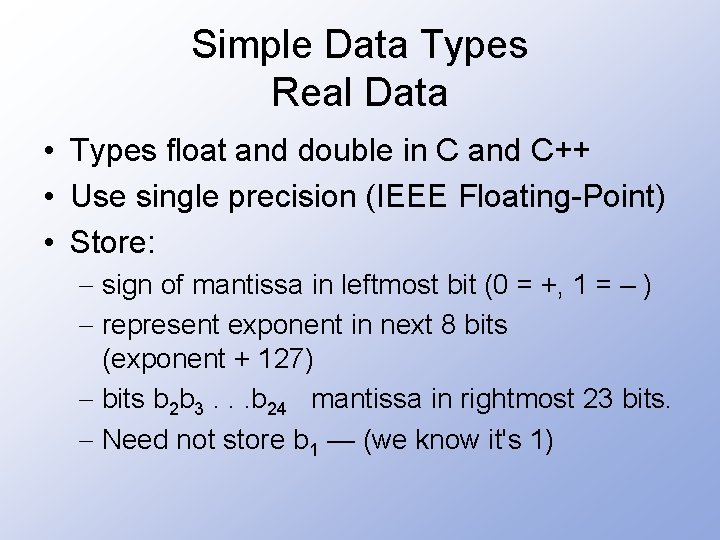
Simple Data Types Real Data • Types float and double in C and C++ • Use single precision (IEEE Floating-Point) • Store: - sign of mantissa in leftmost bit (0 = +, 1 = – ) - represent exponent in next 8 bits (exponent + 127) - bits b 2 b 3. . . b 24 mantissa in rightmost 23 bits. - Need not store b 1 — (we know it's 1)
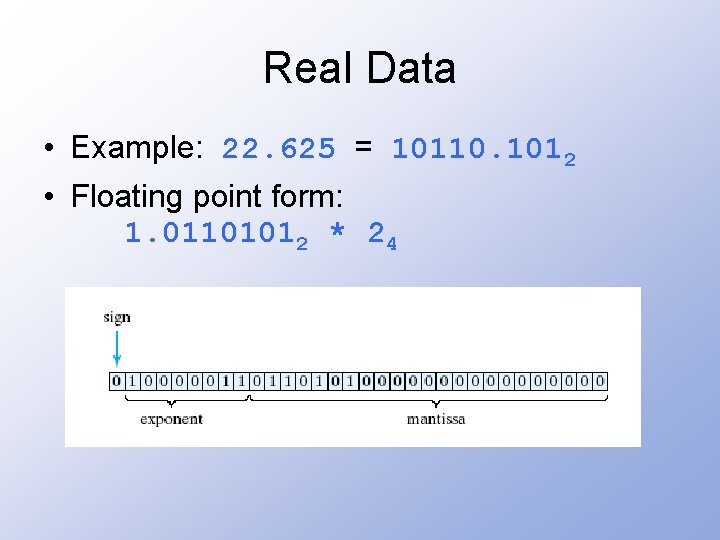
Real Data • Example: 22. 625 = 10110. 1012 • Floating point form: 1. 01101012 * 24
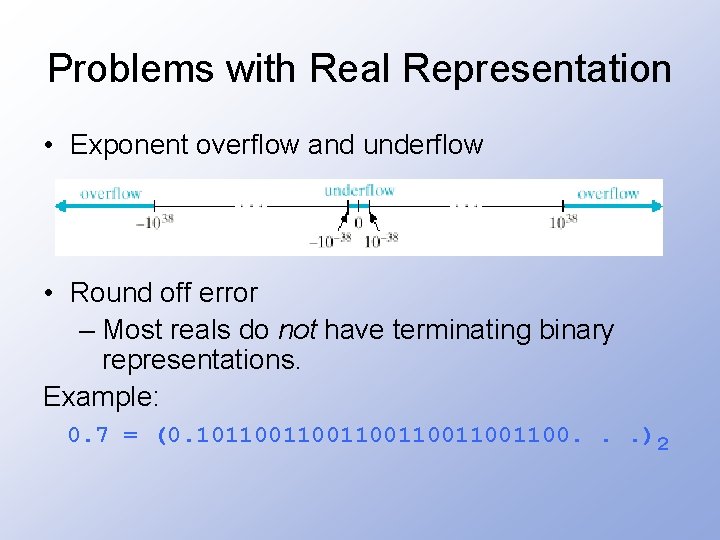
Problems with Real Representation • Exponent overflow and underflow • Round off error – Most reals do not have terminating binary representations. Example: 0. 7 = (0. 10110011001100. . . )2
Problems with Real Representation • Round off error may be compounded in a sequence of operations. – Real-world example – Gulf War Patriot missile guidance affected by accumulated round off • Be careful in comparing reals – with == and !=. – Instead use comparison for closeness if (abs (x – 12. 34) < 0. 001) …
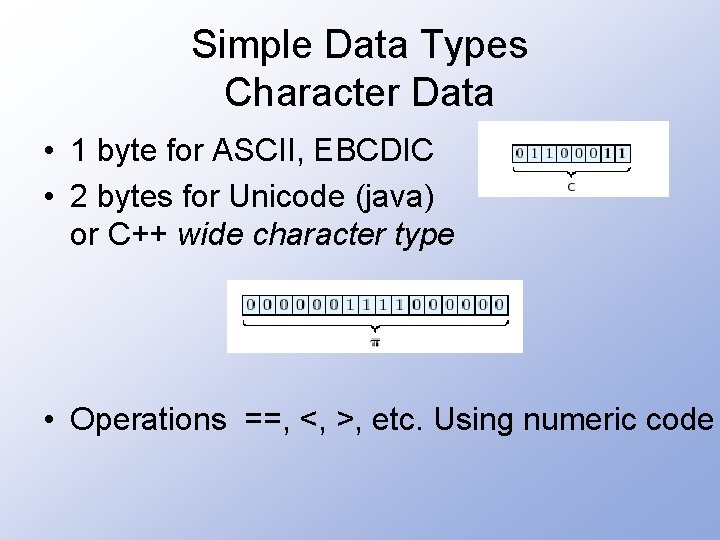
Simple Data Types Character Data • 1 byte for ASCII, EBCDIC • 2 bytes for Unicode (java) or C++ wide character type • Operations ==, <, >, etc. Using numeric code
Simple Data Types Boolean Data • • Values { false, true } Could be stored in bits, usually use a byte Operations &&, || In C++ – bool type – int (bool. Val) evaluates to • 0 if false • 1 if true
Programmer-Defined Data Types • Typedefs – Mechanism usable to create a new type – Give new name to existing type • Example: typedef double real; – Now either double or real can be used.
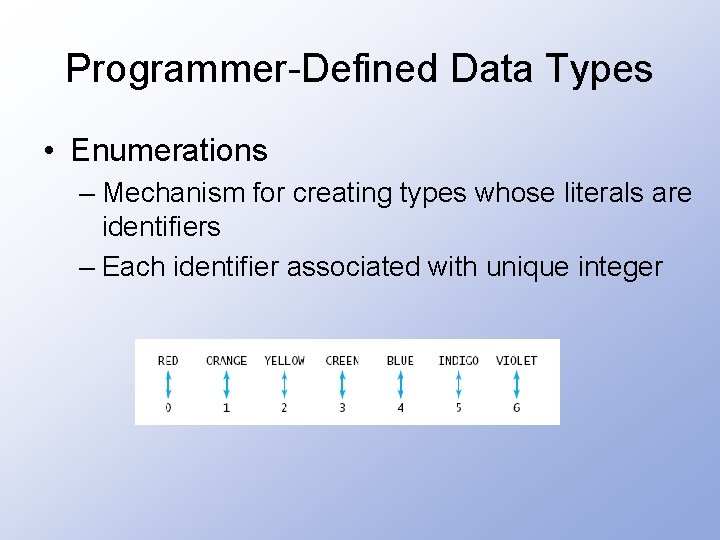
Programmer-Defined Data Types • Enumerations – Mechanism for creating types whose literals are identifiers – Each identifier associated with unique integer
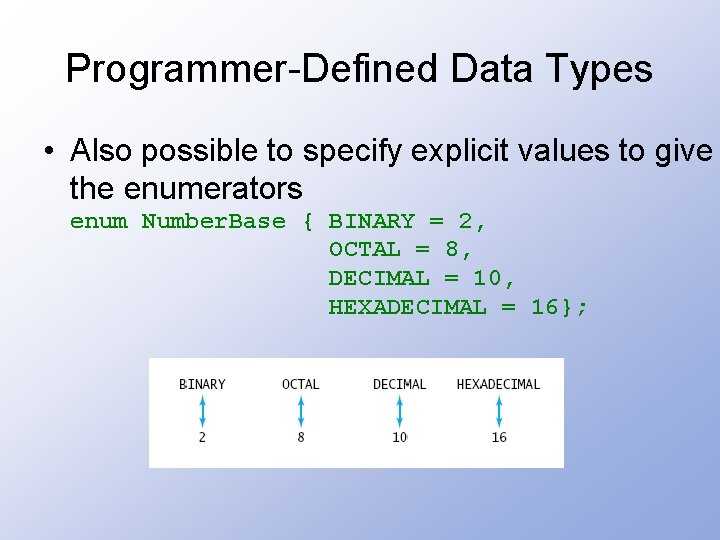
Programmer-Defined Data Types • Also possible to specify explicit values to give the enumerators enum Number. Base { BINARY = 2, OCTAL = 8, DECIMAL = 10, HEXADECIMAL = 16};
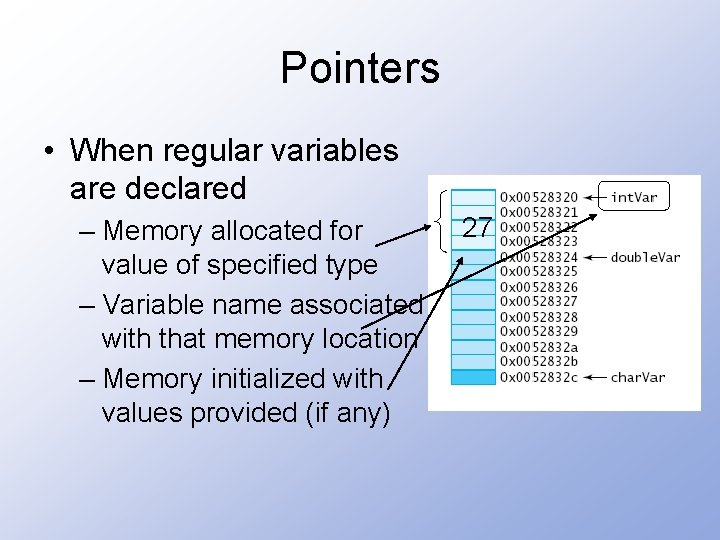
Pointers • When regular variables are declared – Memory allocated for value of specified type – Variable name associated with that memory location – Memory initialized with values provided (if any) 27
Pointers • Pointer Variables – value stored is a memory address • Note sample program, Fig. 2. 4 – Declares variables that can store int addresses and double variables – Displays the addresses
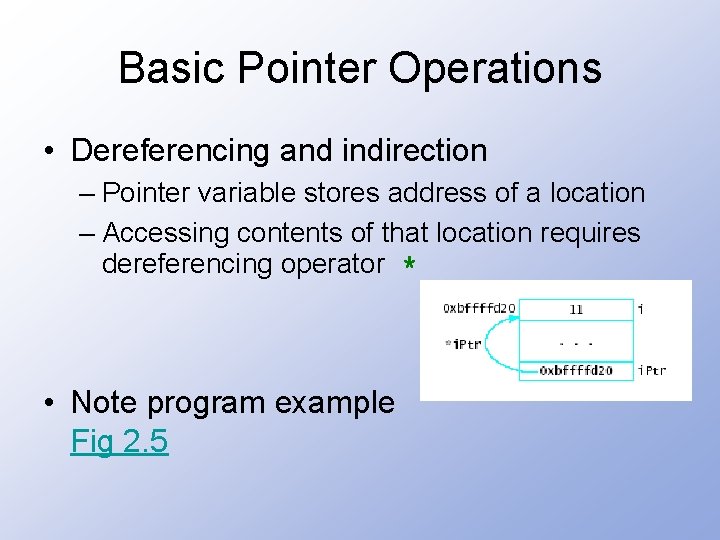
Basic Pointer Operations • Dereferencing and indirection – Pointer variable stores address of a location – Accessing contents of that location requires dereferencing operator * • Note program example Fig 2. 5
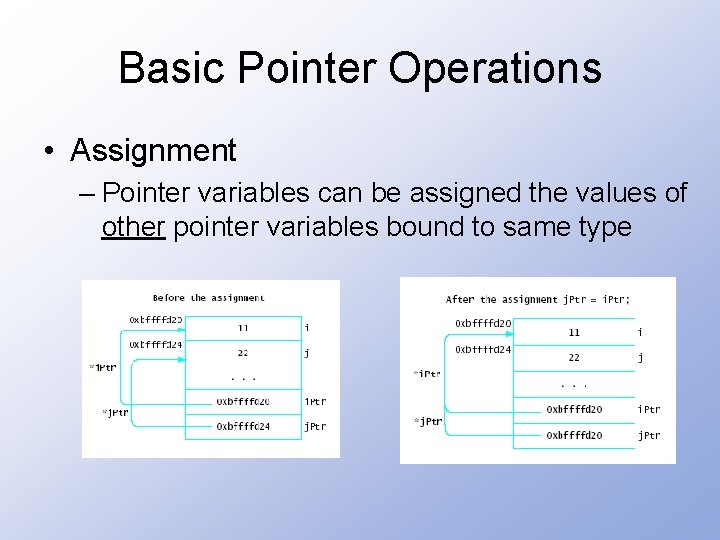
Basic Pointer Operations • Assignment – Pointer variables can be assigned the values of other pointer variables bound to same type
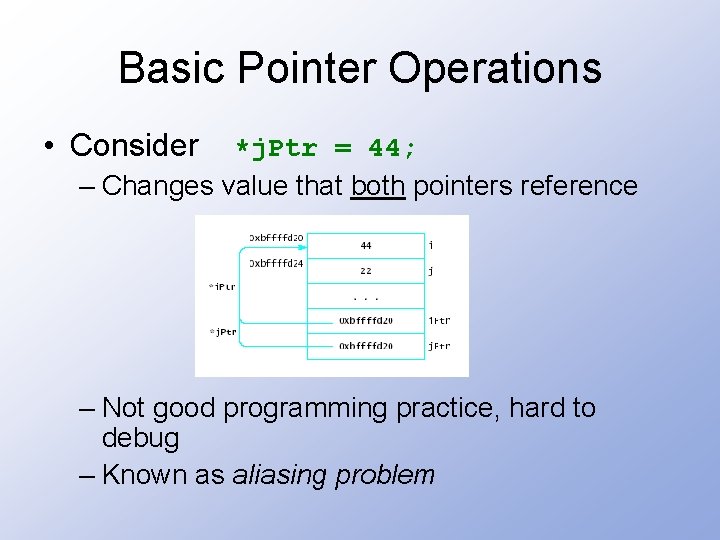
Basic Pointer Operations • Consider *j. Ptr = 44; – Changes value that both pointers reference – Not good programming practice, hard to debug – Known as aliasing problem
Basic Pointer Operations • Comparison – Relational operators used to compare two pointers – Must be bound to same type – Most common = = and != – The null address may be compared with any pointer variable
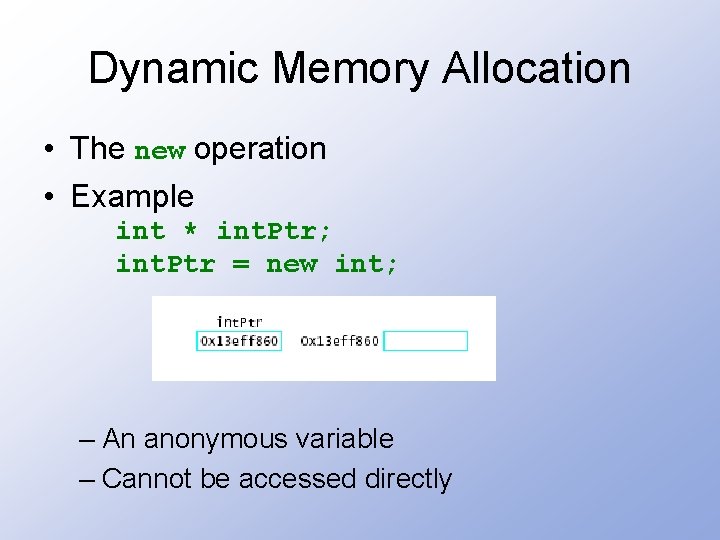
Dynamic Memory Allocation • The new operation • Example int * int. Ptr; int. Ptr = new int; – An anonymous variable – Cannot be accessed directly
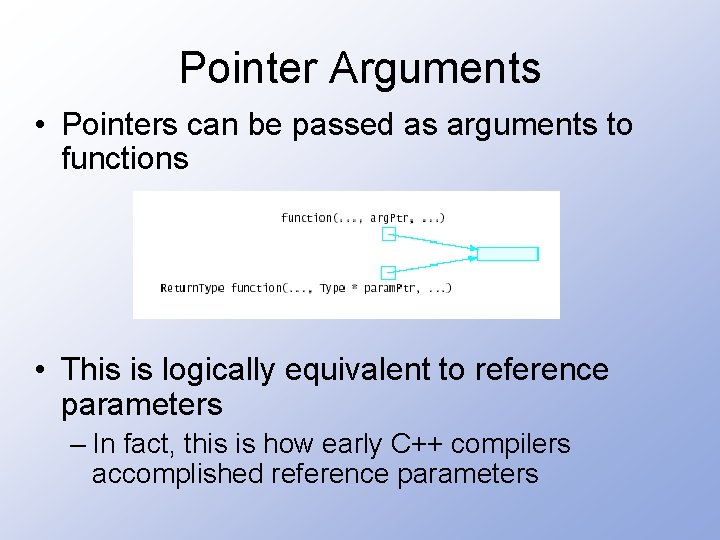
Pointer Arguments • Pointers can be passed as arguments to functions • This is logically equivalent to reference parameters – In fact, this is how early C++ compilers accomplished reference parameters
- Slides: 24