
Basic VHDL RASSP Education Facilitation Module 10 Version
Basic VHDL RASSP Education & Facilitation Module 10 Version 2. 02 Copyright 1995 -1998 RASSP E&F All rights reserved. This information is copyrighted by the RASSP E&F Program and may only be used for non-commercial educational purposes. Any other use of this information without the express written permission of the RASSP E&F Program is prohibited. All information contained herein may be duplicated for noncommercial educational use provided this copyright notice is included. No warranty of any kind is provided or implied, nor is any liability accepted regardless of use. FEEDBACK: The RASSP E&F Program welcomes and encourages any feedback that you may have including any changes that you may make to improve or update the material. You can contact us at feedback@rassp. scra. org or http: //rassp. scra. org/module-request/FEEDBACK/feedback-on-modules. html
Module Goals RASSP E&F SCRA GT UVA Raytheon UCinc EIT ADL l Introduce basic VHDL constructs l Introduce the VHDL simulation cycle and timing model l Illustrate VHDL’s utility as a digital hardware description language Copyright 1995 -1998 RASSP E&F
Module Outline RASSP E&F SCRA GT UVA Raytheon UCinc EIT ADL l Introduction l VHDL Design Example l VHDL Model Components m Entity Declarations m Architecture m Timing Copyright 1995 -1998 RASSP E&F Descriptions Model
Module Outline (Cont. ) RASSP E&F SCRA GT UVA Raytheon UCinc EIT ADL l Basic VHDL Constructs m Data types m Objects m Sequential and concurrent statements m Packages and libraries m Attributes m Predefined operators l l Examples Summary Copyright 1995 -1998 RASSP E&F
Module Outline RASSP E&F SCRA GT UVA Raytheon UCinc EIT ADL l Introduction l VHDL Design Example l VHDL Model Components l Basic VHDL Constructs l Examples l Summary Copyright 1995 -1998 RASSP E&F
Reasons for Using VHDL RASSP E&F SCRA GT UVA Raytheon UCinc EIT ADL l VHDL is an international IEEE standard specification language (IEEE 1076 -1993) for describing digital hardware used by industry worldwide m VHDL is an acronym for VHSIC (Very High Speed Integrated Circuit) Hardware Description Language l VHDL enables hardware modeling from the gate to system level l VHDL provides a mechanism for digital design and reusable design documentation Copyright 1995 -1998 RASSP E&F
VHDL’s History RASSP E&F SCRA GT UVA Raytheon UCinc EIT ADL l Very High Speed Integrated Circuit (VHSIC) Program m Launched in 1980 m Aggressive effort to advance state of the art m Object was to achieve significant gains in VLSI technology m Need for common descriptive language m $17 Million for direct VHDL development m $16 Million for VHDL design tools l Woods Hole Workshop m Held in June 1981 in Massachusetts m Discussion of VHSIC goals m Comprised of members of industry, government, and academia Copyright 1995 -1998 RASSP E&F
VHDL’s History (Cont. ) RASSP E&F SCRA GT UVA Raytheon UCinc EIT ADL l l l In July 1983, a team of Intermetrics, IBM and Texas Instruments were awarded a contract to develop VHDL In August 1985, the final version of the language under government contract was released: VHDL Version 7. 2 In December 1987, VHDL became IEEE Standard 1076 -1987 and in 1988 an ANSI standard In September 1993, VHDL was restandardized to clarify and enhance the language VHDL has been accepted as a Draft International Standard by the IEC Copyright 1995 -1998 RASSP E&F
Additional Benefits of VHDL RASSP E&F SCRA GT UVA Raytheon UCinc EIT ADL l Allows for various design methodologies l Provides technology independence l Describes a wide variety of digital hardware l Eases communication through standard language l Allows for better design management l Provides a flexible design language l Has given rise to derivative standards : m WAVES, Copyright 1995 -1998 RASSP E&F VITAL, Analog VHDL
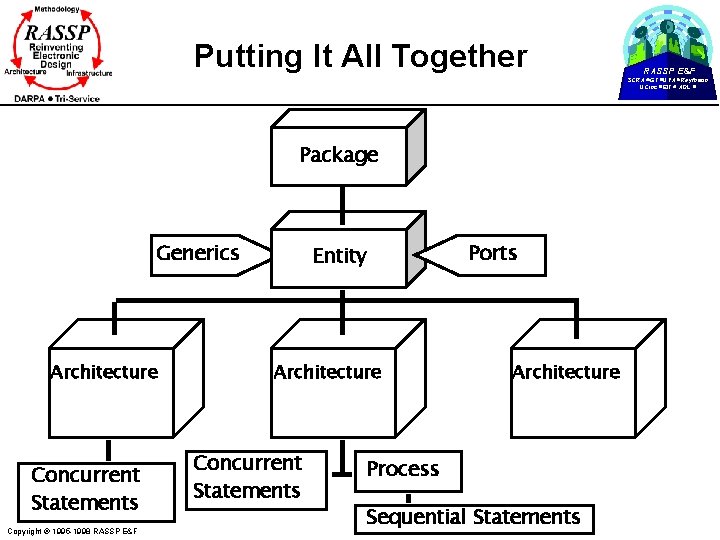
Putting It All Together RASSP E&F SCRA GT UVA Raytheon UCinc EIT ADL Package Generics Architecture Concurrent Statements Copyright 1995 -1998 RASSP E&F Entity Architecture Concurrent Statements Ports Architecture Process Sequential Statements
Module Outline RASSP E&F SCRA GT UVA Raytheon UCinc EIT ADL l Introduction l VHDL Design Example l VHDL Models of Hardware l Basic VHDL Constructs l Examples l Summary Copyright 1995 -1998 RASSP E&F
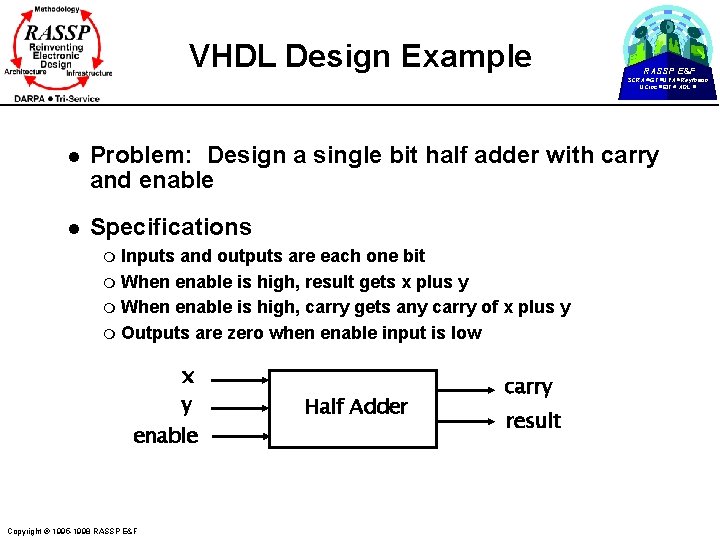
VHDL Design Example RASSP E&F SCRA GT UVA Raytheon UCinc EIT ADL l Problem: Design a single bit half adder with carry and enable l Specifications Inputs and outputs are each one bit m When enable is high, result gets x plus y m When enable is high, carry gets any carry of x plus y m Outputs are zero when enable input is low m x y enable Copyright 1995 -1998 RASSP E&F Half Adder carry result

VHDL Design Example Entity Declaration l RASSP E&F SCRA GT UVA Raytheon UCinc EIT ADL As a first step, the entity declaration describes the interface of the component m input and output ports are declared ENTITY half_adder IS PORT( x, y, enable: IN BIT; carry, result: OUT BIT); END half_adder; x y enable Copyright 1995 -1998 RASSP E&F Half Adder carry result
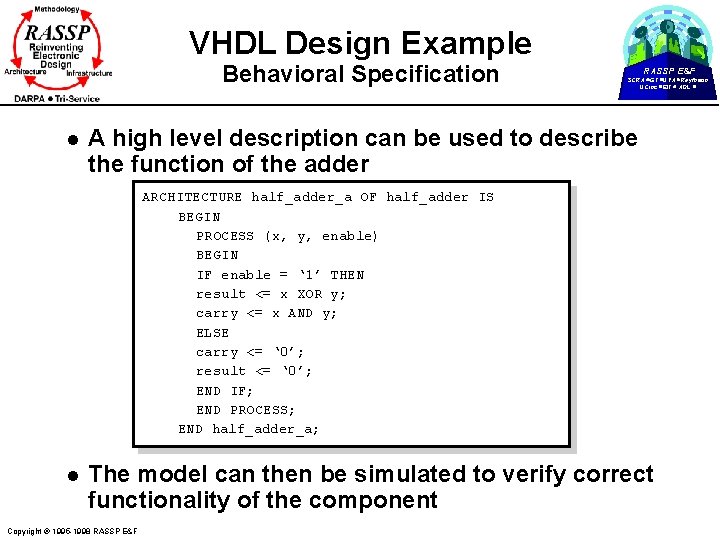
VHDL Design Example Behavioral Specification l RASSP E&F SCRA GT UVA Raytheon UCinc EIT ADL A high level description can be used to describe the function of the adder ARCHITECTURE half_adder_a OF half_adder IS BEGIN PROCESS (x, y, enable) BEGIN IF enable = ‘ 1’ THEN result <= x XOR y; carry <= x AND y; ELSE carry <= ‘ 0’; result <= ‘ 0’; END IF; END PROCESS; END half_adder_a; l The model can then be simulated to verify correct functionality of the component Copyright 1995 -1998 RASSP E&F
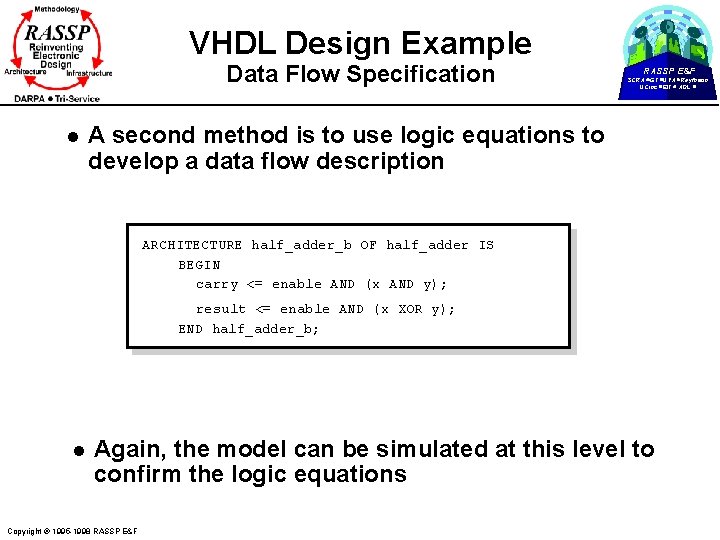
VHDL Design Example Data Flow Specification l RASSP E&F SCRA GT UVA Raytheon UCinc EIT ADL A second method is to use logic equations to develop a data flow description ARCHITECTURE half_adder_b OF half_adder IS BEGIN carry <= enable AND (x AND y); result <= enable AND (x XOR y); END half_adder_b; l Again, the model can be simulated at this level to confirm the logic equations Copyright 1995 -1998 RASSP E&F
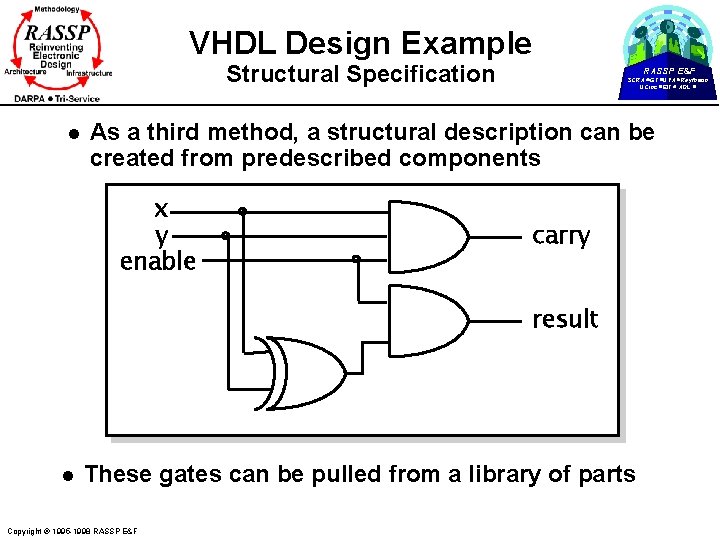
VHDL Design Example Structural Specification l RASSP E&F SCRA GT UVA Raytheon UCinc EIT ADL As a third method, a structural description can be created from predescribed components x y enable carry result l These gates can be pulled from a library of parts Copyright 1995 -1998 RASSP E&F
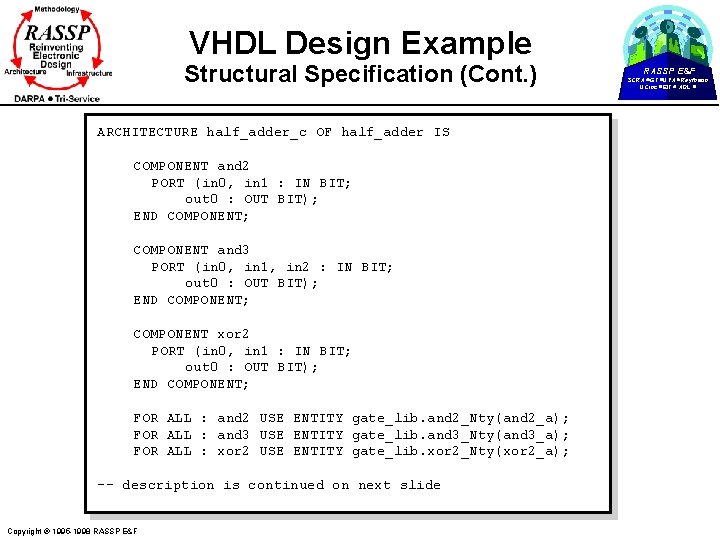
VHDL Design Example Structural Specification (Cont. ) ARCHITECTURE half_adder_c OF half_adder IS COMPONENT and 2 PORT (in 0, in 1 : IN BIT; out 0 : OUT BIT); END COMPONENT; COMPONENT and 3 PORT (in 0, in 1, in 2 : IN BIT; out 0 : OUT BIT); END COMPONENT; COMPONENT xor 2 PORT (in 0, in 1 : IN BIT; out 0 : OUT BIT); END COMPONENT; FOR ALL : and 2 USE ENTITY gate_lib. and 2_Nty(and 2_a); FOR ALL : and 3 USE ENTITY gate_lib. and 3_Nty(and 3_a); FOR ALL : xor 2 USE ENTITY gate_lib. xor 2_Nty(xor 2_a); -- description is continued on next slide Copyright 1995 -1998 RASSP E&F SCRA GT UVA Raytheon UCinc EIT ADL
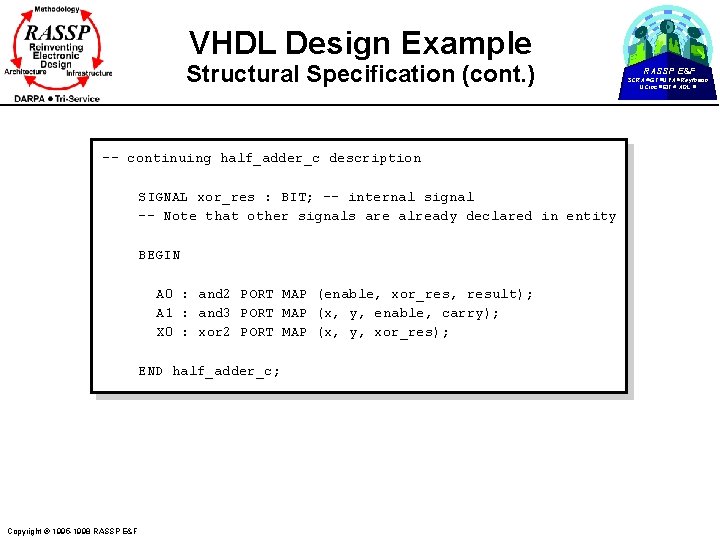
VHDL Design Example Structural Specification (cont. ) -- continuing half_adder_c description SIGNAL xor_res : BIT; -- internal signal -- Note that other signals are already declared in entity BEGIN A 0 : and 2 PORT MAP (enable, xor_res, result); A 1 : and 3 PORT MAP (x, y, enable, carry); X 0 : xor 2 PORT MAP (x, y, xor_res); END half_adder_c; Copyright 1995 -1998 RASSP E&F SCRA GT UVA Raytheon UCinc EIT ADL
Module Outline RASSP E&F SCRA GT UVA Raytheon UCinc EIT ADL l Introduction l VHDL Design Example l VHDL Model Components m m m Entity Declarations Architecture Descriptions Timing Model l Basic VHDL Constructs l Examples l Summary Copyright 1995 -1998 RASSP E&F
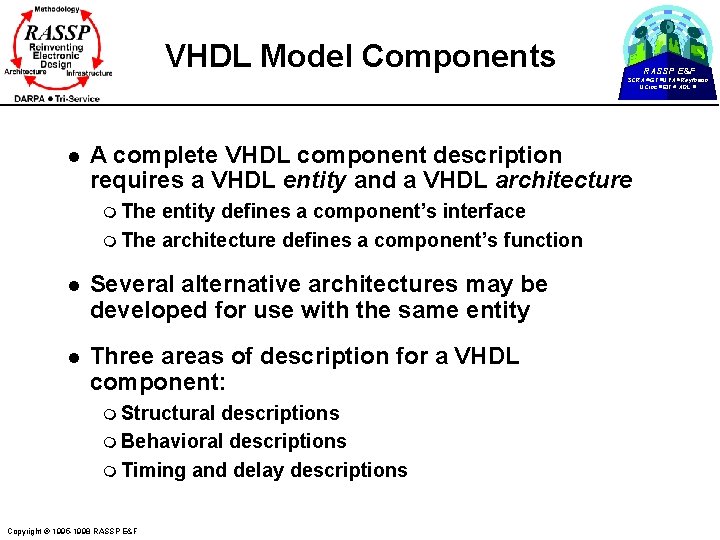
VHDL Model Components RASSP E&F SCRA GT UVA Raytheon UCinc EIT ADL l A complete VHDL component description requires a VHDL entity and a VHDL architecture m The entity defines a component’s interface m The architecture defines a component’s function l Several alternative architectures may be developed for use with the same entity l Three areas of description for a VHDL component: m Structural descriptions m Behavioral descriptions m Timing and delay descriptions Copyright 1995 -1998 RASSP E&F
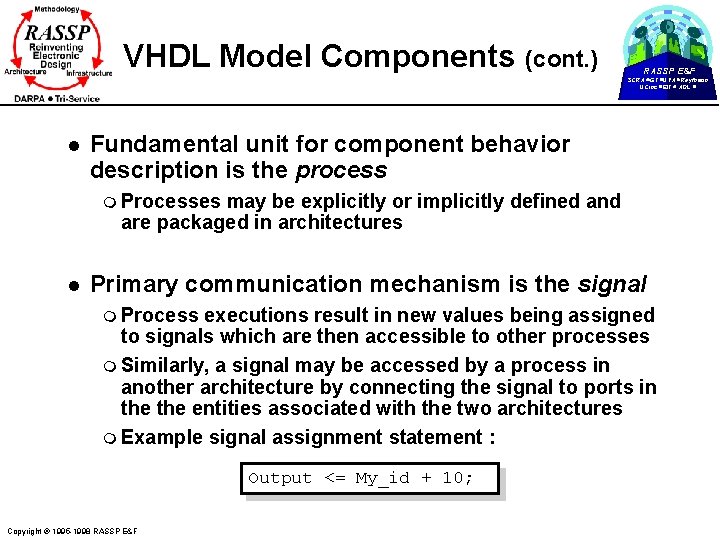
VHDL Model Components (cont. ) RASSP E&F SCRA GT UVA Raytheon UCinc EIT ADL l Fundamental unit for component behavior description is the process m Processes may be explicitly or implicitly defined and are packaged in architectures l Primary communication mechanism is the signal m Process executions result in new values being assigned to signals which are then accessible to other processes m Similarly, a signal may be accessed by a process in another architecture by connecting the signal to ports in the entities associated with the two architectures m Example signal assignment statement : Output <= My_id + 10; Copyright 1995 -1998 RASSP E&F
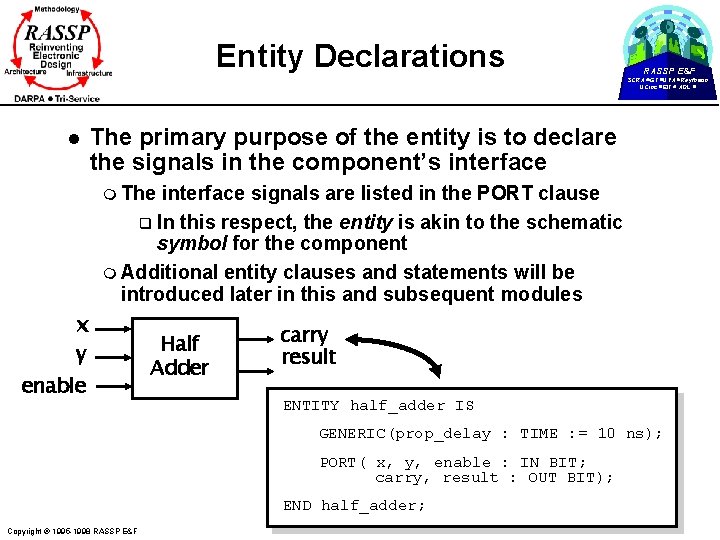
Entity Declarations RASSP E&F SCRA GT UVA Raytheon UCinc EIT ADL l The primary purpose of the entity is to declare the signals in the component’s interface m The interface signals are listed in the PORT clause q In this respect, the entity is akin to the schematic symbol for the component m Additional entity clauses and statements will be introduced later in this and subsequent modules x y enable Half Adder carry result ENTITY half_adder IS GENERIC(prop_delay : TIME : = 10 ns); PORT( x, y, enable : IN BIT; carry, result : OUT BIT); END half_adder; Copyright 1995 -1998 RASSP E&F
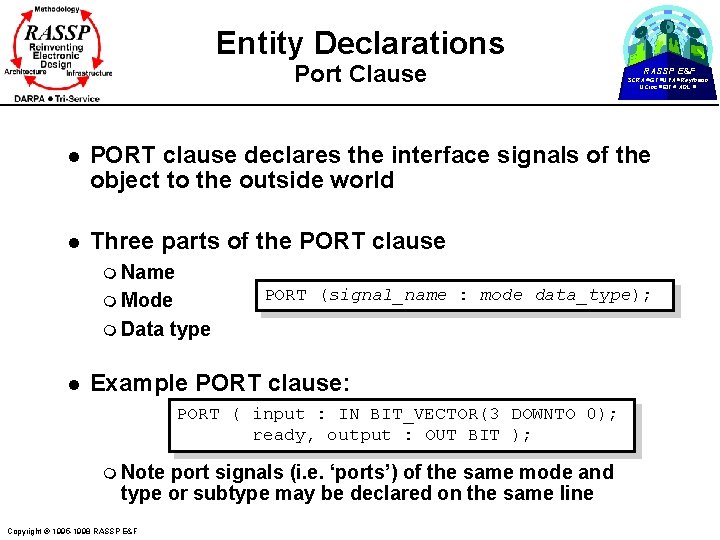
Entity Declarations Port Clause RASSP E&F SCRA GT UVA Raytheon UCinc EIT ADL l PORT clause declares the interface signals of the object to the outside world l Three parts of the PORT clause m Name PORT (signal_name : mode data_type); m Mode m Data l type Example PORT clause: PORT ( input : IN BIT_VECTOR(3 DOWNTO 0); ready, output : OUT BIT ); m Note port signals (i. e. ‘ports’) of the same mode and type or subtype may be declared on the same line Copyright 1995 -1998 RASSP E&F
Entity Declarations Port Clause (cont. ) RASSP E&F SCRA GT UVA Raytheon UCinc EIT ADL l The port mode of the interface describes the direction in which data travels with respect to the component l The five available port modes are: m In - data comes in this port and can only be read m Out - data travels out this port m Buffer - data may travel in either direction, but only one signal driver may be on at any one time m Inout - data may travel in either direction with any number of active drivers allowed; requires a Bus Resolution Function m Linkage - direction of data flow is unknown Copyright 1995 -1998 RASSP E&F
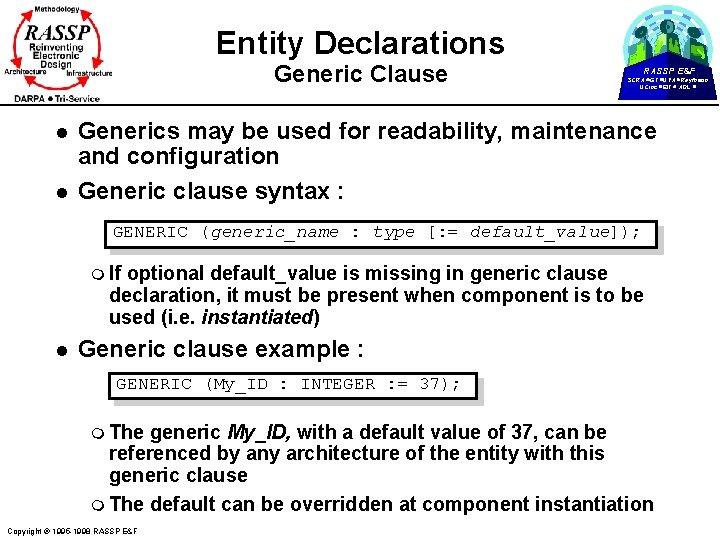
Entity Declarations Generic Clause l l RASSP E&F SCRA GT UVA Raytheon UCinc EIT ADL Generics may be used for readability, maintenance and configuration Generic clause syntax : GENERIC (generic_name : type [: = default_value]); m If optional default_value is missing in generic clause declaration, it must be present when component is to be used (i. e. instantiated) l Generic clause example : GENERIC (My_ID : INTEGER : = 37); m The generic My_ID, with a default value of 37, can be referenced by any architecture of the entity with this generic clause m The default can be overridden at component instantiation Copyright 1995 -1998 RASSP E&F
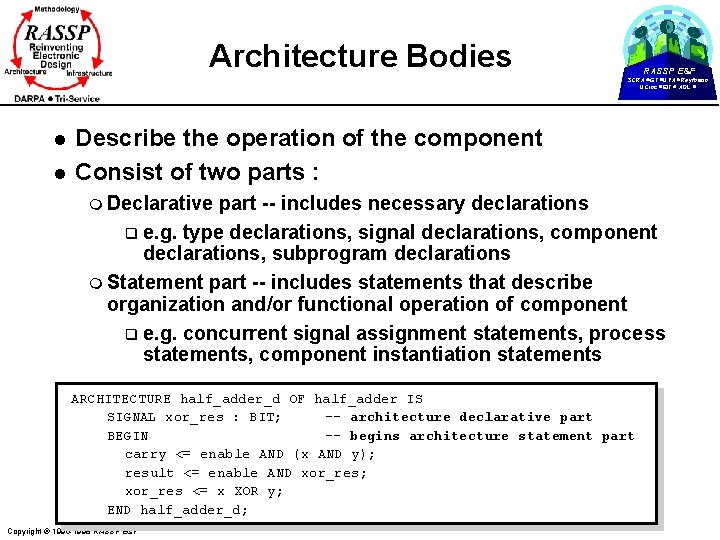
Architecture Bodies RASSP E&F SCRA GT UVA Raytheon UCinc EIT ADL l l Describe the operation of the component Consist of two parts : m Declarative part -- includes necessary declarations q e. g. type declarations, signal declarations, component declarations, subprogram declarations m Statement part -- includes statements that describe organization and/or functional operation of component q e. g. concurrent signal assignment statements, process statements, component instantiation statements ARCHITECTURE half_adder_d OF half_adder IS SIGNAL xor_res : BIT; -- architecture declarative part BEGIN -- begins architecture statement part carry <= enable AND (x AND y); result <= enable AND xor_res; xor_res <= x XOR y; END half_adder_d; Copyright 1995 -1998 RASSP E&F
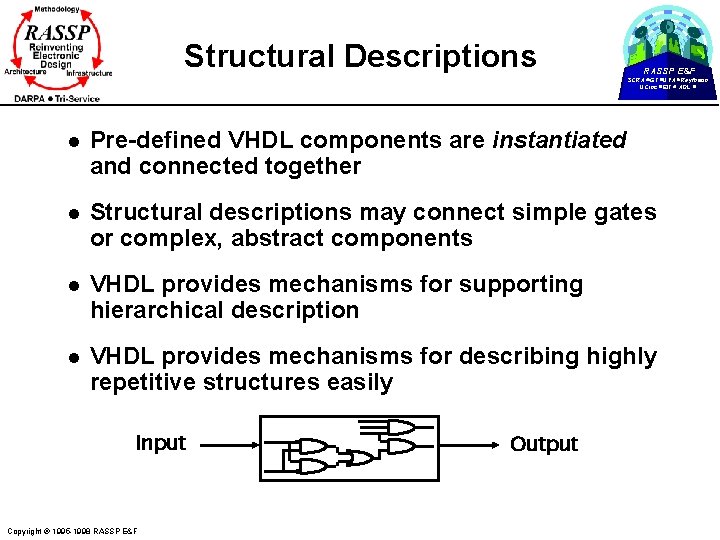
Structural Descriptions RASSP E&F SCRA GT UVA Raytheon UCinc EIT ADL l Pre-defined VHDL components are instantiated and connected together l Structural descriptions may connect simple gates or complex, abstract components l VHDL provides mechanisms for supporting hierarchical description l VHDL provides mechanisms for describing highly repetitive structures easily Input Copyright 1995 -1998 RASSP E&F Behavioral Entity Output
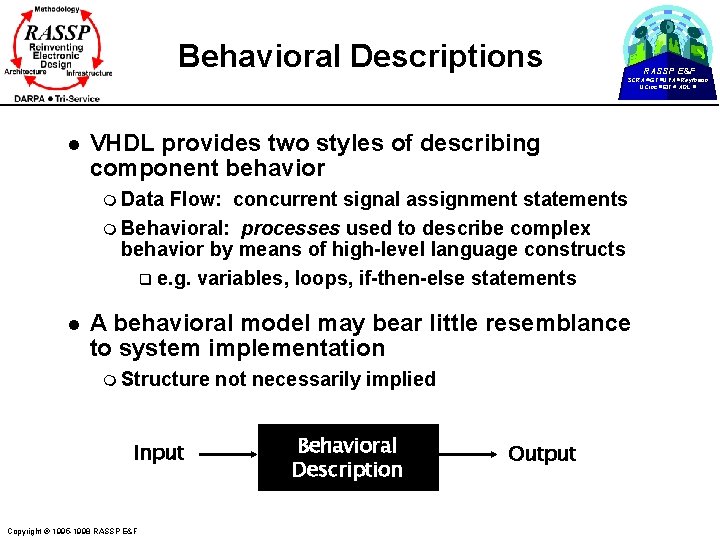
Behavioral Descriptions RASSP E&F SCRA GT UVA Raytheon UCinc EIT ADL l VHDL provides two styles of describing component behavior m Data Flow: concurrent signal assignment statements m Behavioral: processes used to describe complex behavior by means of high-level language constructs q e. g. variables, loops, if-then-else statements l A behavioral model may bear little resemblance to system implementation m Structure Input Copyright 1995 -1998 RASSP E&F not necessarily implied Behavioral Description Output
- Slides: 28