
Basic Units Of Metric Measure Essential Question What
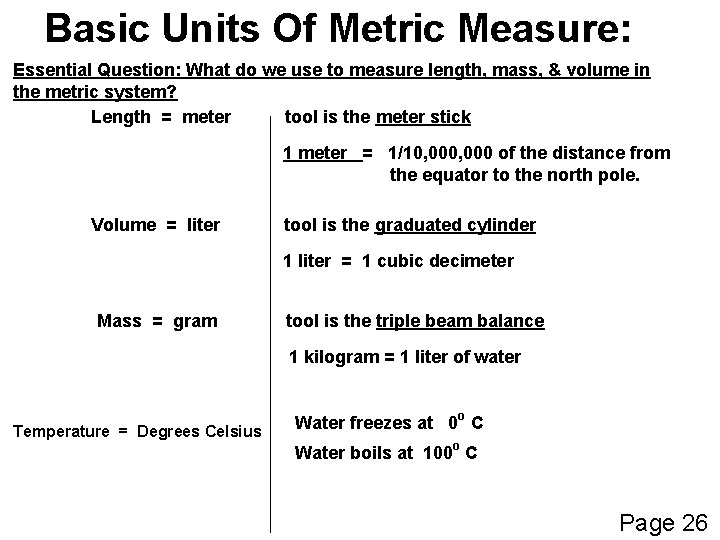
Basic Units Of Metric Measure: Essential Question: What do we use to measure length, mass, & volume in the metric system? Length = meter tool is the meter stick 1 meter = 1/10, 000 of the distance from the equator to the north pole. Volume = liter tool is the graduated cylinder 1 liter = 1 cubic decimeter Mass = gram tool is the triple beam balance 1 kilogram = 1 liter of water Temperature = Degrees Celsius Water freezes at 0 o C Water boils at 100 o C Page 26
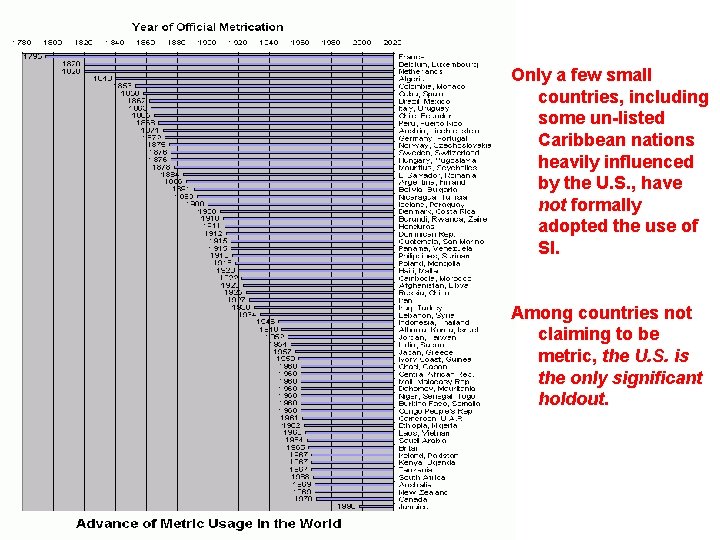
Only a few small countries, including some un-listed Caribbean nations heavily influenced by the U. S. , have not formally adopted the use of SI. Among countries not claiming to be metric, the U. S. is the only significant holdout.
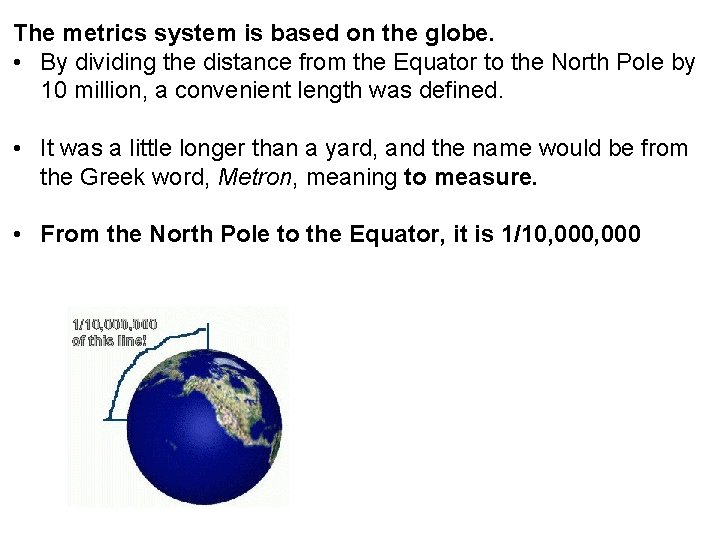
The metrics system is based on the globe. • By dividing the distance from the Equator to the North Pole by 10 million, a convenient length was defined. • It was a little longer than a yard, and the name would be from the Greek word, Metron, meaning to measure. • From the North Pole to the Equator, it is 1/10, 000
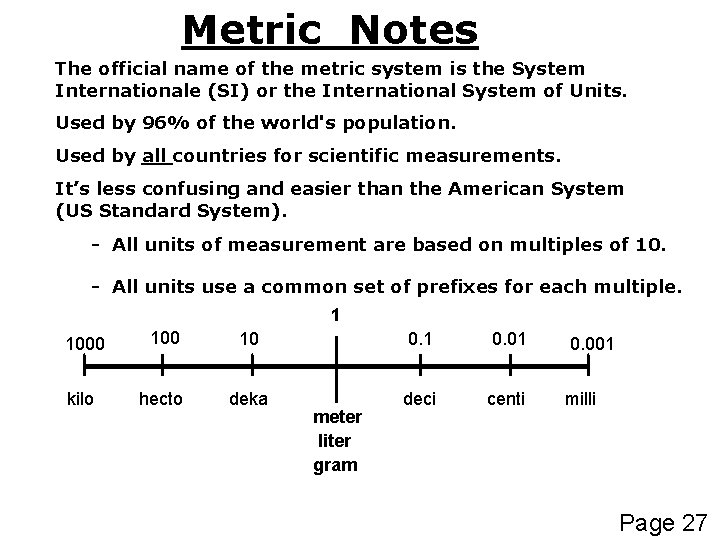
Metric Notes The official name of the metric system is the System Internationale (SI) or the International System of Units. Used by 96% of the world's population. Used by all countries for scientific measurements. It’s less confusing and easier than the American System (US Standard System). - All units of measurement are based on multiples of 10. - All units use a common set of prefixes for each multiple. 1 1000 10 0. 1 0. 001 kilo hecto deka deci centi milli meter liter gram Page 27
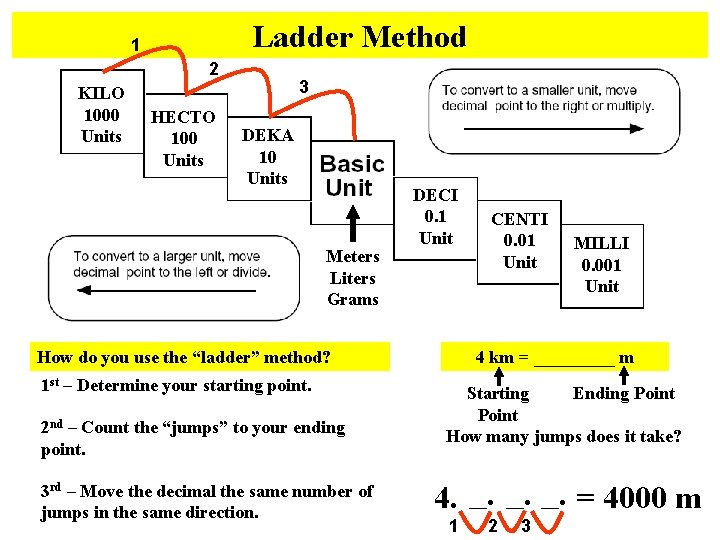
Ladder Method 1 2 KILO 1000 Units HECTO 100 Units 3 DEKA 10 Units Meters Liters Grams DECI 0. 1 Unit How do you use the “ladder” method? 1 st – Determine your starting point. 2 nd – Count the “jumps” to your ending point. 3 rd – Move the decimal the same number of jumps in the same direction. CENTI 0. 01 Unit MILLI 0. 001 Unit 4 km = _____ m Starting Ending Point How many jumps does it take? 4. __. __. = 4000 m 1 2 3
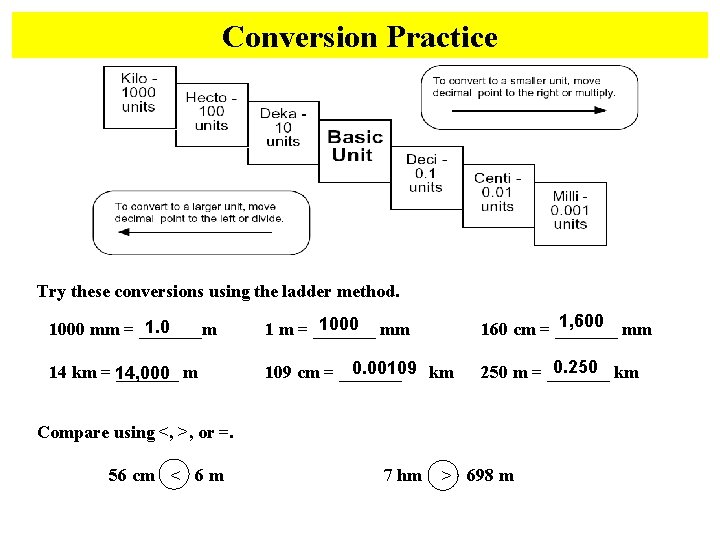
Conversion Practice Try these conversions using the ladder method. 1. 0 1000 mm = _______m 1000 mm 1 m = _______ 1, 600 mm 160 cm = _______ 14 km = 14, 000 _______ m 0. 00109 km 109 cm = _______ 0. 250 km 250 m = _______ Compare using <, >, or =. 56 cm < 6 m 7 hm > 698 m
- Slides: 7