
Basic Understandings of Collectivism Basically collectivism stresses human
Basic Understandings of Collectivism • Basically, collectivism stresses human interdependence and the importance of a collective, regardless of size, rather than the importance of the individual • It considers the well-being of the community at the expense of the individual (ex. Smoking • Indigenous peoples such as the Aboriginal peoples of Canada describe their traditional cultures as having a strong sense of the collective
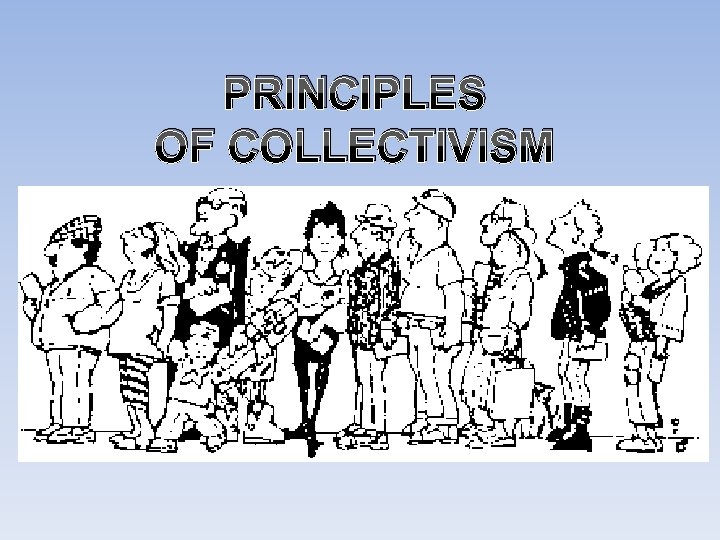
PRINCIPLES OF COLLECTIVISM
Economic Equality Understandings of Economic Equality can be based on any of the follow principles: • People with larger incomes should pay more taxes (progressive taxation) • All people should earn equal wages for work of similar value • There should be a guaranteed annual income (GAI) • All people should share in the wealth of a country or the world • People should own the means of production collectively • There should be no private property; thus all things should be free Different countries adopt different amounts of economic equality. To some, it means that all people have exactly the same of everything, to others it means that all people have access to their basic necessities, to others, it means that all people have reasonable standard of living. Still others reject the principle entirely.

Co-operation • In early society, necessary for mere survival. • Co-operation is meant to ensure that members achieve better results more effectively. It is the means through which members achieve their goals…i. e. roles, quotas, protocols, decision-making, etc. • Cooperation is not always consensual; in certain settings, such as the military, prison, schools and at times, through controls set by government, cooperation may be enforced through threat of punishment or sanctions

Public Property • Usually land, capital, industries, etc… that is stateowned… and managed according to the best interest of the collective • The concept of public property is also present to a lesser extent in liberal democracies like Canada. Parks, schools, roads, libraries, Crown land Crown Corporations (via rail, CBC, the Post Office)…are all examples of property which the government manages the interest of the collectives. These properties are maintained with public money raised through taxation.
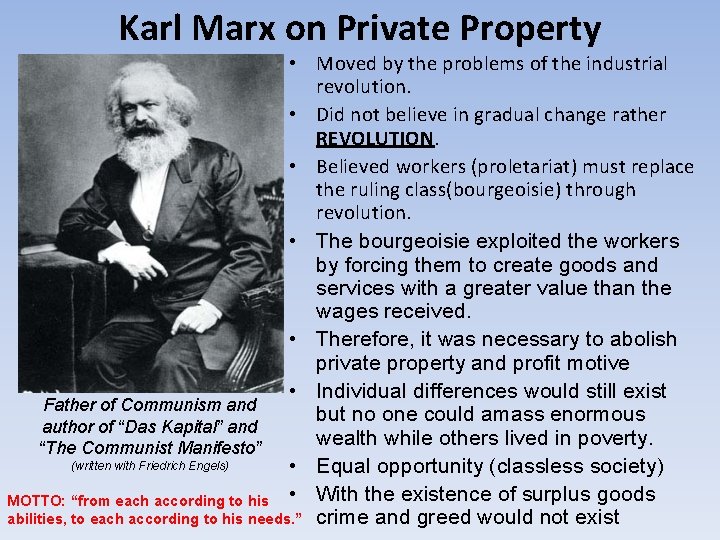
Karl Marx on Private Property • Moved by the problems of the industrial revolution. • Did not believe in gradual change rather REVOLUTION. • Believed workers (proletariat) must replace the ruling class(bourgeoisie) through revolution. • The bourgeoisie exploited the workers by forcing them to create goods and services with a greater value than the wages received. • Therefore, it was necessary to abolish private property and profit motive • Individual differences would still exist Father of Communism and but no one could amass enormous author of “Das Kapital” and wealth while others lived in poverty. “The Communist Manifesto” (written with Friedrich Engels) • Equal opportunity (classless society) MOTTO: “from each according to his • With the existence of surplus goods abilities, to each according to his needs. ” crime and greed would not exist

Collective Interest • A set of interests that a group has in common …labor unions, human rights groups, social programs, lobby groups, etc … The aboriginal groups of Canada have a collective interest for their nations. • Some of these are not found in a communist system, rather, they can be found in democratic societies, where exploitation has occurred and society is trying to right the wrongs of democracy In theory, why is there no need for labour unions or human rights groups in communist systems?

Collective Responsibility • Holding the whole group responsible for the actions of the individuals within the group (makes for group accountability) • Often made in response to deep-rooted social programs that cannot be addressed by targeting the individual. • Collective responsibility can also be used as a punitive measure (particularly in authoritarian governments) to insure that citizens obey the government. For example, if one member of the family speaks out about the government, the entire family or neighbourhood may be punished.

Collective Responsibility • Holding the whole group responsible for the actions of the individuals within the group (makes for group accountability) • Often made in response to deep-rooted social programs that cannot be addressed by targeting the individual.

Collective Responsibility cont’d • Collective responsibility can also be used as a punitive measure (particularly in authoritarian governments) to insure that citizens obey the government. For example, if one member of the family speaks out about the government, the entire family or neighbourhood may be punished.

Adherence to Collective Norms • Standards or norms are imposed in collective societies as a condition of membership in society. These norms relate to values, conditions, conduct or appearance • They are usually binding…trade unions, faith groups, professional groups are all examples • Censorship can be used to impose or protect these norms
- Slides: 11