
Basic Training Module on Key Humanitarian Standards Sphere
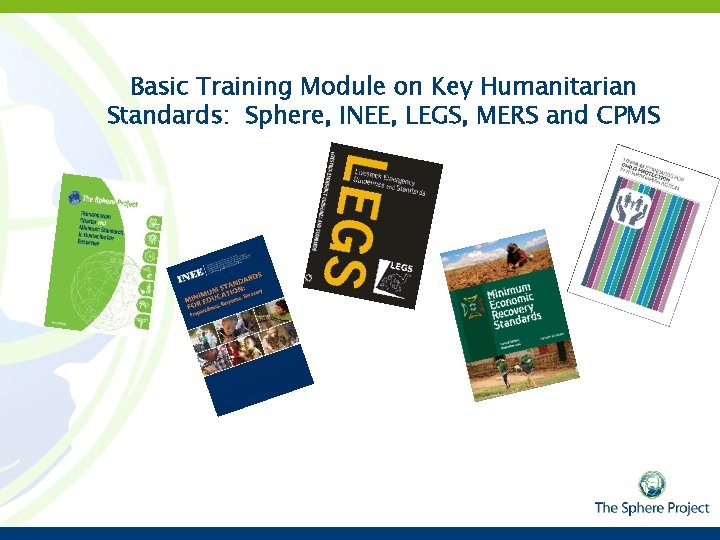
Basic Training Module on Key Humanitarian Standards: Sphere, INEE, LEGS, MERS and CPMS

Sphere Companion Standards • Overall goal of the companionship concept: to provide humanitarian professionals with a pool of harmonised, easy-to-use sets of quality and accountability standards • The Companion Standards complement the Sphere Handbook, covering additional key areas of humanitarian response • Similarities with Sphere: - a consultative and consensus-based writing and revision process - rights-based approach - structure: standard - key actions - key indicators - guidance notes • Cross-references between Sphere Handbook and companion standards and among companion standards • Current companions to the Sphere Handbook: CPMS – Child Protection Minimum Standards INEE – Minimum Standards for Education – Preparedness, Response, Recovery LEGS - Livestock Emergency Guidelines and Standards MERS – Minimum Economic Recovery Standards
The Minimum Standards for Child Protection in Humanitarian Action • Developed through a broad consultation process involving over 400 individuals from 30 agencies in over 40 countries • Sets out a common agreement on quality for child protection in humanitarian preparedness and response • Contains 26 standards and 6 principles. Each standard is accompanied by key actions, measurements (including indicators and targets), and guidance notes • Aims to improve quality, predictability and accountability of child protection responses in humanitarian situations • Intended for use by those working on child protection or related areas in humanitarian action. This includes 1) those working directly with children, families and communities 2) planners and policy makers 3) coordinators 4) donors 5) academics and 6) those working on advocacy, media or communications • Being translated into French, Spanish and Arabic (by end 2013)
INEE Minimum Standards for Education: Preparedness, Response, Recovery • Developed in 2004 through a widely consultative process involving over 2, 250 educationalists. Updated in 2010, with input from over 1, 300 individuals. • Founded upon a human rights framework, specifically the right to education, as expressed in key human rights documents and the Sphere Project’s Humanitarian Charter. • Aims to enhance the quality of education policy and programing, increase access to safe and relevant learning opportunities and ensure accountability in providing these services in all stages of emergency response. • Available in 22 languages, the Handbook has been used in over 110 countries to strengthen education response. • The Handbook is widely used in disaster and preparedness planning, M&E, capacity building,
Livestock Emergency Guidelines and Standards (LEGS) • Published in 2009 following a broad consultation process • Translated into French, Spanish and Arabic • Uses a rights-based approach, in particular the right to food and the right to a standard of living • Contains tools and guidance for the design, implementation and evaluation of livestock-based livelihoods responses in disasters • Focuses on participatory processes to identify appropriate, timely and feasible emergency interventions that help to save livelihoods as well as lives. • The LEGS Training programme, based on regional Training of Trainers courses, has resulted in 260 LEGS trainers worldwide. To-date they have carried out 126 trainings in 26 countries. • A second edition of LEGS is planned for 2014 following global consultation
(MERS) Minimum Economic Recovery Standards • First edition published in 2009 following a broad consultative process, field testing and regional consultations. Second edition was published in 2010 with input from 63 humanitarian agencies and non governmental organizations and over a hundred practitioners. • The MERS training of trainers program has established a global network of trainers and general practitioners to promote the MERS worldwide. • The Handbook is a reference guide on economic recovery in post crisis situations and includes core standards, assessment and analysis standards, and four technical standards: financial services, productive assets, employment creation and enterprise development. • The standards seek to promote the inclusion of longer term economic recovery programming into all emergency response programs to assist affected populations to regain their livelihoods and provide for themselves and their families with dignity. • Aims to improve the quality and accountability of economic recovery programs in post crisis environments.

The Sphere Handbook: Humanitarian Charter and Minimum Standards in Humanitarian Response 3 rd edition • An internationally recognised set of common principles and universal minimum standards to improve quality and accountability of humanitarian response • Result of a broad consultation process within humanitarian sector • The Humanitarian Charter sets out moral and legal principles on which Sphere’s rights-based approach is built • The right to life with dignity: Standards contribute to disaster-affected people to survive and recover in stable conditions and with dignity • Core Standards and Protection Principles applicable to all humanitarian sectors • Technical standards: WASH, Food security & nutrition, Shelter & NFI, Health action • Used also for national disaster management policies and guidelines • Broad ownership – vibrant Sphere community of users – many Handbook translations
- Slides: 7