
BASIC TRAINING FOR BARANGAY HEALTH WORKERS Calasiao Pangasinan
BASIC TRAINING FOR BARANGAY HEALTH WORKERS Calasiao, Pangasinan IDENTIFICATION AND MANAGEMENT OF COMMON ILLNESSES
GENERAL PRECAUTIONS TO OBSERVE: FOOD Øeat properly cooked food Øpreferably, food must be eaten immediately after cooking Øleft-over food should be refrigerated and reheated before eating Øfood handlers should wash their hands before and after food preparation. If sick, avoid preparing food for others.
� DRINKING WATER • avoid drinking water of doubtful quality. • if water quality is doubtful, bring into a boil and let it remain boiling for 5 minutes. � FLOODS • do not wade in flood waters; if unavoidable, wear protective gear (boots and gloves) • water accumulated in old tires, tin cans, flower pots should be drained, water storage container should be covered to prevent them from becoming breeding sites for mosquitoes.
DENGUE FEVER � Ang DENGUE H-FEVER ay isang sakit na nakakahawa, Ang sanhi nito ay isang klase ng “virus” na naisasalin sa pamamagitan ng kagat ng lamok, ang Aedes Aegypti at ang Aedes Albopictus, mga uri ng lamok na nangangagat sa araw at nabubuhay sa loob at sa paligid ng bahay. � Ang isang tao ay maaaring magkasakit ng DENGUE H-FEVER kung siya ay kinagat ng lamok na nakakagat ng pasyenteng mayroong sakit na DENGUE H-FEVER.
DENGUE FEVER � MGA PALATANDAAN AT SINTOMAS NG DENGUE • biglang pagtaas ng lagnat na tumatagal ng • • 2 – 7 araw pananakit ng kalamnan at kasuan pananakit ng ulo panghihina ng katawan pagkakaroon ng maliliit at mapupulang pantal pananakit ng tiyan pagdurugo ng ilong at gilagid pagsusuka o pagduduwal ng maitim ang kulay dulot ng pagdurugo ng bituka
DENGUE FEVER � MGA PALATANDAAN AT SINTOMAS NG DENGUE • biglang pagtaas ng lagnat na tumatagal ng • • 2 – 7 araw pananakit ng kalamnan at kasuan pananakit ng ulo panghihina ng katawan pagkakaroon ng maliliit at mapupulang pantal pananakit ng tiyan pagdurugo ng ilong at gilagid pagsusuka o pagduduwal ng maitim ang kulay dulot ng pagdurugo ng bituka
DENGUE FEVER � PAANO MAIIWASAN ANG DENGUE H-FEVER? • Huwag mag-imbak ng anumang bagay na maaaring pag-ipunan ng tubig at pamugaran ng mga lamok sa loob at sa labas ng bahay tulad ng mga lata, bote at mga gulong ng sasakyan, at panatilihing tuyo ang kapaligiran. • Hugasan at kuskusing mabuti ang mga plorera at iba pang lalagyan ng tubig isang beses sa loob ng isang linggo. • Takpan ng mabuti ang mga pinaglalagyan ng tubig upang maiwasan ang pagpasok at pangingitlog ng mga lamok. • Tingnan at linisin ng regular ang mga alulod ng bahay upang maiwasan ang pag-iipon dito ng tubig-ulan.
DENGUE FEVER � MGA MAHAHALAGANG BAGAY TUNGKOL SA MAY KASO NG DENGUE H-FEVER: • Ipagbigay alam kaagad sa pinakamalapit na Health Worker o Health Center kung may pinaghihinalaang kaso ng DENGU H-FEVER sa komunidad base sa mga palatandaan at mga sintomas na nabanggit. • HUWAG MAGBIBIGAY NG ASPIRIN/ASPILET sa mga taong pinaghihinalaang may sakit ng DENGUE HFEVER para panglunas sa lagnat dahil ang aspirin/aspilet ay maaaring magdulot at magpalubha ng pagdurugo ng pasyente. Gumamit ng PARACETAMOL PARA SA LAGNAT ng pasyenteng may DENGUE H-FEVER. • Iwasan na makagat ng lamok ang mga taong may sakit ng DENGUE H-FEVER upang hindi kumalat ang “virus” sa lamok na kakagat uli sa mga taong walang sakit.
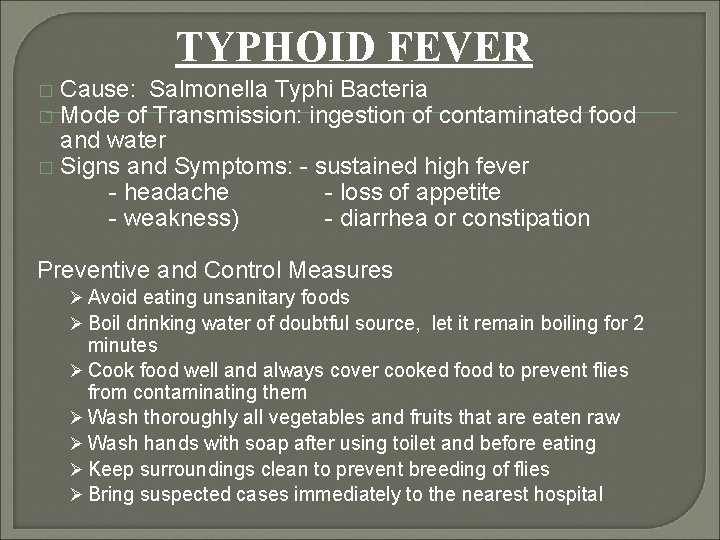
TYPHOID FEVER Cause: Salmonella Typhi Bacteria Mode of Transmission: ingestion of contaminated food and water � Signs and Symptoms: - sustained high fever - headache - loss of appetite - weakness) - diarrhea or constipation � � Preventive and Control Measures Ø Avoid eating unsanitary foods Ø Boil drinking water of doubtful source, let it remain boiling for 2 minutes Ø Cook food well and always cover cooked food to prevent flies from contaminating them Ø Wash thoroughly all vegetables and fruits that are eaten raw Ø Wash hands with soap after using toilet and before eating Ø Keep surroundings clean to prevent breeding of flies Ø Bring suspected cases immediately to the nearest hospital
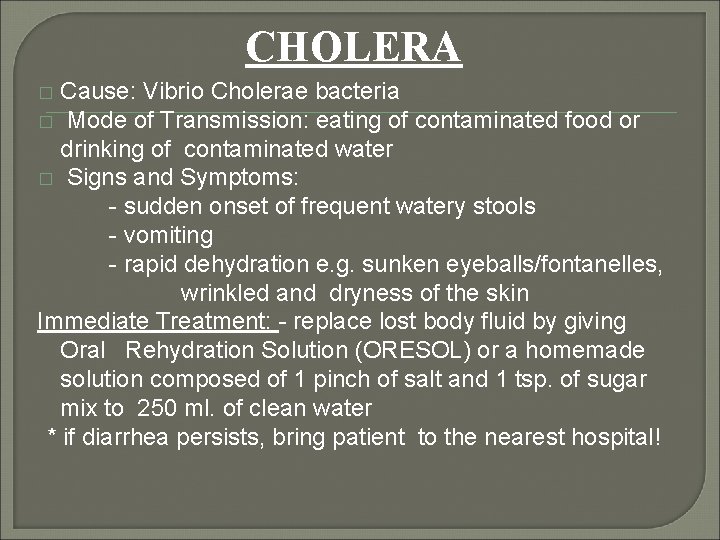
CHOLERA Cause: Vibrio Cholerae bacteria � Mode of Transmission: eating of contaminated food or drinking of contaminated water � Signs and Symptoms: - sudden onset of frequent watery stools - vomiting - rapid dehydration e. g. sunken eyeballs/fontanelles, wrinkled and dryness of the skin Immediate Treatment: - replace lost body fluid by giving Oral Rehydration Solution (ORESOL) or a homemade solution composed of 1 pinch of salt and 1 tsp. of sugar mix to 250 ml. of clean water * if diarrhea persists, bring patient to the nearest hospital! �
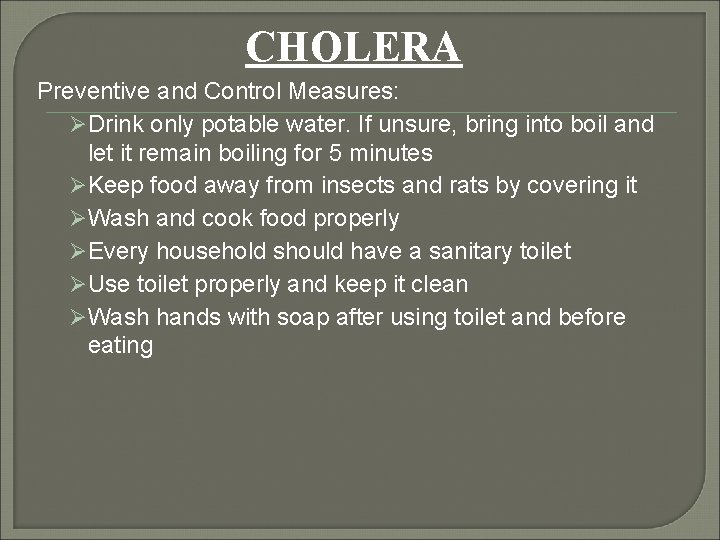
CHOLERA Preventive and Control Measures: ØDrink only potable water. If unsure, bring into boil and let it remain boiling for 5 minutes ØKeep food away from insects and rats by covering it ØWash and cook food properly ØEvery household should have a sanitary toilet ØUse toilet properly and keep it clean ØWash hands with soap after using toilet and before eating
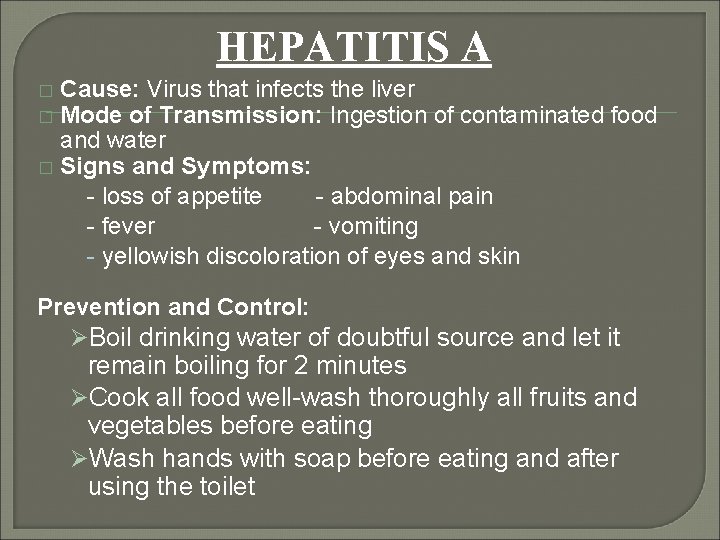
HEPATITIS A Cause: Virus that infects the liver Mode of Transmission: Ingestion of contaminated food and water � Signs and Symptoms: - loss of appetite - abdominal pain - fever - vomiting - yellowish discoloration of eyes and skin � � Prevention and Control: ØBoil drinking water of doubtful source and let it remain boiling for 2 minutes ØCook all food well-wash thoroughly all fruits and vegetables before eating ØWash hands with soap before eating and after using the toilet
HEPATITIS A ØDo not share eating utensils with the patient ØUse sanitary toilet Immediate Treatment: ØTreat fever with anti-fever drug ØIf fever persist for 24 hours, consult your nearest health worker/health center and or hospital
LEPTOSPIROSIS � Cause: Leptospira Bacteria � Mode of Transmission: through contact of the skin, especially open wounds with water, moist soil or vegetation contaminated with urine of infected rats. � Signs and Symptoms: - Calf muscle pain - Fever - Flu-like symptoms (body pains, headache and muscle pains) Preventive and Control Measures: ØUse proper protection such as boots and gloves when work requires exposure to contaminated water ØAvoid swimming or wading in potentially contaminated waters such as flood water ØDrain potentially contaminated water when possible ØControl rats in households
RED TIDE POISONING (Paralytic Shellfish Poisoning) Cause: Shellfish (tahong, talaba, halaan) contaminated with red tide microorganisms � Mode of Transmission: eating of contaminated shellfish � Signs and Symptoms: Neurological: - Sense of numbness around the mouth or the face - Body weakness - Dizziness - Rapid pulse beat - Pricking sensation and/or paralysis of hands and feet - Difficulty of talking, swallowing �
RED TIDE POISONING (Paralytic Shellfish Poisoning) Gastrointestinal: - Abdominal pain - Vomiting - Diarrhea BRING PATIENT IMMEDIATELY TO THE NEAREST HOSPITAL!!! Preventive Measures: ØDo not eat shellfish during rainy season or when an advisory has been issued by the Department of Health (DOH) or the Bureau of Fishery and Aquatic Resources (BFAR) ØWash thoroughly and remove gills and intestines of fish, squid and crabs ØRemove heads of shrimps, avoid alamang; small fishes

THANK YOU!
- Slides: 17