
Basic Things to Know about LED Lamps Performance
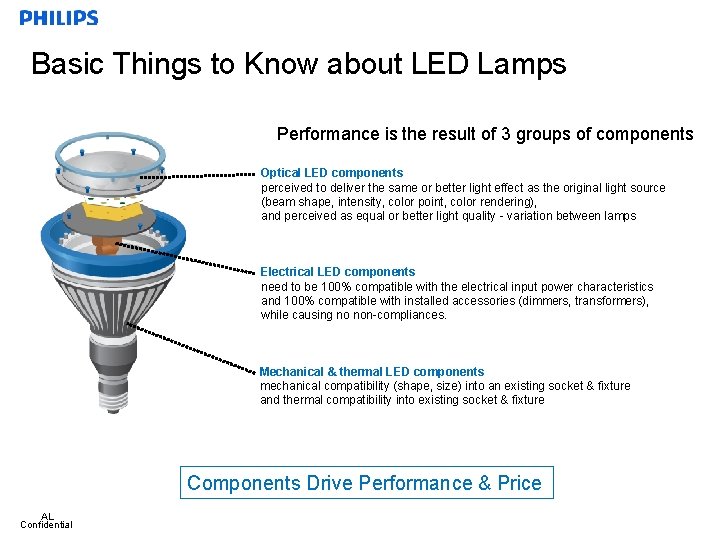
Basic Things to Know about LED Lamps Performance is the result of 3 groups of components Optical LED components perceived to deliver the same or better light effect as the original light source (beam shape, intensity, color point, color rendering), and perceived as equal or better light quality - variation between lamps Electrical LED components need to be 100% compatible with the electrical input power characteristics and 100% compatible with installed accessories (dimmers, transformers), while causing no non-compliances. Mechanical & thermal LED components mechanical compatibility (shape, size) into an existing socket & fixture and thermal compatibility into existing socket & fixture 1 AL Confidential Components Drive Performance & Price

Color Binning Metal Halide • Each color consists of several different “bins” • The performance of each LED is unique • Each LED is binned by three measurements: output color 2 power Confidential HPS CIE Chromaticity Diagram

Binning All LED Components In A Product Batch Are Different Manufacturing • • Inspection & QC Sorting a. k. a. Binning Cool Higher output bins cost more Bins closer to the black body curve (“whiter”) cost more Manufacturers will not sell you just one bin in large volumes Manufacturers will not guarantee availability of specific bins Warm Low Output Confidential High Output 3
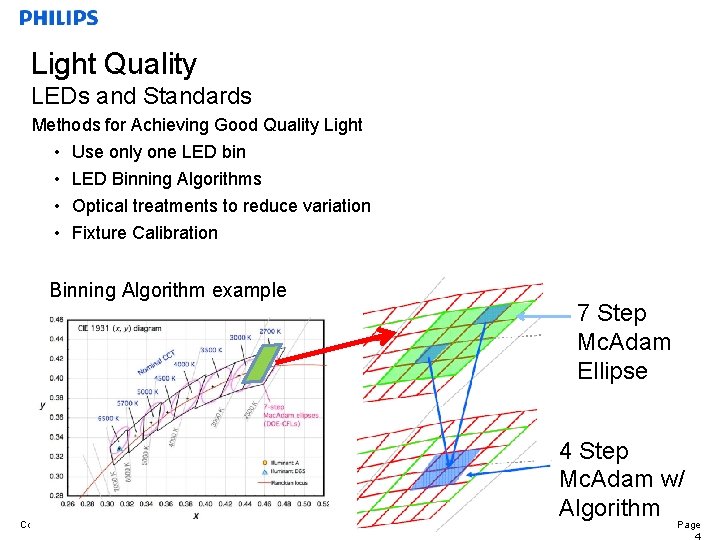
Light Quality LEDs and Standards Methods for Achieving Good Quality Light • Use only one LED bin • LED Binning Algorithms • Optical treatments to reduce variation • Fixture Calibration Binning Algorithm example Confidential 7 Step Mc. Adam Ellipse 4 Step Mc. Adam w/ Algorithm Page 4

Light Quality LEDs and Standards Binning Algorithm example Conforms to ANSI C 78. 377 A 7 Step Mc. Adam Ellipse 4 Step Mc. Adam w/ Algorithm PLC Optibin Confidential Page 5

Light Quality Philips LEDs Philips Optibin’s CCT and hue tolerances for LED’s fall within a 4 -step Mac. Adam ellipse , rather than 7 -step ellipse defined by ANSI standard Optibin dictates the use of LED’s from bins which lie close as possible to the black-body curve within the 4 -step ellipse. This proprietary algorithm intelligently combines LED’s from different bins, guaranteeing color uniformity for lamps purchased and shipped at different times SDCM – Standard Deviation of Color Matching A color difference of 1 SDCM “step” is not visible 2 – 4 “steps” is barely visible 5+ readily noticeable Confidential Page 6
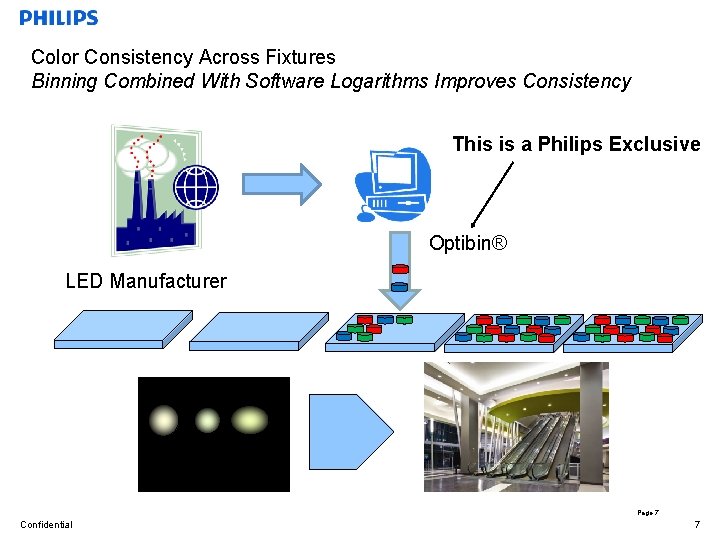
Color Consistency Across Fixtures Binning Combined With Software Logarithms Improves Consistency This is a Philips Exclusive Optibin® LED Manufacturer Page 7 Confidential 7
- Slides: 7