
Basic Teaching Methods in Physics and Social Science

Basic Teaching Methods in Physics and Social Science Classroom Reality and upper secondary school students’ expectations Jari Lavonen 1, Carl Angel 2, Reijo Byman 1, Ellen Henriksen 2 and Ismo Koponen 1 1 University of Helsinki, Finland, 2 University of Oslo, Norway 18. 8. 2003. 1

What might affect on motivation to study science? Typically, answers are searched by investigating pupils’ interests or attitudes to 1 science (or domains of science) generally, 2 to school science subjects, 3 to studying science subjects or teaching methods used (Woolnough, 1994, Hoffman, 2002) 18. 8. 2003 E S E R A 2003 2
E. L. Deci & R. M. Ryan: According to Motivaation theory … • Students will learn if they are interested to learn (topic and teaching method) • continuum: external motivation – intrinsic m. (≈ interest) • It is possible to have an influence on students’ motivation for example by: - wake up students curiosity (topic and method) - support students’ feeling of autonomy • There are several attributes that have an influence on students motivation: genre, workload, easiness, … 18. 8. 2003 E S E R A 2003 3

Research questions The purpose of the study was to determine 1. What is the students’ (physics as their specialisation subject) opinion about how often different teaching methods (categorised by the nature of social interaction) are used and should be used in physics classroom? 2. What kind of background variables (gender, nationality, student orientation to physics or social sciences and subject easiness, interestingness, …) explain how the students wish to study the subject they have selected as their specialisation subject? 18. 8. 2003 E S E R A 2003 4
Method and sample • In Norway a paper questionnaires and in Finland a web based questionnaire were used. • A letter was send to headmasters of all upper secondary schools and they were asked to organise a survey at the second year of upper secondary school for 10 students in beginning of alphabetical list. • Altogether 1349 response in Finland 1487 in Norway were received 18. 8. 2003 E S E R A 2003 5
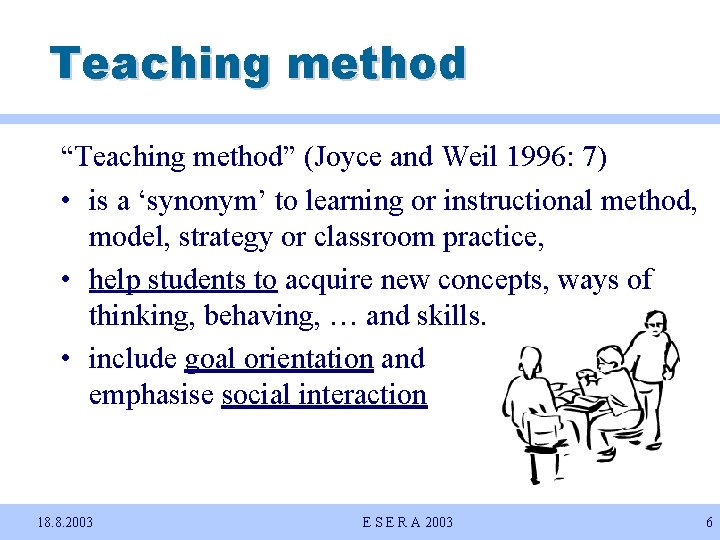
Teaching method “Teaching method” (Joyce and Weil 1996: 7) • is a ‘synonym’ to learning or instructional method, model, strategy or classroom practice, • help students to acquire new concepts, ways of thinking, behaving, … and skills. • include goal orientation and emphasise social interaction 18. 8. 2003 E S E R A 2003 6
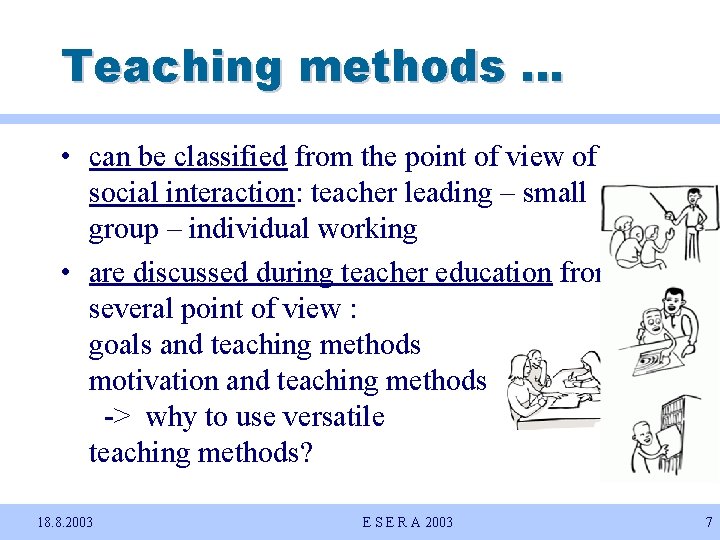
Teaching methods … • can be classified from the point of view of social interaction: teacher leading – small group – individual working • are discussed during teacher education from several point of view : goals and teaching methods motivation and teaching methods -> why to use versatile teaching methods? 18. 8. 2003 E S E R A 2003 7
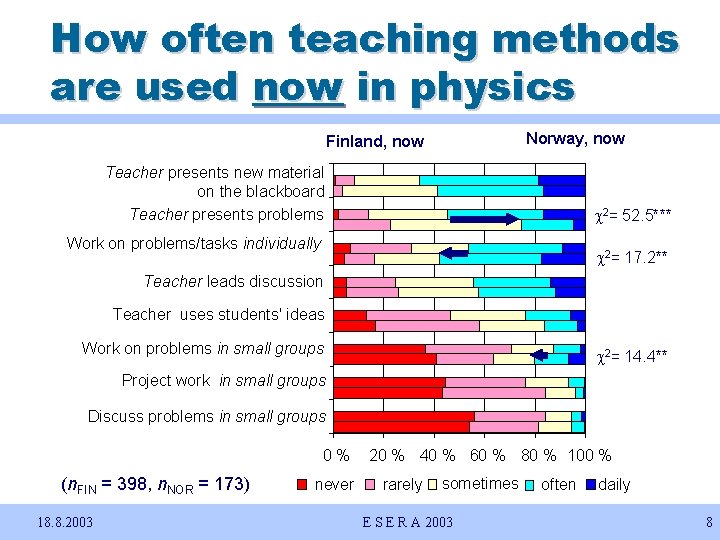
How often teaching methods are used now in physics Norway, now Finland, now Teacher presents new material on the blackboard Teacher presents problems 2= 52. 5*** Work on problems/tasks individually 2= 17. 2** Teacher leads discussion Teacher uses students' ideas Work on problems in small groups 2= 14. 4** Project work in small groups Discuss problems in small groups 0% (n. FIN = 398, n. NOR = 173) 18. 8. 2003 never 20 % 40 % 60 % 80 % 100 % rarely sometimes E S E R A 2003 often daily 8

How often teaching methods should be used in physics (FIN) Finland, wish Finland, now Teacher presents new material on the blackboard Teacher presents problems Z = -3. 8** Z = -2. 9** Work on problems/tasks individually Teacher leads discussion Z = 9. 2*’* Teacher uses students' ideas Z = 9. 9*’* Work on problems in small groups Z = 9. 7*’* Project work in small groups Z = 5. 8*’* Discuss problems in small groups 0% (n. FIN = 398) 18. 8. 2003 never Z = 11. 9*’* 20 % 40 % 60 % 80 % 100 % rarely sometimes E S E R A 2003 often daily 9
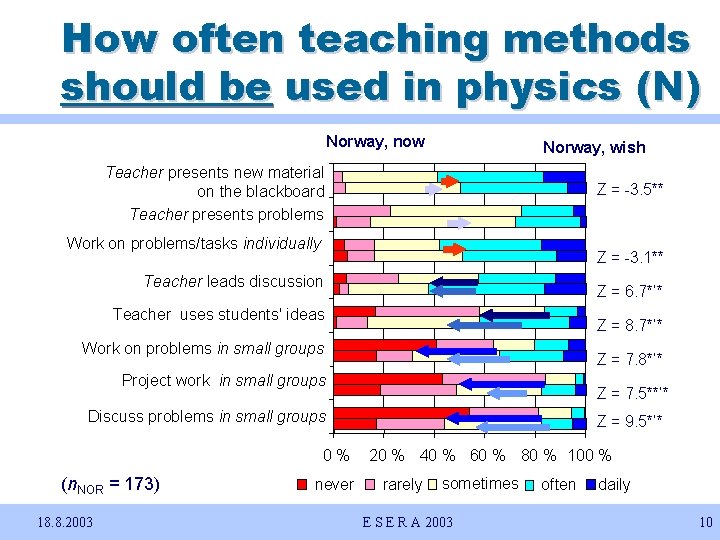
How often teaching methods should be used in physics (N) Norway, now Norway, wish Teacher presents new material on the blackboard Teacher presents problems Z = -3. 5** Work on problems/tasks individually Z = -3. 1** Teacher leads discussion Z = 6. 7*’* Teacher uses students' ideas Z = 8. 7*’* Work on problems in small groups Z = 7. 8*’* Project work in small groups Z = 7. 5**’* Discuss problems in small groups 0% (n. NOR = 173) 18. 8. 2003 never Z = 9. 5*’* 20 % 40 % 60 % 80 % 100 % rarely sometimes E S E R A 2003 often daily 10
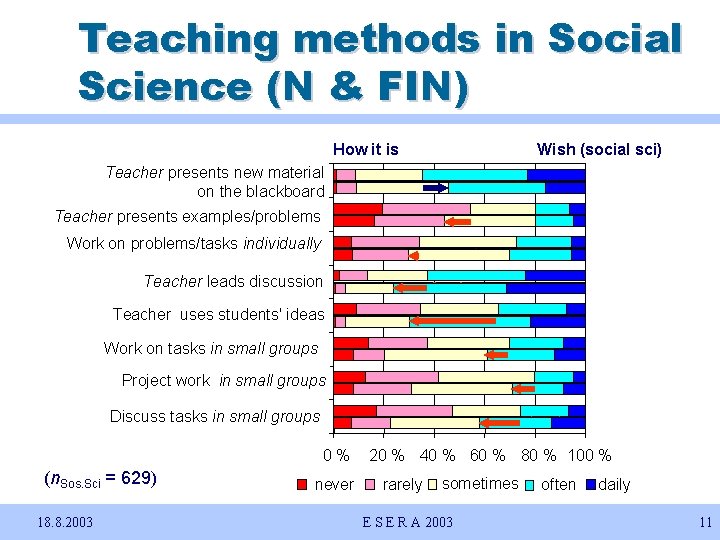
Teaching methods in Social Science (N & FIN) How it is in. Wish Phys(social sci) Teacher presents new material on the blackboard Teacher presents examples/problems Work on problems/tasks individually Teacher leads discussion Teacher uses students' ideas Work on tasks in small groups Project work in small groups Discuss tasks in small groups 0% (n. Sos. Sci = 629) 18. 8. 2003 never 20 % 40 % 60 % 80 % 100 % rarely sometimes E S E R A 2003 often daily 11

Groupping teaching methods by factor analysis Component loadings 1 2 3 4 F 1: Studying in small groups F 1 I 1: Work problems/tasks small factor groups. 774 for Maximum Promax with Kaiser Normalization in -Rotated loading matrix F 1 I 2: Discuss about difficult small group. 198. 624 Likelihood Factoring calculatedconcepts for items in measuring students' (n = 1216) opinions F 1 I 3: project in small about. Have how they wishwork to study duringgroups their lessons in Physics. 614 or Social sciences. -. 105 F 2: Teacher presentation F 2 I 1: A teacher present/solve problems. 668 F 2 I 2: A teacher present new material -. 107. 362. 144 F 3: Teacher leading discussion F 3 I 1: A teacher leads discussion about concepts. 677 F 4: Individual studying F 4 I 1: Work with problems/tasks individually. 513 % of total variance 21. 9 9. 2 6. 1 2. 7 18. 8. 2003 E S E R A 2003 12
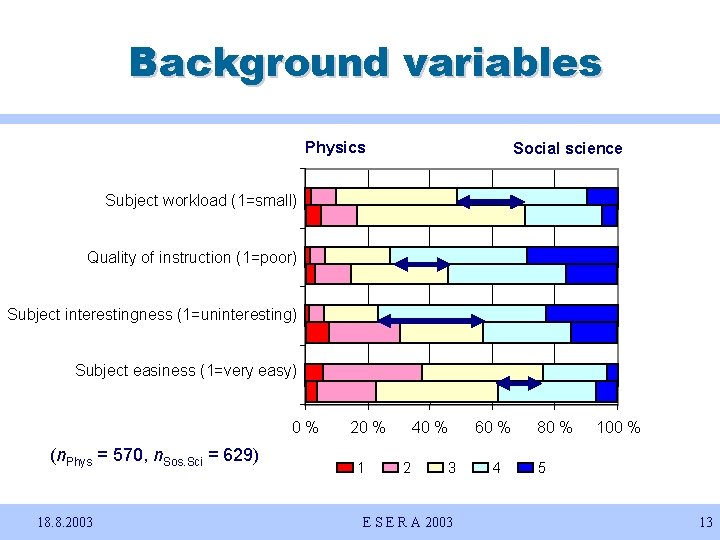
Background variables Physics Social science Subject workload (1=small) Quality of instruction (1=poor) Subject interestingness (1=uninteresting) Subject easiness (1=very easy) 0% (n. Phys = 570, n. Sos. Sci = 629) 18. 8. 2003 20 % 1 40 % 2 3 E S E R A 2003 60 % 4 80 % 100 % 5 13
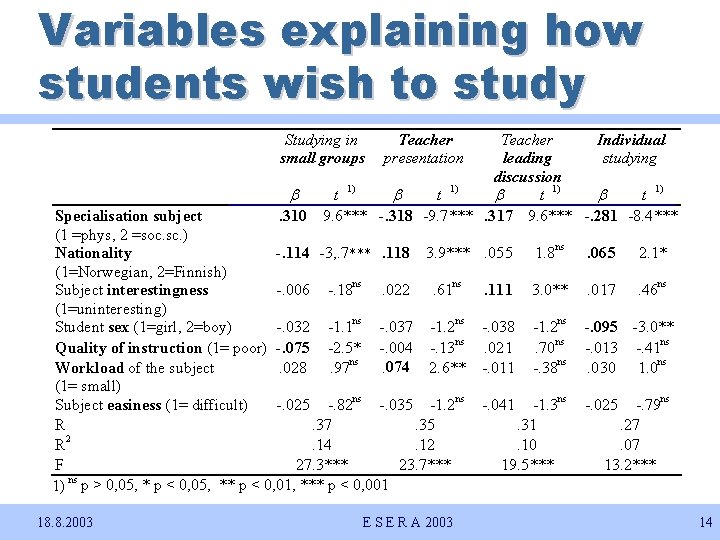
Variables explaining how students wish to study Studying in small groups Teacher presentation Teacher Individual leading studying discussion 1) 1) t t b b. 310 9. 6*** -. 318 -9. 7***. 317 9. 6*** -. 281 -8. 4*** Specialisation subject (1 =phys, 2 =soc. sc. ) Nationality -. 114 -3, . 7***. 118 3. 9*** (1=Norwegian, 2=Finnish) ns ns Subject interestingness -. 006 -. 18. 022. 61 (1=uninteresting) ns ns Student sex (1=girl, 2=boy) -. 032 -1. 1 -. 037 -1. 2 ns Quality of instruction (1= poor) -. 075 -2. 5* -. 004 -. 13 ns Workload of the subject. 028. 97. 074 2. 6** (1= small) ns ns Subject easiness (1= difficult) -. 025 -. 82 -. 035 -1. 2 R. 37. 35 2 R. 14. 12 F 27. 3*** 23. 7*** ns 1) p > 0, 05, * p < 0, 05, ** p < 0, 01, *** p < 0, 001 18. 8. 2003 E S E R A 2003 ns . 055 1. 8 . 111 3. 0** -. 038. 021 -. 011 -1. 2 ns. 70 ns -. 38 ns -. 095 -3. 0** ns -. 013 -. 41 ns. 030 1. 0 -. 041 ns -. 025 -1. 3. 31. 10 19. 5*** . 065 2. 1* . 017 . 46 ns -. 79. 27. 07 13. 2*** ns 14
Conclusions and Implications 1 • It is typical that in Physics teacher present new material or solve problems on the blackboard. This is also students’ wish. • The students would like to discuss more about concepts and problems as well as work with them in small groups. The teacher should support autonomy! • The differences between Finnish and Norwegian students are dealing with how students work with problems: in Finland teacher should present or solve problems - in Norway the students like to work individually 18. 8. 2003 E S E R A 2003 15

Conclusions and Implications 2 • Student gender as well as other predictors, except nationality and subject of specialisation, explain only little about students wishes how they like to study their specialisation subject. • The students preferred more versatile teaching methods than it is in present used and, therefore, the teacher should also think about models when (s)he plan instruction 18. 8. 2003 E S E R A 2003 16
Thank you! 18. 8. 2003. 17
- Slides: 17