
Basic study of the particle measurement in vacuum
Basic study of the particle measurement in vacuum condition 2017/Sep/14 Hiroshi Sakai (KEK) Operating SRF systems reliably in a “dirty” accelerator (14 -15 September 2017) In HZB, Berlin, Germany 1
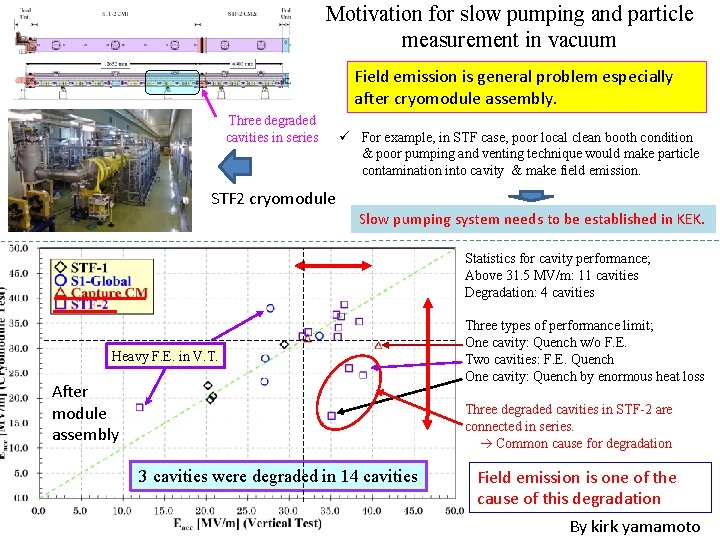
Motivation for slow pumping and particle measurement in vacuum Field emission is general problem especially after cryomodule assembly. Three degraded cavities in series ü For example, in STF case, poor local clean booth condition & poor pumping and venting technique would make particle contamination into cavity & make field emission. STF 2 cryomodule Slow pumping system needs to be established in KEK. Statistics for cavity performance; Above 31. 5 MV/m: 11 cavities Degradation: 4 cavities Heavy F. E. in V. T. After module assembly Three types of performance limit; One cavity: Quench w/o F. E. Two cavities: F. E. Quench One cavity: Quench by enormous heat loss Three degraded cavities in STF-2 are connected in series. Common cause for degradation 3 cavities were degraded in 14 cavities Field emission is one of the cause of this degradation By kirk yamamoto
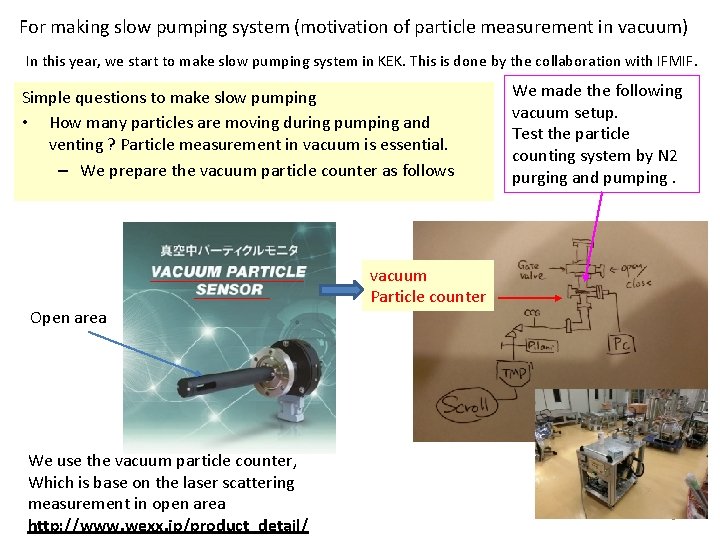
For making slow pumping system (motivation of particle measurement in vacuum) In this year, we start to make slow pumping system in KEK. This is done by the collaboration with IFMIF. Simple questions to make slow pumping • How many particles are moving during pumping and venting ? Particle measurement in vacuum is essential. – We prepare the vacuum particle counter as follows Open area We use the vacuum particle counter, Which is base on the laser scattering measurement in open area http: //www. wexx. jp/product_detail/ We made the following vacuum setup. Test the particle counting system by N 2 purging and pumping. vacuum Particle counter 3

All chambers except for monitor and gate valve are rinsed by high pressure water. All components are assembled in ISO class 4. Setup Particle counter & setup. Blowed by ion gun before setting. Counting hole pump Vacuum particle counter Position of the open area of vacuum particle counter in chamber Final setup 4
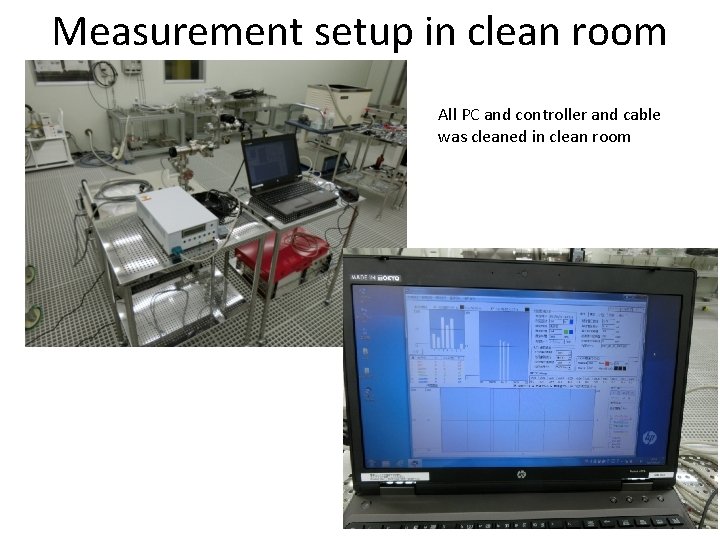
Measurement setup in clean room All PC and controller and cable was cleaned in clean room 5
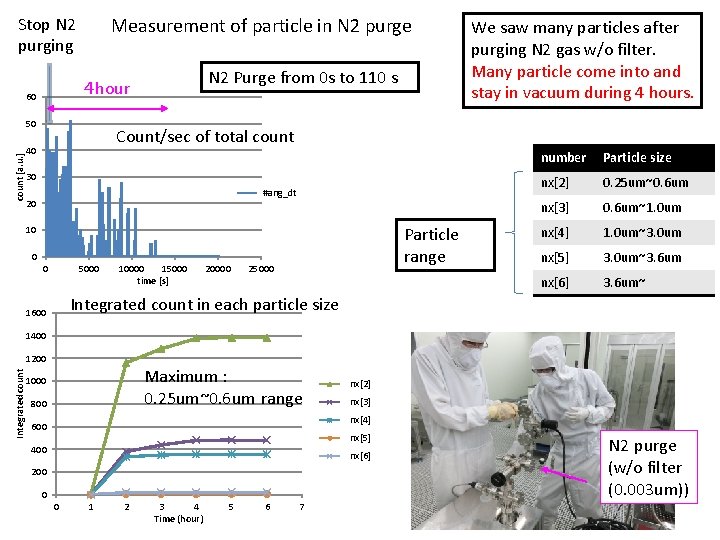
Stop N 2 purging Measurement of particle in N 2 purge 60 50 count [a. u. ] N 2 Purge from 0 s to 110 s 4 hour We saw many particles after purging N 2 gas w/o filter. Many particle come into and stay in vacuum during 4 hours. Count/sec of total count 40 30 #ang_dt 20 Particle range 10 0 0 5000 10000 15000 time [s] 20000 25000 number Particle size nx[2] 0. 25 um~0. 6 um nx[3] 0. 6 um~1. 0 um nx[4] 1. 0 um~3. 0 um nx[5] 3. 0 um~3. 6 um nx[6] 3. 6 um~ Integrated count in each particle size 1600 1400 Integrated count 1200 Maximum : 0. 25 um~0. 6 um range 1000 800 nx[2] nx[3] nx[4] 600 nx[5] 400 nx[6] 200 0 0 1 2 3 4 Time (hour) 5 6 7 N 2 purge (w/o filter (0. 003 um))
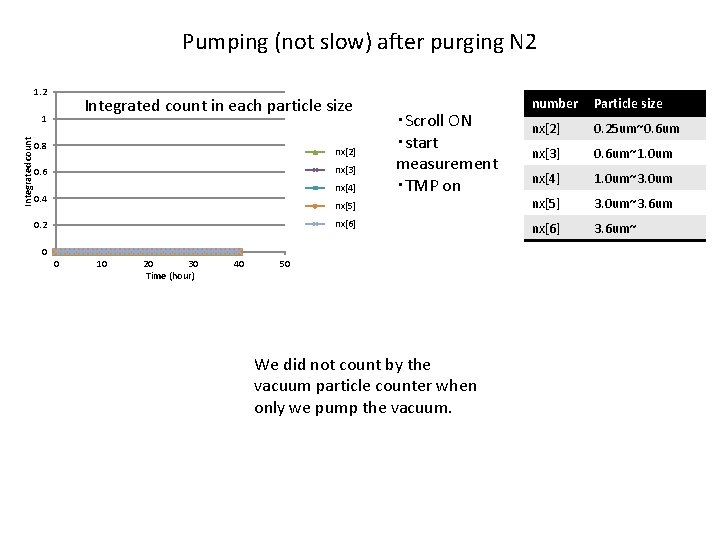
Pumping (not slow) after purging N 2 1. 2 Integrated count in each particle size Integrated count 1 0. 8 number Particle size nx[2] 0. 25 um~0. 6 um nx[3] 0. 6 um~1. 0 um nx[4] 1. 0 um~3. 0 um nx[5] 3. 0 um~3. 6 um nx[6] 3. 6 um~ nx[2] nx[3] 0. 6 nx[4] 0. 4 0. 2 ・Scroll ON ・start measurement ・TMP on 0 0 10 20 30 Time (hour) 40 50 We did not count by the vacuum particle counter when only we pump the vacuum.
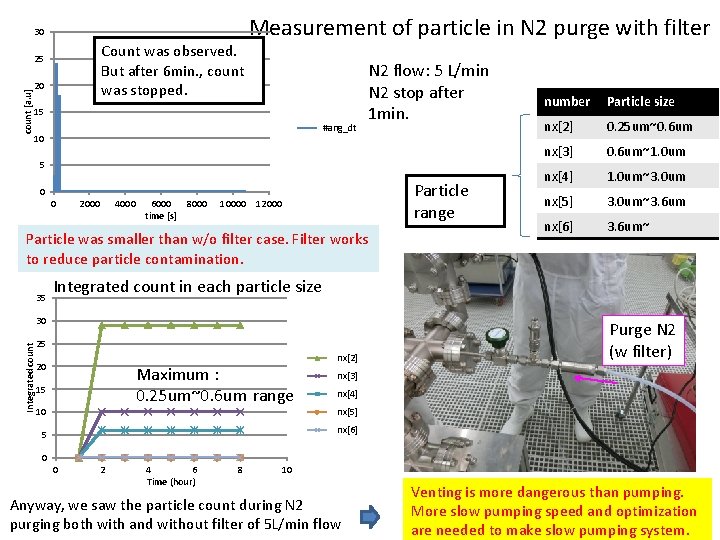
30 Count was observed. But after 6 min. , count was stopped. count [a. u] 25 20 Measurement of particle in N 2 purge with filter 15 #ang_dt 10 N 2 flow: 5 L/min N 2 stop after 1 min. 5 Particle range 0 0 2000 4000 6000 time [s] 8000 10000 12000 Particle was smaller than w/o filter case. Filter works to reduce particle contamination. 35 Particle size nx[2] 0. 25 um~0. 6 um nx[3] 0. 6 um~1. 0 um nx[4] 1. 0 um~3. 0 um nx[5] 3. 0 um~3. 6 um nx[6] 3. 6 um~ Integrated count in each particle size 30 Integrated count number 25 20 Maximum : 0. 25 um~0. 6 um range 15 10 nx[2] Purge N 2 (w filter) nx[3] nx[4] nx[5] nx[6] 5 0 0 2 4 6 Time (hour) 8 10 Anyway, we saw the particle count during N 2 purging both with and without filter of 5 L/min flow Venting is more dangerous than pumping. More slow pumping speed and optimization are needed to make slow pumping system.
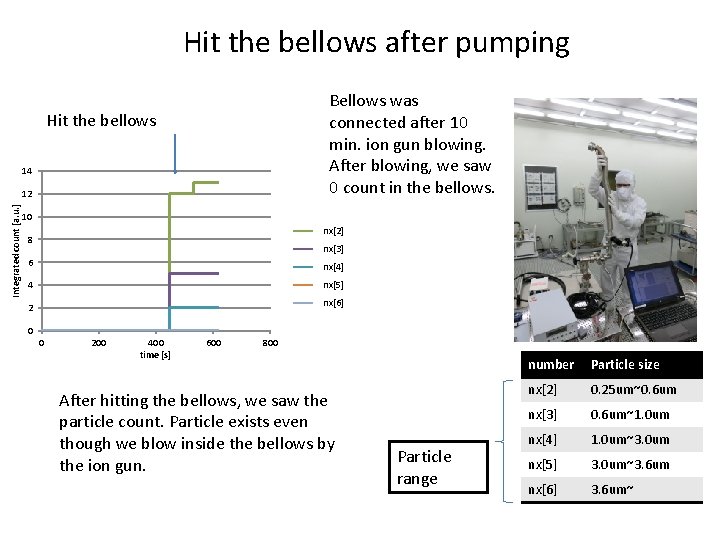
Hit the bellows after pumping Bellows was connected after 10 min. ion gun blowing. After blowing, we saw 0 count in the bellows. Hit the bellows 14 Integrated count [a. u. ] 12 10 nx[2] 8 nx[3] 6 nx[4] 4 nx[5] 2 nx[6] 0 0 200 400 time [s] 600 800 After hitting the bellows, we saw the particle count. Particle exists even though we blow inside the bellows by the ion gun. Particle range number Particle size nx[2] 0. 25 um~0. 6 um nx[3] 0. 6 um~1. 0 um nx[4] 1. 0 um~3. 0 um nx[5] 3. 0 um~3. 6 um nx[6] 3. 6 um~
Brief summary • We started making the slow pumping system in KEK. • We made the test stand to measure the particle count in vacuum by using vacuum particle counter based on laser light. • During N 2 purging, we saw the particle moving in vacuum. Particle counter works well. • We need to study more to optimize the slow pumping condition not to make the particles come into the cavity. • In this fiscal year, we will make slow pumping system by using this particle counter and try to pump in VT and Cryomodule test by using this slow pumping system. 10
backup 11
Acknowledgement • I thank “Hiroyuki Asada”, “Keiji Toriyama” & “Izumi Hattori” of Wexx company by preparing this vacuum particle counter. • I also thank “Hiroki Yamada” & “Shinichi Imada” by helping these measurements. 12
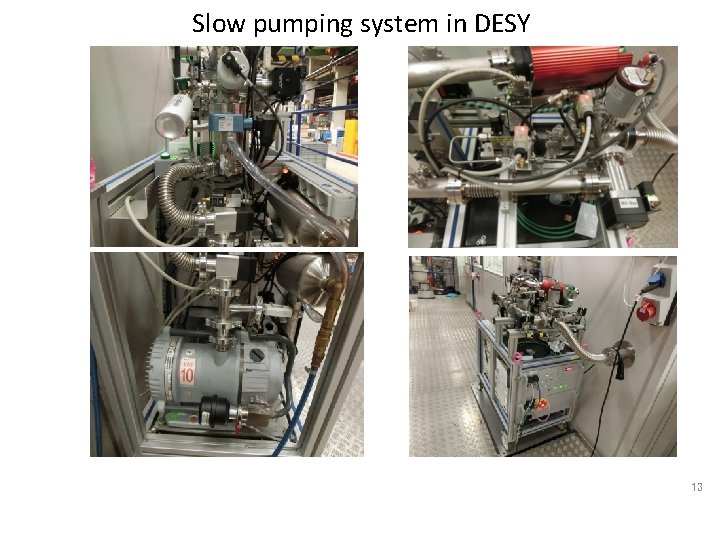
Slow pumping system in DESY 13
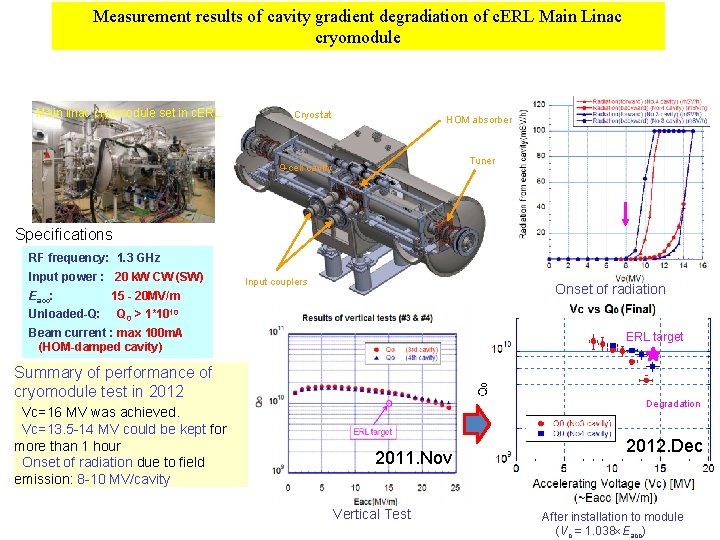
Measurement results of cavity gradient degradiation of c. ERL Main Linac cryomodule Main linac cryomodule set in c. ERL Cryostat HOM absorber Tuner 9 -cell cavity Specifications RF frequency: 1. 3 GHz Input power : 20 k. W CW (SW) Eacc: Unloaded-Q: Input couplers Onset of radiation 15 - 20 MV/m Q 0 > 1*1010 Beam current : max 100 m. A (HOM-damped cavity) ERL target Summary of performance of cryomodule test in 2012 Vc=16 MV was achieved. Vc=13. 5 -14 MV could be kept for more than 1 hour Onset of radiation due to field emission: 8 -10 MV/cavity Degradation 2011. Nov Vertical Test 2012. Dec 14 After installation to module (Vc = 1. 038 Eacc)
- Slides: 14