
Basic Structure of a Cell 1 Warm Up
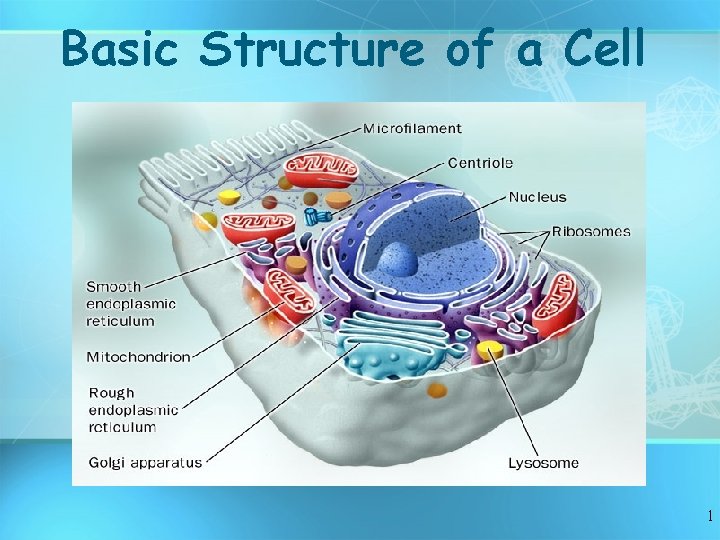
Basic Structure of a Cell 1
Warm Up 2/16/18 Use your textbook to answer the following: • Describe a eukaryote vs. a prokaryote • Compare & contrast plant and animal cells (list an organelle that one has but not the other). Are they prokaryotic or eukaryotic? • What is the function of the nucleus? • What are three theories of the cell theory? 2
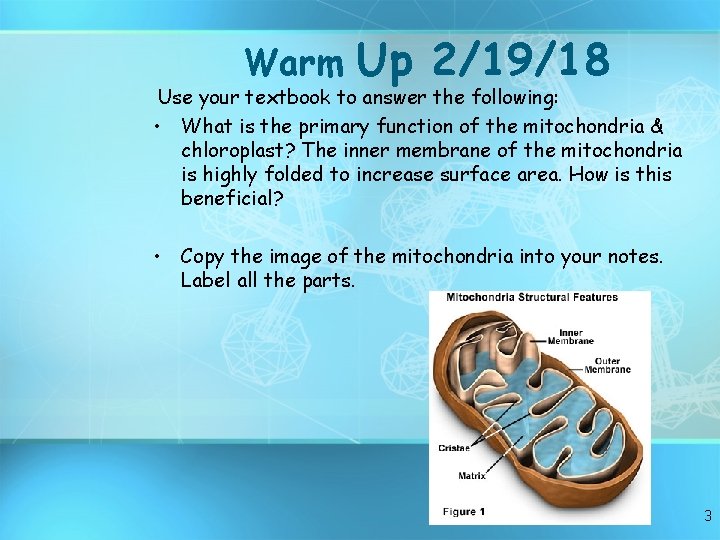
Warm Up 2/19/18 Use your textbook to answer the following: • What is the primary function of the mitochondria & chloroplast? The inner membrane of the mitochondria is highly folded to increase surface area. How is this beneficial? • Copy the image of the mitochondria into your notes. Label all the parts. 3
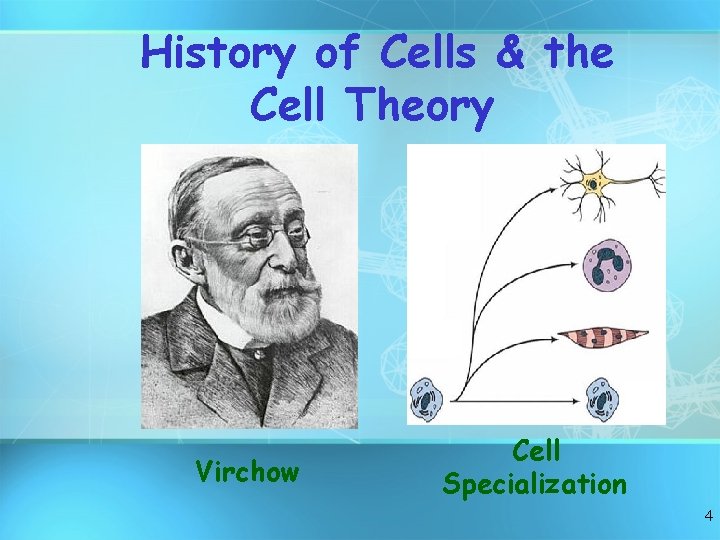
History of Cells & the Cell Theory Virchow Cell Specialization 4
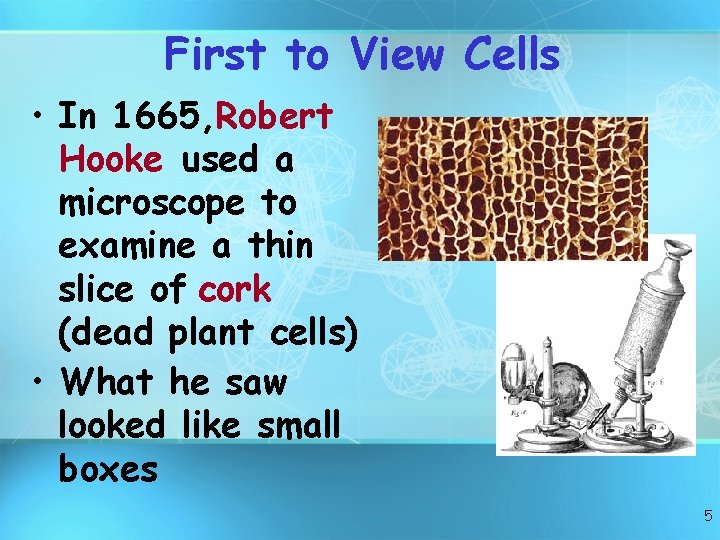
First to View Cells • In 1665, Robert Hooke used a microscope to examine a thin slice of cork (dead plant cells) • What he saw looked like small boxes 5
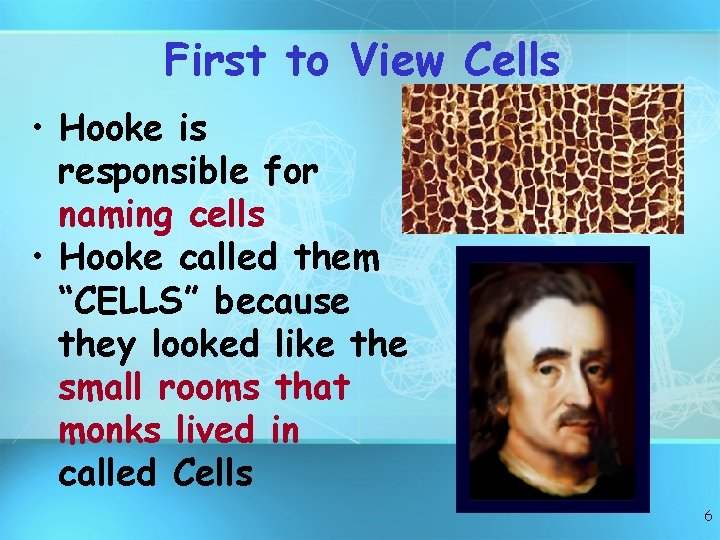
First to View Cells • Hooke is responsible for naming cells • Hooke called them “CELLS” because they looked like the small rooms that monks lived in called Cells 6
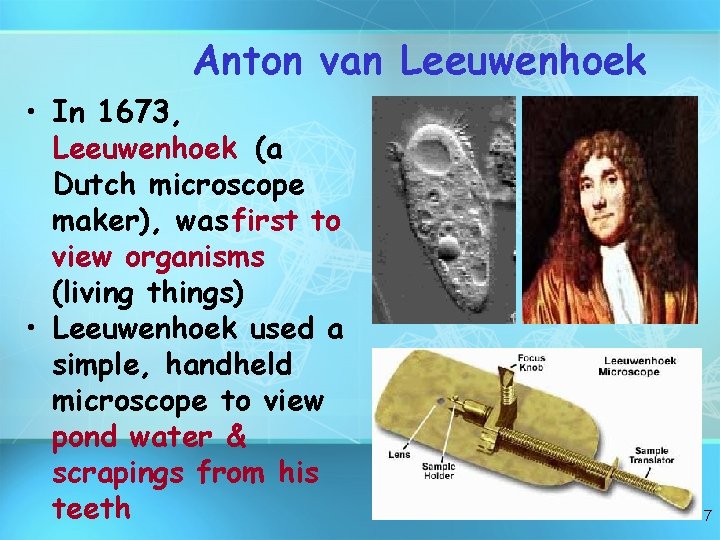
Anton van Leeuwenhoek • In 1673, Leeuwenhoek (a Dutch microscope maker), was first to view organisms (living things) • Leeuwenhoek used a simple, handheld microscope to view pond water & scrapings from his teeth 7
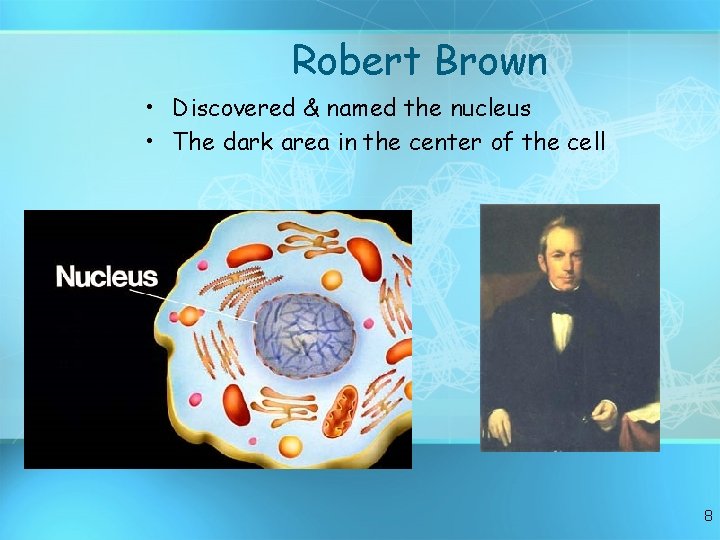
Robert Brown • Discovered & named the nucleus • The dark area in the center of the cell 8
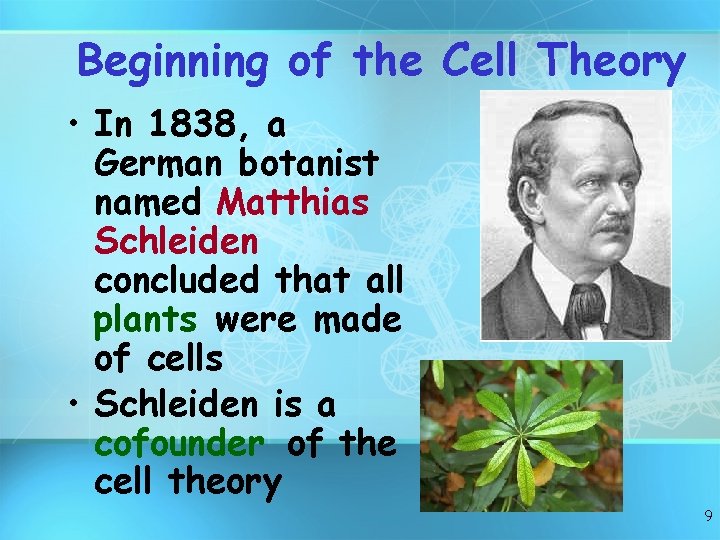
Beginning of the Cell Theory • In 1838, a German botanist named Matthias Schleiden concluded that all plants were made of cells • Schleiden is a cofounder of the cell theory 9
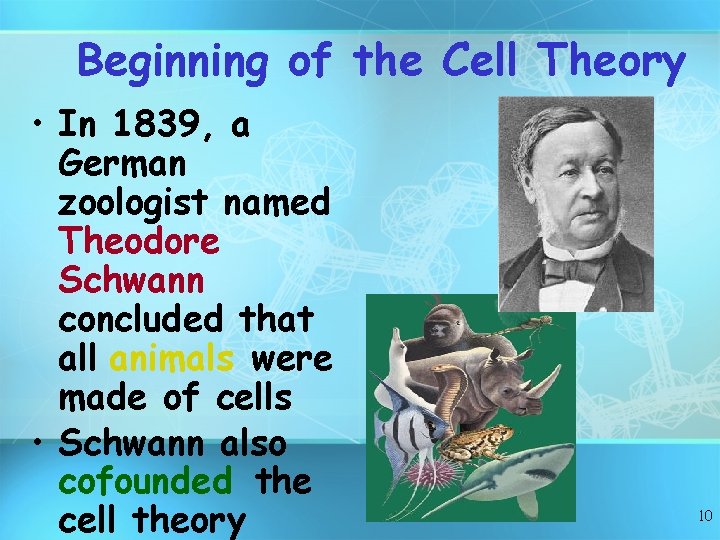
Beginning of the Cell Theory • In 1839, a German zoologist named Theodore Schwann concluded that all animals were made of cells • Schwann also cofounded the cell theory 10
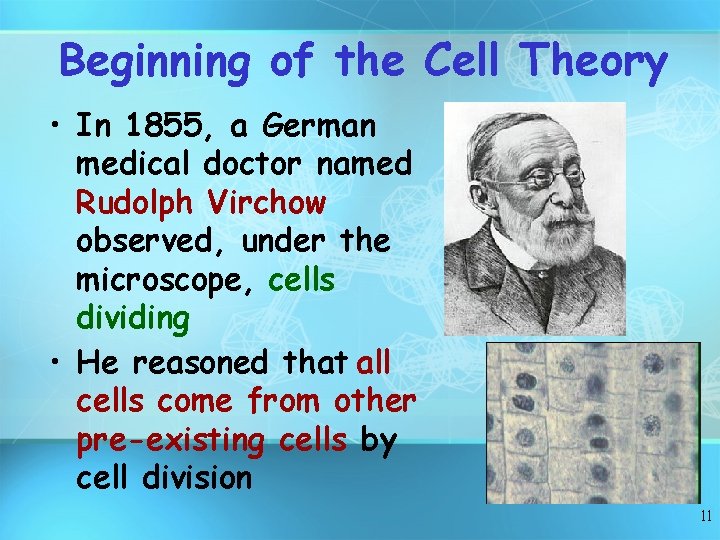
Beginning of the Cell Theory • In 1855, a German medical doctor named Rudolph Virchow observed, under the microscope, cells dividing • He reasoned that all cells come from other pre-existing cells by cell division 11
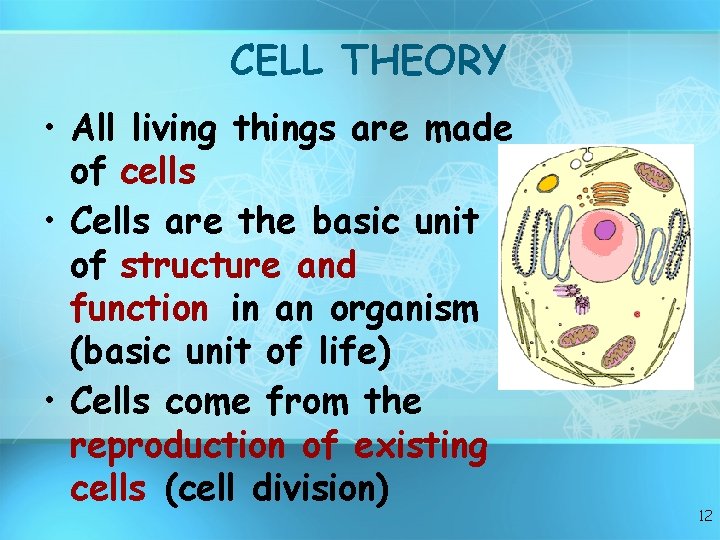
CELL THEORY • All living things are made of cells • Cells are the basic unit of structure and function in an organism (basic unit of life) • Cells come from the reproduction of existing cells (cell division) 12
Cell Size: Surface Area & Volume • As cells get larger, their volume increases at a faster rate than their surface area • Why is this a problem? – Cells depend on their surface area to move needed materials into the cell and waste materials out of the cell – If the surface area decreases, cell cannot move materials fast enough – Therefore, cells must be small to maintain a high surface area to volume ratio 13
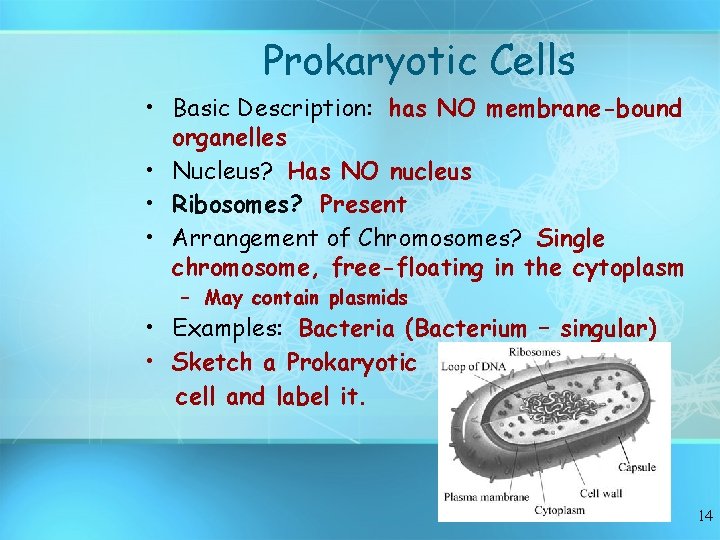
Prokaryotic Cells • Basic Description: has NO membrane-bound organelles • Nucleus? Has NO nucleus • Ribosomes? Present • Arrangement of Chromosomes? Single chromosome, free-floating in the cytoplasm – May contain plasmids • Examples: Bacteria (Bacterium – singular) • Sketch a Prokaryotic cell and label it. 14

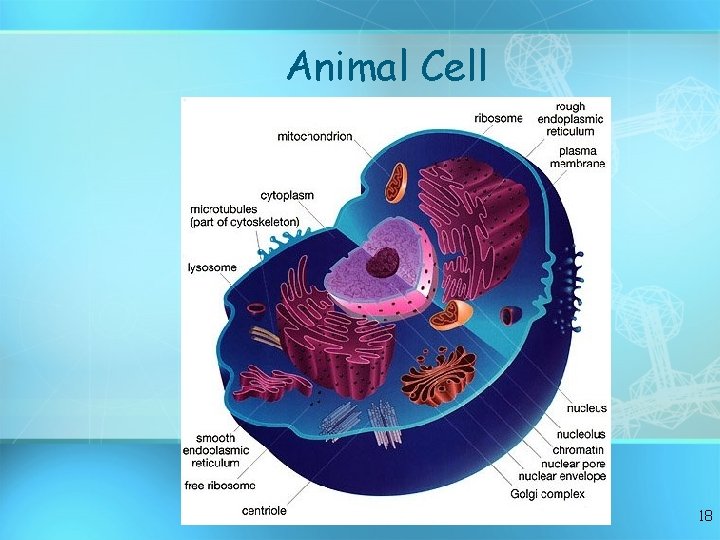
Eukaryotic Cells • Basic Description? Has membrane-bound organelles • Nucleus? Has a true nucleus • Ribosomes? Present – protein factory • Arrangement of Chromosomes? Many linear strands of DNA • Examples? Plants, animals, fungi, & protists (everything except for bacteria) – Sketch and label a basic eukaryotic cell and 15
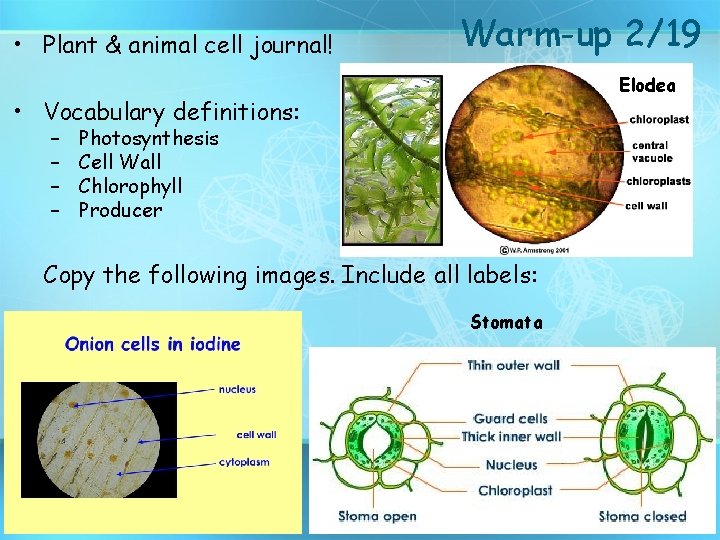
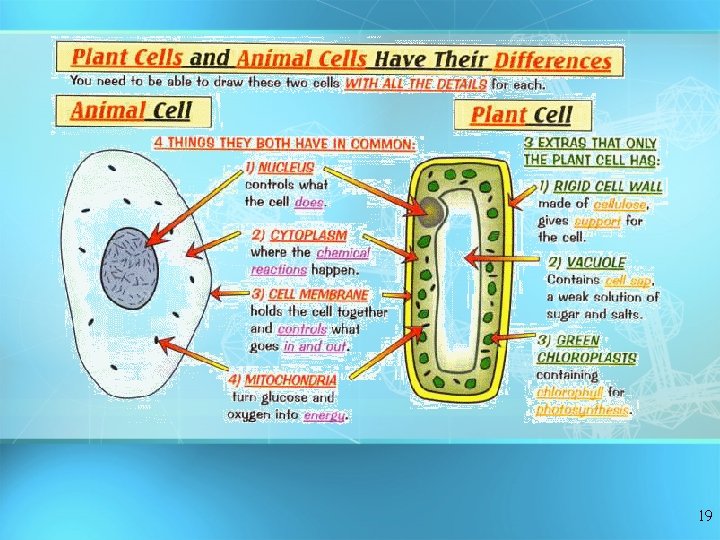
• Plant & animal cell journal! Warm-up 2/19 Elodea • Vocabulary definitions: – – Photosynthesis Cell Wall Chlorophyll Producer Copy the following images. Include all labels: Stomata 16
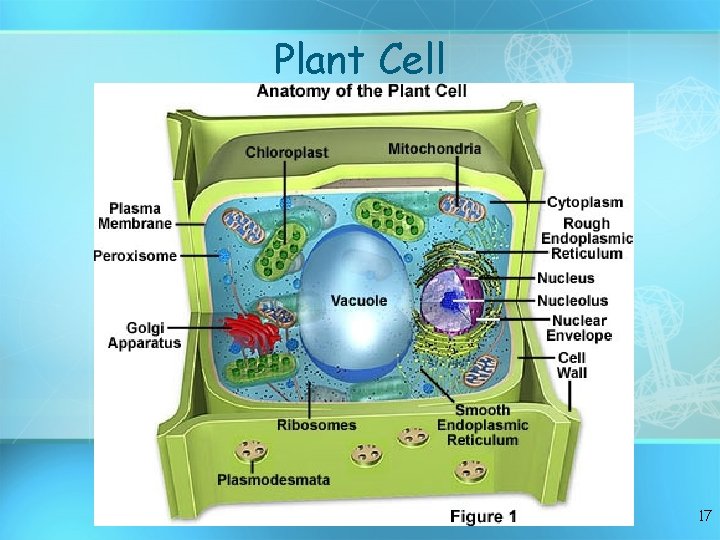
Plant Cell 17
Animal Cell 18
19
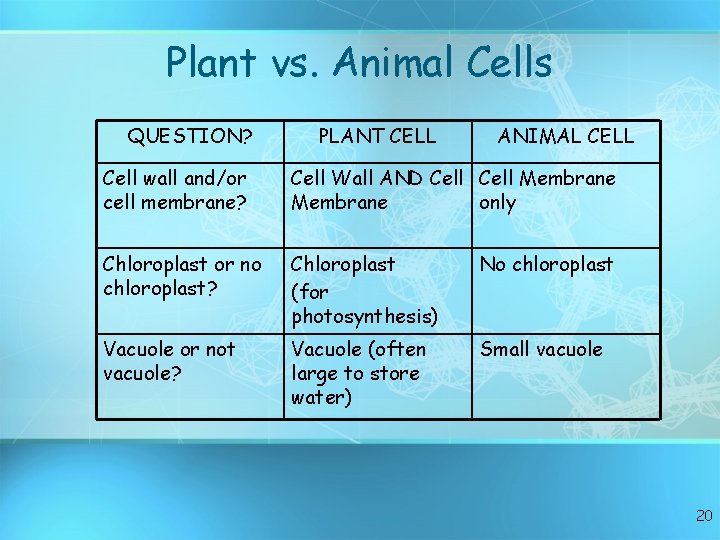
Plant vs. Animal Cells QUESTION? PLANT CELL ANIMAL CELL Cell wall and/or cell membrane? Cell Wall AND Cell Membrane only Chloroplast or no chloroplast? Chloroplast (for photosynthesis) No chloroplast Vacuole or not vacuole? Vacuole (often large to store water) Small vacuole 20
After the Quiz…. Turn to chapter one of your textbook read about the different types of microscopes. Describe the following: Compound Light Microscopes Electron Microscopes. Describe the two different types of electron microscopes. What type of microscope must be used to view LIVING organisms? 21
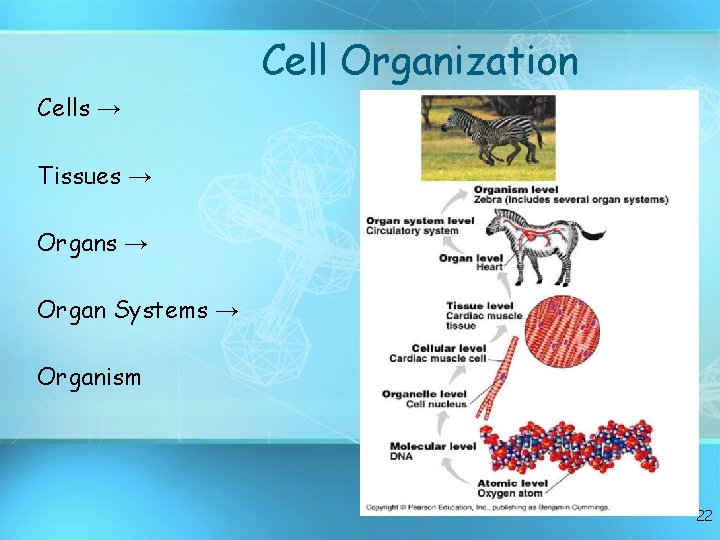
Cell Organization Cells → Tissues → Organ Systems → Organism 22
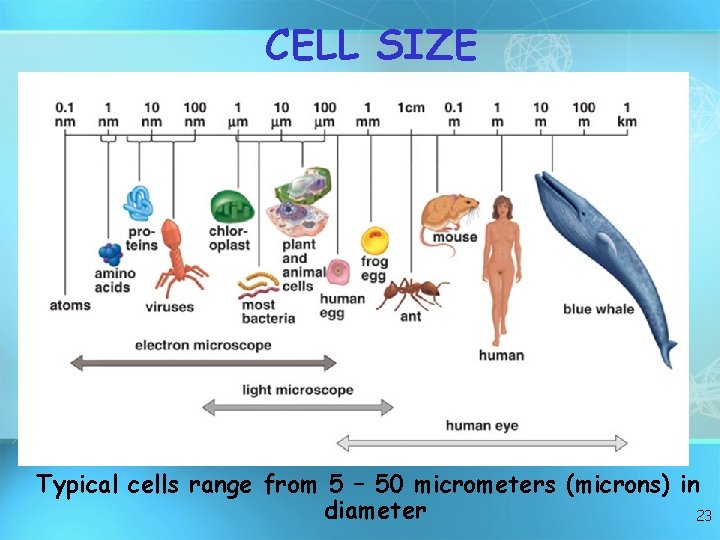
CELL SIZE Typical cells range from 5 – 50 micrometers (microns) in diameter 23
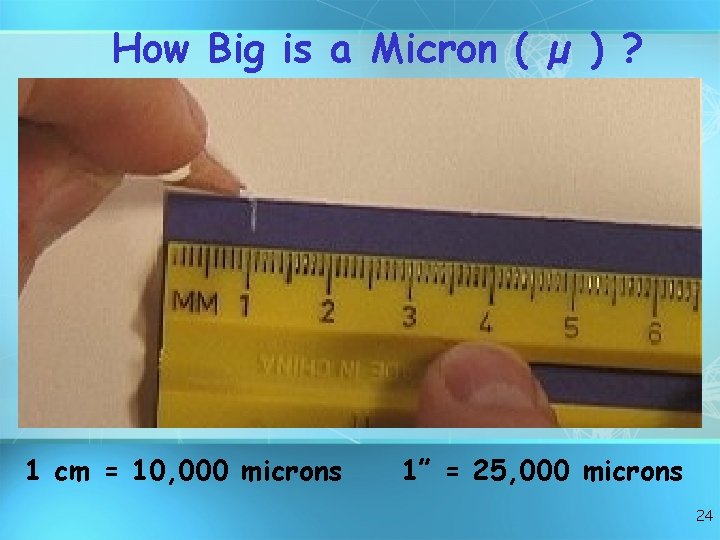
How Big is a Micron ( µ ) ? 1 cm = 10, 000 microns 1” = 25, 000 microns 24
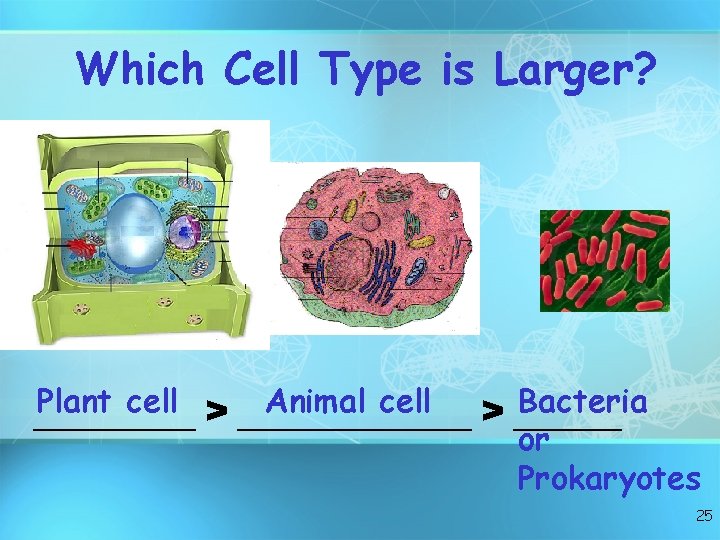
Which Cell Type is Larger? Plant cell > _______ Animal cell Bacteria _____ > ______ or Prokaryotes 25
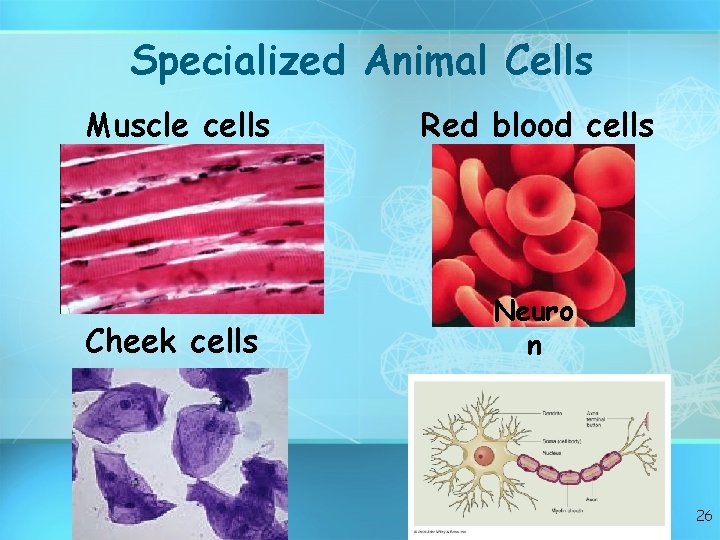
Specialized Animal Cells Muscle cells Red blood cells Cheek cells Neuro n 26
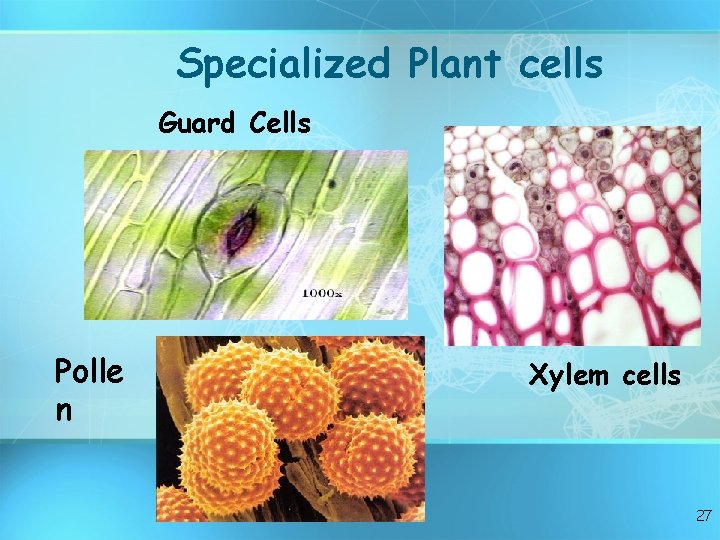
Specialized Plant cells Guard Cells Polle n Xylem cells 27
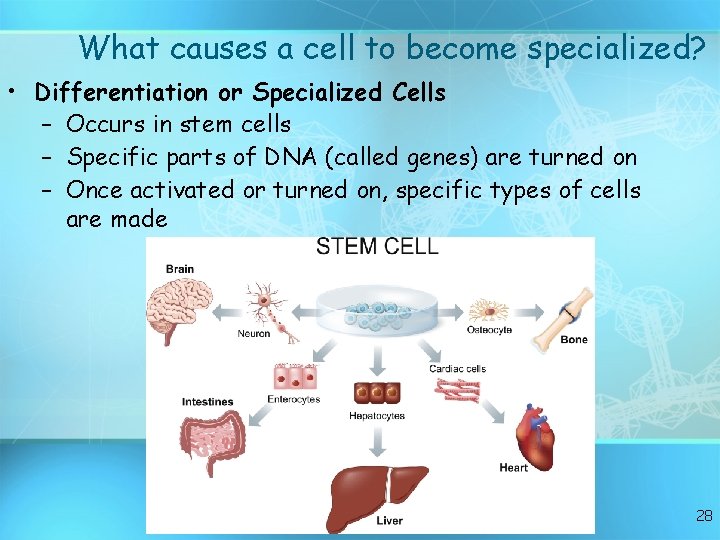
What causes a cell to become specialized? • Differentiation or Specialized Cells – Occurs in stem cells – Specific parts of DNA (called genes) are turned on – Once activated or turned on, specific types of cells are made 28
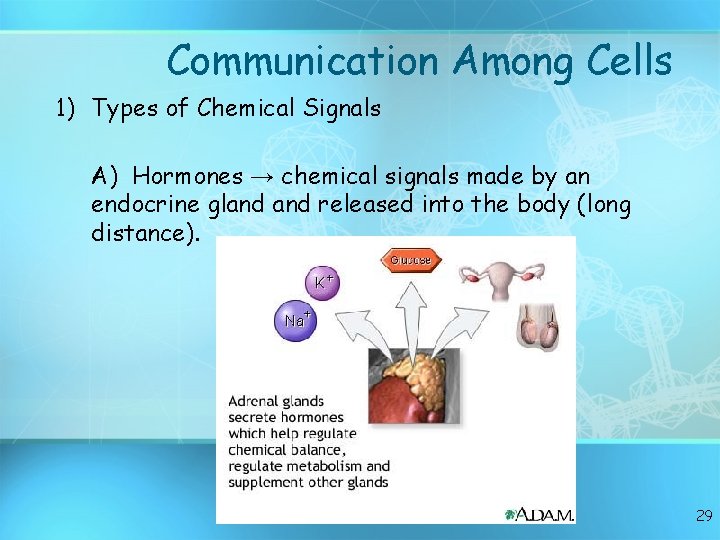
Communication Among Cells 1) Types of Chemical Signals A) Hormones → chemical signals made by an endocrine gland released into the body (long distance). 29
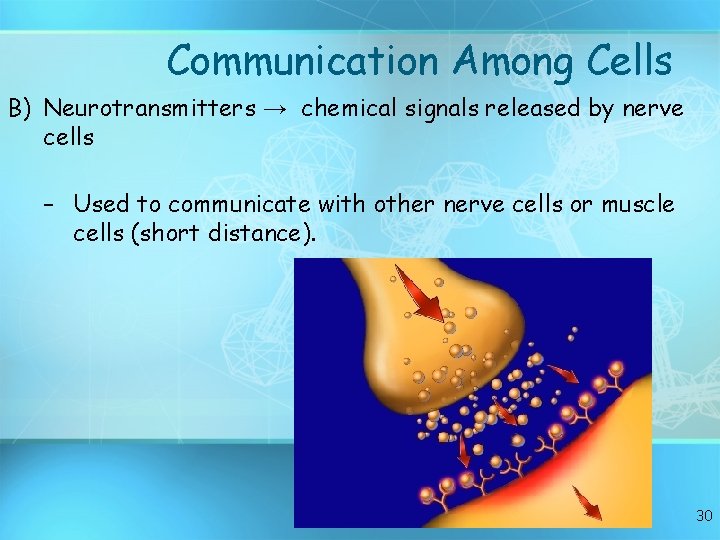
Communication Among Cells B) Neurotransmitters → chemical signals released by nerve cells – Used to communicate with other nerve cells or muscle cells (short distance). 30
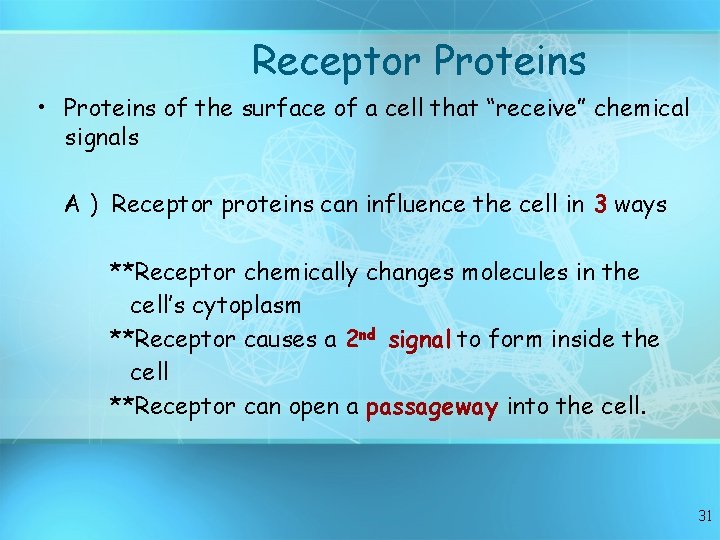
Receptor Proteins • Proteins of the surface of a cell that “receive” chemical signals A ) Receptor proteins can influence the cell in 3 ways **Receptor chemically changes molecules in the cell’s cytoplasm **Receptor causes a 2 nd signal to form inside the cell **Receptor can open a passageway into the cell. 31
- Slides: 31