
Basic statements Programming Language Design and Implementation 4
Basic statements Programming Language Design and Implementation (4 th Edition) by T. Pratt and M. Zelkowitz Prentice Hall, 2001 Section 8. 3. 1 -8. 3. 2
Assignment Basic attribute for imperative languages, although syntax differs: A : = B Pascal, Ada A = B C, FORTRAN, PL/I, Prolog, ML, SNOBOL 4 MOVE B TO A COBOL A B APL (SETQ A B) LISP Note that LISP, an applicative language, has an assignment. Most LISP programmers do not write purely applicative programs. C has multiple ways to assign: A=B, A++, . . . § How many C assignment operations can you identify? 2
Explicit sequence controls Early languages used labels on statements and explicitly determined location of branches (early FORTRAN): IF (A. GT. 7) GOTO 100. . . 100 CONTINUE Explicit control This is the “goto” controversy of the early 1970 s. Languages do not need explicit control and concept is not used or needed even if present. § C includes a break statement for exit out of a loop. It is a limited form of goto, that also has its problems with correctness. 3
Control structures Basic control structures: Programs need 4 basic structures: § A sequencing between statements § A conditional for choosing alternatives § A Loop construct § A function call for calling subroutines. (We consider subprograms elsewhere in this course. ) 4
Sequencing Compound statement: Typical syntax: begin statement 1; statement 2; . . . end; Execute each statement in sequence. Sometimes (e. g. , C) {. . . } used instead of begin. . . end 5
Conditional The if statement is typical: if expression then statement 1 else statement 2 if expression then statement 1 The expression is evaluated and if true, then clause is executed, otherwise the else clause is executed. If there is no else clause, then the next statement is executed. § Since a begin statement is a statement, then or else clause can be an arbitrary number of commands. As with everything else in C, its austere syntax for if is: if (expression) statement 1 else statement 2; 6
Iteration Four iterations are most common: while expression do statement; - Evaluate expression and if true execute statement. Then repeat process. Repeat statement until expression; - Execute statement and then evaluate expression. Quit if expression is now true. For loop - Specify a count of the number of times to execute a loop: § for I=1 to 10 do statement; § for(I=0; I<10; I++) statement; § perform statement 10 times; Indefinite iterations (Ada): loop exit when condition end loop; foreach $X(@arrayitem){statement} – Perl for(var x in arrayitem) statement; - Java 7
Case statement A form of multiway branch (similar to if): case Tag is when 0 => begin statement 0 end; when 1 => begin statement 1 end; when 2 => begin statement 2 end; when others => begin statement 3 end; end case 8
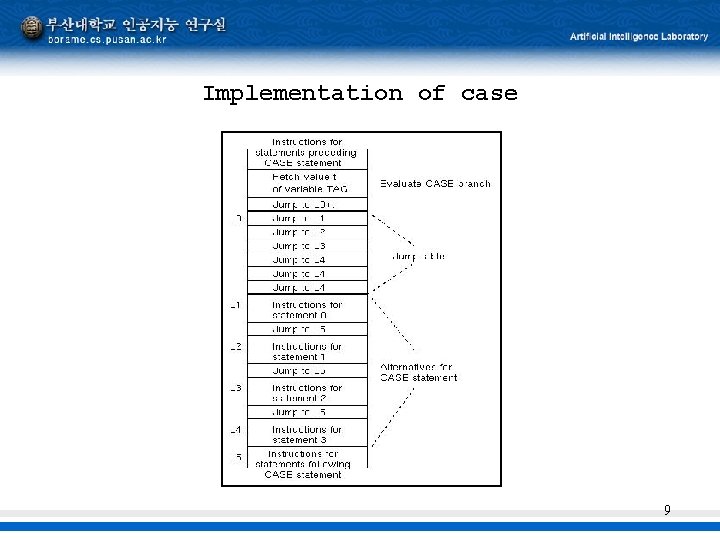
Implementation of case 9
- Slides: 9