
Basic Spine Fractures Naftaly Attias MD Orthopedic Department
Basic Spine Fractures Naftaly Attias, MD Orthopedic Department St Josephs HMC –Phoenix, AZ
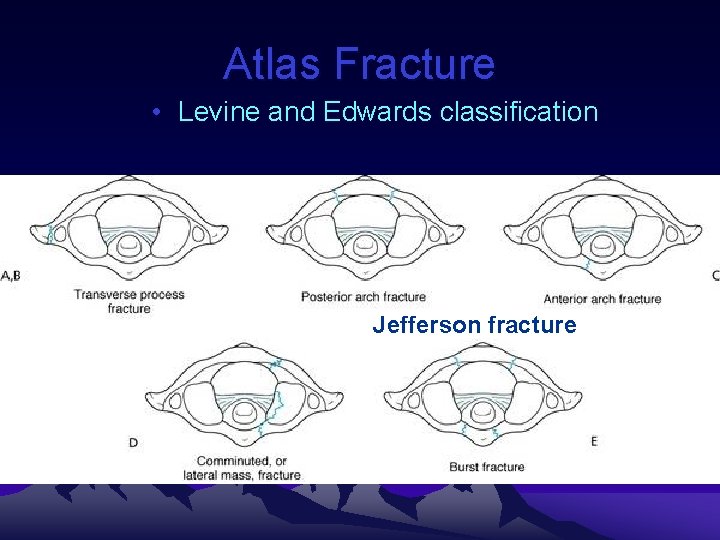
Atlas Fracture • Levine and Edwards classification Jefferson fracture

Atlas Fracture • 43% of C-1 Fx associated with a C-2 fracture • Complete transverse ligament insufficiency has to be assumed if the combined overhang of the C-1 lateral masses relative to the lateral mass walls of C-2 amounts to 7 mm or more • Halo traction is effective in reducing the spreading of the lateral masses • This reduction is not maintained in a halo vest

Dense Fracture • Anderson & D'Alonzo Classification • Type I - avulsion fracture of the tip of the odontoid. It may imply a more extensive craniocervical ligamentous disruption • Type II - located at the waist of the odontoid • Type III - extend into the body of the axis

Dense Fracture • Risks factor for Non-Union • Type II injury with > 5 mm displacement initially • Can't be reduce in traction < 2 -3 mm • Can't be maintained in a halo • Elderly patient? ?

Dense Fracture
![Traumatic Spondylolisthesis of the Axis [hangman's fracture] • Effendi Classification (modified by Levine) •](http://slidetodoc.com/presentation_image/24b853f13afd6ee6b14e818a061803d5/image-7.jpg "Traumatic Spondylolisthesis of the Axis [hangman's fracture] • Effendi Classification (modified by Levine) •")
Traumatic Spondylolisthesis of the Axis [hangman's fracture] • Effendi Classification (modified by Levine) • A: Type I, nondisplaced fracture of the pars interarticularis ⇒ collar • B: Type II, displaced fracture of the pars ⇒ Traction - Halo • C: Type IIa, displaced fracture of the pars with disruption of the C 2– 3 discoligamentous complex ⇒NO Distraction - Halo • D: Type III, dislocation of C 2– 3 facets joints with fractured pars ⇒ NO Traction - ORIF
![Traumatic Spondylolisthesis of the Axis [hangman's fracture] Type IIA](http://slidetodoc.com/presentation_image/24b853f13afd6ee6b14e818a061803d5/image-8.jpg "Traumatic Spondylolisthesis of the Axis [hangman's fracture] Type IIA")
Traumatic Spondylolisthesis of the Axis [hangman's fracture] Type IIA
![Traumatic Spondylolisthesis of the Axis [hangman's fracture]](http://slidetodoc.com/presentation_image/24b853f13afd6ee6b14e818a061803d5/image-9.jpg "Traumatic Spondylolisthesis of the Axis [hangman's fracture]")
Traumatic Spondylolisthesis of the Axis [hangman's fracture]

Cervical Fractures Burst • Pure axial loading injuries • Cause neurologic injury • Usually need operative treatment if unstable or cause neuro deficit
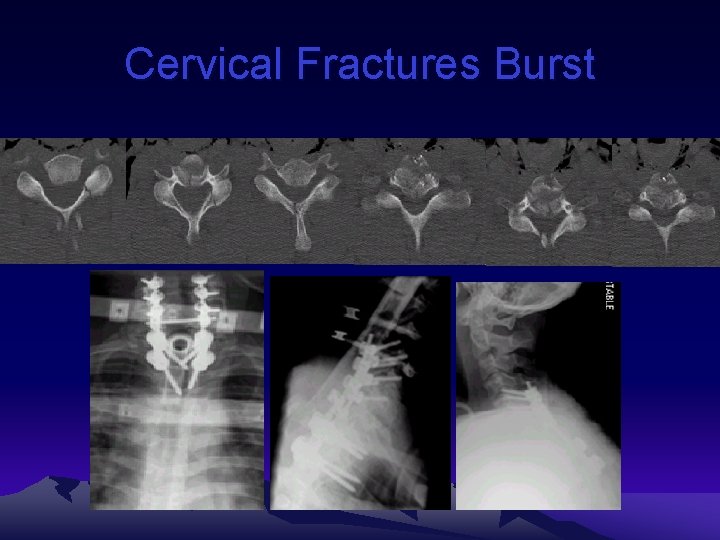
Cervical Fractures Burst

Cervical Fractures – Unilateral Facet dislocation • Caused by flexion & axial rotation - coupled motion ⇒ requires both to dislocate • The facet is intact • Once reduced (if can be reduced) - stable injury • Unilateral facet fracture also a flexion rotation injury. But even if reduced ⇒ still residual rotational instability = different treatment

Cervical Fractures – Bilateral Facet dislocation • High rate of neuro deficit • Close reduction in traction • MRI : 1. if during an awake reduction demonstrates paresthesias 2. any deterioration of neuro status 3. difficulty or failure in achieving an awake closed reduction necessitating a reduction under anesthesia
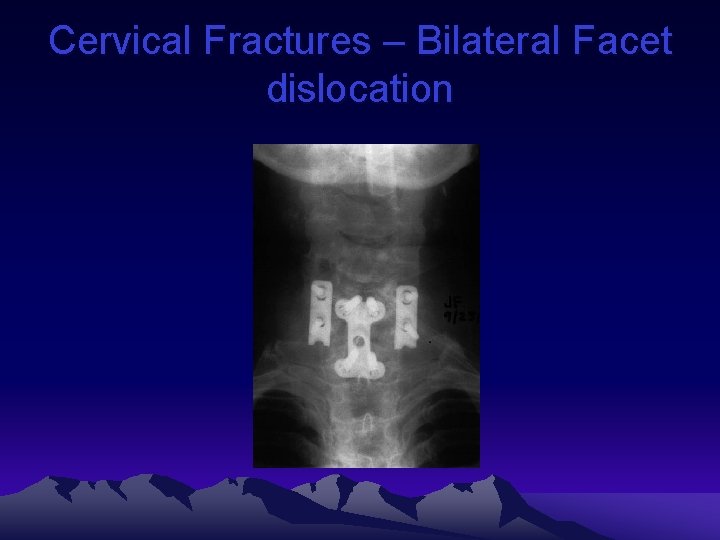
Cervical Fractures – Bilateral Facet dislocation
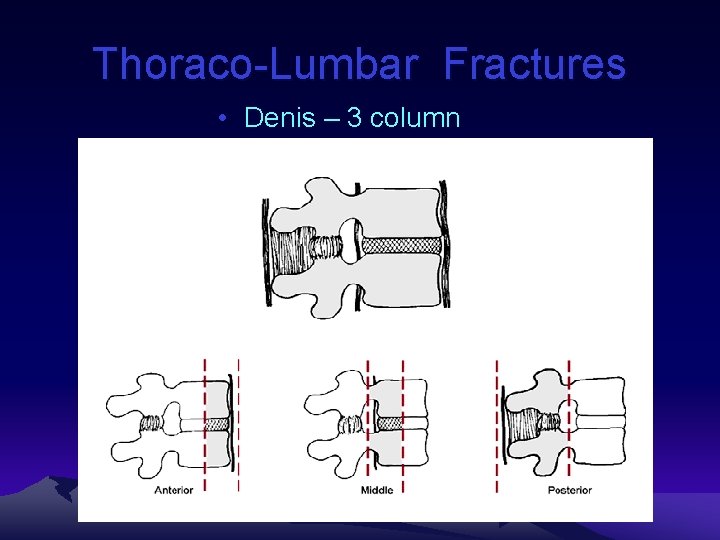
Thoraco-Lumbar Fractures • Denis – 3 column

Thoraco-Lumbar Fractures • Denis - Compression
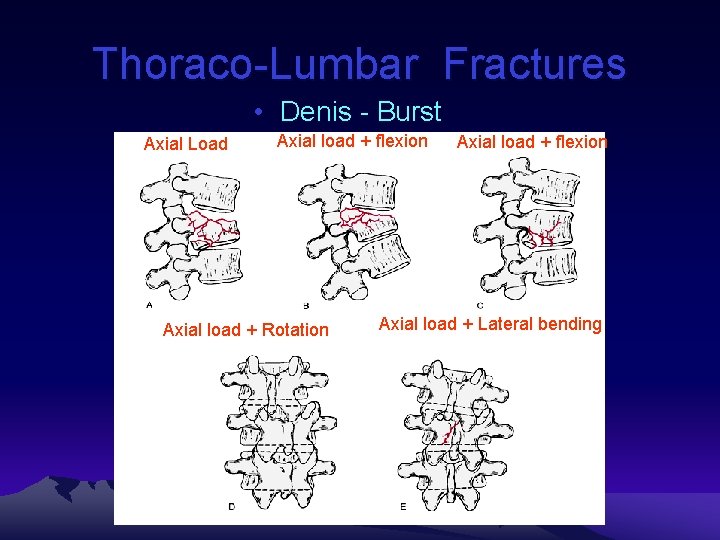
Thoraco-Lumbar Fractures • Denis - Burst Axial Load Axial load + flexion Axial load + Rotation Axial load + flexion Axial load + Lateral bending
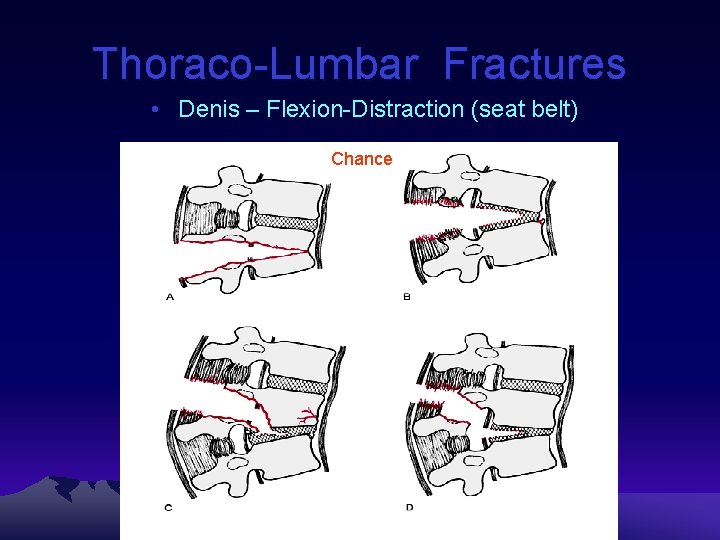
Thoraco-Lumbar Fractures • Denis – Flexion-Distraction (seat belt) Chance
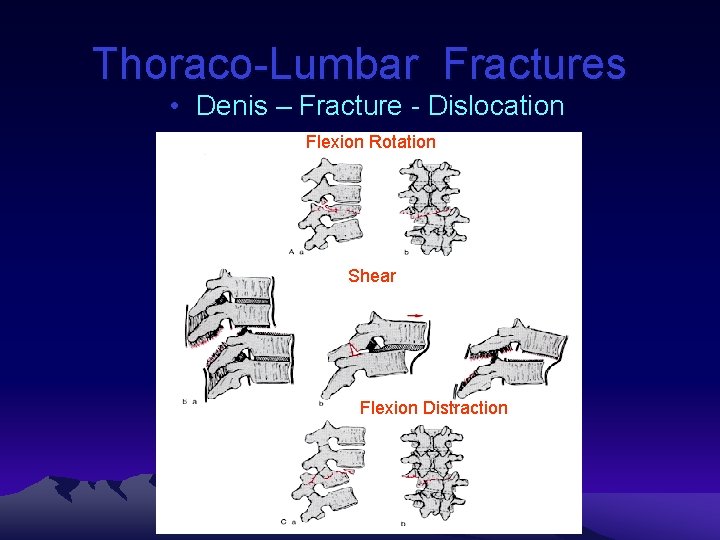
Thoraco-Lumbar Fractures • Denis – Fracture - Dislocation Flexion Rotation Shear Flexion Distraction
Thoraco-Lumbar Fractures • The goals of treatment operative or otherwise: 1. Protect neural elements, restore/maintain neurological function 2. Prevent or correct segmental collapse and deformity 3. Prevent spinal instability and pain 4. Permit early ambulation and return to function 5. Restore normal spinal mechanics
Thoraco-Lumbar Fractures • 1. 2. 3. 4. 5. 6. Unstable injuries include all those with any of the following: Three-column disruption (Two ? ? ? ) Greater than 50% collapse of anterior cortex Greater than 20 -25° of focal kyphosis Any extent of neurologic deficit Patients with extensive associated injuries Greater than 50% canal compromise at L-1 and 80% compromise at L-5.
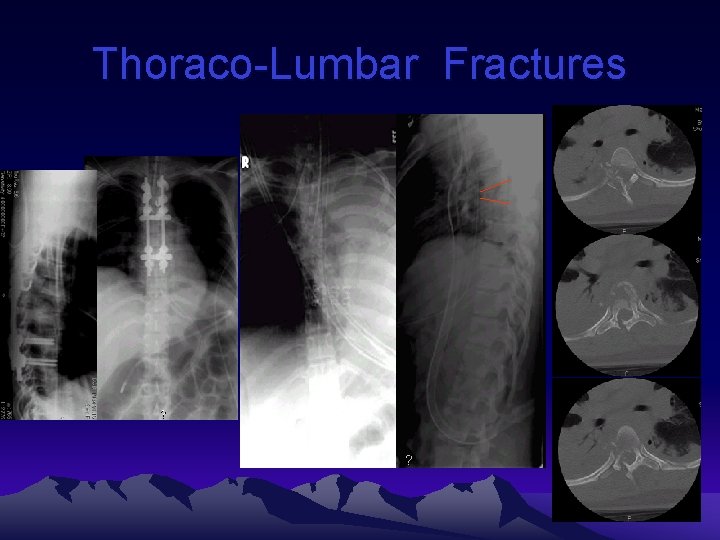
Thoraco-Lumbar Fractures
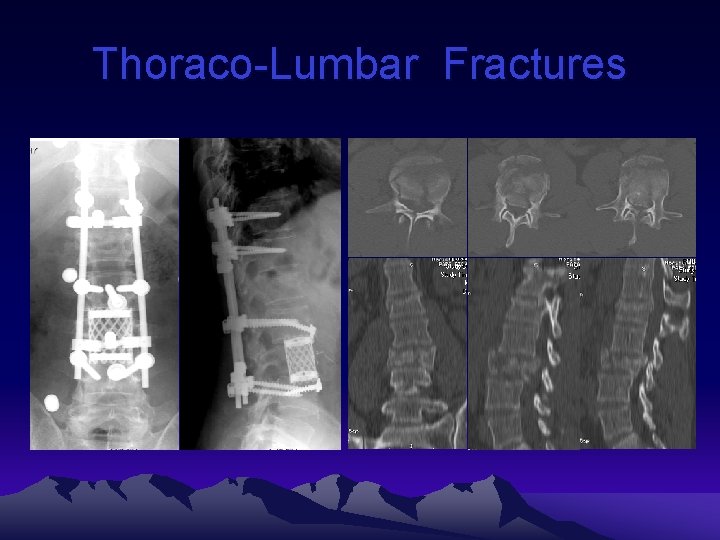
Thoraco-Lumbar Fractures
Thank You
SWOTA : 2010 Resident Course - Fundamentals of Fracture Care Basic Spine Fractures Helpfulness of Material A) Worst B) Bad C) OK D) Good COMMENTS Please E) Best
SWOTA : 2010 Resident Course - Fundamentals of Fracture Care Basic Spine Fractures Quality of Presentation A) Worst B) Bad C) OK D) Good COMMENTS Please E) Best
- Slides: 26