
Basic Soils Training Soil Morphology Nathan Jones MLRA
Basic Soils Training Soil Morphology Nathan Jones MLRA Soil Survey Leader Andy Oxford Soil Scientist January 2013
Objectives • • • Soil Horizons Soil Color Soil Texture Soil Structure Soil Rupture Resistance Soil Roots and Pores Soil Restrictive Layers Soil Boundaries Soil p. H
SOIL MORPHOLOGY - a definition • Characteristics and properties of the soil observable in the field within the various soil horizons • The description of the kind arrangement of soil horizons
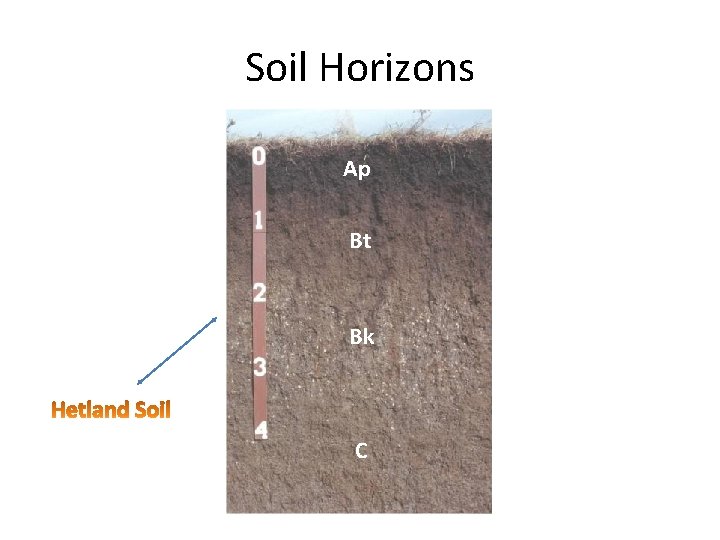
Soil Horizons Ap Bt Bk C
Soil Horizons “Horizon”: A layer of soil or soil material approximately parallel to the land surface and differing from adjacent related layers in physical, chemical, and biological properties or characteristics such as color, structure, texture, consistence, or p. H “Profile”: sequence of horizons stacked vertically that tells the story of how the soil formed “Series”: name given to profile that has characteristic set of properties and horizons (determined by NRCS)
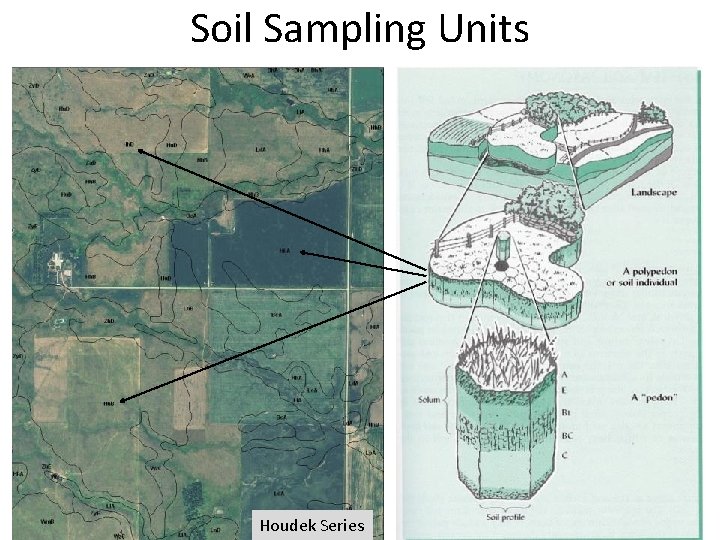
Soil Sampling Units Houdek Series
Soil Horizon Development • A-Horizon development – Accumulation of organic matter – Clumping of individual soil particles – Distinct from parent material and other layers • B and C horizon development – Carbonic and organic acids are carried by water into soil where they dissolve various minerals (transformations) – Clay films - thin layers of oriented trans-located clay – Salts and carbonates are carried by water and precipitate in the soil from upper to lower horizons (translocation) – Wetting and drying cracks soils and creates soil structure – Weathering of parent material
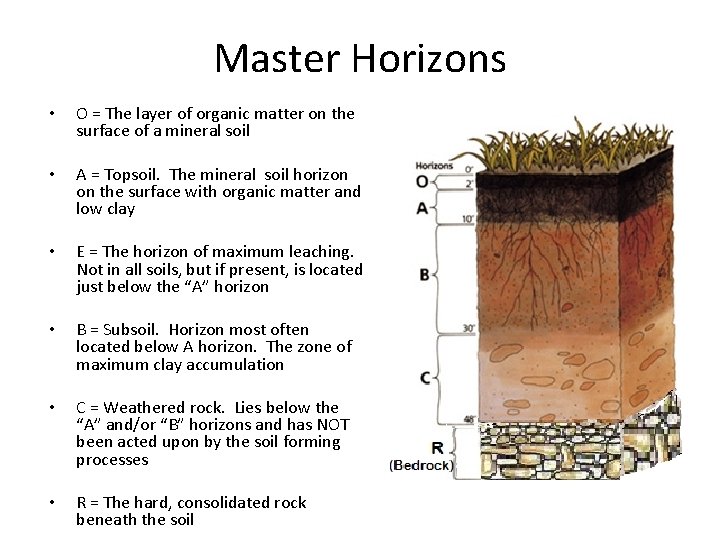
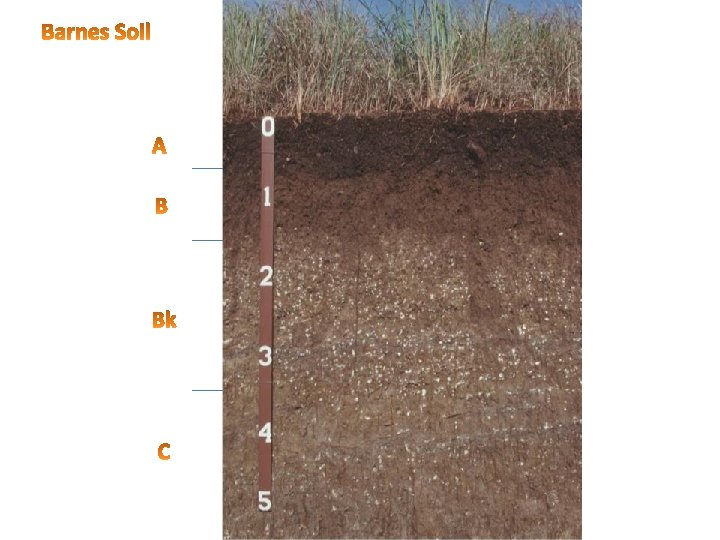
Master Horizons • O = The layer of organic matter on the surface of a mineral soil • A = Topsoil. The mineral soil horizon on the surface with organic matter and low clay • E = The horizon of maximum leaching. Not in all soils, but if present, is located just below the “A” horizon • B = Subsoil. Horizon most often located below A horizon. The zone of maximum clay accumulation • C = Weathered rock. Lies below the “A” and/or “B” horizons and has NOT been acted upon by the soil forming processes • R = The hard, consolidated rock beneath the soil
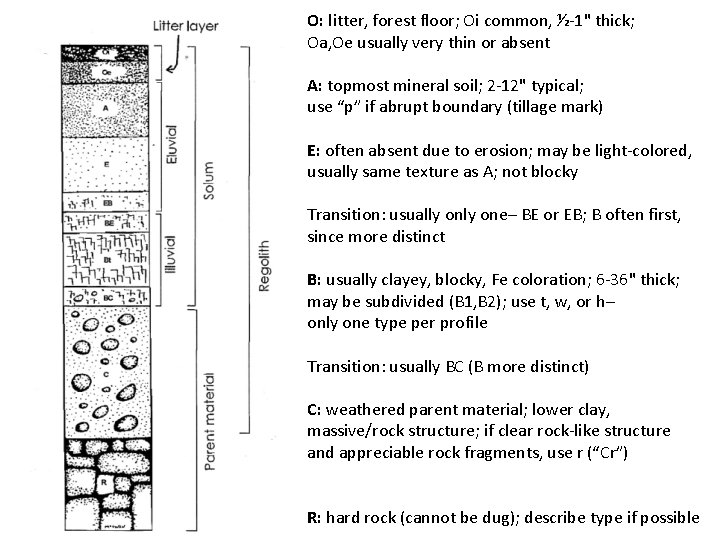
O: litter, forest floor; Oi common, ½-1" thick; Oa, Oe usually very thin or absent A: topmost mineral soil; 2 -12" typical; use “p” if abrupt boundary (tillage mark) E: often absent due to erosion; may be light-colored, usually same texture as A; not blocky Transition: usually one– BE or EB; B often first, since more distinct B: usually clayey, blocky, Fe coloration; 6 -36" thick; may be subdivided (B 1, B 2); use t, w, or h– only one type per profile Transition: usually BC (B more distinct) C: weathered parent material; lower clay, massive/rock structure; if clear rock-like structure and appreciable rock fragments, use r (“Cr”) R: hard rock (cannot be dug); describe type if possible
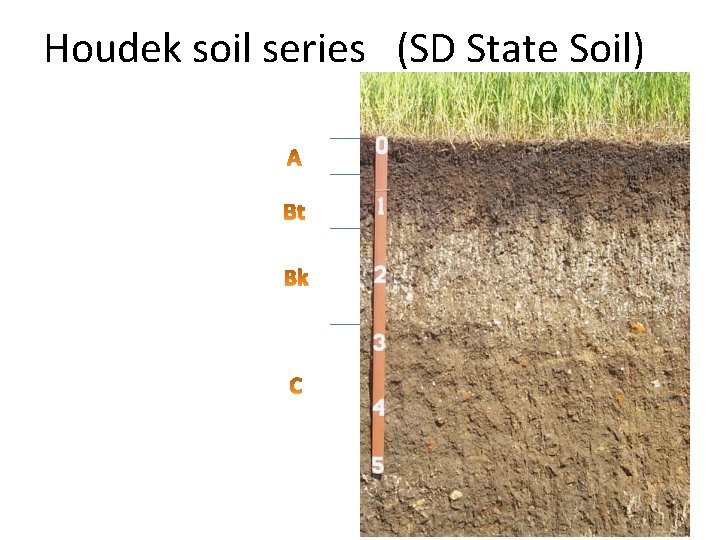
Houdek soil series (SD State Soil)
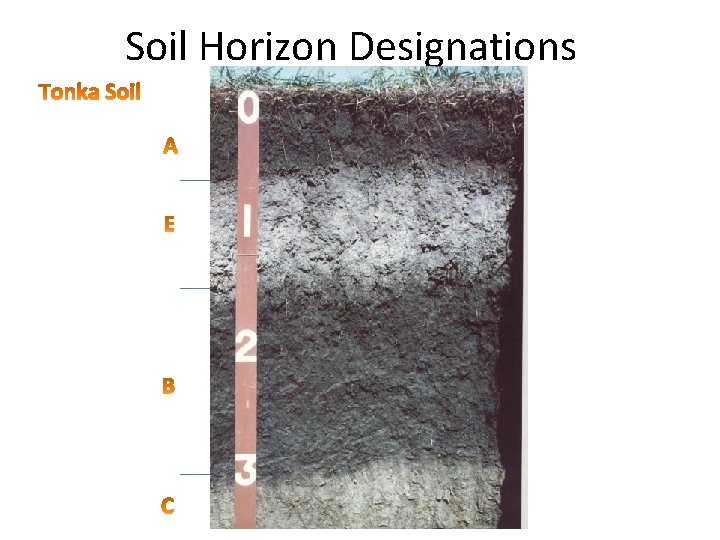
Soil Horizon Designations
Soil Properties Physical: particle size/arrangement; porosity Chemical: effect on plant growth Biological: determine long-term behavior (“sustainability”)
Physical Soil Properties • • • Color Texture Structure Consistency Roots and Pores Restrictive Layers
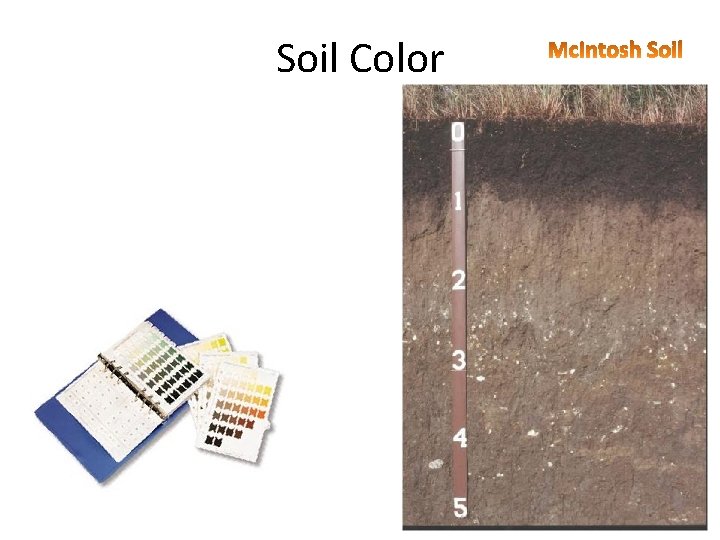
Soil Color
Soil Color • Probably the most obvious soil feature • Munsell system color charts used to standardize colors • Hue = the dominant spectral color (related to wavelength of light) • Value = measure of degree of lightness or darkness (amount of light reflected)
More Soil Color • Chroma = measure of purity or strength of spectral color • Dominant (matrix) color = the color that occupies the greatest volume • Mottling refers to repetitive color changes that cannot be associated to a soil property. Redoximorphic (redox) features are a type of mottling associated with wetness
Soil Color: Pigments in Soils • Dark brown to black: humus/organic matter gives soil this color; topsoils (A horizon) • Reds and yellows: iron oxide, subsoil horizons (B horizons) either red, yellow, oxidized (Fe+3) iron well-oxidized (welldrained) • Grey: reduced (Fe+2) iron; water doesn't drain out, poor drainage; Fe is reduced, depleted • Whitish or light grey: leached out horizons; other pigments (humus, iron oxides) have been leached away Munsell system: soil colors matched to color chips in book– standardized way to describe soil color
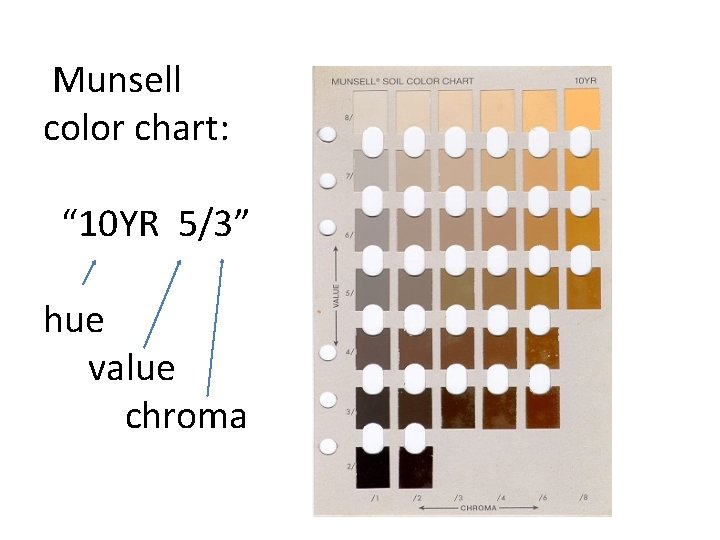
Munsell color chart: “ 10 YR 5/3” hue value chroma
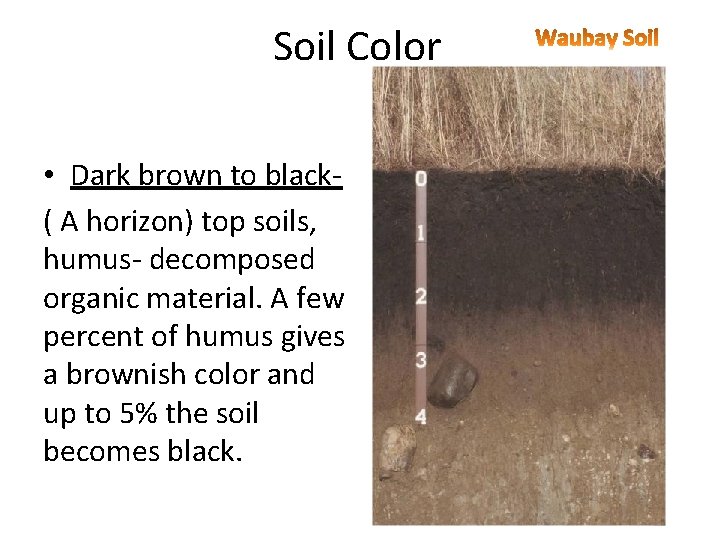
Soil Color • Dark brown to black- ( A horizon) top soils, humus- decomposed organic material. A few percent of humus gives a brownish color and up to 5% the soil becomes black.
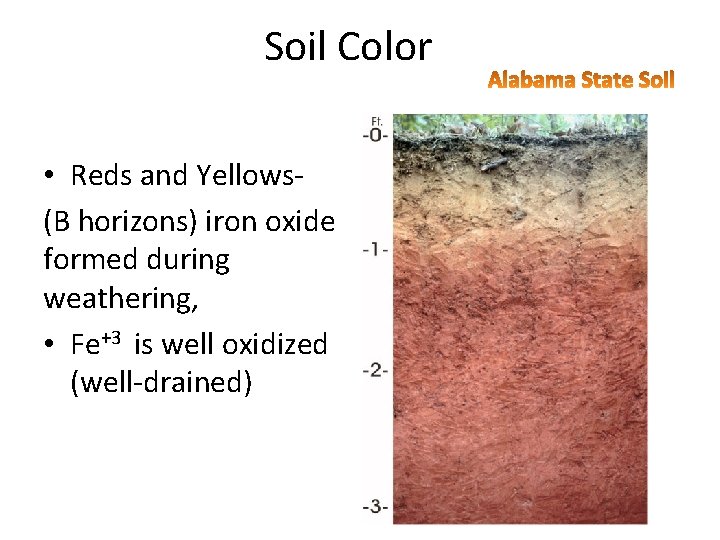
Soil Color • Reds and Yellows- (B horizons) iron oxide formed during weathering, • Fe+3 is well oxidized (well-drained)
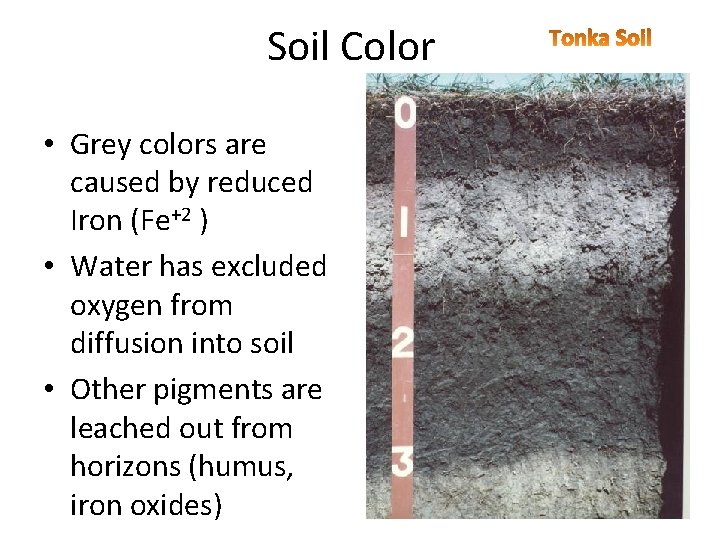
Soil Color • Grey colors are caused by reduced Iron (Fe+2 ) • Water has excluded oxygen from diffusion into soil • Other pigments are leached out from horizons (humus, iron oxides)
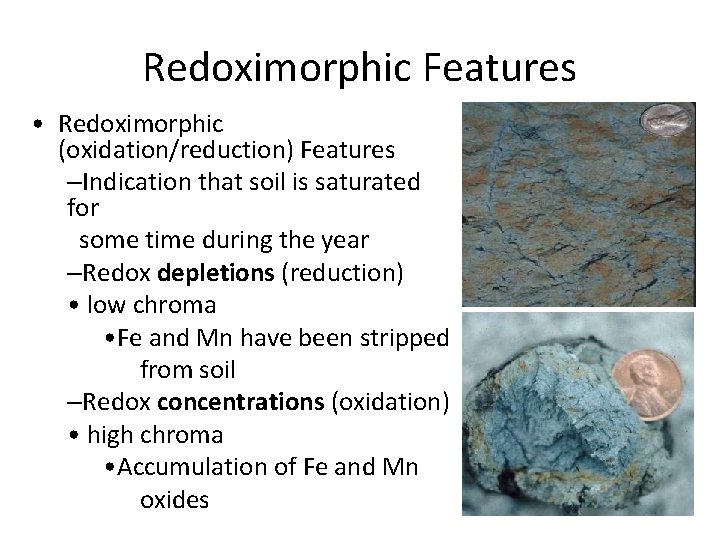
Redoximorphic Features • Redoximorphic (oxidation/reduction) Features –Indication that soil is saturated for some time during the year –Redox depletions (reduction) • low chroma • Fe and Mn have been stripped from soil –Redox concentrations (oxidation) • high chroma • Accumulation of Fe and Mn oxides
Soil Morphology Exercise 1 • Color soil samples with a Munsell color book
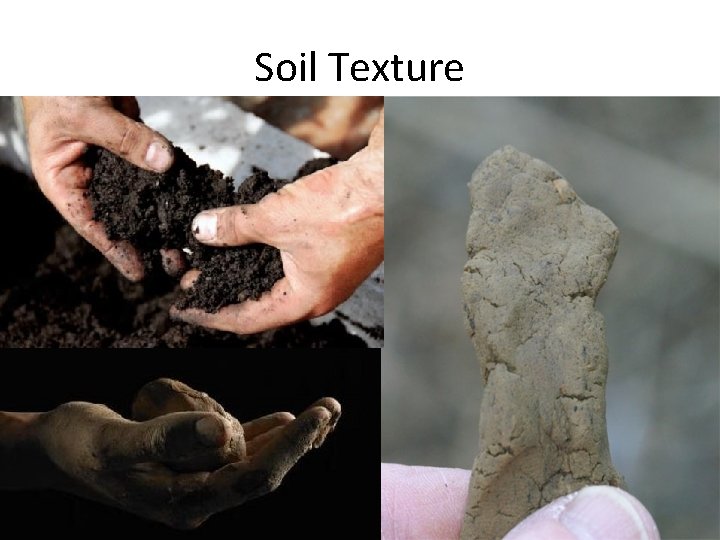
Soil Texture
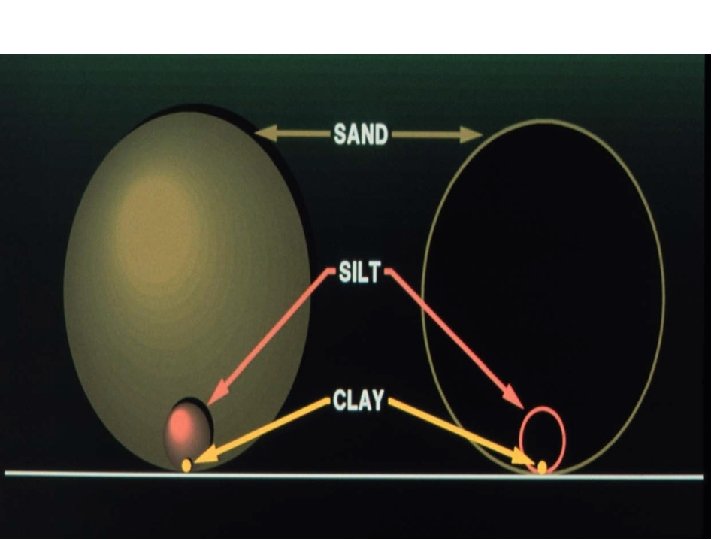
Soil Texture • Definition (USDA ) - the weight proportion of the soil separates less than 2. 0 mm in size (sand, silt, and clay). Or, more commonly, the relative proportions of sand, silt, and clay • Sand = 2. 0 to 0. 05 mm • Silt = 0. 05 to 0. 002 mm • Clay = < 0. 002 mm • Sand, silt, and clay in various proportions make up 12 textural classes
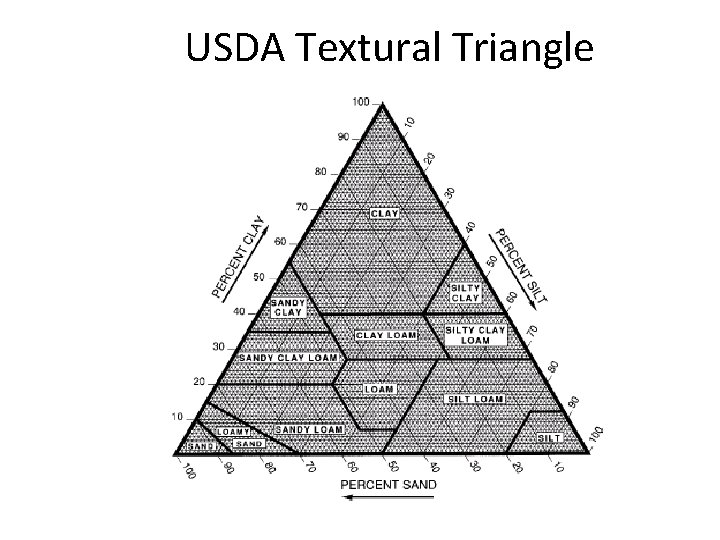
USDA Textural Triangle
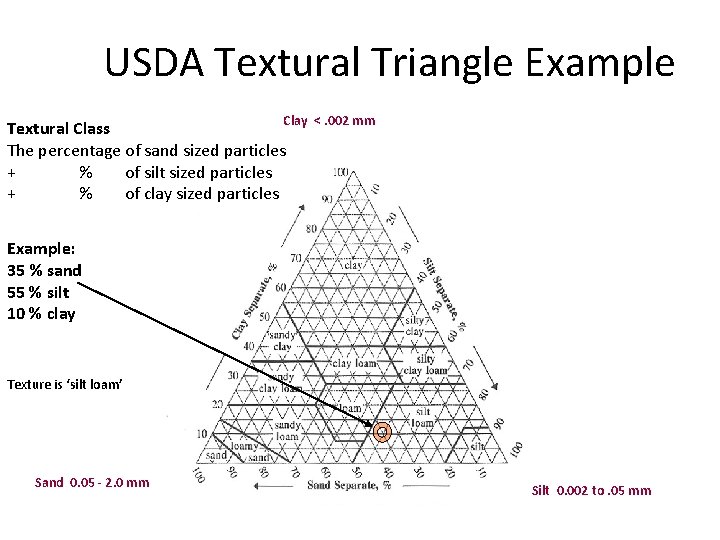
USDA Textural Triangle Example Clay <. 002 mm Textural Class The percentage of sand sized particles + % of silt sized particles + % of clay sized particles Example: 35 % sand 55 % silt 10 % clay Texture is ‘silt loam’ Sand 0. 05 - 2. 0 mm Silt 0. 002 to. 05 mm
Coarse Fragments • Mineral particles larger than 2. 0 mm = rock fragments (gravels, stones, or boulders) • Modifiers = 0 - 15%, 15 - 35%, 35 - 60%, 6090%, > 90%
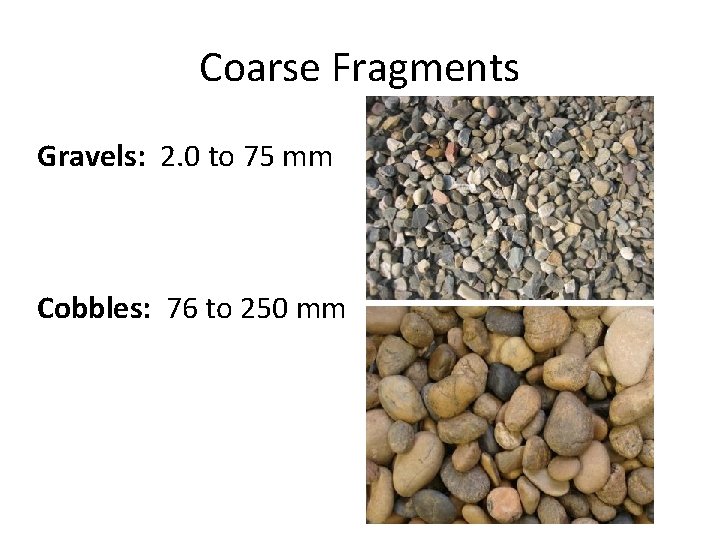
Coarse Fragments Gravels: 2. 0 to 75 mm Cobbles: 76 to 250 mm
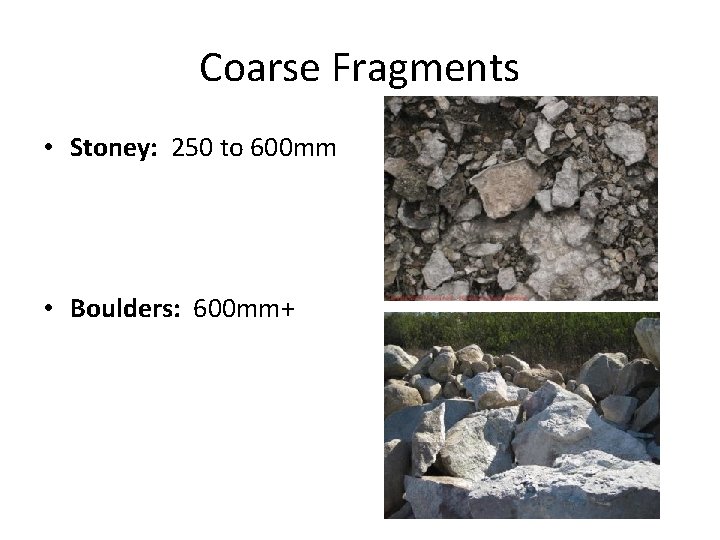
Coarse Fragments • Stoney: 250 to 600 mm • Boulders: 600 mm+
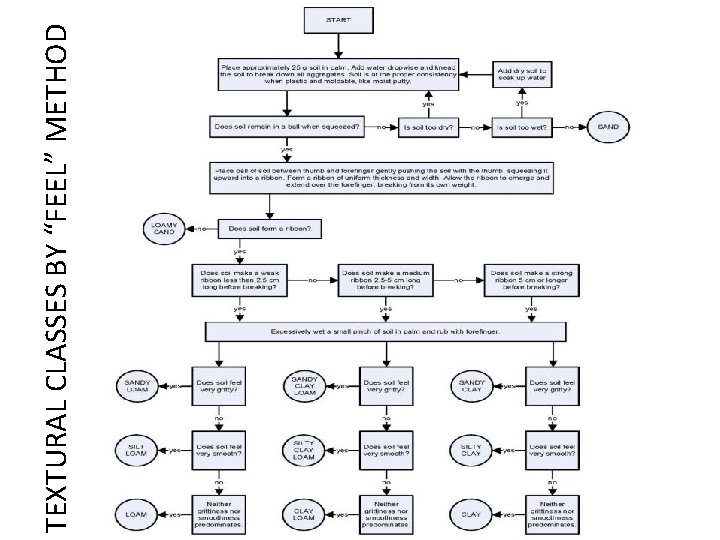
TEXTURAL CLASSES BY “FEEL” METHOD
Soil Morphology Exercise 2 • Texture by “feel” method
Soil Structure
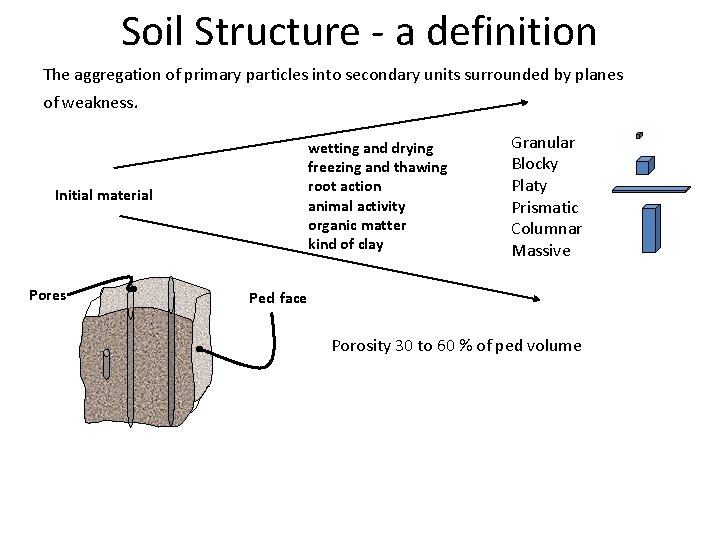
Soil Structure - a definition The aggregation of primary particles into secondary units surrounded by planes of weakness. wetting and drying freezing and thawing root action animal activity organic matter kind of clay Initial material Pores Granular Blocky Platy Prismatic Columnar Massive Ped face Porosity 30 to 60 % of ped volume
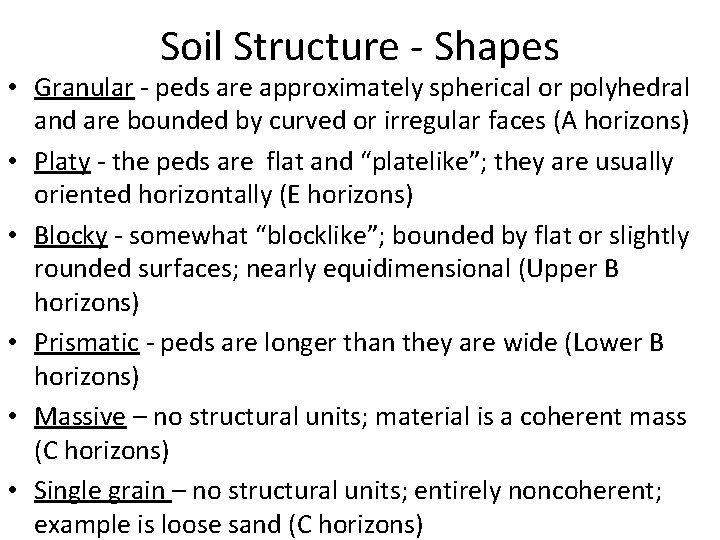
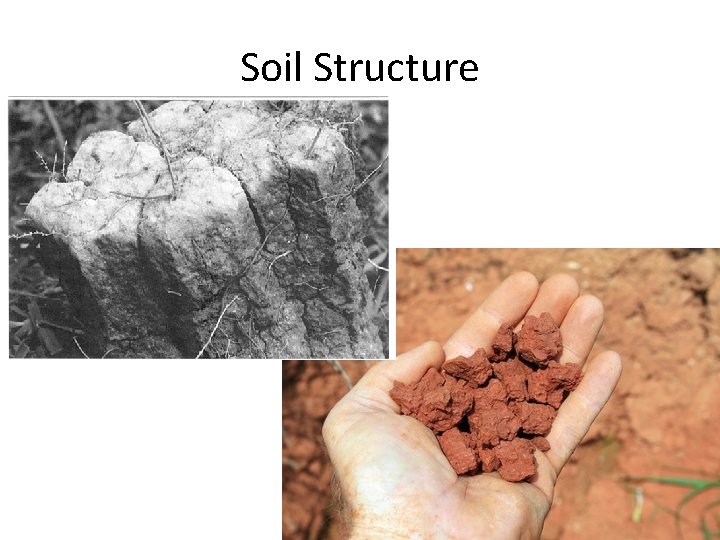
Soil Structure - Shapes • Granular - peds are approximately spherical or polyhedral and are bounded by curved or irregular faces (A horizons) • Platy - the peds are flat and “platelike”; they are usually oriented horizontally (E horizons) • Blocky - somewhat “blocklike”; bounded by flat or slightly rounded surfaces; nearly equidimensional (Upper B horizons) • Prismatic - peds are longer than they are wide (Lower B horizons) • Massive – no structural units; material is a coherent mass (C horizons) • Single grain – no structural units; entirely noncoherent; example is loose sand (C horizons)
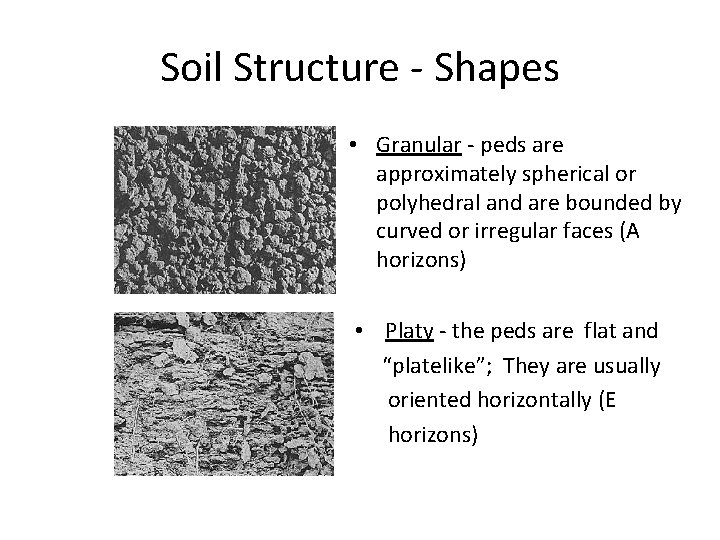
Soil Structure - Shapes • Granular - peds are approximately spherical or polyhedral and are bounded by curved or irregular faces (A horizons) • Platy - the peds are flat and “platelike”; They are usually oriented horizontally (E horizons)
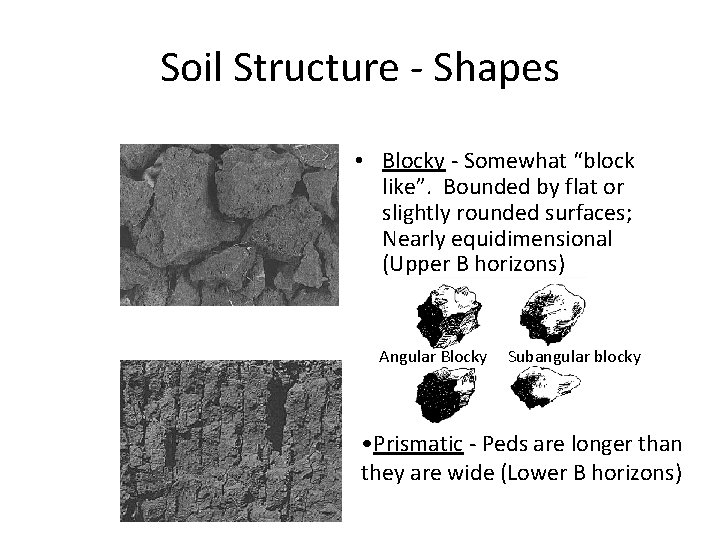
Soil Structure - Shapes • Blocky - Somewhat “block like”. Bounded by flat or slightly rounded surfaces; Nearly equidimensional (Upper B horizons) Angular Blocky Subangular blocky • Prismatic - Peds are longer than they are wide (Lower B horizons)
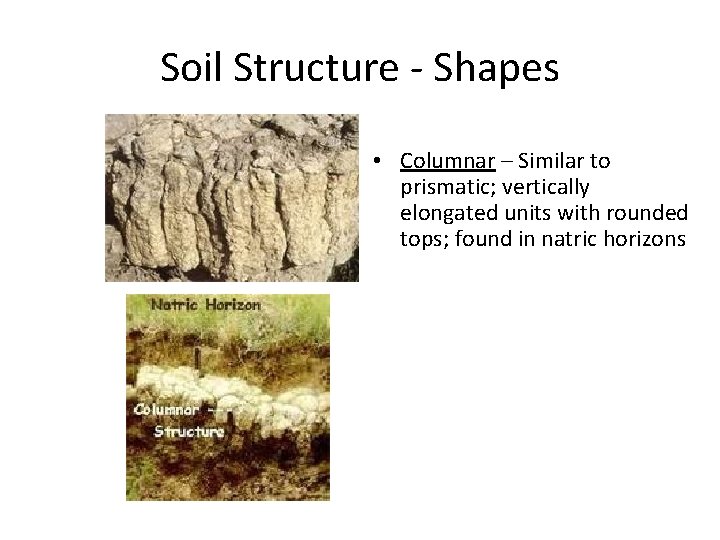
Soil Structure - Shapes • Columnar – Similar to prismatic; vertically elongated units with rounded tops; found in natric horizons
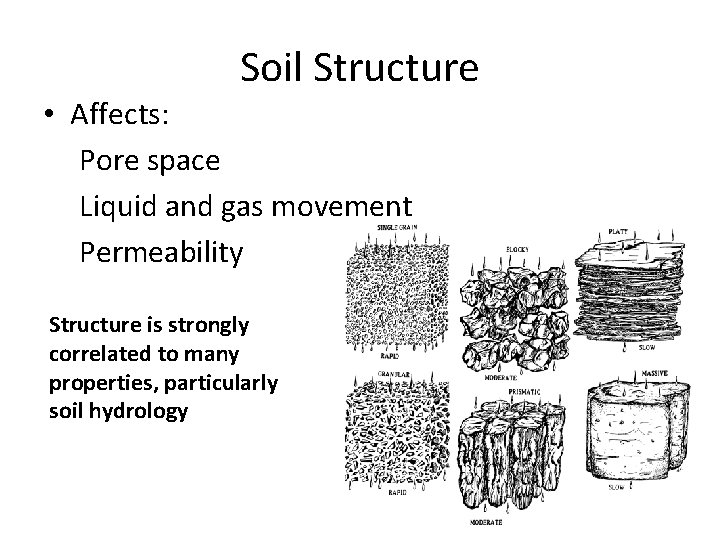
Soil Structure • Affects: Pore space Liquid and gas movement Permeability Structure is strongly correlated to many properties, particularly soil hydrology
Soil Morphology Exercise 3 • Observe structure types using the structure kits
Soil Rupture Resistance
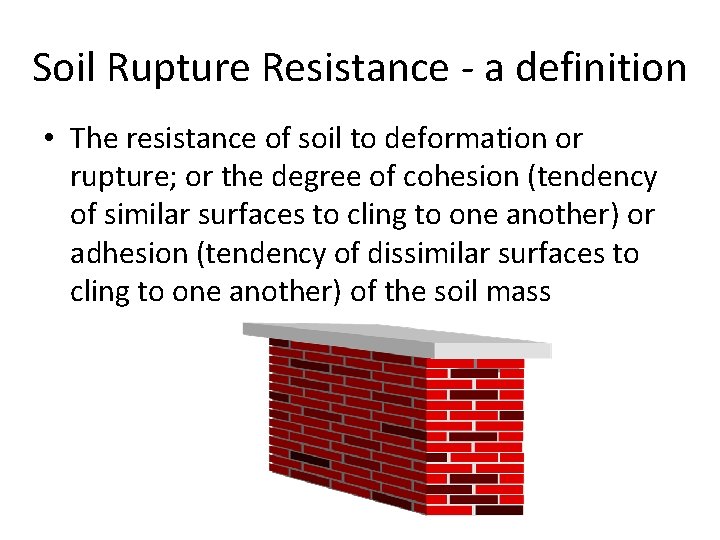
Soil Rupture Resistance - a definition • The resistance of soil to deformation or rupture; or the degree of cohesion (tendency of similar surfaces to cling to one another) or adhesion (tendency of dissimilar surfaces to cling to one another) of the soil mass
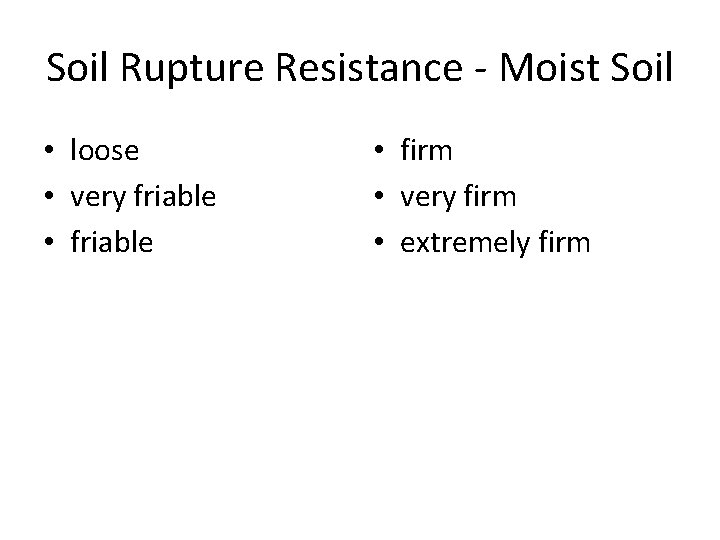
Soil Rupture Resistance - Moist Soil • loose • very friable • friable • firm • very firm • extremely firm
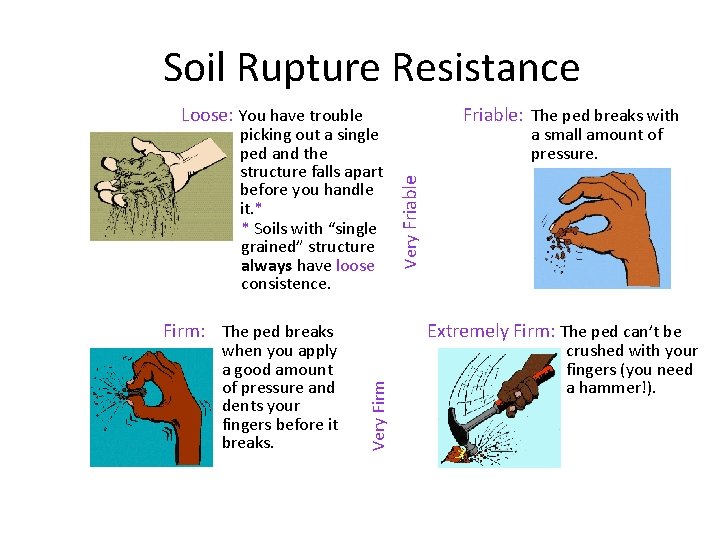
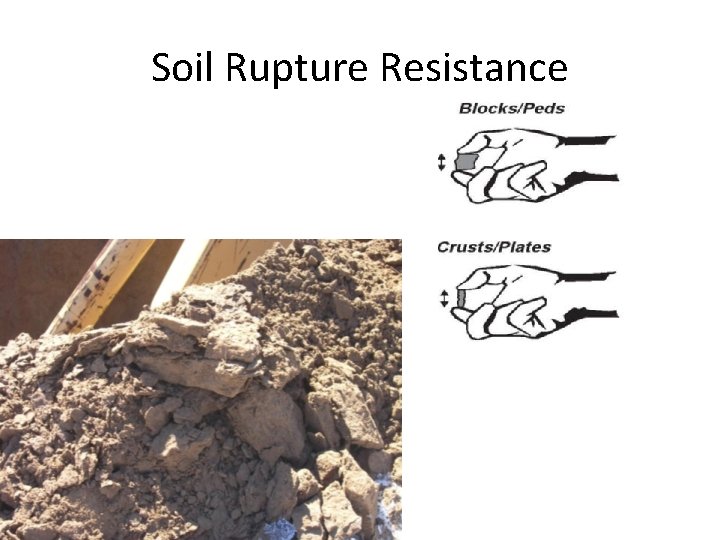
Soil Rupture Resistance Loose: You have trouble when you apply a good amount of pressure and dents your fingers before it breaks. Extremely Firm: The ped can’t be Very Firm: The ped breaks a small amount of pressure. Very Friable picking out a single ped and the structure falls apart before you handle it. * * Soils with “single grained” structure always have loose consistence. Friable: The ped breaks with crushed with your fingers (you need a hammer!).
Soil Morphology Exercise 4 • Practice determining moist rupture resistance class
Soil Roots and Pores
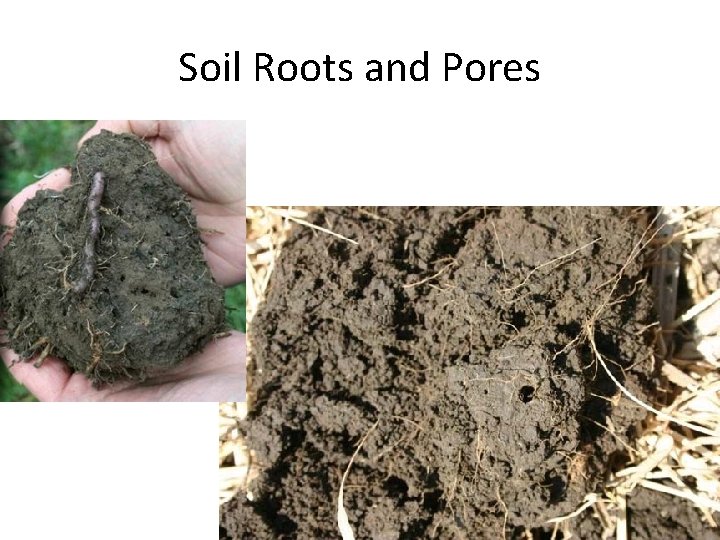
Soil Roots and Pores • Describe the quantity, size, and location of roots and pores • Provides a visual representation of soil health • Affected by soil structure • Impacted by soil restrictive layers and management and use
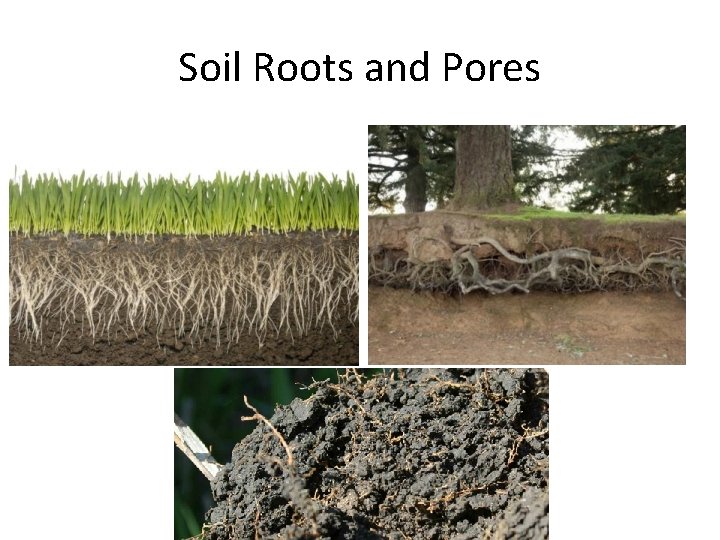
Soil Roots and Pores
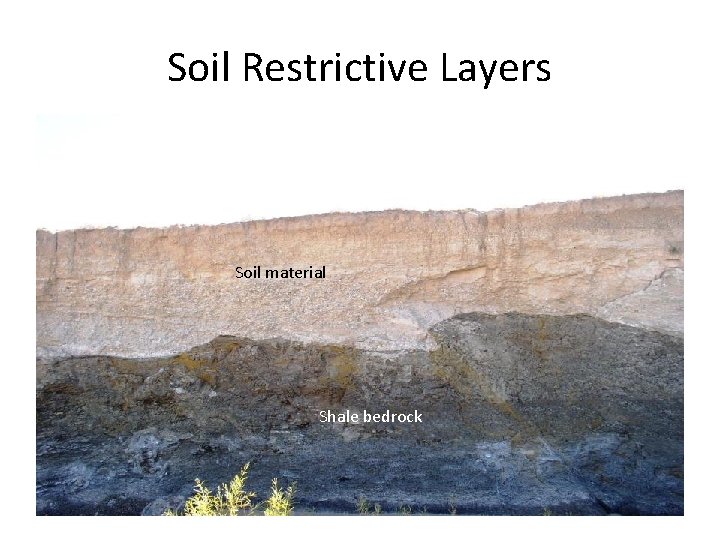
Soil Restrictive Layers Soil material Shale bedrock
Soil and Root Restrictive Layers • • • Bedrock Natric horizons Sand gravel Clay pan Water Compaction
Soil Restrictive Layers • Influences: – Rooting depth – Water infiltration – Salt accumulation – Land use and management
Soil Boundaries
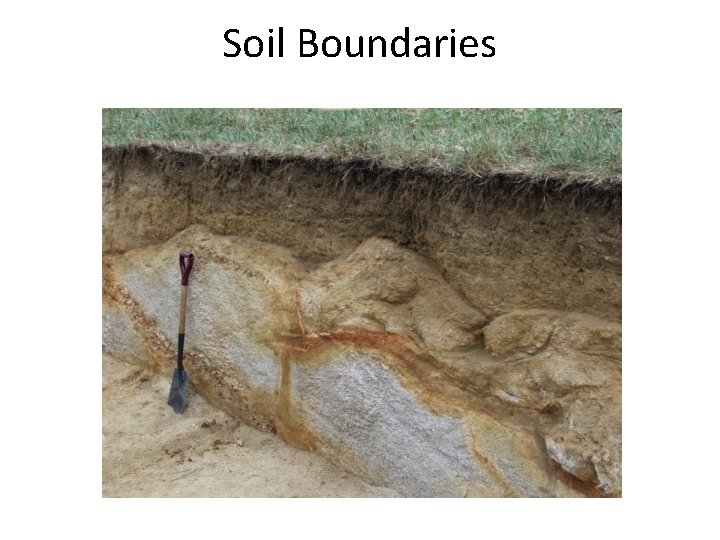
Soil Boundaries - a definition • A surface or transitional layer between two adjoining horizons or layers • Most boundaries are zones of transition rather than sharp lines of division
Soil Boundaries - Distinctness • • Abrupt = less than 1 inch thick Clear = 1 to 2. 5 inches thick Gradual = 2. 5 to 5 inches thick Diffuse = greater than 5 inches thick
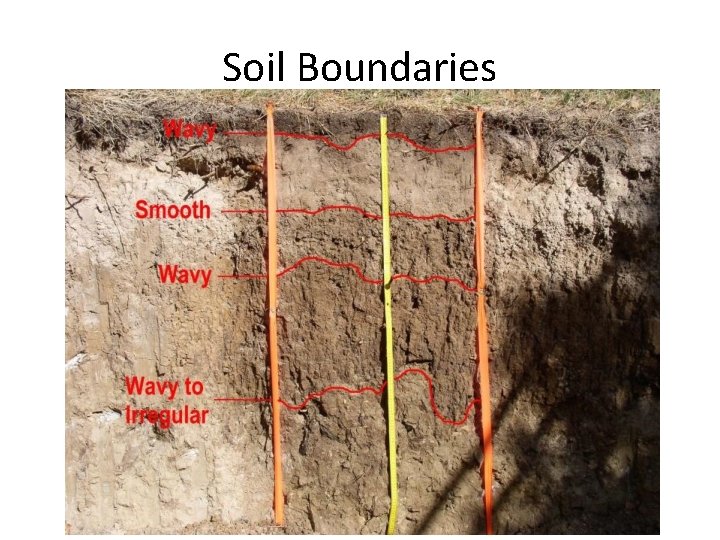
Soil Boundaries - Topography • Smooth = the boundary is a plane with few or no irregularities • Wavy = there are undulations in which depressions are wider than they are deep • Irregular = pockets that are deeper than they are wide • Broken = One or both of the horizons separated by the boundary are discontinuous and the boundary is interrupted
Soil Boundaries
Soil Chemical Properties • Acidity/alkalinity: “p. H” – Affects many other soil chemical properties – Large effect on nutrient availability (solubility) – Optimum range (most plants): 5. 5 -6. 5
Soil p. H
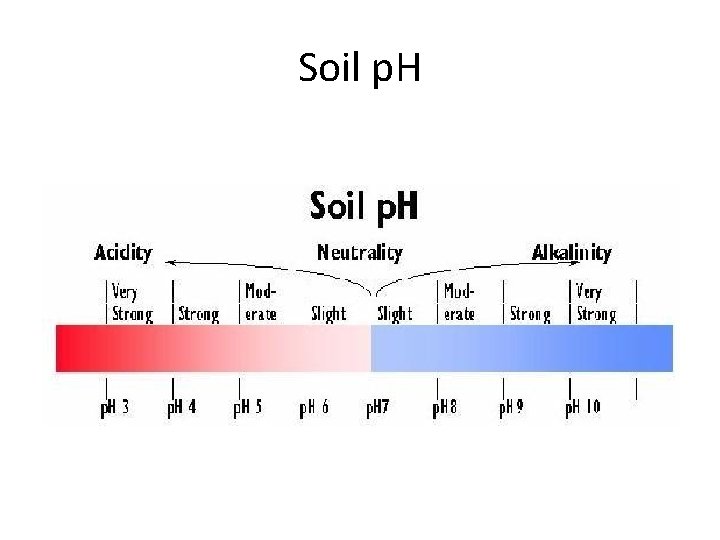
Soil p. H – definition • A numeric designation of the acidity or alkalinity in soils • A measure of the H+ ion activity in soils • On a scale of 0 to 14
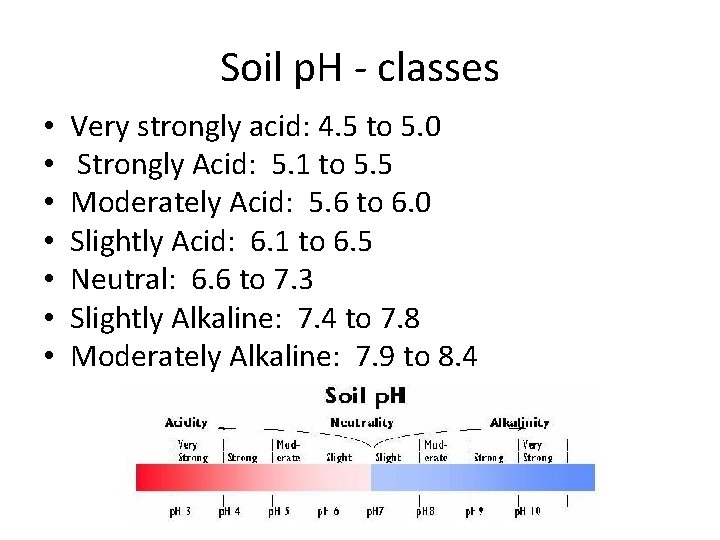
Soil p. H - classes • • Very strongly acid: 4. 5 to 5. 0 Strongly Acid: 5. 1 to 5. 5 Moderately Acid: 5. 6 to 6. 0 Slightly Acid: 6. 1 to 6. 5 Neutral: 6. 6 to 7. 3 Slightly Alkaline: 7. 4 to 7. 8 Moderately Alkaline: 7. 9 to 8. 4
Soil p. H • p. H influences nutrient availability, rate of biological and chemical processes, the amount and types of plants and microorganisms present, and the corrosion potential of concrete or steel structures in the soil • You can alter the soil p. H by incorporating compounds in to the soil. The most common is to add lime (calcium carbonate, Ca. CO 3 ) to increase the p. H
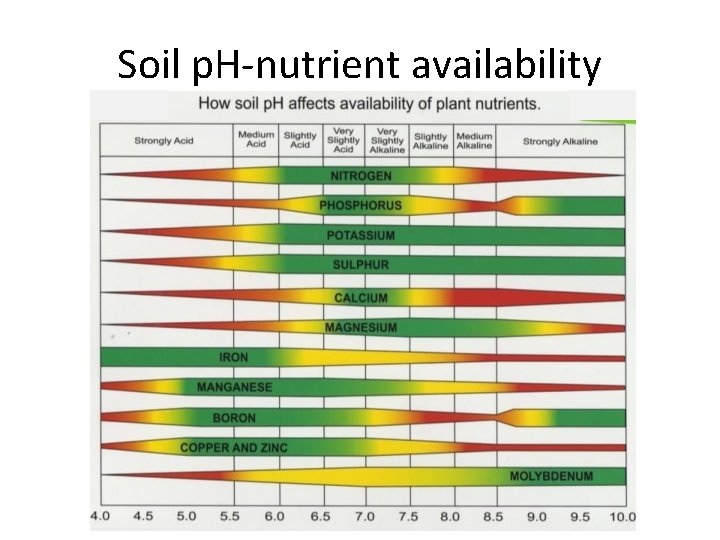
Soil p. H-nutrient availability
Questions? ?
Credits • Pictures and Content from Power. Point Presentations Created by: – William Miller and David Radcliffe, Crop and Soil Sciences, University of Georgia – University of Florida Soil Lab – Alabama A&M University – USDA Natural Resources Conservation Service Alaska Soil Survey Program – Earl D. Lockridge, USDA NRCS National Soil Survey Center
• Credits Other pictures and content provided by: – USDA Handbook No. 18, Soil Survey Manual by the Soil Survey Division Staff – Field Book for Describing and Sampling Soils Version 2. 0 by USDA NRCS National Soil Survey Center – USDA NRCS Keys to Soil Taxonomy 10 th Edition – Verdegaalbrothers. com – Stthomas. edu – Soilquality. org – Noonturfcare. com – Viette. com – Ehow. com – Gardeningstepbystep. com – Mccc. msu. edu – Deeproot. com – Swac. umn. edu – Scifaithkansas. net – Allianceforwaterefficiency. org – Ecoclublive. blogspot. com – Sd. nrcs. usda. gov – Water-research. net
- Slides: 67