
BASIC RIGGING MSHA REGULATIONS 5657 16007 Taglines Hitches
BASIC RIGGING

MSHA REGULATIONS • 56/57. 16007 Taglines, Hitches, and Slings n n (a) Taglines shall be attached to loads that may require steadying or guidance while suspended. (b) Hitches and slings used to hoist materials shall be suitable for the particular material handled. • 56/57. 16009 Suspended Loads n Persons shall stay clear of suspended loads.

TOOLS OF RIGGING • • Hoists Cranes Slings Special lifting devices

HOISTS AND CRANES • Different types of hoisting equipment – Manual and powered devices – underhung and top running cranes – monorails – various types of jig cranes
SLINGS • Main purpose is to suspend a load from a hoist • Commonly made of wire rope or welded link chain • Can be constructed from fiber rope, synthetic webbing or metal mesh • Most slings are assembled by sling manufacturers • Can be assembled at the job site
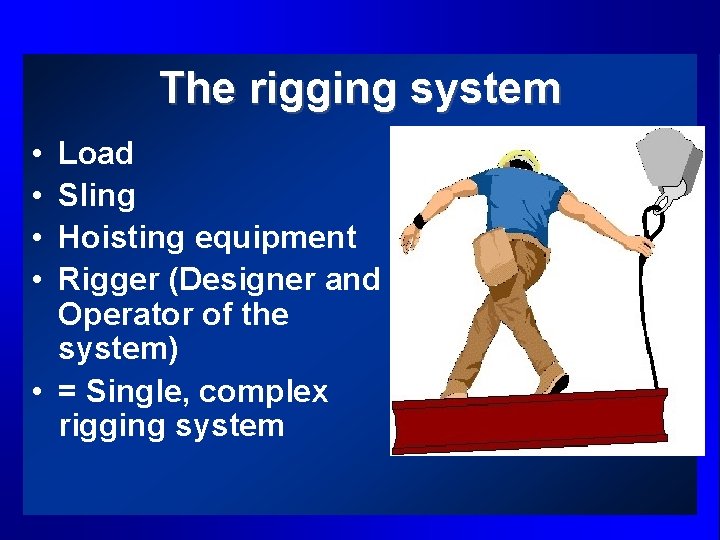
The rigging system • • Load Sling Hoisting equipment Rigger (Designer and Operator of the system) • = Single, complex rigging system
The Rigger • Must apply intelligence, common sense and experience • Anticipate what will happen when the load is moved • Thought process must take place before the work is started • Must answer the following questions…. .

Questions that must be answered by rigger • What is to be done with the load? • What tools are needed? • Do the tools have the capacity to handle the loads and forces involved?

Questions that must be answered by rigger • How can the hookup be made? • What will happen when the load is first moved? • What will be the travel path of the load to reach the desired location?

Questions that must be answered by rigger • How will the load be set down at the desired location? • What other factors are involved (weather, electrical wires, sloping grades, visibility)? • Are additional personnel needed to control the load safely during the process?

Planning a rigging system • Determine the weight of the load • Locating the center of gravity of a load • Distinguishing the force components (horizontal and vertical) at work in a diagonal force(loads at some angles other than 90 degrees to the horizontal) • Limitations of each component of the rigging system
Determining the weight of the load • Shipping paper • Manufacturers information attached to the load • Catalogs or blueprints • Tables of weights from manufacturers or handbooks • Make sure the weight has not changed

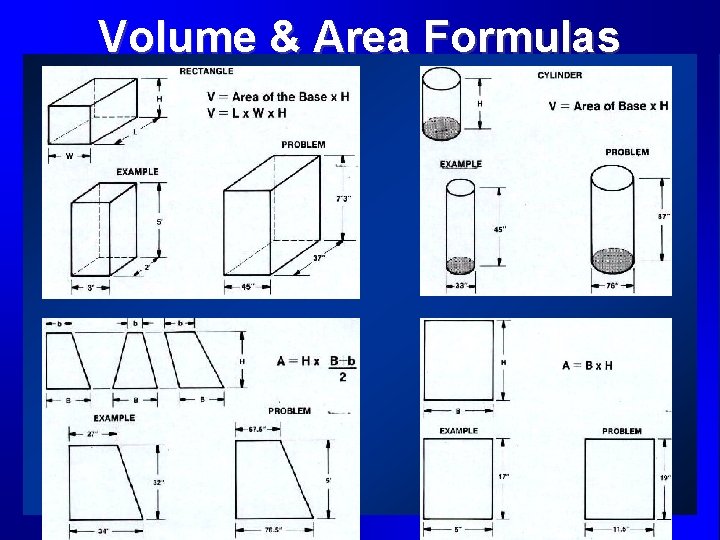
Volume & Area Formulas

Calculating an allowable load • Determine the breaking strength of the rope – Load which will cause the rope to break – Refer to standard tables in rigging handbooks – Listed according to the diameter and kind of rope – Design or safety factor usually 5

Calculating an allowable load • Find the load limit by dividing the breaking strength of the rope by the design factor • Example– If the table indicates that the breaking strength of the rope you are using is 27, 000 pounds. Dividing this figure by the design factor of 5 gives you a 5400 pound maximum allowable load.
Determine the center of gravity • The point at which the load will balance • Whole weight of the load is considered concentrated at this balance point • When suspended from a point, the load tends to move so that the center of gravity is directly below the point of support. • Make sure the center of gravity is located directly below the hoisting hook
Determine the center of gravity • Stable load – Balanced about its center of gravity – Directly below the hoisting hook • Unstable load – has a tendency to tip or topple – Creates a hazard to personnel and equipment

Before Lifting any load check for hazards • If not directly below the hook the load is unstable • If the sling is free to slide across the hook the center of gravity will shift directly below the hook • If two slings are used one will assume the greater share of the load

Before Lifting any load check for hazards • The sling must not be attached to the load at a point lower than the loads center of gravity – Exception to this rule when lifting loads on pallets or skids – Then apex of sling must be above the center of gravity

Determining the center of gravity • • Marked on the load by manufacturer Located in catalogs or blueprints Some objects have lifting lugs Calculate or estimate it – Make an educated guess and correct through trial and error before making the lift

Procedures to determine center of gravity • Connect slings and hoist based on estimate of object’s center of gravity • Take up slack in slings or hoist • Lift the load just enough to check stability • If stable, continue to lift • If unstable, lower load and adjust the rigging – Lift point should be moved closer to end that dips • Repeat until load is stable
Horizontal Force • Very often sling legs are attached at an angle less than 900 • Then a horizontal force is added to the vertical force • Resulting Combined force is greater than the weight of the load • Horizontal force increases as the angle becomes smaller

Horizontal Force • When a sling angle is 300 the total force is twice that of the load • Sling Angles of 450 are not recommended
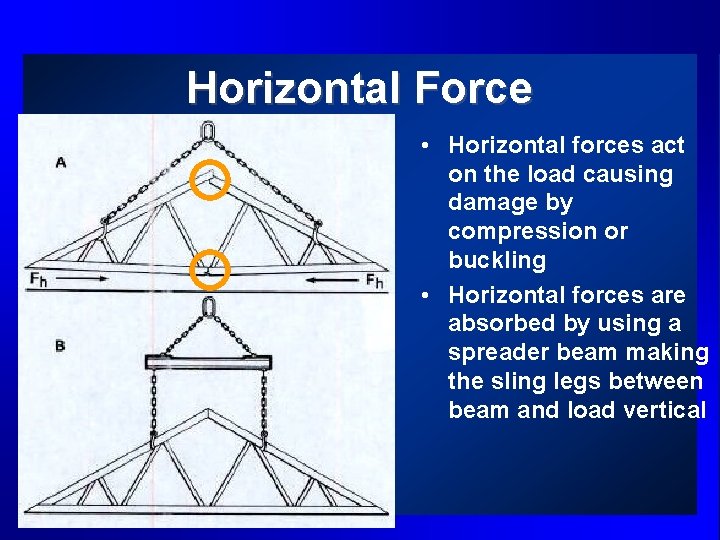
Horizontal Force • Horizontal forces act on the load causing damage by compression or buckling • Horizontal forces are absorbed by using a spreader beam making the sling legs between beam and load vertical
Sling Components • • • Hooks Coupling Links Fittings Sling Legs Can be assembled at the job site but must use recommended components and assembly procedures – May also require some sort of weight test
Hook Hazards • Attachments should never be field welded to a hook • Heat should not be applied in an attempt to reshape a hook – Can reduce strength of hook – Could result in hook failure at loads lower than the rated load • If handles or attachments are required they should be obtained from the hook manufacturer

Purpose of a latch? • Purpose is to retain slings in the hook – Not intended to support the load – Should be sturdy enough to retain the sling if the moving load should catch on something • Latches are used to close throat opening • Must be provided on hoist and crane hooks
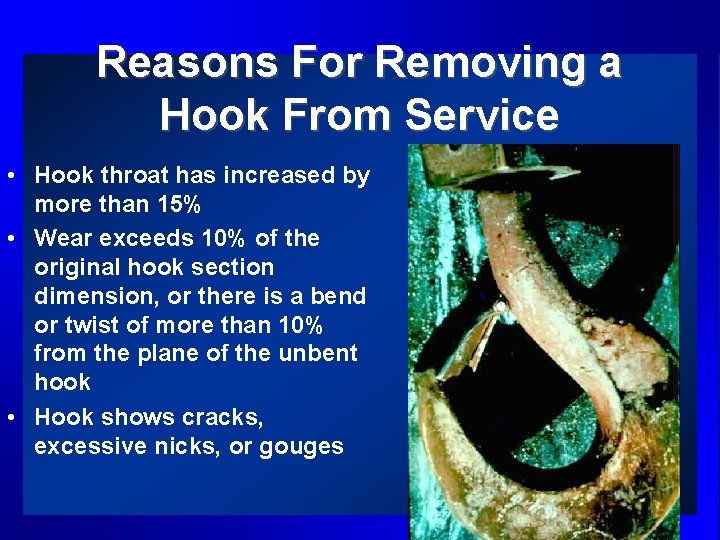
Reasons For Removing a Hook From Service • Hook throat has increased by more than 15% • Wear exceeds 10% of the original hook section dimension, or there is a bend or twist of more than 10% from the plane of the unbent hook • Hook shows cracks, excessive nicks, or gouges

Factors Affecting Wire-Rope Strength • Three major signs of loss of strength – Flat spots worn on outer wires – Broken wires – reduction of rope diameter • Other factors that can reduce strength – – Bending the rope over a curved surface Temperature Corrosion and environment Rope fittings or terminations
Bending The Rope Over A Curved Surface • Normal curved surfaces that ropes are curved over include sheaves, pins and other curved surfaces • The rope is subjected to bending stress • Reduces rope efficiency/nominal strength by a certain percentage • Efficiency depends upon the: – D = Diameter of curved surface – d = Nominal diameter of rope
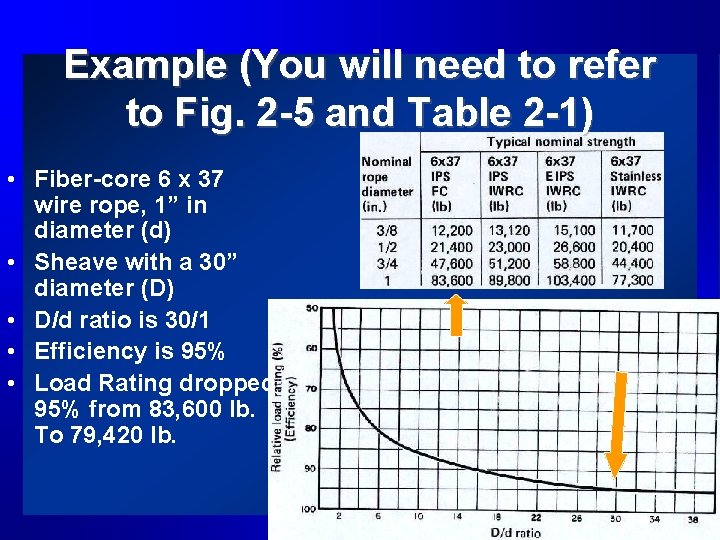
Example (You will need to refer to Fig. 2 -5 and Table 2 -1) • Fiber-core 6 x 37 wire rope, 1” in diameter (d) • Sheave with a 30” diameter (D) • D/d ratio is 30/1 • Efficiency is 95% • Load Rating dropped 95% from 83, 600 lb. To 79, 420 lb.
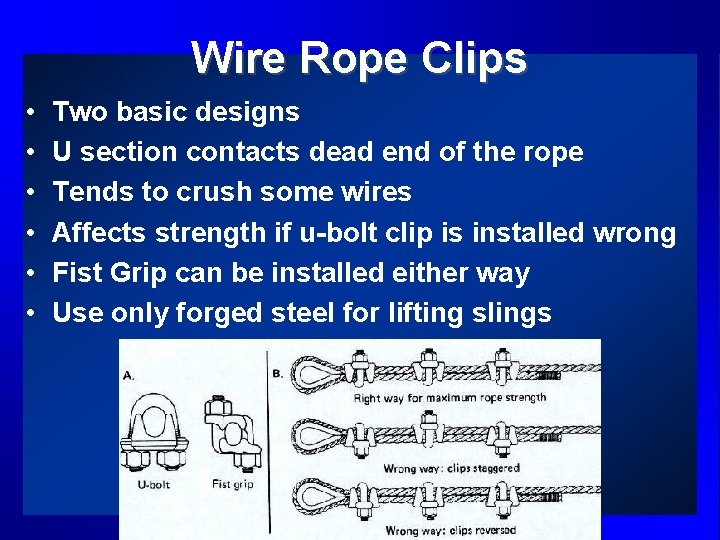
Wire Rope Clips • • • Two basic designs U section contacts dead end of the rope Tends to crush some wires Affects strength if u-bolt clip is installed wrong Fist Grip can be installed either way Use only forged steel for lifting slings

Removal From Service • Rope Distortion such as kinking, crushing, unstranding, birdcaging or core protrusion • Heat Damage from any source – Look for damage from weld and weld splatter • Cracked or deformed end fittings(hooks particularly) • Corrosive failure of one wire adjacent to end fitting
Removal From Service • One broken or cut strand • Pitting due to corrosion • For Single Wire Rope Either: – 10 broken wires in a section the length of one rope lay – 5 broken wires in one strand within a distance of one rope lay
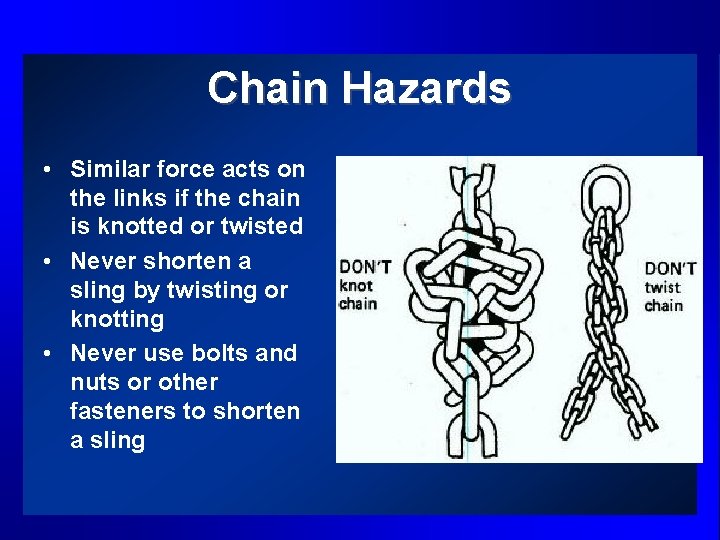
Chain Hazards • Similar force acts on the links if the chain is knotted or twisted • Never shorten a sling by twisting or knotting • Never use bolts and nuts or other fasteners to shorten a sling
- Slides: 36