
Basic Radiation Protection for Search Teams IAEA International
Basic Radiation Protection for Search Teams IAEA International Atomic Energy Agency
Introduction • By the end of this module students will be able to: • Explain the two main radiological hazards • List the main methods of controlling these two hazards • Describe the basic radiation protection principles for orphan source search personnel • State the doses and dose rates requiring action on their part IAEA
Overview • Basic radiation protection • • • Biological effects • Significant doses External radiological hazard and its control Internal radiological hazard and its control Basic radiological surveys Establishment of controlled areas Personal protection and dose limits IAEA
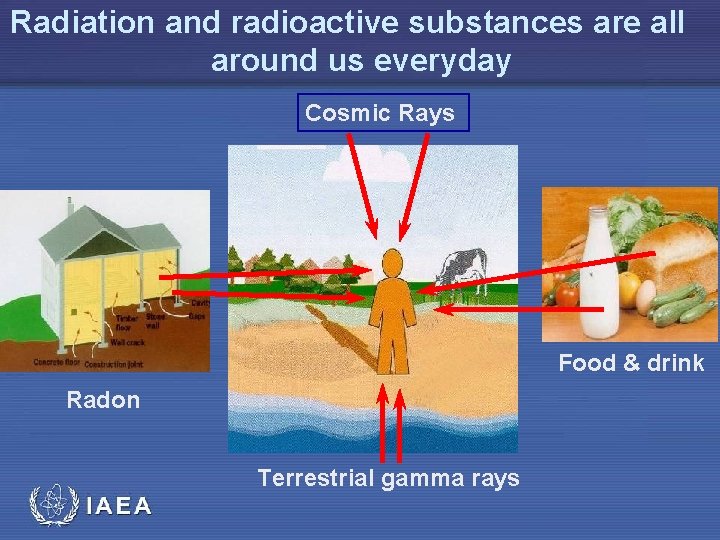
Radiation and radioactive substances are all around us everyday Cosmic Rays Food & drink Radon Terrestrial gamma rays IAEA
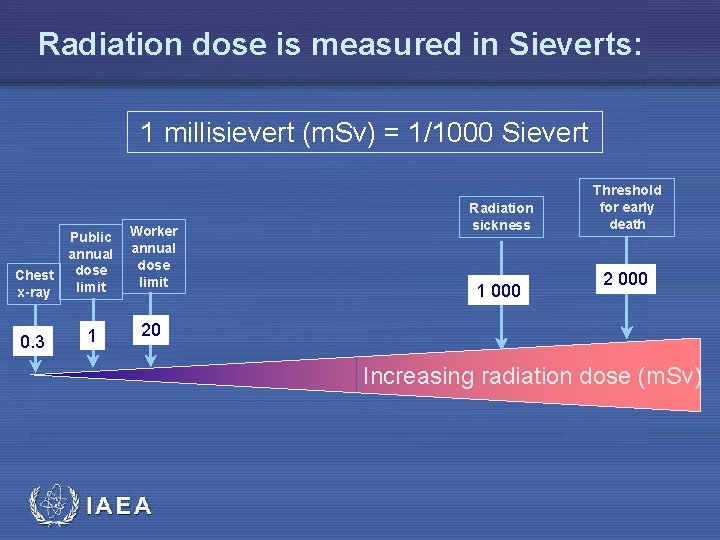
Radiation dose is measured in Sieverts: 1 millisievert (m. Sv) = 1/1000 Sievert Chest x-ray Public annual dose limit Worker annual dose limit 0. 3 1 20 Radiation sickness 1 000 Threshold for early death 2 000 Increasing radiation dose (m. Sv) IAEA
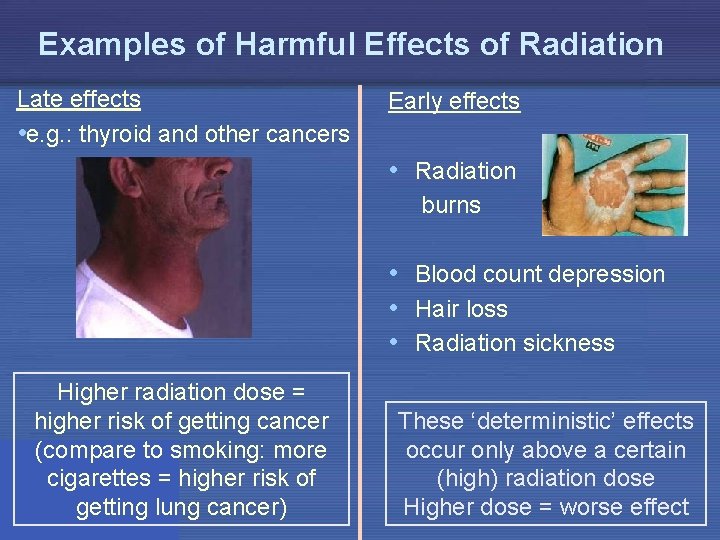
Examples of Harmful Effects of Radiation Late effects • e. g. : thyroid and other cancers Early effects • Radiation burns • Blood count depression • Hair loss • Radiation sickness Higher radiation dose = higher risk of getting cancer (compare to smoking: more cigarettes = higher risk of IAEA lung cancer) getting These ‘deterministic’ effects occur only above a certain (high) radiation dose Higher dose = worse effect
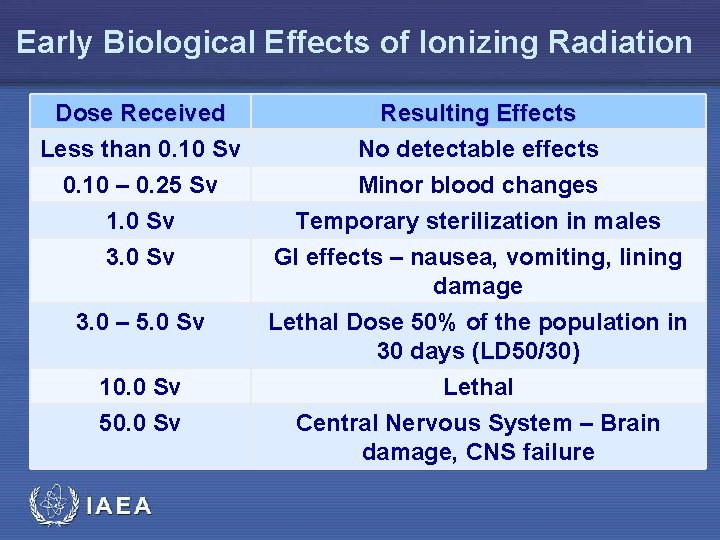
Early Biological Effects of Ionizing Radiation Dose Received Less than 0. 10 Sv 0. 10 – 0. 25 Sv 1. 0 Sv 3. 0 – 5. 0 Sv 10. 0 Sv 50. 0 Sv IAEA Resulting Effects No detectable effects Minor blood changes Temporary sterilization in males GI effects – nausea, vomiting, lining damage Lethal Dose 50% of the population in 30 days (LD 50/30) Lethal Central Nervous System – Brain damage, CNS failure
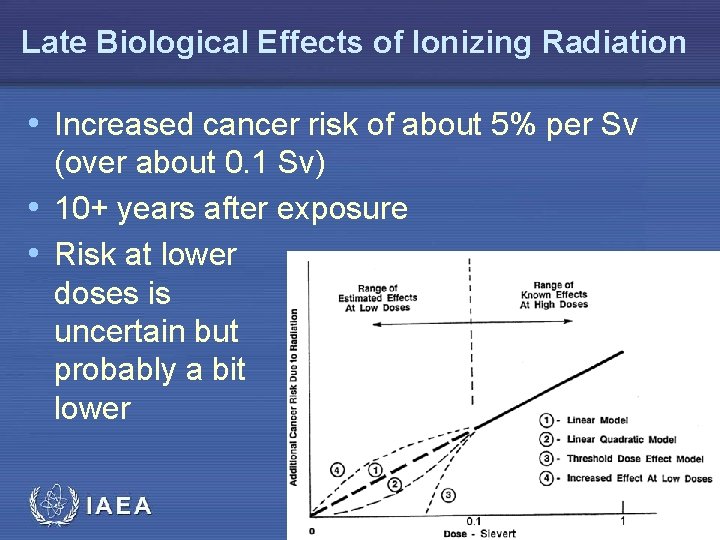
Late Biological Effects of Ionizing Radiation • Increased cancer risk of about 5% per Sv (over about 0. 1 Sv) • 10+ years after exposure • Risk at lower doses is uncertain but probably a bit lower IAEA
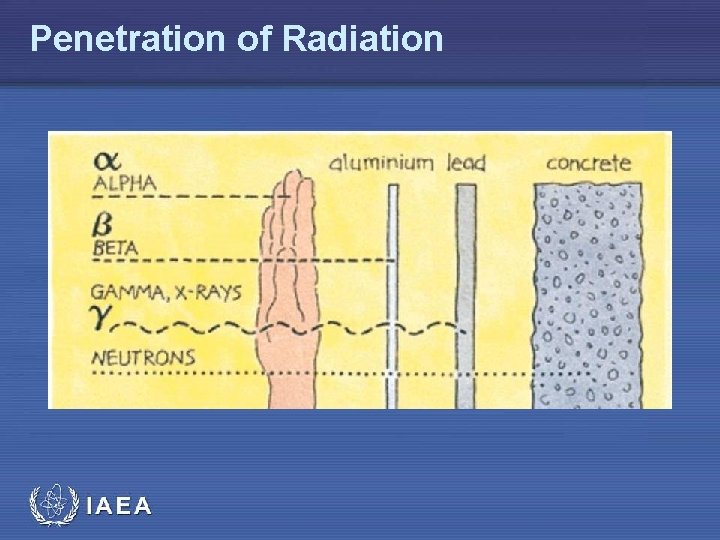
Penetration of Radiation IAEA
Two Types of Radiation Exposure from a radiation source outside the body (external hazard) IAEA Exposure due to inhaling or ingesting radioactive material (internal hazard)
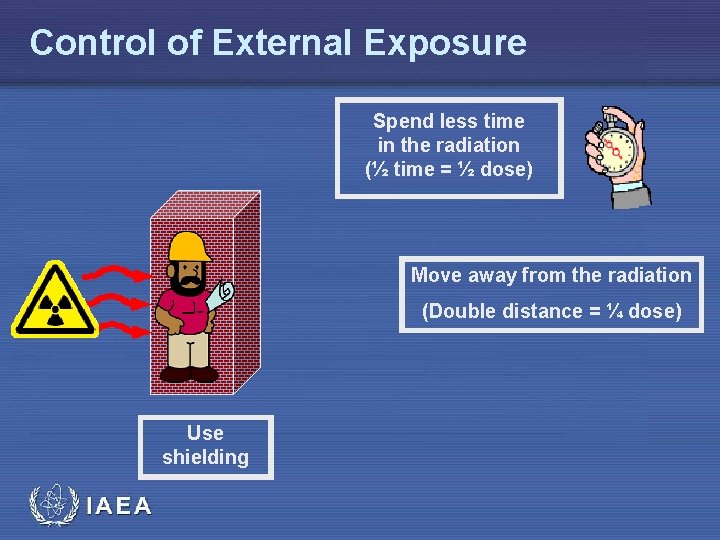
Control of External Exposure Spend less time in the radiation (½ time = ½ dose) Move away from the radiation (Double distance = ¼ dose) Use shielding IAEA
As Low As Reasonably Achievable • So, while performing search activities keep radiation exposure As Low As Reasonably Achievable (ALARA) • Minimize time in the area • Maximize distance from the source • Use shielding if possible IAEA
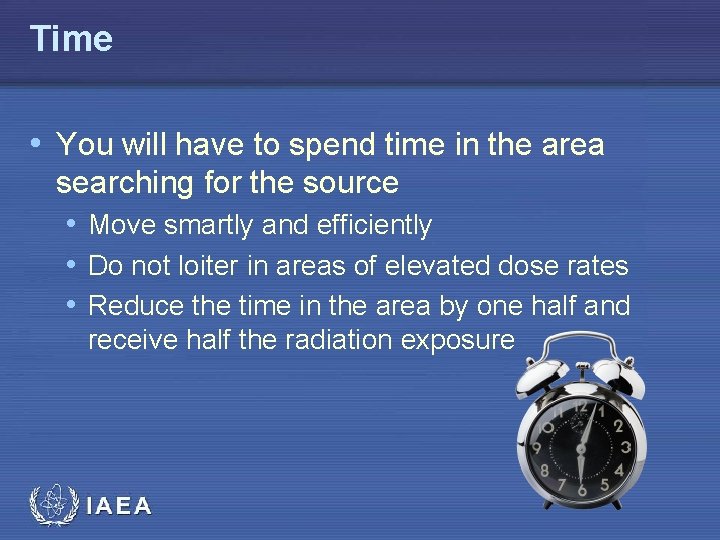
Time • You will have to spend time in the area searching for the source • Move smartly and efficiently • Do not loiter in areas of elevated dose rates • Reduce the time in the area by one half and receive half the radiation exposure IAEA
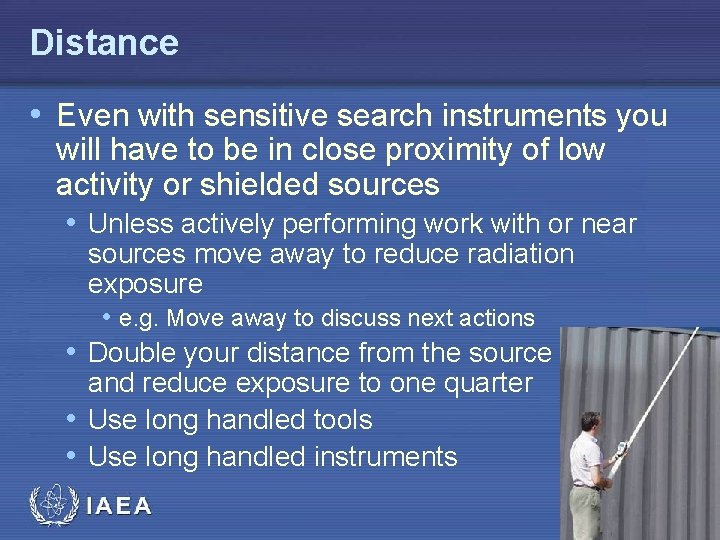
Distance • Even with sensitive search instruments you will have to be in close proximity of low activity or shielded sources • Unless actively performing work with or near sources move away to reduce radiation exposure • e. g. Move away to discuss next actions • Double your distance from the source and reduce exposure to one quarter • Use long handled tools • Use long handled instruments IAEA
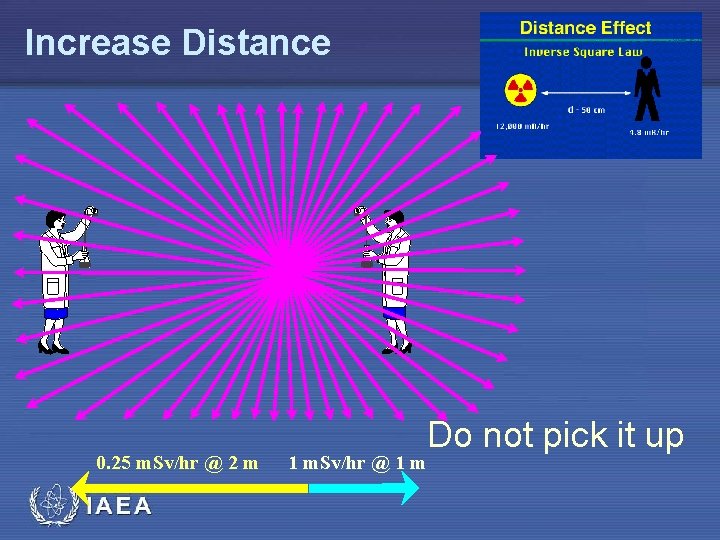
Increase Distance 0. 25 m. Sv/hr @ 2 m IAEA 1 m. Sv/hr @ 1 m Do not pick it up
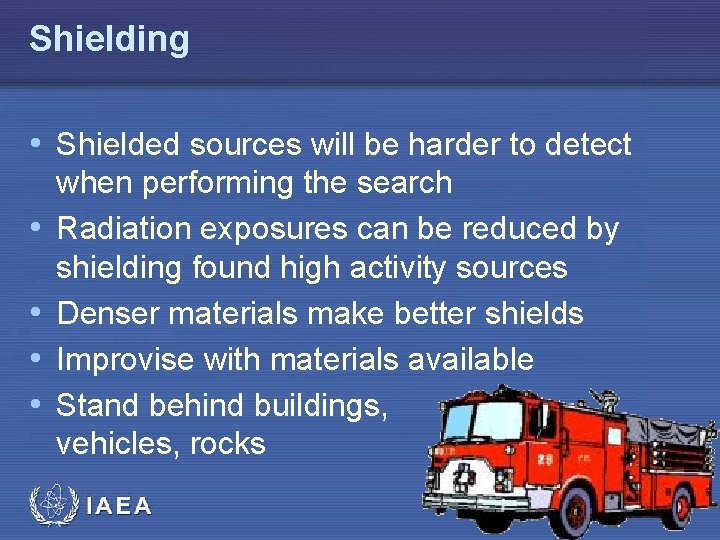
Shielding • Shielded sources will be harder to detect • • when performing the search Radiation exposures can be reduced by shielding found high activity sources Denser materials make better shields Improvise with materials available Stand behind buildings, vehicles, rocks IAEA
Control of Internal Exposure Hazard • Cannot apply time, distance and shielding once the radioactive material is inside the body • Small quantities become more significant because the body is committed to a certain dose once it is inside • Hence preventing it getting inside is the most important control for loose radioactive material – contamination IAEA
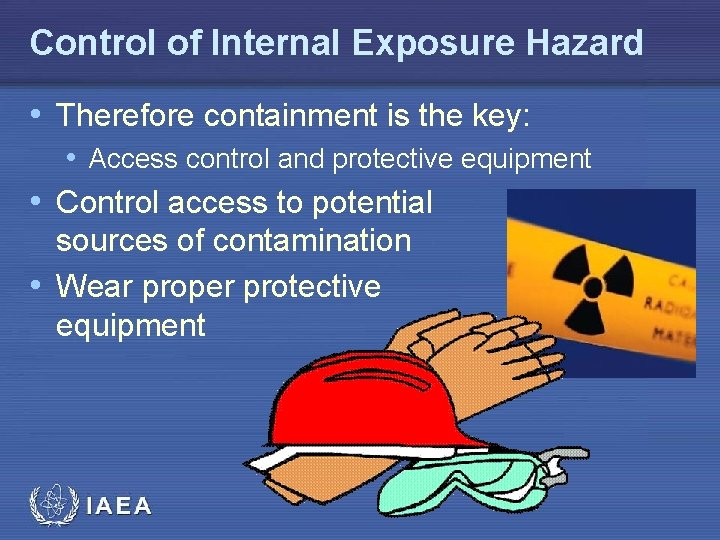
Control of Internal Exposure Hazard • Therefore containment is the key: • Access control and protective equipment • Control access to potential sources of contamination • Wear proper protective equipment IAEA
Protection Against Internal Exposure • Perform frequent surveys • No eating, drinking, smoking in potentially contaminated areas • Keep hands away from mouth • Cover open wounds IAEA
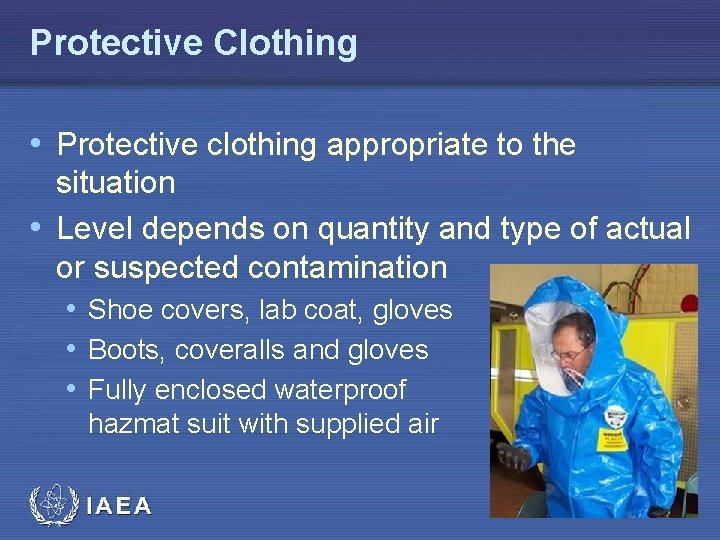
Protective Clothing • Protective clothing appropriate to the situation • Level depends on quantity and type of actual or suspected contamination • Shoe covers, lab coat, gloves • Boots, coveralls and gloves • Fully enclosed waterproof hazmat suit with supplied air IAEA
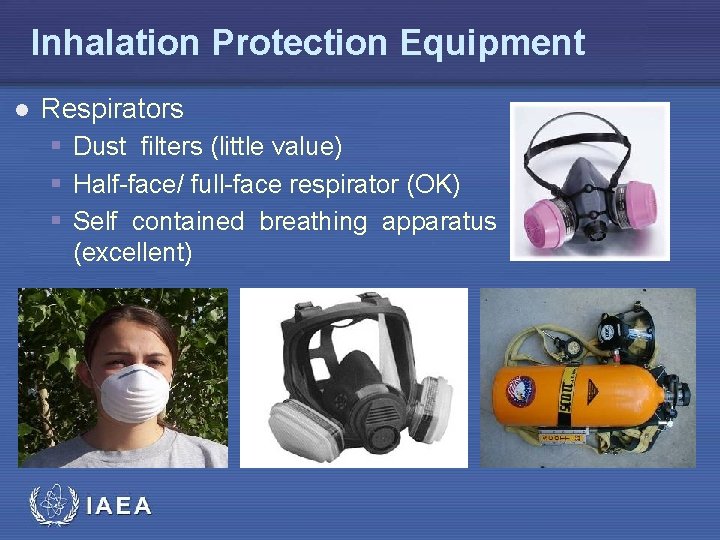
Inhalation Protection Equipment l Respirators § Dust filters (little value) § Half-face/ full-face respirator (OK) § Self contained breathing apparatus (excellent) IAEA
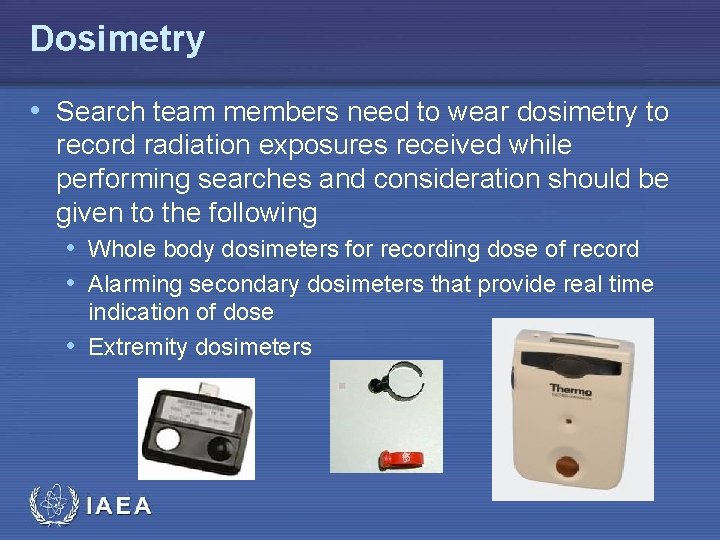
Dosimetry • Search team members need to wear dosimetry to record radiation exposures received while performing searches and consideration should be given to the following • Whole body dosimeters for recording dose of record • Alarming secondary dosimeters that provide real time indication of dose • Extremity dosimeters IAEA
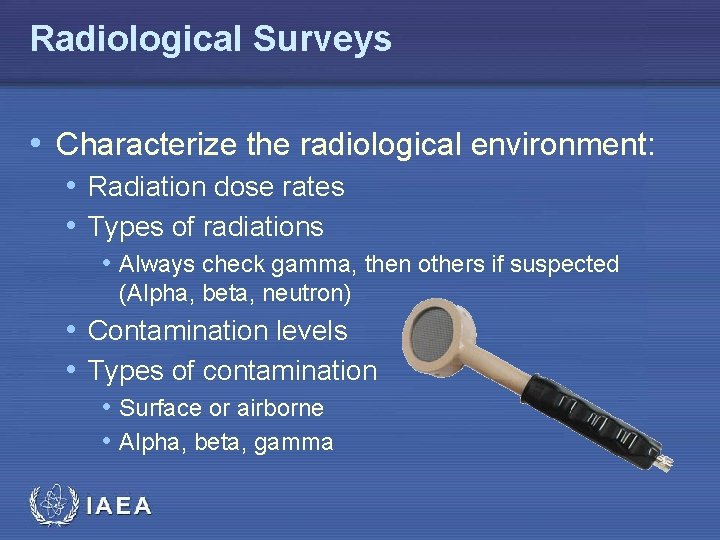
Radiological Surveys • Characterize the radiological environment: • Radiation dose rates • Types of radiations • Always check gamma, then others if suspected (Alpha, beta, neutron) • Contamination levels • Types of contamination • Surface or airborne • Alpha, beta, gamma IAEA
Radiation Surveys • Turn on and checkout instrument away from area • Ensure that dose rate at current location is background or at an acceptable low level • Move towards suspected radiation with instrument on IAEA
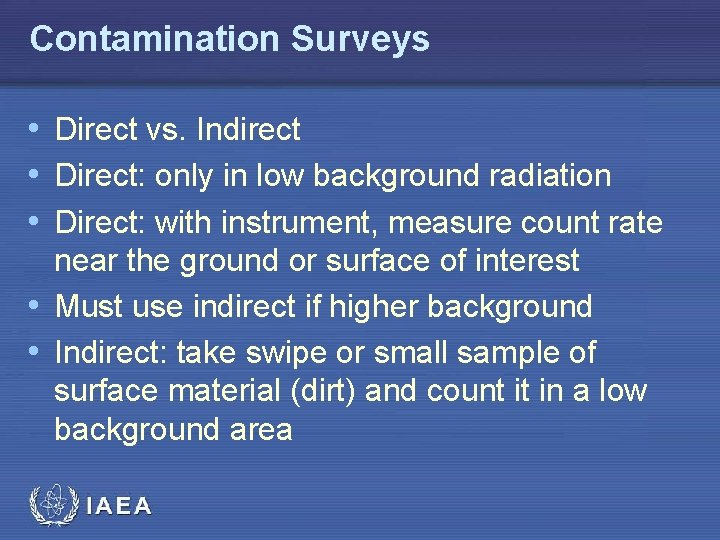
Contamination Surveys • Direct vs. Indirect • Direct: only in low background radiation • Direct: with instrument, measure count rate near the ground or surface of interest • Must use indirect if higher background • Indirect: take swipe or small sample of surface material (dirt) and count it in a low background area IAEA
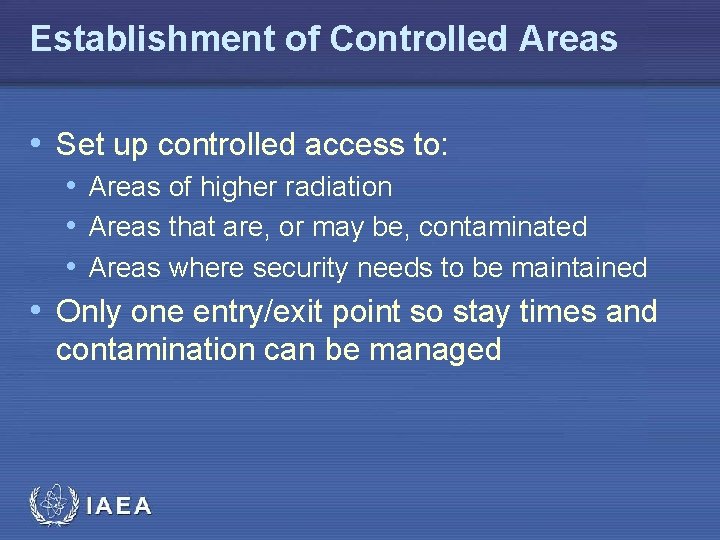
Establishment of Controlled Areas • Set up controlled access to: • Areas of higher radiation • Areas that are, or may be, contaminated • Areas where security needs to be maintained • Only one entry/exit point so stay times and contamination can be managed IAEA

Controlled Area for Major Event IAEA
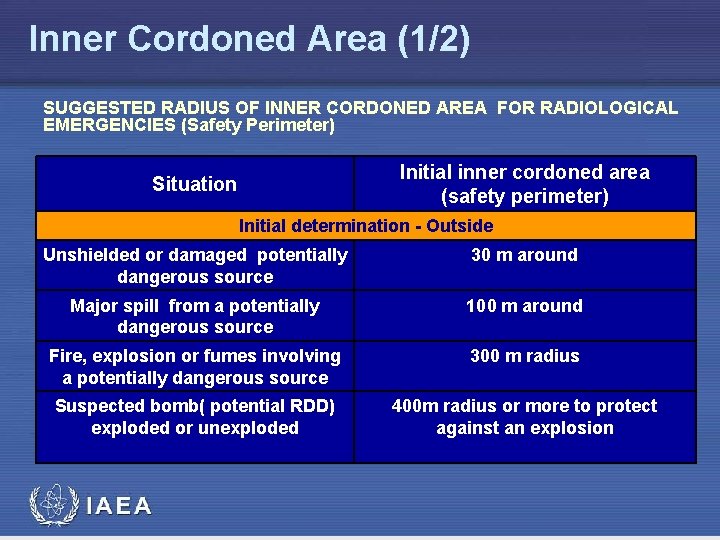
Inner Cordoned Area (1/2) SUGGESTED RADIUS OF INNER CORDONED AREA FOR RADIOLOGICAL EMERGENCIES (Safety Perimeter) Initial inner cordoned area (safety perimeter) Situation Initial determination - Outside Unshielded or damaged potentially dangerous source 30 m around Major spill from a potentially dangerous source 100 m around Fire, explosion or fumes involving a potentially dangerous source 300 m radius Suspected bomb( potential RDD) exploded or unexploded 400 m radius or more to protect against an explosion IAEA
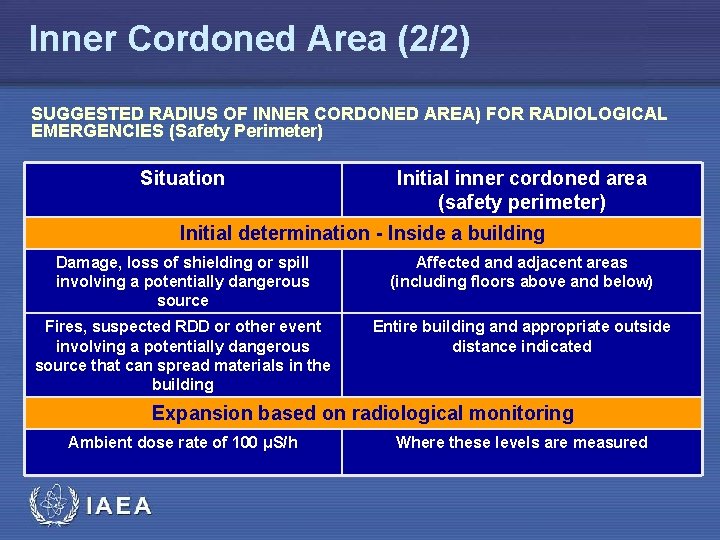
Inner Cordoned Area (2/2) SUGGESTED RADIUS OF INNER CORDONED AREA) FOR RADIOLOGICAL EMERGENCIES (Safety Perimeter) Situation Initial inner cordoned area (safety perimeter) Initial determination - Inside a building Damage, loss of shielding or spill involving a potentially dangerous source Affected and adjacent areas (including floors above and below) Fires, suspected RDD or other event involving a potentially dangerous source that can spread materials in the building Entire building and appropriate outside distance indicated Expansion based on radiological monitoring Ambient dose rate of 100 μS/h IAEA Where these levels are measured
Summary for Individuals • Wear proper dosimetry • Whole body dosimeter • Alarming secondary dosimeter • Extremity dosimeter • Wear proper protective equipment (as needed) • Gloves • Coveralls • Boots (or easily decontaminated footwear) IAEA
Summary for Individuals • Carry appropriate radiation/contamination detectors – or be with someone who does • Observe appropriate controls in and out of controlled access areas • Know the radiation doses and dose rates that require action IAEA
Individual Dose Limits IAEA
Summary • Radiological hazards and personal protection • Specific applications of these to source search personnel IAEA
- Slides: 33