
BASIC QUANTUM THEORY Lecture 3 Modern Atomic Theory
BASIC QUANTUM THEORY Lecture 3: Modern Atomic Theory Learning Outcomes By the end of this session, you are able to: Describe the main features of the quantum mechanical picture of the atom. Describe the four quantum numbers, and give possible combinations of their values for specific atomic orbitals Describe the shapes of orbitals and recall the usual order of their relative energies Write the electron configurations of atoms Relate the electron configuration of an atom to its position in the periodic table
Wave Mechanical Model of the Atom Experiments later showed that electrons could be treated as waves. (just as light energy could be treated as particles) Electrons have both wave and matter properties Electrons can be at a variety of specific energy levels in an atom-Energy levels are called orbits De-Broglie proposed that electron had both wave and matter properties • Heisenberg Werner Heisenberg in 1927 developed the concept of the Uncertainty Principle. Heisenberg uncertainty principle states that we cannot know both the position and the momentum of an electron at the same time. Therefore, we do not know the exact path of the electron in an orbital.
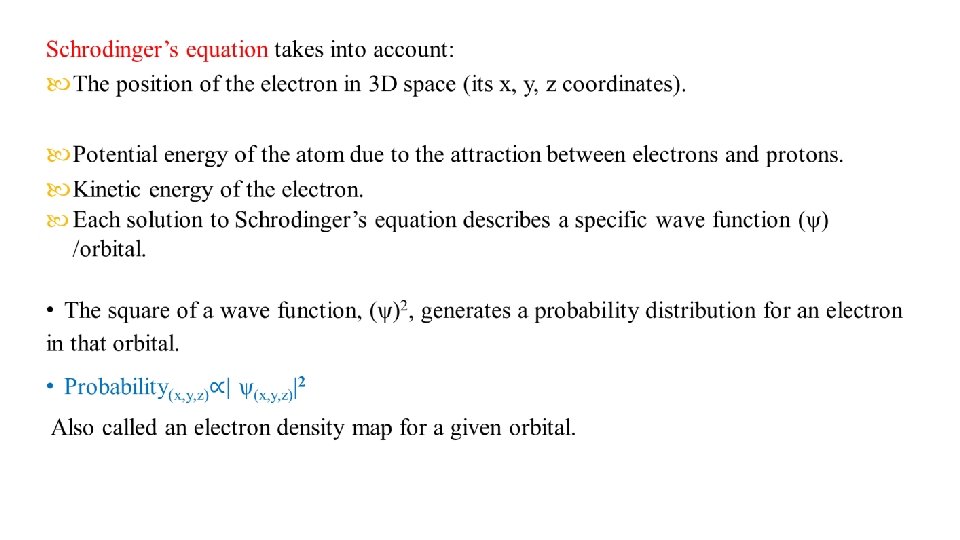
The Quantum-Mechanical Model of the Atom The quantum mechanical model treats electrons as waves and uses wave mathematics to calculate probability densities of finding the electron in a particular region in the atom Schrödinger Wave Equation can only be solved for simple systems, but approximated for others • Erwin Schrödinger applied the mathematics of probability and the ideas of quantitization to the physics equations that describe waves – resulting in an equation that predicts the probability of finding an electron with a particular amount of energy at a particular location in the atom.
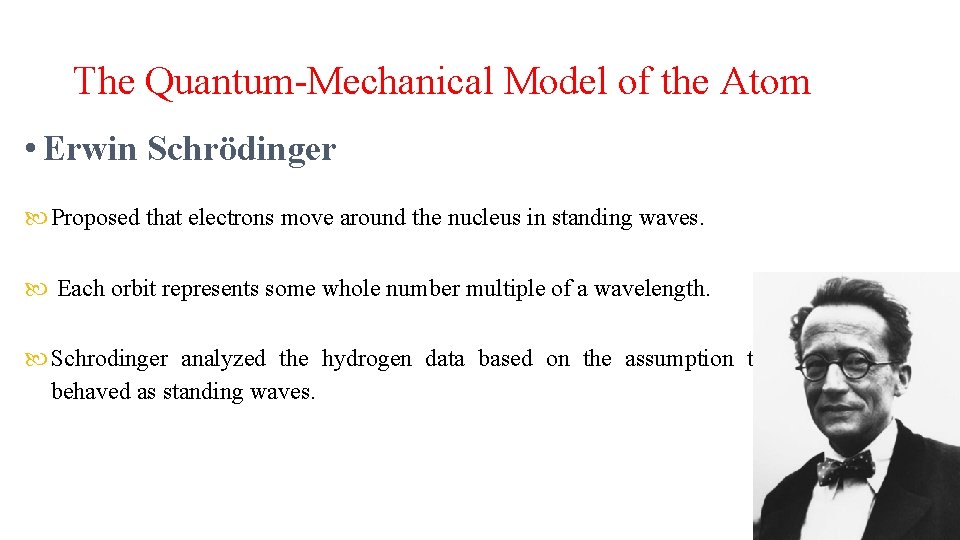
The Quantum-Mechanical Model of the Atom • Erwin Schrödinger Proposed that electrons move around the nucleus in standing waves. Each orbit represents some whole number multiple of a wavelength. Schrodinger analyzed the hydrogen data based on the assumption that the electrons behaved as standing waves.
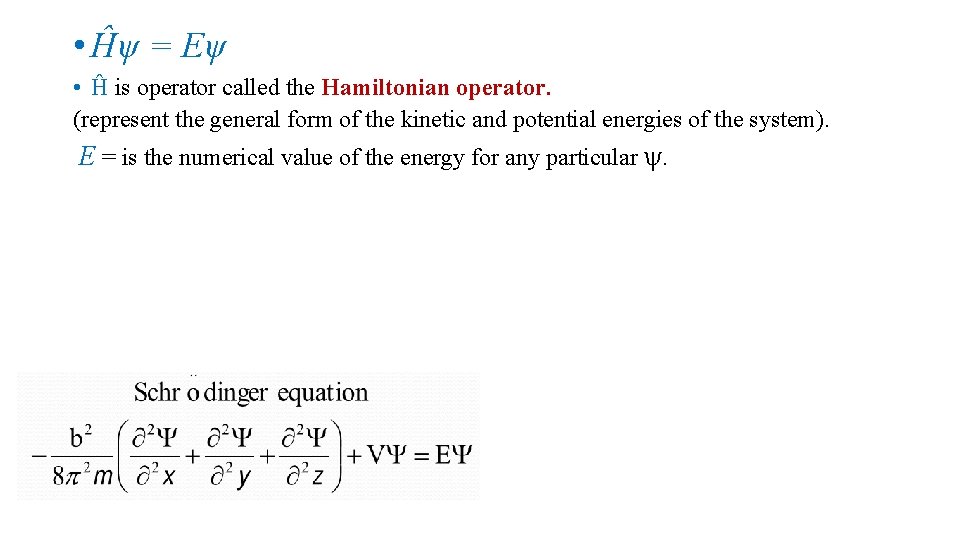
• Ĥψ = Eψ • Ĥ is operator called the Hamiltonian operator. (represent the general form of the kinetic and potential energies of the system). E = is the numerical value of the energy for any particular ѱ.
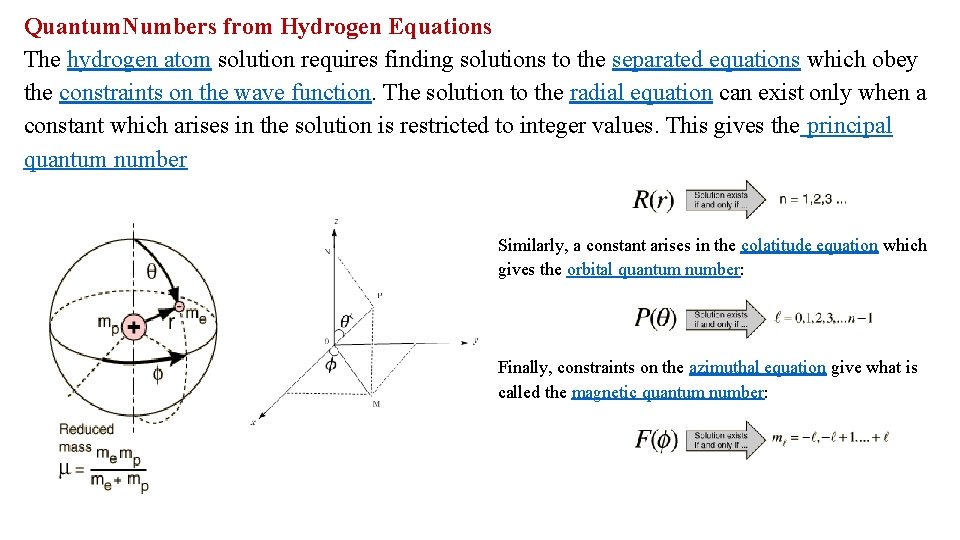
Quantum. Numbers from Hydrogen Equations The hydrogen atom solution requires finding solutions to the separated equations which obey the constraints on the wave function. The solution to the radial equation can exist only when a constant which arises in the solution is restricted to integer values. This gives the principal quantum number Similarly, a constant arises in the colatitude equation which gives the orbital quantum number: Finally, constraints on the azimuthal equation give what is called the magnetic quantum number:
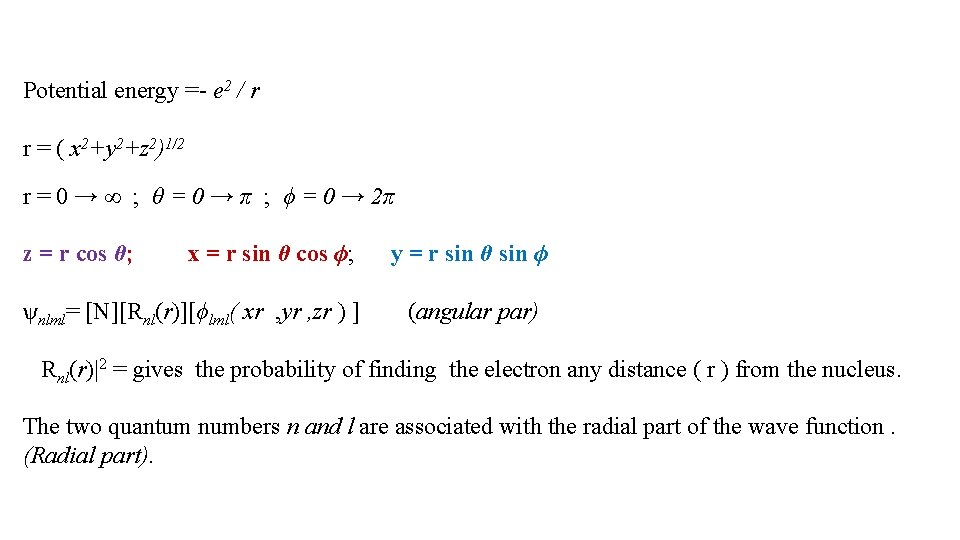
Potential energy =- e 2 / r r = ( x 2+y 2+z 2)1/2 r = 0 → ∞ ; θ = 0 → π ; ϕ = 0 → 2π z = r cos θ; x = r sin θ cos ϕ; ѱnlml= [N][Rnl(r)][ϕlml( xr , yr , zr ) ] y = r sin θ sin ϕ (angular par) Rnl(r)|2 = gives the probability of finding the electron any distance ( r ) from the nucleus. The two quantum numbers n and l are associated with the radial part of the wave function. (Radial part).
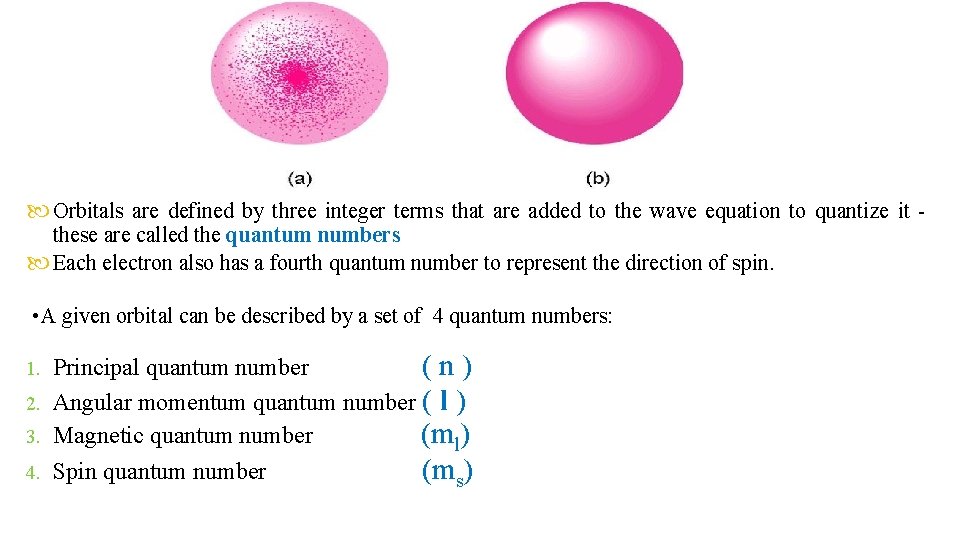
Orbitals The result is a map of regions in the atom that have a particular probability for finding the electron. Orbitals are regions in space where an electron is likely to be found. 90% of the time the electron is within the boundaries described by the electron density map. The exact path of an electron in a given orbital is not known! Schrodinger’s equation allows us to describe the energy, size, and electron density maps for orbitals. The lowest energy solution for an electron in a hydrogen atom describes what is known as the 1 s orbital.
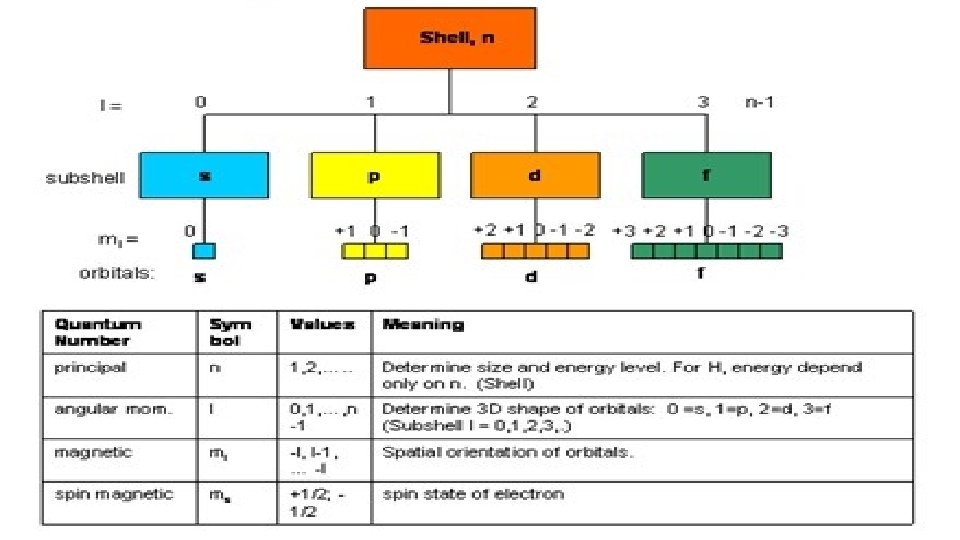
Orbitals are defined by three integer terms that are added to the wave equation to quantize it these are called the quantum numbers Each electron also has a fourth quantum number to represent the direction of spin. • A given orbital can be described by a set of 4 quantum numbers: (n) Angular momentum quantum number ( l ) Magnetic quantum number (ml) Spin quantum number (ms) 1. Principal quantum number 2. 3. 4.
Principal Quantum Number (n) describes the size and energy of the orbital Possible values: whole number integer 1, 2, 3, … As “n” increases so does the size and energy of the orbital. • Angular momentum quantum number (l) Value (l) is related to the shape of the orbital Possible values: (l) is an integer between 0 and n-1. Each (l) value is also assigned a letter designation Letter Designation 0 s 1 p 2 d 3 f
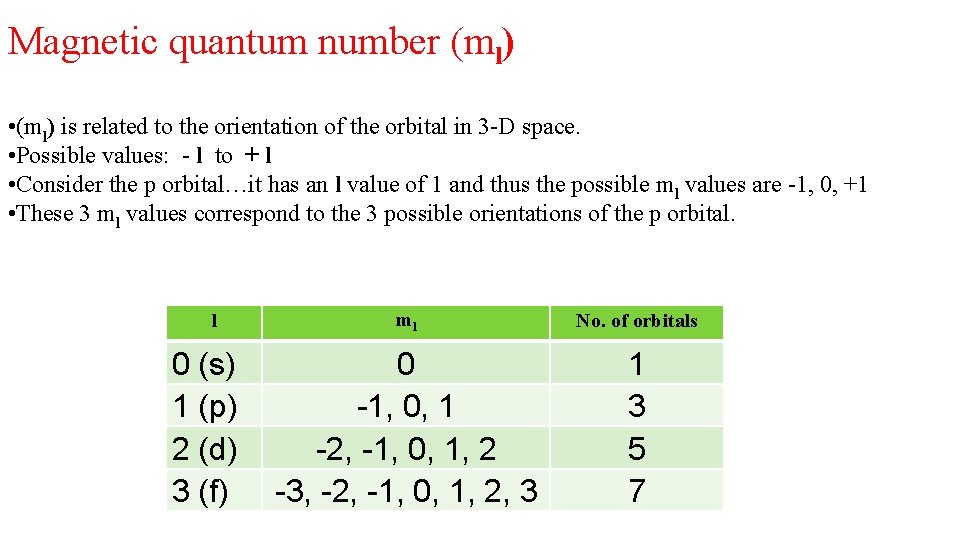
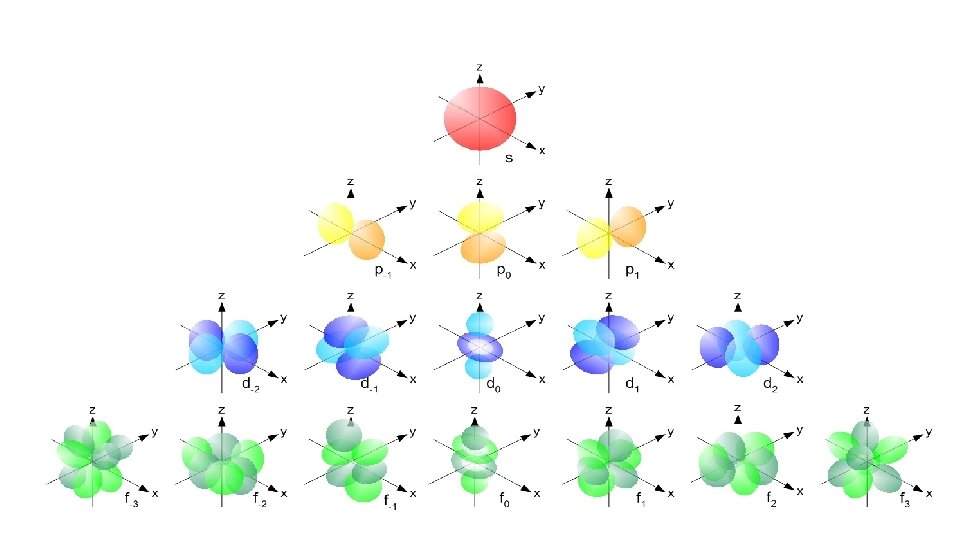
Magnetic quantum number (ml) • (ml) is related to the orientation of the orbital in 3 -D space. • Possible values: - l to + l • Consider the p orbital…it has an l value of 1 and thus the possible ml values are -1, 0, +1 • These 3 ml values correspond to the 3 possible orientations of the p orbital. l 0 (s) 1 (p) 2 (d) 3 (f) ml No. of orbitals 0 -1, 0, 1 -2, -1, 0, 1, 2 -3, -2, -1, 0, 1, 2, 3 1 3 5 7
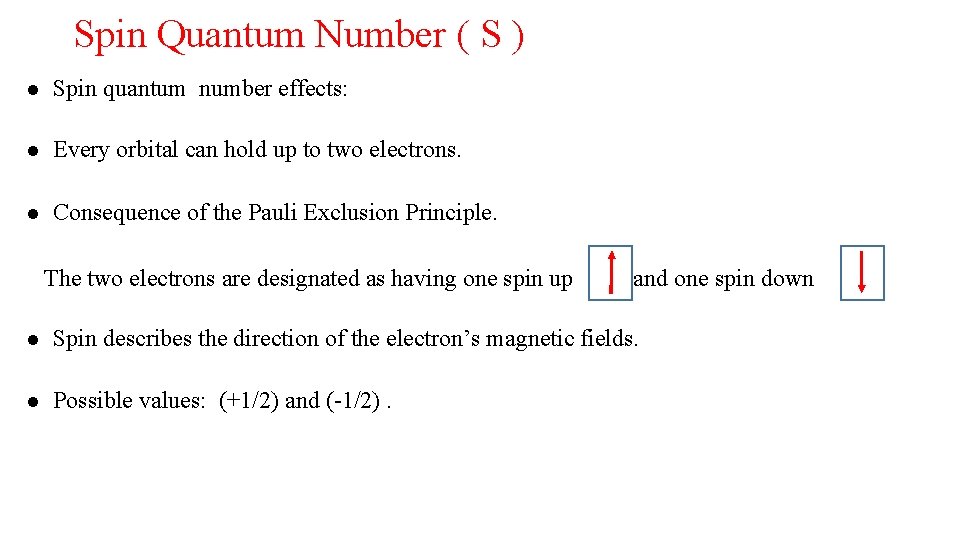
Spin Quantum Number ( S ) Spin quantum number effects: Every orbital can hold up to two electrons. Consequence of the Pauli Exclusion Principle. The two electrons are designated as having one spin up and one spin down Spin describes the direction of the electron’s magnetic fields. Possible values: (+1/2) and (-1/2).
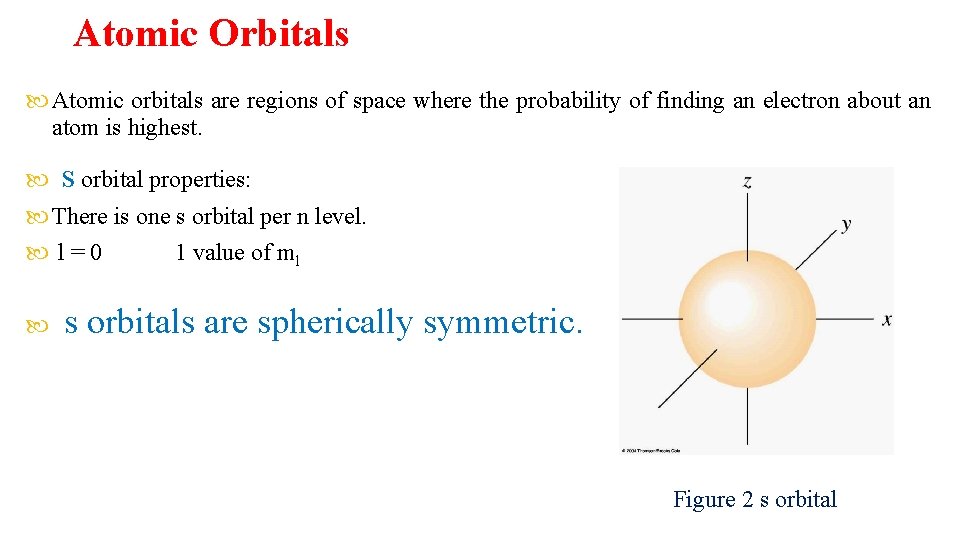
Atomic Orbitals Atomic orbitals are regions of space where the probability of finding an electron about an atom is highest. s orbital properties: There is one s orbital per n level. l=0 1 value of ml s orbitals are spherically symmetric. Figure 2 s orbital
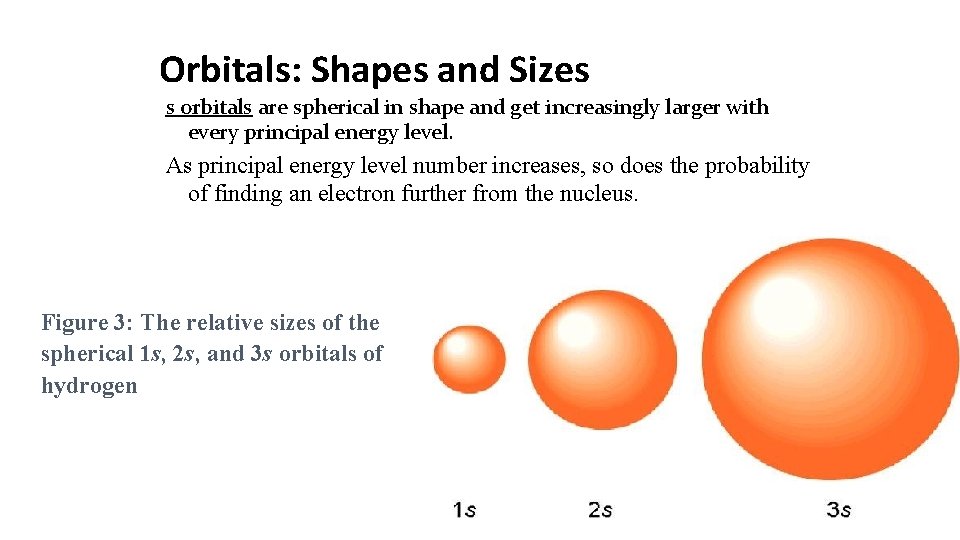
Orbitals: Shapes and Sizes s orbitals are spherical in shape and get increasingly larger with every principal energy level. As principal energy level number increases, so does the probability of finding an electron further from the nucleus. Figure 3: The relative sizes of the spherical 1 s, 2 s, and 3 s orbitals of hydrogen
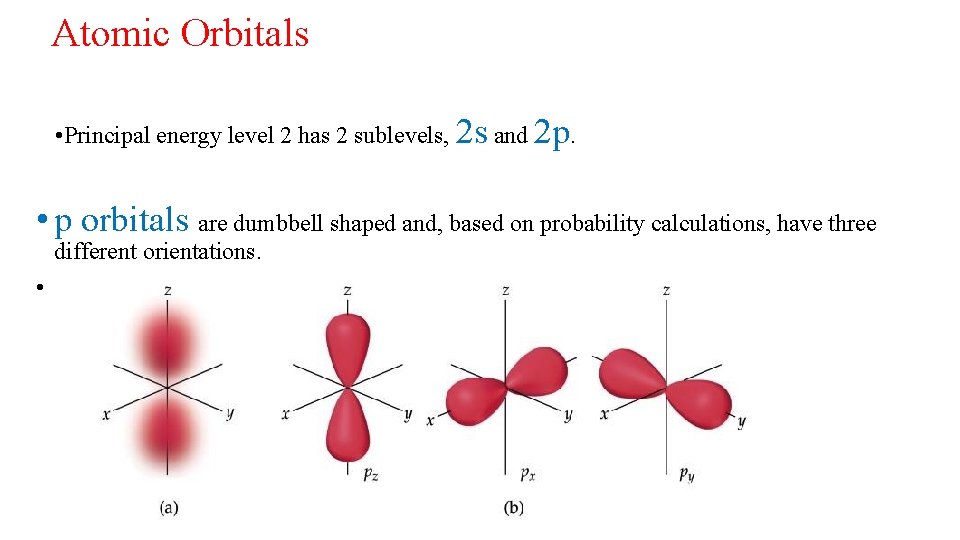
Atomic Orbitals • Principal energy level 2 has 2 sublevels, 2 s and 2 p. • p orbitals are dumbbell shaped and, based on probability calculations, have three different orientations. •
• The 3 p, 4 p, 5 p…orbitals have the same shape, but are larger and further away from the nucleus. Same trend as s orbitals. p orbital properties: The first p orbitals appear in the n = 2 shell. p orbitals are peanut or dumbbell shaped volumes. They are directed along the axis of a Cartesian coordinate system. There are 3 p orbitals per n level. The three orbitals are named px, py, pz. They have an l = 1. ml = -1, 0, +1 3 values of ml
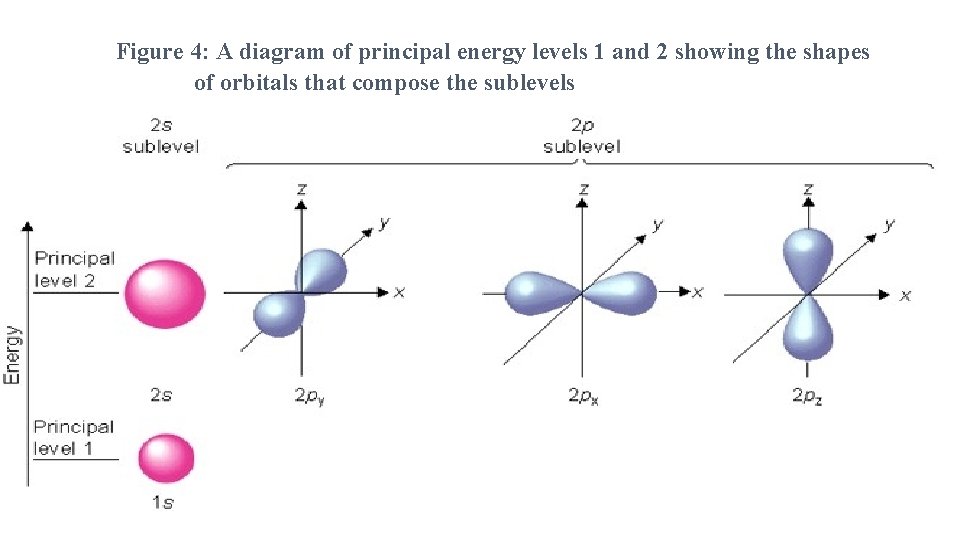
Figure 4: A diagram of principal energy levels 1 and 2 showing the shapes of orbitals that compose the sublevels
• d orbital properties: • The first d orbitals appear in the n = 3 shell. • The five d orbitals have two different shapes: - 4 are clover leaf shaped. - 1 is peanut shaped with a doughnut around it. • The orbitals lie directly on the Cartesian axes or are rotated 45 o from the axes. There are 5 d orbitals per n level. The five orbitals are named dxy, dyz, dx 2 -y 2 , dz 2 They have an l = 2. ml = -2, -1, 0, +1, +2 (5 values of m l )
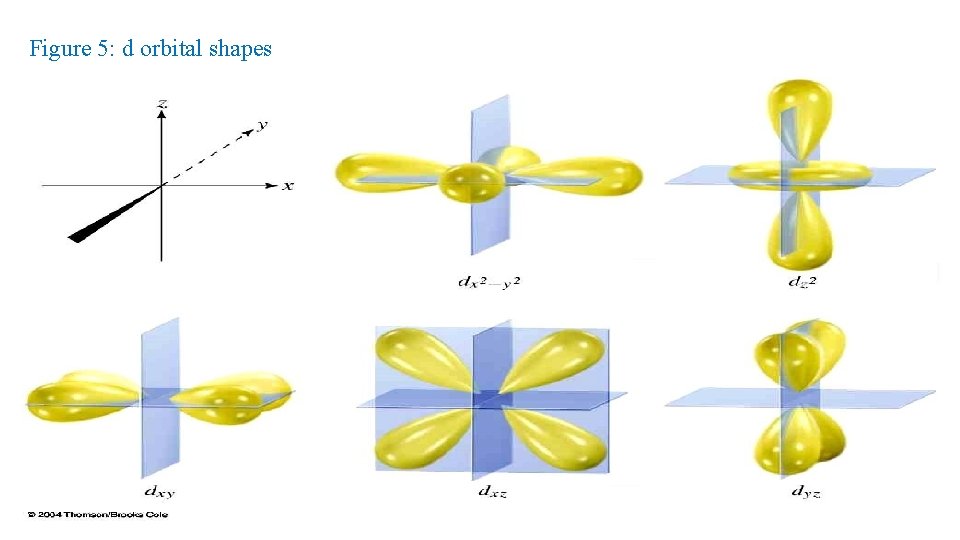
Figure 5: d orbital shapes
f orbital properties: The first f orbitals appear in the n = 4 shell. The f orbitals have the most complex shapes. There are seven f orbitals per n level. The f orbitals have complicated names. They have an l = 3 ml = -3, -2, -1, 0, +1, +2, +3 7 values of ml • The f orbitals have important effects in the lanthanide
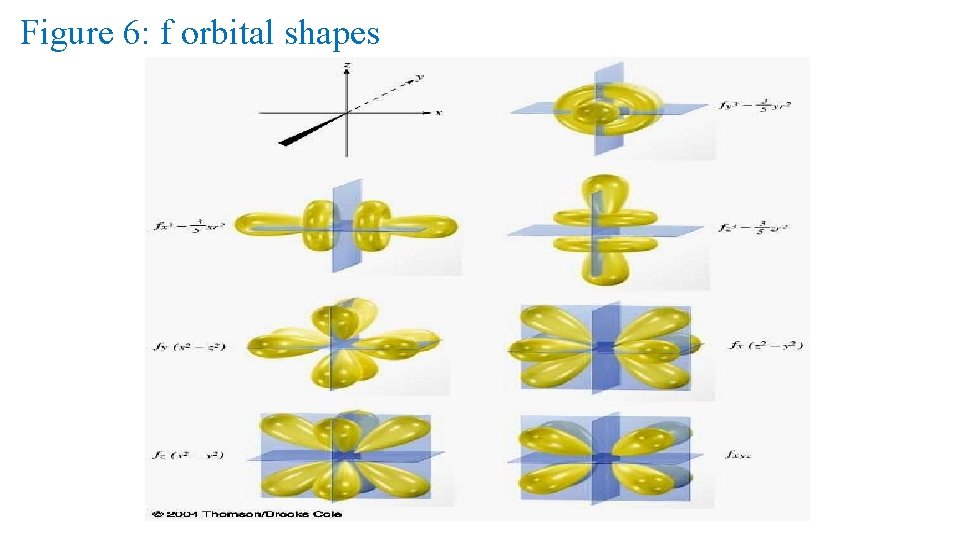
Figure 6: f orbital shapes
Subshells and Orbitals the subshells of a principal shell have slightly different energies. the subshells in a shell of H all have the same energy, but for multielectron atoms the subshells have different energies. s<p<d<f each subshell contains one or more orbitals s subshells have 1 orbital p subshells have 3 orbitals d subshells have 5 orbitals f subshells have 7 orbitals
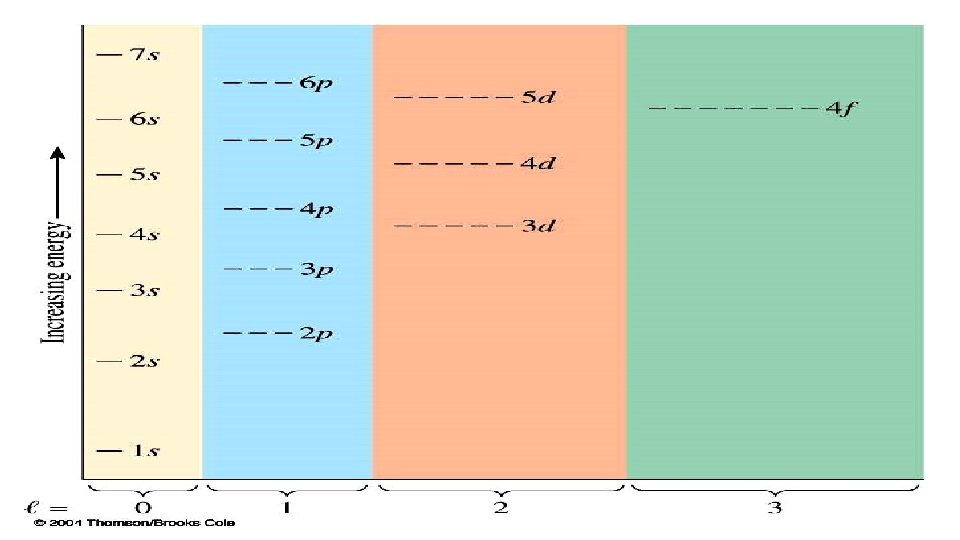
Orbitals, Sublevels & Electrons for a many electron atom, build-up the energy levels, filling each orbital in succession by energy ground state 1 s < 2 p < 3 s < 3 p < 4 s < 3 d < 4 p < 5 s < 4 d < 5 p < 6 s < 4 f < 5 d < 6 p < 7 s < 5 f < 6 d < 7 p. degenerate orbitals are orbitals with the same energy. each p sublevel has 3 degenerate p orbitals each d sublevel has 5 degenerate d orbitals each f sublevel has 7 degenerate f orbitals
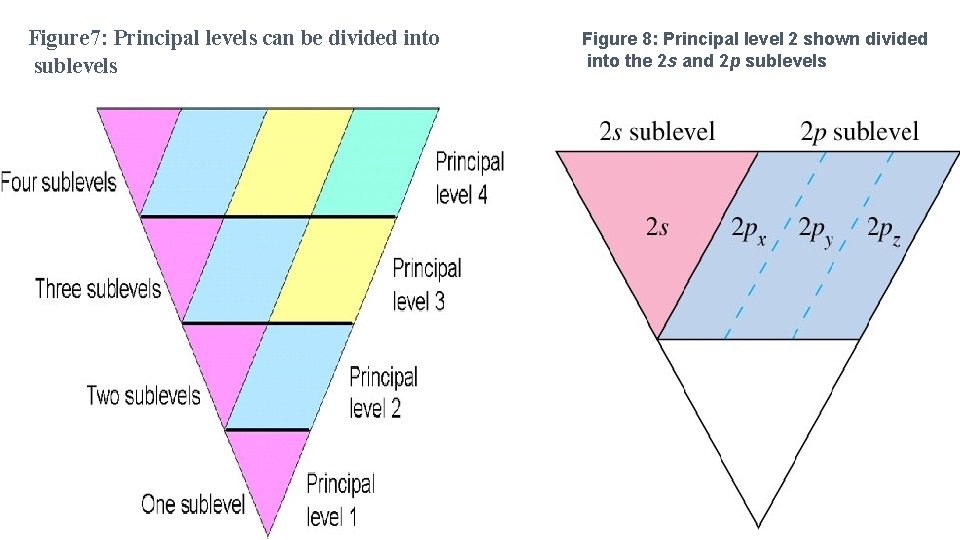
Figure 7: Principal levels can be divided into sublevels Figure 8: Principal level 2 shown divided into the 2 s and 2 p sublevels
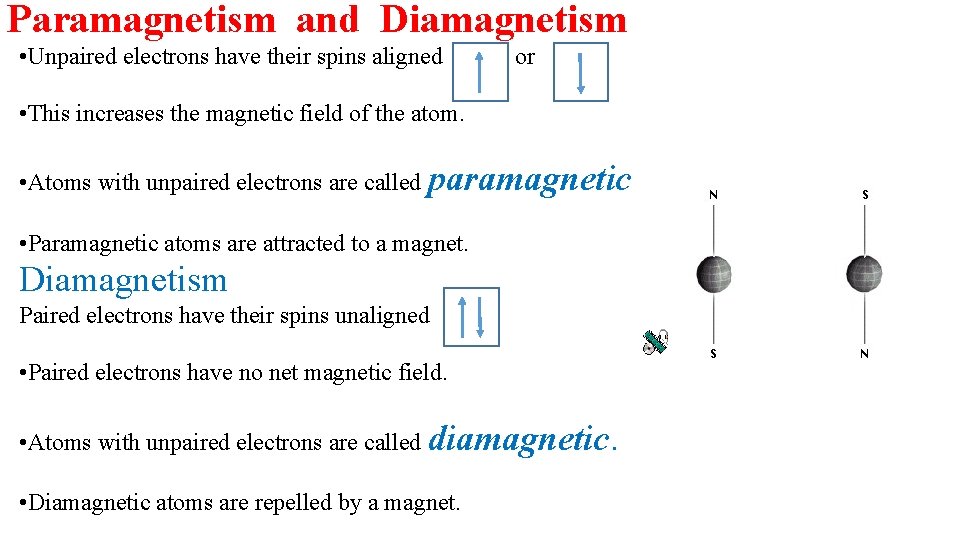
Paramagnetism and Diamagnetism • Unpaired electrons have their spins aligned or • This increases the magnetic field of the atom. • Atoms with unpaired electrons are called paramagnetic. • Paramagnetic atoms are attracted to a magnet. Diamagnetism Paired electrons have their spins unaligned • Paired electrons have no net magnetic field. • Atoms with unpaired electrons are called diamagnetic. • Diamagnetic atoms are repelled by a magnet.
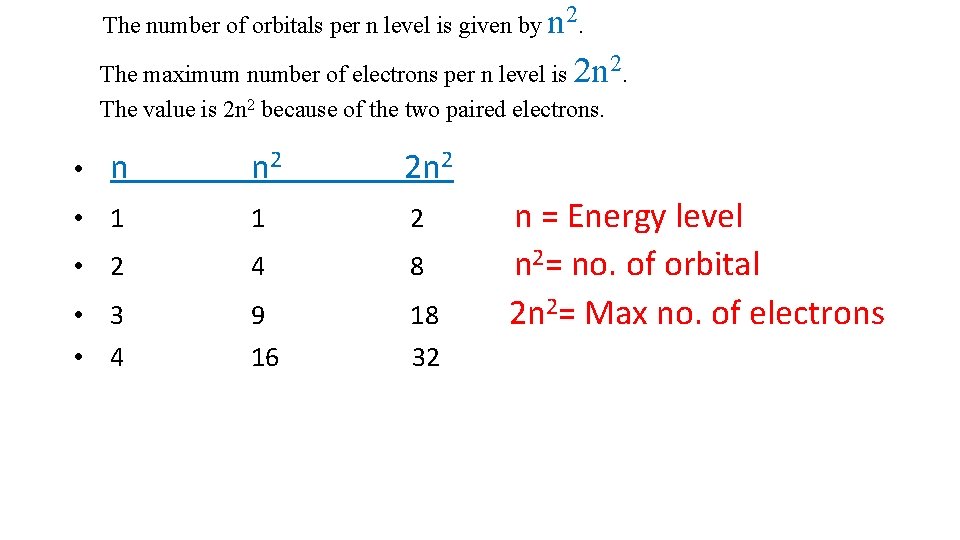
The number of orbitals per n level is given by n 2. The maximum number of electrons per n level is 2 n 2. The value is 2 n 2 because of the two paired electrons. n 2 2 n 2 • 1 1 2 • 2 4 8 • 3 • 4 9 18 16 32 • n n = Energy level n 2= no. of orbital 2 n 2= Max no. of electrons
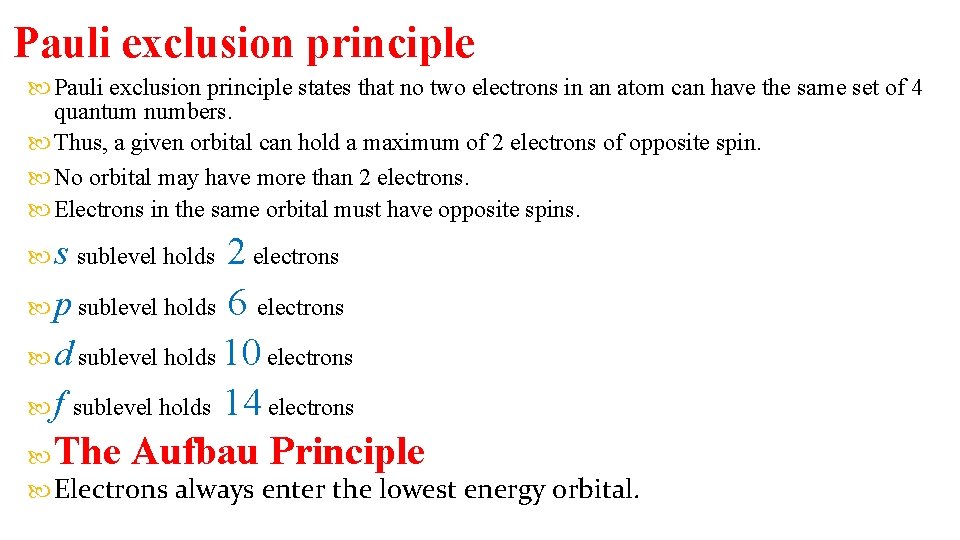
Pauli exclusion principle states that no two electrons in an atom can have the same set of 4 quantum numbers. Thus, a given orbital can hold a maximum of 2 electrons of opposite spin. No orbital may have more than 2 electrons. Electrons in the same orbital must have opposite spins. 2 electrons p sublevel holds 6 electrons d sublevel holds 10 electrons f sublevel holds 14 electrons The Aufbau Principle s sublevel holds Electrons always enter the lowest energy orbital.
Electron configuration the distribution of electrons into the various energy shells and subshells in an atom in its ground state is called its electron configuration. each energy shell and subshell has a maximum number of electrons it can hold s = 2, p = 6, d = 10, f = 14 we place electrons in the energy shells and subshells in order of energy, from low energy up (Aufbau Principal). Filling an Orbital with Electrons each orbital may have a maximum of 2 electrons (Pauli Exclusion Principle). electrons spin on an axis (generating their own magnetic field). when two electrons are in the same orbital, they must have opposite spins (so there magnetic fields will cancel).
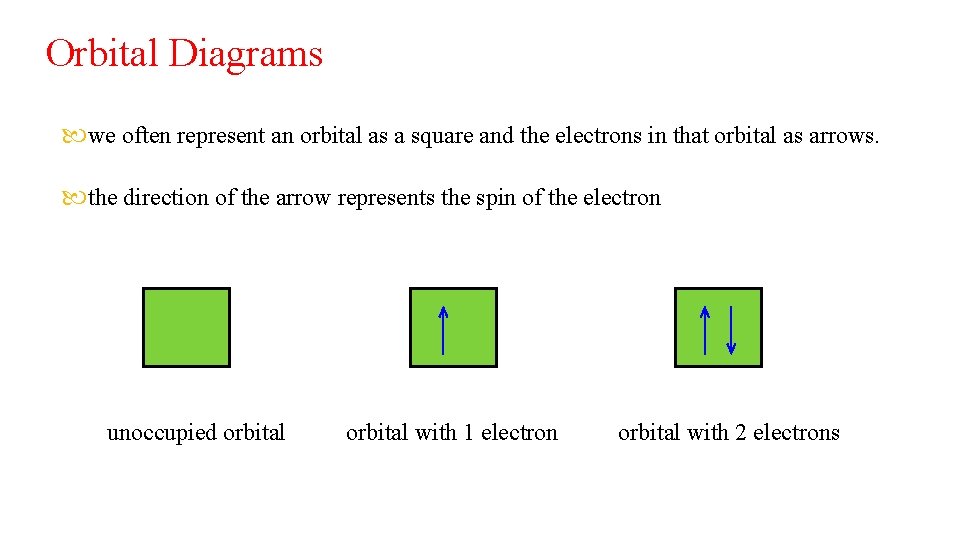
Orbital Diagrams we often represent an orbital as a square and the electrons in that orbital as arrows. the direction of the arrow represents the spin of the electron unoccupied orbital with 1 electron orbital with 2 electrons
Filling the Orbitals in a Subshell with Electrons energy shells fill from lowest energy to high subshells fill from lowest energy to high s → p → d → f orbitals that are in the same subshell have the same energy when filling orbitals that have the same energy, place one electron in each before completing pairs Hund’s Rule The Aufbau Principle describes the electron filling order in atoms.
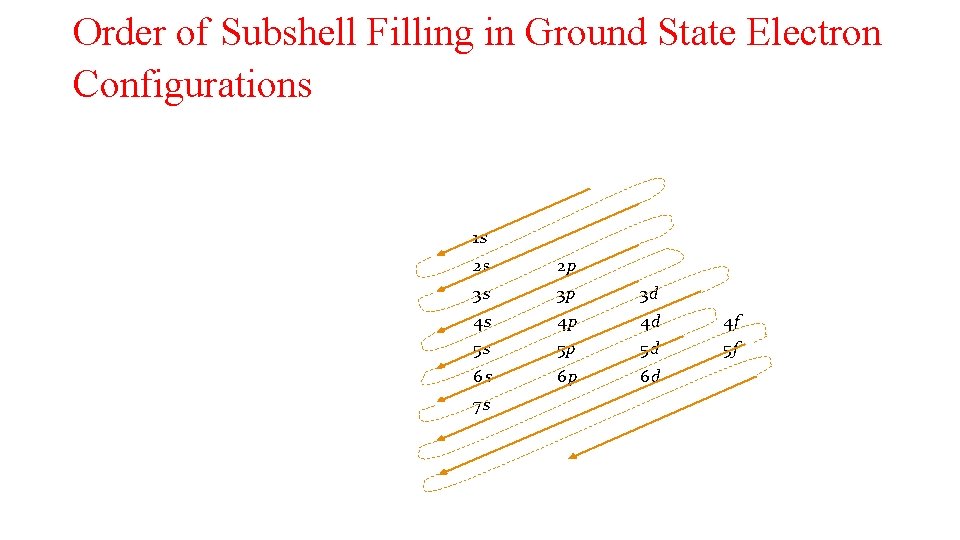
Order of Subshell Filling in Ground State Electron Configurations 1 s 2 s 2 p 3 s 3 p 3 d 4 s 4 p 4 d 4 f 5 s 5 p 5 d 5 f 6 s 6 p 6 d 7 s
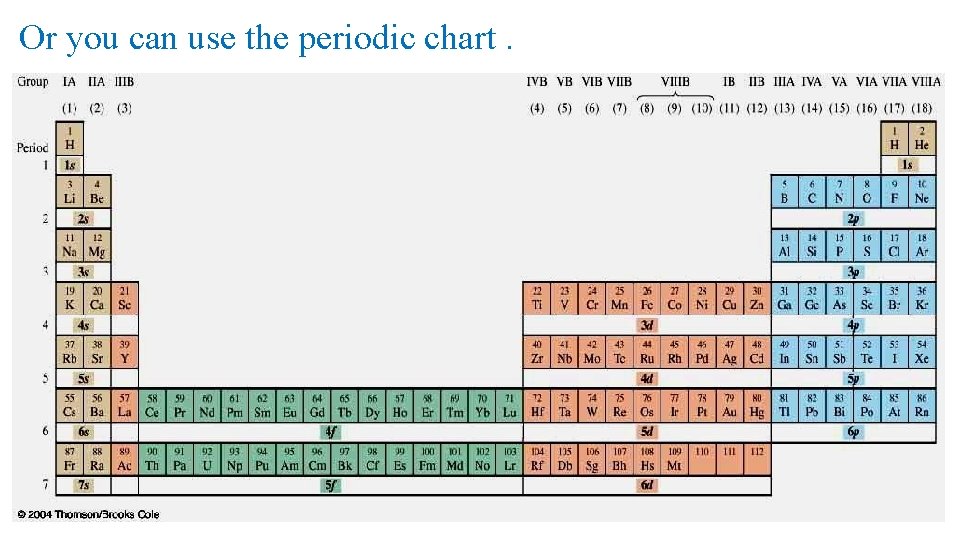
Or you can use the periodic chart.
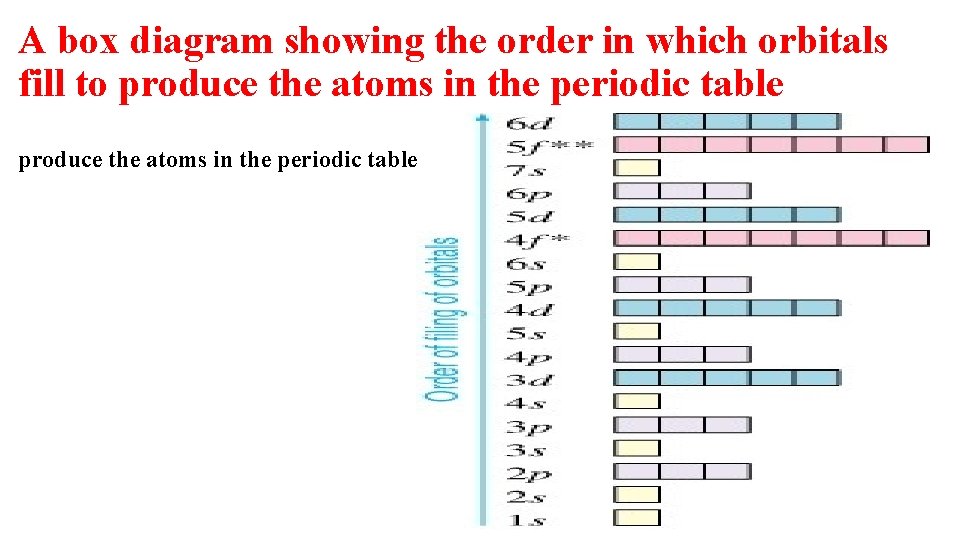
A box diagram showing the order in which orbitals fill to produce the atoms in the periodic table
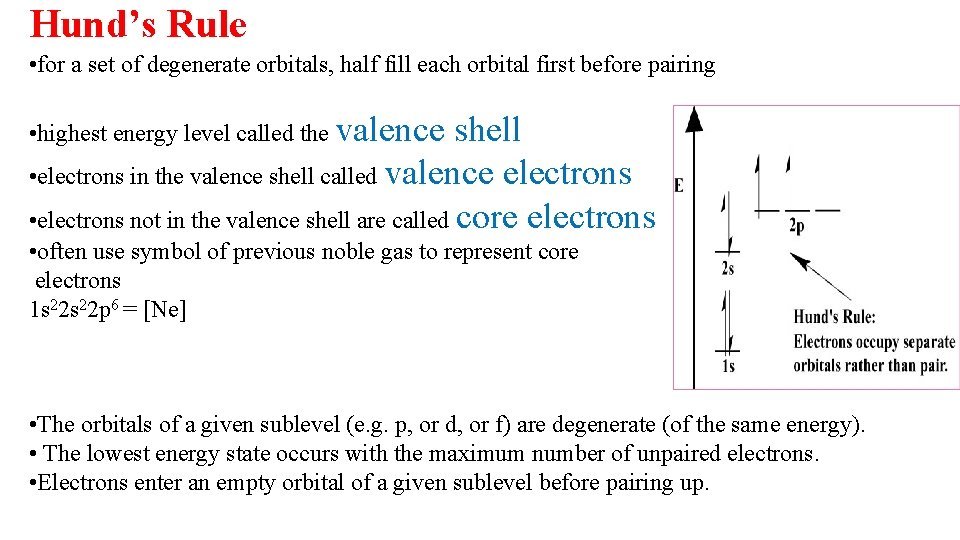
Hund’s Rule • for a set of degenerate orbitals, half fill each orbital first before pairing • highest energy level called the valence shell • electrons in the valence shell called valence electrons • electrons not in the valence shell are called core electrons • often use symbol of previous noble gas to represent core electrons 1 s 22 p 6 = [Ne] • The orbitals of a given sublevel (e. g. p, or d, or f) are degenerate (of the same energy). • The lowest energy state occurs with the maximum number of unpaired electrons. • Electrons enter an empty orbital of a given sublevel before pairing up.
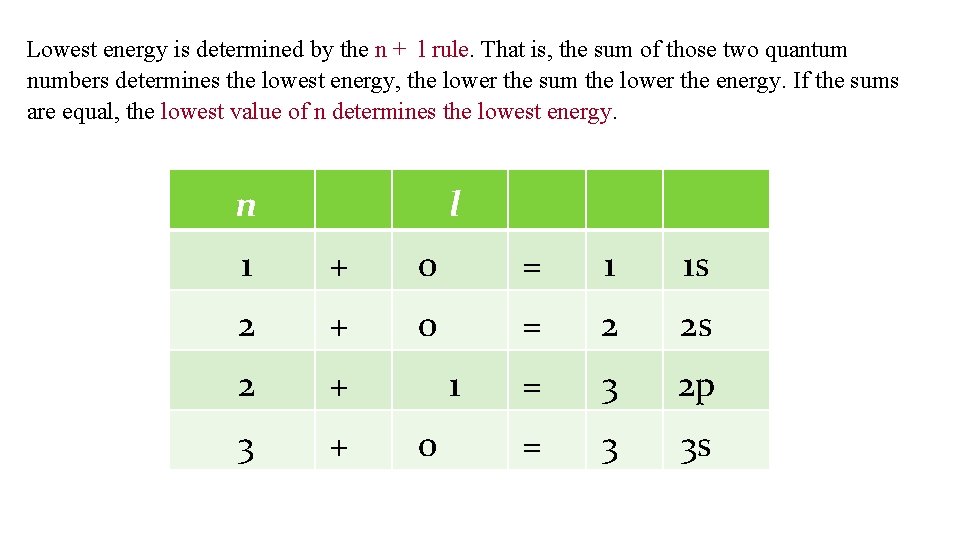
Lowest energy is determined by the n + l rule. That is, the sum of those two quantum numbers determines the lowest energy, the lower the sum the lower the energy. If the sums are equal, the lowest value of n determines the lowest energy. n l 1 + 0 = 1 1 s 2 + 0 = 2 2 s 2 + = 3 2 p 3 + = 3 3 s 1 0
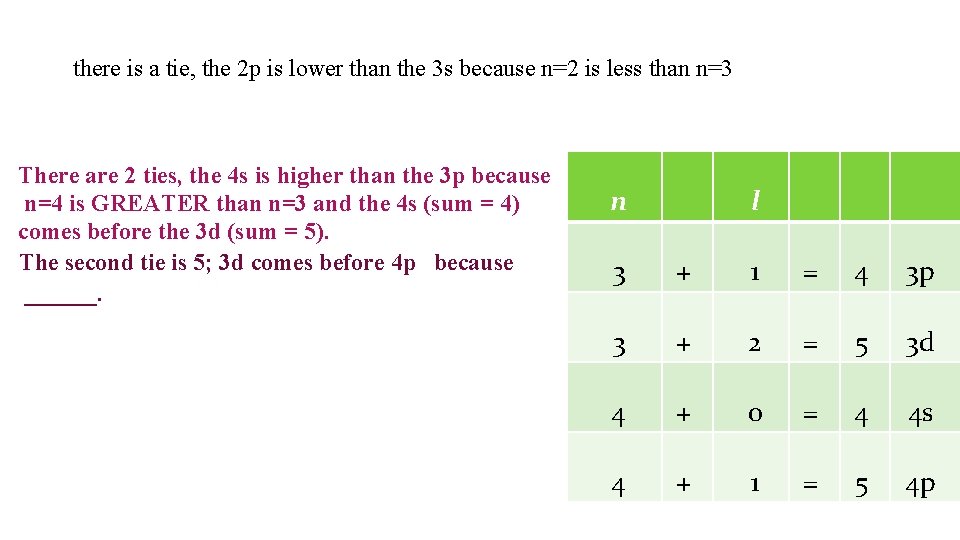
there is a tie, the 2 p is lower than the 3 s because n=2 is less than n=3 There are 2 ties, the 4 s is higher than the 3 p because n=4 is GREATER than n=3 and the 4 s (sum = 4) comes before the 3 d (sum = 5). The second tie is 5; 3 d comes before 4 p because ______. n l 3 + 1 = 4 3 p 3 + 2 = 5 3 d 4 + 0 = 4 4 s 4 + 1 = 5 4 p
Electron Configuration of Atoms in their Ground State the electron configuration is a listing of the subshells in order of filling with the number of electrons in that subshell written as a superscript • Kr = 36 electrons = 1 s 22 p 63 s 23 p 64 s 23 d 104 p 6 a shorthand way of writing an electron configuration is to use the symbol of the previous noble gas in [] to represent all the inner electrons, then just write the last set • Rb = 37 electrons = 1 s 22 p 63 s 23 p 64 s 23 d 104 p 65 s 1 = [Kr]5 s 1
Example – Write the Ground State Orbital Diagram and Electron Configuration of Magnesium. • 1. Determine the atomic number of the element from the Periodic Table This gives the number of protons and electrons in the atom • Mg Z = 12, so Mg has 12 protons and 12 electrons • Filling of orbitals for elements Z = 1 to 18 (H to Ar)
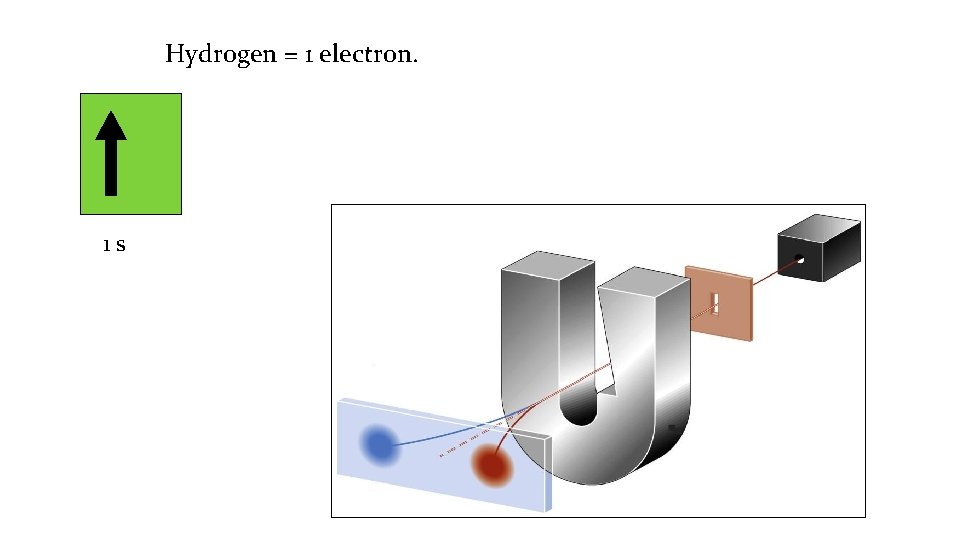
Hydrogen = 1 electron. 1 s
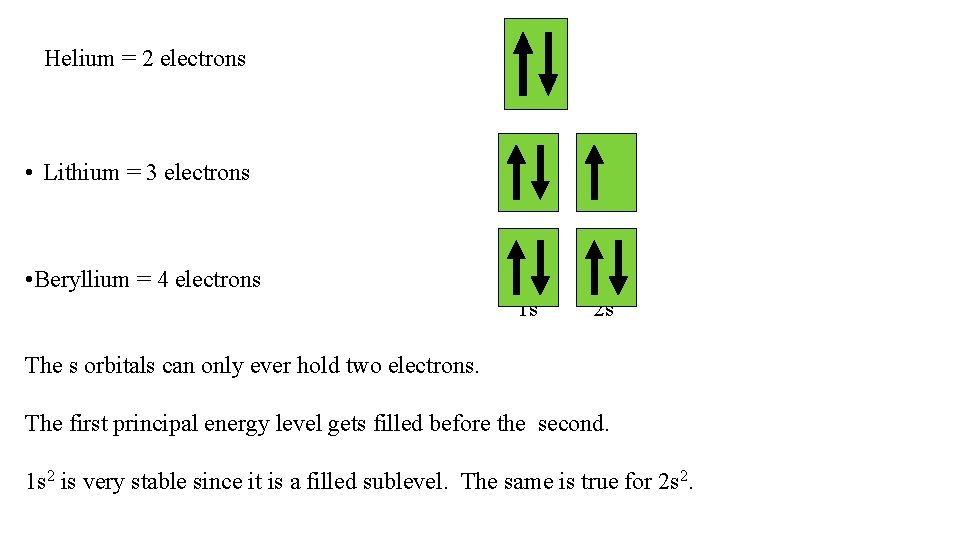
Helium = 2 electrons • Lithium = 3 electrons • Beryllium = 4 electrons 1 s 2 s The s orbitals can only ever hold two electrons. The first principal energy level gets filled before the second. 1 s 2 is very stable since it is a filled sublevel. The same is true for 2 s 2.
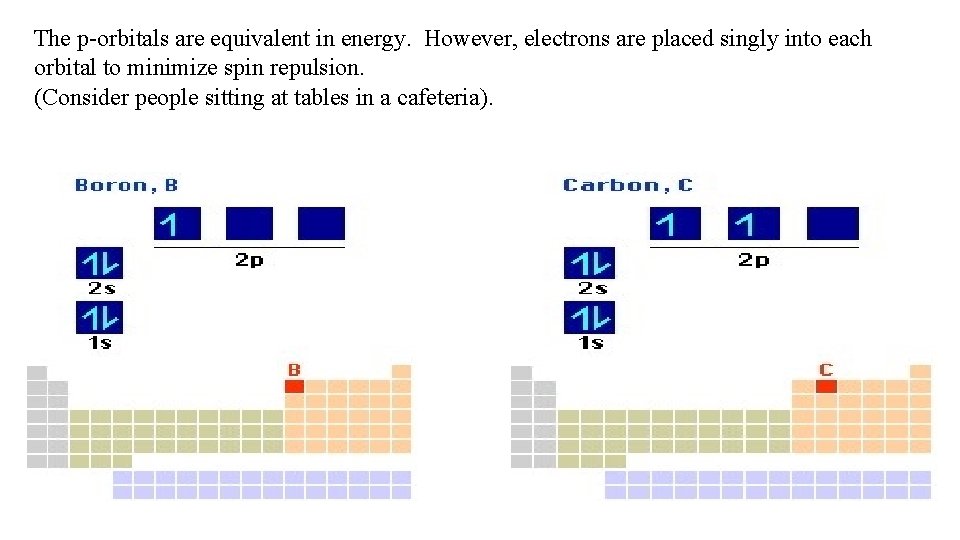
The p-orbitals are equivalent in energy. However, electrons are placed singly into each orbital to minimize spin repulsion. (Consider people sitting at tables in a cafeteria).
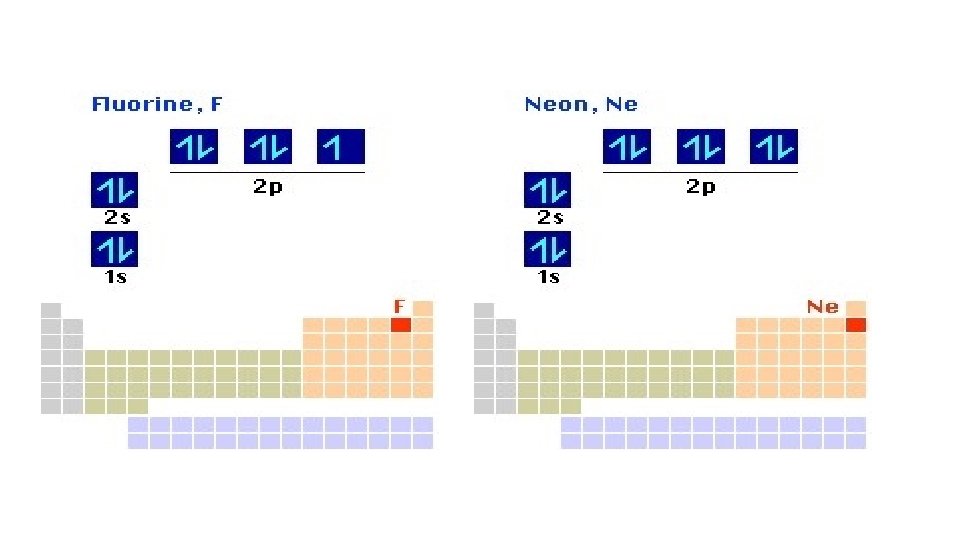
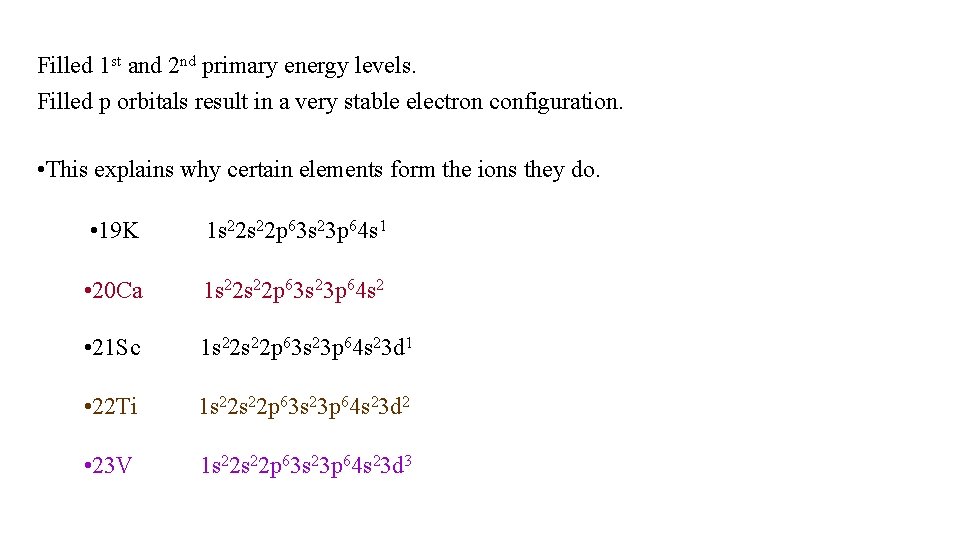
Filled 1 st and 2 nd primary energy levels. Filled p orbitals result in a very stable electron configuration. • This explains why certain elements form the ions they do. • 19 K 1 s 22 p 63 s 23 p 64 s 1 • 20 Ca 1 s 22 p 63 s 23 p 64 s 2 • 21 Sc 1 s 22 p 63 s 23 p 64 s 23 d 1 • 22 Ti 1 s 22 p 63 s 23 p 64 s 23 d 2 • 23 V 1 s 22 p 63 s 23 p 64 s 23 d 3
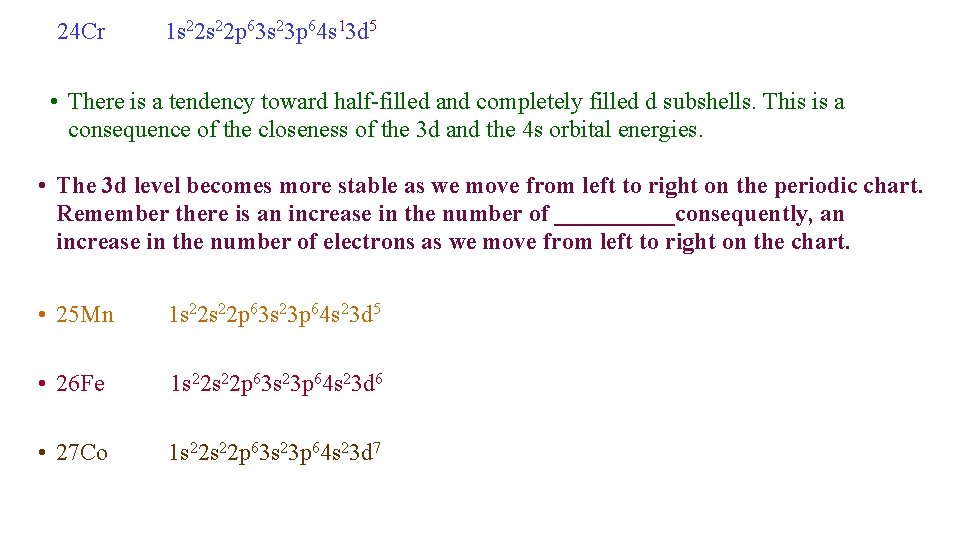
24 Cr 1 s 22 p 63 s 23 p 64 s 13 d 5 • There is a tendency toward half-filled and completely filled d subshells. This is a consequence of the closeness of the 3 d and the 4 s orbital energies. • The 3 d level becomes more stable as we move from left to right on the periodic chart. Remember there is an increase in the number of _____consequently, an increase in the number of electrons as we move from left to right on the chart. • 25 Mn 1 s 22 p 63 s 23 p 64 s 23 d 5 • 26 Fe 1 s 22 p 63 s 23 p 64 s 23 d 6 • 27 Co 1 s 22 p 63 s 23 p 64 s 23 d 7
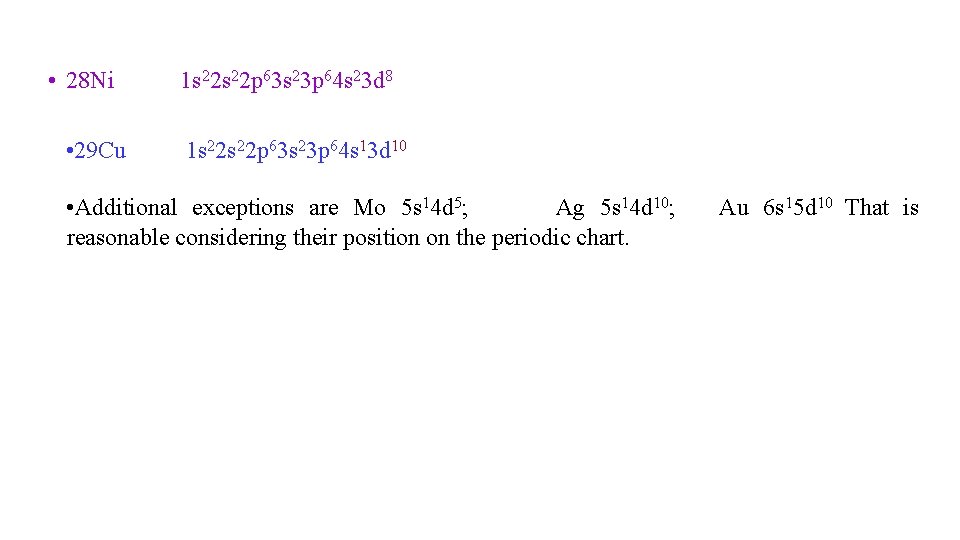
• 28 Ni • 29 Cu 1 s 22 p 63 s 23 p 64 s 23 d 8 1 s 22 p 63 s 23 p 64 s 13 d 10 • Additional exceptions are Mo 5 s 14 d 5; Ag 5 s 14 d 10; reasonable considering their position on the periodic chart. Au 6 s 15 d 10 That is
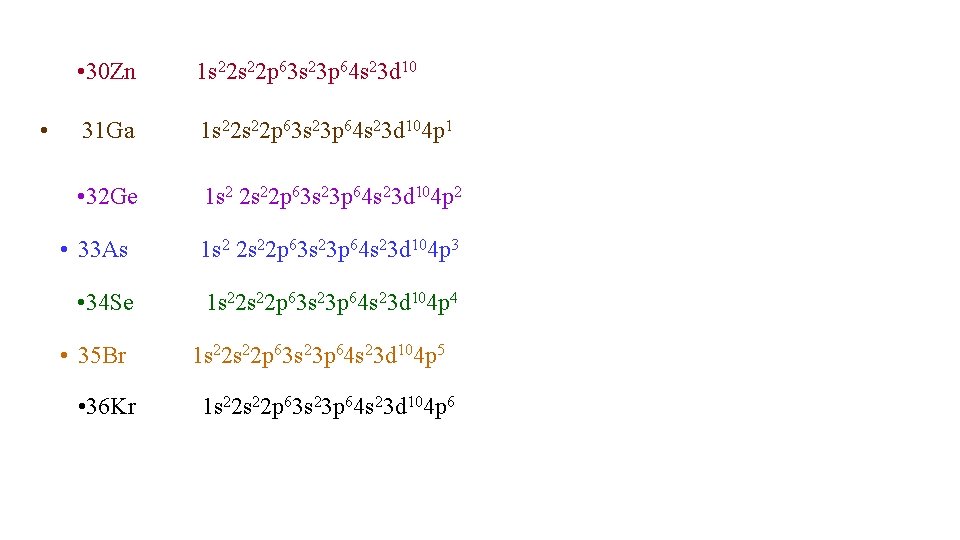
• • 30 Zn 1 s 22 p 63 s 23 p 64 s 23 d 10 31 Ga 1 s 22 p 63 s 23 p 64 s 23 d 104 p 1 • 32 Ge 1 s 2 2 s 22 p 63 s 23 p 64 s 23 d 104 p 2 • 33 As 1 s 2 2 s 22 p 63 s 23 p 64 s 23 d 104 p 3 • 34 Se 1 s 22 p 63 s 23 p 64 s 23 d 104 p 4 • 35 Br • 36 Kr 1 s 22 p 63 s 23 p 64 s 23 d 104 p 5 1 s 22 p 63 s 23 p 64 s 23 d 104 p 6
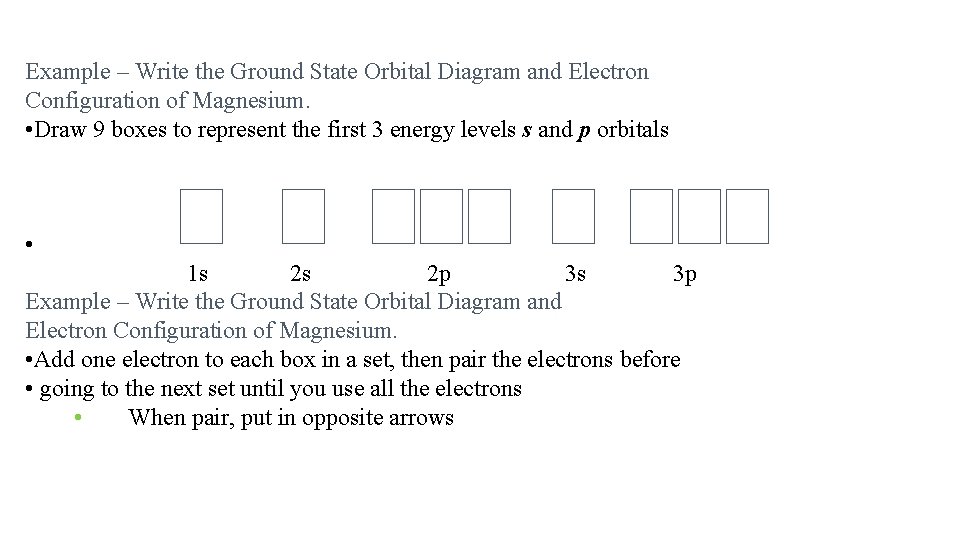
Example – Write the Ground State Orbital Diagram and Electron Configuration of Magnesium. • Draw 9 boxes to represent the first 3 energy levels s and p orbitals • 1 s 2 s 2 p 3 s 3 p Example – Write the Ground State Orbital Diagram and Electron Configuration of Magnesium. • Add one electron to each box in a set, then pair the electrons before • going to the next set until you use all the electrons • When pair, put in opposite arrows
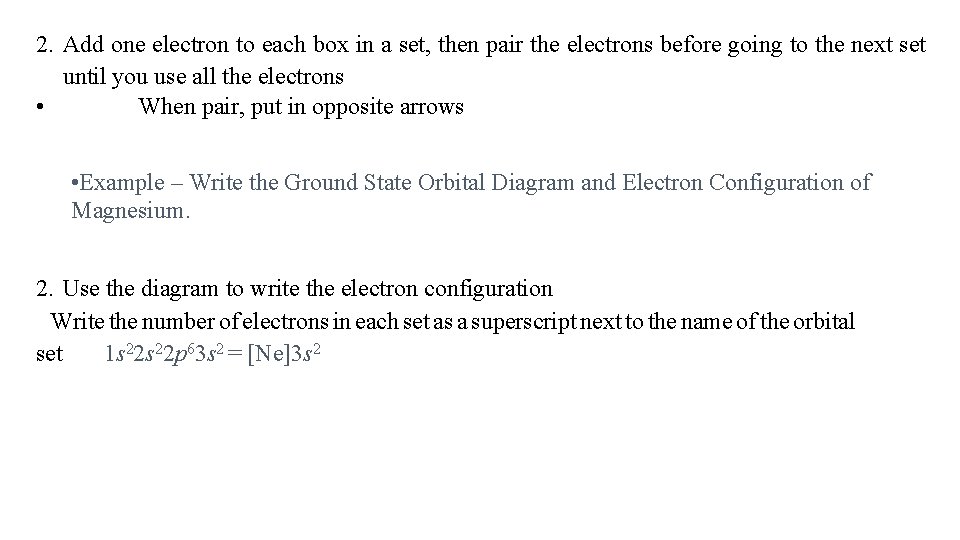
2. Add one electron to each box in a set, then pair the electrons before going to the next set until you use all the electrons • When pair, put in opposite arrows • Example – Write the Ground State Orbital Diagram and Electron Configuration of Magnesium. 2. Use the diagram to write the electron configuration Write the number of electrons in each set as a superscript next to the name of the orbital set 1 s 22 p 63 s 2 = [Ne]3 s 2
• Valence Electrons the electrons in all the subshells with the highest principal energy shell are called the valence electrons in lower energy shells are called core electrons. chemists have observed that one of the most important factors in the way an atom behaves, both chemically and physically, is the number of valence electrons.
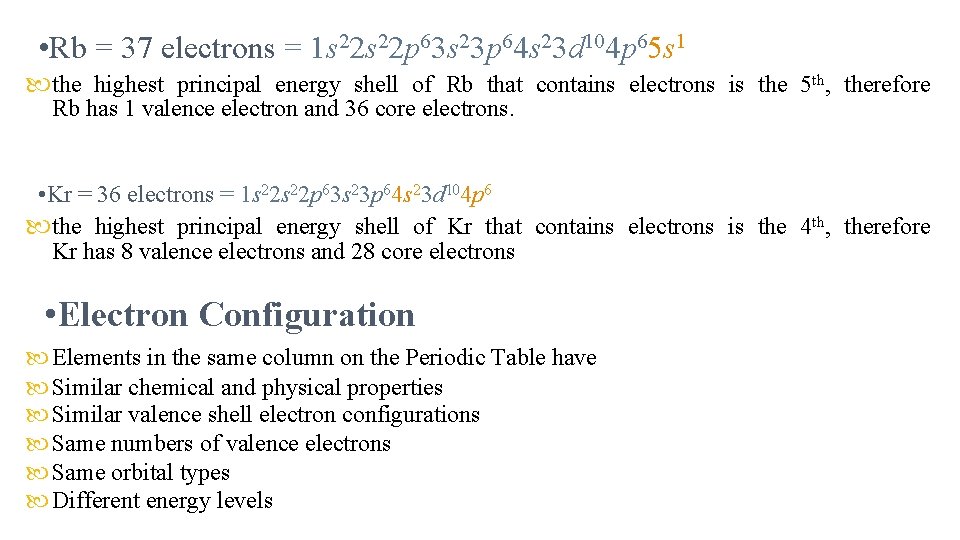
• Rb = 37 electrons = 1 s 22 p 63 s 23 p 64 s 23 d 104 p 65 s 1 the highest principal energy shell of Rb that contains electrons is the 5 th, therefore Rb has 1 valence electron and 36 core electrons. • Kr = 36 electrons = 1 s 22 p 63 s 23 p 64 s 23 d 104 p 6 the highest principal energy shell of Kr that contains electrons is the 4 th, therefore Kr has 8 valence electrons and 28 core electrons • Electron Configuration Elements in the same column on the Periodic Table have Similar chemical and physical properties Similar valence shell electron configurations Same numbers of valence electrons Same orbital types Different energy levels
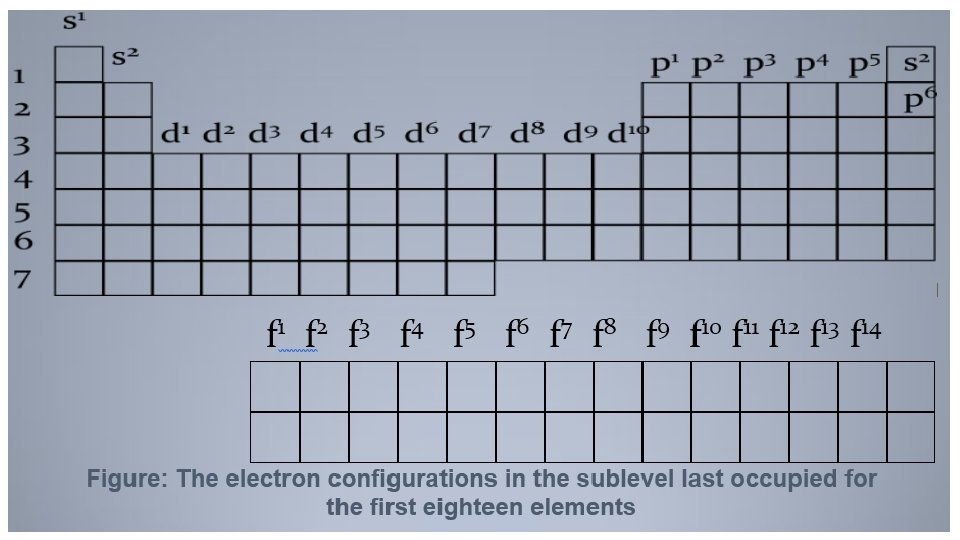
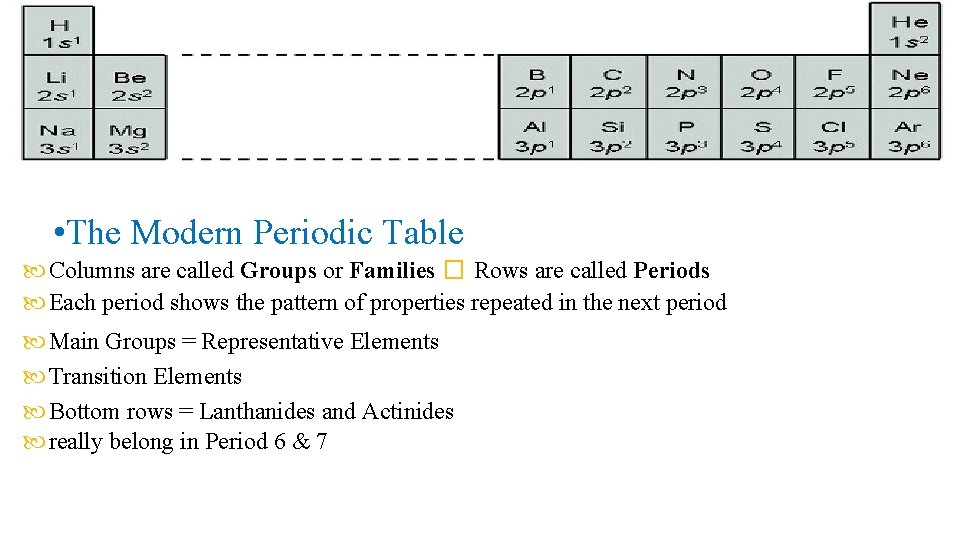
• The Modern Periodic Table Columns are called Groups or Families � Rows are called Periods Each period shows the pattern of properties repeated in the next period Main Groups = Representative Elements Transition Elements Bottom rows = Lanthanides and Actinides really belong in Period 6 & 7
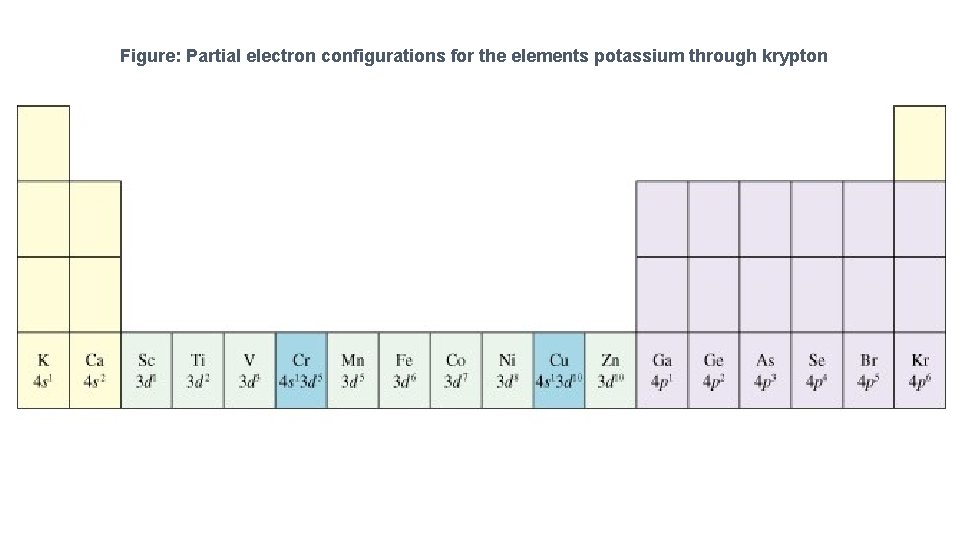
Figure: Partial electron configurations for the elements potassium through krypton
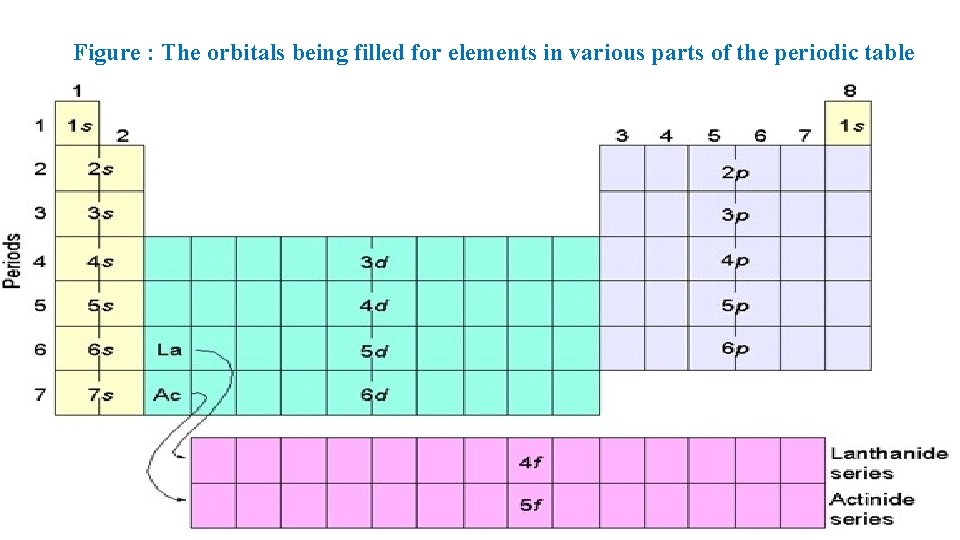
Figure : The orbitals being filled for elements in various parts of the periodic table
Synthesis Question What is the atomic number of the element that should theoretically be the noble gas below Rn? The 6 d’s are completed with element 112 and the 7 p’s are completed with element 118. Thus the next noble gas (or perhaps it will be a noble liquid) should be element 118. • Group Question • � In a universe different from ours, the laws of quantum mechanics are the same as ours with one small change. Electrons in this universe have three spin states, -1, 0, and +1, rather than the two, +1/2 and -1/2, that we have. What two elements in this universe would be the first and second noble gases? (Assume that the elements in this different universe have the same symbols as in ours. )
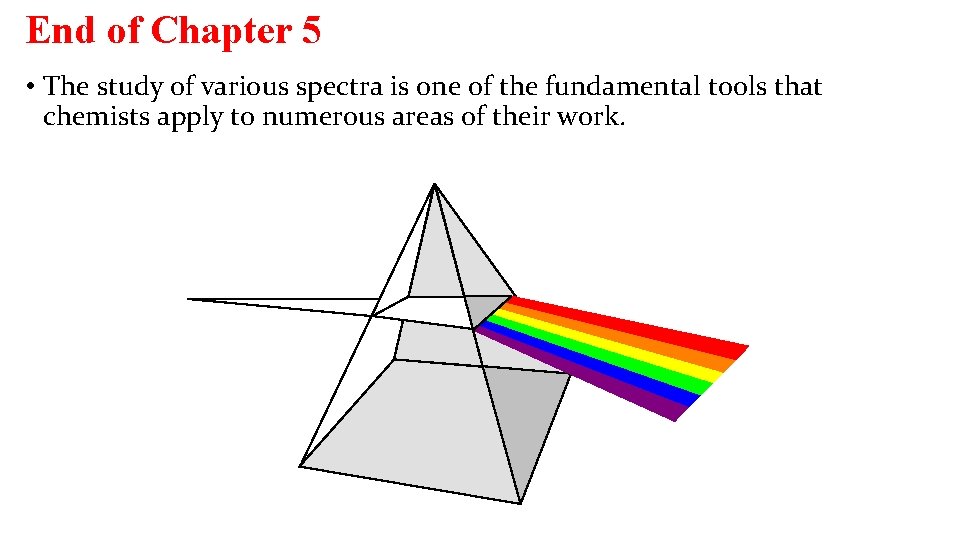
End of Chapter 5 • The study of various spectra is one of the fundamental tools that chemists apply to numerous areas of their work.
- Slides: 60