
Basic Program Analysis Suman Jana some slides are
Basic Program Analysis Suman Jana *some slides are borrowed from Baishakhi Ray and Ras Bodik
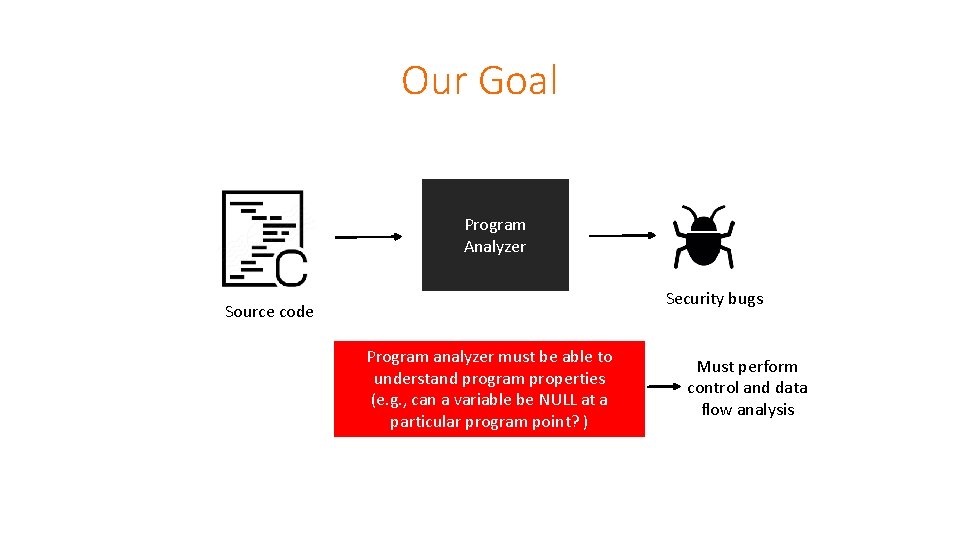
Our Goal Program Analyzer Security bugs Source code Program analyzer must be able to understand program properties (e. g. , can a variable be NULL at a particular program point? ) Must perform control and data flow analysis
Do we need to implement control and data flow analysis from scratch? • Most modern compilers already perform several types of such analysis for code optimization • We can hook into different layers of analysis and customize them • We still need to understand the details • LLVM (http: //llvm. org/) is a highly customizable and modular compiler framework • Users can write LLVM passes to perform different types of analysis • Clang static analyzer can find several types of bugs • Can instrument code for dynamic analysis
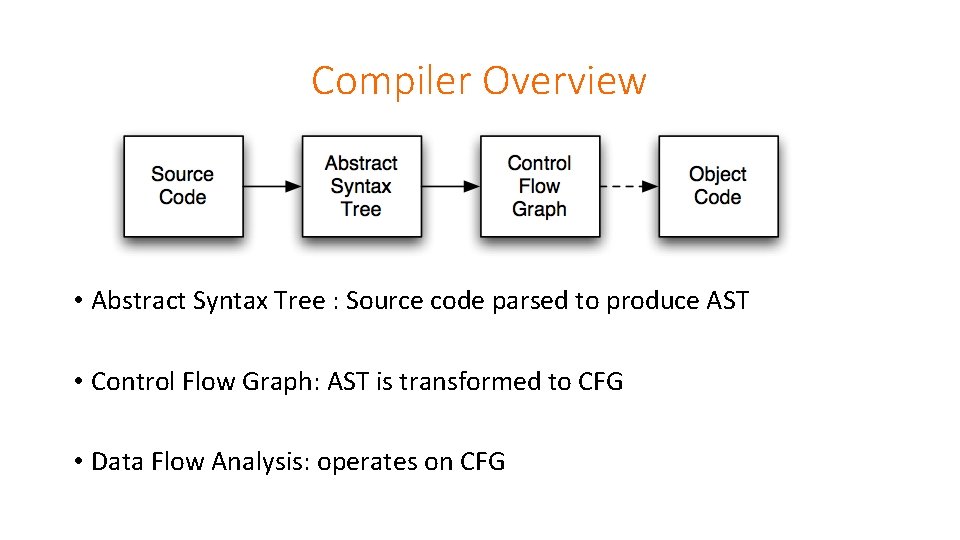
Compiler Overview • Abstract Syntax Tree : Source code parsed to produce AST • Control Flow Graph: AST is transformed to CFG • Data Flow Analysis: operates on CFG
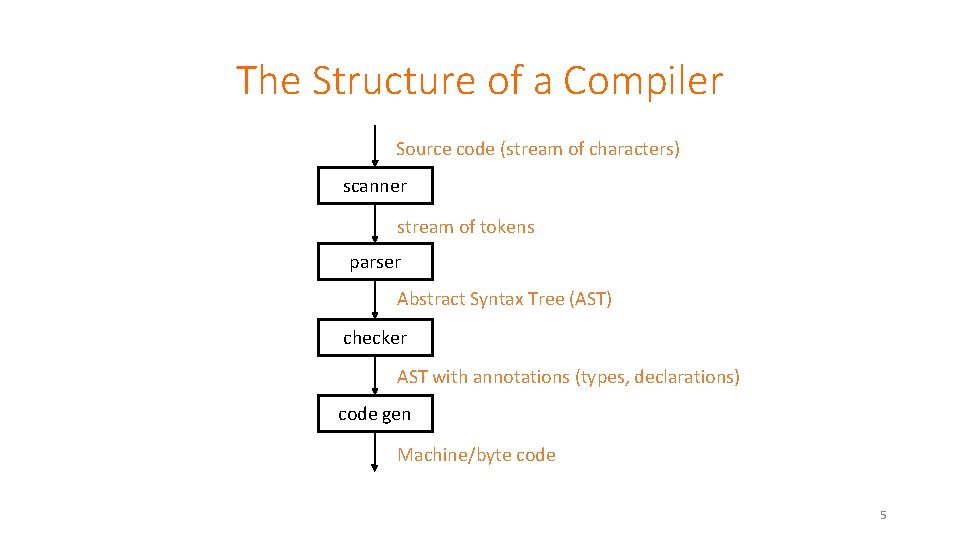
The Structure of a Compiler Source code (stream of characters) scanner stream of tokens parser Abstract Syntax Tree (AST) checker AST with annotations (types, declarations) code gen Machine/byte code 5

Syntactic Analysis • Input: sequence of tokens from scanner • Output: abstract syntax tree • Actually, • parser first builds a parse tree • AST is then built by translating the parse tree • parse tree rarely built explicitly; only determined by, say, how parser pushes stuff to stack Adopted From UC Berkeley: Prof. Bodik CS 164 Lecture 5 6
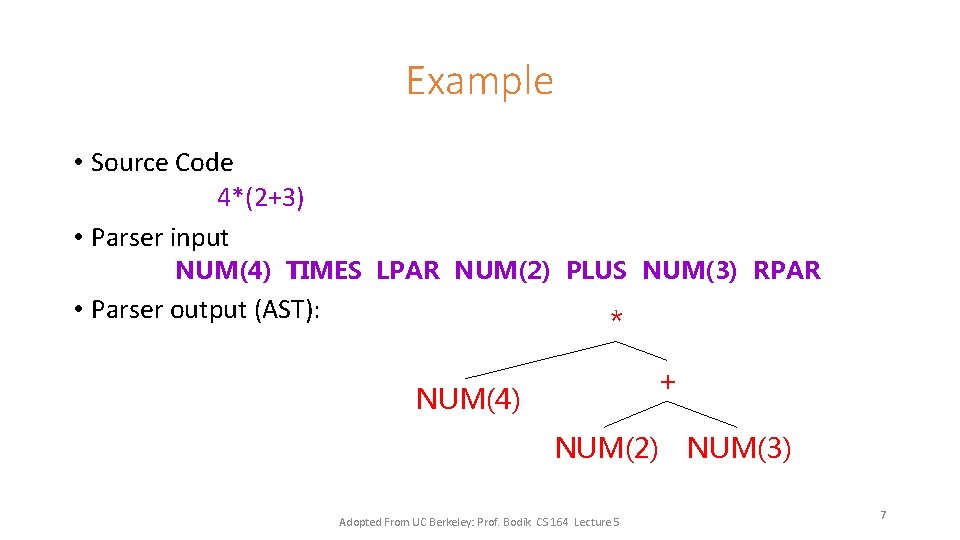
Example • Source Code 4*(2+3) • Parser input NUM(4) TIMES LPAR NUM(2) PLUS NUM(3) RPAR • Parser output (AST): * + NUM(4) NUM(2) NUM(3) Adopted From UC Berkeley: Prof. Bodik CS 164 Lecture 5 7
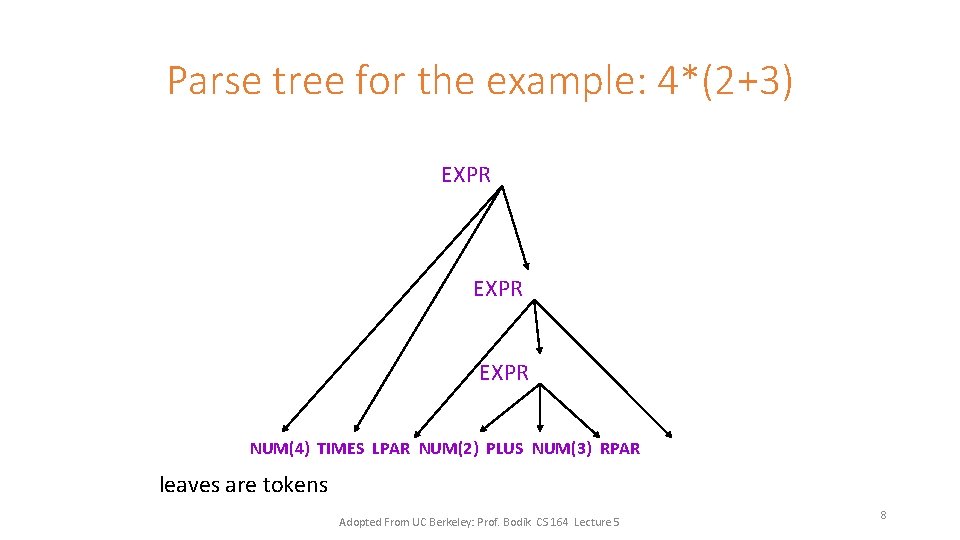
Parse tree for the example: 4*(2+3) EXPR NUM(4) TIMES LPAR NUM(2) PLUS NUM(3) RPAR leaves are tokens Adopted From UC Berkeley: Prof. Bodik CS 164 Lecture 5 8
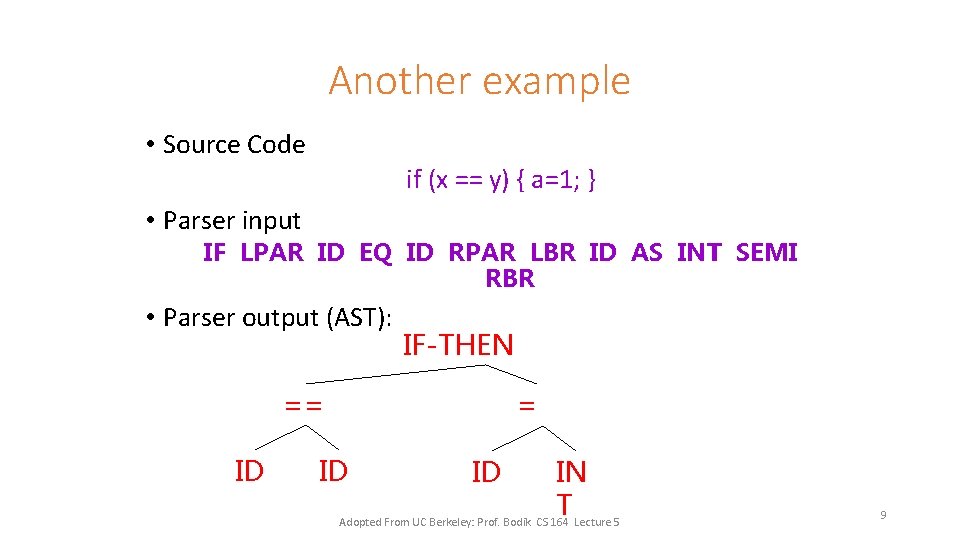
Another example • Source Code if (x == y) { a=1; } • Parser input IF LPAR ID EQ ID RPAR LBR ID AS INT SEMI RBR • Parser output (AST): IF-THEN == ID ID IN T Adopted From UC Berkeley: Prof. Bodik CS 164 Lecture 5 9
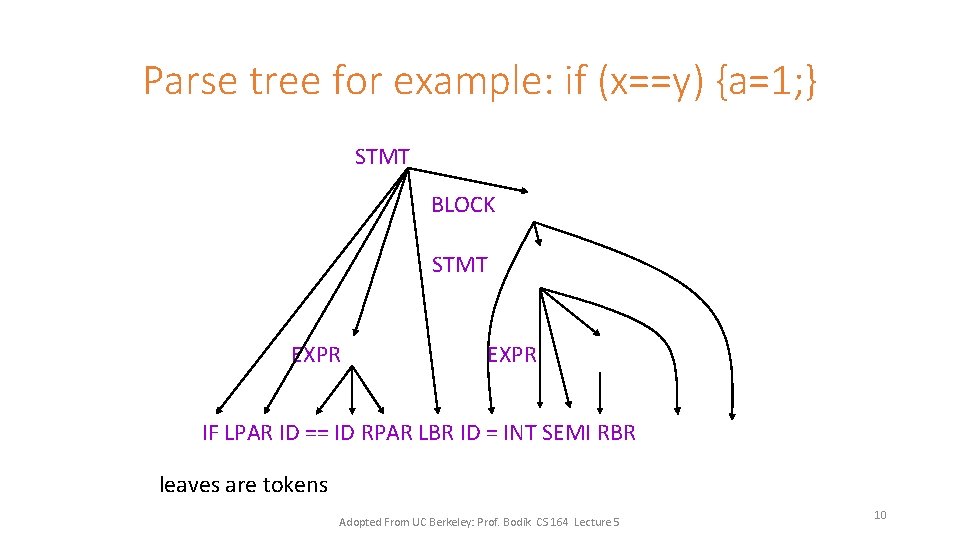
Parse tree for example: if (x==y) {a=1; } STMT BLOCK STMT EXPR IF LPAR ID == ID RPAR LBR ID = INT SEMI RBR leaves are tokens Adopted From UC Berkeley: Prof. Bodik CS 164 Lecture 5 10
Parse Tree • Representation of grammars in a tree-like form. A parse tree pictorially shows how the start symbol of a grammar derives a string in the language. … Dragon Book • Is a one-to-one mapping from the grammar to a tree-form.
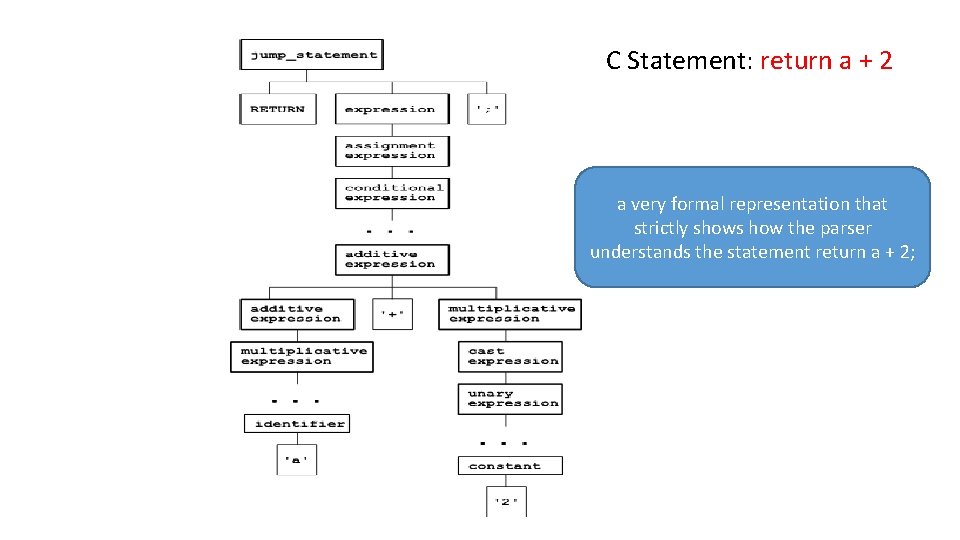
C Statement: return a + 2 a very formal representation that strictly shows how the parser understands the statement return a + 2;
Abstract Syntax Tree (AST) • Simplified syntactic representations of the source code, and they're most often expressed by the data structures of the language used for implementation ASTs differ from parse trees because superficial distinctions of form, unimportant for translation, do not appear in syntax trees. . … Dragon Book • Without showing the whole syntactic clutter, represents the parsed string in a structured way, discarding all information that may be important for parsing the string, but isn't needed for analyzing it.
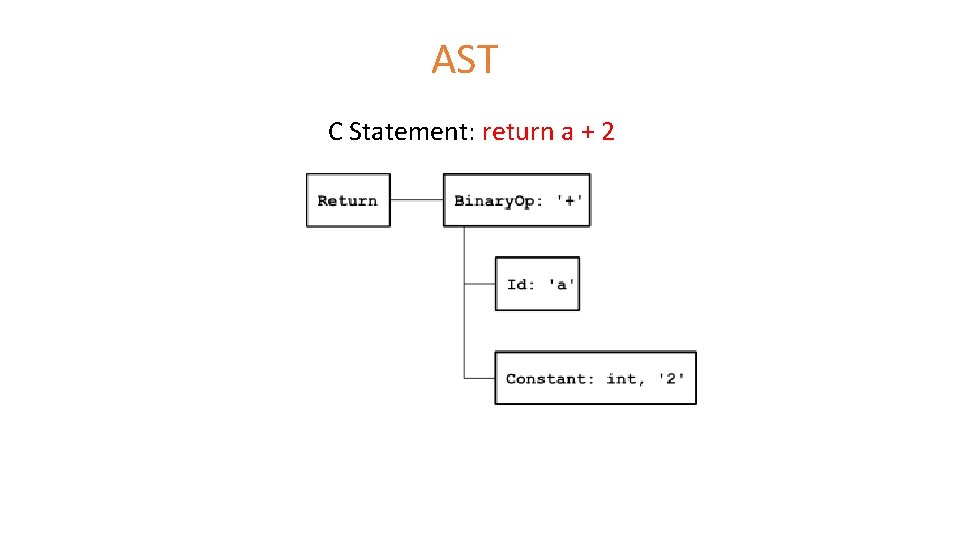
AST C Statement: return a + 2
Disadvantages of ASTs • AST has many similar forms • E. g. , for, while, repeat. . . until • E. g. , if, ? : , switch int x = 1 // what’s the value of x ? // AST traversal can give the answer, right? What about int x; x = 1; or int x= 0; x += 1; ? • Expressions in AST may be complex, nested • (x * y) + (z > 5 ? 12 * z : z + 20) • Want simpler representation for analysis • . . . at least, for dataflow analysis 15
Control Flow Graph & Analysis
Representing Control Flow High-level representation –Control flow is implicit in an AST Low-level representation: –Use a Control-flow graph (CFG) –Nodes represent statements (low-level linear IR) –Edges represent explicit flow of control Adopted From U Penn CIS 570: Modern Programming Language Implementation (Autumn 2006)
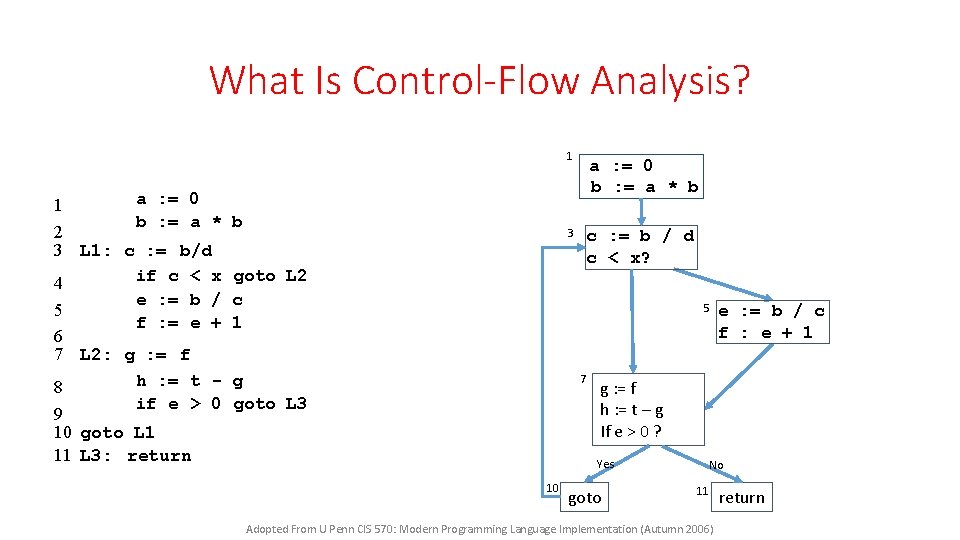
What Is Control-Flow Analysis? 1 a : = 0 1 b : = a * 2 3 L 1: c : = b/d if c < x 4 e : = b / 5 f : = e + 6 7 L 2: g : = f h : = t 8 if e > 0 9 10 goto L 1 11 L 3: return b 3 goto L 2 c 1 a : = 0 b : = a * b c : = b / d c < x? 5 g goto L 3 7 g : = f h : = t – g If e > 0 ? Yes 10 e : = b / c f : e + 1 goto No 11 Adopted From U Penn CIS 570: Modern Programming Language Implementation (Autumn 2006) return
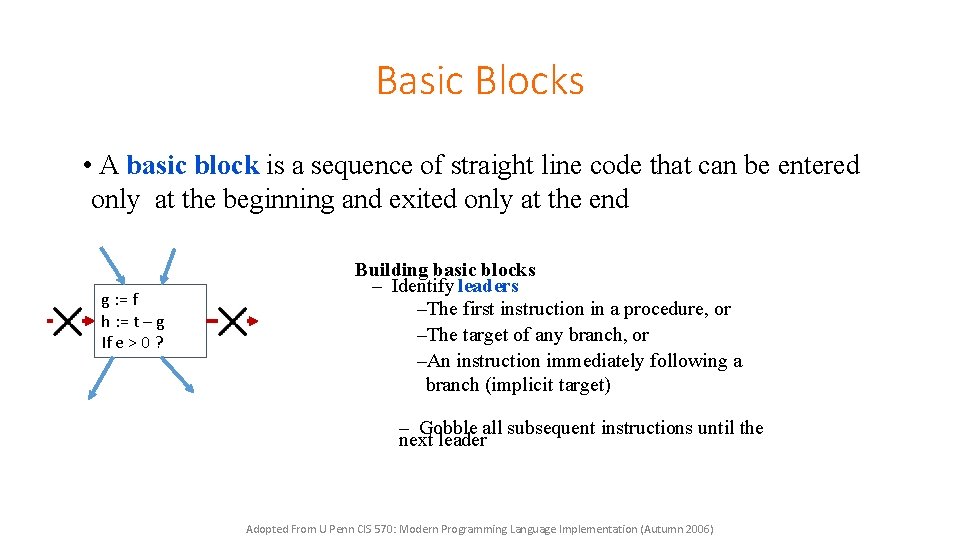
Basic Blocks • A basic block is a sequence of straight line code that can be entered only at the beginning and exited only at the end g : = f h : = t – g If e > 0 ? Building basic blocks – Identify leaders –The first instruction in a procedure, or –The target of any branch, or –An instruction immediately following a branch (implicit target) – Gobble all subsequent instructions until the next leader Adopted From U Penn CIS 570: Modern Programming Language Implementation (Autumn 2006)

Basic Block Example a : = 0 1 b : = a * 2 3 L 1: c : = b/d if c < x 4 e : = b / 5 f : = e + 6 7 L 2: g : = f h : = t 8 if e > 0 9 10 goto L 1 11 L 3: return b goto L 2 c 1 g goto L 3 Leaders? – {1, 3, 5, 7, 10, 11} Blocks? – {1, 2} – {3, 4} – {5, 6} – {7, 8, 9} – {10} – {11} Adopted From U Penn CIS 570: Modern Programming Language Implementation (Autumn 2006)
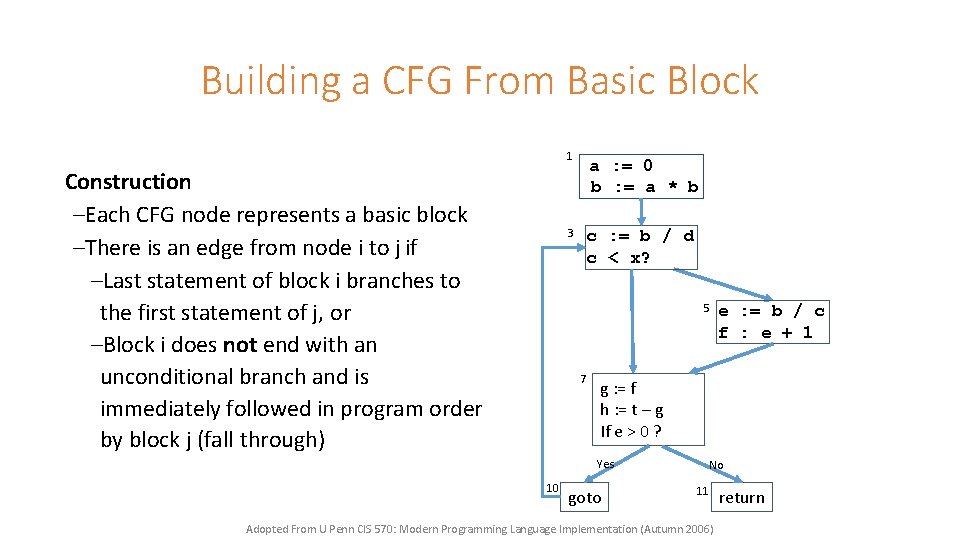
Building a CFG From Basic Block 1 Construction –Each CFG node represents a basic block –There is an edge from node i to j if –Last statement of block i branches to the first statement of j, or –Block i does not end with an unconditional branch and is immediately followed in program order by block j (fall through) 3 a : = 0 b : = a * b c : = b / d c < x? 5 7 g : = f h : = t – g If e > 0 ? Yes 10 e : = b / c f : e + 1 goto No 11 Adopted From U Penn CIS 570: Modern Programming Language Implementation (Autumn 2006) return
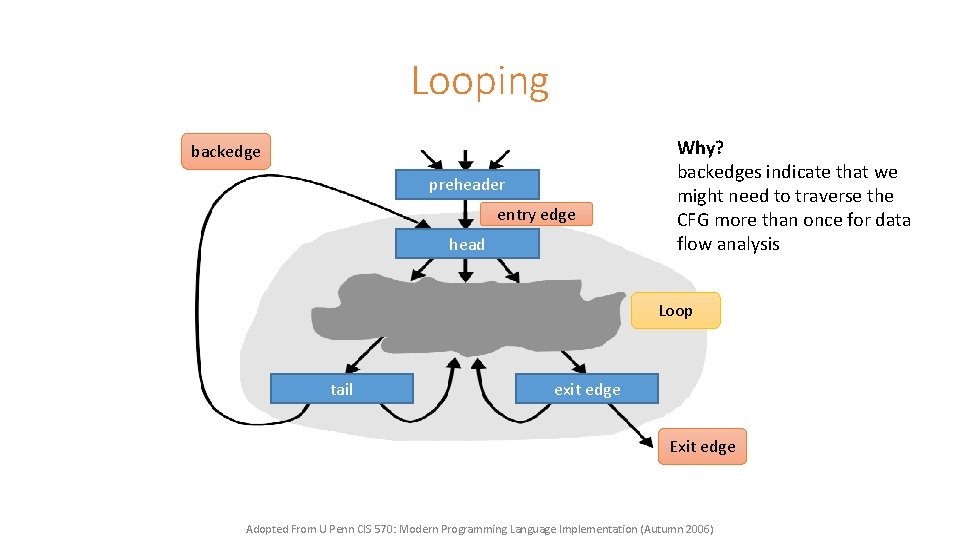
Looping backedge preheader entry edge head Why? backedges indicate that we might need to traverse the CFG more than once for data flow analysis Loop tail exit edge Exit edge Adopted From U Penn CIS 570: Modern Programming Language Implementation (Autumn 2006)
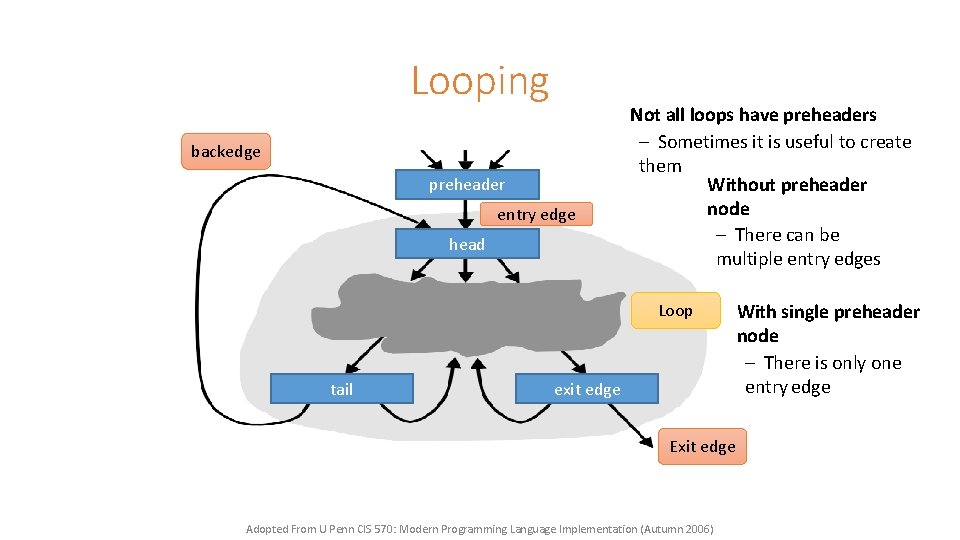
Looping backedge preheader entry edge head Not all loops have preheaders – Sometimes it is useful to create them Without preheader node – There can be multiple entry edges Loop tail exit edge Exit edge Adopted From U Penn CIS 570: Modern Programming Language Implementation (Autumn 2006) With single preheader node – There is only one entry edge
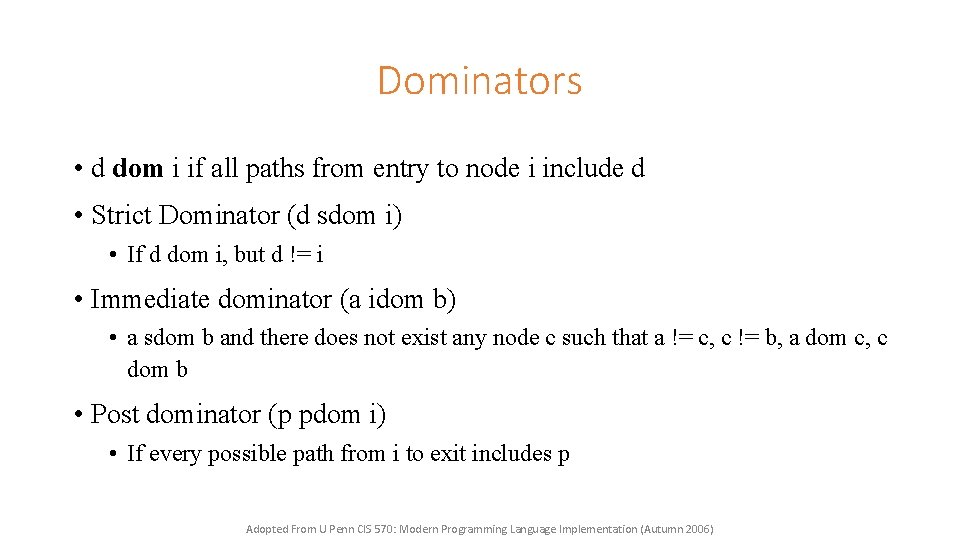
Dominators • d dom i if all paths from entry to node i include d • Strict Dominator (d sdom i) • If d dom i, but d != i • Immediate dominator (a idom b) • a sdom b and there does not exist any node c such that a != c, c != b, a dom c, c dom b • Post dominator (p pdom i) • If every possible path from i to exit includes p Adopted From U Penn CIS 570: Modern Programming Language Implementation (Autumn 2006)
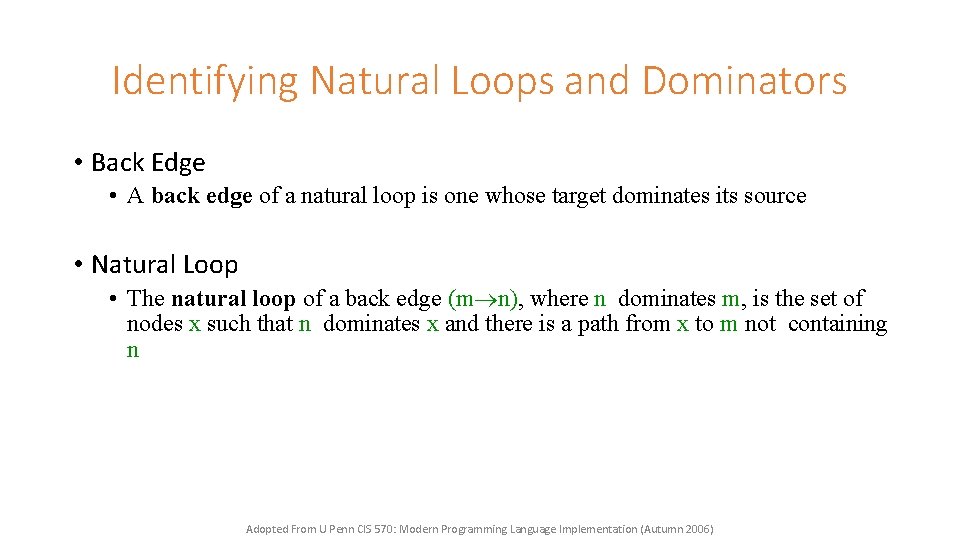
Identifying Natural Loops and Dominators • Back Edge • A back edge of a natural loop is one whose target dominates its source • Natural Loop • The natural loop of a back edge (m n), where n dominates m, is the set of nodes x such that n dominates x and there is a path from x to m not containing n Adopted From U Penn CIS 570: Modern Programming Language Implementation (Autumn 2006)
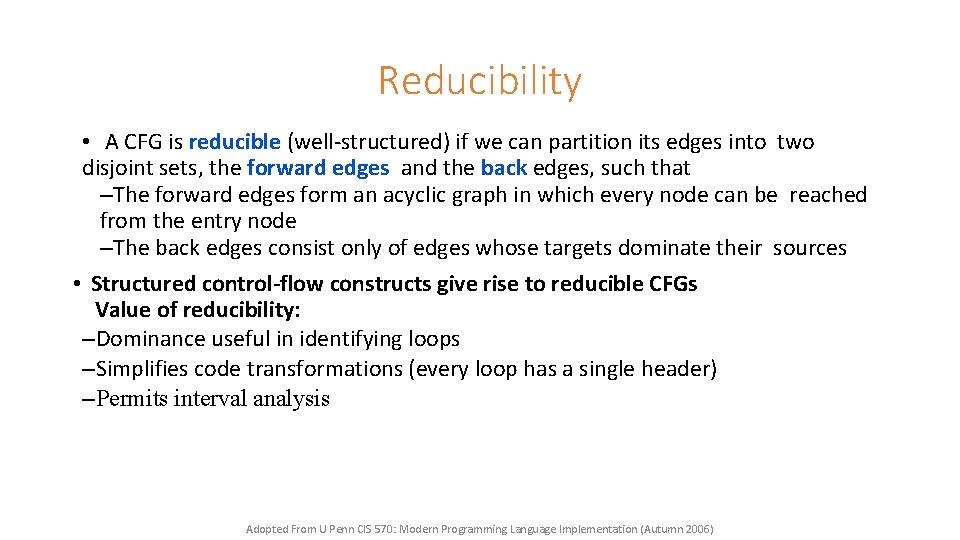
Reducibility • A CFG is reducible (well-structured) if we can partition its edges into two disjoint sets, the forward edges and the back edges, such that –The forward edges form an acyclic graph in which every node can be reached from the entry node –The back edges consist only of edges whose targets dominate their sources • Structured control-flow constructs give rise to reducible CFGs Value of reducibility: –Dominance useful in identifying loops –Simplifies code transformations (every loop has a single header) –Permits interval analysis Adopted From U Penn CIS 570: Modern Programming Language Implementation (Autumn 2006)
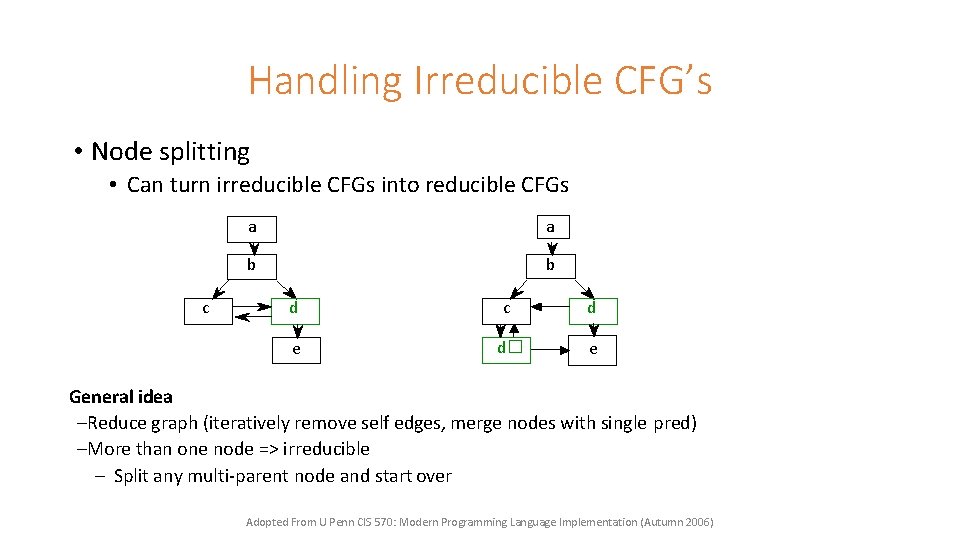
Handling Irreducible CFG’s • Node splitting • Can turn irreducible CFGs into reducible CFGs c a a b b d c d e d� e General idea –Reduce graph (iteratively remove self edges, merge nodes with single pred) –More than one node => irreducible – Split any multi-parent node and start over Adopted From U Penn CIS 570: Modern Programming Language Implementation (Autumn 2006)
Why go through all this trouble? • Modern languages provide structured control flow –Shouldn’t the compiler remember this information rather than throw it away and then re-compute it? • Answers? –We may want to work on the binary code –Most modern languages still provide a goto statement –Languages typically provide multiple types of loops. This analysis lets us treat them all uniformly –We may want a compiler with multiple front ends for multiple languages; rather than translating each language to a CFG, translate each language to a canonical IR and then to a CFG Adopted From U Penn CIS 570: Modern Programming Language Implementation (Autumn 2006)
- Slides: 28