
BASIC PROFESSIONAL TRAINING COURSE Module XI Operational limits
BASIC PROFESSIONAL TRAINING COURSE Module XI Operational limits and conditions Version 1. 0, May 2015 This material was prepared by the IAEA and co-funded by the European Union.
CONCEPT OF OPERATIONAL LIMITS AND CONDITIONS Learning objectives After completing this chapter, the trainee will be able to: 1. Explain the bases and objectives of operational limits and conditions (OLCs). 2. List items included in OLCs. 3. Explain the implementation of OLCs. Basic Professional Training Course; Module XI Operational limits and conditions 2

CONCEPT OF OPERATIONAL LIMITS AND CONDITIONS 3 • For a nuclear power plant to be operated in a safe manner, the provisions made in the final design and subsequent modifications are reflected in: − The limitations on plant operating parameters; − The requirements on plant equipment and personnel. • Developed during the design safety evaluation as a set of operational limits and conditions (OLCs). • Operating procedures are consistent with and fully implement the OLC. Basic Professional Training Course; Module XI Operational limits and conditions
CONCEPT OF OPERATIONAL LIMITS AND CONDITIONS 4 • OLCs are at the junction between design and safety analysis and plant operations. • The OLCs are derived from the design and safety analysis report that assures that the plant is operated in accordance with: − Its design basis, − Its licence conditions. • The OLCs are the part of operating rules. Basic Professional Training Course; Module XI Operational limits and conditions

CONCEPT OF OPERATIONAL LIMITS AND CONDITIONS 5 • The OLCs cover the operational requirements that structures, systems and components important to the safety are able to perform their intended functions as assumed in the safety analysis report. • Safe operation depends upon personnel as well as on equipment. • OLCs cover the actions that are taken and the limitations that are observed by operating personnel. Basic Professional Training Course; Module XI Operational limits and conditions
6 Objectives and bases of OLCs • The basic objectives of OLCs are: − To prevent operational situations that might lead to accident conditions; − To assure that mitigation is available if an accident should occur. • The OLCs are based on the whole safety assessment of the plant: − Deterministic and probabilistic; − Analysis of plant performance; − Surveillance and testing requirements for safety systems; − Allowable system outage times, etc. Basic Professional Training Course; Module XI Operational limits and conditions
7 Scope of OLCs • Operational limits and conditions consider all aspects of plant operation that bear on safety: − Process related aspects such as power level, pressure, temperature, flow; − Equipment status; − Personnel status; − The existence of potential external threats, etc. Basic Professional Training Course; Module XI Operational limits and conditions
8 Scope of OLCs • The OLCs at the power plant include the following items: − Safety limits; − Safety System Settings; − Limits and Conditions for normal operation; − Surveillance Requirements; − Action statements. • Safety limits are limits to process variables within which the plant operation is safe. Basic Professional Training Course; Module XI Operational limits and conditions
9 Scope of OLCs • Safety system settings: − Limits at which the Reactor Protection System (RPS) activates reactor trip, − Limits at which the RPS activates the Engineering Safety Features Actuation System (ESFAS) that starts the Engineering Safety Features (ESF) systems to mitigate core damage during an accident condition. • Limits and conditions for normal operation: − Limits on normal process variables; − Requirements for minimum staffing; − Minimum operable equipment; − Allowable outage times for systems and equipment. Basic Professional Training Course; Module XI Operational limits and conditions
10 Scope of OLCs • Surveillance requirements: − Periodic checks, tests, calibrations; − Inspections of equipment, components; − Actions to establish operability. • Action statements: − Actions to be taken by operating staff in the event of various abnormal conditions; − May take the form of emergency operating instructions or similar procedures. Basic Professional Training Course; Module XI Operational limits and conditions
11 Scope of OLCs • The OLCs include requirements related to all modes of normal operation: − Start up and power ascension; − Operation at steady power; − Power increase and decrease; − Shutdown to hot standby; − Shutdown to hot shutdown; − Shutdown to cold shutdown; − Fuel handling with the reactor shutdown; − Maintenance, surveillance, and testing during operation and shutdown. Basic Professional Training Course; Module XI Operational limits and conditions

12 Implementation of OLCs • Operational limits and conditions are: − Implemented in the technical specifications (TS); − Reflected in operating instructions and procedures. • OLCs must be available to: − Operators; − Technical support personnel; − Maintenance personnel. • The limits must be stated in terms that are easily measurable and identifiable to the personnel needing the information. Basic Professional Training Course; Module XI Operational limits and conditions
13 SAFETY LIMITS Learning objectives After completing this chapter, the trainee will be able to: 1. Explain the purpose of the First Safety Limit. 2. Explain the purpose of the Second Safety Limit. Basic Professional Training Course; Module XI Operational limits and conditions

14 SAFETY LIMITS • The First Safety Limit sets constraints on the combination of average coolant temperature Tavg in the core as a function of reactor power P for a given pressurizer pressure p. • Operation under the curve for certain pressure ensures that: − − The min DNBR will not be less than the limiting DNBR. The core exit temperature is less than the saturation temperature for that pressure. • Reactor operation below the curve assures the integrity of the cladding of the fuel rod. Basic Professional Training Course; Module XI Operational limits and conditions

15 SAFETY LIMITS Basic Professional Training Course; Module XI Operational limits and conditions
16 SAFETY LIMITS • The Second Safety Limit in the Technical Specifications is a restriction on RCS pressure. • The RCS pressure is limited in order to ensure the integrity of the primary system boundaries. • The primary boundaries must be maintained to prevent potential radioactive release into the environment. Basic Professional Training Course; Module XI Operational limits and conditions
17 SAFETY SYSTEM Learning objectives After completing this chapter, the trainee will be able to: 1. Explain the purpose of the reactor safety system. 2. Describe the principle of defence-in-depth. 3. Describe the general principles used for designing the safety system. 4. Explain the purpose of the reactor protection system. 5. List reactor trip signals. Basic Professional Training Course; Module XI Operational limits and conditions
18 SAFETY SYSTEM • Reactor safety systems are designed to protect the plant in case of pre determined accident scenarios. • Scenarios are grouped into categories 1 to 4 according to their decreasing probability of occurrence: − Category 1 Normal operation and normal operational transients; − Category 2 Faults of Moderate Frequency; − Category 3 Infrequent faults; − Category 4 Limiting faults. Basic Professional Training Course; Module XI Operational limits and conditions
19 SAFETY SYSTEM • During category 1 events it is not necessary to trip the reactor or to start ESF systems. − Expected doses due to any release are lower than the dose limits. • Examples of category 1 events: − Steady state and shutdown operation; − Refuelling; − Operation with permissible deviations; − Radioactivity in RCS, others; − Operational transients: − Plant heat up and cool down; − Load rejection, others. Basic Professional Training Course; Module XI Operational limits and conditions
20 SAFETY SYSTEM • During category 2 events, there is a requirement for a reactor trip, but not for the ESF systems to start: − Fuel or cladding damage is not expected; − The plant is immediately able to restart; − Expected doses due to any release are lower than dose limits. • Examples of category 2 events: − Feedwater system (FWS) malfunction; − Inadvertent opening of Pressurizer PORV or SV; − Uncontrolled Rod Control Cluster Assembly (RCCA) bank withdrawal; − Partial loss of RCS flow, others. Basic Professional Training Course; Module XI Operational limits and conditions
21 SAFETY SYSTEM • During category 3 events, RPS has to trip the reactor and start the ESF systems: − A small amount of fuel could be damaged. − It is necessary to shut the plant down for a longer period of time. − Expected doses due to release are lower than dose limits. • Examples of category 3 events: − Complete loss of RCS flow; − Inadvertent loading of and operation with fuel assembly in an improper position; − Loss of coolant accident (LOCA) from small pipes; − Etc. Basic Professional Training Course; Module XI Operational limits and conditions
22 SAFETY SYSTEM • Category 4 events are Design Bases Accidents (DBA): − Reactor trip and start ESF systems are needed. − Fuel damage is expected. − Coolable core geometry is maintained. − An accident could lead to a definite shutdown of the power plant. − Expected doses due to release are lower than dose limits. • Examples of category 4 events: − LOCA; − Main steam line break (MSLB) − Feed line break (FLB), etc. Basic Professional Training Course; Module XI Operational limits and conditions
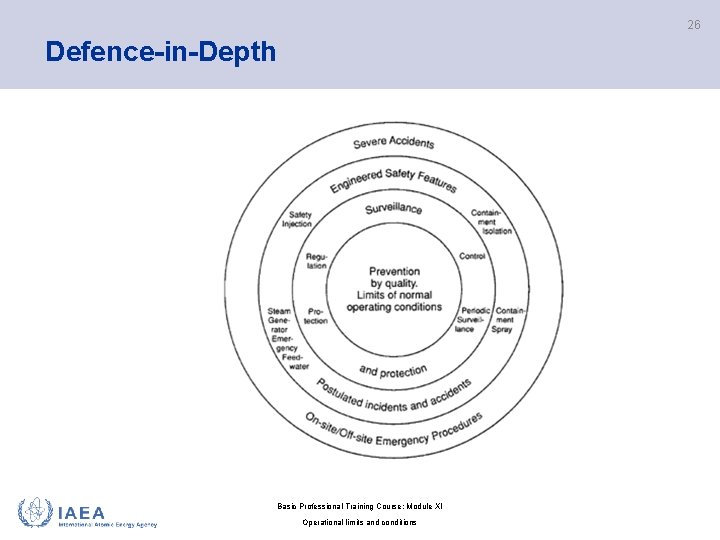
23 Defence-in-Depth • Defence-in-depth is concept for the design and operation of nuclear reactors, by requiring a concentric protective barriers, all of which must be breached before the radioactive release can adversely affect human beings or the environment. • The four classic physical barriers to radiation release are: − Fuel, − Cladding, − Reactor coolant system, − Containment. Basic Professional Training Course; Module XI Operational limits and conditions
24 Defence-in-Depth • A specific application of the principle of defence in depth: − the arrangement of instrumentation and control systems, which act as multiple layer, − These systems provide necessary signals for reactor operation and reactor protection. • These multiple layers are: − Control system, − Reactor protection system, − Engineered Safety Feature system (ESF) − Monitoring and Indication system. Basic Professional Training Course; Module XI Operational limits and conditions
25 Defence-in-Depth • The control system maintains steady state operating conditions, suppresses excursions of the transients before protective action is required and by this assures adequate margin to reactor trip. • Instrumentation measures corresponding process variables which are essentially the same parameters required by the protection system. • If adverse conditions occur and the Control systems are not able to control the reactor RPS trip the reactor. • If accident conditions progress further, ESF systems continue supporting the barriers to prevent radiological release. Basic Professional Training Course; Module XI Operational limits and conditions
26 Defence-in-Depth Basic Professional Training Course; Module XI Operational limits and conditions
General principles used for designing the safety system • The safety systems ensure the effectiveness of the barriers in case of pre determined accidents in the nuclear power plant. • The safety system design − includes a definition of the protection channels, − calculation of the signal set point for safety system actuation. Basic Professional Training Course; Module XI Operational limits and conditions 27
General principles used for designing the safety system • Typical limits applicable during Category I and Category II which assure clad integrity are: − DNB must not occur. − Fuel centreline temperature (TCL) must be maintained at a less than the fuel melt temperature. − Clad stress must be maintained at a less than the yield stress. − Clad strain is maintained less than 1. 0%. − Fuel rod internal pressure maintained less than 155 bar. Basic Professional Training Course; Module XI Operational limits and conditions 28
General principles used for designing the safety system • The limits applied during Category III and Category IV which assure integrity of the clad: − Peak cladding temperature (PCT) during LOCA will not exceed 1200°C. − Cladding oxidation will not exceed 17% of the total cladding thickness. − Hydrogen generation will not exceed 1% of the hydrogen generated if all the zirconium surrounding the fuel reacted. − Coolable core geometry must be maintained. − Long term cooling must be provided. Basic Professional Training Course; Module XI Operational limits and conditions 29
General principles used for designing the safety system • During LOCA condition: − The reactor should be tripped. − Decay heat is transferred from the fuel into the coolant and dictates the clad temperature. − To limit the PCT, decay heat has to be limited which can be managed by limiting maximum heat flux during normal operation. − Limiting FQ during normal operation, means limiting maximal heat flux in the core, which dictates the limit of the PCT during LOCA. Basic Professional Training Course; Module XI Operational limits and conditions 30
General principles used for designing the safety system • The integrity of the second barrier Reactor Coolant System is assured by limiting pressure in the RCS, Westinghouse PWR examples: − Normal operating pressure is 154. 1 bar. − Design pressure of the Reactor coolant system is 171. 3 bar. − Pressure Safety Limit is a 110% of design pressure which means 188. 6 bar. − Reactor protection system generates a reactor trip signal if the pressurizer pressure exceeds the set point value of 163. 8 bar. Basic Professional Training Course; Module XI Operational limits and conditions 31
General principles used for designing the safety system • Safety design basis for the containment: − must withstand the pressures and temperatures of the DBA without exceeding the design leak rate. • The ESFs must ensure that the release of radioactive material due to a DBA does not exceed the specified values referring to the » exclusion area « and the » low population zone «. Basic Professional Training Course; Module XI Operational limits and conditions 32
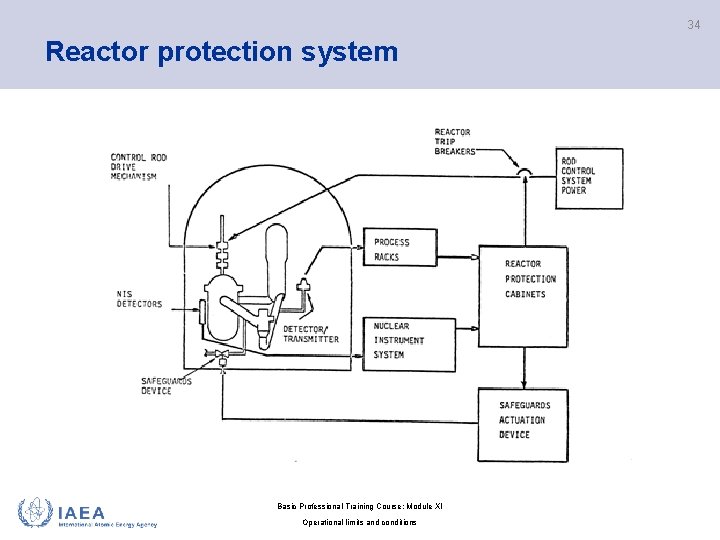
33 Reactor protection system • Reactor Protection System (RPS) provides protection for all normal operating and accident conditions by generating: − reactor trip signals, − engineered safety features actuation signals. • When an unsafe condition is sensed, a trip signal is sent to the protection cabinets: − If a reactor trip is required, the protection cabinets will send a signal to the reactor trip breakers. − Tripping of these breakers will remove power from the control rod drive mechanisms allowing the rods to drop into the reactor core. • If an ESF actuation is required, the protection cabinets will actuate the appropriate safeguard devices. Basic Professional Training Course; Module XI Operational limits and conditions
34 Reactor protection system Basic Professional Training Course; Module XI Operational limits and conditions
35 Reactor protection system • To insure that the RPS performs its required functions under all credible accident conditions, it is designed with a high degree of reliability incorporating the following features: − Redundancy: − Parameters that indicate an unsafe condition have redundant measurement systems. − Two trains of protection logic are provided. − Independence: − Each channel of measurement and each train of protection is physically and electrically independent. Basic Professional Training Course; Module XI Operational limits and conditions
36 Reactor protection system − Diversification: − Several different methods are used to perform similar functions. − Fail Safe: − The system is designed to supply the safest signal in case of loss of power or a failure. − Testability: − The reactor protection system is capable of being calibrated or tested at power without the loss of protection. Basic Professional Training Course; Module XI Operational limits and conditions
37 Reactor protection system − Control System interactions will not degrade reliability: − Variables for the Control system are essentially the same parameters required by the protection system. − Primary sensor and transmitting equipment that is used in the protection system is also used for the control system. − The control system is maintained separate and distinct from protection. − There is no feedback from the control system to the protection system. Basic Professional Training Course; Module XI Operational limits and conditions
38 Reactor protection system • Reactor protection system generates a reactor trip when nuclear and/or process variable reach its predetermined value (trip set point). • The function of a reactor trip system is to shut down a reactor to prevent core Safety Limits from being exceeded. Basic Professional Training Course; Module XI Operational limits and conditions
39 Reactor protection system • Below is the list of origins of reactor trip signals: − Manual trip (operator judgment); − Nuclear instrumentation trips; − Pressurizer pressure and level trips; − RCS flow trips; − Steam generator level trip; − Turbine trip; − Overtemperature (OT∆T) trip; − Overpower (OP∆T) trip; − Reactor trip on ESFAS signals. Basic Professional Training Course; Module XI Operational limits and conditions
40 Reactor protection system • Basic Professional Training Course; Module XI Operational limits and conditions
41 Reactor protection system • If the measured loop T signal exceeds the calculated OT∆T set point, the affected channel will be tripped. • If two or more channels are simultaneously tripped, the reactor will be tripped. • The OT∆T trip will provide protection against DNB only if: − The transient encountered is slow with respect to piping transient delays from the core to the temperature detectors and − The reactor coolant pressure is within the bounds set by the high and low pressure trips. Basic Professional Training Course; Module XI Operational limits and conditions
42 Reactor protection system • Reactor Coolant Low Flow trips (example): − The low flow trips are provided to protect the core from DNB following a loss of coolant flow accident where there is not enough coolant flow to remove the heat generated by the fuel. • The diverse methods for sensing a low flow condition are: − Measured flow in the reactor coolant piping. − Detecting an open position of the reactor coolant pump breakers. − Sensing an undervoltage condition on the reactor coolant pump buses. − Sensing an underfrequency condition on the reactor coolant pump buses. Basic Professional Training Course; Module XI Operational limits and conditions
43 Reactor protection system • Low Flow Trip: − Each reactor coolant loop has three flow measuring circuits that generate a low flow trip signal if any two of the three circuits sense a flow below 90 % of the normal full flow. • RCP Breaker Opening trip: − The trip signal from the reactor coolant pump breaker is provided to anticipate probable loss of forced flow through the core. Basic Professional Training Course; Module XI Operational limits and conditions
44 Reactor protection system • RCP Undervoltage Trip: − This trip is provided for protection following a complete loss of power to the RCP's. • RCP Underfrequency Trip: − The purpose of this trip is to provide reactor protection following a major network frequency disturbance. If an underfrequency condition below certain value exists on the reactor coolant pump buses, all RCP breakers and the reactor are tripped. Basic Professional Training Course; Module XI Operational limits and conditions
45 Reactor protection system • The function of the Engineered Safety Features Systems (ESF) is to mitigate the consequences of Category 3 and 4 event (DBA) to: − Protect the fuel and fuel cladding, − Protect RCS integrity, − Ensure containment integrity, − Limit fission product releases to the environment. Basic Professional Training Course; Module XI Operational limits and conditions
46 Reactor protection system • The ESF systems and subsystems: − Containment Systems: − Containment, − Containment Heat Removal System, − Fission Product Removal and Control Systems, − Containment Isolation System, − Containment Combustible Gas Control System. − Emergency Core Cooling System (ECCS). − Control Room HVAC System. − Reactor Building Annulus Negative Pressure Control System. Basic Professional Training Course; Module XI Operational limits and conditions
47 Reactor protection system • The design bases for the containment is that it must withstand the pressures and temperatures of the DBA without exceeding the design leak rate. • The design bases of the Containment Heat Removal System is to reduce the containment temperature and pressure following a LOCA or main steam line break accident. • The Fission Product Removal and Control Systems function to reduce or limit the amount of fission products released following a LOCA or fuel handling accident. Basic Professional Training Course; Module XI Operational limits and conditions
48 Reactor protection system • The Containment Isolation System allows the normal or emergency passage of fluids through the containment boundary while minimizing the release of fission products from containment following a LOCA or fuel handling accident. • The safety design basis of the Containment Combustible Gas Control System is to maintain hydrogen concentration below 4. 0 percent by volume in containment. Basic Professional Training Course; Module XI Operational limits and conditions
49 Reactor protection system • The ECCS is designed to cool the reactor core and provide shutdown capability following LOCA, RCCA ejection accident, SLB or FLB, SGTR. • The Control Room HVAC Systems provide radiation protection of personnel occupying the control room during the duration of the accident. • The function of the Reactor Building Annulus Negative Pressure Control System is to achieve a negative pressure differential relative to the outside immediately after LOCA. Basic Professional Training Course; Module XI Operational limits and conditions
50 Reactor protection system • The RPS automatically initiates ESF systems through various ESF Actuation Signals (ESFAS) like: − Safety Injection Signal (SIS), − Containment Isolation Signal phase A (CISA), − Control Room Ventilation Isolation Signal (CRVIS), − Main Steam Line Isolation Signal (MSLIS), − Auxiliary Feedwater Actuation Signal (AFAS), − Containment Spray Actuation Signal (CSAS), − Etc. Basic Professional Training Course; Module XI Operational limits and conditions
51 Reactor protection system • Safety Injection Signal (SIS) is generated by: − Low steam line pressure, − Low pressurizer pressure, − HI 1 containment pressure, − Manual operator judgment. • The functions of the SIS are: − to shutdown the reactor, − maintain the reactor shutdown, − provide cooling to the reactor, − and maintain containment integrity. Basic Professional Training Course; Module XI Operational limits and conditions
52 Reactor protection system • Upon the receipt of a SIS the following actions will occur: − A reactor trip signal is generated. − The diesel generators are started. − The SI sequencers are actuated. • The SI sequencers will start the following loads: − Safety Injection Pumps, − Residual Heat Removal (RHR) Pumps, − Essential Service Water (ESW) Pumps, − Component Cooling Water (CCW) Pumps, − Motor Driven Auxiliary Feedwater Pumps, − Etc. Basic Professional Training Course; Module XI Operational limits and conditions
LIMITS AND CONDITIONS (LC) FOR NORMAL OPERATION • The limits and conditions for normal operation: − Are major subset of the total list of OLCs. − Ensure that assumptions of the safety analysis report are valid and that established safety limits are not exceeded in the operation of the plant. − Ensure safe operation. • In the LCs for normal operation an acceptable margin between allowable normal operating values and the required safety system settings is established to avoid undesirably frequent actuation of safety systems. Basic Professional Training Course; Module XI Operational limits and conditions 53
54 LCs for NORMAL OPERATION • The LCs for normal conditions address: − allowable values of the reactor process variables, − reactivity control − reactor protection, − core cooling, − coolant (and moderator) chemistry, − requirements on containment − accident management systems, − electrical systems, − and other systems. Basic Professional Training Course; Module XI Operational limits and conditions
55 LCs for NORMAL OPERATION • LCs for normal operation also address: − minimum operable equipment, − minimum staffing in the control room and elsewhere, − and requirements for operator action in case abnormal conditions are encountered, − abnormal conditions may include violation of limits on process variables or operability requirements. Basic Professional Training Course; Module XI Operational limits and conditions
56 LCs for NORMAL OPERATION • LCs for normal operation state operability requirements for the various modes of normal operation: − Number of systems or components important to safety that is either in operating condition or in standby condition. − Operability requirements define the minimum safe plant configuration for each mode of normal operation. − Where operability requirements are not met, the actions to be taken are given to manoeuvre the plant to a safer state: − power reduction or reactor shutdown, − time allowed to complete the action. Basic Professional Training Course; Module XI Operational limits and conditions
57 LCs for NORMAL OPERATION • Guidance and recommendations for this limits and conditions for normal operation are provided by IAEA Safety Guide NS G 2. 2 (Operational Limits and Conditions and Operating Procedures for Nuclear Power Plants). Basic Professional Training Course; Module XI Operational limits and conditions
LCs for NORMAL OPERATION Reactivity control • Negative reactivity requirements: − The minimum negative reactivity available in the reactivity control devices is such that the degree of subcriticality assumed in the safety report is reached immediately after shutdown from any operational state and relevant accident conditions. − To maintain the specified degree of subcriticality after shutdown, additional means are provided, such as borated water, or other poisons to compensate for temperature, xenon or other transient reactivity effects. • The required negative reactivity is specified in terms of the information available to the reactor operator such as control rod positions, liquid poison concentration or neutron multiplication factors. Basic Professional Training Course; Module XI Operational limits and conditions 58
LCs for NORMAL OPERATION Reactivity control • Reactivity coefficients: − Where the safety report indicates the need, limits are stated for the reactivity coefficients for different reactor conditions to ensure that the assumptions used in the accident and transient analyses remain valid through fuelling cycle. • Positive reactivity insertion rates: − Positive reactivity insertion rate limits are stated and ensured either by reactivity system logic or by special limitations to be observed by operating personnel in order to avoid reactivity related accident conditions which leads to excessive fuel temperatures. Basic Professional Training Course; Module XI Operational limits and conditions 59
LCs for NORMAL OPERATION Reactivity control • Reactor core neutron flux monitoring: − Instrumentation requirements for adequate neutron flux monitoring for all reactor power levels including start up and shutdown conditions are stated. − May include the necessity of the independent neutron sources in the core in order to assure the minimum detector response during shutdown and start up operation. Basic Professional Training Course; Module XI Operational limits and conditions 60
LCs for NORMAL OPERATION Reactivity control • Reactivity control logic like control rod and/or absorber patterns, together with control rod reactivity values are stated to ensure − permissible flux differences, − power peaking factors and power distribution for various modes of normal operation are met. • Proper control of flux distribution ensures that the limiting fuel temperatures and heat flux assumed in the accident analyses are not exceeded. − Where appropriate, proper calculation methods or measuring techniques are provided to enable the reactor operator to determine compliance. Basic Professional Training Course; Module XI Operational limits and conditions 61
LCs for NORMAL OPERATION Reactivity control • Reactivity control devices operability requirements, their position indicators, are stated for the various modes of normal operation: − comply with requirements for reactivity control logic and − meet the negative reactivity requirements presented above. • Reactivity differences: − Limits on permissible reactivity differences between predicted and actual critical configurations of reactivity control devices are stated. − Conformance is verified during initial criticality, after every major refuelling, and at specified intervals. − The cause of significant differences is evaluated and necessary corrective action are taken. Basic Professional Training Course; Module XI Operational limits and conditions 62
LCs for NORMAL OPERATION Reactivity control • Liquid poison systems: − Concentration, storage and temperature limits affecting solubility are stated for all liquid poison systems. − Appropriate measures are specified to ensure detection and correction of deviations from limits. − Operability requirements to ensure proper actuation and functioning of the systems are also stated. • Boron dilution prevention: − Requirements for boron concentration in the coolant are established if necessary to maintain an acceptable shutdown margin. − Boron concentration is monitored to assure that it is not reduced below the prescribed level. Basic Professional Training Course; Module XI Operational limits and conditions 63
LCs for NORMAL OPERATION Reactivity control • Reactor protection system: − Operability requirements for reactor protection and other safety system instrumentation and logic, together with limits on response times, instrument drift and accuracy are stated. − Interlocks required by the safety report are identified and appropriate operability requirements stated. Basic Professional Training Course; Module XI Operational limits and conditions 64
LCs for NORMAL OPERATION Core cooling • Coolant temperature limits of coolant temperature (maximum or minimum) and rate of temperature change are stated for the various modes of normal operation to ensure: − Specified safety limits of core parameters are not exceeded. − Temperatures affecting coolant system integrity are maintained within appropriate bounds. Basic Professional Training Course; Module XI Operational limits and conditions 65
LCs for NORMAL OPERATION Core cooling • Coolant pressure limits on permissible reactor coolant system pressure are stated for the various modes of normal operation: − Account of limitations in material properties, these operational limits are stated in conjunction with other parameters such as temperature or coolant flow. − The relations are stated clearly and any curves or calculation techniques required to ensure that permissible conditions are not exceeded are provided. • Selection of limits is made so that the initial conditions assumed for the various accident analyses are not exceeded and the integrity of the primary coolant system is maintained. Basic Professional Training Course; Module XI Operational limits and conditions 66
LCs for NORMAL OPERATION Core cooling • Reactor power and power distribution limits are established to ensure: − Limits on the fuel linear power density (k. W/m) and − DNBR will not be exceeded. • Safety and relief valves operability requirements are stated: − The number of safety and/or relief valves required for the reactor coolant system. − For direct cycle boiling water plants, this system includes the steam system relief and safety valves. − Pressure settings for valve actuation are stated. − Selection of these values is such that reactor system integrity is maintained under all operational states. Basic Professional Training Course; Module XI Operational limits and conditions 67
LCs for NORMAL OPERATION Core cooling • Steam generators operability requirements consistent with those described in the safety report are stated for steam generators: − Operability of emergency feedwater systems, − Safety and isolation valves of the steam system, − Water quality, limitations on water level and on minimum heat exchange capacity. • Coolant system leakage limits are such that: − Coolant inventory is maintained by normal make up systems. − System integrity is maintained as assumed in the safety report. − Permissible limits of contamination of secondary systems are stated. − Operability requirements regarding reactor coolant leakage detection systems. Basic Professional Training Course; Module XI Operational limits and conditions 68
LCs for NORMAL OPERATION Core cooling • Radioactivity in coolant limits regarding permissible specific activity of the reactor coolant are stated: − to ensure the protection of personnel and the environment, − to provide a measure of fuel integrity as discussed in the safety report. • Ultimate heat sink from which cooling water for equipment and condensers is drawn: − Usually the river, lake or sea. − Dry or wet cooling towers are also used. − Limitations on power production levels consistent with the cooling capability of sinks are specified. Basic Professional Training Course; Module XI Operational limits and conditions 69
LCs for NORMAL OPERATION Core cooling • Decay heat removal: − Minimum requirements for decay heat removal system availability are established, − Actions to be taken in case this essential function is not satisfactory, are prescribed. • Emergency core cooling: − Operability requirements for emergency core cooling systems. − Include pump and valve operability, adequacy of coolant injection and recirculation flow, integrity of piping system, − Limitations on minimum available volume of fluids in the subsystems as part of emergency core cooling. Basic Professional Training Course; Module XI Operational limits and conditions 70
LCs for NORMAL OPERATION Coolant and moderator chemistry • Reactor coolant chemical quality limits are stated for coolant chemical quality: − conductivity, − p. H value, − oxygen content, − impurities such as chlorine and fluorine. • Moderator and cover gas system limits regarding: − Moderator temperature, chemical quality and contamination levels. − Permissible concentrations of explosive gas mixtures in the cover gas. − Operability requirements for on line process monitoring equipment are specified. Basic Professional Training Course; Module XI Operational limits and conditions 71
LCs for NORMAL OPERATION Coolant and moderator chemistry • Failed fuel detection: − On line measurement of coolant activity to monitor fuel cladding integrity during operation, − The minimum provisions for the detection, − Identification of failed or suspect fuel are stated. Basic Professional Training Course; Module XI Operational limits and conditions 72
LCs for NORMAL OPERATION Containment systems and accident management systems • Operability requirements for containment systems are stated. • Permissible leakage rates are specified. • The operability for the following are stated: − isolation valves, − vacuum breaker valves, − actuation devices, − filtration, cooling, dousing and spray systems, − combustible gas control and analysing systems, − venting and purging systems, − associated instrumentation. Basic Professional Training Course; Module XI Operational limits and conditions 73
LCs for NORMAL OPERATION Containment systems and accident management systems • The release of radioactive materials from the containment system is restricted to those leakage paths and rates assumed in the accident analyses. • Precautions for access control are specified to ensure that the containment system’s effectiveness is not impaired. • Remote shutdown instrumentation and control: − For the possible loss of habitability of the main control room, − To permit the plant to be shutdown and maintained in a safe condition from a location outside the main control room, − Operability requirements for the essential items like temperature, pressure, flow, neutron flux are stated. Basic Professional Training Course; Module XI Operational limits and conditions 74
LCs for NORMAL OPERATION Electrical power systems • Operability of the electrical power sources are stated for all operational states: − off site sources; − on site generation (diesels, gas turbines, including associated fuel reserves); − batteries and associated control; − protective, distribution and switching devices. Basic Professional Training Course; Module XI Operational limits and conditions 75
LCs for NORMAL OPERATION Electrical power systems • The operability requirements are such that sufficient power will be available to supply all safety related equipment required for: − Safe shutdown of the plant, − Mitigation and control of accident conditions. • The operability requirements determine: − the necessary power, − redundancy of supply lines, − maximum permissible time delay, − necessary duration of emergency power supply. Basic Professional Training Course; Module XI Operational limits and conditions 76
LCs for NORMAL OPERATION Other systems • Ventilation systems: − To control airborne radioactivity within stated limits. − Ventilation of secondary containment to keep it under negative pressure to ensure that any leakage remains below the value assumed. − Appropriate limits in terms of pressure or leakage rates are stated. • Seismic monitors: − Operability requirements for seismic monitoring instrumentation are stated. − Settings are established for alarms or for any corrective action consistent with the safety report. − The number of devices specified is sufficient to ensure that any required automatic action is initiated at the specified limits. Basic Professional Training Course; Module XI Operational limits and conditions 77
LCs for NORMAL OPERATION Other systems • Fuel handling: − Operational requirements and procedures are stated for fuel and absorber handling. − Measures include limits on the quantity of fuel which can be handled simultaneously. − Limits on the temperature of cooling water. − Consideration of movements of heavy equipment, such as the fuel shipping cask, above stored irradiated fuel. − If appropriate, the operability of fuel handling equipment is stated. Basic Professional Training Course; Module XI Operational limits and conditions 78
LCs for NORMAL OPERATION Other systems • Fuel handling: − Provision is made for monitoring the core reactivity during fuel loading or refuelling operations to ensure reactivity requirements are met. − The procedures and instrumentation required for monitoring are specified. − Requirements for communication between the fuel handling personnel and the operating personnel in the control room are stated. − To prevent operations which might give rise to nuclear excursions or radiation hazards during fuel movements. Basic Professional Training Course; Module XI Operational limits and conditions 79
LCs for NORMAL OPERATION Other systems • Irradiated fuel storage: − Minimum cooling capability of the spent fuel cooling system. − Minimum water level above the fuel. − Prohibition against storage of fuel in any position other than that designated for irradiated fuel. − Minimum storage reserve capacity. − Appropriate reactivity margins to criticality in the storage area. − Appropriate radiation monitoring is specified for the irradiated fuel storage area. Basic Professional Training Course; Module XI Operational limits and conditions 80
LCs for NORMAL OPERATION Other systems • New fuel storage: − The criteria for new fuel storage are stated. − Any special measures to avoid criticality of new fuel during handling or storage are stated. − When required, fuel enrichment is verified before insertion into the core. • Core verification: − After any core alteration, the location of fuel and other in core components is confirmed in accordance with a written procedure, to ensure that every item is located in its correct place. Basic Professional Training Course; Module XI Operational limits and conditions 81
LCs for NORMAL OPERATION Other systems • Radiation monitoring: − Operability requirements for radiation monitoring instrumentation, including effluent monitoring, are stated. − To ensure that appropriate areas and release paths are adequately monitored in accordance with the radiological protection and regulatory body requirements. − Alarm or appropriate action is initiated when the prescribed radiation or activity limit is exceeded. Basic Professional Training Course; Module XI Operational limits and conditions 82
LCs for NORMAL OPERATION Other systems • External events: − Requirements are stated for assessment and inspection of the nuclear power plant systems for possible damage (before resumption of power operation) for external events: − Man induced events such as an airplane crash, pressure waves, and toxic and corrosive gases. − Extreme natural events such as tornadoes, earthquakes and floods. Basic Professional Training Course; Module XI Operational limits and conditions 83
OPERATIONAL LIMITS AND CONDITIONS DOCUMENT – TECHNICAL SPECIFICATIONS • The main threat of the nuclear power plant for the public is the uncontrolled release of radioactive material into the environment. • Four physical barriers are placed in the nuclear power plant to prevent the release of radioactive material: − fuel, − fuel clad, − reactor coolant system (RCS), − containment. Basic Professional Training Course; Module XI Operational limits and conditions 84
OPERATIONAL LIMITS AND CONDITIONS DOCUMENT – TECHNICAL SPECIFICATIONS • The criterion for the design of a nuclear power plant includes analysis of the plant response to transients and accidents that occur at different frequencies and have different implications. • The primary purpose of the accidents analysis is to confirm − the integrity of the barriers, − that the risk to the population and the personnel of nuclear power plants is within the limits that are specified in the regulations. • In the accident analysis some initial assumptions (criteria) are chosen which are in general always conservative. Basic Professional Training Course; Module XI Operational limits and conditions 85
OPERATIONAL LIMITS AND CONDITIONS DOCUMENT – TECHNICAL SPECIFICATIONS • Assumptions in the accident analysis deal with: − Design features of the nuclear power plant: − number of loops, − type of containment, − number of fuel elements in the core − Etc. − Operability of the systems and components. − Operating characteristics of devices. − Values of process variables (flow, temperature, pressure, power distributions peaking factors, etc. ). − Maintaining equipment and buildings. Basic Professional Training Course; Module XI Operational limits and conditions 86
OPERATIONAL LIMITS AND CONDITIONS DOCUMENT – TECHNICAL SPECIFICATIONS • The purpose of Technical specifications (TS) is that NPP operate according to the initial assumptions used for accident analysis. • Operators must maintain the state of the plant and plant parameters within the limits given in the Technical specifications. • Operating according to the TS assure the validity of the input assumptions for accidents analysis and thereby ensuring the validity of the analysis. • TS form a part of the operating license of the plant. Basic Professional Training Course; Module XI Operational limits and conditions 87
OPERATIONAL LIMITS AND CONDITIONS DOCUMENT – TECHNICAL SPECIFICATIONS • The original specifications, the so called "customized TS", were custom made for each plant and covered the main aspects of radiological operation. • They did not have a standard meaning or form and were separated from plant to plant. • The U. S. NRC (Nuclear Regulatory Commission) initiated a programme that would manufacture generic "standard technical specifications" with a standard content and format, thus generate a basis upon which power plants would set up their own TS. Basic Professional Training Course; Module XI Operational limits and conditions 88
OPERATIONAL LIMITS AND CONDITIONS DOCUMENT – TS (Westinghouse PWR) • Technical specifications consist of five sections: − Definitions, − Safety Limits (SL) and Limiting safety system settings (LSSS), − Limiting conditions for operation (LCO) and Surveillance requirements (SR), − Design features, − Administrative control. Basic Professional Training Course; Module XI Operational limits and conditions 89
OPERATIONAL LIMITS AND CONDITIONS DOCUMENT – TS (Westinghouse PWR) • Definitions: − Defined important terms that appear in the TS. − The terms with their own definition appear in capital letters for the whole TS. − This section defines Operational Modes, relied on by any operational requirements in TS and standard abbreviations (frequency notations). − The Operational modes are: − Power operation, Startup, Hot standby, Hot shutdown, Cold shutdown, Refuelling. − Defined by the value of keff, Tavg and by the percent of rated thermal power. Basic Professional Training Course; Module XI Operational limits and conditions 90
OPERATIONAL LIMITS AND CONDITIONS DOCUMENT – TS (Westinghouse PWR) • Definitions: − The standard abbreviations refer to the length of the time interval; − for example "D" stands for "DAY" (24 hours), "M" for "MONTH" (31 days), etc. − Standard abbreviations are used in Surveillance requirements, where it is stated how often each type of surveillance should be implemented. Basic Professional Training Course; Module XI Operational limits and conditions 91
OPERATIONAL LIMITS AND CONDITIONS DOCUMENT – TS (Westinghouse PWR) • Example of the definition: OPERABLE – OPERABILITY − A system, subsystem, train, component or device shall be OPERABLE or have OPERABILITY when it is capable of performing its specified function(s), and when all necessary attendant instrumentation, controls, electrical power, cooling or seal water, lubrication or other auxiliary equipment required for the system, subsystem, train, component, or device to perform its function(s) are also capable of performing their related support function(s). • PRESSURE BOUNDARY LEAKAGE: − PRESSURE BOUNDARY LEAKAGE shall be leakage (except steam generator tube leakage) through a nonisolable fault in a Reactor Coolant System component body, pipe wall, or vessel wall. Basic Professional Training Course; Module XI Operational limits and conditions 92
OPERATIONAL LIMITS AND CONDITIONS DOCUMENT – TS (Westinghouse PWR) • Safety Limits and Limiting Safety System Settings: − Safety Limits are restrictions on certain measured variables to ensure the integrity of the barriers against the release of radioactive material into the environment. • First Safety Limit: − The first safety limit refers to the DNBR and to the linear power density of fuel rods in the core. − Restrictions are given on the combination of three measured variables: average coolant temperature, thermal power and pressure in the primary circuit. − The first safety limit ensures the integrity of the cladding. Basic Professional Training Course; Module XI Operational limits and conditions 93
OPERATIONAL LIMITS AND CONDITIONS DOCUMENT – TS (Westinghouse PWR) • Second Safety Limit: − The second safety limit relates to the pressure in the primary circuit. − It ensures the integrity of the pressure boundary of the RCS. • Limiting Safety System Settings: − One of the important functions of the reactor protection system is to shutdown the reactor to prevent its operation in the areas where safety limits could be exceeded. − So assuring the integrity of the fuel clad and the RCS. − In this section are collected all reactor trip signals and their settings. − When analysing the settings it is assumed that the plant was previously operated in accordance with the TS. Basic Professional Training Course; Module XI Operational limits and conditions 94
OPERATIONAL LIMITS AND CONDITIONS DOCUMENT – TS (Westinghouse PWR) • Limiting Conditions for Operation (LCO): − The most extensive part of the TS. − Boundary conditions of operation (LCO) are defined like: − a minimum acceptable operational capability of system (subsystem, equipment. . . ), − the maximum or minimum allowable values of process variables, parameters, constants, etc. − If the LCO is not met, the necessary action must follow, instructions are written in the Action statement. Basic Professional Training Course; Module XI Operational limits and conditions 95
OPERATIONAL LIMITS AND CONDITIONS DOCUMENT – TS (Westinghouse PWR) − The Action statement specifies the duration of time during which the system (device, parameter, etc. ) must be recovered into the state required by the corresponding LCO. − If LCO cannot be corrected in time, the Action statement gives further instructions on the time frame and the Operational mode the plant should be brought into. − Each LCO has a corresponding Surveillance requirement (SR). Basic Professional Training Course; Module XI Operational limits and conditions 96
OPERATIONAL LIMITS AND CONDITIONS DOCUMENT – TS (Westinghouse PWR) − SR dictates how often the system (subsystem, equipment, parameter, etc. ) needs to be tested, calibrated or otherwise revised if it follows the LCO requirement. − If surveillance is performed timely and correctly, we can assume that the LCO requirements are also met during time periods between individual tests. − Each LCO requirement refers to a specified Operational mode. − The APPLICABILITY statement asserts which Operational mode a certain LCO refers to. Basic Professional Training Course; Module XI Operational limits and conditions 97
OPERATIONAL LIMITS AND CONDITIONS DOCUMENT – TS (Westinghouse PWR) • Limiting conditions for operation have the following subsection: − Applicability; − Reactivity control system; − Power distribution limits; − Instrumentation; − Reactor cooling system; − Emergency core cooling systems; − Containment systems; − Plant systems; − Electrical power systems; − Refuelling operations; − Special test exceptions; − Radioactive effluents. Basic Professional Training Course; Module XI Operational limits and conditions 98
OPERATIONAL LIMITS AND CONDITIONS DOCUMENT – TS (Westinghouse PWR) • Applicability: − Not to be confused with the » applicability « that is a part of the LCO requirement. − Set basic rules on how to use the whole section of Limiting conditions for operation. Basic Professional Training Course; Module XI Operational limits and conditions 99
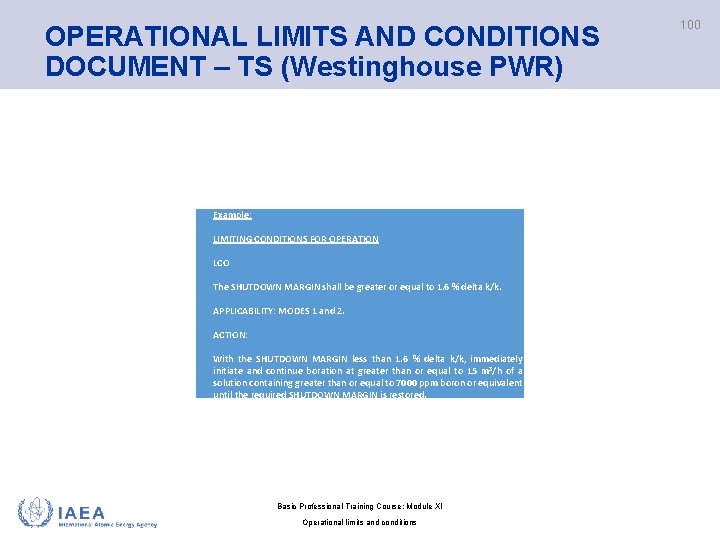
OPERATIONAL LIMITS AND CONDITIONS DOCUMENT – TS (Westinghouse PWR) Example: LIMITING CONDITIONS FOR OPERATION LCO The SHUTDOWN MARGIN shall be greater or equal to 1. 6 % delta k/k. APPLICABILITY: MODES 1 and 2. ACTION: With the SHUTDOWN MARGIN less than 1. 6 % delta k/k, immediately initiate and continue boration at greater than or equal to 15 m 3/h of a solution containing greater than or equal to 7000 ppm boron or equivalent until the required SHUTDOWN MARGIN is restored. Basic Professional Training Course; Module XI Operational limits and conditions 100
OPERATIONAL LIMITS AND CONDITIONS DOCUMENT – TS (Westinghouse PWR) • Design features: − Important design features of the plant that are not addressed in other sections are listed in this section. − Their amendment would affect the safety of the plant and invalidate the conclusions of the safety analysis. − Example: − Basic design characteristic of the Containment, − Core and Reactor cooling system, − Capacity and limitations for Spent fuel pit, − Component cyclic limits, − etc. Basic Professional Training Course; Module XI Operational limits and conditions 101
OPERATIONAL LIMITS AND CONDITIONS DOCUMENT – TS (Westinghouse PWR) • Administrative controls: − The administrative requirements for the safe operation of the plant. − The measures used in cases of violation of safety margins and operating conditions. − The responsibilities of leading managing personnel. − Composition and qualification required for the shift operators. − The minimum requirements for procedures and programs required for reporting, archiving and reviews. Basic Professional Training Course; Module XI Operational limits and conditions 102
OPERATIONAL LIMITS AND CONDITIONS DOCUMENT – TS (Westinghouse PWR) 103 • Basis: − At the end of technical specifications. − Basis explain the reasons for the specifications given in the sections "Safety limits and limiting safety system settings" and "Limiting conditions for operation and surveillance requirement". − Basis explicitly connect restrictions in the specification to the safety analysis. − The Basis are not part of the technical specifications. Basic Professional Training Course; Module XI Operational limits and conditions The views expressed in this document do not necessarily reflect the views of the European Commission.
- Slides: 103