
Basic problem A random variable X follows the
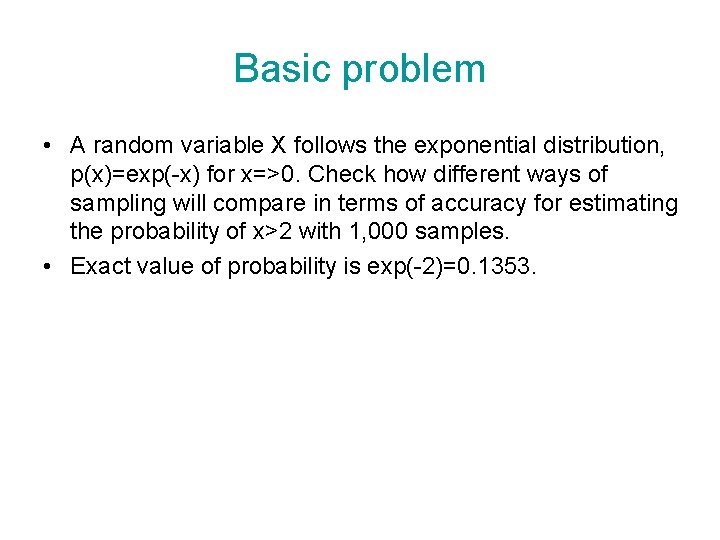
Basic problem • A random variable X follows the exponential distribution, p(x)=exp(-x) for x=>0. Check how different ways of sampling will compare in terms of accuracy for estimating the probability of x>2 with 1, 000 samples. • Exact value of probability is exp(-2)=0. 1353.
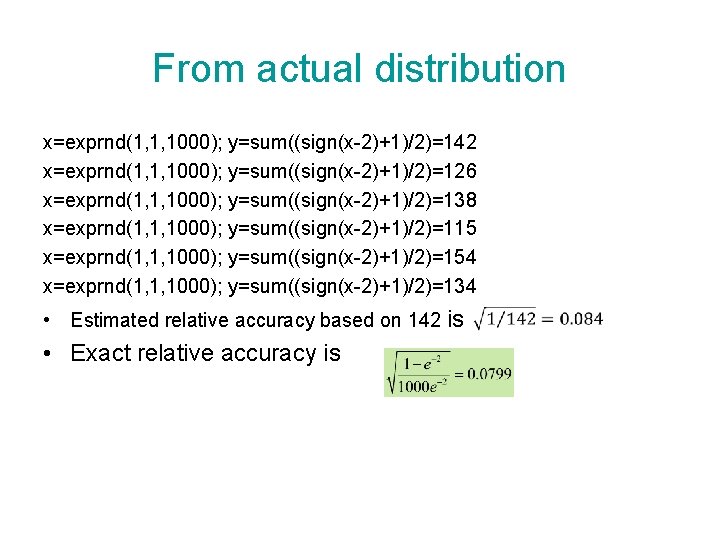
From actual distribution x=exprnd(1, 1, 1000); y=sum((sign(x-2)+1)/2)=142 x=exprnd(1, 1, 1000); y=sum((sign(x-2)+1)/2)=126 x=exprnd(1, 1, 1000); y=sum((sign(x-2)+1)/2)=138 x=exprnd(1, 1, 1000); y=sum((sign(x-2)+1)/2)=115 x=exprnd(1, 1, 1000); y=sum((sign(x-2)+1)/2)=154 x=exprnd(1, 1, 1000); y=sum((sign(x-2)+1)/2)=134 • Estimated relative accuracy based on 142 is • Exact relative accuracy is
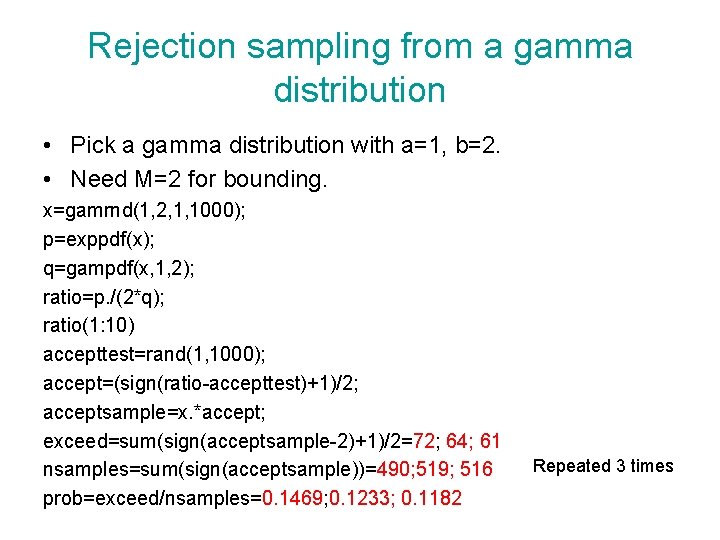
Rejection sampling from a gamma distribution • Pick a gamma distribution with a=1, b=2. • Need M=2 for bounding. x=gamrnd(1, 2, 1, 1000); p=exppdf(x); q=gampdf(x, 1, 2); ratio=p. /(2*q); ratio(1: 10) accepttest=rand(1, 1000); accept=(sign(ratio-accepttest)+1)/2; acceptsample=x. *accept; exceed=sum(sign(acceptsample-2)+1)/2=72; 64; 61 nsamples=sum(sign(acceptsample))=490; 519; 516 prob=exceed/nsamples=0. 1469; 0. 1233; 0. 1182 Repeated 3 times
Question • Why the number of accepted samples is more stable than the estimate of the probability?
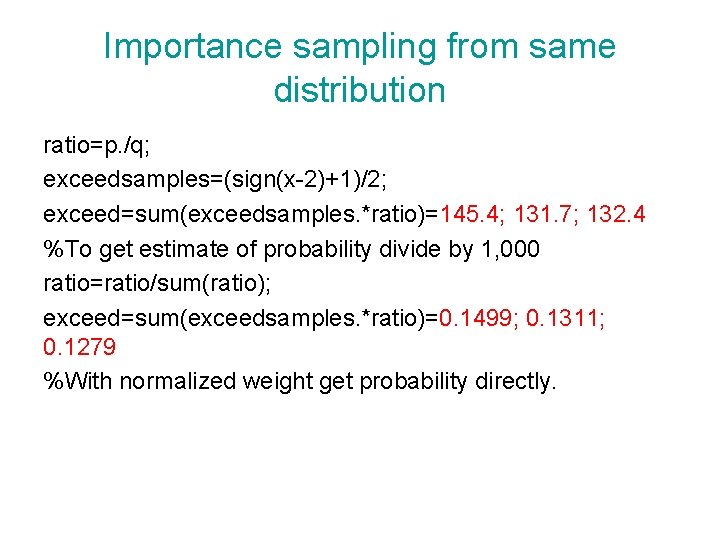
Importance sampling from same distribution ratio=p. /q; exceedsamples=(sign(x-2)+1)/2; exceed=sum(exceedsamples. *ratio)=145. 4; 131. 7; 132. 4 %To get estimate of probability divide by 1, 000 ratio=ratio/sum(ratio); exceed=sum(exceedsamples. *ratio)=0. 1499; 0. 1311; 0. 1279 %With normalized weight get probability directly.
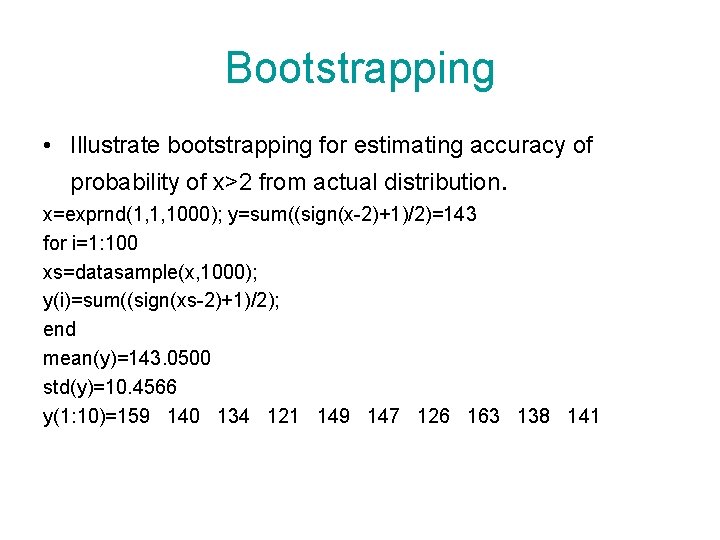
Bootstrapping • Illustrate bootstrapping for estimating accuracy of probability of x>2 from actual distribution. x=exprnd(1, 1, 1000); y=sum((sign(x-2)+1)/2)=143 for i=1: 100 xs=datasample(x, 1000); y(i)=sum((sign(xs-2)+1)/2); end mean(y)=143. 0500 std(y)=10. 4566 y(1: 10)=159 140 134 121 149 147 126 163 138 141
- Slides: 6