
Basic Principles of the Rorschach Comprehensive System Barry
Basic Principles of the Rorschach Comprehensive System Barry Ritzler, Ph. D. Rorschach Training Programs
The Current System ► John Exner died on February 20, 2006 ► Since then, no changes have been made in the System ► The System is “a work in progress” ► The Rorschach Development Group (RDG) has been formed from the previous Research Council
Recommended Changes 1. 2. 3. 4. 5. Mutuality of Autonomy (Urist) A scale that is sensitive to behavioral dependency (Oral Dependency Scale— Bornstein and Masling) More on Aggression More on Color (Affect) Mihuda Workshop (SPA)
Three Phases of the Comprehensive System ► 1. Administration (Little Book—Sciara and Ritzler) ► 2. Coding (Must be accurate; depends on adequate administration, good instruction, and guided practice) ► 3. Interpretation (Hopefully accurate; depends on accurate coding, knowledge of personality and psychopathology, and experience.
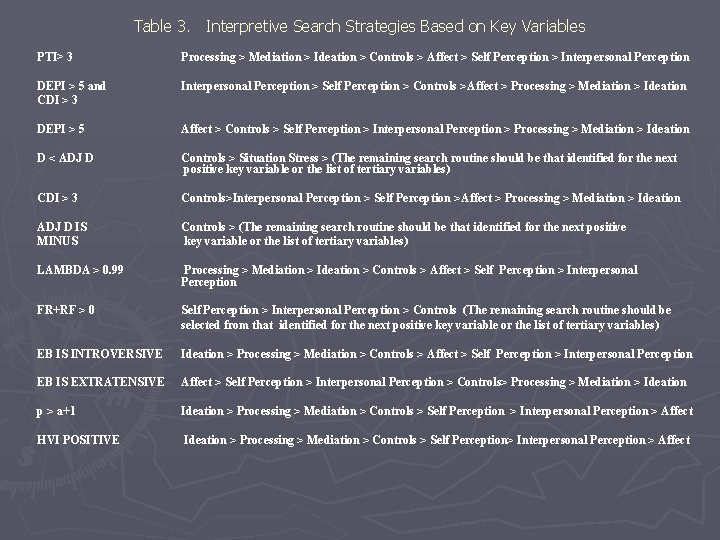
Table 3. Interpretive Search Strategies Based on Key Variables PTI> 3 Processing > Mediation > Ideation > Controls > Affect > Self Perception > Interpersonal Perception DEPI > 5 and CDI > 3 Interpersonal Perception > Self Perception > Controls >Affect > Processing > Mediation > Ideation DEPI > 5 Affect > Controls > Self Perception > Interpersonal Perception > Processing > Mediation > Ideation D < ADJ D Controls > Situation Stress > (The remaining search routine should be that identified for the next positive key variable or the list of tertiary variables) CDI > 3 Controls>Interpersonal Perception > Self Perception >Affect > Processing > Mediation > Ideation ADJ D IS MINUS Controls > (The remaining search routine should be that identified for the next positive key variable or the list of tertiary variables) LAMBDA > 0. 99 Processing > Mediation > Ideation > Controls > Affect > Self Perception > Interpersonal Perception FR+RF > 0 Self Perception > Interpersonal Perception > Controls (The remaining search routine should be selected from that identified for the next positive key variable or the list of tertiary variables) EB IS INTROVERSIVE Ideation > Processing > Mediation > Controls > Affect > Self Perception > Interpersonal Perception EB IS EXTRATENSIVE Affect > Self Perception > Interpersonal Perception > Controls> Processing > Mediation > Ideation p > a+1 Ideation > Processing > Mediation > Controls > Self Perception > Interpersonal Perception > Affect HVI POSITIVE Ideation > Processing > Mediation > Controls > Self Perception> Interpersonal Perception > Affect
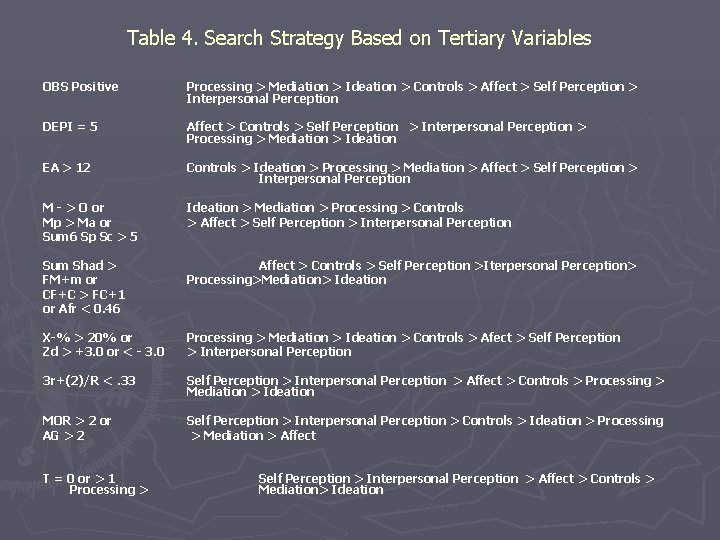
Table 4. Search Strategy Based on Tertiary Variables OBS Positive Processing > Mediation > Ideation > Controls > Affect > Self Perception > Interpersonal Perception DEPI = 5 Affect > Controls > Self Perception > Interpersonal Perception > Processing > Mediation > Ideation EA > 12 Controls > Ideation > Processing > Mediation > Affect > Self Perception > Interpersonal Perception M - > O or Mp > Ma or Sum 6 Sp Sc > 5 Ideation > Mediation > Processing > Controls > Affect > Self Perception > Interpersonal Perception Sum Shad > FM+m or CF+C > FC+1 or Afr < 0. 46 Affect > Controls > Self Perception > Iterpersonal Perception> Processing>Mediation> Ideation X-% > 20% or Zd > +3. 0 or < - 3. 0 Processing > Mediation > Ideation > Controls > Afect > Self Perception > Interpersonal Perception 3 r+(2)/R <. 33 Self Perception > Interpersonal Perception > Affect > Controls > Processing > Mediation > Ideation MOR > 2 or AG > 2 Self Perception > Interpersonal Perception > Controls > Ideation > Processing > Mediation > Affect T = 0 or > 1 Processing > Self Perception > Interpersonal Perception > Affect > Controls > Mediation> Ideation
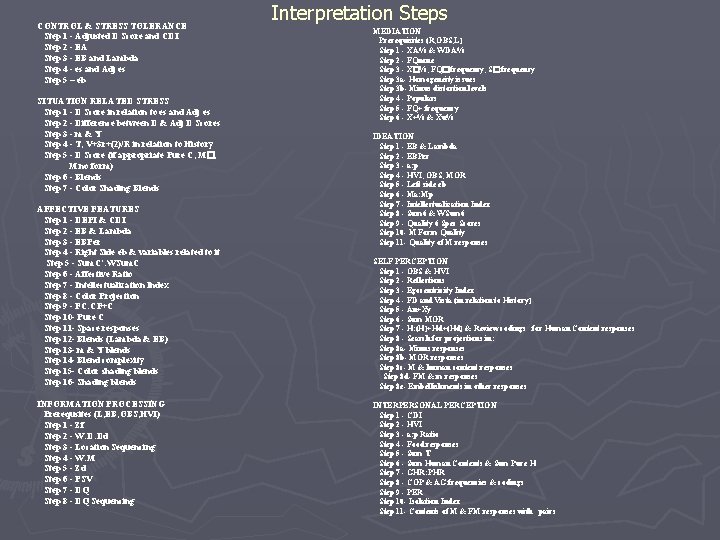
CONTROL & STRESS TOLERANCE Step 1 - Adjusted D Score and CDI Step 2 - EA Step 3 - EB and Lambda Step 4 - es and Adj es Step 5 – eb SITUATION RELATED STRESS Step 1 - D Score in relation to es and Adj es Step 2 - Difference between D & Adj D Scores Step 3 - m & Y Step 4 - T, V+3 r+(2)/R in relation to History Step 5 - D Score (if appropriate Pure C, M� M�, M no form) Step 6 - Blends Step 7 - Color Shading Blends AFFECTIVE FEATURES Step 1 - DEPI & CDI Step 2 - EB & Lambda Step 3 - EBPer Step 4 - Right Side eb & variables related to it Step 5 - Sum. C': WSum. C Step 6 - Affective Ratio Step 7 - Intellectualization Index Step 8 - Color Projection Step 9 - FC: CF+C Step 10 - Pure C Step 11 - Space responses Step 12 - Blends (Lambda & EB) Step 13 - m & Y blends Step 14 - Blend complexity Step 15 - Color shading blends Step 16 - Shading blends INFORMATION PROCESSING Prerequsites (L, EB, OBS, HVI) Step 1 - Zf Step 2 - W: D: Dd Step 3 - Location Sequencing Step 4 - W: M Step 5 - Zd Step 6 - PSV Step 7 - DQ Step 8 - DQ Sequencing Interpretation Steps MEDIATION Prerequisites (R, OBS, L) Step 1 - XA% & WDA% Step 2 - FQnone Step 3 - X� X�%, FQ� frequency, S� S� frequency Step 3 a- Homogeneity issues Step 3 b- Minus distortion levels Step 4 - Populars Step 5 - FQ+ frequency Step 6 - X+% & Xu% IDEATION Step 1 - EB & Lambda Step 2 - EBPer Step 3 - a: p Step 4 - HVI, OBS, MOR Step 5 - Left side eb Step 6 - Ma: Mp Step 7 - Intellectualization Index Step 8 - Sum 6 & WSum 6 Step 9 - Quality 6 Spec Scores Step 10 - M Form Quality Step 11 - Quality of M responses SELF PERCEPTION Step 1 - OBS & HVI Step 2 - Reflections Step 3 - Egocentricity Index Step 4 - FD and Vista (in relation to History) Step 5 - An+Xy Step 6 - Sum MOR Step 7 - H: (H)+Hd+(Hd) & Review codings for Human Content responses Step 8 - Search for projections in: Step 8 a- Minus responses Step 8 b- MOR responses Step 8 c- M & human content responses Step 8 d- FM & m responses Step 8 e- Embellishments in other responses INTERPERSONAL PERCEPTION Step 1 - CDI Step 2 - HVI Step 3 - a: p Ratio Step 4 - Food responses Step 5 - Sum T Step 6 - Sum Human Contents & Sum Pure H Step 7 - GHR: PHR Step 8 - COP & AG frequencies & codings Step 9 - PER Step 10 - Isolation Index Step 11 - Contents of M & FM responses with pairs
Interpretation Guidelines ► Know as much as possible about client ► Integrate! ► Translate! ► Use Cluster Search Routine
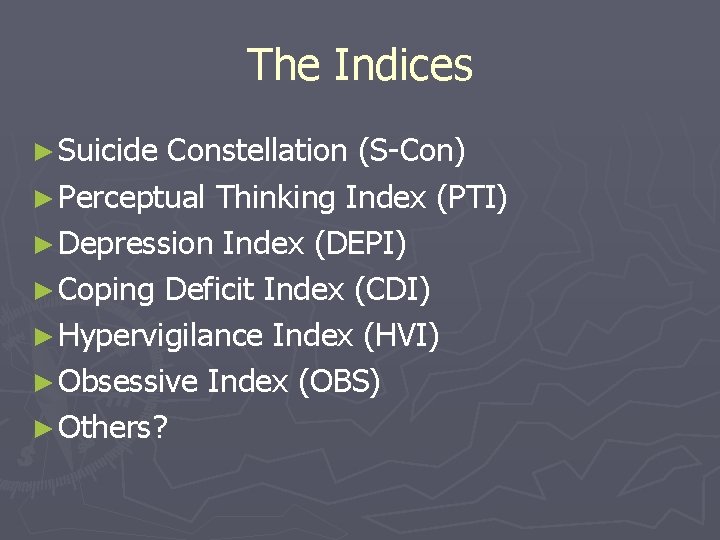
The Indices ► Suicide Constellation (S-Con) ► Perceptual Thinking Index (PTI) ► Depression Index (DEPI) ► Coping Deficit Index (CDI) ► Hypervigilance Index (HVI) ► Obsessive Index (OBS) ► Others?
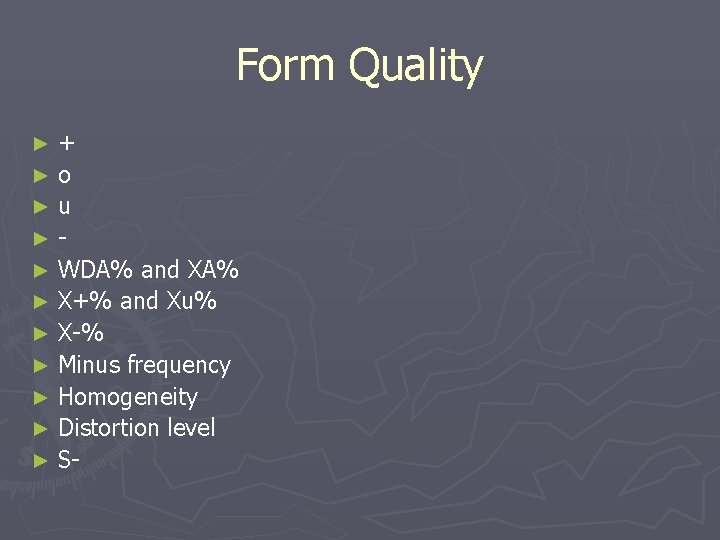
Form Quality + ►o ►u ►► WDA% and XA% ► X+% and Xu% ► X-% ► Minus frequency ► Homogeneity ► Distortion level ► S►
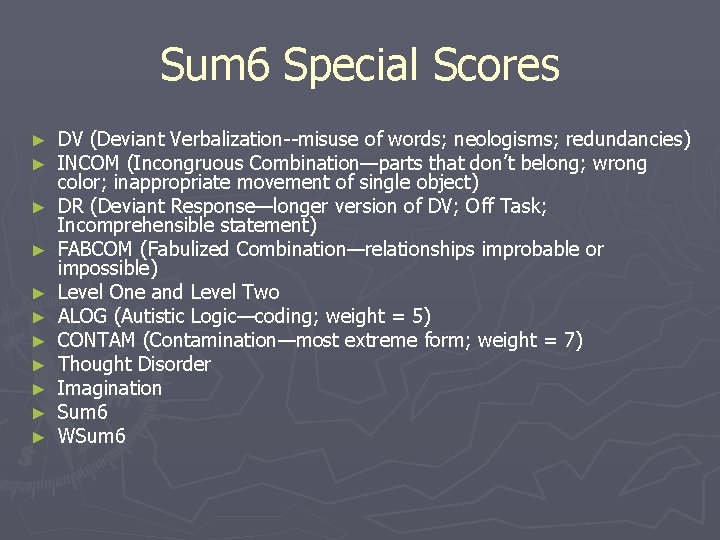
Sum 6 Special Scores ► ► ► DV (Deviant Verbalization--misuse of words; neologisms; redundancies) INCOM (Incongruous Combination—parts that don’t belong; wrong color; inappropriate movement of single object) DR (Deviant Response—longer version of DV; Off Task; Incomprehensible statement) FABCOM (Fabulized Combination—relationships improbable or impossible) Level One and Level Two ALOG (Autistic Logic—coding; weight = 5) CONTAM (Contamination—most extreme form; weight = 7) Thought Disorder Imagination Sum 6 WSum 6
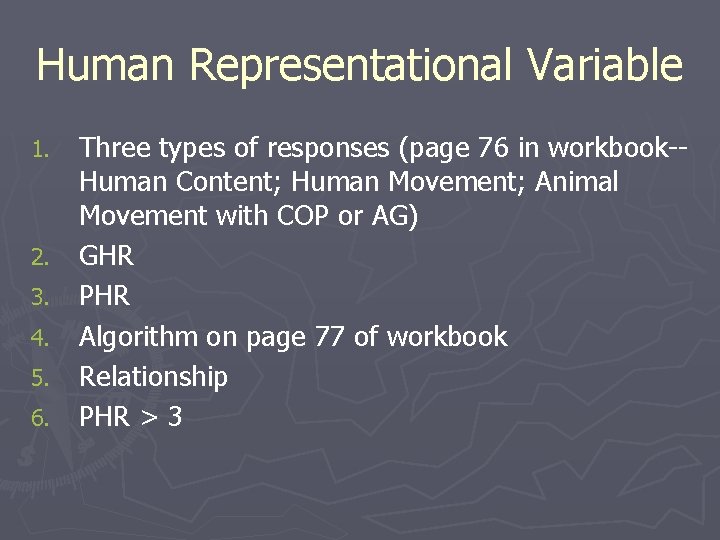
Human Representational Variable 1. 2. 3. 4. 5. 6. Three types of responses (page 76 in workbook-Human Content; Human Movement; Animal Movement with COP or AG) GHR PHR Algorithm on page 77 of workbook Relationship PHR > 3
Responses ► OK between 16 and 36 ► Distortions at other levels
Other Comprehensive System Issues ► Norms ► Children and Adolescents ► Need for more integrative research ► Cross-cultural?
- Slides: 14