
Basic Principles of Software Quality Assurance Adapted from
Basic Principles of Software Quality Assurance Adapted from S. Somé, A. Williams 1
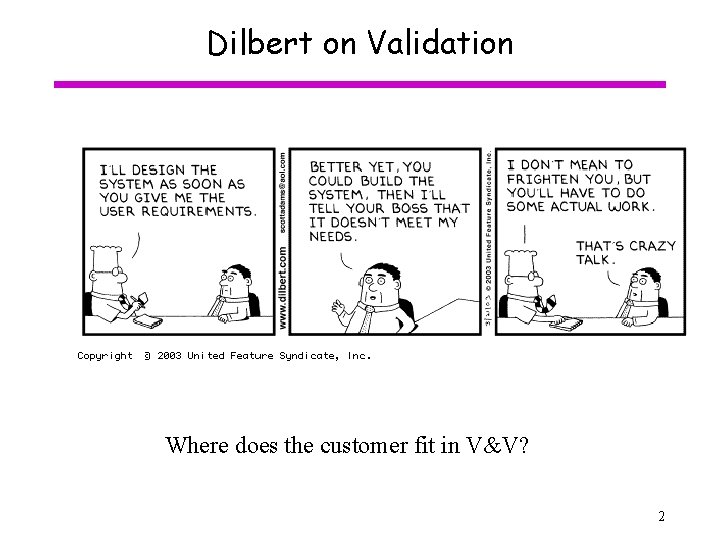
Dilbert on Validation Where does the customer fit in V&V? 2

Three General Principles of QA • Know what you are doing – Understand what is being built, how it is being built and what it currently does. – Follow a software development process with – Management structure (milestones, scheduling) – Reporting policies – Tracking
Three General Principles of QA • Know what you should be doing: – Having explicit requirements and specifications – JP: really? ? Can they be the same? ? – Follow a software development process with – Requirements analysis, – Acceptance tests, – Frequent user feedback.

Three General Principles of QA • Know how to measure the difference. – Have explicit measures comparing what is being done from what should be done. – Four complementary methods: – Formal methods – verify mathematically specified properties. – Testing – explicit input to exercise software and check for expected output. – Inspections – human examination of requirements, design, code, . . . based on checklists. – Metrics – measures a known set of properties related to quality
One categorization of V&V Approaches • Walkthroughs and inspections – Not formal, yet systematic and cost-effective • Correctness proofs – Theorem proving – Complex, undecidable, not for all programs… • Symbolic execution (NO execution of IUT) – The spec has variables and you explore their possible values • Model checking (with/out execution of IUT) – Typically: State-based model + logical formula (property) – Decidable if state space is finite (and small enough) • Testing – Incomplete, but practical.
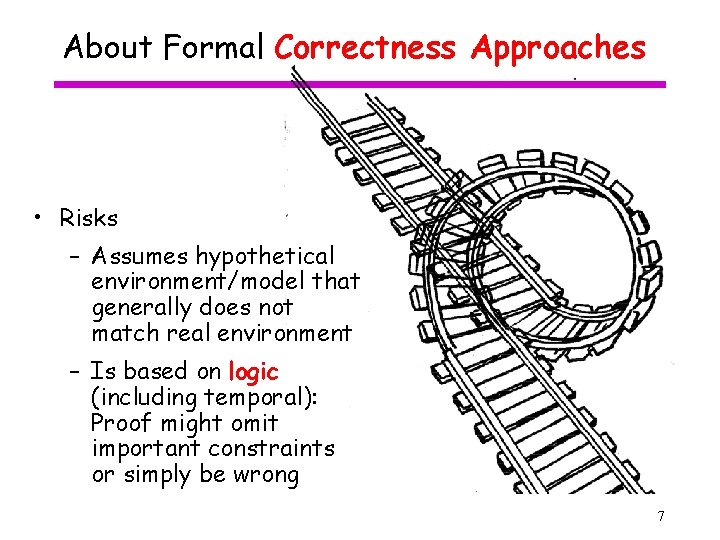
About Formal Correctness Approaches • Risks – Assumes hypothetical environment/model that generally does not match real environment – Is based on logic (including temporal): Proof might omit important constraints or simply be wrong 7

Specification Based Functional Testing with Formal Methods Goal: Testing functional behaviour of black-box implementation with respect to specification in a formal language based on formal definition of conformance. specification s formal testing s SPECS Specification IUT: Implementation under Test implementation under test Spec S is assumed to be correct and correspond to the reqs. This is the origins of Model. Based Testing (MBT) 8

An Example of Formal Testing S test generation correctness criterion implementation relation exhaustive i ioco s specification sound i passes Ts test suite TS implementation i test execution ioco-test theory: this theory works on labeled transition systems. The acronym ioco stands for input/output conformance. pass / fail 9
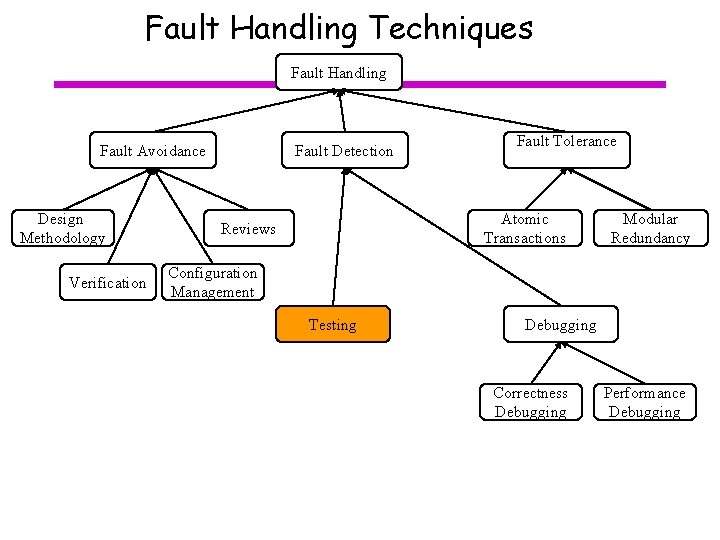
Fault Handling Techniques Fault Handling Fault Avoidance Design Methodology Verification Fault Detection Fault Tolerance Atomic Transactions Reviews Modular Redundancy Configuration Management Testing Debugging Correctness Debugging Performance Debugging
What is Software testing ? • Examination of a software unit, several integrated software units or an entire software package by running it. – execution based on test cases – expectation – reveal faults as failures • Failure: incorrect execution of the system – usually consequence of a fault / defect • Fault/defect/bug result of a human error

Objectives of testing • To find defects before they cause a production system to fail. • To bring the tested software, after correction of the identified defects and retesting, to an acceptable level of quality. • To perform the required tests efficiently and effectively, within the limits of budgetary and scheduling constraints. • To compile a record of software errors for use in error prevention (by corrective and preventive actions), and for process tracking.
When does a fault occur ? • Software doesn't do something that the specification says it should do. • Software does something that the specification says it shouldn't do. • Software does something that the specification doesn't mention. • Software doesn't do something that the specification doesn't mention but should. • Software is difficult to understand, hard to use, slow, or – in the software tester's eyes – will be viewed by the end user as just plain not right.
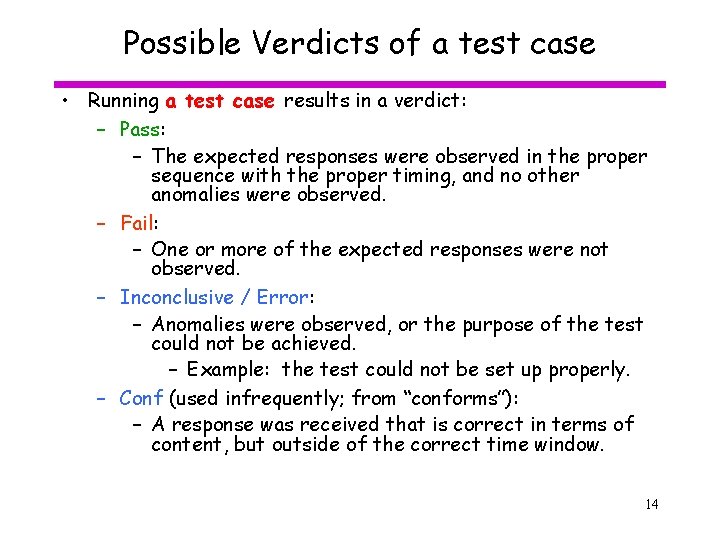
Possible Verdicts of a test case • Running a test case results in a verdict: – Pass: – The expected responses were observed in the proper sequence with the proper timing, and no other anomalies were observed. – Fail: – One or more of the expected responses were not observed. – Inconclusive / Error: – Anomalies were observed, or the purpose of the test could not be achieved. – Example: the test could not be set up properly. – Conf (used infrequently; from “conforms”): – A response was received that is correct in terms of content, but outside of the correct time window. 14
Testing Axioms • It is impossible to test a program completely. – large input space – large output space – large state space – large number of possible execution paths – subjectivity of specifications
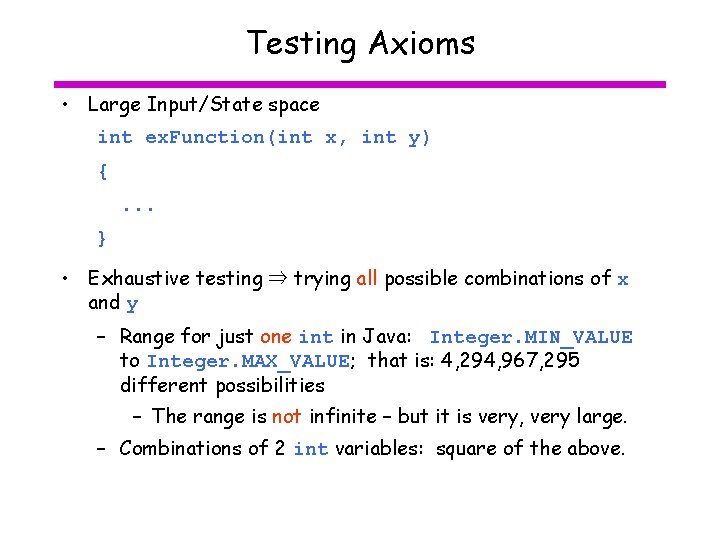
Testing Axioms • Large Input/State space int ex. Function(int x, int y) {. . . } • Exhaustive testing ⇒ trying all possible combinations of x and y – Range for just one int in Java: Integer. MIN_VALUE to Integer. MAX_VALUE; that is: 4, 294, 967, 295 different possibilities – The range is not infinite – but it is very, very large. – Combinations of 2 int variables: square of the above.
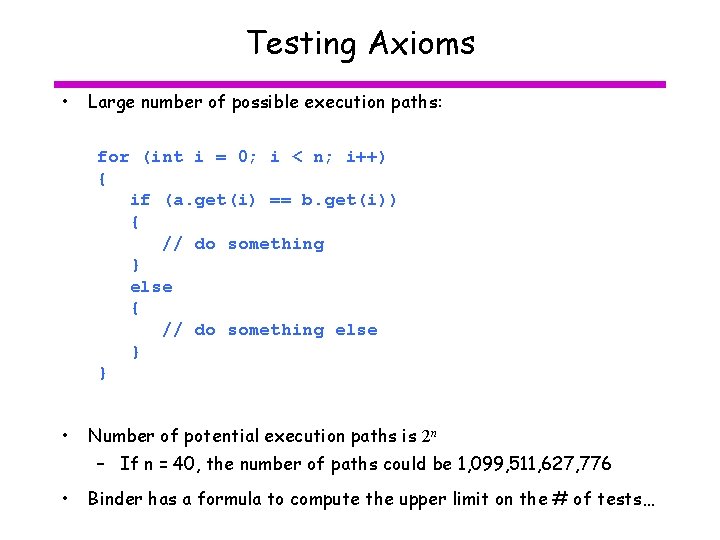
Testing Axioms • Large number of possible execution paths: for (int i = 0; i < n; i++) { if (a. get(i) == b. get(i)) { // do something } else { // do something else } } • Number of potential execution paths is 2 n – If n = 40, the number of paths could be 1, 099, 511, 627, 776 • Binder has a formula to compute the upper limit on the # of tests…
Testing Axioms • Software testing is a risk-based exercise – Need to balance cost and risk of missing bugs • Testing cannot prove the absence of bugs • The more bugs you find, the more bugs there are • The “pesticide paradox” – A system tends to build resistance to a particular testing technique.
Testing Axioms • Not all bugs found are fixed. • Difficult to say when a bug is a bug. – only when observed (latent otherwise) • Product specifications are never final. • Software testers sometimes aren't the most popular members of a project team. • Software testing is a disciplined technical profession that requires training.
What Testing can accomplish • Reveal faults that would be too costly or impossible to find using other techniques • Show the system complies (JP: or conforms? ? ) with its stated requirements for a given test suite • Testing is made easier and more effective by good software engineering practices: – That is to say, Fowler and Meszaros are relevant
Risk • Risk is the probability of an observed failure, multiplied by the potential cost (usually, estimated) of the failure. – Example: – Dropping one regular phone call: low probability, low potential cost (customer hits redial) – Dropping a 911 emergency call: low probability, high potential cost (lives) 21
Risk-based testing • Choosing what to test is often influenced by risk. • What are the probabilities that the following were implemented incorrectly. . . ? – A “typical” scenario – Exceptional scenarios • Empirically, the probability of a defect is much higher in the code for exceptional scenarios, and testing resources are often directed towards them. – Keep the cost factor of risk in mind as well. 22
- Slides: 22