
Basic principles of rock magnetism Outline Magnetic properties
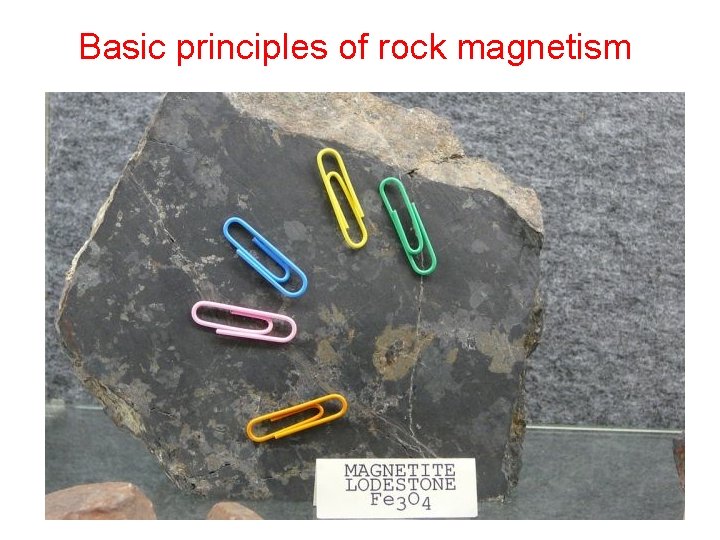
Basic principles of rock magnetism
Outline ²Magnetic properties of solids ²Magnetic remanence The magnetic field of of external origin ²Magnetic properties minerals ²Magnetic minerals in rocks
What is Rock magnetism? Rock magnetism is the study of induced and remanent magnetization of magnetic minerals grains in rocks, sediments, soils, and organisms. --- David J. Dunlop
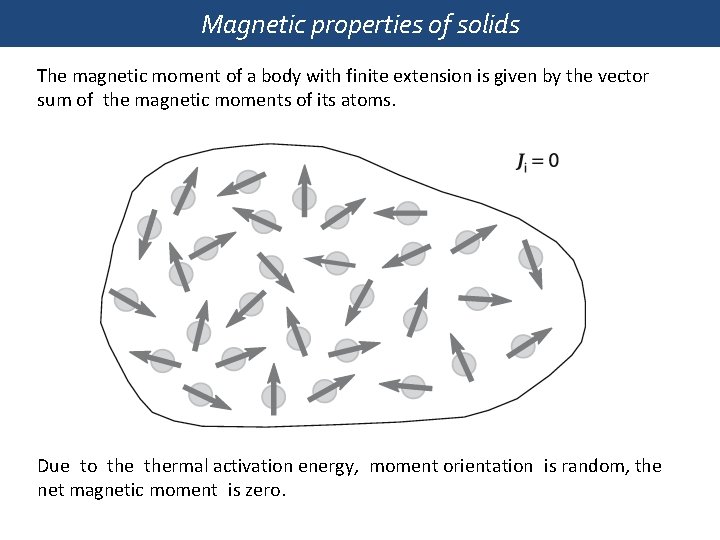
Magnetic properties of solids The magnetic moment of a body with finite extension is given by the vector sum of the magnetic moments of its atoms. Due to thermal activation energy, moment orientation is random, the net magnetic moment is zero.
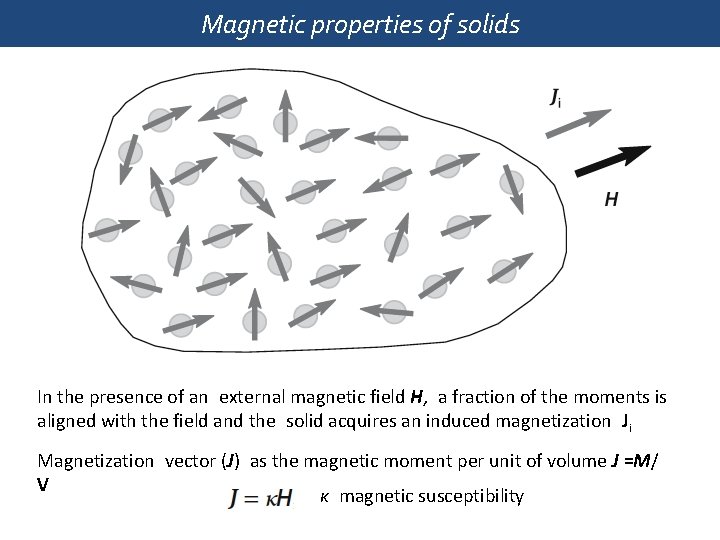
Magnetic properties of solids In the presence of an external magnetic field H, a fraction of the moments is aligned with the field and the solid acquires an induced magnetization Ji Magnetization vector (J) as the magnetic moment per unit of volume J =M/ V κ magnetic susceptibility
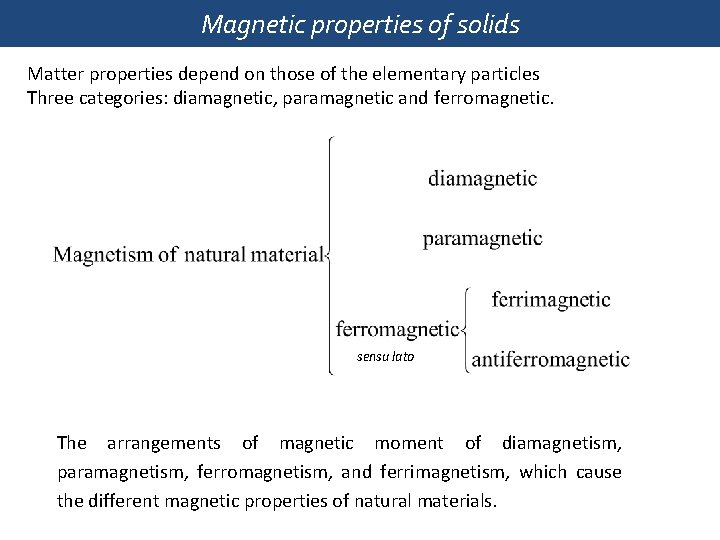
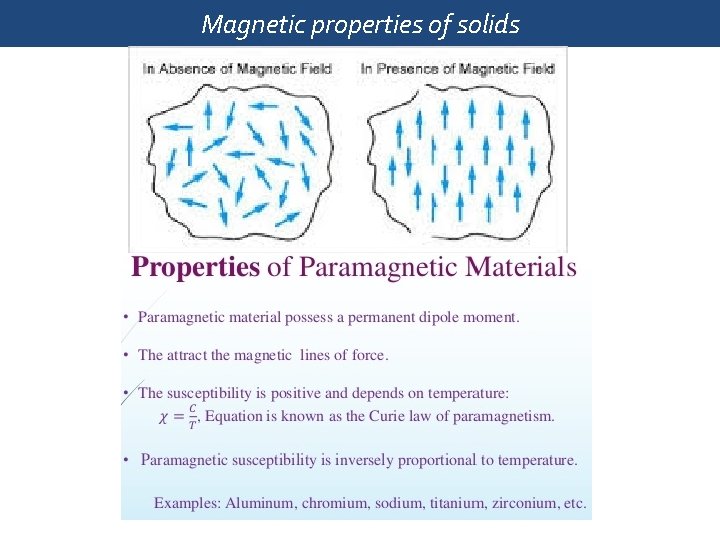
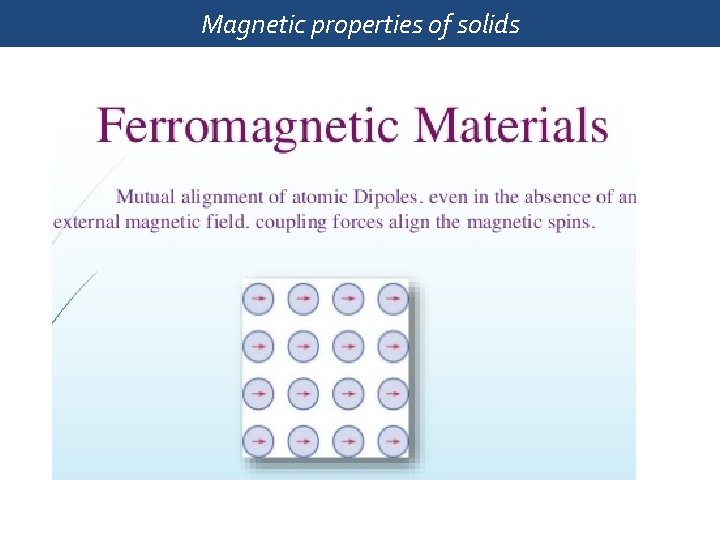
Magnetic properties of solids Matter properties depend on those of the elementary particles Three categories: diamagnetic, paramagnetic and ferromagnetic. sensu lato The arrangements of magnetic moment of diamagnetism, paramagnetism, ferromagnetism, and ferrimagnetism, which cause the different magnetic properties of natural materials.
Everything Is Magnetic
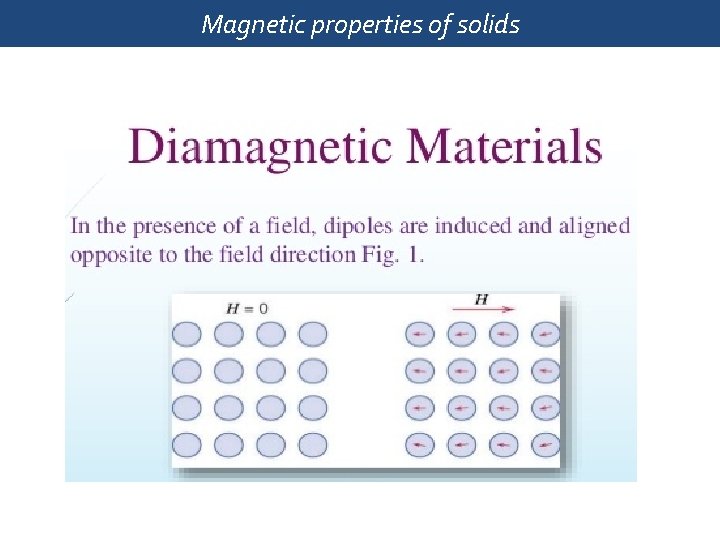
Magnetic properties of solids
Magnetic properties of solids
Magnetic properties of solids
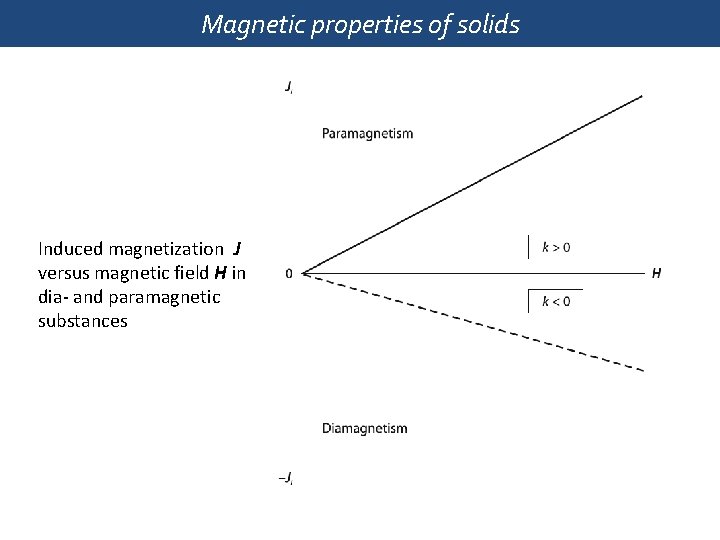
Magnetic properties of solids Induced magnetization J versus magnetic field H in dia- and paramagnetic substances
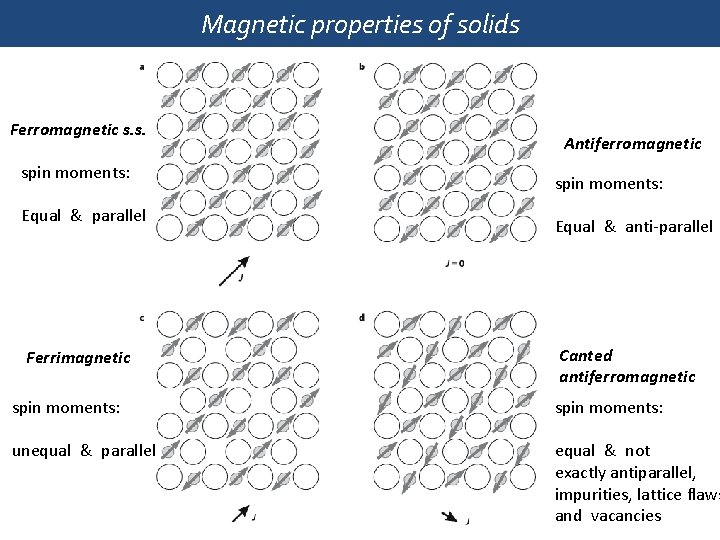
Magnetic properties of solids Ferromagnetic s. s. spin moments: Equal & parallel Ferrimagnetic Antiferromagnetic spin moments: Equal & anti-parallel Canted antiferromagnetic spin moments: unequal & parallel equal & not exactly antiparallel, impurities, lattice flaws and vacancies
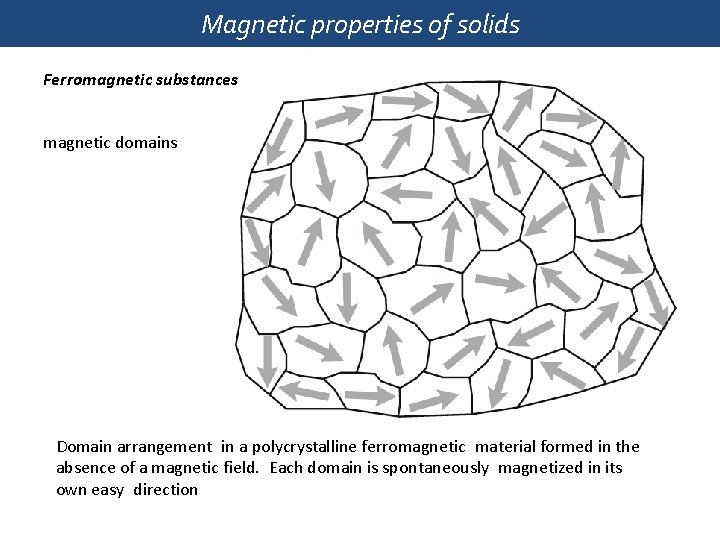
Magnetic properties of solids Ferromagnetic substances magnetic domains Domain arrangement in a polycrystalline ferromagnetic material formed in the absence of a magnetic field. Each domain is spontaneously magnetized in its own easy direction
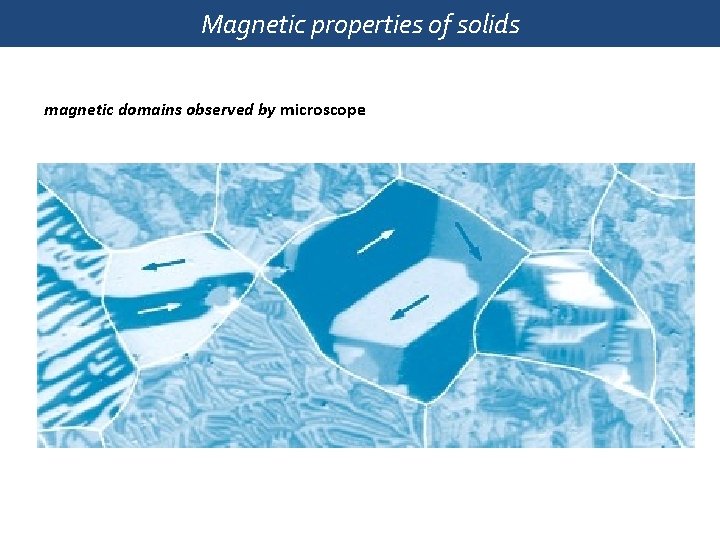
Magnetic properties of solids magnetic domains observed by microscope
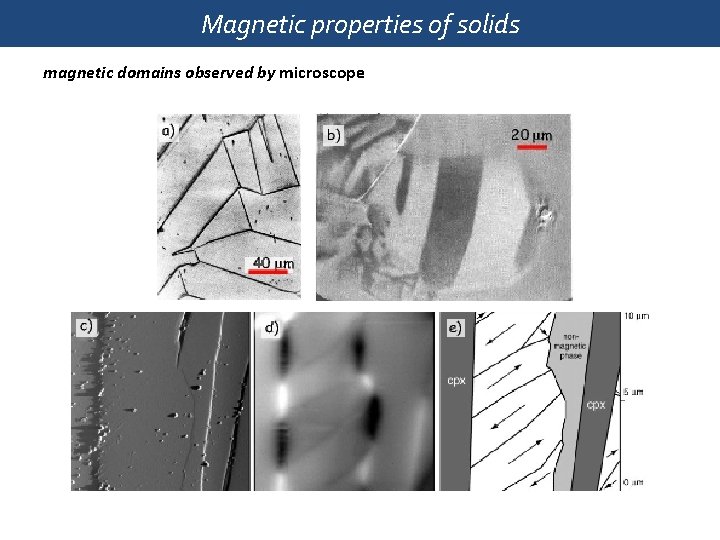
Magnetic properties of solids magnetic domains observed by microscope
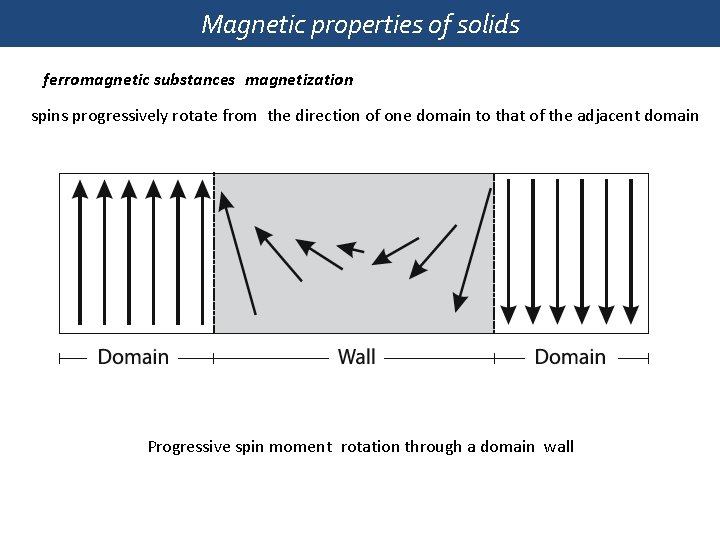
Magnetic properties of solids ferromagnetic substances magnetization spins progressively rotate from the direction of one domain to that of the adjacent domain Progressive spin moment rotation through a domain wall
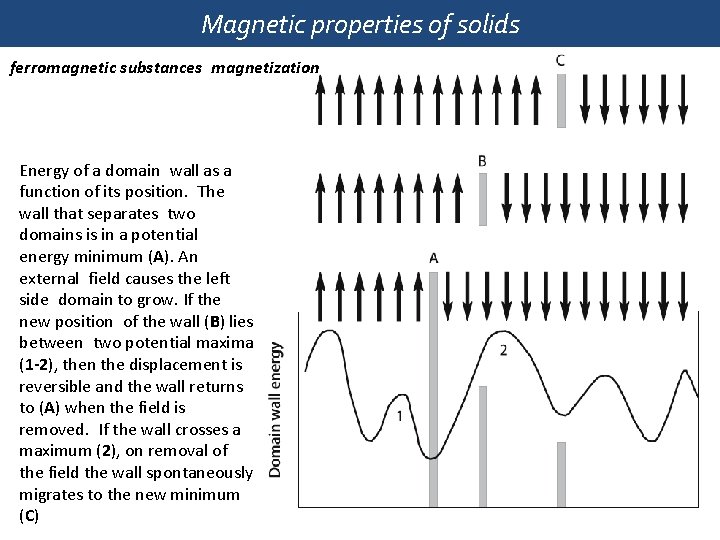
The magnetic field of external Magnetic properties of solidsorigin ferromagnetic substances magnetization Energy of a domain wall as a function of its position. The wall that separates two domains is in a potential energy minimum (A). An external field causes the left side domain to grow. If the new position of the wall (B) lies between two potential maxima (1 -2), then the displacement is reversible and the wall returns to (A) when the field is removed. If the wall crosses a maximum (2), on removal of the field the wall spontaneously migrates to the new minimum (C)
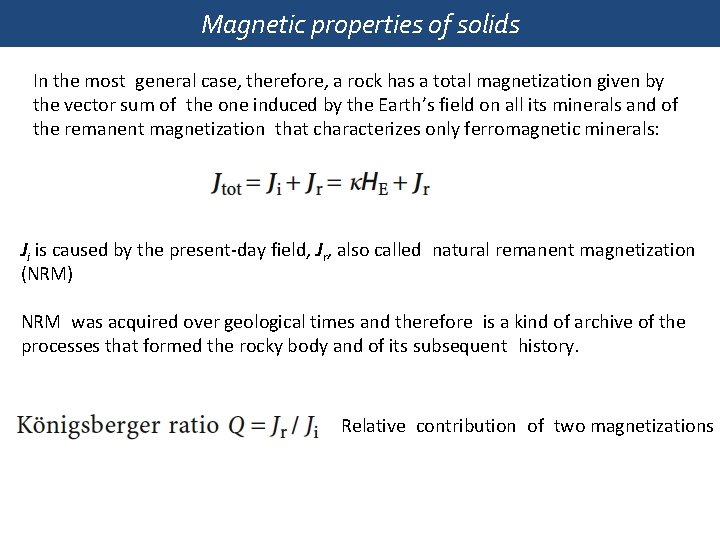
The magnetic field of external Magnetic properties of solidsorigin In the most general case, therefore, a rock has a total magnetization given by the vector sum of the one induced by the Earth’s field on all its minerals and of the remanent magnetization that characterizes only ferromagnetic minerals: Ji is caused by the present-day field, Jr, also called natural remanent magnetization (NRM) NRM was acquired over geological times and therefore is a kind of archive of the processes that formed the rocky body and of its subsequent history. Relative contribution of two magnetizations
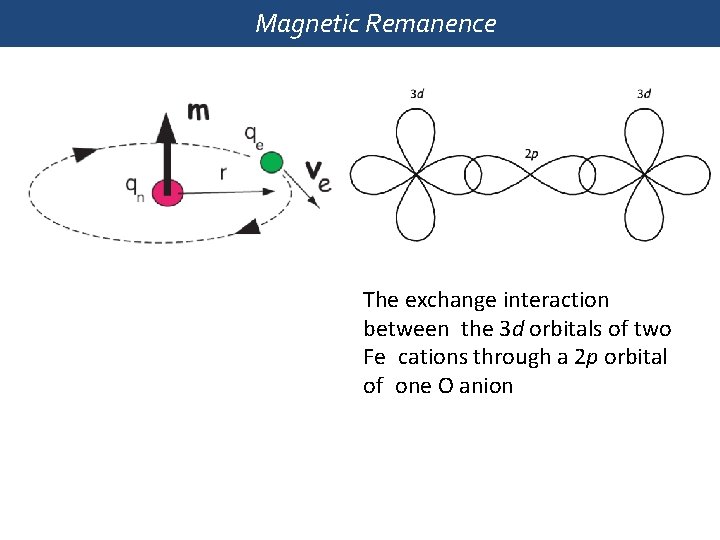
Magnetic Remanence The exchange interaction between the 3 d orbitals of two Fe cations through a 2 p orbital of one O anion
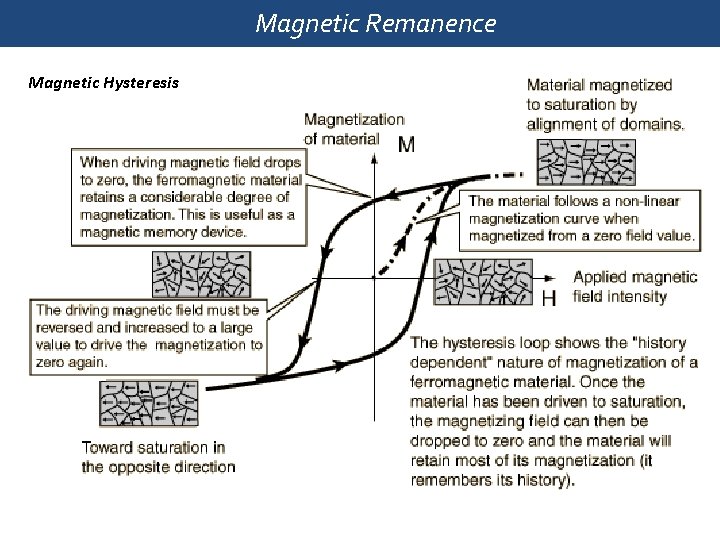
Magnetic Remanence Magnetic Hysteresis
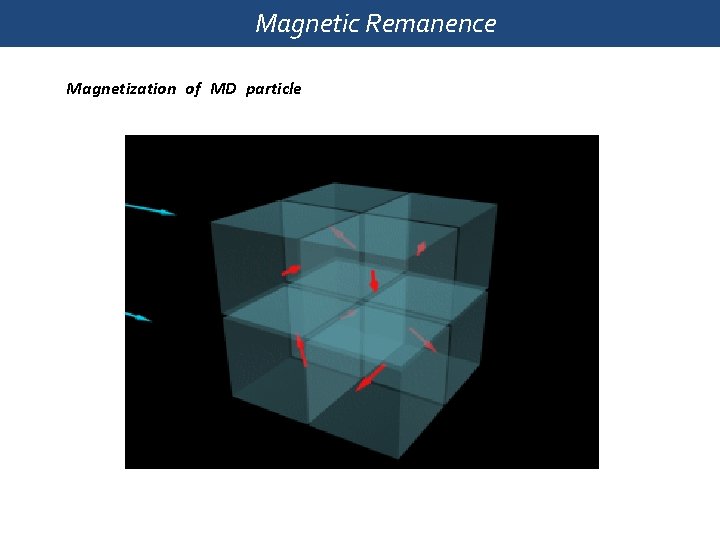
Magnetic Remanence Magnetization of MD particle
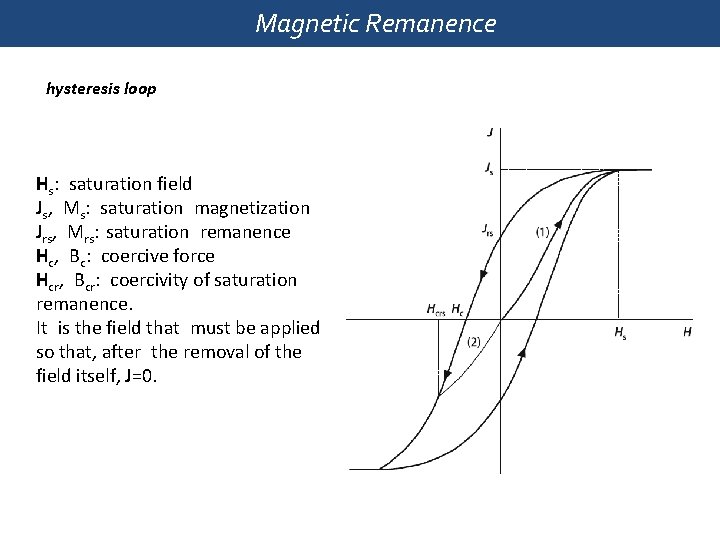
Magnetic Remanence hysteresis loop Magnetic properties of solids Hs: saturation field Js, Ms: saturation magnetization Jrs, Mrs: saturation remanence Hc, Bc: coercive force Hcr, Bcr: coercivity of saturation remanence. It is the field that must be applied so that, after the removal of the field itself, J=0.
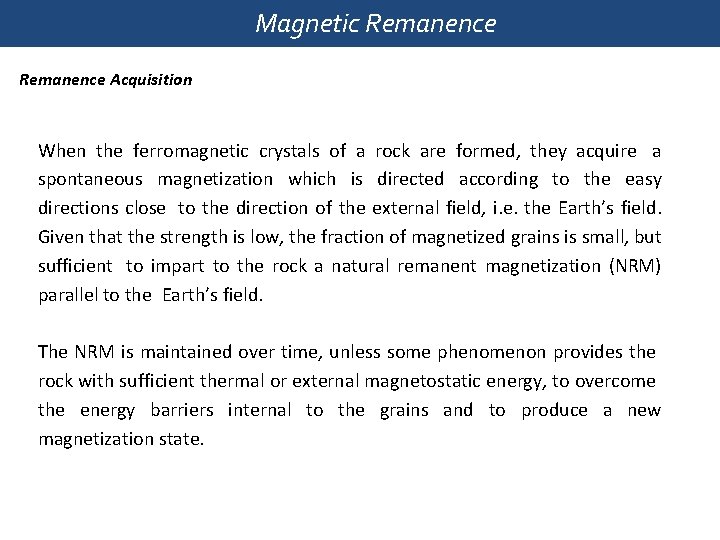
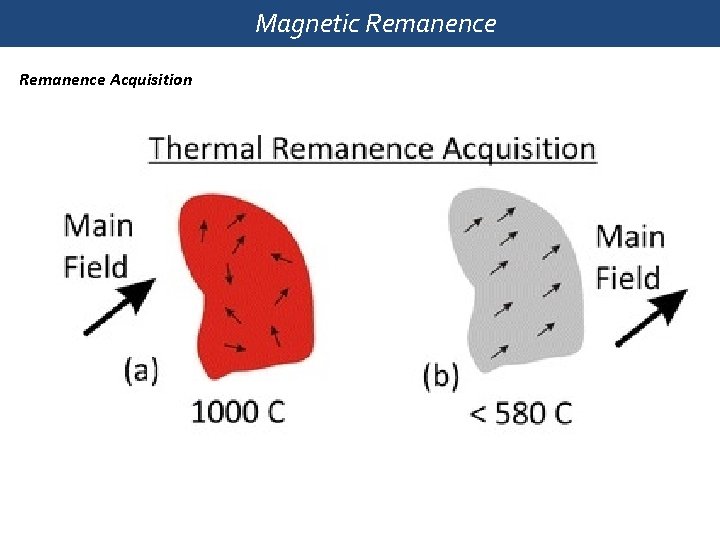
Magnetic Remanence Acquisition When the ferromagnetic crystals of a rock are formed, they acquire a spontaneous magnetization which is directed according to the easy directions close to the direction of the external field, i. e. the Earth’s field. Given that the strength is low, the fraction of magnetized grains is small, but sufficient to impart to the rock a natural remanent magnetization (NRM) parallel to the Earth’s field. The NRM is maintained over time, unless some phenomenon provides the rock with sufficient thermal or external magnetostatic energy, to overcome the energy barriers internal to the grains and to produce a new magnetization state.
Magnetic Remanence Acquisition
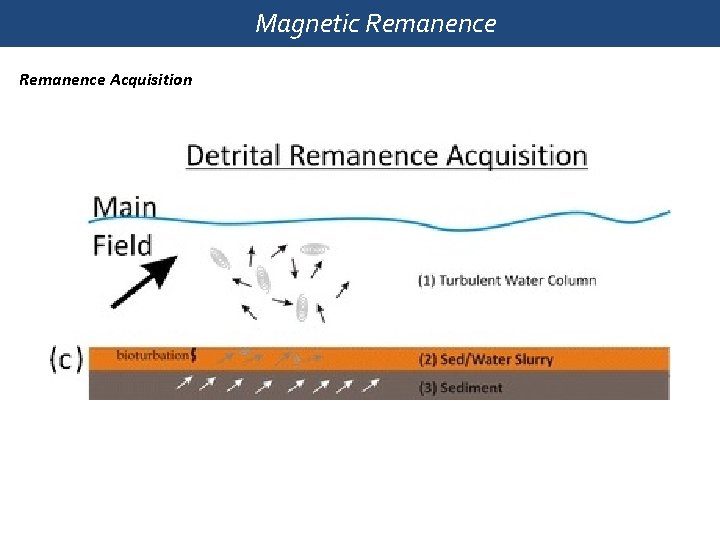
Magnetic Remanence Acquisition
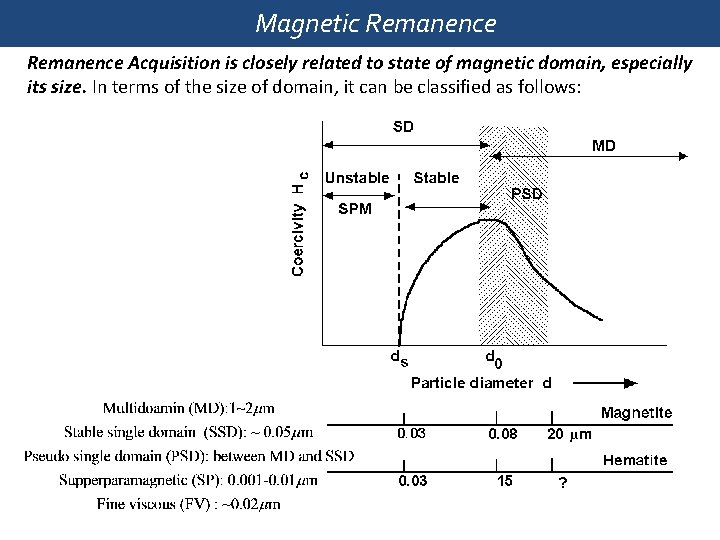
Magnetic Remanence Acquisition is closely related to state of magnetic domain, especially its size. In terms of the size of domain, it can be classified as follows:
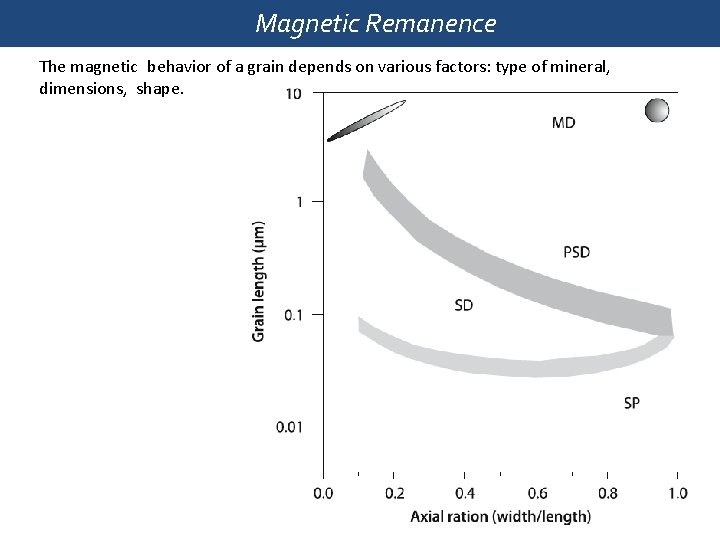
Magnetic Remanence The magnetic behavior of a grain depends on various factors: type of mineral, dimensions, shape.
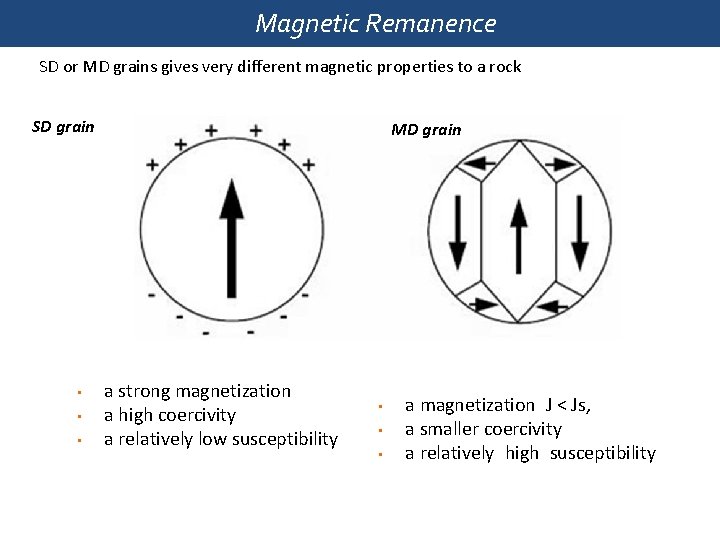
Magnetic Remanence SD or MD grains gives very different magnetic properties to a rock SD grain • • • MD grain a strong magnetization a high coercivity a relatively low susceptibility • • • a magnetization J < Js, a smaller coercivity a relatively high susceptibility
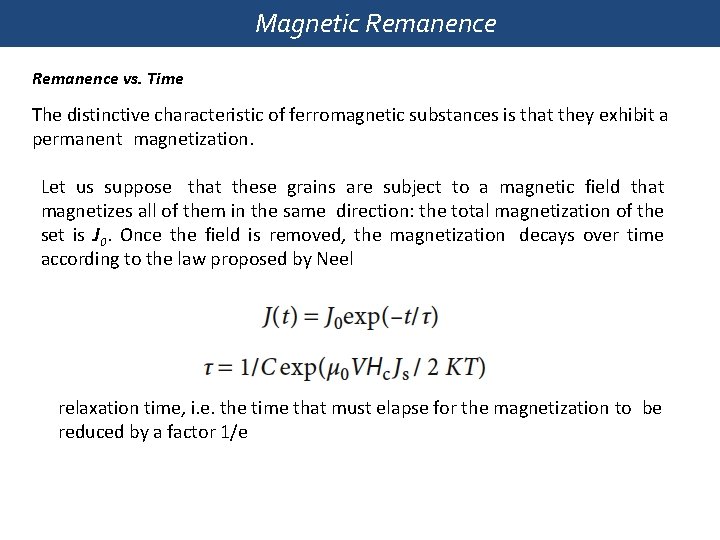
Magnetic Remanence vs. Time The distinctive characteristic of ferromagnetic substances is that they exhibit a permanent magnetization. Let us suppose that these grains are subject to a magnetic field that magnetizes all of them in the same direction: the total magnetization of the set is J 0. Once the field is removed, the magnetization decays over time according to the law proposed by Neel relaxation time, i. e. the time that must elapse for the magnetization to be reduced by a factor 1/e
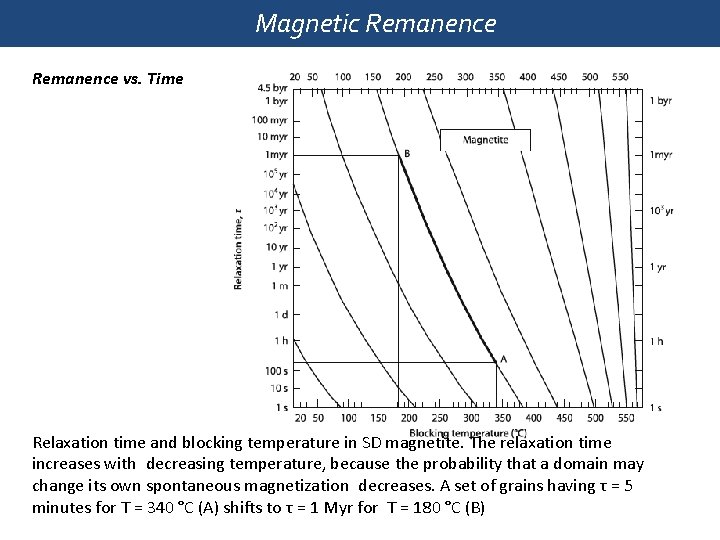
Magnetic Remanence vs. Time Relaxation time and blocking temperature in SD magnetite. The relaxation time increases with decreasing temperature, because the probability that a domain may change its own spontaneous magnetization decreases. A set of grains having τ = 5 minutes for T = 340 °C (A) shifts to τ = 1 Myr for T = 180 °C (B)
Magnetic Properties of Minerals Magnetic parameters often used in Rock Magnetism • Indicators of concentration of magnetic minerals Magnetic susceptibility, Saturation isothermal remanent magnetization, • Indicators of concentration of magnetic grain size Frequency-dependent magnetic susceptibility, Anhysteretic Remanent Magnetization (ARM), Magnetic hysteresis loop and parameters • The parameters indicating magnetic minerals Curier point (or Neel temperature), Low temperature transition
Magnetic Properties of Minerals Indicators of concentration of magnetic minerals (1) Magnetic Susceptibility Magnetic susceptibility is a measurement of the ease with which a substance can be magnetized. Specific susceptibility (χ) is the ratio between volume susceptibility versus density. Susceptibility depends principally on the type, concentration and grain size of magnetic minerals in a sample.
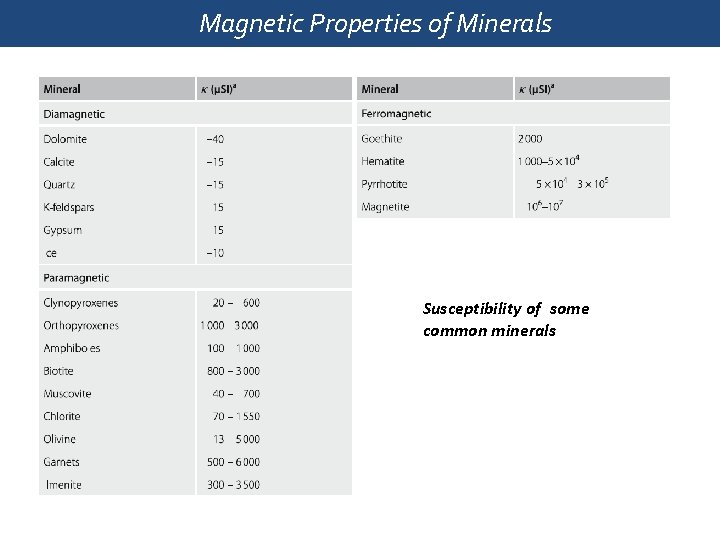
Magnetic Properties of Minerals Susceptibility of some common minerals
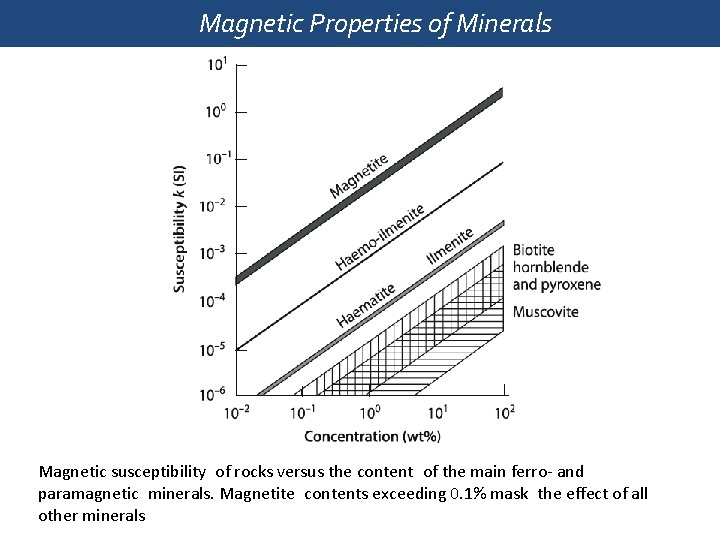
Magnetic Properties of Minerals Magnetic susceptibility of rocks versus the content of the main ferro- and paramagnetic minerals. Magnetite contents exceeding 0. 1% mask the effect of all other minerals
Magnetic Properties of Minerals (2) SIRM -- is the magnetization acquired by imposing a certain DC magnetic field to a sample at a constant temperature (usually room temperature). The maximum remanence value (after magnetic saturation of the sample) is termed Saturation isothermal remanent magnetization (SIRM). SIRM is strongly affected by variations in magnetic grain size and mineral assemblages and is primarily an expression of magnetic minerals concentrations.
Magnetic Properties of Minerals (3) Soft: Low field isothermal remanence (20 m. T), provides a simple basis for approximating the total concentration of remanence carrying by ferrimagnetic minerals. (4) Hard: High field isothermal remanence (SIRM-IRM 300 m. T) is used as a basis for approximating the total concentration of remanence carrying by hematite or goethite in a sample. (5) F 300 m. T (%)= IRM 300 m. T/SIRM, indicating the relative concentrations between ferrimagnetic and canted ferromagnetic minerals in samples. The ratio decrease with the increasing concentrations of canted ferromagnetic minerals in the sample.
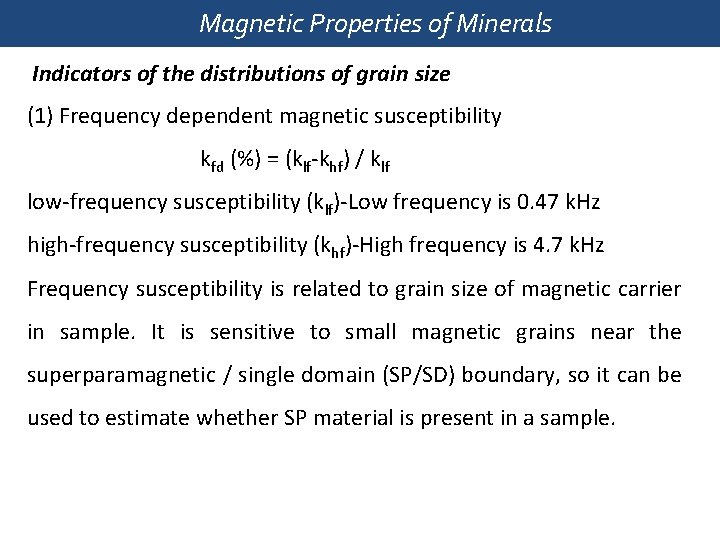
Magnetic Properties of Minerals Indicators of the distributions of grain size (1) Frequency dependent magnetic susceptibility kfd (%) = (klf-khf) / klf low-frequency susceptibility (klf)-Low frequency is 0. 47 k. Hz high-frequency susceptibility (khf)-High frequency is 4. 7 k. Hz Frequency susceptibility is related to grain size of magnetic carrier in sample. It is sensitive to small magnetic grains near the superparamagnetic / single domain (SP/SD) boundary, so it can be used to estimate whether SP material is present in a sample.
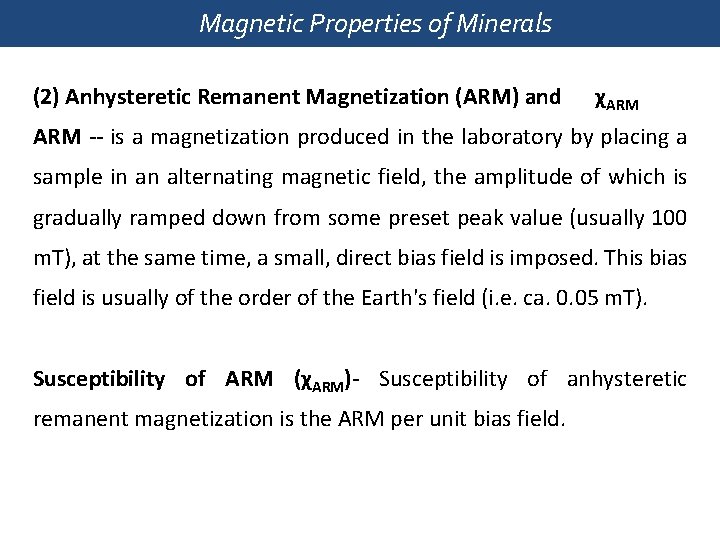
Magnetic Properties of Minerals (2) Anhysteretic Remanent Magnetization (ARM) and χARM -- is a magnetization produced in the laboratory by placing a sample in an alternating magnetic field, the amplitude of which is gradually ramped down from some preset peak value (usually 100 m. T), at the same time, a small, direct bias field is imposed. This bias field is usually of the order of the Earth's field (i. e. ca. 0. 05 m. T). Susceptibility of ARM (χARM)- Susceptibility of anhysteretic remanent magnetization is the ARM per unit bias field.
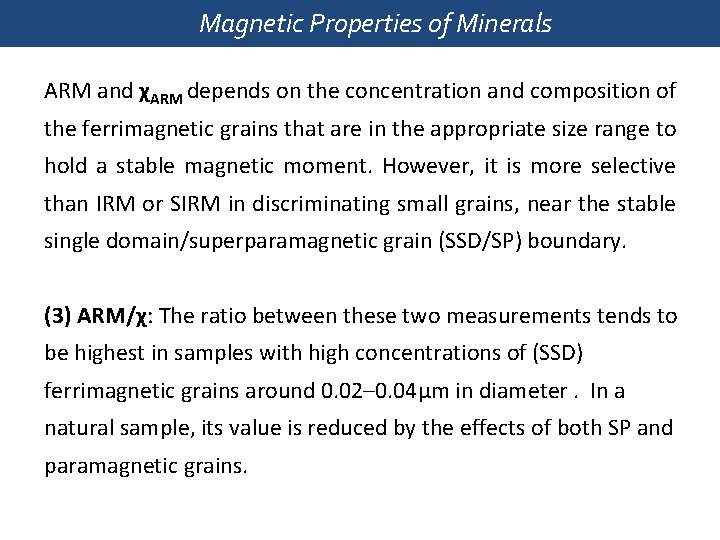
Magnetic Properties of Minerals ARM and χARM depends on the concentration and composition of the ferrimagnetic grains that are in the appropriate size range to hold a stable magnetic moment. However, it is more selective than IRM or SIRM in discriminating small grains, near the stable single domain/superparamagnetic grain (SSD/SP) boundary. (3) ARM/χ: The ratio between these two measurements tends to be highest in samples with high concentrations of (SSD) ferrimagnetic grains around 0. 02– 0. 04μm in diameter. In a natural sample, its value is reduced by the effects of both SP and paramagnetic grains.
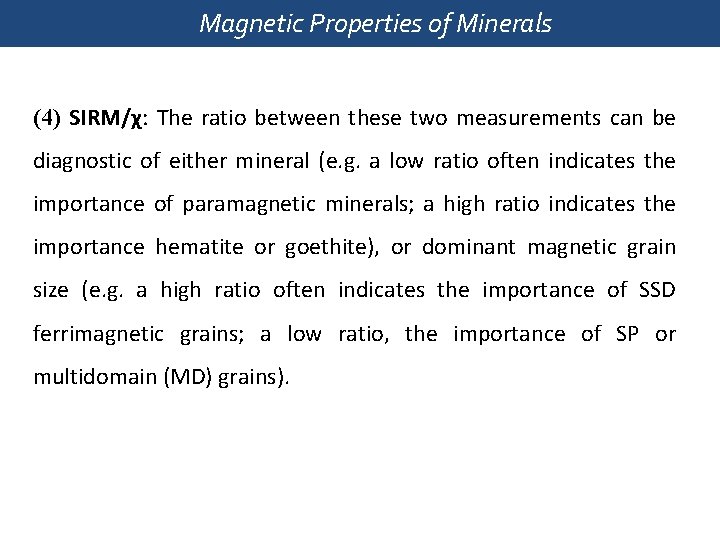
Magnetic Properties of Minerals (4) SIRM/χ: The ratio between these two measurements can be diagnostic of either mineral (e. g. a low ratio often indicates the importance of paramagnetic minerals; a high ratio indicates the importance hematite or goethite), or dominant magnetic grain size (e. g. a high ratio often indicates the importance of SSD ferrimagnetic grains; a low ratio, the importance of SP or multidomain (MD) grains).
Magnetic Properties of Minerals (5) SIRM/ARM: This ratio mainly reflects magnetic grain size variations in a sample. High concentrations of SSD grains usually gives rise to lower values of SIRM/ARM. (6) χARM/SIRM: This ratio strongly relates to magnetite grain size across the SSD-MD range. Peak values occur in true SSD grains (approximately 0. 02 - 0. 06μm in diameter) and decline steeply with increasing grain size. ARM/χ , SIRM/ARM generally respond similarly to the χARM/χ discussed above, with values decreasing as the relative proportion of fine grains increases. Because superparamagnetic (SP) grains contribute to neither ARM nor SIRM, so using χARM/SIRM can avoid ambiguity caused by very small grains.
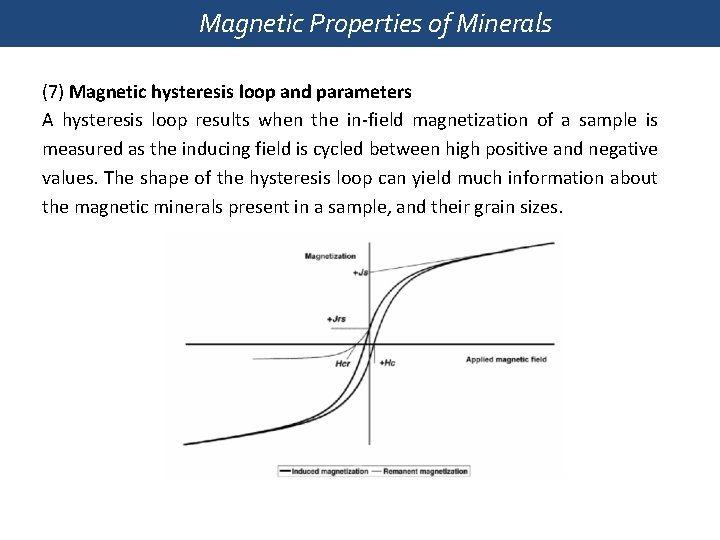
Magnetic Properties of Minerals (7) Magnetic hysteresis loop and parameters A hysteresis loop results when the in-field magnetization of a sample is measured as the inducing field is cycled between high positive and negative values. The shape of the hysteresis loop can yield much information about the magnetic minerals present in a sample, and their grain sizes.
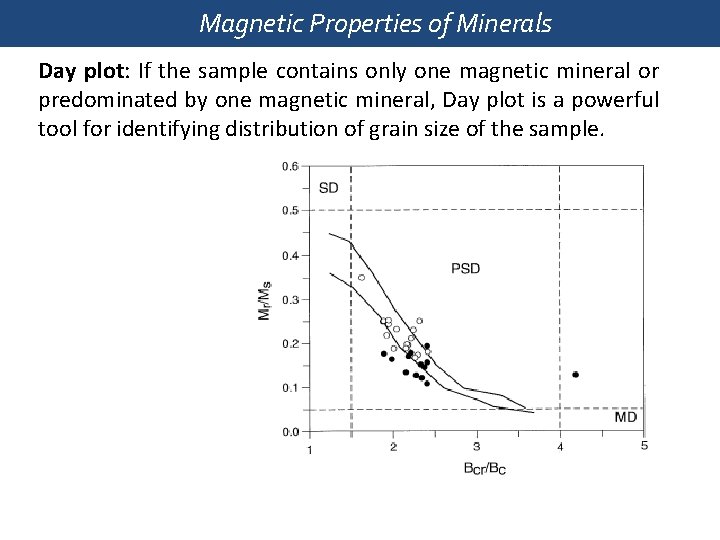
Magnetic Properties of Minerals Day plot: If the sample contains only one magnetic mineral or predominated by one magnetic mineral, Day plot is a powerful tool for identifying distribution of grain size of the sample.
Magnetic Properties of Minerals The parameters indicating magnetic minerals (1) Curier point (or Neel temperature) - For every ferrimagnetic mineral there is a characteristic temperature, the Curie temperature, above which ferrimagnetic behavior ceases. Determination of Curie temperature(s) can diagnose magnetic mineral(s) in a specimen. (2) Low temperature transition: Verwey Transition (Tv) – for example, the properties of the magnetite will occur distinct changes at ~120 K, which is called Verwey Transition.
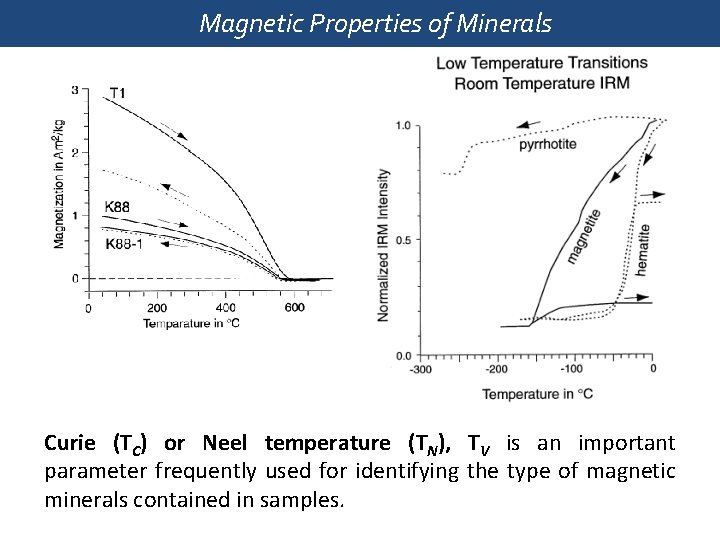
Magnetic Properties of Minerals Curie (TC) or Neel temperature (TN), TV is an important parameter frequently used for identifying the type of magnetic minerals contained in samples.
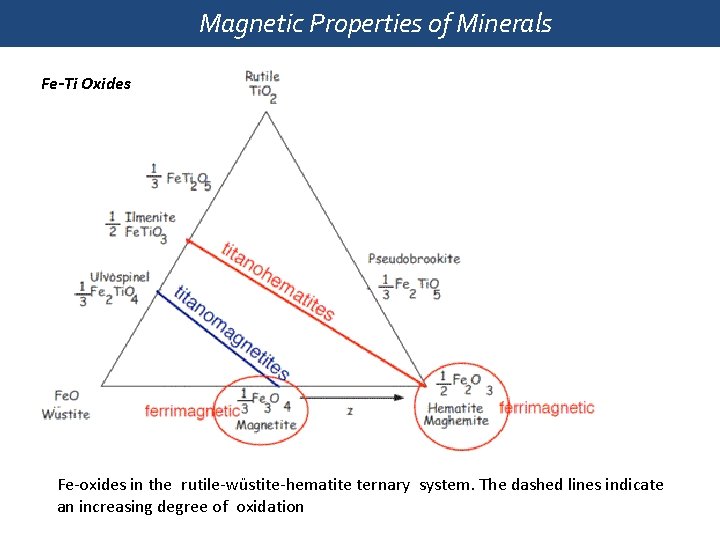
Magnetic Properties of Minerals Fe-Ti Oxides Fe-oxides in the rutile-wu stite-hematite ternary system. The dashed lines indicate an increasing degree of oxidation
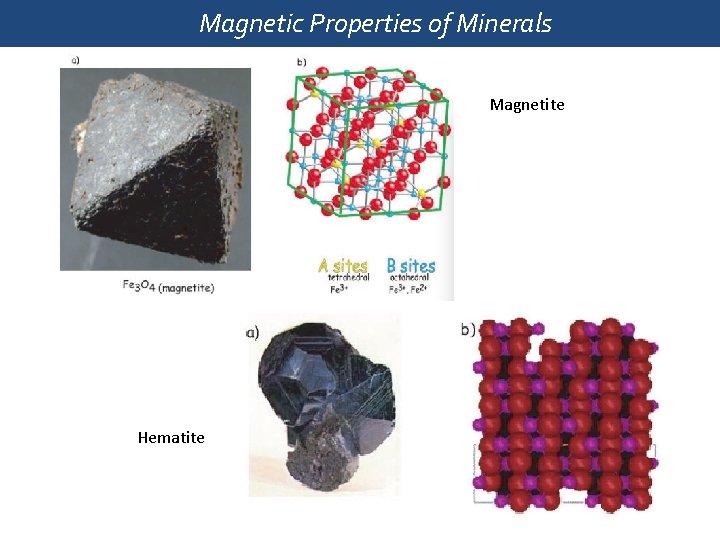
Magnetic Properties of Minerals Magnetite Hematite
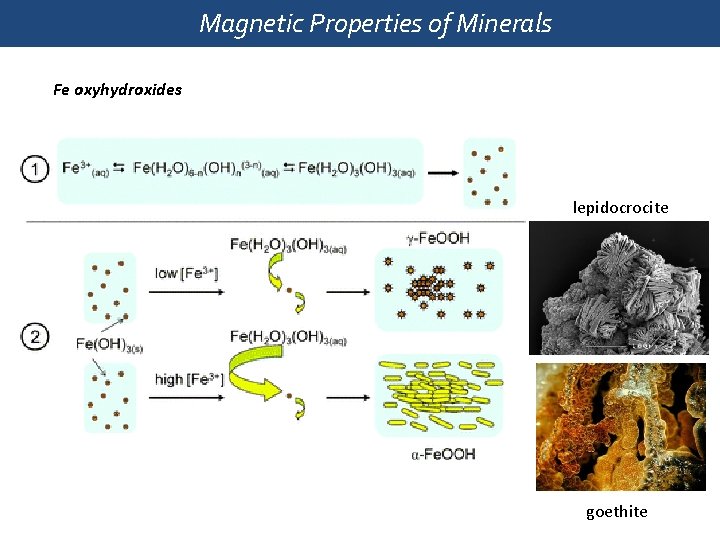
Magnetic Properties of Minerals Fe oxyhydroxides lepidocrocite goethite
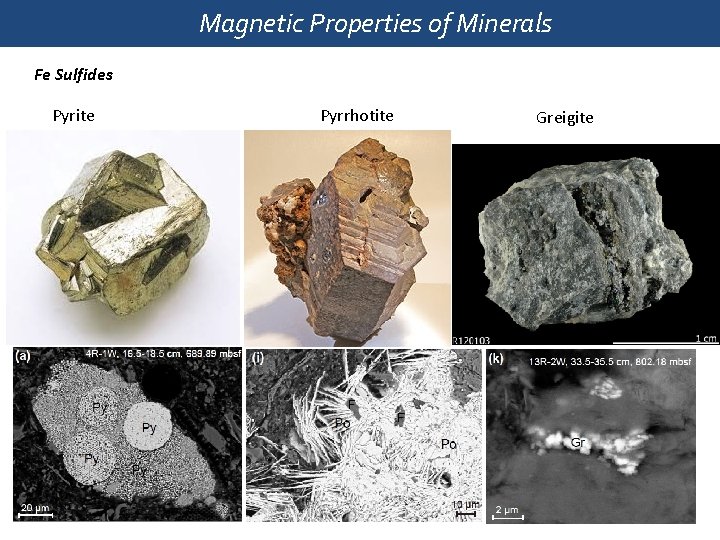
Magnetic Properties of Minerals Fe Sulfides Pyrite Pyrrhotite Greigite
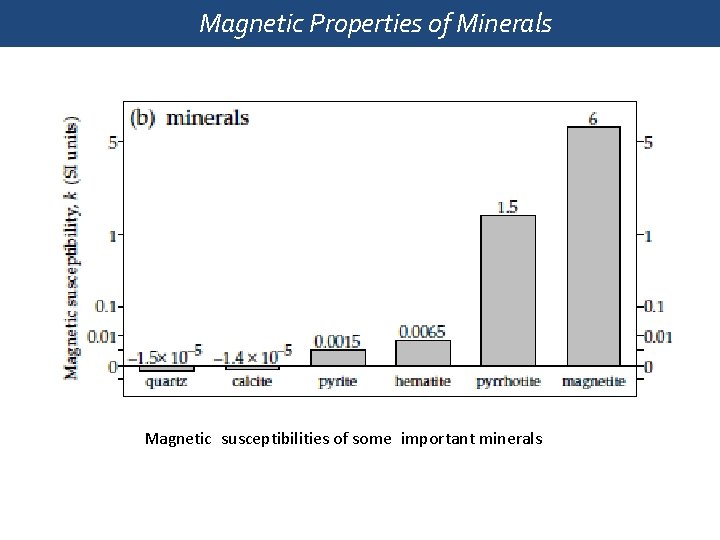
Magnetic Properties of Minerals Magnetic susceptibilities of some important minerals
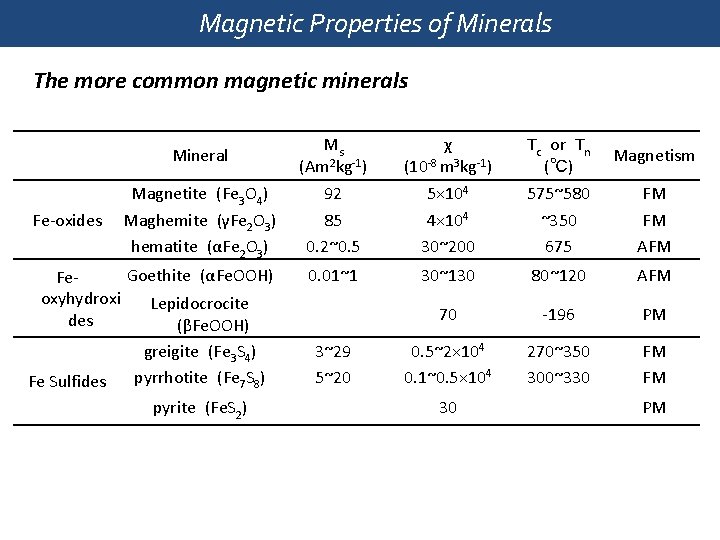
Magnetic Properties of Minerals The more common magnetic minerals Mineral Ms (Am 2 kg-1) χ (10 -8 m 3 kg-1) Tc or Tn (℃) Magnetism Magnetite (Fe 3 O 4) Maghemite (γFe 2 O 3) hematite (αFe 2 O 3) 92 85 0. 2~0. 5 5× 10⁴ 4× 10⁴ 30~200 575~580 ~350 675 FM FM AFM Goethite (αFe. OOH) Feoxyhydroxi Lepidocrocite des (βFe. OOH) greigite (Fe 3 S 4) pyrrhotite (Fe 7 S 8) Fe Sulfides 0. 01~1 30~130 80~120 AFM 70 -196 PM 0. 5~2× 10⁴ 0. 1~0. 5× 10⁴ 270~350 300~330 FM FM Fe-oxides pyrite (Fe. S 2) 3~29 5~20 30 PM
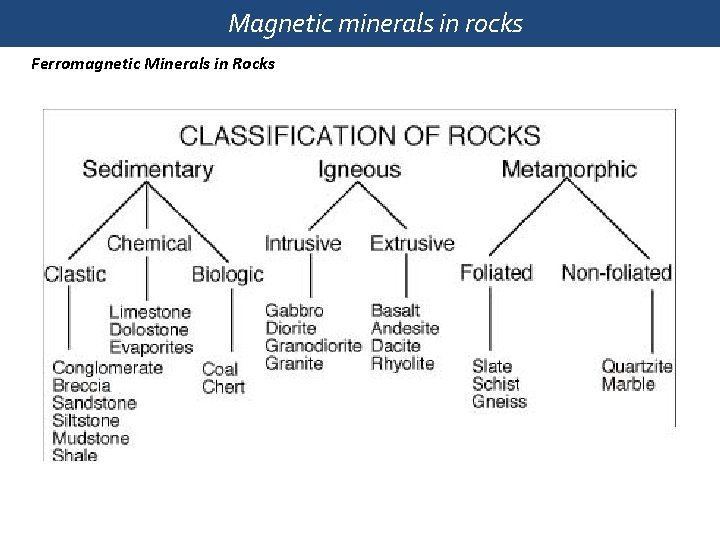
Magnetic minerals in rocks Ferromagnetic Minerals in Rocks
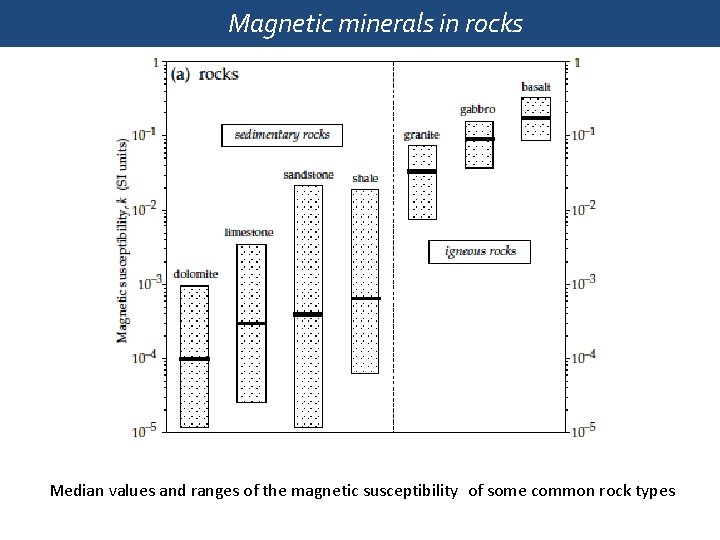
Magnetic minerals in rocks Median values and ranges of the magnetic susceptibility of some common rock types
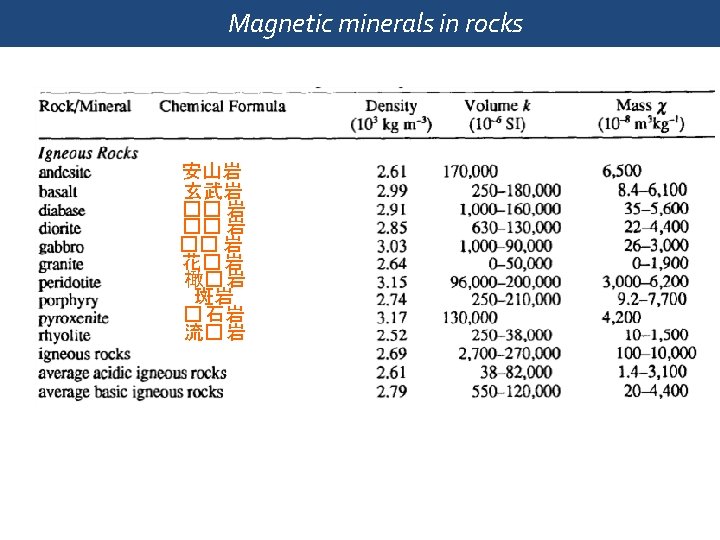
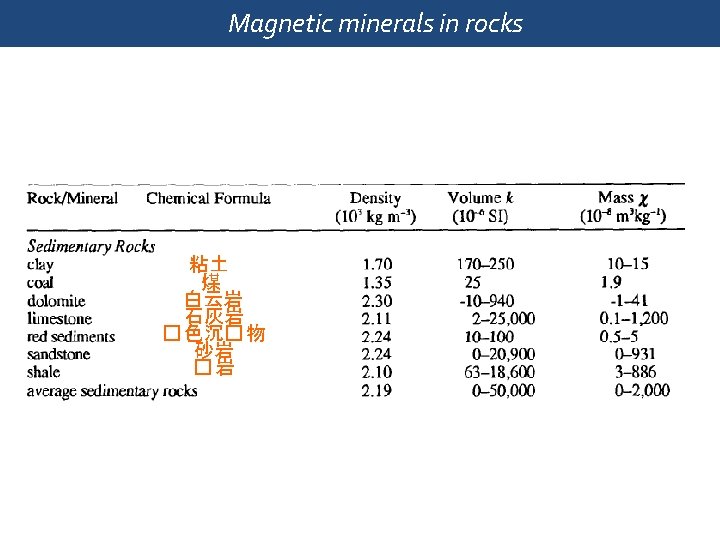
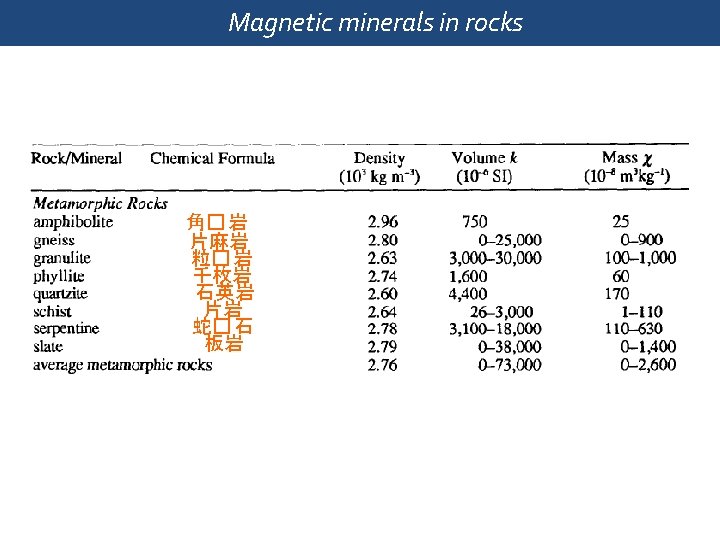
Magnetic mineralsofin. Minerals rocks Magnetic Properties 角� 岩 片麻岩 粒� 岩 千枚岩 石英岩 片岩 蛇� 石 板岩
- Slides: 57