
Basic Principles of Imaging and Photometry Lecture 2
Basic Principles of Imaging and Photometry Lecture #2 Thanks to Shree Nayar, Ravi Ramamoorthi, Pat Hanrahan

Computer Vision: Building Machines that See Lighting Camera Physical Models Computer Scene Interpretation We need to understand the Geometric and Radiometric relations between the scene and its image.

A Brief History of Images Camera Obscura, Gemma Frisius, 1558

A Brief History of Images Lens Based Camera Obscura, 1568 1558 1568

A Brief History of Images 1558 1568 1837 Still Life, Louis Jaques Mande Daguerre, 1837
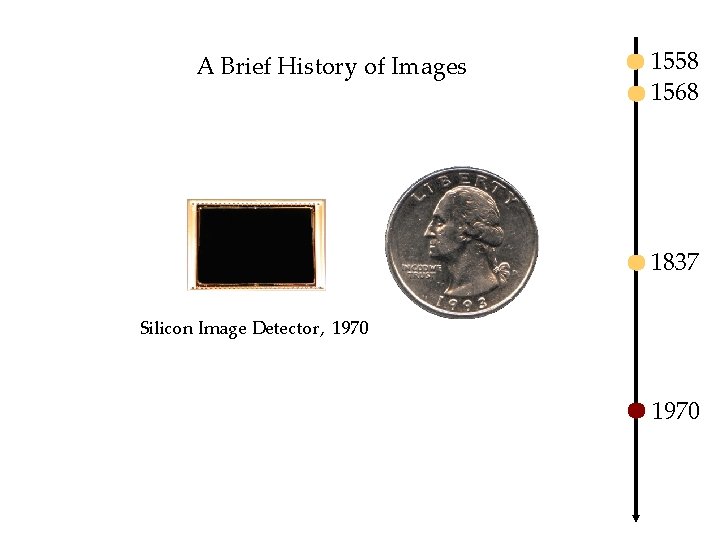
A Brief History of Images 1558 1568 1837 Silicon Image Detector, 1970

A Brief History of Images 1558 1568 1837 Digital Cameras 1970 1995

Geometric Optics and Image Formation TOPICS TO BE COVERED : 1) Pinhole and Perspective Projection 2) Image Formation using Lenses 3) Lens related issues

Pinhole and the Perspective Projection Is an image being formed on the screen? (x, y) YES! But, not a “clear” one. screen scene image plane y optical axis effective focal length, f’ z x pinhole
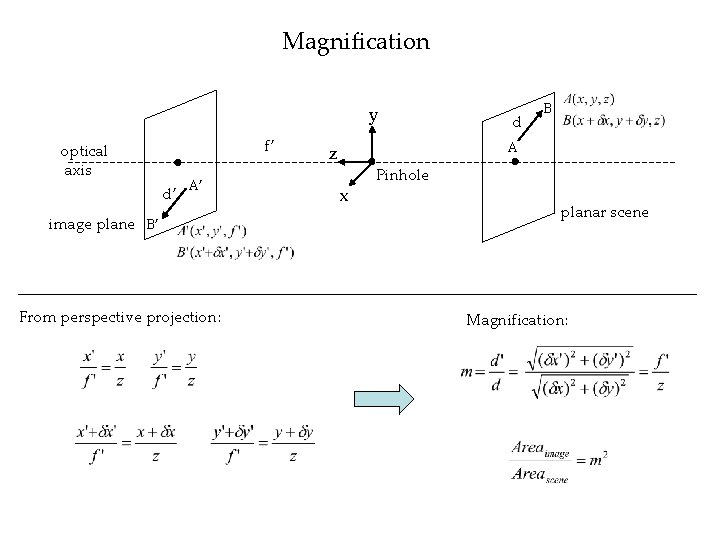
Magnification y f’ optical axis d’ A’ image plane B’ From perspective projection: d B A z x Pinhole planar scene Magnification:

Orthographic Projection Magnification: When m = 1, we have orthographic projection y optical axis z x image plane This is possible only when In other words, the range of scene depths is assumed to be much smaller than the average scene depth. But, how do we produce non-inverted images?

Better Approximations to Perspective Projection

Problems with Pinholes • Pinhole size (aperture) must be “very small” to obtain a clear image. • However, as pinhole size is made smaller, less light is received by image plane. • If pinhole is comparable to wavelength of incoming light, DIFFRACTION effects blur the image! • Sharpest image is obtained when: pinhole diameter Example: If f’ = 50 mm, = 600 nm (red), d = 0. 36 mm

Image Formation using Lenses • Lenses are used to avoid problems with pinholes. • Ideal Lens: Same projection as pinhole but gathers more light! o i P P’ f Gaussian Lens Formula: • f is the focal length of the lens – determines the lens’s ability to bend (refract) light • f different from the effective focal length f’ discussed before!

Focus and Defocus aperture Blur Circle, b aperture diameter d Gaussian Law: Blur Circle Diameter : Depth of Field: Range of object distances over which image is sufficiently well focused. i. e. Range for which blur circle is less than the resolution of the imaging sensor.

Two Lens System object final image plane lens 2 intermediate virtual image lens 1 • Rule : Image formed by first lens is the object for the second lens. • Main Rays : Ray passing through focus emerges parallel to optical axis. Ray through optical center passes un-deviated. • Magnification: Exercises: What is the combined focal length of the system? What is the combined focal length if d = 0?

Lens related issues Compound (Thick) Lens Vignetting B principal planes A nodal points thickness Chromatic Abberation more light from A than B ! Radial and Tangential Distortion ideal actual image plane Lens has different refractive indices for different wavelengths.
Radiometry and Image Formation • To interpret image intensities, we need to understand Radiometric Concepts and Reflectance Properties. • TOPICS TO BE COVERED: 1) Image Intensities: Overview 2) Radiometric Concepts: Radiant Intensity Irradiance Radiance BRDF 3) Image Formation using a Lens 4) Radiometric Camera Calibration
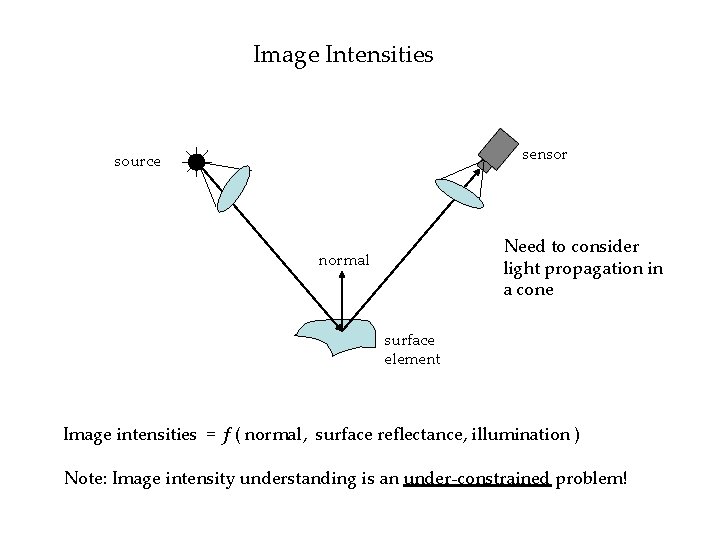
Image Intensities sensor source Need to consider light propagation in a cone normal surface element Image intensities = f ( normal, surface reflectance, illumination ) Note: Image intensity understanding is an under-constrained problem!

Radiometric concepts – boring…but, important! (solid angle subtended by source ) (foreshortened area) (surface area) (1) Solid Angle : ( steradian ) (4) Surface Radiance (tricky) : 2 What is the solid angle subtended by a hemisphere? (2) Radiant Intensity of Source : ( watts / steradian ) Light Flux (power) emitted per unit solid angle (3) Surface Irradiance : ( watts / m ) Light Flux (power) incident per unit surface area. Does not depend on where the light is coming from! (watts / m steradian ) • Flux emitted per unit foreshortened area per unit solid angle. • L depends on direction • Surface can radiate into whole hemisphere. • L depends on reflectance properties of surface.

The Fundamental Assumption in Vision Lighting No Change in Radiance Surface Camera

Radiance properties • Radiance is constant as it propagates along ray – Derived from conservation of flux – Fundamental in Light Transport.

Relationship between Scene and Image Brightness • Before light hits the image plane: Scene Radiance L Lens Image Irradiance E Linear Mapping! • After light hits the image plane: Image Irradiance E Camera Electronics Measured Pixel Values, I Non-linear Mapping! Can we go from measured pixel value, I, to scene radiance, L?
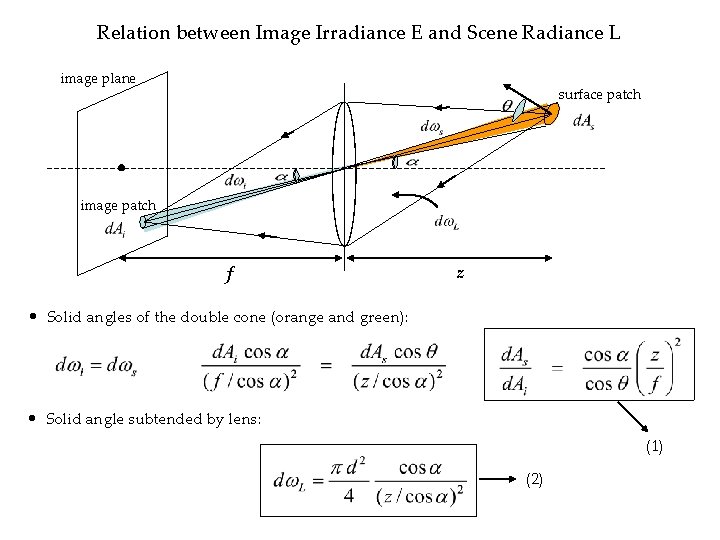
Relation between Image Irradiance E and Scene Radiance L image plane surface patch image patch f z • Solid angles of the double cone (orange and green): • Solid angle subtended by lens: (1) (2)

Relation between Image Irradiance E and Scene Radiance L image plane surface patch image patch z f • Flux received by lens from = Flux projected onto image (3) • From (1), (2), and (3): • Image irradiance is proportional to Scene Radiance! • Small field of view Effects of 4 th power of cosine are small.

Relation between Pixel Values I and Image Irradiance E Camera Electronics Measured Pixel Values, I • The camera response function relates image irradiance at the image plane to the measured pixel intensity values. (Grossberg and Nayar)
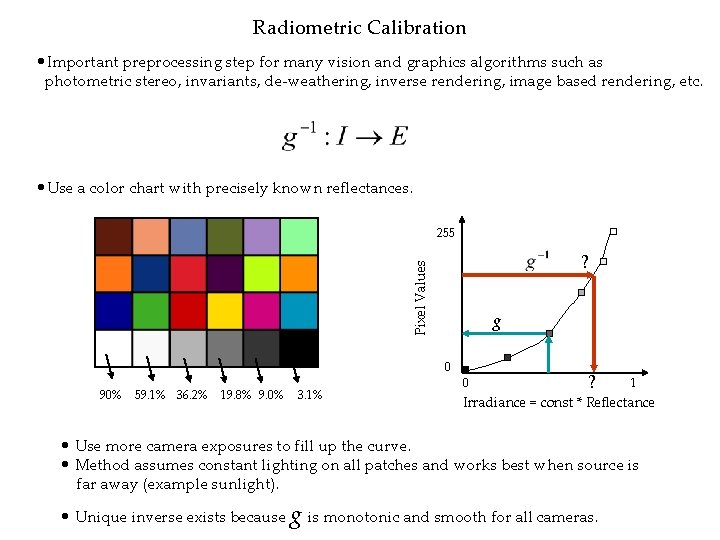
Radiometric Calibration • Important preprocessing step for many vision and graphics algorithms such as photometric stereo, invariants, de-weathering, inverse rendering, image based rendering, etc. • Use a color chart with precisely known reflectances. 255 Pixel Values ? g 0 90% 59. 1% 36. 2% 19. 8% 9. 0% 3. 1% 0 ? 1 Irradiance = const * Reflectance • Use more camera exposures to fill up the curve. • Method assumes constant lighting on all patches and works best when source is far away (example sunlight). • Unique inverse exists because g is monotonic and smooth for all cameras.
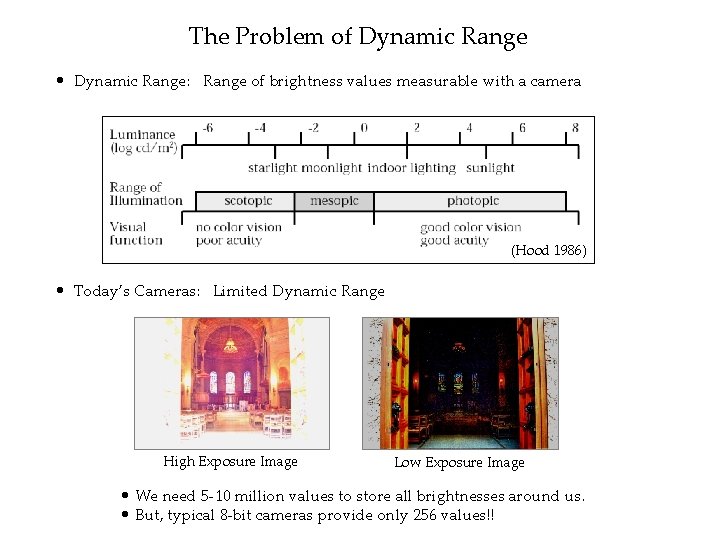
The Problem of Dynamic Range • Dynamic Range: Range of brightness values measurable with a camera (Hood 1986) • Today’s Cameras: Limited Dynamic Range High Exposure Image Low Exposure Image • We need 5 -10 million values to store all brightnesses around us. • But, typical 8 -bit cameras provide only 256 values!!

High Dynamic Range Imaging • Capture a lot of images with different exposure settings. • Apply radiometric calibration to each camera. • Combine the calibrated images (for example, using averaging weighted by exposures). (Mitsunaga) (Debevec) Images taken with a fish-eye lens of the sky show the wide range of brightnesses.
- Slides: 29