
Basic Principles of GMP for Sterile Pharmaceutical Products
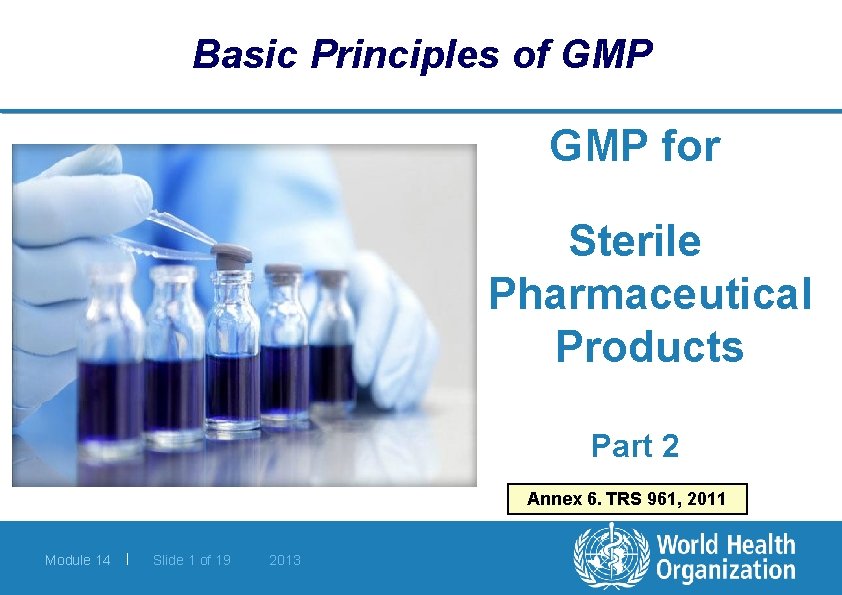
Basic Principles of GMP for Sterile Pharmaceutical Products Part 2 Annex 6. TRS 961, 2011 Module 14 | Slide 1 of 19 2013
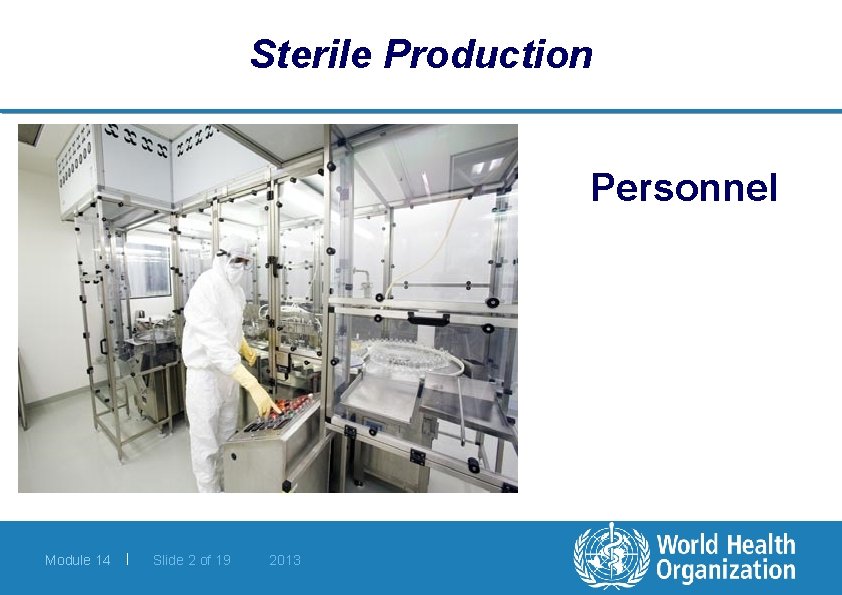
Sterile Production Personnel Module 14 | Slide 2 of 19 2013
Sterile Production Personnel l Minimum number present in clean areas l Inspections and controls conducted from outside clean areas l All to receive initial and regular training l Manufacture, hygiene, microbiology l Staff who have been engaged in the processing of animal-tissue materials or of cultures of microorganisms other than those used in the current manufacturing process should not enter sterileproduct areas unless rigorous and clearly defined 10. 1 – 10. 3 decontamination procedures have been followed Module 14 | Slide 3 of 19 2013
Sterile Production l High standards of personal hygiene and cleanliness 10. 4 – 10. 7 l Report any conditions and periodic health checks l Changing and washing procedure l Gowning and quality appropriate for the process and work area l No outdoor clothing into changing rooms to Grade B and C rooms and no wrist-watches, cosmetics and jewellery worn l Grade A/B area - clean sterile garments at each work session l Gloves regularly disinfected during operations. Masks and gloves changed at least every working session; wear sanitized goggles. Module 14 | Slide 4 of 19 2013
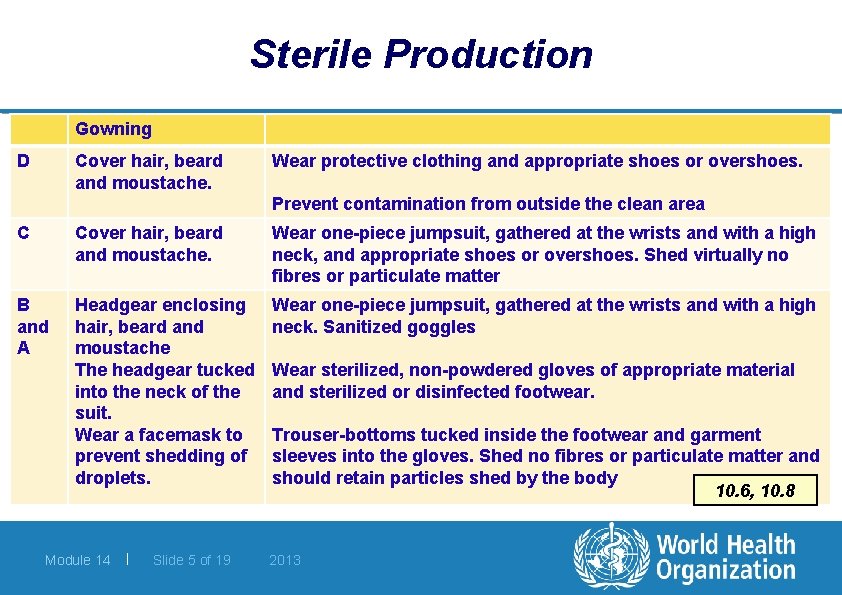
Sterile Production Gowning D Cover hair, beard and moustache. Wear protective clothing and appropriate shoes or overshoes. Prevent contamination from outside the clean area C Cover hair, beard and moustache. Wear one-piece jumpsuit, gathered at the wrists and with a high neck, and appropriate shoes or overshoes. Shed virtually no fibres or particulate matter B and A Headgear enclosing hair, beard and moustache The headgear tucked into the neck of the suit. Wear a facemask to prevent shedding of droplets. Wear one-piece jumpsuit, gathered at the wrists and with a high neck. Sanitized goggles Wear sterilized, non-powdered gloves of appropriate material and sterilized or disinfected footwear. Trouser-bottoms tucked inside the footwear and garment sleeves into the gloves. Shed no fibres or particulate matter and should retain particles shed by the body 10. 6, 10. 8 Module 14 | Slide 5 of 19 2013
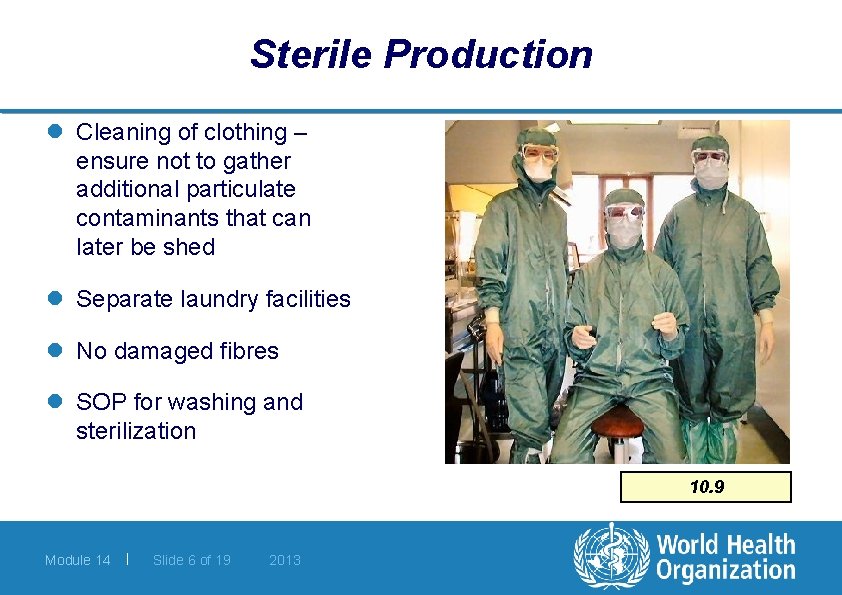
Sterile Production l Cleaning of clothing – ensure not to gather additional particulate contaminants that can later be shed l Separate laundry facilities l No damaged fibres l SOP for washing and sterilization 10. 9 Module 14 | Slide 6 of 19 2013
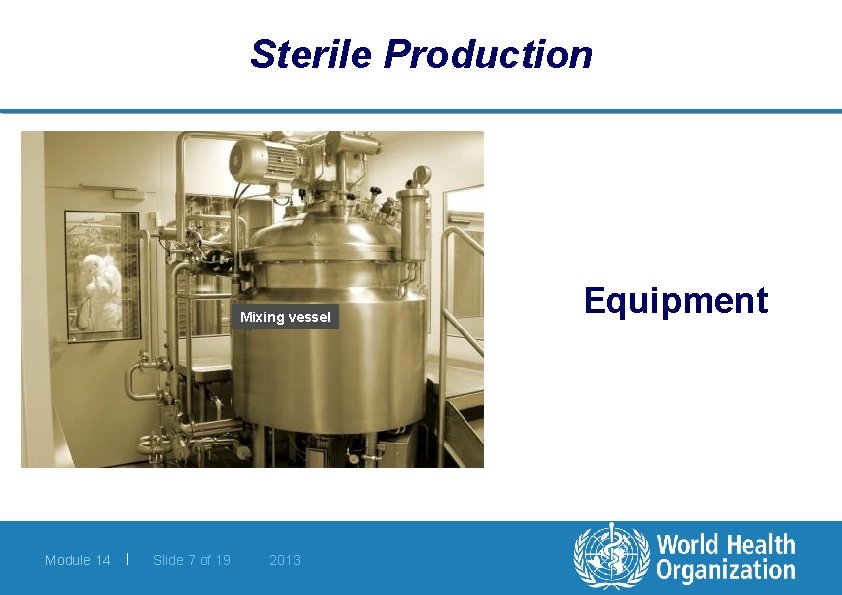
Sterile Production Mixing vessel Module 14 | Slide 7 of 19 2013 Equipment
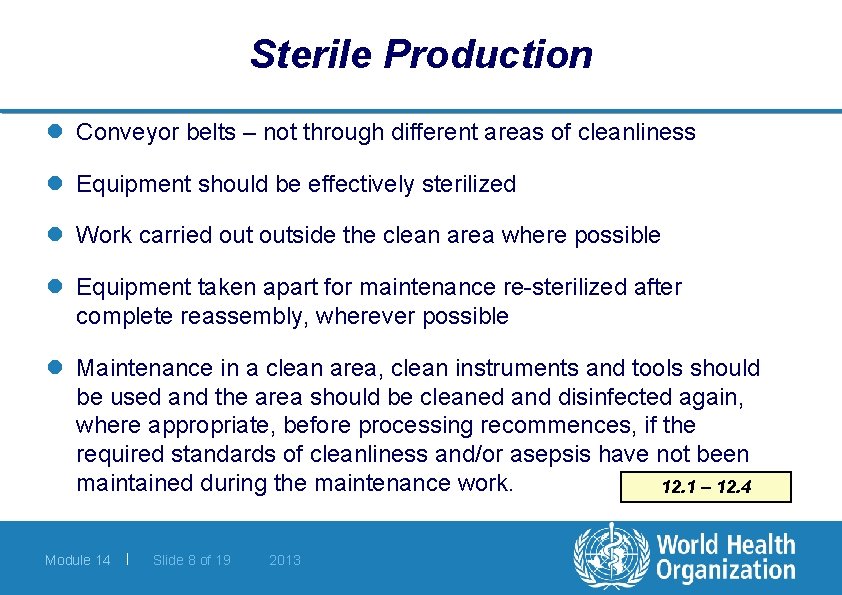
Sterile Production l Conveyor belts – not through different areas of cleanliness l Equipment should be effectively sterilized l Work carried outside the clean area where possible l Equipment taken apart for maintenance re-sterilized after complete reassembly, wherever possible l Maintenance in a clean area, clean instruments and tools should be used and the area should be cleaned and disinfected again, where appropriate, before processing recommences, if the required standards of cleanliness and/or asepsis have not been maintained during the maintenance work. 12. 1 – 12. 4 Module 14 | Slide 8 of 19 2013
Sterile Production l Equipment and utilities subject to validation and planned maintenance l Return to use should be approved l Water-treatment plants and distribution systems – Designed, constructed and maintained – Operate within their designed capacity l Water for injection 12. 5 – 12. 6 – Appropriately produced, stored and distributed (prevents the growth of microorganisms, e. g. by constant circulation at a temperature above 70 °C or not more than 4 °C) Module 14 | Slide 9 of 19 2013
Sterile Production Processing l Take precautions to minimize contamination during all processing stages, including the stages before sterilization l Normally no preparations with live microorganisms in areas used for the processing of other pharmaceutical products l Vaccines consisting of dead organisms or of bacterial extracts l Demonstrate and validate the effective decontamination of the live microorganisms l Validation of aseptic processing Module 14 | Slide 10 of 19 2013 4. 21 – 4. 23
Sterile Production Validation of aseptic processing – Media Fill l Includes process simulation test (media fill) – appropriate medium l based on dosage form, selectivity, clarity, concentration and suitability for sterilization l Imitate routine aseptic manufacturing steps, actions, interventions, worst case situation, shift change l Part of validation - three consecutive satisfactory simulation tests l Repeated at defined intervals and after any significant modifications (e. g. HVAC, equipment, process) 4. 24 – 4. 25 Module 14 | Slide 11 of 19 2013
Sterile Production l The number of containers used for media fills appropriate – Small batch of product - equal the size of the product batch l Target zero growth and the following applies: l < 5000 units 0 contaminated units l 5000– 10 000 units 1 contaminated unit - investigation and consideration of a repeat media fill 2 contaminated units - revalidation following investigation; l > 10 000 units 4. 26 1 contaminated unit - investigation 2 contaminated units - revalidation following investigation Module 14 | Slide 12 of 19 2013
Sterile Production l Investigate intermittent incidents of microbial contamination l Investigation of gross failures should include the potential impact on the sterility assurance of batches manufactured since the last successful media fill l Validation must not compromise the processes l Water sources, water-treatment equipment and treated water should be monitored regularly for chemicals, biological contamination and contamination with endotoxins l Water complies with the specification l Records maintained of the results and of any action taken Module 14 | Slide 13 of 19 2013 4. 27 – 4. 29
Sterile Production l Activities during operations kept to a minimum l Movement of personnel controlled and methodical - avoid excessive shedding of particles and organisms l Personnel excluded from Grade A zones as far as possible l Temperature and humidity controlled and monitored - appropriate 4. 30 Module 14 | Slide 14 of 19 2013
Sterile Production l Minimal number containers and materials present l No recontamination of components, bulk-product containers and equipment after final cleaning process l Interval between the washing and drying and the sterilization and use - as short as possible. Validated time limits l Time between the start of the preparation of a solution and its sterilization or filtration through a bacteria-retaining filter as short as possible. Maximum time set for each product l Use filtered gas to purge a solution or blanket a product 4. 31 – 4. 35 Module 14 | Slide 15 of 19 2013
Sterile Production l Bioburden monitored before sterilization - working limits l Bioburden assay on each batch (aseptically and terminally sterilized products) l Level of endotoxins monitored when needed l All solutions passed through a microorganism-retaining filter immediately before filling l Components, bulk-product containers, equipment, and any other articles required in a clean area where aseptic work is in progress, should be sterilized and wherever possible l Passed into the area through double ended sterilizers Module 14 | Slide 16 of 19 2013 4. 36 – 4. 37
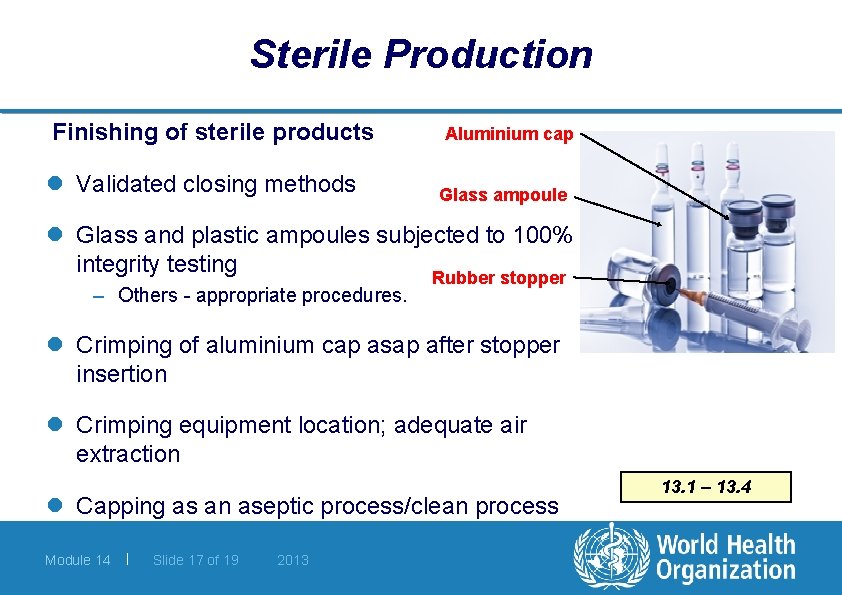
Sterile Production Finishing of sterile products l Validated closing methods Aluminium cap Glass ampoule l Glass and plastic ampoules subjected to 100% integrity testing Rubber stopper – Others - appropriate procedures. l Crimping of aluminium cap asap after stopper insertion l Crimping equipment location; adequate air extraction l Capping as an aseptic process/clean process Module 14 | Slide 17 of 19 2013 13. 1 – 13. 4
Sterile Production l Vials with missing or displaced stoppers rejected prior to capping l Human intervention - appropriate technology to be used l RABS and isolators may be beneficial l Containers sealed under vacuum tested l Filled containers of parenteral products individually inspected - suitable and controlled conditions - illumination and background l Operators: regular eyesight checks, frequent breaks l May use validated equipment l Results recorded Module 14 | Slide 18 of 19 2013 13. 5 – 13. 8
Sterile Production Summary l l l l Key points here include the role of operators Operator gowning, actions, health and hygiene Appropriate use of equipment Equipment finishing, cleaning, maintenance Qualification of equipment Cleaning validation Appropriate closure of dosage units Media fill (validation) Module 14 | Slide 19 of 19 2013
- Slides: 19