
Basic Predictive Analysis Basics of Time Series Analysis

Basic Predictive Analysis Basics of Time Series Analysis Moving Average Problems Those who do not remember the past are condemned to repeat it George Santayana Spanish philosopher, poet and novelist (1863 -
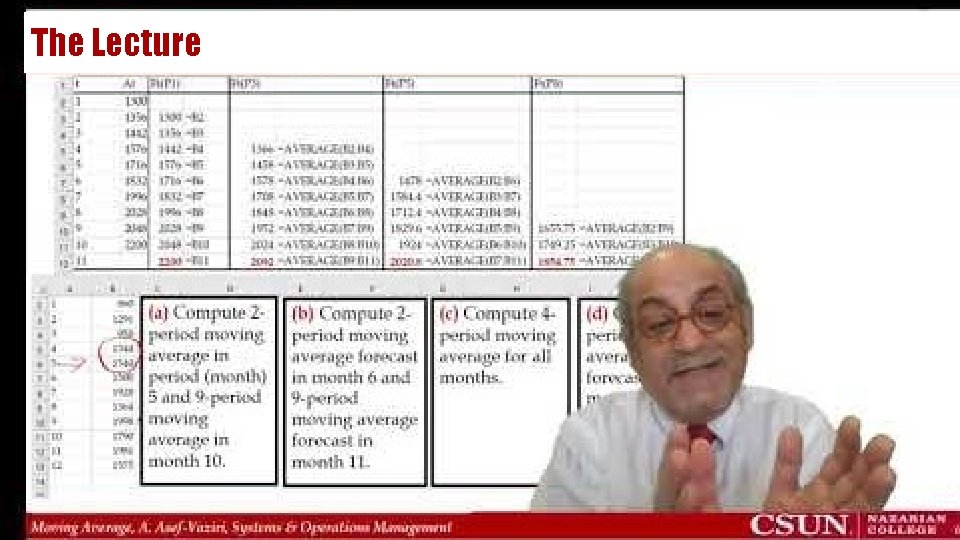
The The. Lecturehttps: //youtu. be/g_lg 0 F_7 Hmc Moving Average, Problems, A. Asef-Vaziri, Systems & Operations Management 2
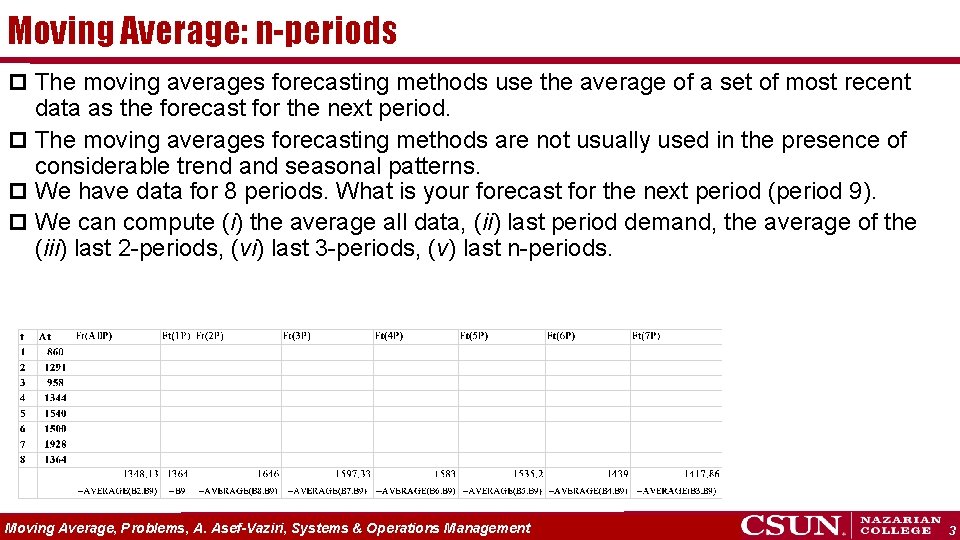
Moving Average: n-periods p The moving averages forecasting methods use the average of a set of most recent data as the forecast for the next period. p The moving averages forecasting methods are not usually used in the presence of considerable trend and seasonal patterns. p We have data for 8 periods. What is your forecast for the next period (period 9). p We can compute (i) the average all data, (ii) last period demand, the average of the (iii) last 2 -periods, (vi) last 3 -periods, (v) last n-periods. Moving Average, Problems, A. Asef-Vaziri, Systems & Operations Management 3

Moving Average vs. Moving Average Forecast Given the following data, a) Compute 3 -period moving average for period 5? Period 1 2 3 4 5 Demand 73 68 65 72 67 b) Compute 3 -period moving average forecast for period 6? Moving Average, Problems, A. Asef-Vaziri, Systems & Operations Management 4
Notations p 3 period moving average in period 5: MA(5, 3) p 3 period moving average forecast in period 5: FMA(5, 3) p n period moving average forecast in period t: FMA(t, n) p n period moving average : MA(t, n) p n period moving average forecast : Ft(np) p Naïve Forecast: Forecast for next period = Actual for this period. F(t+1) = At p 3 -period moving average in month t Ft(3 p) = Average (At+A(t-1)+A(t-2)) p 5 -period moving average n Ft(5 p) = Average (At+A(t-1)+A(t-2)+A(t-3)+A(t-4)) p 8 -period moving average n Ft(8 p) = Average (At+A(t-1)+A(t-2)+A(t-3)+A(t-4)+A(t-5)+A(t-6)A(t-7)) p For Simplicity, in many cases, we simply use At and Ft for actual and forecast values. n Moving Average, Problems, A. Asef-Vaziri, Systems & Operations Management 5
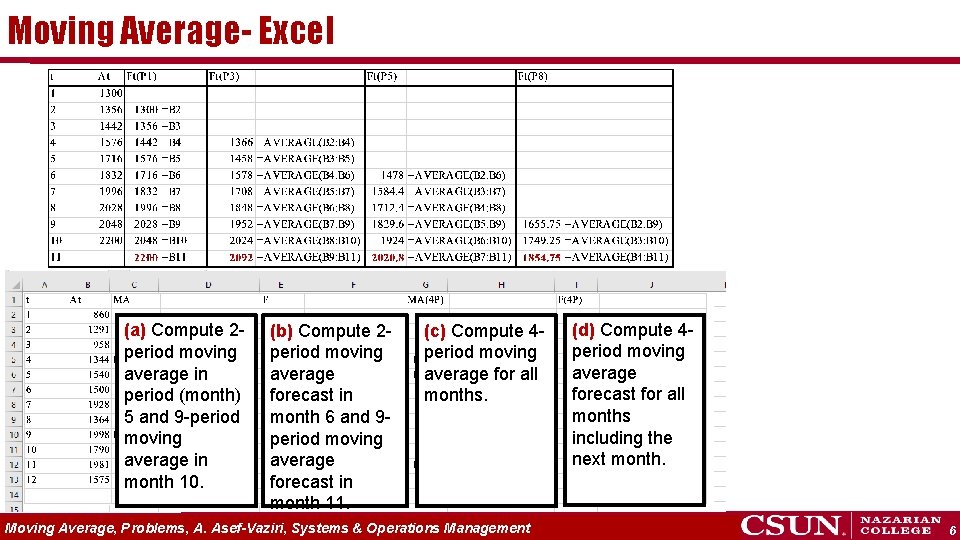
Moving Average- Excel (a) Compute 2 period moving average in period (month) 5 and 9 -period moving average in month 10. (b) Compute 2 period moving average forecast in month 6 and 9 period moving average forecast in month 11. (c) Compute 4 period moving average for all months. Moving Average, Problems, A. Asef-Vaziri, Systems & Operations Management (d) Compute 4 period moving average forecast for all months including the next month. 6
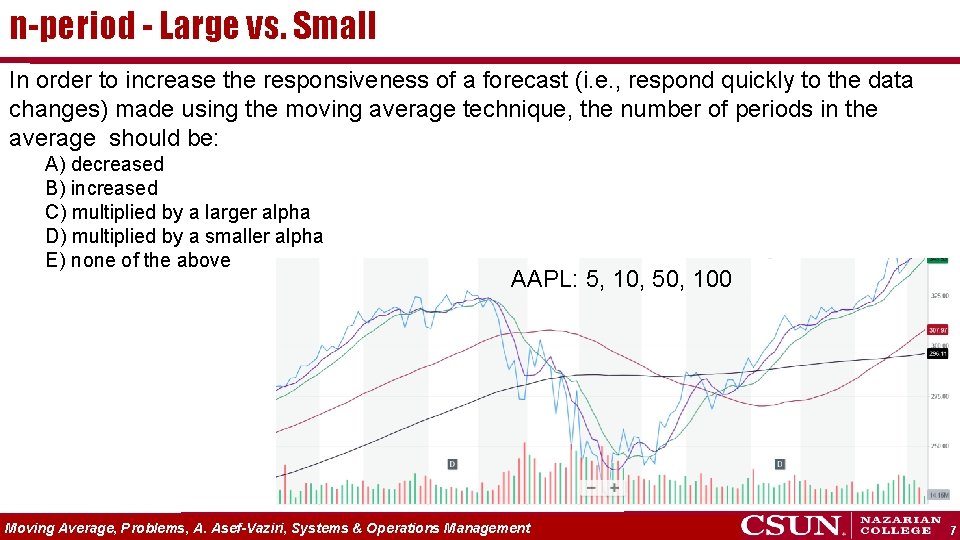
n-period - Large vs. Small In order to increase the responsiveness of a forecast (i. e. , respond quickly to the data changes) made using the moving average technique, the number of periods in the average should be: A) decreased B) increased C) multiplied by a larger alpha D) multiplied by a smaller alpha E) none of the above AAPL: 5, 10, 50, 100 Moving Average, Problems, A. Asef-Vaziri, Systems & Operations Management 7
Age of Data Compute the age of data in 3 period moving average forecasts. In a 3 period moving average forecast, the most recent piece of data belongs to the previous period. It is 1 period old. The second piece is 2 periods and the oldest piece is 3 periods old. Average Age of Data = (1+2+3)/3 = 2. However when we have a linear trend, we can average the first and the last pieces of data Average Age of Data = (1+3)/2 = 2. We can do the same even for non-linear patterns, but the answer will be an approximate (not exact). Compute the age of data in 7 period moving average forecasts. Average Age of Data = (1+7)/2 = 4. Moving Average, Problems, A. Asef-Vaziri, Systems & Operations Management 8
N-Period MA to (n+1)-Period MA The 5 -period moving average in month 6 was 150 units. Actual demand in month 7 is 180 units. What is 6 period moving average in month 7? MA 56 = (A 6+A 5+A 4+A 3+A 2)/5 MA 67 = (A 7+A 6+A 5+A 4+A 3+A 2)/6 MA 56 = (A 6+A 5+A 4+A 3+A 2)/5 = 150 A 6+A 5+A 4+A 3+A 2 = 750 A 7 = 180 MA 67 = (A 7+A 6+A 5+A 4+A 3+A 2)/6 MA 67 = (180+750)/6 = 155 Moving Average, Problems, A. Asef-Vaziri, Systems & Operations Management 9
Alternative Solution The 5 -period moving average in month 6 was 150 units. Actual demand in month 7 is 180 units. What is 6 period moving average in month 7? We may assume that 5 -period moving average was MA 56=(150+150+150)/5 = 150. Now we have MA 67=(180+150+150+150)/6 = 155. We could have also said suppose A 7= 150+30. If A 7 was 150, then MA 67 = 150, since all the actual values are 150. But the reality is the most current value is 30 units more than 150. In 6 period moving average there are 6 numbers: 30/6=5. MA 67 = 150+5 =155 Moving Average, Problems, A. Asef-Vaziri, Systems & Operations Management 10
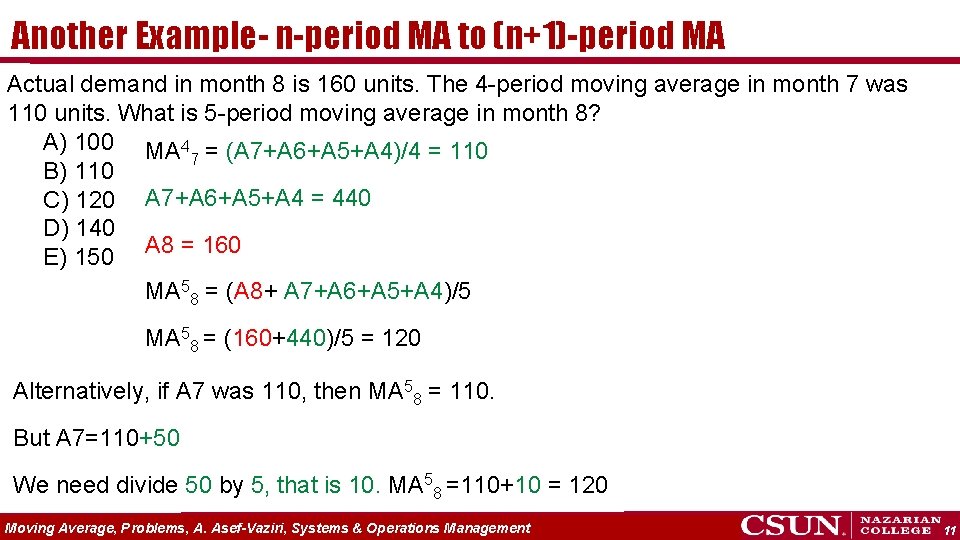
Another Example- n-period MA to (n+1)-period MA Actual demand in month 8 is 160 units. The 4 -period moving average in month 7 was 110 units. What is 5 -period moving average in month 8? A) 100 MA 4 = (A 7+A 6+A 5+A 4)/4 = 110 7 B) 110 C) 120 A 7+A 6+A 5+A 4 = 440 D) 140 A 8 = 160 E) 150 MA 58 = (A 8+ A 7+A 6+A 5+A 4)/5 MA 58 = (160+440)/5 = 120 Alternatively, if A 7 was 110, then MA 58 = 110. But A 7=110+50 We need divide 50 by 5, that is 10. MA 58 =110+10 = 120 Moving Average, Problems, A. Asef-Vaziri, Systems & Operations Management 11
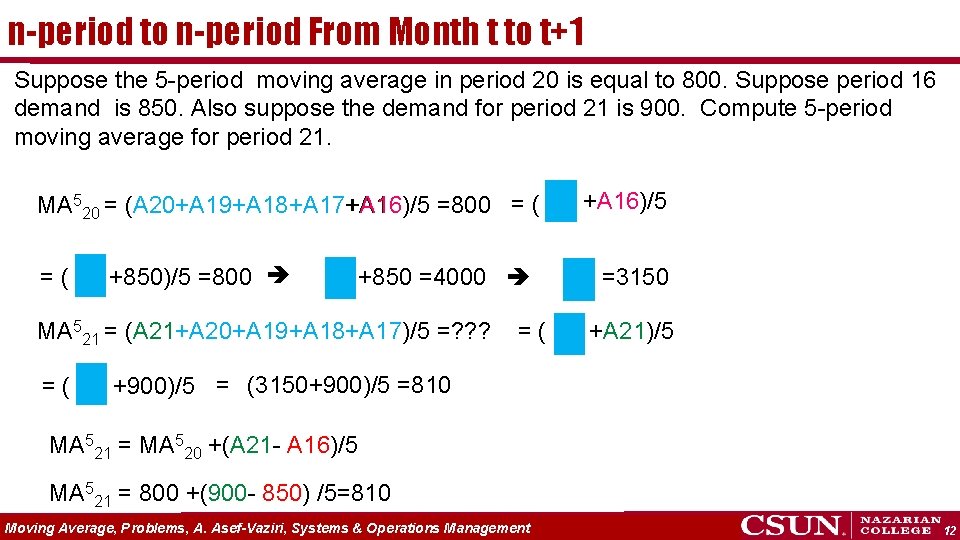
n-period to n-period From Month t to t+1 Suppose the 5 -period moving average in period 20 is equal to 800. Suppose period 16 demand is 850. Also suppose the demand for period 21 is 900. Compute 5 -period moving average for period 21. MA 520 = (A 20+A 19+A 18+A 17+A 16)/5 =800 = ( =( +850)/5 =800 +850 =4000 MA 521 = (A 21+A 20+A 19+A 18+A 17)/5 =? ? ? =( =( +A 16)/5 =3150 +A 21)/5 +900)/5 = (3150+900)/5 =810 MA 521 = MA 520 +(A 21 - A 16)/5 MA 521 = 800 +(900 - 850) /5=810 Moving Average, Problems, A. Asef-Vaziri, Systems & Operations Management 12
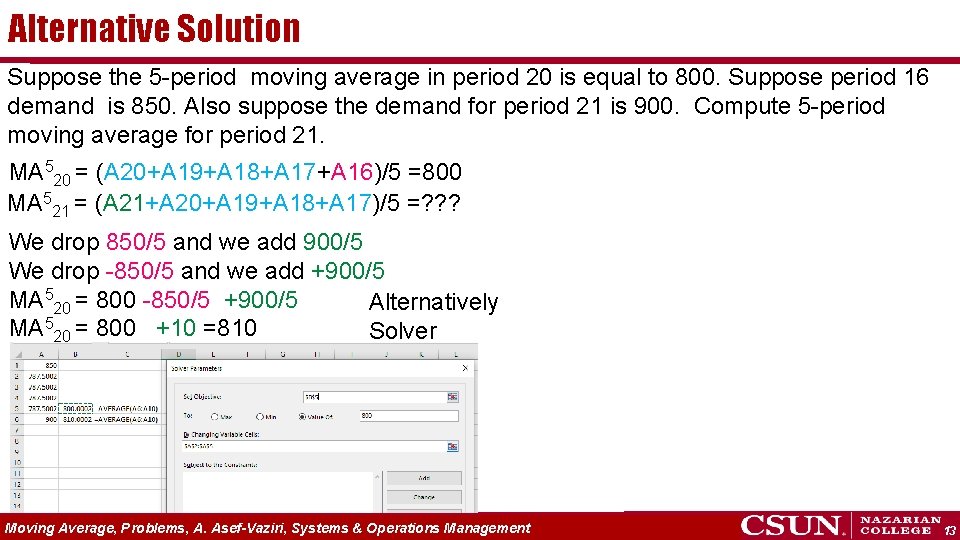
Alternative Solution Suppose the 5 -period moving average in period 20 is equal to 800. Suppose period 16 demand is 850. Also suppose the demand for period 21 is 900. Compute 5 -period moving average for period 21. MA 520 = (A 20+A 19+A 18+A 17+A 16)/5 =800 MA 521 = (A 21+A 20+A 19+A 18+A 17)/5 =? ? ? We drop 850/5 and we add 900/5 We drop -850/5 and we add +900/5 MA 520 = 800 -850/5 +900/5 Alternatively MA 520 = 800 +10 =810 Solver Moving Average, Problems, A. Asef-Vaziri, Systems & Operations Management 13
- Slides: 13