
Basic Poetic Vocabulary 5 Basic Categories 1 2
Basic Poetic Vocabulary

5 Basic Categories 1. 2. 3. 4. 5. Structure Comparison Word Order Poetic Style Miscellaneous

Structure O Stanza: a group of lines forming a cohesive thought/idea O Line: a horizontal row of words, which may or may not form a complete sentence O Rhythm: pattern of sound created by the arrangement of stressed & unstressed syllables. O Meter: regular pattern of (un)stressed syllables O Foot: basic unit of measurement
Structure cont. O Refrain: a group of repeated words or lines; also called a chorus O Couplet: 2 rhyming lines O Quatrain: 4 lines with a rhyme scheme O Blank verse: contains no rhyme O Free Verse: contains no meter or rhyme
Comparison O Analogy: A comparison of dissimilar things or ideas O Simile: uses the words “like” or “as” to compare to dissimilar things O Metaphor: compares 2 or more different things by stating or implying that one thing is another. O Personification: gives human characteristics to an animal, object or idea. O Double Entendre: a word or phrase with multiple meanings
Examples O Analogy: When life gives you lemons, make lemonade. O Simile: My cold was like the plague. O Metaphor: The sky is melting. O Personification: The humble dog sat patiently. O Double Entendre: She’s on fire tonight.
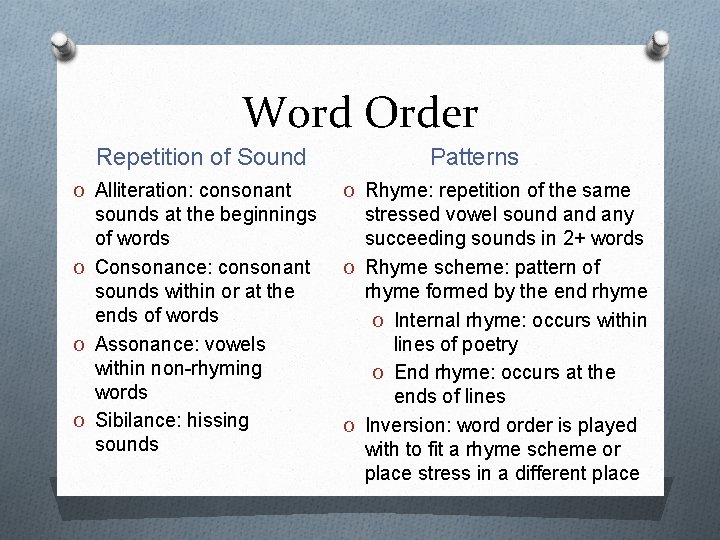
Word Order Repetition of Sound Patterns O Alliteration: consonant O Rhyme: repetition of the same sounds at the beginnings of words O Consonance: consonant sounds within or at the ends of words O Assonance: vowels within non-rhyming words O Sibilance: hissing sounds stressed vowel sound any succeeding sounds in 2+ words O Rhyme scheme: pattern of rhyme formed by the end rhyme O Internal rhyme: occurs within lines of poetry O End rhyme: occurs at the ends of lines O Inversion: word order is played with to fit a rhyme scheme or place stress in a different place
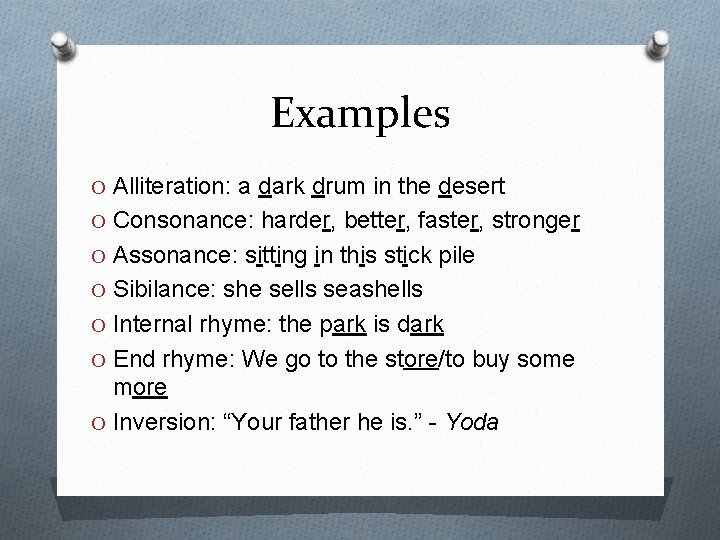
Examples O Alliteration: a dark drum in the desert O Consonance: harder, better, faster, stronger O Assonance: sitting in this stick pile O Sibilance: she sells seashells O Internal rhyme: the park is dark O End rhyme: We go to the store/to buy some more O Inversion: “Your father he is. ” - Yoda

Poetic Styles O Acrostic O First letter of lines spell a hidden message O Ballad O Song with a dramatic conclusion; often sad O Elegy O Written in response to a death O Epic O Long narrative telling the story of a hero
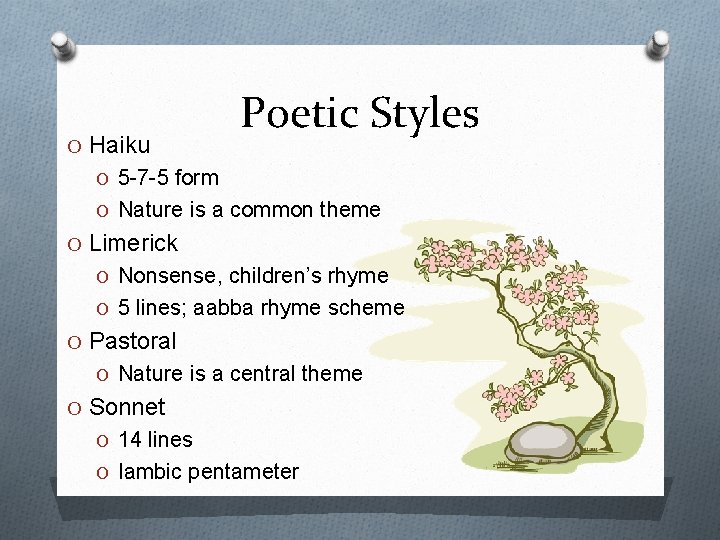
O Haiku Poetic Styles O 5 -7 -5 form O Nature is a common theme O Limerick O Nonsense, children’s rhyme O 5 lines; aabba rhyme scheme O Pastoral O Nature is a central theme O Sonnet O 14 lines O Iambic pentameter
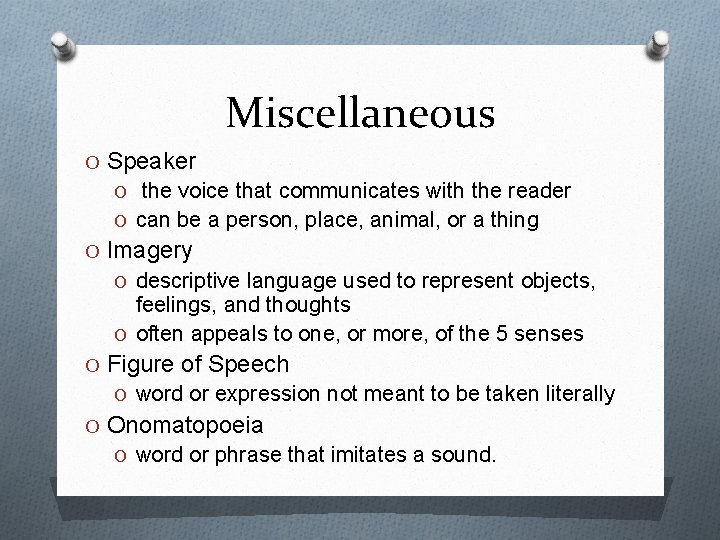
Miscellaneous O Speaker O the voice that communicates with the reader O can be a person, place, animal, or a thing O Imagery O descriptive language used to represent objects, feelings, and thoughts O often appeals to one, or more, of the 5 senses O Figure of Speech O word or expression not meant to be taken literally O Onomatopoeia O word or phrase that imitates a sound.
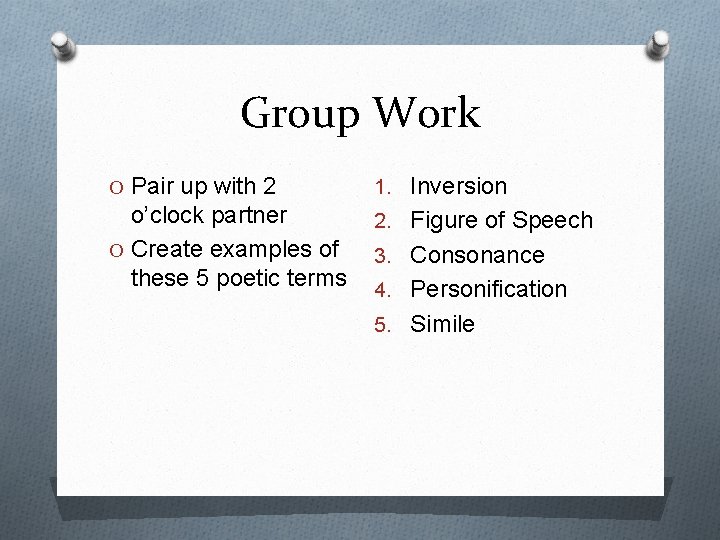
Group Work O Pair up with 2 1. Inversion o’clock partner O Create examples of these 5 poetic terms 2. Figure of Speech 3. Consonance 4. Personification 5. Simile
- Slides: 12