
BASIC PICTURE COMPOSITION PART 1 FRAMING Definition Using

BASIC PICTURE COMPOSITION PART 1
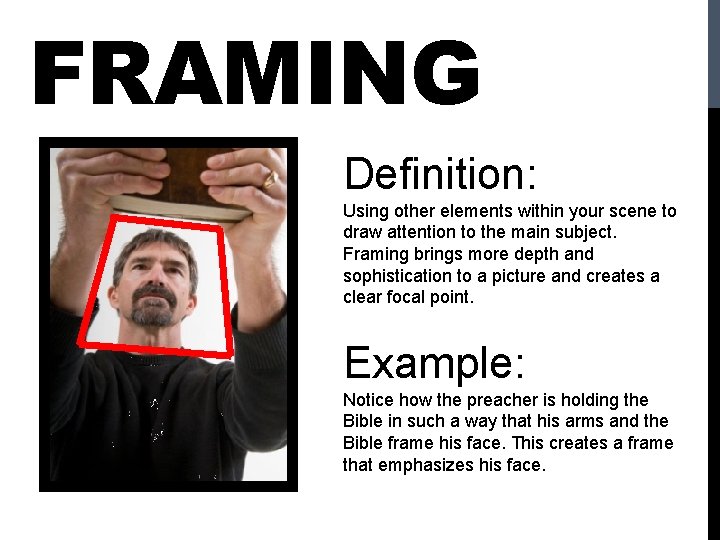
FRAMING Definition: Using other elements within your scene to draw attention to the main subject. Framing brings more depth and sophistication to a picture and creates a clear focal point. Example: Notice how the preacher is holding the Bible in such a way that his arms and the Bible frame his face. This creates a frame that emphasizes his face.
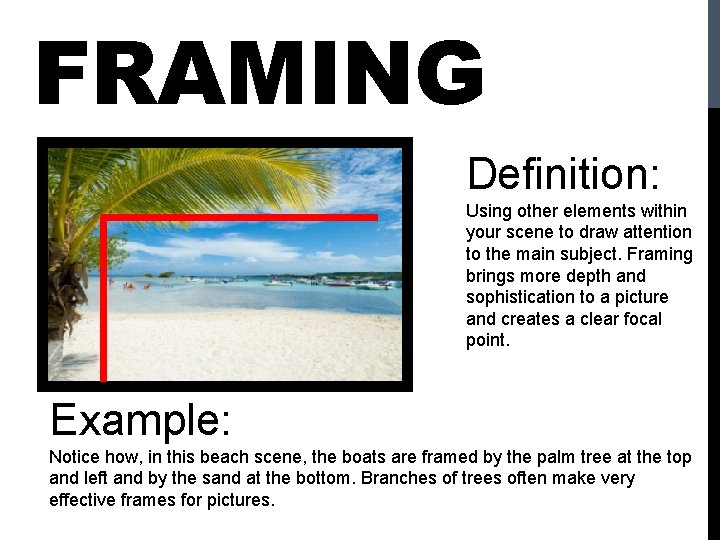
FRAMING Definition: Using other elements within your scene to draw attention to the main subject. Framing brings more depth and sophistication to a picture and creates a clear focal point. Example: Notice how, in this beach scene, the boats are framed by the palm tree at the top and left and by the sand at the bottom. Branches of trees often make very effective frames for pictures.
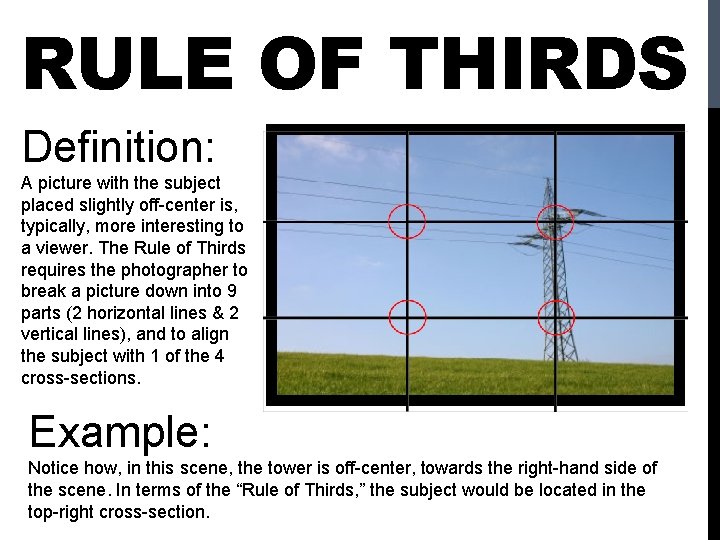
RULE OF THIRDS Definition: A picture with the subject placed slightly off-center is, typically, more interesting to a viewer. The Rule of Thirds requires the photographer to break a picture down into 9 parts (2 horizontal lines & 2 vertical lines), and to align the subject with 1 of the 4 cross-sections. Example: Notice how, in this scene, the tower is off-center, towards the right-hand side of the scene. In terms of the “Rule of Thirds, ” the subject would be located in the top-right cross-section.
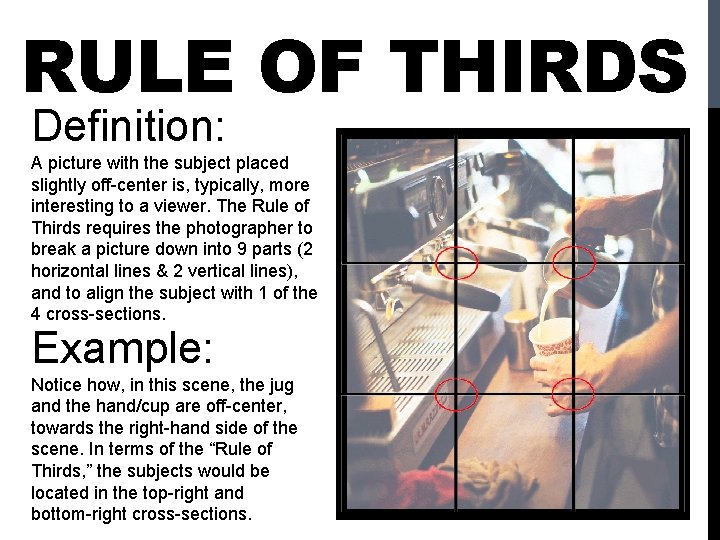
RULE OF THIRDS Definition: A picture with the subject placed slightly off-center is, typically, more interesting to a viewer. The Rule of Thirds requires the photographer to break a picture down into 9 parts (2 horizontal lines & 2 vertical lines), and to align the subject with 1 of the 4 cross-sections. Example: Notice how, in this scene, the jug and the hand/cup are off-center, towards the right-hand side of the scene. In terms of the “Rule of Thirds, ” the subjects would be located in the top-right and bottom-right cross-sections.
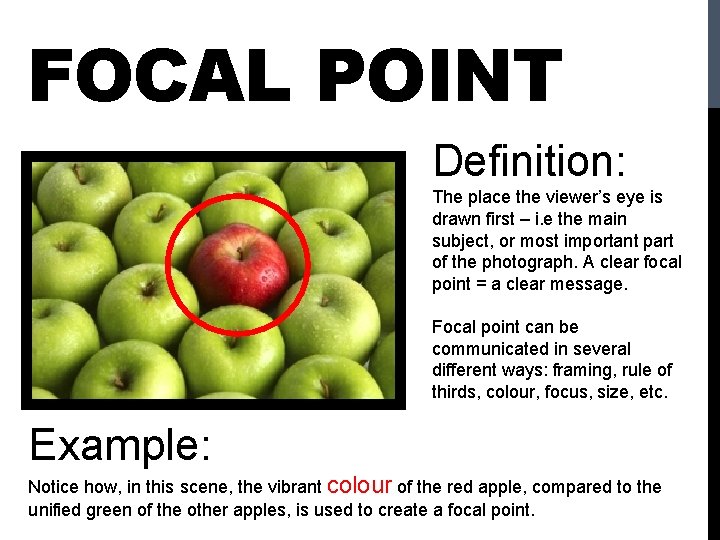
FOCAL POINT Definition: The place the viewer’s eye is drawn first – i. e the main subject, or most important part of the photograph. A clear focal point = a clear message. Focal point can be communicated in several different ways: framing, rule of thirds, colour, focus, size, etc. Example: Notice how, in this scene, the vibrant colour of the red apple, compared to the unified green of the other apples, is used to create a focal point.
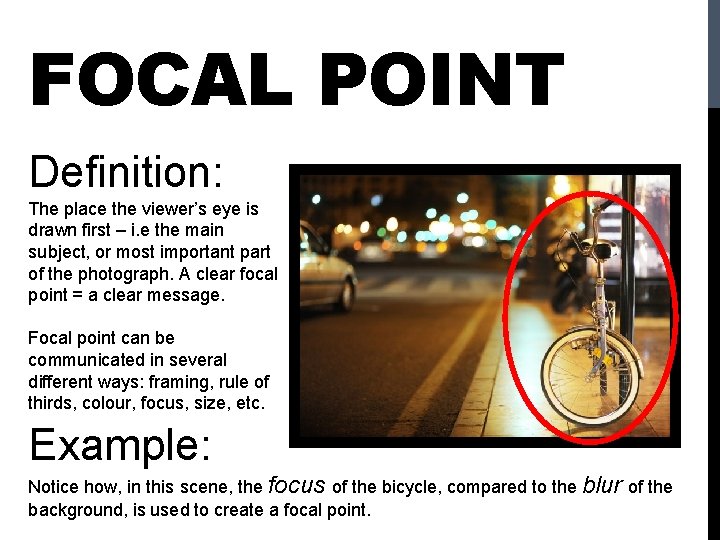
FOCAL POINT Definition: The place the viewer’s eye is drawn first – i. e the main subject, or most important part of the photograph. A clear focal point = a clear message. Focal point can be communicated in several different ways: framing, rule of thirds, colour, focus, size, etc. Example: Notice how, in this scene, the focus of the bicycle, compared to the blur of the background, is used to create a focal point.

FOCAL POINT Definition: The place the viewer’s eye is drawn first – i. e the main subject, or most important part of the photograph. A clear focal point = a clear message. Focal point can be communicated in several different ways: framing, rule of thirds, colour, focus, size, etc. Example: Notice how, in this scene, the size of the larger ship, compared to the size of the smaller ship is used to create a focal point.
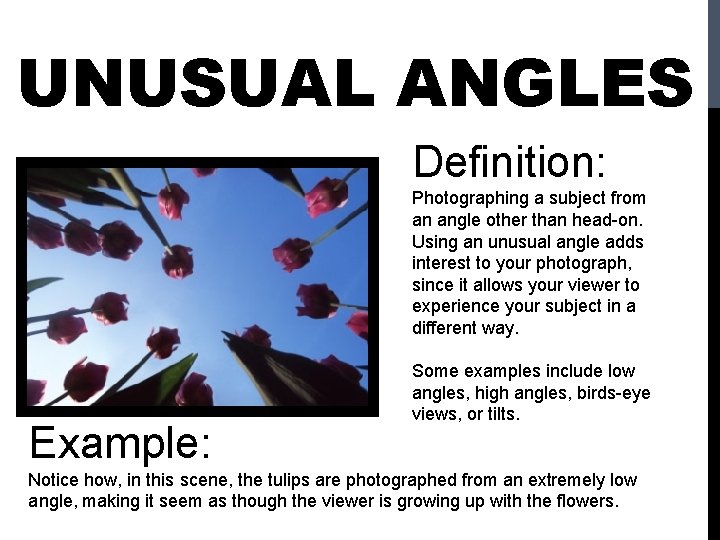
UNUSUAL ANGLES Definition: Photographing a subject from an angle other than head-on. Using an unusual angle adds interest to your photograph, since it allows your viewer to experience your subject in a different way. Example: Some examples include low angles, high angles, birds-eye views, or tilts. Notice how, in this scene, the tulips are photographed from an extremely low angle, making it seem as though the viewer is growing up with the flowers.
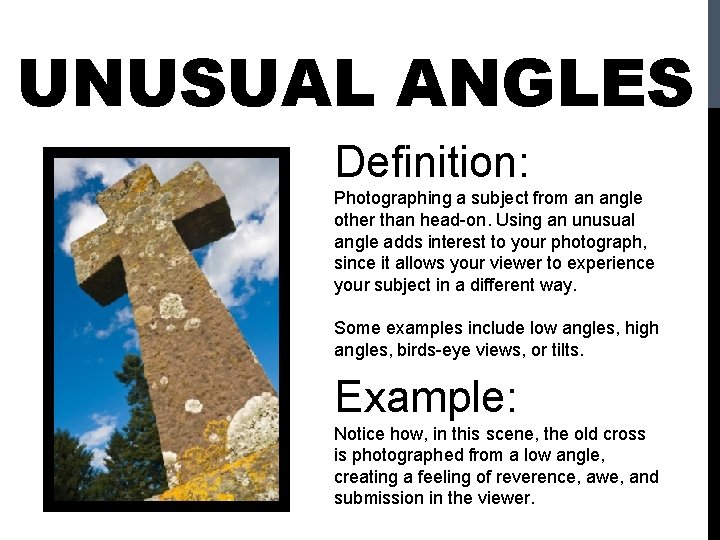
UNUSUAL ANGLES Definition: Photographing a subject from an angle other than head-on. Using an unusual angle adds interest to your photograph, since it allows your viewer to experience your subject in a different way. Some examples include low angles, high angles, birds-eye views, or tilts. Example: Notice how, in this scene, the old cross is photographed from a low angle, creating a feeling of reverence, awe, and submission in the viewer.
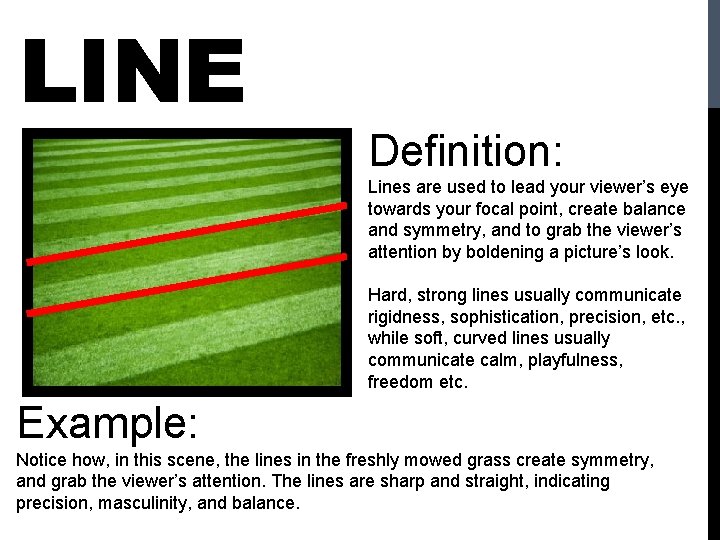
LINE Definition: Lines are used to lead your viewer’s eye towards your focal point, create balance and symmetry, and to grab the viewer’s attention by boldening a picture’s look. Hard, strong lines usually communicate rigidness, sophistication, precision, etc. , while soft, curved lines usually communicate calm, playfulness, freedom etc. Example: Notice how, in this scene, the lines in the freshly mowed grass create symmetry, and grab the viewer’s attention. The lines are sharp and straight, indicating precision, masculinity, and balance.
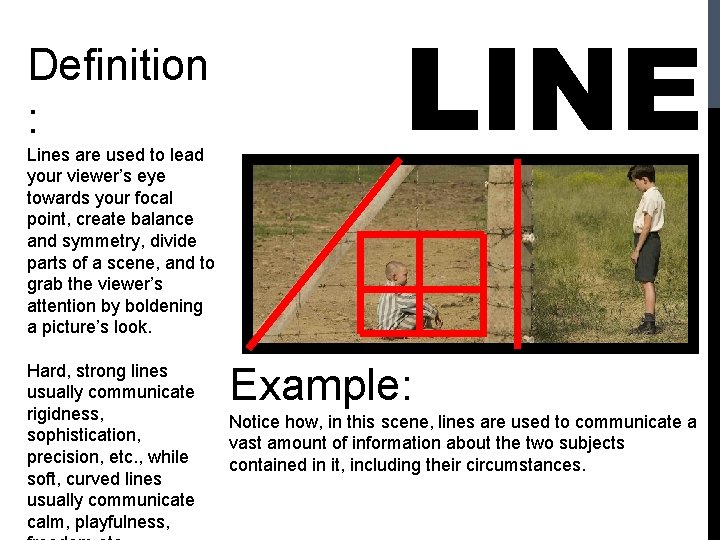
Definition : Lines are used to lead your viewer’s eye towards your focal point, create balance and symmetry, divide parts of a scene, and to grab the viewer’s attention by boldening a picture’s look. Hard, strong lines usually communicate rigidness, sophistication, precision, etc. , while soft, curved lines usually communicate calm, playfulness, LINE Example: Notice how, in this scene, lines are used to communicate a vast amount of information about the two subjects contained in it, including their circumstances.
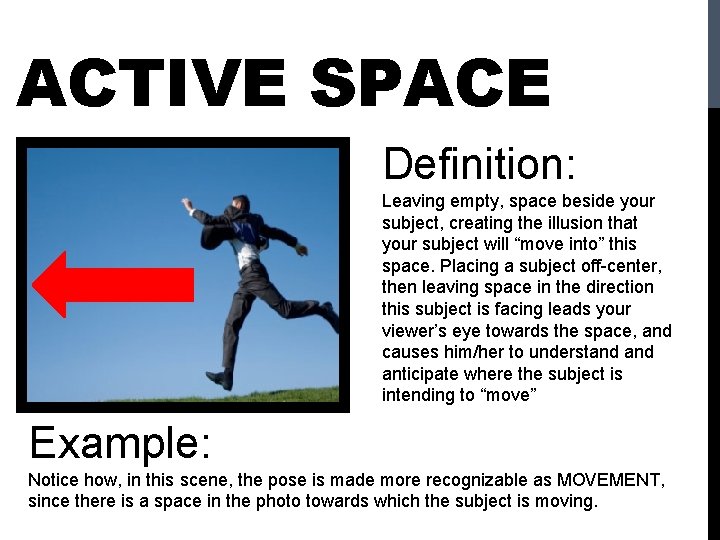
ACTIVE SPACE Definition: Leaving empty, space beside your subject, creating the illusion that your subject will “move into” this space. Placing a subject off-center, then leaving space in the direction this subject is facing leads your viewer’s eye towards the space, and causes him/her to understand anticipate where the subject is intending to “move” Example: Notice how, in this scene, the pose is made more recognizable as MOVEMENT, since there is a space in the photo towards which the subject is moving.
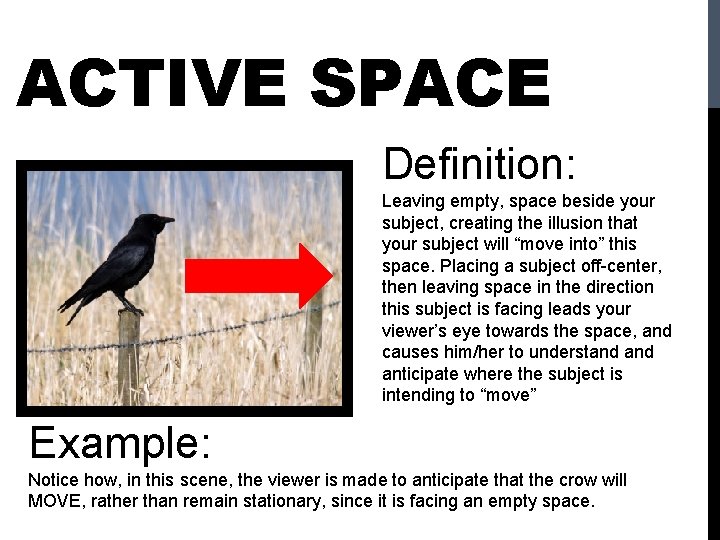
ACTIVE SPACE Definition: Leaving empty, space beside your subject, creating the illusion that your subject will “move into” this space. Placing a subject off-center, then leaving space in the direction this subject is facing leads your viewer’s eye towards the space, and causes him/her to understand anticipate where the subject is intending to “move” Example: Notice how, in this scene, the viewer is made to anticipate that the crow will MOVE, rather than remain stationary, since it is facing an empty space.
- Slides: 14