
Basic Pharmacology of Drugs Used in Respiratory System
Basic Pharmacology of Drugs Used in Respiratory System Disorders Ankara University Faculty of Medicine, Pharmacology Department Ongun Onaran
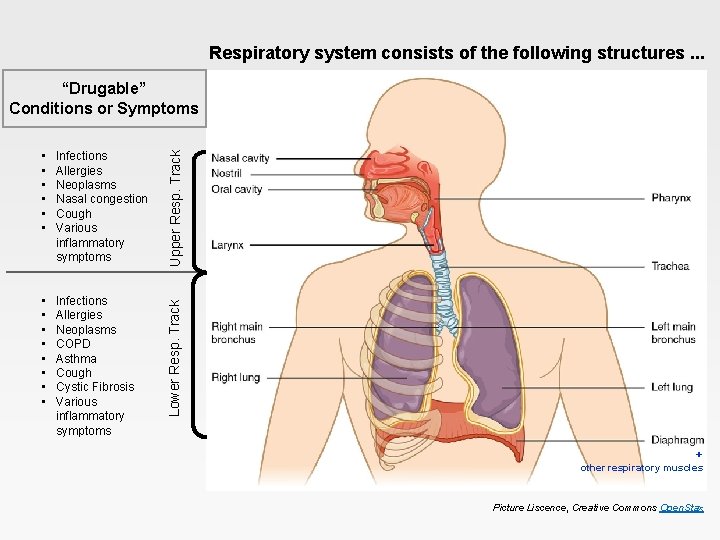
Respiratory system consists of the following structures. . . • • • Infections Allergies Neoplasms Nasal congestion Cough Various inflammatory symptoms Upper Resp. Track • • Infections Allergies Neoplasms COPD Asthma Cough Cystic Fibrosis Various inflammatory symptoms Lower Resp. Track “Drugable” Conditions or Symptoms + other respiratory muscles Picture Liscence, Creative Commons Open. Stax
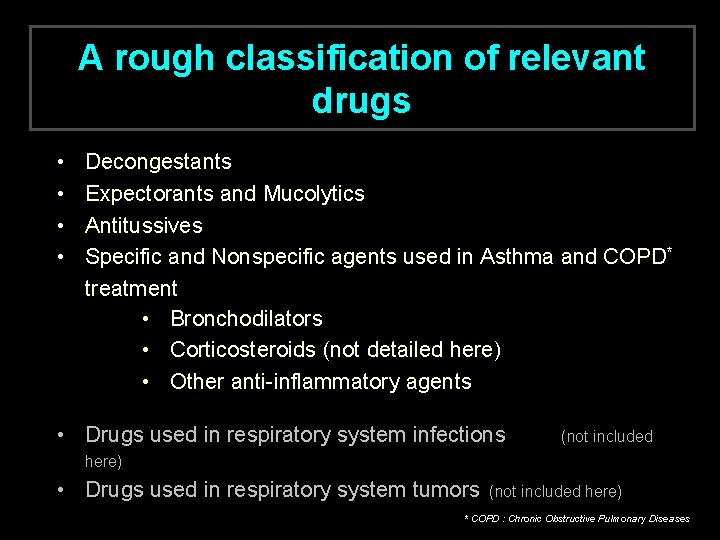
A rough classification of relevant drugs • • Decongestants Expectorants and Mucolytics Antitussives Specific and Nonspecific agents used in Asthma and COPD* treatment • Bronchodilators • Corticosteroids (not detailed here) • Other anti-inflammatory agents • Drugs used in respiratory system infections (not included here) • Drugs used in respiratory system tumors (not included here) * COPD : Chronic Obstructive Pulmonary Diseases
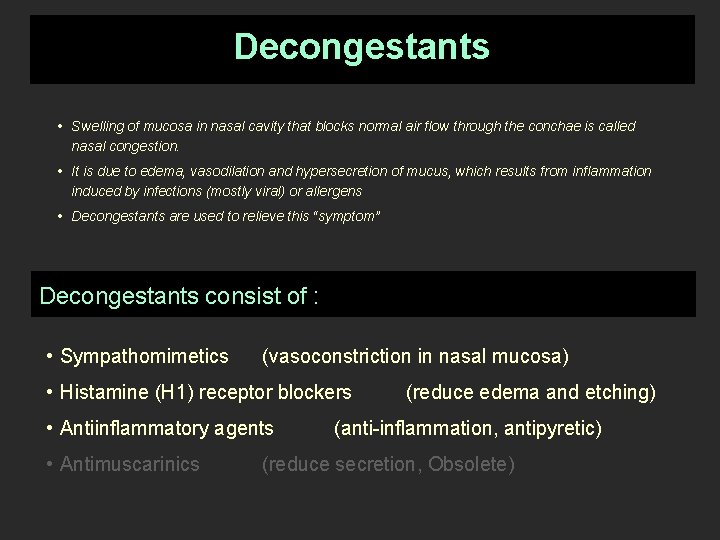
Decongestants • Swelling of mucosa in nasal cavity that blocks normal air flow through the conchae is called nasal congestion. • It is due to edema, vasodilation and hypersecretion of mucus, which results from inflammation induced by infections (mostly viral) or allergens • Decongestants are used to relieve this “symptom” Decongestants consist of : • Sympathomimetics (vasoconstriction in nasal mucosa) • Histamine (H 1) receptor blockers • Antiinflammatory agents • Antimuscarinics (reduce edema and etching) (anti-inflammation, antipyretic) (reduce secretion, Obsolete)
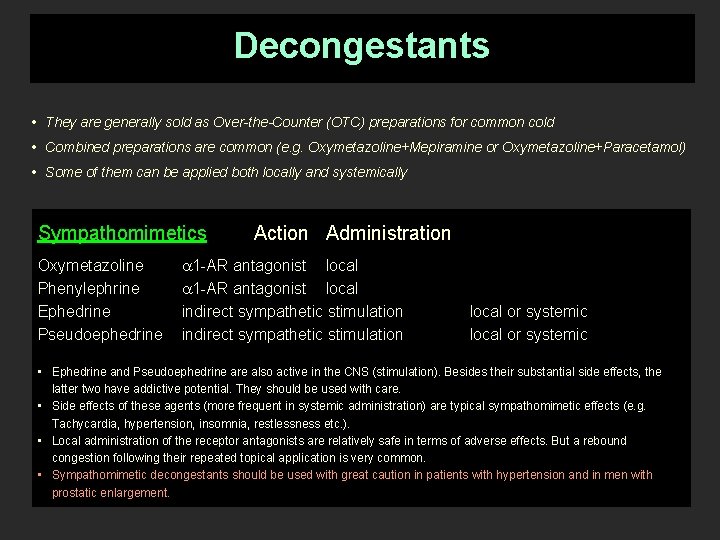
Decongestants • They are generally sold as Over-the-Counter (OTC) preparations for common cold • Combined preparations are common (e. g. Oxymetazoline+Mepiramine or Oxymetazoline+Paracetamol) • Some of them can be applied both locally and systemically Sympathomimetics Oxymetazoline Phenylephrine Ephedrine Pseudoephedrine Action Administration 1 -AR antagonist local indirect sympathetic stimulation local or systemic • Ephedrine and Pseudoephedrine are also active in the CNS (stimulation). Besides their substantial side effects, the latter two have addictive potential. They should be used with care. • Side effects of these agents (more frequent in systemic administration) are typical sympathomimetic effects (e. g. Tachycardia, hypertension, insomnia, restlessness etc. ). • Local administration of the receptor antagonists are relatively safe in terms of adverse effects. But a rebound congestion following their repeated topical application is very common. • Sympathomimetic decongestants should be used with great caution in patients with hypertension and in men with prostatic enlargement.
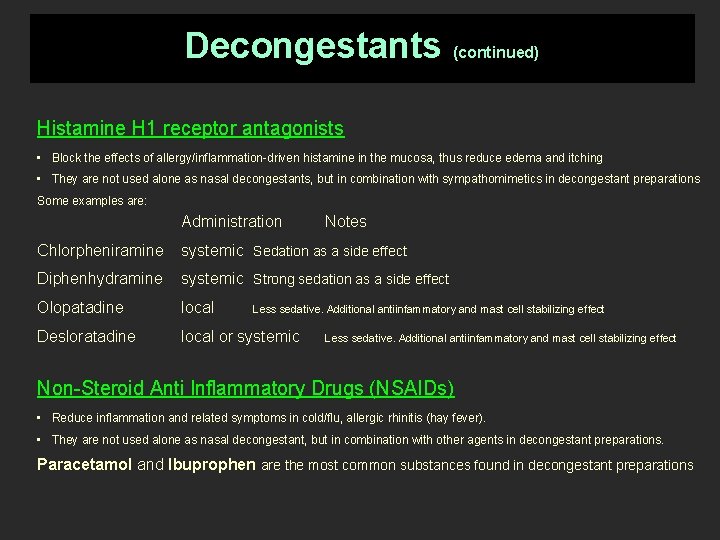
Decongestants (continued) Histamine H 1 receptor antagonists • Block the effects of allergy/inflammation-driven histamine in the mucosa, thus reduce edema and itching • They are not used alone as nasal decongestants, but in combination with sympathomimetics in decongestant preparations Some examples are: Administration Notes Chlorpheniramine systemic Sedation as a side effect Diphenhydramine systemic Strong sedation as a side effect Olopatadine local Desloratadine local or systemic Less sedative. Additional antiinfammatory and mast cell stabilizing effect Non-Steroid Anti Inflammatory Drugs (NSAIDs) • Reduce inflammation and related symptoms in cold/flu, allergic rhinitis (hay fever). • They are not used alone as nasal decongestant, but in combination with other agents in decongestant preparations. Paracetamol and Ibuprophen are the most common substances found in decongestant preparations

Expectorants and Mucolytics • Increased mucus secretion or reduced mucus clearance in the airway impairs effective respiration. • Many conditions may lead to mucus hypersecretion: Chronic Obstructive Pulmonary Diseases (COPD, i. e. Chronic Bronchitis or emphysema), Asthma, Cystic Fibrosis. • As their names imply, expectorant and mucolytic drugs are meant to increase mucus clearance in the airway Expectorants • Reduce mucus viscosity by increasing the water content of mucus or by increasing overall secretion. They are “emetics” used in lower doses. • Although once commonly prescribed, they are obsolete now for the lack of evidence for their efficacy. • Examples are: Iodine salts of Na or K, Ipecac, Guaifenesin (which is the only one approved in the USA) Mucolytics • Reduce mucus viscosity by changing the mucus composition. • Cysteine derivatives such as N-acetylcysteine, act by reducing disulfide bridges, which reduce the binding of glycoproteins to other proteins in mucus. Not recommended in COPD anymore. • Dornase alpha (DNAse) reduce viscosity of sputum in cystic fibrosis patients. But, there is no evidence that it is effective in COPD or Asthma None of these drugs are generally any better than adequate hydration or steam inhalation in patients requiring expectoration, except in some severe cases.
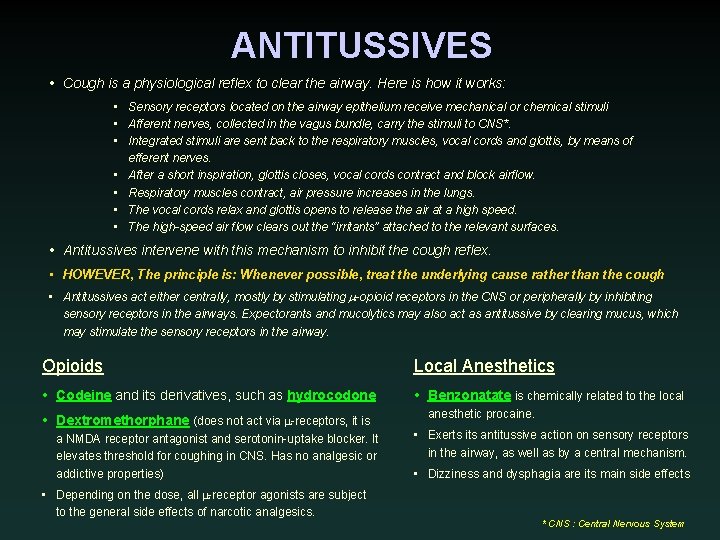
ANTITUSSIVES • Cough is a physiological reflex to clear the airway. Here is how it works: • Sensory receptors located on the airway epithelium receive mechanical or chemical stimuli • Afferent nerves, collected in the vagus bundle, carry the stimuli to CNS*. • Integrated stimuli are sent back to the respiratory muscles, vocal cords and glottis, by means of efferent nerves. • After a short inspiration, glottis closes, vocal cords contract and block airflow. • Respiratory muscles contract, air pressure increases in the lungs. • The vocal cords relax and glottis opens to release the air at a high speed. • The high-speed air flow clears out the “irritants” attached to the relevant surfaces. • Antitussives intervene with this mechanism to inhibit the cough reflex. • HOWEVER, The principle is: Whenever possible, treat the underlying cause rather than the cough • Antitussives act either centrally, mostly by stimulating -opioid receptors in the CNS or peripherally by inhibiting sensory receptors in the airways. Expectorants and mucolytics may also act as antitussive by clearing mucus, which may stimulate the sensory receptors in the airway. Opioids Local Anesthetics • Codeine and its derivatives, such as hydrocodone • Benzonatate is chemically related to the local • Dextromethorphane (does not act via -receptors, it is a NMDA receptor antagonist and serotonin-uptake blocker. It elevates threshold for coughing in CNS. Has no analgesic or addictive properties) • Depending on the dose, all -receptor agonists are subject to the general side effects of narcotic analgesics. anesthetic procaine. • Exerts its antitussive action on sensory receptors in the airway, as well as by a central mechanism. • Dizziness and dysphagia are its main side effects * CNS : Central Nervous System
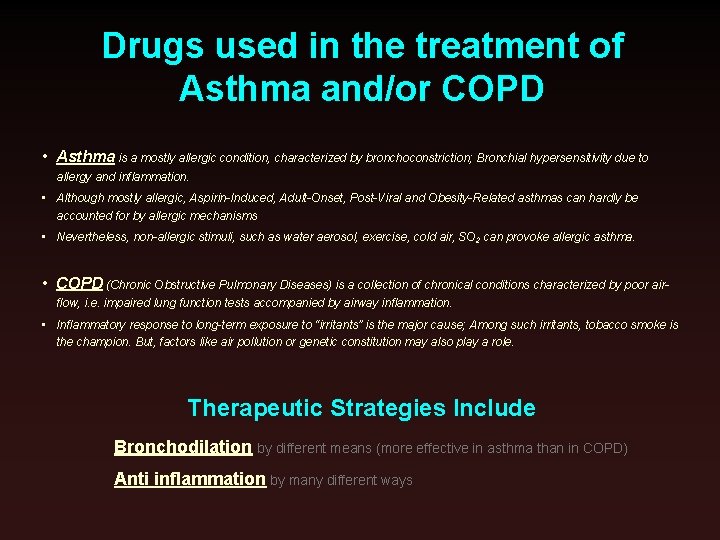
Drugs used in the treatment of Asthma and/or COPD • Asthma is a mostly allergic condition, characterized by bronchoconstriction; Bronchial hypersensitivity due to allergy and inflammation. • Although mostly allergic, Aspirin-Induced, Adult-Onset, Post-Viral and Obesity-Related asthmas can hardly be accounted for by allergic mechanisms • Nevertheless, non-allergic stimuli, such as water aerosol, exercise, cold air, SO 2 can provoke allergic asthma. • COPD (Chronic Obstructive Pulmonary Diseases) is a collection of chronical conditions characterized by poor airflow, i. e. impaired lung function tests accompanied by airway inflammation. • Inflammatory response to long-term exposure to “irritants” is the major cause; Among such irritants, tobacco smoke is the champion. But, factors like air pollution or genetic constitution may also play a role. Therapeutic Strategies Include Bronchodilation by different means (more effective in asthma than in COPD) Anti inflammation by many different ways
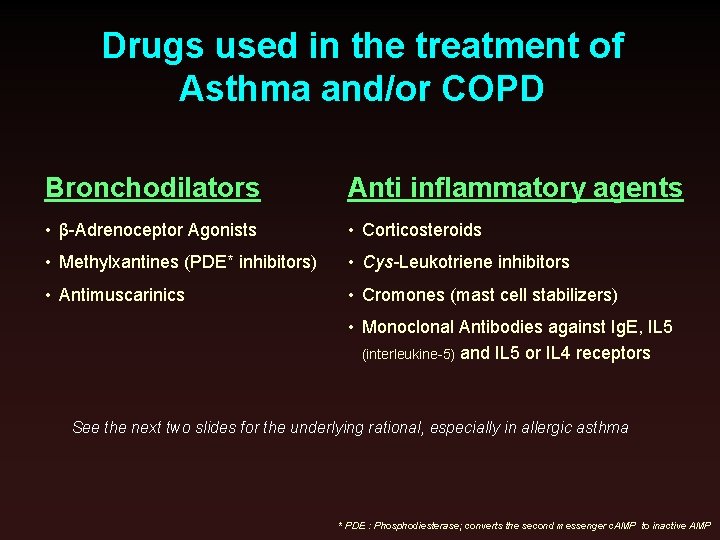
Drugs used in the treatment of Asthma and/or COPD Bronchodilators Anti inflammatory agents • β-Adrenoceptor Agonists • Corticosteroids • Methylxantines (PDE* inhibitors) • Cys-Leukotriene inhibitors • Antimuscarinics • Cromones (mast cell stabilizers) • Monoclonal Antibodies against Ig. E, IL 5 (interleukine-5) and IL 5 or IL 4 receptors See the next two slides for the underlying rational, especially in allergic asthma * PDE : Phosphodiesterase; converts the second messenger c. AMP to inactive AMP
- Slides: 10