
Basic Pattern of the Central Nervous System Spinal
Basic Pattern of the Central Nervous System • Spinal Cord – _______________ surrounded by a _ – Gray matter is surrounded by _ • myelinated fiber _ • Brain – Similar to spinal cord but with _ – Cerebellum has gray matter in nuclei – Cerebrum has nuclei and additional gray matter in the cortex
Ventricles of the Brain • Arise from expansion of the lumen of the neural tube • The ventricles are: – The paired _ – The third ventricle found in the diencephalon – The fourth ventricle found in the hindbrain dorsal to the pons
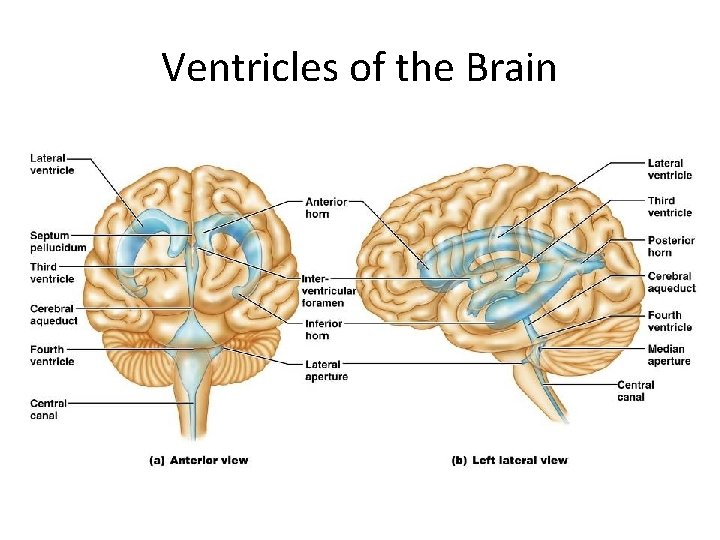
Ventricles of the Brain
Cerebral Hemispheres • Contains ridges – • and shallow grooves – • Contain deep grooves – • Are separated by the _ • Have three basic regions: – cortex, white matter, and basal nuclei
Major Lobes, Gyri, and Sulci of the Cerebral Hemisphere • Deep sulci divide the hemispheres into five lobes: – • – separates the frontal and parietal lobes

Brain Lobes
• Major Lobes, Gyri, and Sulci of the Cerebral Hemisphere – separates the parietal and occipital lobes • – separates the parietal and temporal lobes • The
Cerebral Cortex • The cortex – superficial gray matter – accounts for 40% of the mass of the brain • It enables • Each hemisphere acts _______________ (controls the opposite side of the body) • Hemispheres are not equal in function • No functional area acts alone; conscious behavior involves the entire cortex
Functional Areas of the Cerebral Cortex • The three types of functional areas are: – • control voluntary movement – • conscious awareness of sensation – • integrate diverse information
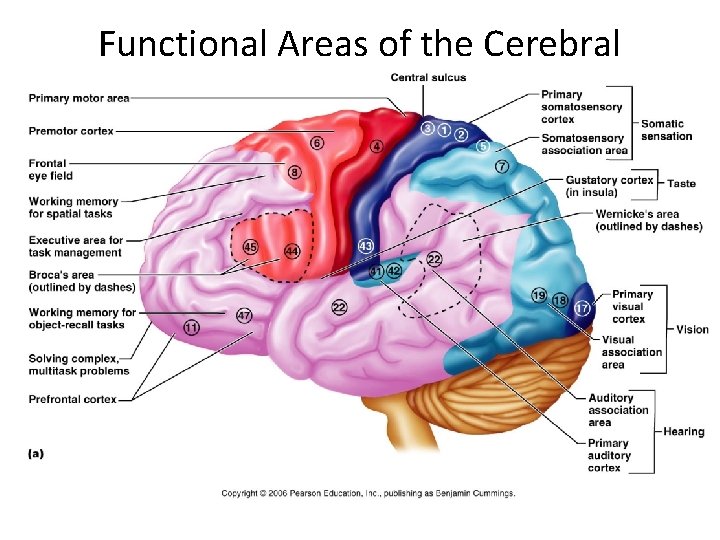
Functional Areas of the Cerebral Cortex
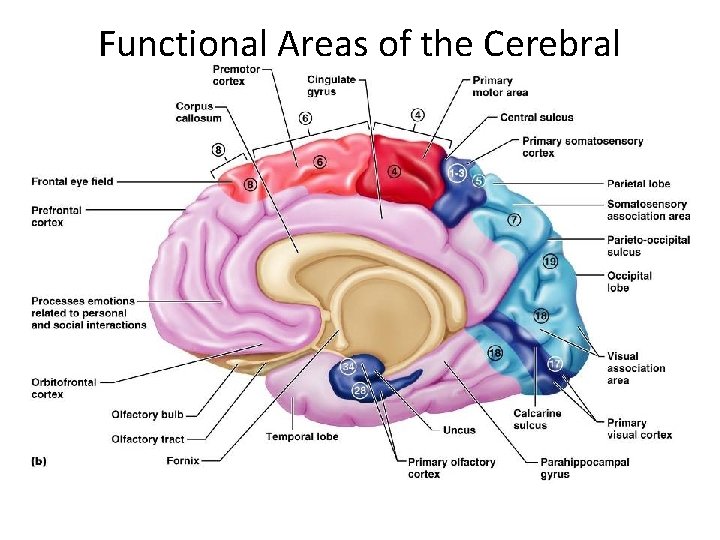
Functional Areas of the Cerebral Cortex
Cerebral Cortex: Motor Areas • Primary _ • Premotor cortex • • Frontal eye field

Primary Motor Cortex • Located in the _ • Pyramidal cells whose axons make up the _ • Allows conscious control of precise, skilled, voluntary movements
Premotor Cortex • Located _ • Controls _ • Coordinates simultaneous or sequential actions • Involved in the planning of movements
Broca’s Area • Broca’s area – Located anterior to the inferior region of the premotor area – Present in _ – A motor speech area that _ – Is active as one prepares to speak

Frontal Eye Field • – Located anterior to the premotor cortex and superior to Broca’s area – Controls _
Sensory Areas • • Primary _ Somatosensory association cortex Visual and _ Olfactory, ______________, and vestibular cortices
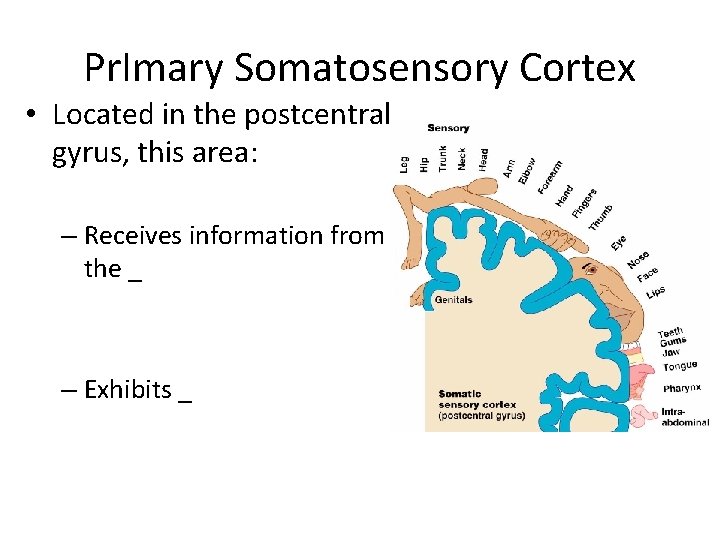
Pr. Imary Somatosensory Cortex • Located in the postcentral gyrus, this area: – Receives information from the _ – Exhibits _
Somatosensory Association Cortex • Located posterior to the primary somatosensory cortex • • Forms _______________ understanding of the stimulus • Determines size, texture, and relationship of parts
Visual Areas • Primary visual (striate) cortex – Seen on the _ – Most of it is buried in the calcarine sulcus – Receives visual information from the retinas • Visual association area – – Interprets visual stimuli (e. g. , color, form, and movement)
Auditory Areas • Primary auditory cortex – Located at the superior margin of the _ – Receives information related to _ • Auditory association area – Located posterior to the primary auditory cortex – __________________ and permits perception of sounds –
Association Areas • • Language areas • General (common) interpretation area •
Prefrontal Cortex • Located in the _ • Involved with ____________, cognition, recall, and _ • Necessary for judgment, ____________, persistence, and conscience • Closely linked to the _________ system (emotional part of the brain)
Cerebellar Cognitive Function • Plays a role in _ • Recognizes and ___________ sequences of events
Language Areas • Located in a large area surrounding the ________ (or language-dominant) _ • Major parts and functions: – • sounding out unfamiliar words – • speech preparation and production – • language comprehension and word analysis – Lateral and ventral temporal lobe • coordinate auditory and visual aspects of language
General (Common) Interpretation Area • _____________ region including parts of the temporal, parietal, and occipital lobes • Found in one hemisphere, _ • Integrates incoming signals _ • Involved in processing spatial relationships
Visceral Association Area • Located in the _ • Involved in conscious perception of _
Lateralization of Cortical Function • Lateralization – each hemisphere has _ • Cerebral dominance – designates the hemisphere _ • Left hemisphere – controls _ • Right hemisphere – controls _

Cerebral White Matter • Consists of deep _ • It is responsible for communication between: – The cerebral cortex and lower CNS center, and areas of the cerebrum
- Slides: 29