
Basic Parliamentary Procedure An overview presented to University
Basic Parliamentary Procedure An overview presented to University of Washington students of Professor Wilkerson October 26, 2005 Presented by: Mike Hoover, Senate Counsel
Where do you start? n n Begin with the process in mind! Understand that, over and above the substantive law, the bill will need to go through the legislative process.
Balancing Act Part 1 n n n Substantive Law v. Politics What sort of “horsetrading” might need to go on, politically, to achieve your aims? What if the perfect becomes the enemy of the good?
Balancing Act Part 2 n n n Process v. Players Where are you in the process? Who can help you get to the next step?

The Process 1. Introduced in the Senate or House 2. Referred to a policy committee 3. Passed from the policy committee (with amendments? ) 4. Referred to a fiscal committee 5. Passed from the fiscal committee (with amendments? ) 6. Referred to the Rules committee 7. Passed from the Rules committee, sent to the Floor 11. Go to the Governor for action. 10. Negotiate, concur, conference until same measure passes both houses. 9. Go to opposite house, repeat 1 -8 8. Passed on the Floor (with amendments? )
Know the process! n Find the sources of law and process applicable to your proceedings, such as: n n n The Constitution; Joint, Senate, House, and Reed’s Rules; and Tradition: That’s the way it’s always been done!
Bases of Process: Rules n What’s the point of the rules? n n To enable the majority to conduct its business while protecting the rights of the minority. This doesn’t necessarily mean a partisan majority or minority– 25 & 50 rule the floor! Avoid results that would stop the business before the body! Keep in mind that these are self imposed! Thus, bending or even breaking the rules has little (if any) legal impact. n n Question: What’s the result of breaking or bending the rules in a parliamentary sense? Answer: Also very little. By subsequent actions, the body could be viewed as having waived particular rules to conducts its business.
Bases of Process: Rules n Some Final Thoughts on the Rules: The legislative process is simply one whereby a measure has to advance to certain points by certain times. Knowing which rule can help get the measure to the next point in time (or stop it, depending on your perspective) is key to understanding the process. You don’t need to know every rule, just the ones that are applicable to where you’re at in the process. If the rules are against you, get 25 votes (or 50)!

Bases of Process: Timelines n A hierarchy of legislative timelines: n Constitution & RCW’s n n Concurrent Resolutions, the “Cutoff Resolution” n n n Article II and RCW 44. 010 set the time and duration of the Sessions. Passed by both chambers, cannot be suspended by one chamber alone (not like a rule, which can be waived). Instead, need to pass an exemption or a new cutoff resolution– both chambers ultimately need to agree on the change. Joint, Senate, & House Rules n Various rules provide timelines specific to a particular matter.
Know the players! n n n Once you know understand the process, you need to know who those people are that are key to the process. Identify those who can help! Identify those who could hinder!
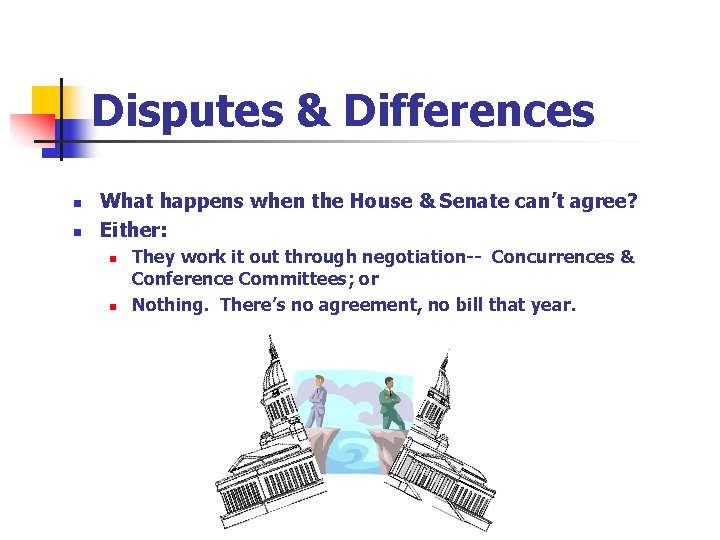
Disputes & Differences n n What happens when the House & Senate can’t agree? Either: n n They work it out through negotiation-- Concurrences & Conference Committees; or Nothing. There’s no agreement, no bill that year.
How do bills die? n n n Most bills die quietly! Rarely is a bill voted down. Instead, the majority simply never moves it along in the process and it misses all of the relevant time deadlines and votes.
Process + Players = Success! n n n Knowing where you are in the process and who can help you to the next step is crucial! Moving ahead can be a strange mix of policy and politics! Remember: It’s supposed to be hard to pass a law!
- Slides: 13