
BASIC PARAGRAPH STRUCTURE INTRODUCTION P 29 Definition of
BASIC PARAGRAPH STRUCTURE
INTRODUCTION P. 29 • Definition of ‘Paragraph’: • A paragraph is a series of sentences (not a list) that presents and develops one main idea (and only one!) about a topic. • Series: • The word ‘series’ tells us that the sentences in a paragraph are linked together logically, and that the paragraph is not merely a list of sentences. • One Main Idea: • All of the details in a paragraph must be directly related to the main idea. If you choose to develop a new idea, you must start a new paragraph.
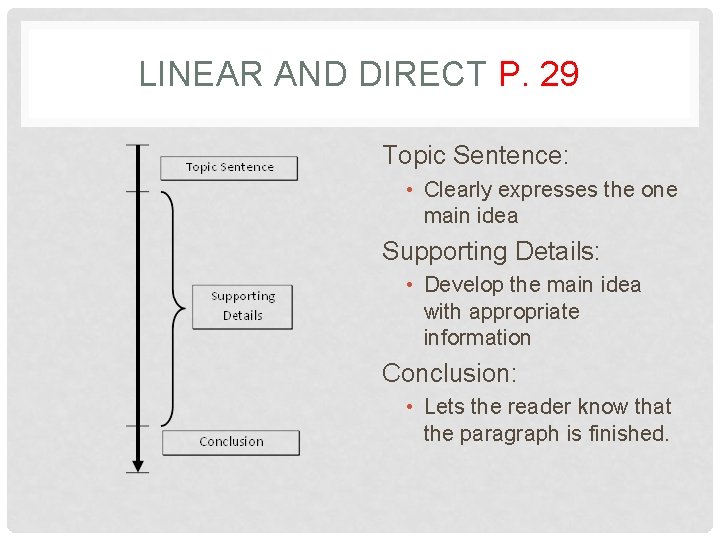
LINEAR AND DIRECT P. 29 Topic Sentence: • Clearly expresses the one main idea Supporting Details: • Develop the main idea with appropriate information Conclusion: • Lets the reader know that the paragraph is finished.
COMPARING STRUCTURES • Mastering a language does not just involve pronunciation, vocabulary, grammar, speaking, listening, and writing. • The pieces of conversations and compositions (the Structure) must be organized in ways that a native speaker will understand.
COMPARING STRUCTURES Culture and Language are closely connected • “Logic is not universal” • “If one doesn’t know the discourse pattern one can’t read for comprehension. ” • “If one doesn’t know the discourse pattern one can’t write for comprehension. ”
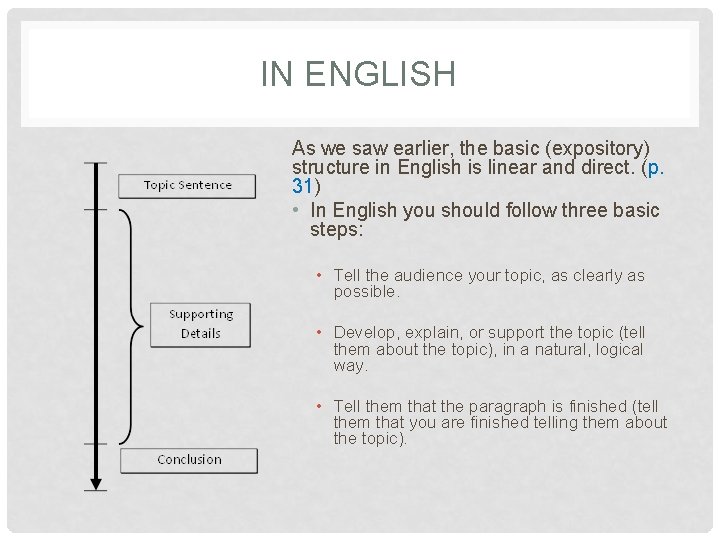
IN ENGLISH As we saw earlier, the basic (expository) structure in English is linear and direct. (p. 31) • In English you should follow three basic steps: • Tell the audience your topic, as clearly as possible. • Develop, explain, or support the topic (tell them about the topic), in a natural, logical way. • Tell them that the paragraph is finished (tell them that you are finished telling them about the topic).
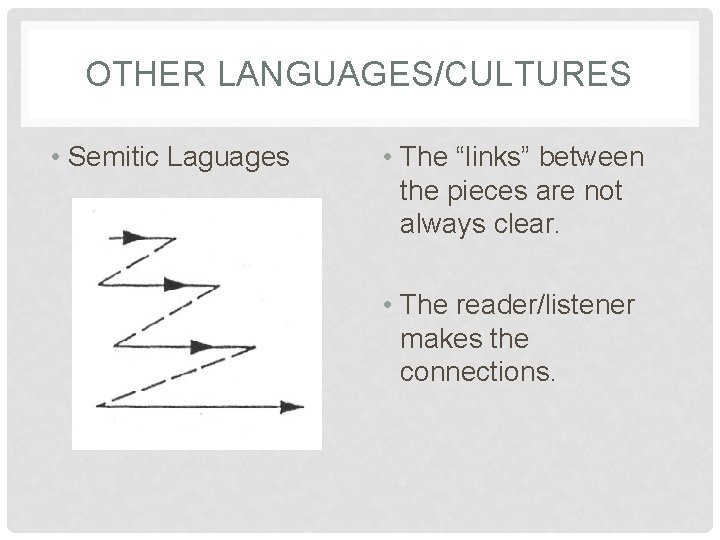
OTHER LANGUAGES/CULTURES • Semitic Laguages • The “links” between the pieces are not always clear. • The reader/listener makes the connections.
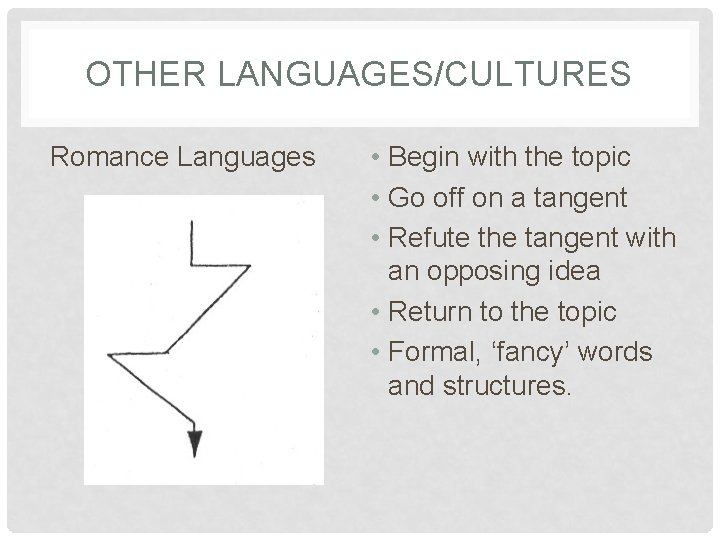
OTHER LANGUAGES/CULTURES Romance Languages • Begin with the topic • Go off on a tangent • Refute the tangent with an opposing idea • Return to the topic • Formal, ‘fancy’ words and structures.
OTHER LANGUAGES/CULTURES • Using the linear/direct style of English-speaking cultures may seem rude or abrupt to a native speaker of a romance language. • Using the romance language structure to communicate in English may leave the native English speaking wondering: • What is the point? • When is he/she going to tell me what’s happeing? • Why is this taking so long?
THE ‘ASIAN’ DISCOURSE PATTERN • Can you guess what it looks like? • Is it linear? • Is it direct? • Why or why not?
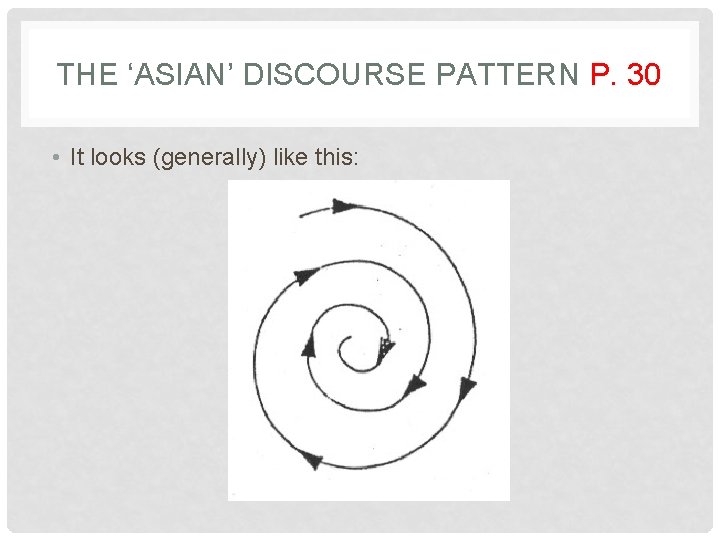
THE ‘ASIAN’ DISCOURSE PATTERN P. 30 • It looks (generally) like this:
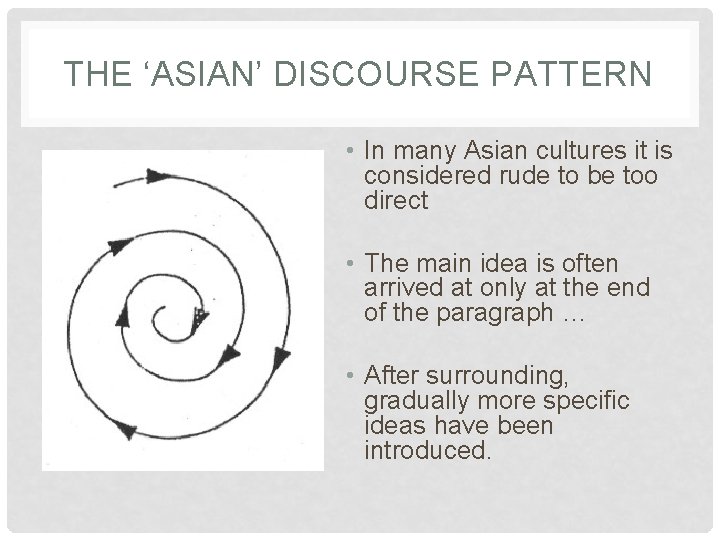
THE ‘ASIAN’ DISCOURSE PATTERN • In many Asian cultures it is considered rude to be too direct • The main idea is often arrived at only at the end of the paragraph … • After surrounding, gradually more specific ideas have been introduced.

BACK TO THE TEXTBOOK • See pp 34~35 for more …
THE TOPIC SENTENCE • The topic sentence tells the reader what the paragraph is about. • Every sentence in the paragraph must develop or support that topic sentence and the controlling idea it contains. • It introduces the main idea so that the reader knows what to expect.
THE TOPIC SENTENCE • This is very useful for the readers: • they can scan quickly through a large text and find what they are looking for by looking at the topic sentences; • they don't have to read the entire paragraph to know what it is about. • The topic sentence also gets the reader's mind focused on what is to follow in the rest of the paragraph. • The topic sentence is usually very general, and does not usually contain specific information about the topic. We save the specifics for the body. • See p 36 for some examples
THE CONTROLLING IDEA Topic Sentence = Topic + Controlling Idea • The controlling idea controls the details in the paragraph. • It lets the reader know what you want to say about your topic. • It is your … • • • Opinion Feelings Attitude Evaluation Main impression Etc • … of the topic
THE CONTROLLING IDEA The sentence • Cheongju is a city in South Korea. does not contain a controlling idea. What do you want to say about Cheongju?
THE CONTROLLING IDEA Any of these would be better: • Cheongju is a beautiful city in South Korea. • Cheongju is a very friendly city. • Cheongju is the most conveniently located city in South Korea. • Etc. • See pp 37~39 for more
THE BODY • The body of the paragraph holds the information – the supporting details – that the writer has collected (through research, brainstorming, cluster diagrams, free-writing, etc. ) • Details are presented to the reader in a natural, logical order. • English and Korean compositions are organized very differently. • Native English speakers expect paragraphs to be organized in certain ways, and, as we have seen, these ways are usually quite different from what we find in Korean writing.
THE BODY Common Logical Orders • Chronological (Time) order • Spatial (location) order • Emphatic (emphasis) order See pp 41~42 for specific examples
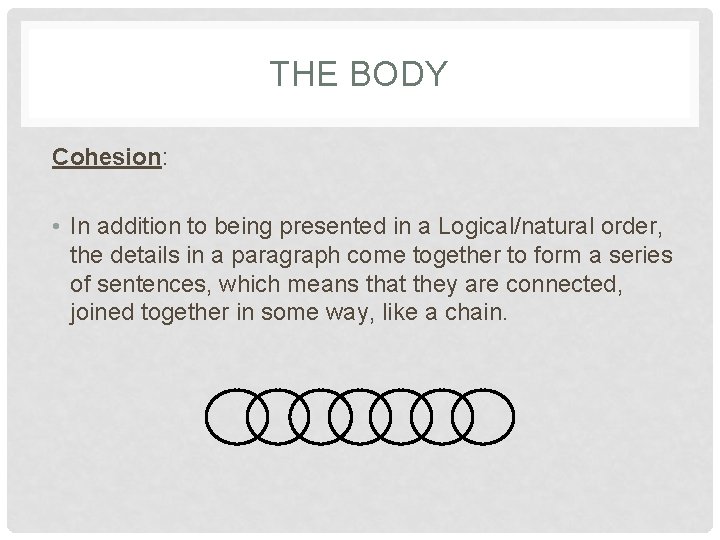
THE BODY Cohesion: • In addition to being presented in a Logical/natural order, the details in a paragraph come together to form a series of sentences, which means that they are connected, joined together in some way, like a chain.
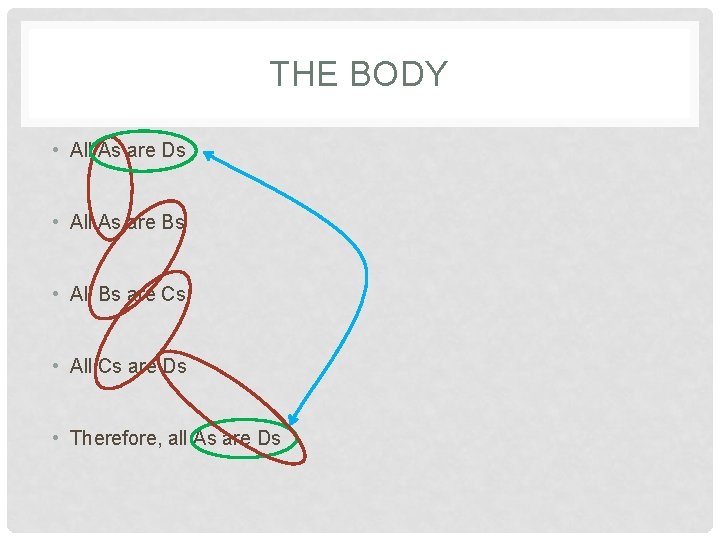
THE BODY • All As are Ds • All As are Bs • All Bs are Cs • All Cs are Ds • Therefore, all As are Ds
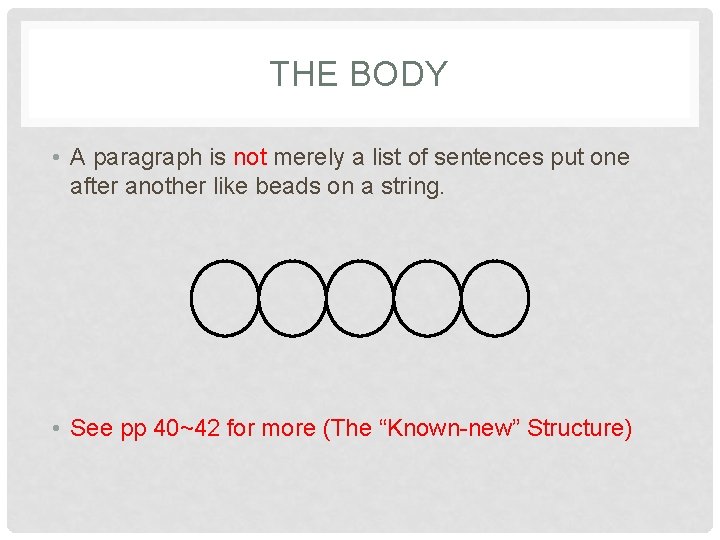
THE BODY • A paragraph is not merely a list of sentences put one after another like beads on a string. • See pp 40~42 for more (The “Known-new” Structure)
TRANSITIONAL MARKERS Another very common way to maintain cohesion is through the use of specific words that help the reader to understand the logical/semantic connections between sentences. These words and phrases are called Transitional Markers (sometimes called signal words, or clause connectors).
TRANSITIONAL MARKERS • A transition is a change, or shift, a state of moving from one situation/detail to another. • A marker is a sign/signal. • Transitional Markers, then, are words that tell the reader how the ideas in the sentences connect logically. • The reader must be told, as simply and precisely as possible, how the two sentences connect and why they belong together.
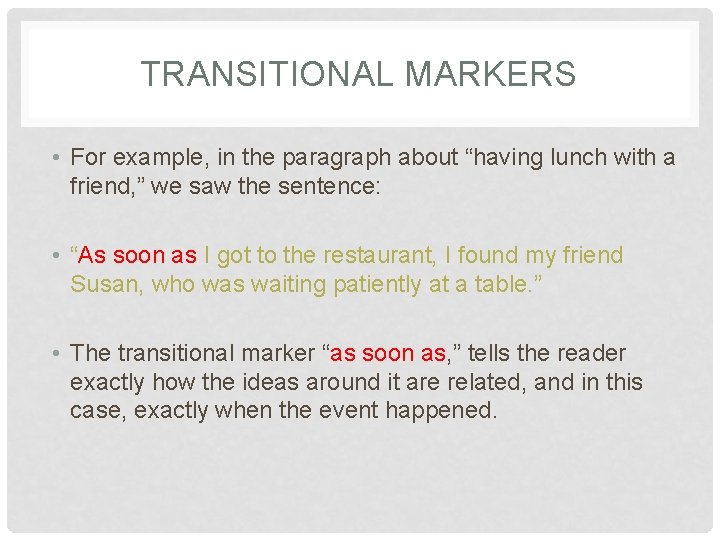
TRANSITIONAL MARKERS • For example, in the paragraph about “having lunch with a friend, ” we saw the sentence: • “As soon as I got to the restaurant, I found my friend Susan, who was waiting patiently at a table. ” • The transitional marker “as soon as, ” tells the reader exactly how the ideas around it are related, and in this case, exactly when the event happened.
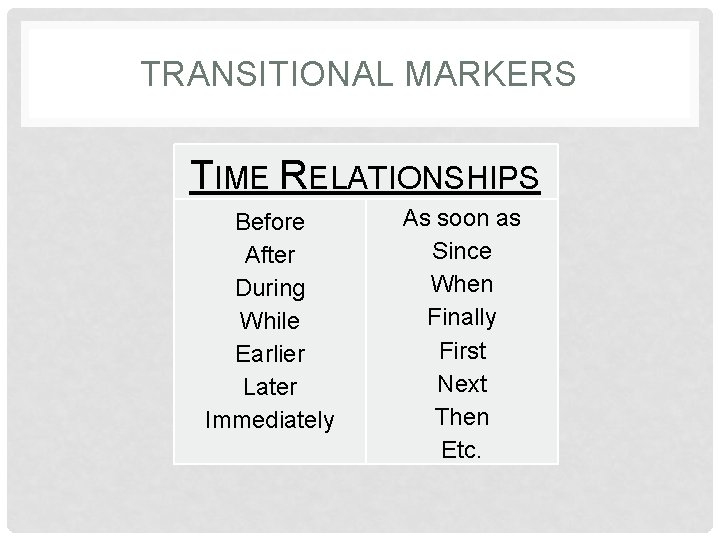
TRANSITIONAL MARKERS TIME RELATIONSHIPS Before After During While Earlier Later Immediately As soon as Since When Finally First Next Then Etc.
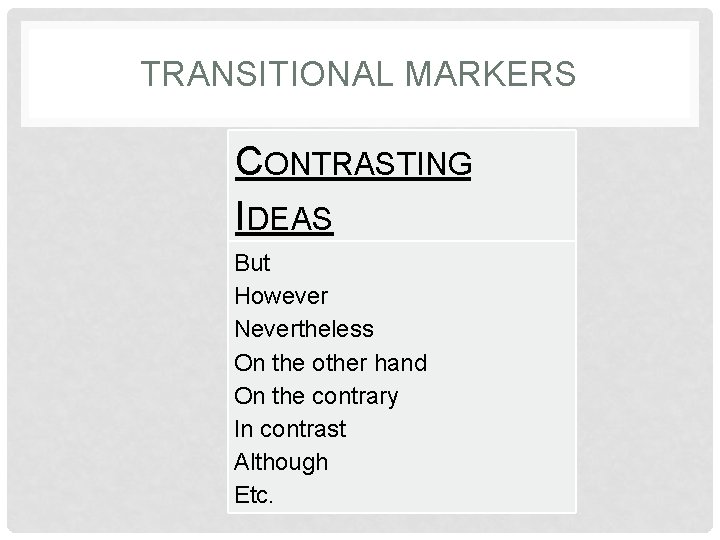
TRANSITIONAL MARKERS CONTRASTING IDEAS But However Nevertheless On the other hand On the contrary In contrast Although Etc.
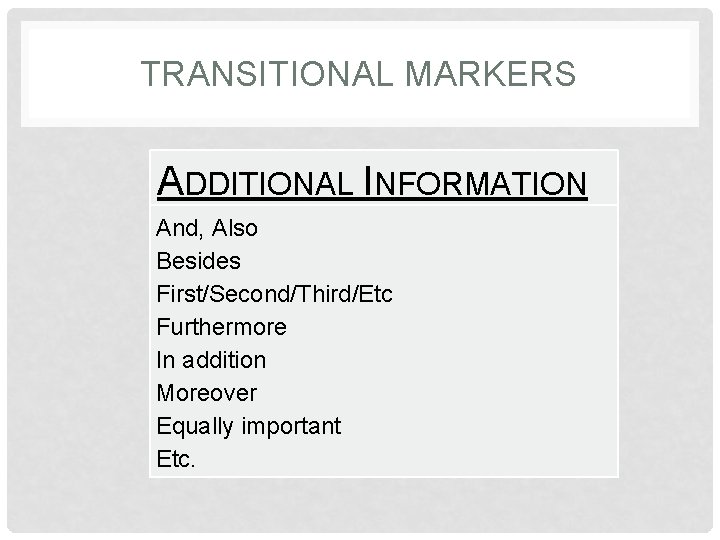
TRANSITIONAL MARKERS ADDITIONAL INFORMATION And, Also Besides First/Second/Third/Etc Furthermore In addition Moreover Equally important Etc.
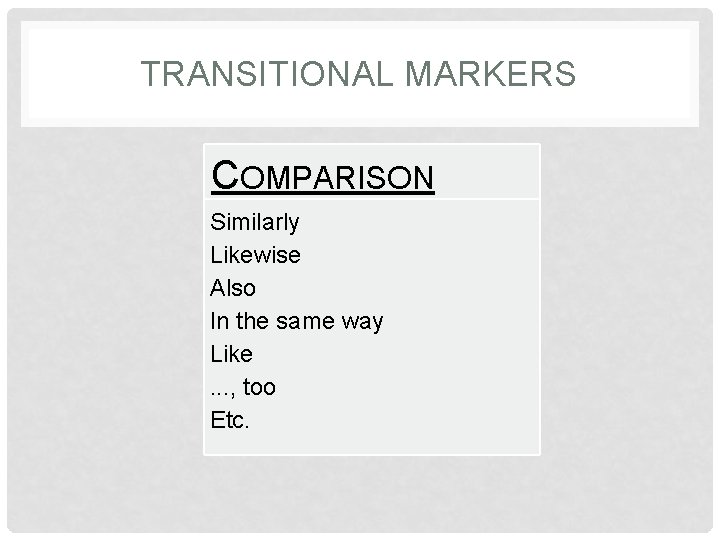
TRANSITIONAL MARKERS COMPARISON Similarly Likewise Also In the same way Like. . . , too Etc.
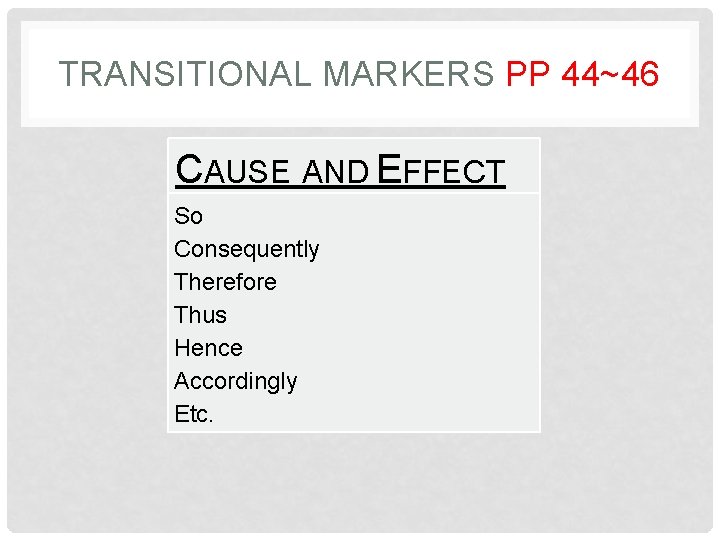
TRANSITIONAL MARKERS PP 44~46 CAUSE AND EFFECT So Consequently Therefore Thus Hence Accordingly Etc.
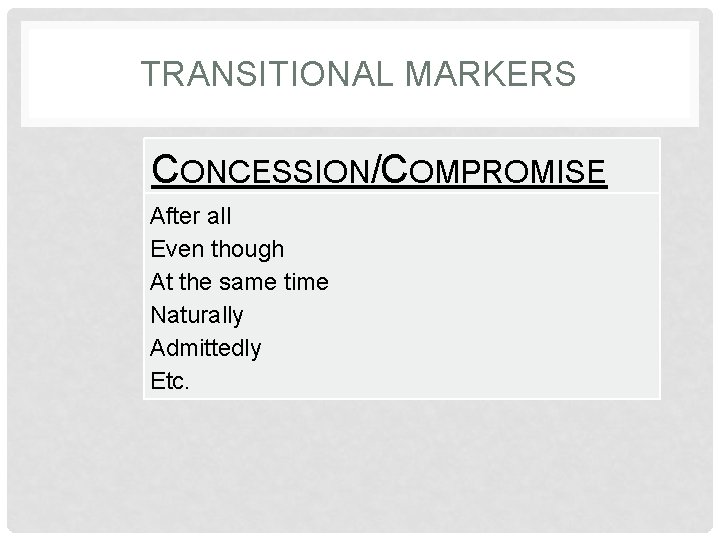
TRANSITIONAL MARKERS CONCESSION/COMPROMISE After all Even though At the same time Naturally Admittedly Etc.
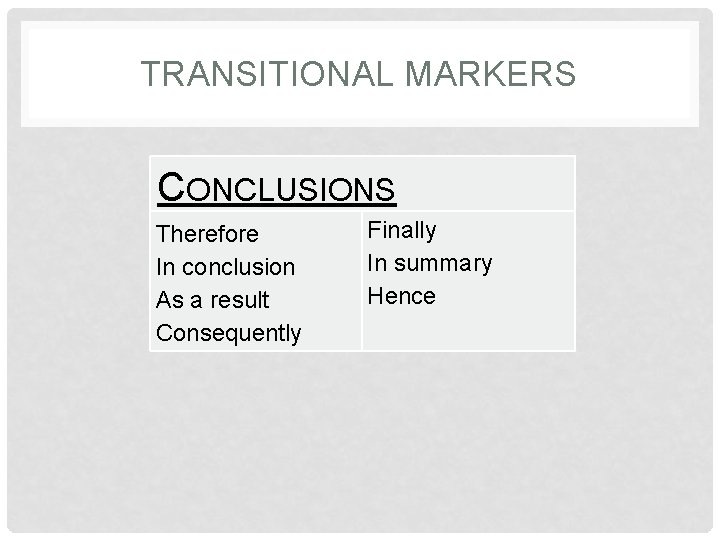
TRANSITIONAL MARKERS CONCLUSIONS Therefore In conclusion As a result Consequently Finally In summary Hence
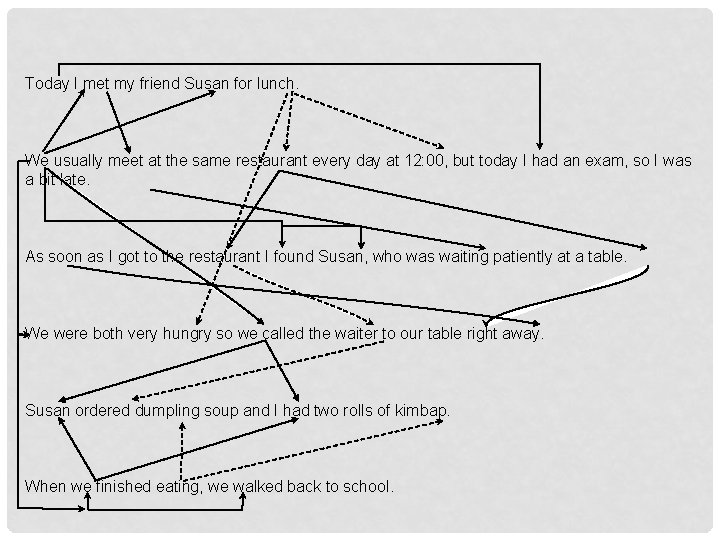
Today I met my friend Susan for lunch. We usually meet at the same restaurant every day at 12: 00, but today I had an exam, so I was a bit late. As soon as I got to the restaurant I found Susan, who was waiting patiently at a table. We were both very hungry so we called the waiter to our table right away. Susan ordered dumpling soup and I had two rolls of kimbap. When we finished eating, we walked back to school.

- Slides: 35